

You wake up with a tight neck, stretch a bit, and get on with the day. A few weeks later, your lower back starts grumbling after long hours at the desk. Then you stop turning fully when reversing the car, avoid longer walks, and wonder when “a bit stiff” turned into “this is affecting everything”.
That pattern is common. Small problems rarely arrive with drama. They build through repetition: the same chair, the same commute, the same weekend gardening posture, the same gym technique done slightly off when you're tired. By the time pain forces action, the issue is often less about one sore spot and more about a body that has been compensating for months.
Preventive care changes that mindset. Instead of waiting for the body to break down, you look for early signs that something is drifting off course. In musculoskeletal health, that might mean noticing reduced hip rotation before running becomes painful, or picking up shoulder restriction before it starts disturbing sleep.
That shift matters because the body is good at adapting, but not always in helpful ways. It will find a way to keep you moving. It may just do it by overworking another joint, tightening another muscle group, or changing how you load your spine. Preventive care is about stepping in early, when changes are smaller, options are broader, and recovery is usually simpler.
Table of Contents
- Introduction From Niggling Aches to Proactive Health
- What Is Preventive Care Really
- The Clinical and Practical Benefits of Proactive Health
- How Preventive Care Reduces Your Healthcare Costs
- Examples of Preventive Services You Can Access
- Your Preventive Care Journey with Bayside Osteopathic Health
- Frequently Asked Questions About Preventive Osteopathy
Introduction From Niggling Aches to Proactive Health
People don't ignore pain because they're careless. They ignore it because life is busy and the problem feels manageable. You loosen up after a shower, shift position at work, or tell yourself that next week will be calmer.
The trouble is that musculoskeletal strain doesn't always stay local. A stiff ankle can alter the way you walk. A desk-bound thoracic spine can load the neck and shoulders. A weak hip can leave the knee doing more work than it should. What begins as inconvenience can become a movement pattern that keeps feeding the same irritation.
In practice, the clearest difference between reactive care and proactive care is timing. Reactive care starts when pain has already taken centre stage. Proactive care starts when you notice warning signs: morning stiffness that lingers, a shoulder that catches, headaches that appear after computer work, or a back that feels “fine” until you sit too long.
Preventive care works best when you treat reduced movement and recurring tension as useful information, not just something to push through.
That doesn't mean chasing every sensation or becoming fixated on your body. It means paying attention to patterns. If the same issue keeps returning, your body is usually asking for a change in load, movement, recovery, or mechanics.
For osteopathy, that preventive lens is practical. It focuses on how joints move, how tissues tolerate load, how posture interacts with breathing and work habits, and how everyday routines either support or wear down your mobility. The aim isn't to create a life without normal aches. It's to stop small, manageable issues from becoming the reason you stop walking, lifting, travelling, gardening, training, or sleeping comfortably.
What Is Preventive Care Really
Preventive care is often reduced to check-ups and screenings. That's part of it, but it's broader than that. At its core, it's a way of managing health before symptoms become the only reason you act.
A maintenance mindset
A simple analogy helps. You don't wait for a car engine to seize before changing the oil. You service it because maintenance is cheaper, safer, and far less disruptive than a full breakdown. The body works differently from a machine, but the principle is similar. Small checks and small corrections can prevent bigger problems later.
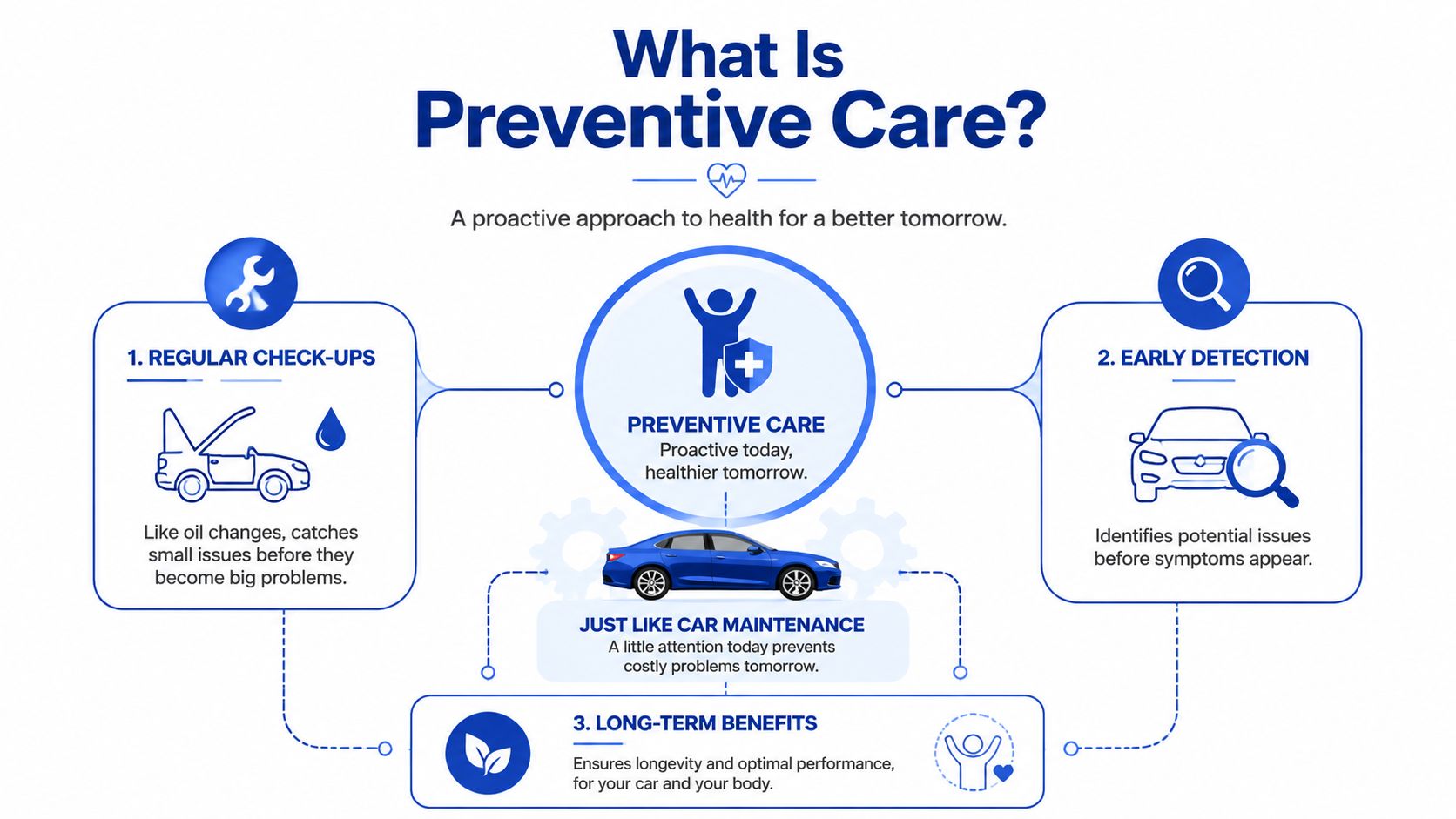
The idea is not perfection. It's regular maintenance. If your hips are gradually losing range, your upper back is stiff from screen time, or your recovery has dropped off because you've stopped moving well, preventive care gives you a chance to address those changes while they're still workable.
The three parts of prevention
Preventive health usually sits on three connected pillars.
| Pillar | What it includes | Why it matters |
|---|---|---|
| Medical screening | Blood pressure checks, routine reviews, age and risk-based screening | Finds problems that may not cause symptoms early |
| Lifestyle factors | Sleep, food choices, stress, alcohol, smoking, daily movement | Shapes long-term health risks and recovery capacity |
| Proactive physical maintenance | Mobility checks, posture review, movement assessment, load management | Reduces strain patterns that often lead to pain |
In musculoskeletal care, that third pillar is often the neglected one. People may get a blood test and know they should exercise more, yet they still move through the day with a body that is stiff, overloaded, or compensating around a weak link.
That's where preventive osteopathic care makes sense. It looks at how the body is functioning now, not only whether a diagnosis exists. Are you rotating through your thoracic spine, or forcing movement through your neck? Are your glutes sharing the work, or is your lower back taking over? Are you breathing and bracing well when lifting, or relying on tension?
A preventive approach also accepts trade-offs. Not every ache needs treatment. Not every posture issue is a problem. What usually does need attention is a recurring pattern that reduces function, confidence, or tolerance for daily life.
Practical rule: If a movement problem keeps returning under normal load, don't just treat the soreness. Check the pattern causing it.
The Clinical and Practical Benefits of Proactive Health
The strongest preventive care benefits show up in two places at once: your body and your daily life. You move better, and the ordinary things you want to do stop feeling like a negotiation.
Early detection changes the path
Early detection is often discussed in the context of disease screening, and that principle matters more broadly. Australian evidence notes that preventive health interventions through early detection programs can reduce mortality, with broad population interventions targeting lifestyle factors estimated to prevent 15.4 fewer deaths per 1,000 females and 24.2 fewer deaths per 1,000 males annually, while improving the health of Australians could increase GDP by $4 billion per year, according to the RACGP discussion of preventive health benefits.
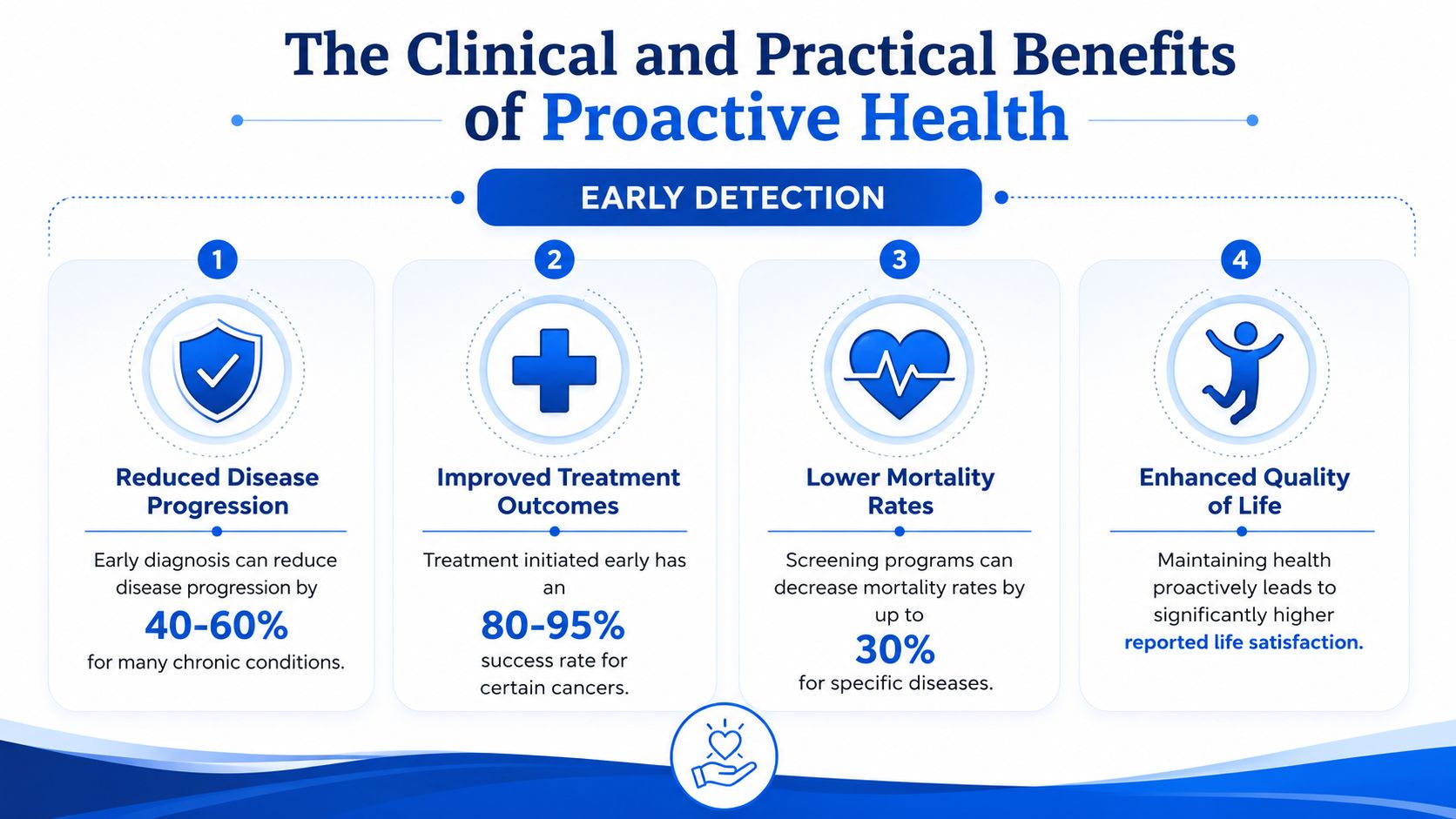
In musculoskeletal care, early detection looks less dramatic but is often just as useful. You catch a loss of hip extension before the lower back starts absorbing more strain. You notice a balance change before a person becomes fearful of walking uneven ground. You identify a shoulder movement fault before every overhead reach becomes provocative.
A useful example is how clinicians use movement education and self-management strategies for pain relief to stop a mild issue becoming a repeating flare-up cycle. The earlier that process starts, the more options a person usually has.
Less pain escalation and better function
Pain rarely depends on one structure alone. It reflects load, recovery, mobility, strength, confidence, work demands, sleep, and sometimes stress. Preventive care helps because it intervenes before pain becomes the organiser of your week.
Common wins include:
- Fewer repeated flare-ups: recurring neck tension, headaches, low back stiffness, and joint irritation are easier to manage when the triggers are identified early.
- Better load tolerance: you can sit, walk, lift, train, or garden with less rebound soreness because the body distributes work more evenly.
- Slower progression of avoidable strain patterns: if a joint is stiff and nearby tissues are overworking, restoring movement early can reduce the cycle of compensation.
What doesn't work as well is waiting until the body only responds to rest, medication, or avoidance. That approach often shrinks activity first and asks questions later. Preventive care does the reverse. It keeps useful activity in the plan wherever possible.
Early care is not only about finding disease. It's also about finding the mechanical habits that quietly narrow your options.
Mobility protects independence
Mobility is one of the most underrated preventive assets. When people say they “just want to feel normal again”, they usually mean they want ordinary freedom back. Turning in bed without pain. Walking the dog without tightening up. Reaching a high shelf without bracing first.
For older adults especially, preventive musculoskeletal care supports confidence. For office workers, it protects tolerance for long static positions. For active people, it keeps training from becoming a cycle of niggles. The point isn't endless treatment. It's preserving function early enough that the body doesn't learn a poorer workaround.
How Preventive Care Reduces Your Healthcare Costs
Many people hesitate over preventive care because it can feel optional when pain is mild. Financially, that's understandable. But delayed care often becomes expensive in ways people don't count at first: missed work, reduced activity, more appointments later, and the cost of trying to manage a bigger problem that had smaller beginnings.

Small maintenance often costs less than delayed repair
Australia currently spends only 1.34% of total health spending on preventive health, and every dollar invested saves an estimated $14.30 in future healthcare costs, according to the Australian Government 2023–24 preventive health budget documentation.
That system-level figure points to a personal reality. Small, steady action often costs less than crisis management. A person who deals with recurring postural strain early may avoid months of stop-start discomfort, reduced productivity, and a much more involved recovery later.
In musculoskeletal care, the financial case is usually about preventing accumulation. The issue isn't only the appointment fee. It's the chain reaction: poorer sleep, less exercise, more stiffness, lower work tolerance, less confidence moving, and sometimes a drift into doing less because movement feels unreliable.
The real household trade-off
The better question isn't “Does preventive care cost money?” It does. The better question is “What does waiting cost if this pattern keeps repeating?”
That calculation may include:
- Time costs: repeated bad days, slower mornings, and reduced capacity at work or home.
- Function costs: avoiding exercise, sport, travel, lifting, or household tasks.
- Treatment costs later: a more stubborn problem often needs more input than an early one.
- Decision fatigue: when pain keeps returning, people often spend money on short-term fixes that don't address the pattern.
For some patients, practical support around funding matters too. Resources such as this patient guide to Medicare chronic disease management can help people understand whether some care pathways may apply to them.

A short explainer can help frame the decision:
The practical lesson is simple. Preventive care benefits are not only about avoiding severe illness. They're also about reducing the long tail of avoidable musculoskeletal cost that comes from doing nothing until the problem becomes disruptive.
Examples of Preventive Services You Can Access
Preventive care becomes easier to value when you can picture what it looks like in real life. Some services are familiar. Others are specific to movement and physical function.
General preventive care you already know
A few preventive services are already widely recognized:
- Routine health checks: blood pressure review, discussion of risk factors, and timely monitoring through your GP.
- Vaccination and screening programs: these help identify or reduce risks before symptoms appear.
- Lifestyle support: advice around smoking, nutrition, alcohol, and physical activity.
These matter because prevention isn't one appointment type. It's a pattern of care that catches risk early and supports better choices before a problem becomes harder to reverse.

Preventive care in an osteopathic setting
In musculoskeletal health, preventive services often look more hands-on and more individual.
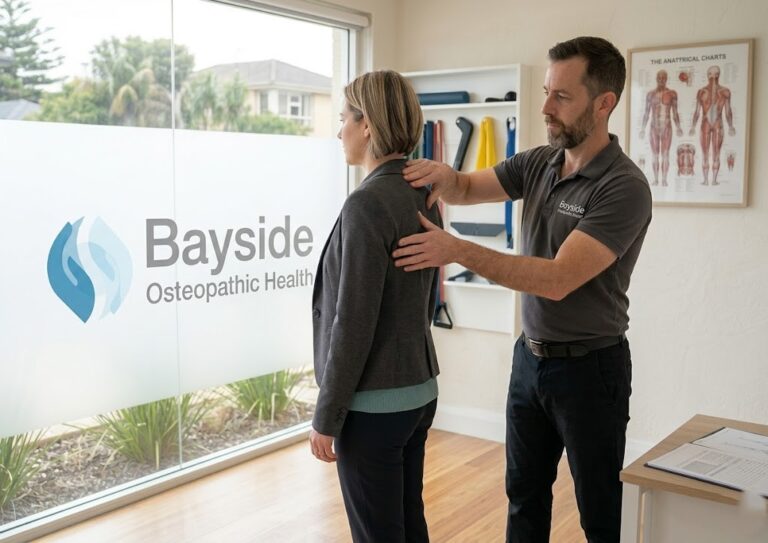
A posture and movement assessment can identify whether your body is relying too heavily on one area. An office worker might discover they are hinging almost entirely through the lower back because the thoracic spine is stiff. A recreational runner may find that limited ankle mobility is changing knee load. Someone with arthritis may benefit from a plan that protects motion before stiffness leads to inactivity.
Useful preventive osteopathic services may include:
- Movement review: checking how you bend, rotate, reach, squat, walk, and transfer load through the body.
- Hands-on treatment: soft-tissue work, articulation, and gentle mobilisation to maintain or restore movement where restriction is building.
- Ergonomic and postural guidance: practical adjustment of workstations, habits, and movement breaks, especially for people affected by prolonged sitting or repetitive tasks. A visual guide to posture and corporate ergonomics can be useful for this.
- Home strategies: short mobility routines, pacing advice, and strength or control exercises that fit real schedules.
Movement advice that does real work
Movement advice is one of the most valuable parts of preventive musculoskeletal care because it gives patients something they can continue themselves. Australian evidence shows that sufficient physical activity reduces the risk of musculoskeletal conditions, osteoporosis, and falls, and if all Australians were sufficiently active it would avoid approximately 2% of the total national disease burden and generate AU$29 billion in net annual health benefits, according to the Australian Sports Commission evidence summary on preventive health.
That does not mean everyone needs an intense exercise program. Often the best preventive plan is the one a person will keep doing. For one patient, that's walking and calf strength. For another, it's hip mobility before tennis. For someone with desk strain, it may be thoracic extension, breathing work, and regular changes of position.
The best preventive exercise is not the most impressive one. It's the one that solves your problem and still fits into Thursday morning.
Your Preventive Care Journey with Bayside Osteopathic Health
Booking a preventive appointment can feel unusual if you're used to only seeking care when something hurts badly. In reality, a preventive visit is often calmer and more useful because there's room to assess patterns before pain dominates the conversation.
What a first preventive appointment usually involves
A first appointment usually begins with a clear history. That includes current symptoms if you have them, but also work demands, sport, previous injuries, sleep, walking tolerance, and the activities you want to keep doing well.
The physical assessment then looks at how your body moves as a whole. Rather than focusing only on the sore area, an osteopath will usually look at related joints, soft tissue tension, balance, posture, movement control, and how you transfer load. If your neck is tight, the assessment may include your upper back, shoulders, breathing pattern, and desk setup. If your knee is irritated, the hips and ankles often matter too.
A preventive consult is collaborative. The goal is not to hand you a generic sheet of exercises and send you away. It's to work out which findings matter for your life, then build a manageable plan around them.
What happens after the assessment
The most useful care plan is usually simple and specific. That may involve some hands-on treatment, a few targeted exercises, advice on pacing or training load, and practical changes to daily habits that are feeding the issue.
People often want to know whether funding support may apply. Where relevant, guidance on private health insurance and Medicare options can help clarify access to care, including whether some patients may be eligible under Chronic Disease Management arrangements.
A good preventive plan also has a clear purpose. It might be to keep a parent comfortable lifting a toddler, help an older adult stay confident on stairs, support a walker with arthritic stiffness, or reduce the neck and shoulder load of long computer days. Prevention works best when the plan is tied to function, not just anatomy.
Frequently Asked Questions About Preventive Osteopathy
How often should I book if I am not in pain
There isn't one schedule that suits everyone. Frequency depends on your history, workload, activity level, age, and how quickly you stiffen or flare. Someone with recurring desk-related neck strain may benefit from a different rhythm than a retired person managing joint stiffness or an active person training most days.
Is preventive osteopathic treatment gentle
It can be. Preventive care doesn't need to be forceful to be effective. Osteopathic treatment often includes gentle hands-on techniques, articulation, soft-tissue work, movement coaching, and advice that supports better mechanics between appointments.
What happens if a problem is found
The important part is not only detection but follow-up. National data has shown that preventive care can be undermined when initial checks occur but follow-up and management of abnormal findings are poor, particularly in some settings, as discussed in this Australian review of preventive care delivery and follow-up gaps. In a structured clinic setting, the value comes from turning a finding into a clear plan: what it means, what to do next, what to monitor, and when to review.
Finding a problem is only useful if someone helps you act on it.
Who benefits most from preventive osteo care
Office workers with posture-related strain often do well. So do older adults who want to maintain confidence and mobility, active people who keep getting the same niggle, and anyone with recurring back, neck, or joint tension that hasn't yet become severe but clearly isn't resolving on its own.
If you want help staying ahead of pain rather than reacting to it, Bayside Osteopathic Health offers gentle, practical osteopathic care focused on movement, mobility, and long-term function. Whether you're dealing with recurring stiffness, posture-related strain, or early joint discomfort, booking an appointment is a sensible first step toward moving with more ease and confidence.