
You've probably had the same thought many Bayside locals have after a long day at a desk or a weekend in the garden. Your neck feels tight, your lower back has seized up, and you're trying to work out whether a massage will help, or whether you need something more structured than a simple rub-down. Remedial massage therapy sits right in that space, between symptom relief and hands-on treatment, so it's worth understanding properly before you book.
For people in the Bayside area, that question often comes up alongside osteopathic care. You might want something gentle, practical, and clear about what it can and can't do. This guide keeps things plain, focused, and useful, so you can decide what to book, what to expect in the room, and when combining remedial massage with osteopathic treatment makes more sense than choosing just one.
Table of Contents
- Why People in Bayside Are Asking About Remedial Massage
- What Remedial Massage Therapy Actually Means
- Common Techniques and the Conditions They Target
- What a Remedial Massage Appointment Looks Like
- How Remedial Massage Fits With Osteopathic Care
- Choosing a Qualified Therapist in Bayside
- Simple Self-Care Between Sessions
- Common Myths About Remedial Massage
Why People in Bayside Are Asking About Remedial Massage
A common Bayside scene goes like this. Someone spends the week leaning over a laptop, then spends Saturday morning gardening, and by Sunday night their neck is tight, their shoulders feel jammed, and their lower back is not moving the way it should. They're not looking for a spa day. They want to know whether hands-on treatment can help them move more comfortably again.
That question makes sense because remedial massage therapy has a real place in Australian health care, not just in wellness culture. The occupation profile for remedial massage therapist shows 6,200 employed persons, with most workers in Health Care and Social Assistance and a broad spread across states including New South Wales, Queensland and Victoria. That doesn't make it a niche service. It shows a recognised occupation with a clear role in musculoskeletal care. Jobs and Skills Australia's occupation profile for remedial massage therapist
Why the interest keeps growing
People usually come to remedial massage for one of three reasons. They want relief from a tight muscle pattern, they want help with movement that feels blocked, or they want a treatment that fits alongside osteopathic care without feeling too aggressive. The work is popular because it addresses everyday problems people can feel in their own bodies, like desk-related neck pain, postural strain, and sore backs after lifting or carrying.
Practical rule: if the problem feels local, like one area is tight, irritable, or overworked, remedial massage may be a good starting point.
There's also a historical reason it feels familiar to many Australians. Massage has been part of mainstream complementary care in Australia and nearby countries for decades, and research literature has long discussed its use for musculoskeletal pain, especially back pain. That history matters because it explains why so many people already have a mental model for massage, even if they're still unsure what makes remedial massage different from general relaxation work. Review of Australian and New Zealand massage service research
For a Bayside resident, the useful question isn't whether massage is trendy. It's whether the treatment is matched to the complaint. If you want plain guidance on that, the next step is understanding what the therapy is.
What Remedial Massage Therapy Actually Means
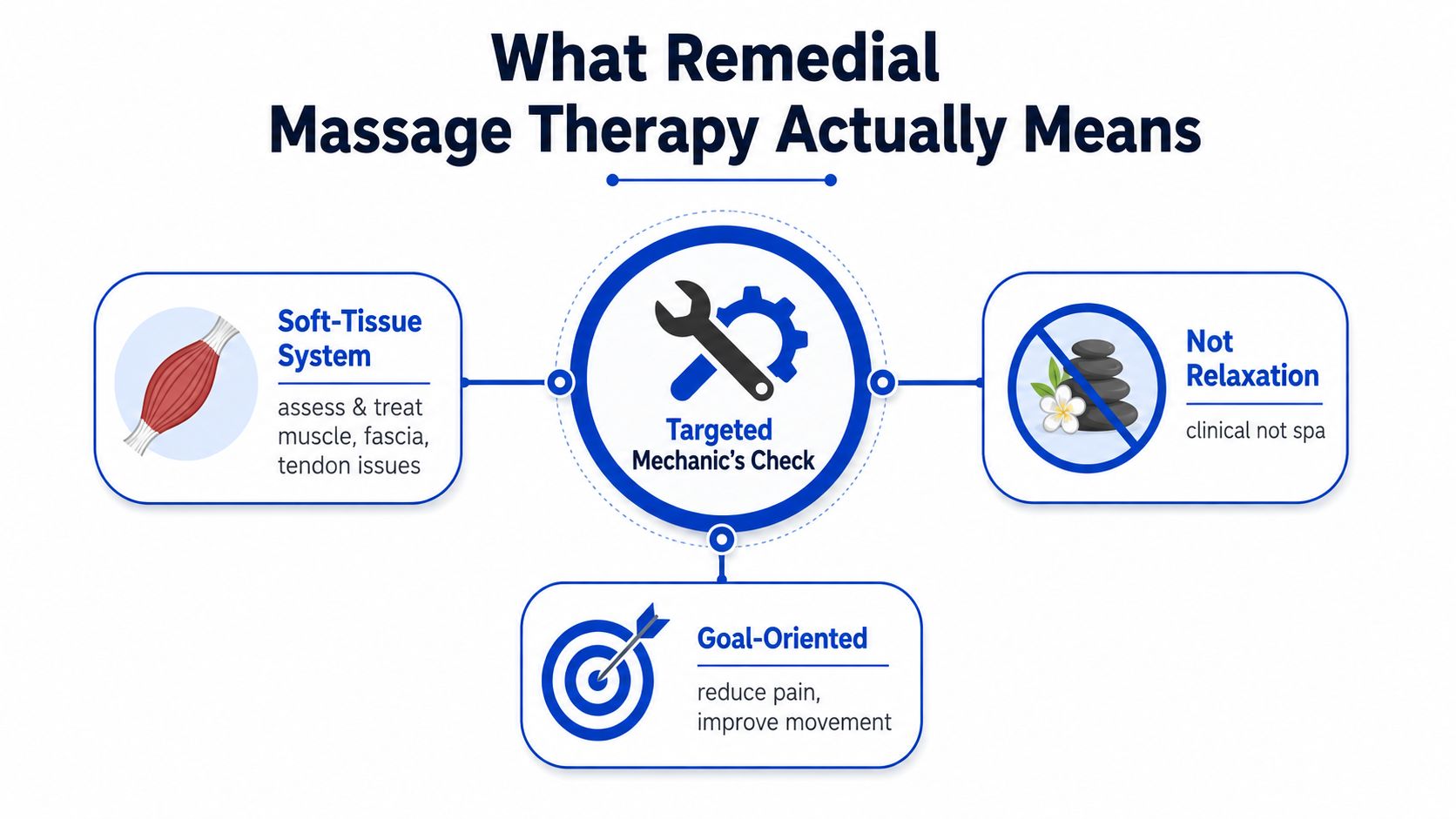
Think of remedial massage therapy as a targeted mechanic's check on the soft-tissue system. A relaxation massage tries to help you unwind. A remedial session looks more like a structured assessment of what's driving pain or restriction, then a selection of techniques matched to that finding. The Australian occupation profile classifies remedial massage therapists as allied health practitioners who perform musculoskeletal assessment and treatment, not just general comfort work. ABS occupation standard classification for remedial massage therapist
That's the key difference. The therapist isn't working down a checklist of body parts. They're looking for the tissue or movement pattern that seems irritated, restricted, or overloaded, then choosing a method with a reason behind it. In plain English, it's assessment-led and goal-oriented, not a generic full-body routine.
What it is designed to change
The practical aim is to help restore pain, circulation and movement through soft-tissue and joint techniques. That's why the session may include muscle work, stretching, joint movement, or other hands-on methods, depending on what the therapist finds. The result should feel purposeful, not random.
Australian training standards describe remedial massage as a structured treatment approach using techniques such as friction, passive joint movement, deep tissue massage, muscle energy techniques, neuromuscular techniques, myofascial techniques, trigger point therapy, lymphatic drainage, temperature therapy, and PNF. Provide Remedial Massage Treatments summary
Simple way to say it: remedial massage tries to change a specific problem in muscle or soft tissue, not just make you feel generally relaxed.
That's why the term “remedial” matters. It signals that the therapist is working with a problem to address, not just a mood to improve. If you can remember one sentence, make it this one. Remedial massage therapy is assessment-led soft-tissue treatment aimed at reducing pain and improving movement.
Common Techniques and the Conditions They Target
A good remedial session often uses more than one technique, because different tissues respond to different kinds of pressure and movement. That's why the method matters less than the logic behind it. A therapist might find a tight band in the upper shoulder, a stiff thoracic spine, or a painful patch in the calf, and then choose the technique that fits the finding.
The main tools you're likely to hear about
Deep tissue massage uses slower, firmer pressure to work through deeper layers of muscle. It's often used for persistent tightness in the neck, shoulders, or back, especially when someone has spent long hours at a desk.
Trigger point therapy targets very tender, hyperirritable spots in a muscle. People often feel this in the upper trapezius, jaw, or gluteal muscles, where local pain can also refer to other areas.
Myofascial release works on the fascia, the connective tissue surrounding muscles. It's commonly used when movement feels restricted through a broad area, such as the side of the thigh, the foot, or the chest wall.
Neuromuscular techniques aim to calm an overactive muscle and improve how it relaxes. This can be useful when a muscle feels stuck in a guarding pattern.
Muscle energy techniques use gentle, active effort from the patient against the therapist's resistance. They're often chosen when range of motion is limited and the therapist wants to improve movement without forcing it.
Passive joint movement involves the therapist moving a joint for you. It can help when the spine, ribs, or a limb feels stiff rather than just tender.
A few methods are easier to interpret in everyday language. PNF, or proprioceptive neuromuscular facilitation, is a stretch-and-contract approach used to improve flexibility and control. Friction is a focused technique over a specific tissue line, often used where a tendon or tight band needs detailed work.
Clinical takeaway: the therapist chooses techniques to match the problem, not the other way around.
What people usually come in with
In Australian guidance, remedial massage is used in pain management for chronic musculoskeletal, postural, sporting and occupational injuries. That fits the problems many Bayside residents describe, especially lower back pain, neck and shoulder tension, desk-related postural strain, arthritis-related stiffness, and muscular headache patterns. SIRA massage and myotherapy guidance
It helps to be clear about what that means. Remedial massage may improve comfort and movement, but it isn't a cure for the underlying condition on its own. If the tissue is irritated because of how a joint moves, how you sit, or how you load your body day after day, the massage can ease the symptoms, but the cause may still need a broader plan.
For readers trying to compare treatment types, a useful reminder is that remedial massage works on soft tissue, while other care may focus more on joint mechanics or movement retraining. A treatment choice makes more sense when it matches the pattern of pain you have. Related visual on care options

What a Remedial Massage Appointment Looks Like
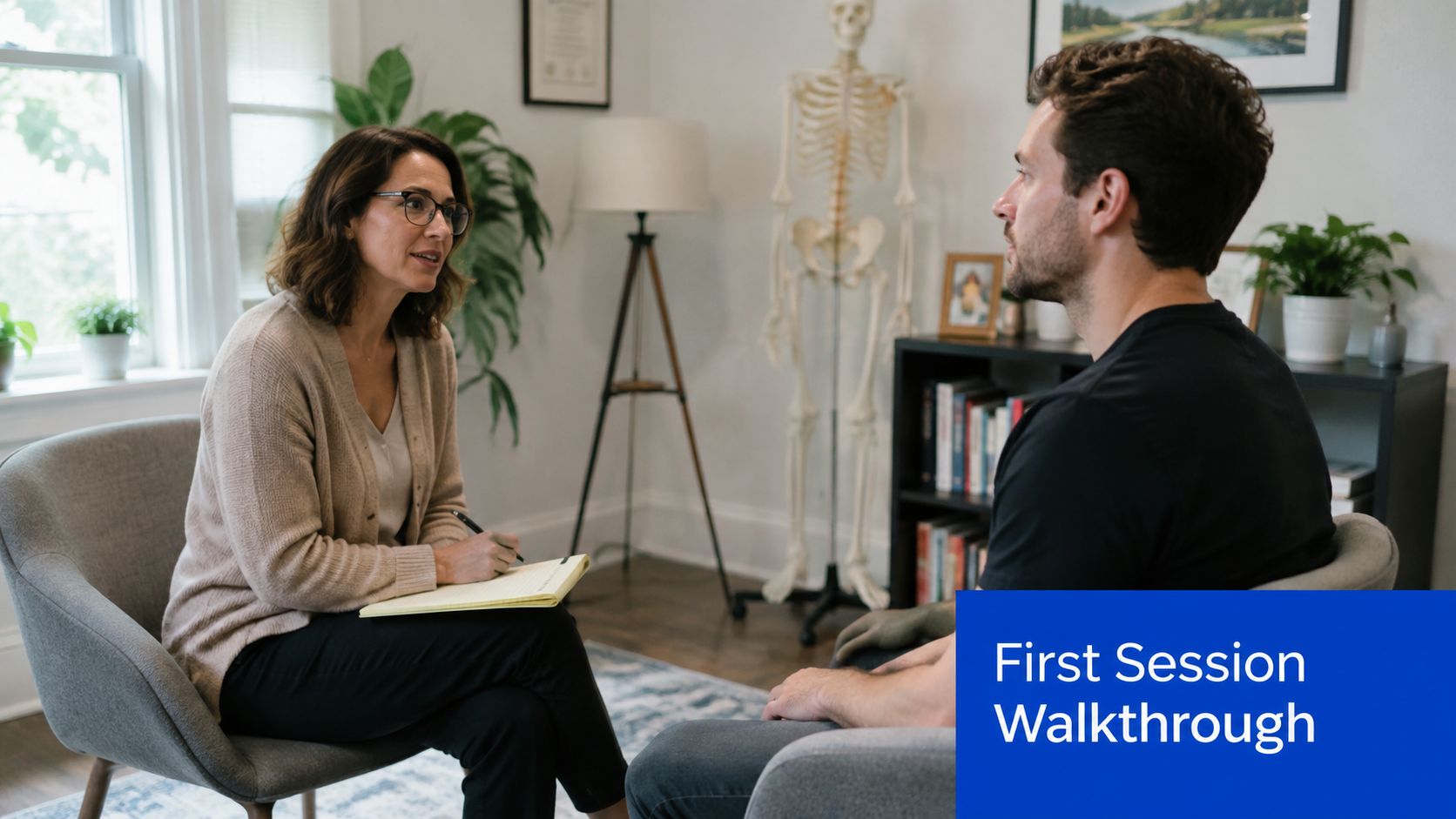
A first remedial massage appointment usually begins with a conversation, then moves into hands-on treatment. The therapist asks about the pain pattern, when it started, what makes it worse, what eases it, and any medical factors that could change the approach. That intake is the map for the session, because the same ache can come from a few different causes, and the work should match the likely source rather than guess.
What happens in the room
The therapist usually asks you to move a little, bend, turn, or lift an arm or leg so they can see how the body is behaving. They may also use palpation, which means feeling the tissues with their hands to check for tenderness, tension, or restriction. If you are unsure why a movement is being tested, a good therapist should explain what they are looking for and how that information guides treatment.
The room is usually set up to protect modesty. You will be draped appropriately, and only the area being treated is uncovered at any one time. Oils or lotions are often used so the therapist can glide smoothly across the tissues without pulling on the skin.
An initial appointment is often 45 to 75 minutes, depending on the clinic and how complex the problem is. The first visit can feel longer because assessment is part of the treatment, not something that happens before the main work begins.
A good session does not feel random. It should feel more like a mechanic checking both the engine and the way the car moves on the road, rather than pressing on sore spots and hoping for the best.
After the hands-on work, the therapist should check how you feel, explain what after-effects are normal, and suggest what to do next. Mild tenderness for 24 to 48 hours is common, and some people feel tired or develop a mild headache. If you get sharp pain, worsening numbness, unusual swelling, or symptoms that feel well outside the usual response, let the therapist know promptly.
How often people usually book
A short-term, more frequent schedule can suit recent strain or an acute flare. Once symptoms settle, many people shift to less frequent maintenance sessions. A case like a long flight followed by carrying a heavy suitcase, or an older adult easing into a walking routine, often needs a different pace from a long-standing back issue that keeps returning.
The main thing to notice is this. A good first appointment should feel calm, specific, and clear. You should leave understanding what was done, why it was done, and what the next step is.
How Remedial Massage Fits With Osteopathic Care
Osteopathic care looks at the body as a connected system. A stiff ankle can change how the hip works, the hip can change how the lower back behaves, and rib movement can affect neck comfort. Remedial massage zooms in more narrowly on the soft-tissue side of that picture, which is why the two approaches often work well together.

Three practical ways people use them
A standalone remedial massage makes sense when the problem is straightforward and muscular, such as a tight upper back after a long week at the computer or a local flare of calf tension after exercise.
A standalone osteopathic visit can be the better fit when the pain feels more joint-based, postural, or pattern-driven, especially if it keeps coming back or seems to travel between regions.
A combined plan is often the smartest option when both soft tissue and joint mechanics are involved. Massage may reduce guarding and tenderness, while osteopathic treatment can address movement, alignment, and loading patterns. That combination is what many patients are really looking for when they say they want “something gentle that does something”.
If the body feels locked in one muscle group, remedial massage may be enough. If it feels mechanically stuck, keeps recurring, or involves several regions, an osteopathic assessment can help decide what needs attention first.
Bayside Osteopathic Health provides gentle, hands-on osteopathic care, so a person with neck pain, back stiffness, or arthritis-related discomfort can be assessed for the broader movement pattern, then matched to the most appropriate hands-on approach. In some cases that means osteopathic care alone. In others, it means remedial massage plus joint articulation or gentle mobilisation, with notes shared between practitioners so the treatment stays consistent. Bayside Osteopathic Health movement and rehabilitation image

The takeaway is simple. Muscle problem, start with massage. Joint or movement problem, see an osteopath. Unsure, book the assessment first. That order saves time and usually leads to a better plan.
Choosing a Qualified Therapist in Bayside
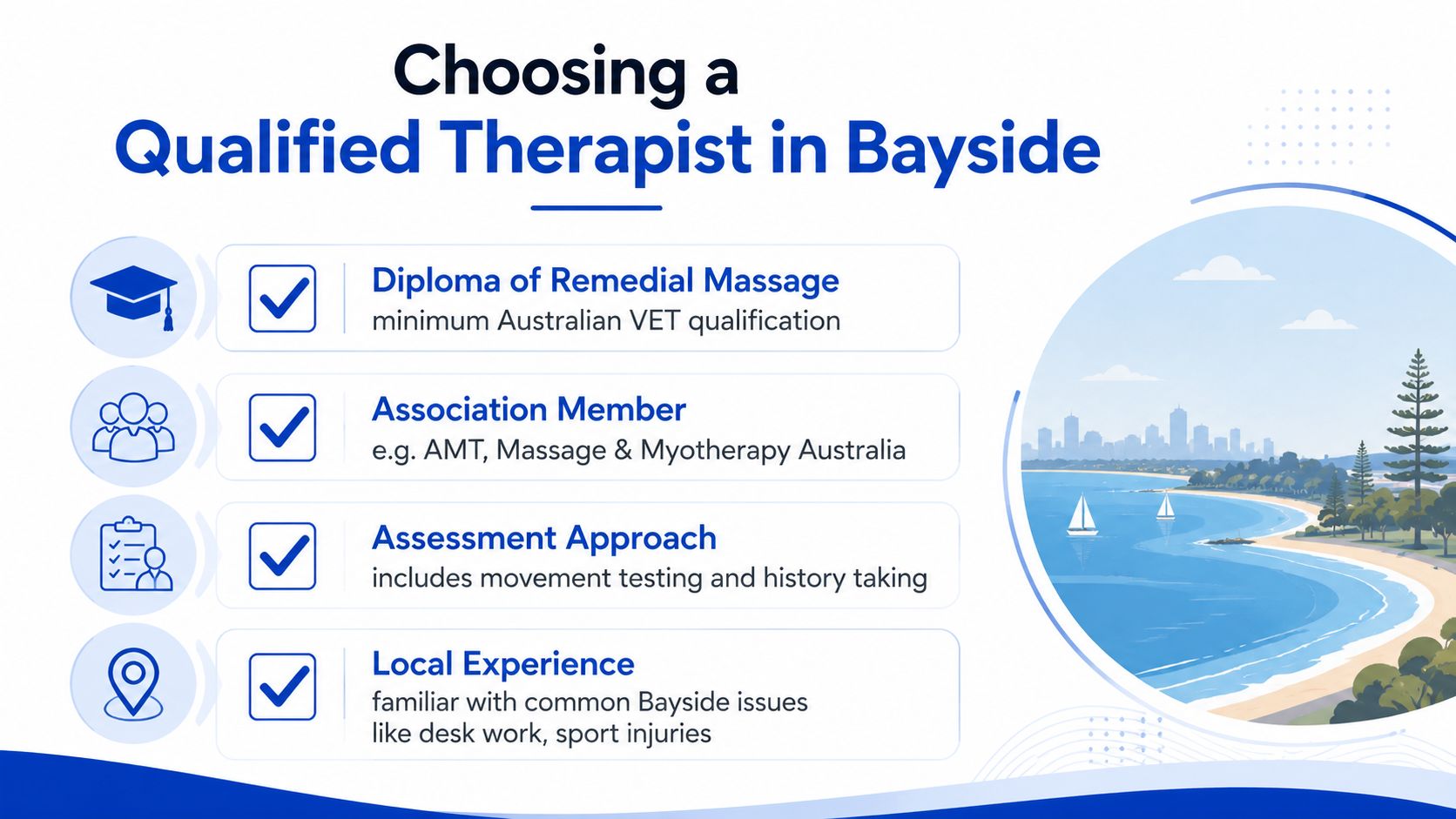
A qualified therapist should be easy to identify before you even walk in the door. Start with the basics. In Australia, look for a Diploma of Remedial Massage, professional membership with an organisation such as AMT, Massage & Myotherapy Australia, or ANTA, and clear evidence of professional indemnity insurance. Those aren't extras. They're part of basic professional safety.
A booking checklist that actually helps
- Ask about assessment: a good therapist should mention history-taking and movement testing, not just table time.
- Check the complaint match: if you have neck pain, desk strain, or sporting overload, ask whether they treat that kind of issue regularly.
- Confirm insurance and membership: professional standing matters if you want accountable care.
- Disclose your full health history: recent fractures, acute infection, deep vein thrombosis, unstable medical conditions, and certain cancers can change whether massage is appropriate.
Cost matters too, but price alone isn't a good guide. I won't give you a made-up Bayside price range, because that changes by clinic, appointment length, and whether the visit includes assessment. A cheaper session that skips assessment can cost more in the long run if it doesn't match the actual problem.
Medicare is another point people often get wrong. Most remedial massage isn't covered under standard Medicare, although some patients with chronic conditions may be eligible for rebates under an Enhanced Primary Care or GP Management Plan arrangement, depending on the referral pathway. Private health fund extras cover also varies, so it's worth checking your own policy rather than assuming.
What to ask before you book
Good question to ask: “Do you treat my type of problem, and will you assess it before starting hands-on work?”
That one question tells you a lot. It reveals whether the therapist works clinically, communicates clearly, and understands when massage is appropriate and when further care is needed.
Simple Self-Care Between Sessions
The benefit of treatment lasts longer when you support it with ordinary habits that don't overcomplicate your day. If you've just had work done on a tight neck, a grumbly lower back, or an overworked calf, the goal isn't to baby the area. It's to keep it moving in a gentle, predictable way.
A few habits that help
- Drink water steadily through the day: not because water is magic, but because hydrated tissue and a settled nervous system tend to cope better after hands-on work.
- Choose gentle mobility for the first 48 hours: think short walks, easy shoulder rolls, or slow spinal movement rather than hard stretching or gym work.
- Check your sleep setup: for neck complaints, a pillow that keeps your head from tipping too far up or down usually helps more than stacking extra cushions.
- Use micro-breaks if you sit for work: stand up, change position, and move your neck, ribs, and hips every so often instead of waiting until the pain is loud.
For the desk worker with neck pain, that might mean a one-minute reset between meetings. For the weekend gardener, it might mean a short walk before resuming another round of bending. For the older adult starting a walking routine, it might mean keeping the pace easy enough that the next day still feels good.
Simple rule: after treatment, movement should feel easier, not forceful.
If you want ongoing practical guidance like this, join the Bayside Osteopathic Health newsletter and get straightforward tips on posture, mobility, and everyday pain management from a local osteopathic perspective.
Common Myths About Remedial Massage
One of the biggest myths is that if it doesn't hurt, it isn't working. That's not how good treatment should feel. Pressure should match tissue irritability and your tolerance, and bruising or sharp pain aren't badges of a successful session. If a therapist pushes too hard, the body may just guard more.
Another myth is that one session fixes the problem. Sometimes one visit is enough to settle a simple flare, but many soft-tissue complaints build up over time. A recurring shoulder issue from computer work, for example, usually needs a short series plus some changes to how you sit, move, or recover.
A third myth says remedial massage and osteopathy are the same thing. They overlap, but they're not identical. Remedial massage focuses more tightly on soft tissue, while osteopathic care looks more broadly at how the whole body is moving and loading itself. Used together, they often complement each other well.
A quick reality check
- More pressure is not better: the right pressure is the pressure that helps the tissue settle.
- Good care is measured, not dramatic: the aim is change, not endurance.
- Releasing toxins is not the point: the practical goal is better comfort and movement.
If you've ever left a treatment thinking, “That was intense, but I'm not sure it was helpful,” trust that instinct. Good remedial work should make sense, not just feel hard. It should leave you with a clearer body and a clearer plan.
If you'd like help working out whether remedial massage, osteopathic care, or a combination of both suits your pain pattern, book with Bayside Osteopathic Health. The team offers gentle, hands-on care for back, neck, joint, and posture-related concerns, with a focus on finding the approach that fits your body rather than forcing a one-size-fits-all treatment.