
You know the feeling. You reach for a seatbelt, a laptop bag, or the top shelf, and your shoulder gives you that small catch that makes you pause for a second too long. By the end of the day it's a dull ache at the desk, or it pinches when you roll onto that side in bed, and suddenly even simple movement feels negotiated.
The good news is that many shoulder pain relief exercises work best when they're matched to the shoulder in front of you, not copied from a generic list. A stiff shoulder needs different loading from a weak one. An irritable shoulder needs a calmer dose than an older, settled one. When the program fits, movement starts to feel like help instead of provocation.
Table of Contents
- Why Your Shoulder Hurts and What Movement Can Do About It
- The Shoulder in Plain English
- Mobility Drills to Loosen a Stiff or Pinchy Shoulder
- Building Strength Without Flaring the Joint
- Matching the Program to Your Shoulder
- Red Flags, Setbacks and When to Stop
- When Self-Care Stops Being Enough and Osteopathy Can Help
Why Your Shoulder Hurts and What Movement Can Do About It
The shoulder usually does not complain because it has failed in one dramatic moment. It more often breaks down under repeated loading. You notice it while twisting for a seatbelt, lifting a bag from the floor, or reaching to a high shelf, and the shoulder starts doing more than its share because the rest of the system is not sharing the work well.
The pattern behind the pain
A recent systematic review and network meta-analysis found that shoulder-specific exercise therapy reduced pain more than usual medical care, especially when it was paired with other treatments such as electro-physical agents, injections, or manual therapy. That does not make exercise magic. It means the shoulder often settles when movement, control, and load tolerance are restored instead of relying on rest alone.
The same review also reported that pain relief could last for a long time after a short exercise programme. That is the part many people miss. The right exercises can produce changes that stick, especially when the shoulder is not being repeatedly irritated by poor mechanics during the day.
Practical rule: if a movement leaves the shoulder freer and calmer later in the day, it is probably helping. If it leaves the joint hotter, sharper, or more guarded for hours, the dose is too high.
Why stretching alone rarely solves it
A shoulder can feel tight because it is stiff, or because it is guarding. Those are not the same thing. If the rotator cuff and scapula are not coordinating well, stretching the front or back of the shoulder may give brief relief, but it does not fix the part that is overloaded every time you lift.
A layered approach tends to work better. Mobility creates room to move. Control teaches the shoulder blade and upper arm to share the load. Strengthening then gives the joint enough tolerance to handle daily tasks without flaring up. In practice, that sequence usually does more than any single drill.
A patient who cannot reach behind the car seat without a catch may need mobility first. A desk worker whose shoulder aches after typing all day often needs postural endurance and scapular control. Someone with longstanding stiffness usually needs patience more than intensity.
The Shoulder in Plain English
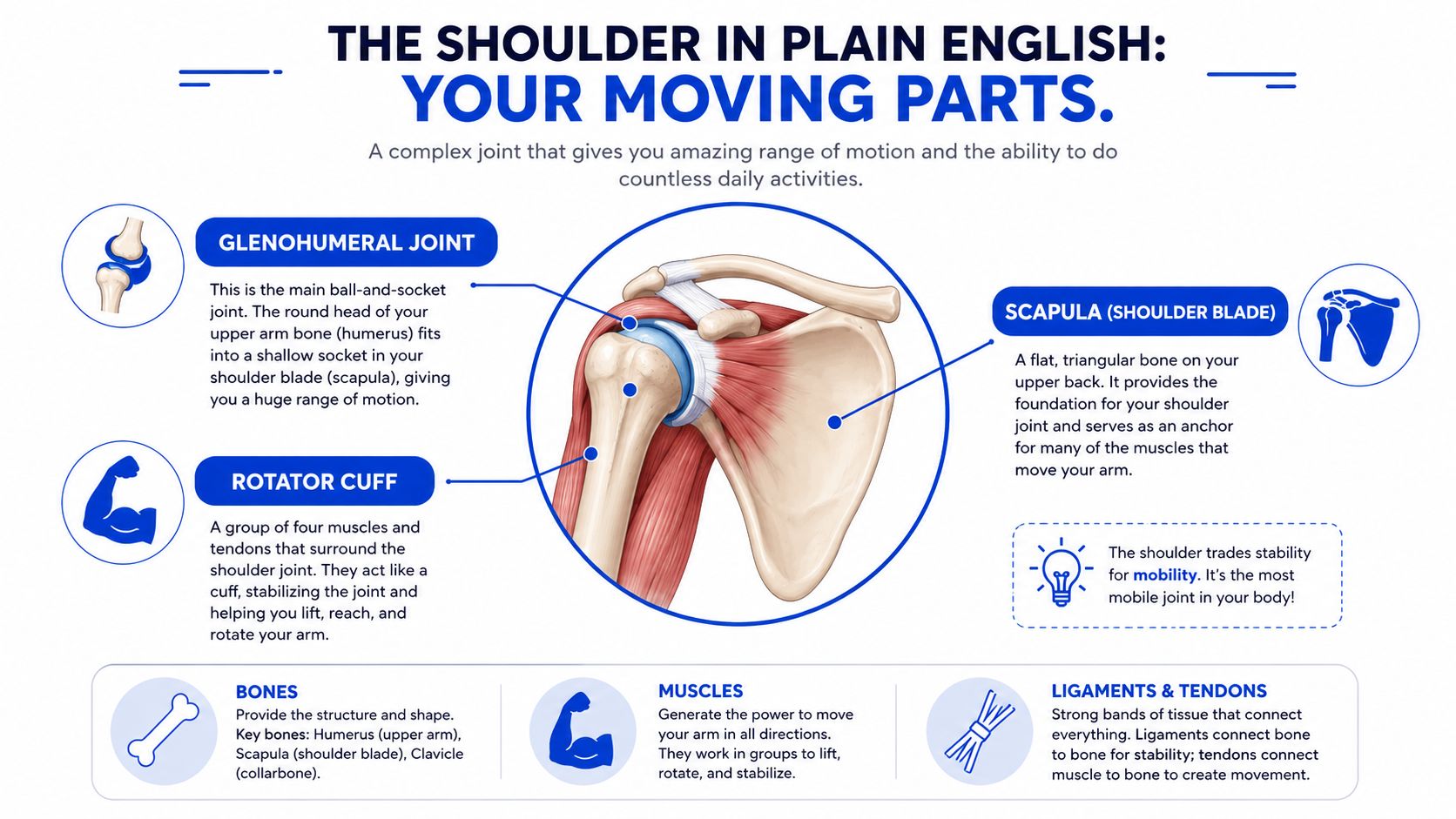
The shoulder is the most mobile joint in the body, and that freedom is exactly why it can become temperamental. It's built for reach, lift and rotation, but it depends on several parts working together. When one part lags, the others compensate, and that's when the movement starts to feel pinchy, unstable or just plain awkward.
The main moving parts
The glenohumeral joint is the ball-and-socket joint commonly referred to as the “shoulder.” The rotator cuff keeps the ball centred as the arm moves. The scapula, or shoulder blade, gives the arm a stable base to move from. The upper back and rib cage matter too, because overhead reach is never just about one joint.
That's why shoulder pain often shows up at the front or side rather than deep in the joint. The front of the shoulder gets crowded when the arm bone isn't guided well. The side of the shoulder often complains when the cuff is working too hard to keep things steady. Poor scapular control is usually part of the story, even when the pain feels local.
What scapular control really means
Scapular control isn't a fancy phrase for “pull your shoulders back.” That cue is too blunt. Good control means the shoulder blade can glide, tilt and rotate in sync with the arm, without shrugging, pinching or collapsing forward. When that rhythm is off, overhead work feels expensive.
Rounded shoulders, forward head posture, and a locked upper back often feed the problem, especially in desk workers. Older adults can also lose comfortable range because they move less and guard more. In both cases, the shoulder can start acting like it's smaller than it really is.
Reach overhead, and the whole chain has to participate. The upper back opens, the shoulder blade rotates, the cuff steadies the ball, and the arm travels without force. If one link drops out, the movement gets substituted by tension elsewhere.
What that means for exercise choice
This is why some drills calm one shoulder and aggravate another. A person with stiffness may need guided motion to wake up the joint. A weaker shoulder may need support and gradual loading. A very irritable shoulder needs low-load work that restores movement without poking the pain. The exercise isn't chosen because it looks clever. It's chosen because it matches the shoulder's job on that day.
Mobility Drills to Loosen a Stiff or Pinchy Shoulder
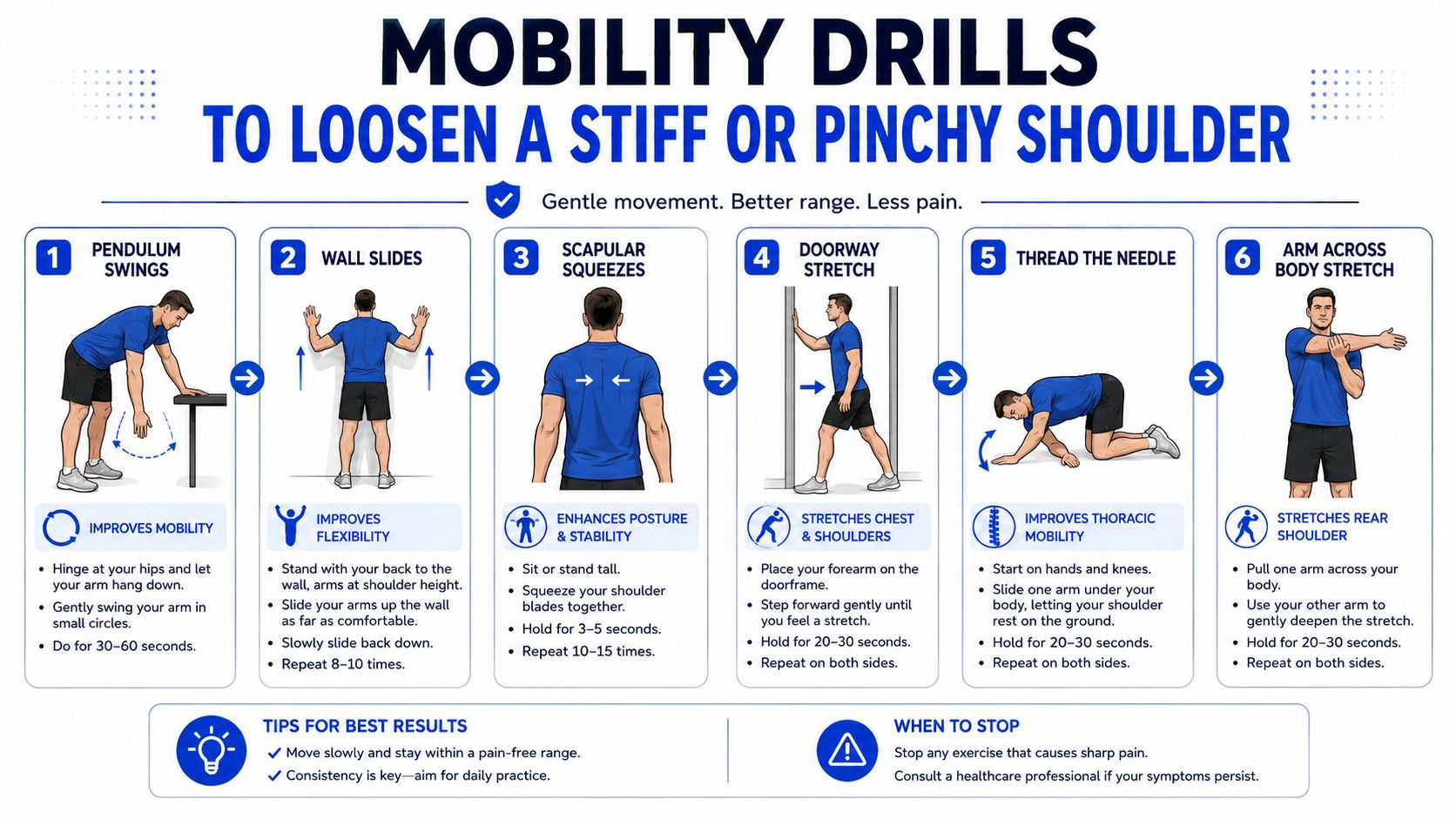
If the shoulder feels stiff after rest, guarded at the top of a reach, or catchy at the front, start with mobility before strength. These drills are also a better first step for older adults and desk workers whose shoulders have learned to protect themselves by moving less. The aim is to restore motion without poking the joint into a flare.
A home routine usually works best in small, repeatable doses on 6 days per week. That matches the low-load style used in shoulder rehab handouts and the kind of movement advice often used in Australian public health settings (shoulder exercise guidance). The useful dose is the one the shoulder can recover from, not the one that leaves it sulking by evening.
Pendulum swings and wall slides
Start with pendulum swings. Lean forward with one hand supported on a bench or table, let the sore arm hang relaxed, then make small circles or gentle forward-back swings. Let the body move the arm, not the shoulder muscles. 30 to 60 seconds is enough at first, and breathing should stay easy.
A good rep feels loose and weighted. The arm should swing without you hauling it into place. If the shoulder tightens, the movement turns jerky, or you start actively lifting the arm, the drill has crossed from calming into effort the joint is not ready for yet.
Wall slides come next. Stand with your back near a wall and slide the forearms upward in a controlled path, keeping the ribs from flaring. A towel under the forearms can help if the motion feels sticky. Keep the lift smooth, and stop before the low back arches to steal the range.
Some shoulders only tolerate a short climb up the wall. That is useful information, not failure. Older adults often do better staying below the point where the shoulder starts guarding, and people with arthritis-prone joints usually need a quieter range than they expect.
The wall is there to slow you down. If you have to arch, shrug or shove your way higher, the shoulder is not ready for that range today.
Scapular squeezes and supported cross-body work
Scapular squeezes are simple but easy to overdo. Sit or stand tall, gently draw the shoulder blades back and slightly down, then release. Keep it brief and neat, with no hard pinching through the neck. For many people, 10 to 15 repetitions is enough.
A supported cross-body stretch can help when the back of the shoulder feels tight. Bring the arm across the chest and use the opposite hand only as a guide, not a lever. A mild stretch is fine. A sharp pinch at the front is not. If you need to lean your whole body into it, the stretch is too aggressive for that shoulder today.
Desk workers often do well with this one because the arm has usually been living in front of the body for hours. Older adults may need to keep the shoulder lower and the reach gentler. Arthritis-prone shoulders should stay in the range that feels like movement, not a fight.
A quick rule for a good mobility day
Pendulums and wall slides usually suit a stiffer shoulder. Scapular squeezes help if you have spent too long rounded forward at a desk. Cross-body work can help when the shoulder feels like it has lost reach across the body. If any drill leaves the joint more irritable afterwards, shrink the range, slow the pace, or leave it out for a few days.
Building Strength Without Flaring the Joint
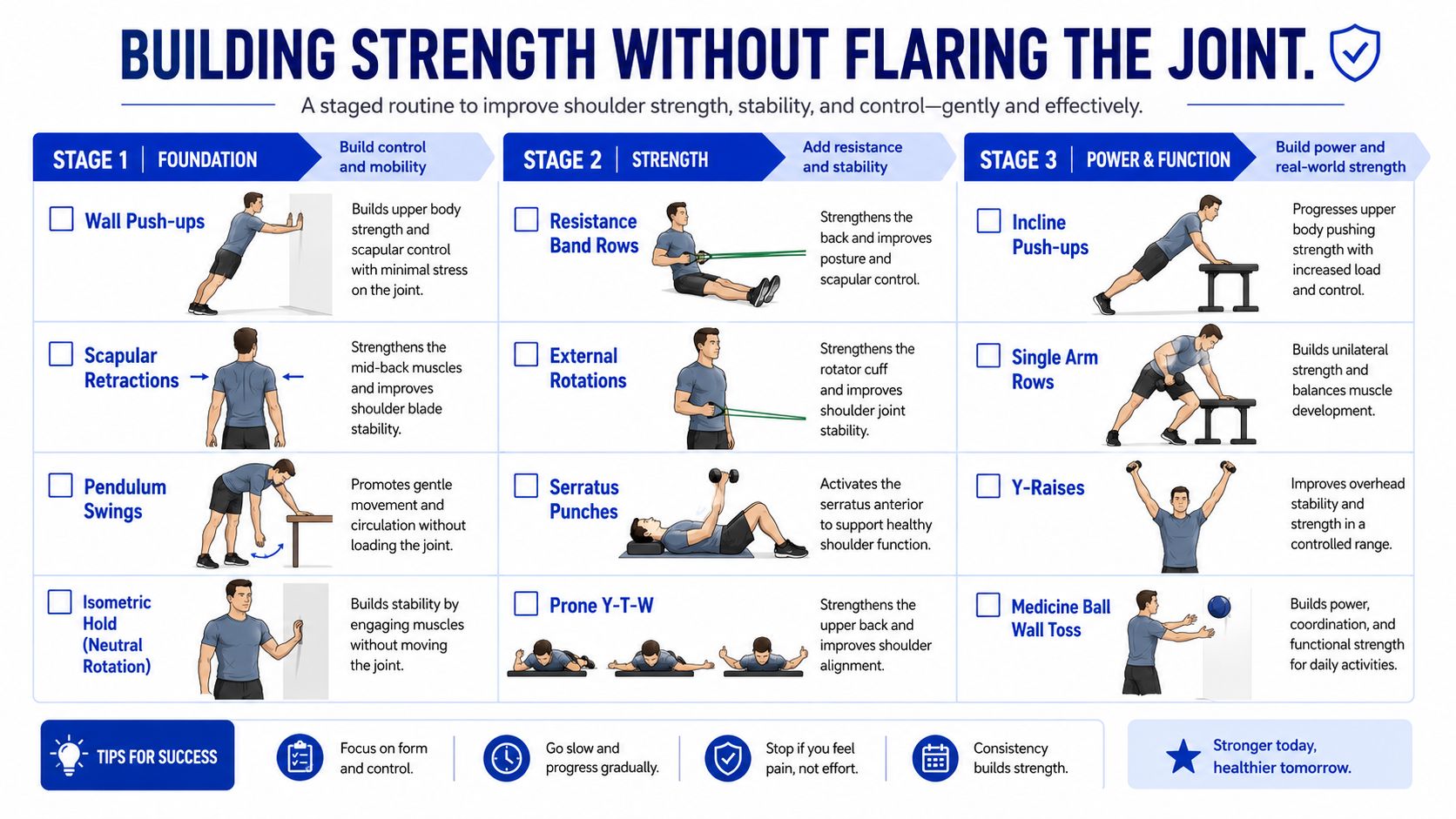
If the shoulder has stopped picking a fight with simple movement, the next step is load. Pain often keeps returning because the joint is weak, underprepared for carrying, or asked to do more than it can tolerate. The right place to start is with positions that are difficult to fail, then progress only when the shoulder stays calm afterwards.
Wall work before free weights
Start with wall push-ups and wall slides. The wall reduces load while you build control, which makes these drills a safer first step for a shoulder that is still settling. Keep the movement small, controlled and symmetrical. For many people, 2 sets of 12 to 15 reps, 3 to 4 times per week is a sensible starting point, and that fits the low-volume strengthening approach commonly recommended in patient guidance (shoulder exercise guidance).
A wall push-up should feel like steady work through the chest, shoulder and upper arm. A jab at the front of the shoulder is a sign that the load or angle is wrong. If the elbows flare hard or the shoulders shrug, the pattern has lost its shape. Wall slides should stay smooth and controlled, not forced into a range the shoulder does not yet trust.
Rows and external rotation
After that, add a light row and external rotation. A bent-over row with a band or a very light dumbbell helps the back of the shoulder and upper back share the work. External rotation trains the rotator cuff to keep the ball of the shoulder centred.
The dosage matters more than the label. Keep the load light, the control clean and the shoulder quiet after the session. If the shoulder aches during the set but settles quickly afterwards, that is often acceptable. If the pain climbs and stays sharp, the load is too much for that stage.
A 2024 meta-analysis on rotator cuff-related shoulder pain found that specific exercise modes improved pain and function, with short-term benefits for scapular stability training and shoulder mobilisation and stretching. That supports the practical choice to combine control work with carefully dosed mobility, rather than relying on one drill alone.
When overhead work makes sense
Heavy overhead pressing should wait. Wall work, rows and band rotations need to feel stable and repeatable first. Light overhead reaches or presses only make sense once the shoulder stays calm later that day and the next morning. That rule is more useful than chasing a fixed weight target.
Progression rule: change one variable at a time, usually range, then resistance, then speed. If pain spikes after training, reduce the challenge and earn the range again.
Matching the Program to Your Shoulder
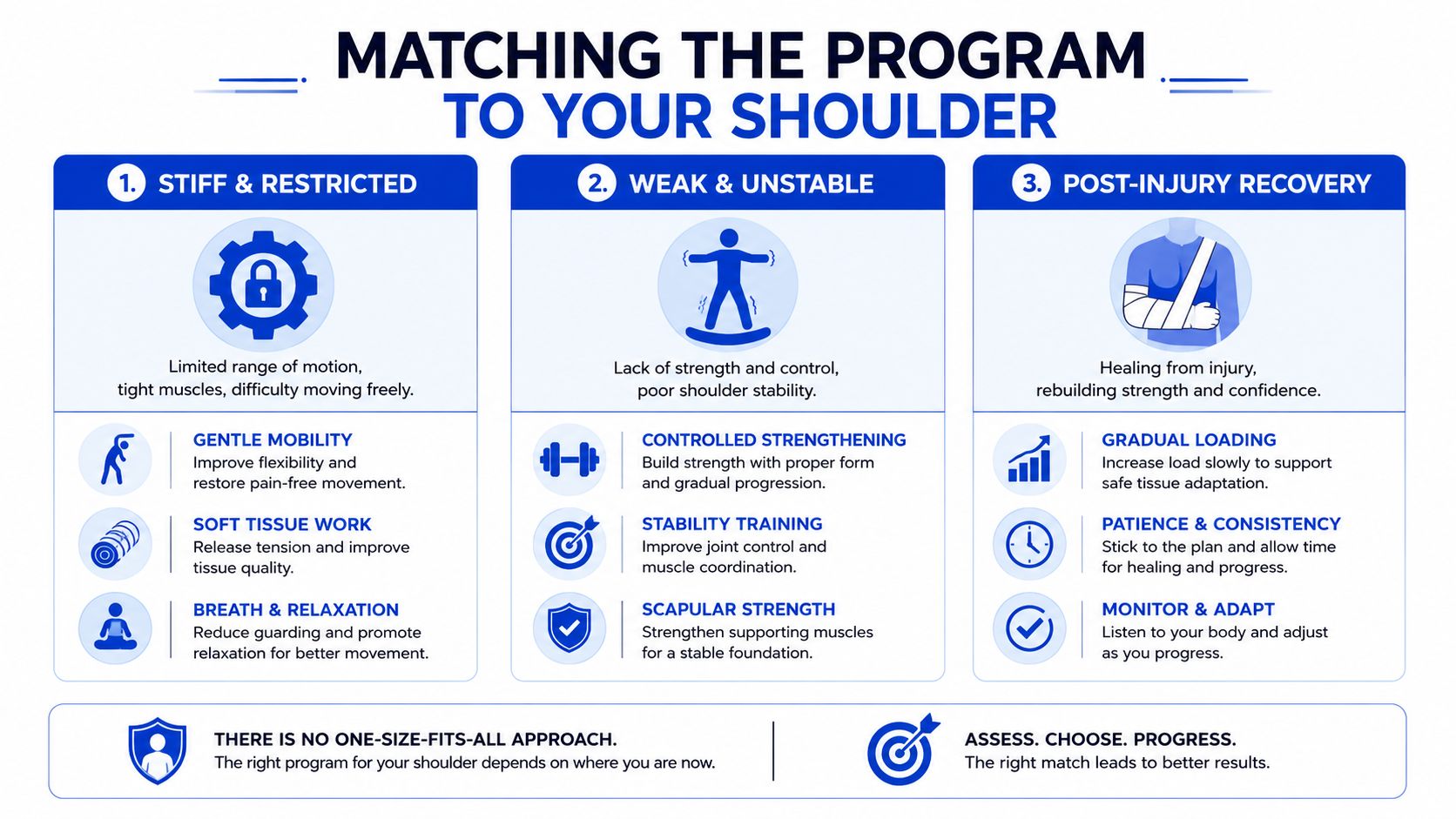
A shoulder that feels tight after a desk day needs a different plan from one that aches because it is underpowered, and a shoulder that flares with nearly every movement needs a lighter touch again. The point is to match the exercise to the current irritability, not to force everyone through the same routine. That is the difference between steady progress and a week of unnecessary soreness.
The practical question is simple. What does this shoulder tolerate today? A stiff shoulder wants motion. A weak shoulder wants control and load. An irritable shoulder wants less intensity, fewer ranges and more recovery between sessions.
Stiff and arthritic
A stiff or arthritis-prone shoulder usually dislikes being pushed. It tends to respond better to low-load mobility, supported range and short, repeatable sessions. Older adults often do better with chair support, wall support and slower transitions, because a stable setup makes the movement feel safer and easier to repeat.
For this pattern, keep the range comfortable and skip long, aggressive holds at end range. The shoulder should feel warmer and easier to move after the session. If it feels jammed, pinchy or more inflamed later in the day, the drill was too ambitious. The posture and corporate ergonomics reference also fits here, because a stiff shoulder often needs fewer provocation points during the day, not just in the exercise block.

Weak and overloaded
A weak shoulder often seems manageable until it has to do real work. Then it complains with carrying, lifting or overhead tasks. Desk workers commonly fit this pattern, especially when the upper back stays stiff and the shoulders live in a forward position for hours.
This shoulder usually needs more strengthening than stretching. Wall push-ups, rows and external rotations should stay in the plan for longer, even after pain settles, because control is what helps protect the joint during daily tasks. Micro-breaks at the desk matter too. A few controlled shoulder-blade resets through the day can stop the same overload pattern from building up again.
Irritable and reactive
An irritable shoulder gets annoyed quickly. It may feel fine during gentle movement, then flare after too much range, too much speed or too many repetitions. Here, cut the session short before symptoms spike, and use easier versions until the joint settles.
Progress shows up in steadier day-to-day behaviour. If you can do less and feel better, that is the right direction for now. If a session leaves the shoulder quieter for the rest of the day and no worse the next morning, the dose is probably right.
Red Flags, Setbacks and When to Stop
Some shoulder pain is safe to work around. Some isn't. A fall, a pop, sudden severe pain, obvious deformity, progressive weakness, numbness, a shoulder that feels unstable, or night pain that won't settle deserves prompt professional assessment. Don't try to train through those signs and hope they disappear.
The kinds of drills that backfire
Aggressive behind-the-back stretches often irritate shoulders that are already annoyed. Loaded overhead work too early can have the same effect. Fast, momentum-driven drills can make the joint feel like it's moving, but they usually skip the control the shoulder needs.
The problem isn't just discomfort. It's that the shoulder starts guarding harder after repeated irritation. A drill that leaves you more painful for the rest of the day, or worse the next morning, is telling you the dosage is wrong. If two weeks of steady exercise still leads to gradually worsening pain, it's time to book in rather than keep pushing.
Stretchy discomfort versus joint irritation
Stretchy discomfort usually feels broad, mild and predictable. It eases when you back off and doesn't leave the joint angry later. Joint irritation tends to feel sharper, more local, and more likely to linger after the set is over.
If you're unsure, use the simplest test available. Repeat the movement at half the range and half the speed. If it still bites, stop it. Pain that keeps escalating during a session is not a sign of grit, it's a sign the shoulder has had enough.
A better exercise today is often a smaller dose of the same pattern, not a more dramatic one. That's especially true for arthritis-prone shoulders, because irritation builds quickly when the joint is asked for more than it can comfortably give.
When to pause the home plan
Pause if the shoulder becomes steadily more painful across several sessions, if sleep starts breaking down, or if function drops rather than improves. Those are the signals that self-management has reached its limit. At that point, the smartest move is to get the shoulder examined properly instead of layering random exercises on top of a reactive joint.
When Self-Care Stops Being Enough and Osteopathy Can Help
Home exercise does most of the heavy lifting for non-traumatic shoulder pain, but it can run out of road. When the shoulder plateaus, keeps flaring, or starts affecting sleep and daily tasks again, a hands-on assessment becomes useful. That's where osteopathic care can add something a generic routine can't.
What a hands-on assessment adds
An osteopath looks beyond the shoulder itself. The neck, thoracic spine, ribs and shoulder blade all affect how the arm moves, and those links matter when pain keeps coming back. Soft-tissue work, joint articulation and gentle mobilisation can reduce tension and make the movement drills easier to perform well.
That's especially relevant for office workers with postural strain and older adults with arthritis-related stiffness. A plan can be adjusted to what the shoulder tolerates rather than what a brochure assumes it should tolerate. The right hands-on treatment doesn't replace exercise, it makes exercise more workable.
You can also expect a plan that blends treatment with practical self-care. That usually means keeping the parts of the routine that help, dropping the ones that provoke the joint, and modifying the load so the shoulder stops bouncing between relief and flare-up.
Who should book
If the shoulder keeps waking you at night, if the same movement keeps provoking symptoms despite sensible home care, or if the pain is migrating rather than settling, it's worth being assessed. If you've been trying to manage a stiff, weak or arthritic shoulder on your own and the progress has flattened out, that's another good reason to seek help.
This shoulder and posture resource shows the kind of hands-on environment that often supports a more individualised plan. For eligible patients, it's also sensible to ask about Medicare options where applicable, because support may depend on the plan and referral pathway.

If you're in the Bayside community and your shoulder has stopped responding to well-chosen home exercise, book a consultation with Bayside Osteopathic Health. A calm assessment can tell you whether you need more mobility, more strength, or less aggravation, and it gives you a clear plan instead of another guess.