
You wake up with a neck that won't turn properly. Or you stand up from the desk after a long day and your lower back feels tight, stiff, and strangely protective, as if your body has decided that even simple movement is a bad idea. Sometimes it's not dramatic pain at all. It's the shoulder that keeps gripping, the hip that feels jammed on walks, or the hands that ache after gardening, lifting, or hours at a keyboard.
That's where soft tissue treatment often helps. In osteopathic care, it isn't just a bit of rubbing over the sore spot. It's a hands-on way of working with the muscles, fascia, tendons, and ligaments that influence how you move, how you compensate, and why pain keeps returning. The aim isn't just to chase symptoms for a day or two. The aim is to help the body move more freely so irritated areas don't keep getting overloaded.
For many people in the Bayside community, that means finding a calmer, more practical path forward. Less fighting with your body. More confidence bending, walking, reaching, working, and sleeping.
Table of Contents
- Feeling the Strain of Everyday Life
- Understanding Your Body's Soft Tissues
- Common Osteopathic Soft Tissue Techniques
- Conditions That Respond Well to Soft Tissue Treatment
- What to Expect During Your Osteopathy Session
- Simple At-Home Care to Support Your Progress
- Accessing Care and Choosing Your Practitioner
Feeling the Strain of Everyday Life
The search for soft tissue treatment is seldom prompted by a single, perfect textbook injury. Instead, it arises because life has piled up in the body.
It might start with long hours at a computer. Your head creeps forward, your shoulders round, and by late afternoon the muscles between your neck and shoulder blade feel like tight ropes. Or maybe you're active and busy, carrying kids, lifting boxes, training hard on weekends, then wondering why your back still feels vulnerable days later. For older adults, it's often a quieter pattern. Stiffness in the morning, sore joints by evening, and a sense that movement is becoming harder work than it used to be.
Those aches can feel random, but they usually aren't. The body often tightens to protect an area that feels irritated or overloaded. At first, that guarding can be useful. If it stays too long, it becomes part of the problem. Muscles stay switched on, fascia loses some of its easy glide, and nearby joints stop moving as comfortably as they should.
Soft tissue treatment often works best when pain feels mechanical. Worse after sitting, lifting, twisting, or repetitive tasks, and easier when movement improves.
An osteopath uses soft tissue treatment to calm that protective tension and restore more natural movement. Sometimes the sore spot needs direct treatment. Sometimes the underlying issue sits a little further away, like a stiff upper back feeding neck strain, or tight hips forcing the lower back to do too much.
That's the osteopathic difference. We don't only ask, “Where does it hurt?” We ask, “Why is this area taking the load?”
Understanding Your Body's Soft Tissues
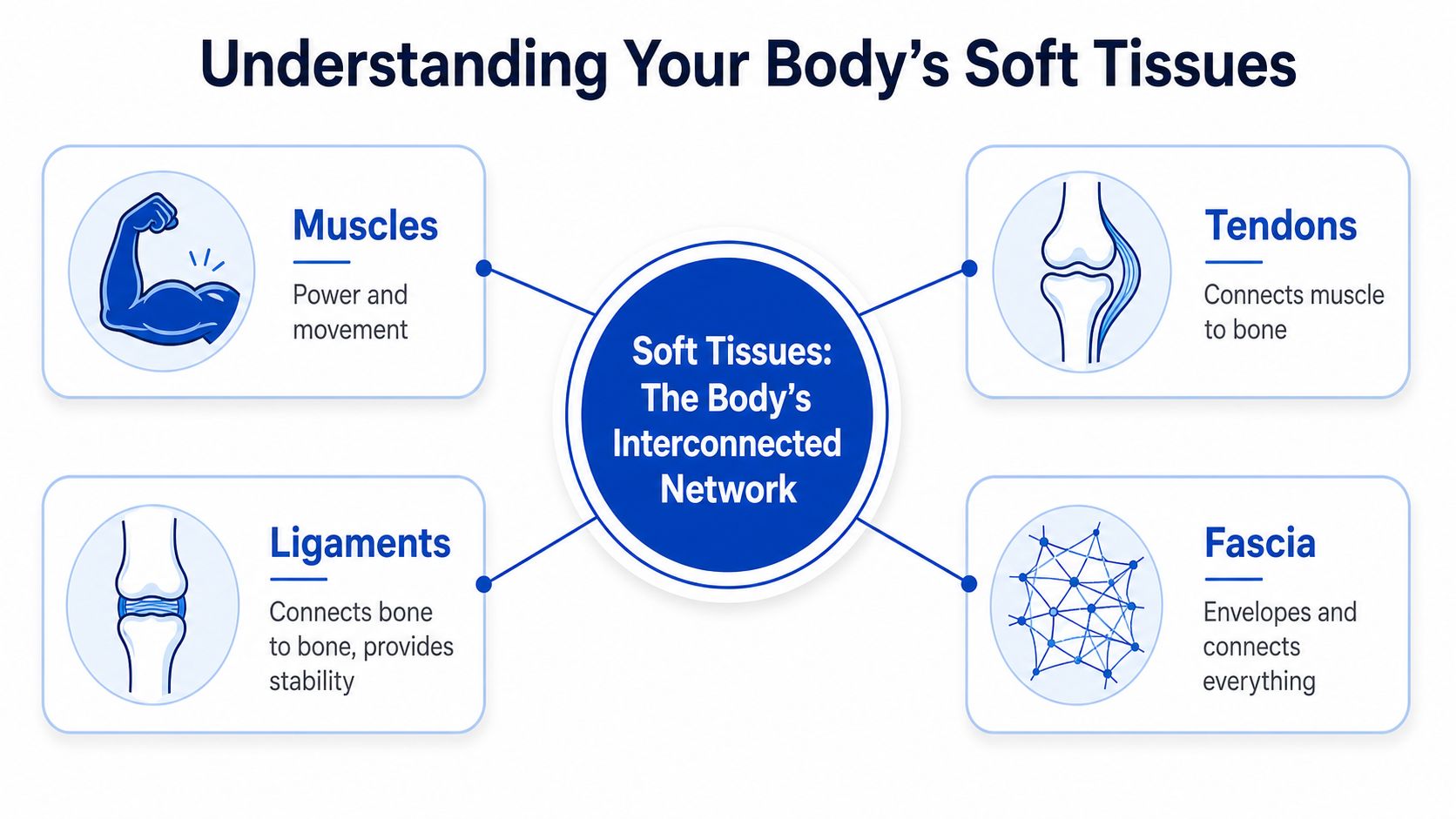
When people hear the term soft tissues, they often think only of muscles. But the picture is bigger than that. Soft tissues include muscles, tendons, ligaments, and fascia. Together, they form the body's supporting web.
A useful way to think about them is like layers of fabric in a fitted shirt. If one layer gets twisted, shrunk, or pulled tight, the whole garment stops sitting properly. You don't just feel the problem at one seam. The tension spreads. The body behaves in much the same way.
Why pain isn't always where the problem starts
Muscles generate movement. Tendons connect muscle to bone. Ligaments support joints. Fascia wraps around and through everything, helping tissues slide and transfer force.
If one part of that network loses flexibility or becomes irritated, nearby areas often compensate. A tight calf can change the way you walk. A stiff chest and upper back can feed neck tension. A guarded hip can make the lower back work harder than it should.
That's one reason soft tissue problems can linger. The body adapts well, but those adaptations come at a cost. Over time, the area doing the extra work becomes sore, tired, or restricted.
In Australia, soft-tissue injuries account for a large share of lost-work time because they can produce persistent pain and reduced mobility. That's why soft-tissue treatment became established as a key part of rehabilitation, often combined with movement advice rather than used in isolation, as discussed in this occupational health review on musculoskeletal injury burden.
Why osteopaths treat the system, not just the sore spot
Soft tissue treatment is the process of improving how these layers move, glide, and tolerate load. That might mean reducing excessive muscle tension, easing strain through fascia, or helping a tendon and its surrounding tissues move with less irritation.
An osteopath chooses treatment based on the pattern, not just the label. Two people can both say, “My neck hurts,” while needing very different care. One may need upper thoracic release and breathing-related rib work. Another may need jaw, shoulder, and desk posture factors addressed.
If you'd like a broader view of that whole-body approach, this guide to understanding osteopathy and whole-body care explains why osteopaths assess movement as a connected system.
Practical rule: If treatment only chases the sore spot and ignores the reason it's overloaded, relief often fades quickly.
Common Osteopathic Soft Tissue Techniques
Different soft tissue techniques do different jobs. Some calm an overactive muscle. Others improve tissue glide. Some help a stiff joint move better by reducing the tension around it. A good treatment isn't about using every technique available. It's about choosing the smallest effective input for the person on the table.
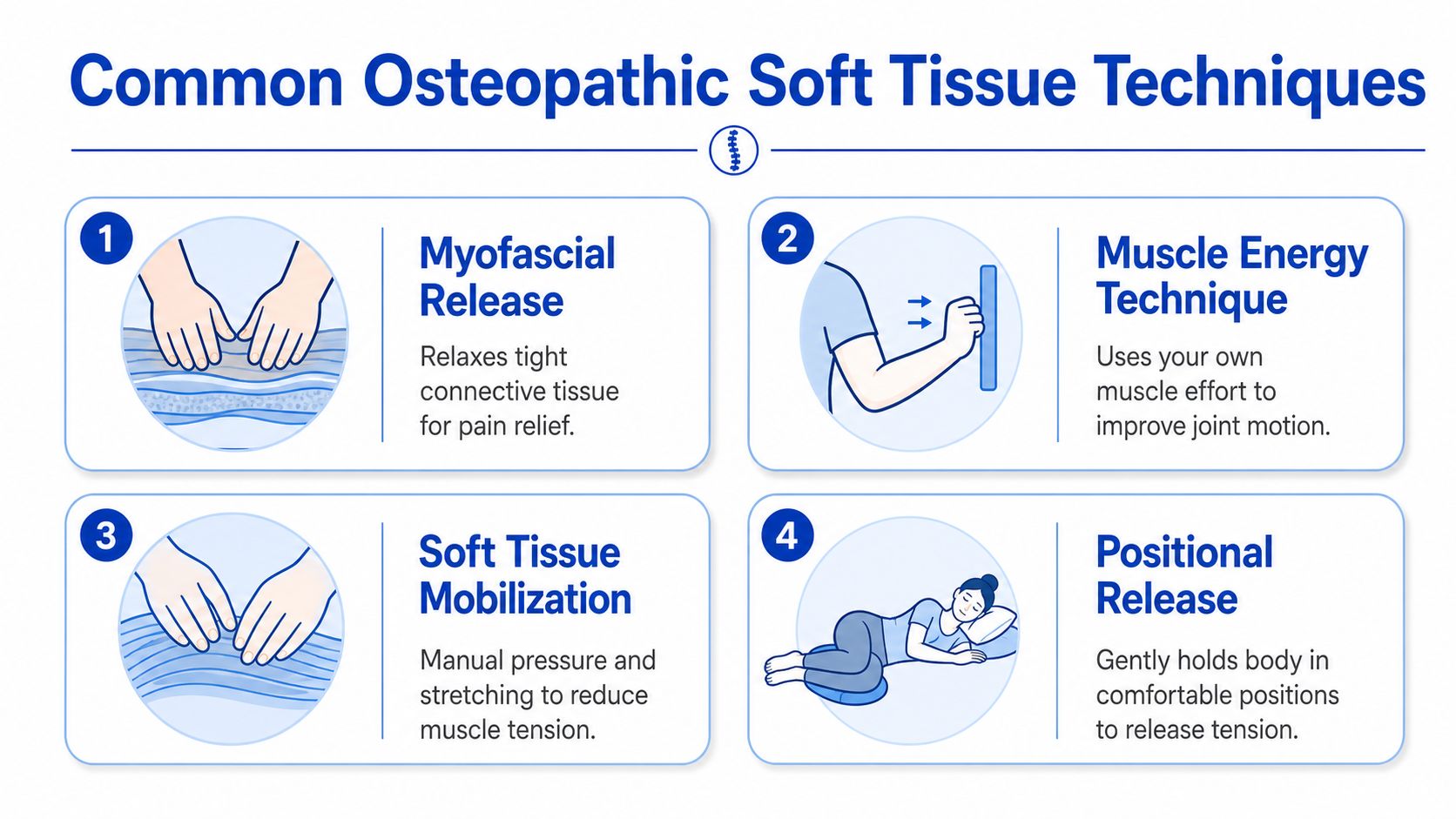
A few common methods are shown below.
Myofascial release and soft tissue mobilisation
Myofascial release targets the connective tissue layers that can become tight, sticky, or less mobile after overuse, stress, or injury. The pressure is usually slow and deliberate rather than forceful. Patients often describe it as a sustained stretch or a broad, firm contact that gradually melts resistance.
Soft tissue mobilisation is a broader term for hands-on work that kneads, lengthens, or unloads tissue. It might be used over the calves, forearms, glutes, neck, or between the shoulder blades, depending on the pattern of tension.
These techniques are useful when tissue feels dense, guarded, or restricted. They often help with:
- Reducing protective tension so movement feels less effortful
- Improving glide between layers when tissues feel stuck, not just weak
- Preparing the body for exercise so stretches and strengthening feel more natural afterwards
Trigger point work and positional release
A trigger point is an irritable, localised spot in a muscle that can refer discomfort elsewhere. A classic example is the top of the shoulder referring pain up into the neck or towards the head. Trigger point work uses focused pressure, but it should feel tolerable and controlled, not like a battle.
Positional release takes almost the opposite approach. Instead of pressing through a tight area, the body part is placed in a position of ease and held there briefly. This can be particularly helpful when tissue is reactive and doesn't respond well to stronger input.
Here's the trade-off:
| Technique | Often chosen when | What it usually feels like |
|---|---|---|
| Trigger point work | A distinct knot or referred pain pattern is present | Local pressure, then easing |
| Positional release | Tissue is sensitive, guarded, or flares easily | Gentle support and a sense of letting go |
The mistake people sometimes make is assuming stronger pressure means better results. It doesn't. If tissue is already irritated, aggressive work can leave it more defensive afterwards.
A short demonstration of hands-on osteopathic soft tissue methods can help make these approaches easier to picture.
Muscle energy technique and gentle articulation
Muscle energy technique involves the patient gently contracting a muscle against the practitioner's resistance, followed by relaxation and repositioning. It's active, collaborative, and especially useful when a joint and its surrounding muscles seem to be stuck in a pattern.
Gentle articulation moves a joint through a comfortable range in a guided, rhythmical way. The goal isn't force. It's to invite movement back into an area that has become stiff because the soft tissues around it are bracing.
These approaches often work well together. Release the tight tissue first, then help the body use that new freedom.
The best sessions usually feel specific, not dramatic. You should leave feeling easier to move, not as if your body has been wrestled.
Conditions That Respond Well to Soft Tissue Treatment
Soft tissue treatment is often most useful when pain is being driven, maintained, or amplified by how muscles and connective tissues are handling load. That includes common complaints seen in office workers, active adults, parents, tradies, and older people trying to stay mobile without aggravating sore joints.
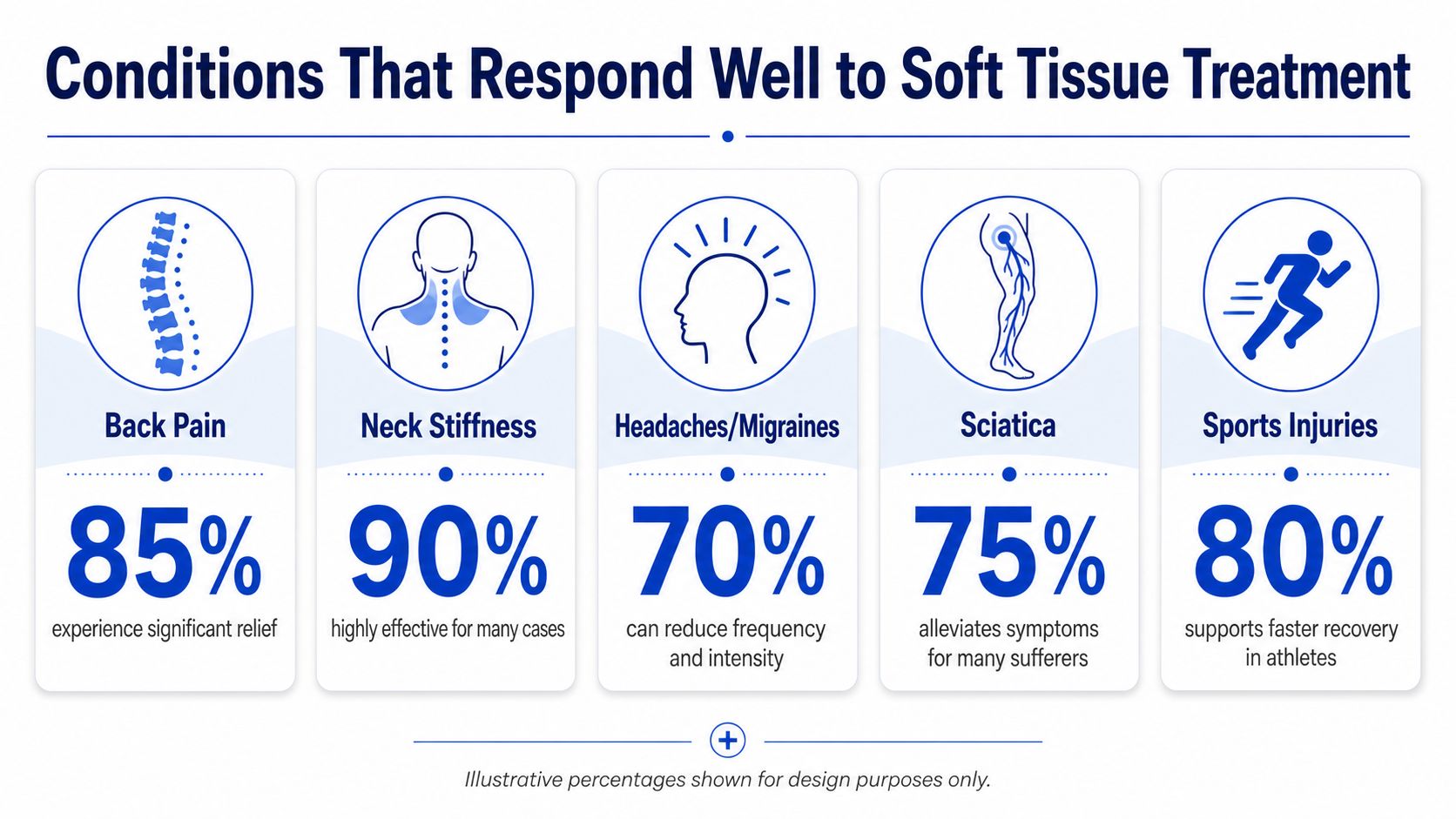
Australia's musculoskeletal burden is large. Musculoskeletal conditions affect 7.3 million adults (29%), with back problems affecting 4.0 million (16%) and arthritis affecting 3.7 million (15%), which highlights why soft-tissue care is relevant for so many people dealing with pain and movement limits, according to this summary on musculoskeletal conditions and soft tissue mobilisation.
Postural back and neck pain
This is one of the most common patterns. The lower back feels tight after sitting, or the neck and shoulders build tension through the day until turning your head becomes uncomfortable.
In many cases, the body isn't asking for endless stretching of the painful area. It's asking for better load-sharing. That may involve easing tight hip flexors, upper trapezius, chest muscles, or thoracic fascia so the spine doesn't keep paying the price.
Soft tissue treatment can help by:
- Reducing local guarding around the painful area
- Freeing nearby regions that have become stiff and are forcing compensation
- Making exercise easier to tolerate so long-term change is more realistic
Arthritis related stiffness and protective muscle tension
Soft tissue treatment doesn't cure arthritis. That's an important distinction.
What it can do is improve comfort around an arthritic joint by reducing the muscle tension and movement restriction that often builds around it. A knee with arthritis, for example, rarely affects only the knee. The calf, hamstrings, thigh, and hip often change their behaviour too. The same is true for arthritic hands, shoulders, necks, and lower backs.
When care is well judged, people often notice that movement feels less blocked and less effortful. That matters, because comfortable movement helps people keep doing the everyday things that preserve independence.
Repetitive strain and activity related overload
Not all soft tissue problems come from a single incident. Many build gradually through repetition. Keyboard and mouse use, gardening, painting, lifting, carrying, running, racquet sports, and gym training can all create patterns of overload.
A sore forearm may be linked to shoulder mechanics. A tight calf may relate to ankle stiffness and walking pattern. A recurrent glute strain may reflect how the pelvis and lower back are sharing force.
For those dealing with recurring overuse issues, targeted care alongside sensible activity modification often works better than complete rest. If repetitive loading is part of your picture, this page on repetitive strain injury treatment gives a useful overview of how these patterns are usually managed.
If a problem keeps returning, the body usually isn't failing. It's repeating the same compensation because the underlying movement pattern hasn't changed yet.
What to Expect During Your Osteopathy Session
A first appointment usually feels much more conversational than people expect. The hands-on treatment matters, but the early part of the session matters just as much because it helps explain why the problem developed in the first place.
The first conversation matters
You'll usually be asked where the pain is, when it started, what makes it worse, and what eases it. But the questions shouldn't stop there.
An osteopath will also want to know how you work, sleep, train, sit, lift, and recover. If your neck pain always ramps up after laptop use, that matters. If your hip only complains on hills, that matters too. A symptom doesn't exist in isolation from the way you live and move.
Sometimes patients are surprised when an osteopath asks about an old ankle sprain during a back pain appointment. There's a reason. Old restrictions can keep shaping present movement patterns long after the original injury seemed to settle.
Assessment, treatment, and after effects
The physical assessment usually looks at more than the painful area. You may be asked to bend, twist, squat, reach, or walk. The aim is to spot where movement is limited, guarded, or being diverted elsewhere.
Treatment itself is customized. One person may need soft tissue work through the neck, chest, and upper back. Another may need hips, glutes, and lower back addressed with a mix of release, mobilisation, and guided movement. The osteopath should explain what they're doing and check in about comfort as they go.
Afterwards, people often feel looser, lighter, or easier in their movement. Some feel pleasantly worked, as if they've used muscles that had been asleep. Mild temporary soreness can happen, particularly if tissues have been tight for a while, but treatment shouldn't leave you flattened.
A good session usually ends with practical advice. That might be a stretch, a walking suggestion, a change to desk setup, or a short exercise to reinforce what the hands-on work has opened up.
Simple At-Home Care to Support Your Progress
Hands-on care helps, but what you do between sessions often decides whether progress sticks. The goal at home isn't to attack the body. It's to keep the new movement available and reduce the habits that drove the strain in the first place.

Three gentle ways to help your body between sessions
1. Chin tucks for desk-related neck strain
Sit tall or stand against a wall. Gently draw your chin straight back, as if making a small double chin. Hold briefly, then relax.
This isn't a forceful movement. It helps wake up support around the front of the neck and gives overworked upper neck muscles a break.
2. Pelvic tilts for a stiff lower back
Lie on your back with knees bent. Gently rock your pelvis so your lower back flattens a little into the floor, then ease away.
Small movements are enough. This can be a good reset for people whose back feels locked after sitting or first thing in the morning.
3. Gentle upper back extension over a foam roller or rolled towel
Place the support across the upper back, not the lower back. Support your head if needed, then gently extend over it within comfort.
This often suits people who feel hunched, tight through the chest, or restricted between the shoulder blades.
For more guided ideas focused on the cervical spine, these neck pain relief exercises can be a helpful complement.
What usually helps and what often slows progress
A few simple habits make a difference:
- Move often: Short, regular movement breaks usually beat one heroic stretch after a full day.
- Stay below flare level: A gentle pull is fine. Sharp pain, tingling, or rising irritation means back off.
- Use heat or a warm shower thoughtfully: This can help relax guarded muscles before mobility work.
What tends not to work is forcing stretches into pain, smashing sore tissue with hard tools, or doing random online exercises that don't match the problem.
A home plan should leave you feeling more confident in your body, not more worried about doing something wrong.
Accessing Care and Choosing Your Practitioner
Good care should be practical to access and easy to understand. If you think osteopathy may help, it's worth checking both funding options and practitioner credentials before you book.
Funding options and practical checks
Some patients may be able to access osteopathy under a Medicare Chronic Disease Management plan. Eligibility isn't automatic, so the right first step is to speak with your GP and ask whether your health situation fits the criteria.
Private health insurance may also help with rebates, depending on your level of extras cover. It's best to confirm directly with your insurer so you know what's included.
When booking, it's also sensible to check a few basics:
- Registration: Make sure the practitioner is registered with AHPRA.
- Communication style: Choose someone who explains things clearly and answers questions without jargon.
- Approach: Look for care that combines hands-on treatment with movement advice, not passive treatment alone.
What to look for in an osteopath
A good osteopath should assess the body as a whole, adapt treatment to your comfort, and give a clear reason for the techniques they choose. They shouldn't make you feel rushed or pressured into a one-size-fits-all plan.
The right fit also matters on a human level. You want someone who listens well, takes your goals seriously, and can adjust the plan if your body responds differently than expected. Soft tissue treatment works best as part of a thoughtful process, not a fixed script.
If pain has been limiting how you work, exercise, sleep, or go about your day, getting skilled help early can stop a short-term problem from becoming a long-term pattern.
If you're ready to move with less pain and more confidence, Bayside Osteopathic Health offers gentle, hands-on osteopathic care for back pain, neck strain, joint stiffness, arthritis-related discomfort, and postural overload. If you'd like a personalised assessment and a practical treatment plan that includes soft tissue treatment, movement advice, and simple self-care, book a consultation and get started.