

You finish a day at your Bayside desk, stand up and feel that familiar catch in your lower back. You'd planned a walk before dinner, but now you're wondering whether movement will help or make things worse. The discomfort settles eventually, so you carry on, until the same pattern returns.
Wellness and prevention start in that uncertain space. You don't need a perfect exercise routine or a pain-free body to begin. You need a manageable starting point, a way to judge your response and clinical support when symptoms need more than home care.
Table of Contents
- What Wellness and Prevention Mean in Osteopathic Care
- Why Prevention Matters Across the Lifespan
- Building a Daily Movement Habit That Fits Your Day
- Graded Movement When the Body Already Hurts
- Self-Care Routines for Back, Neck and Arthritis
- Fall Prevention That Starts Before the First Fall
- When Self-Care Is Not Enough and What to Expect at Bayside
- Medicare Eligibility and Booking Your First Visit
What Wellness and Prevention Mean in Osteopathic Care
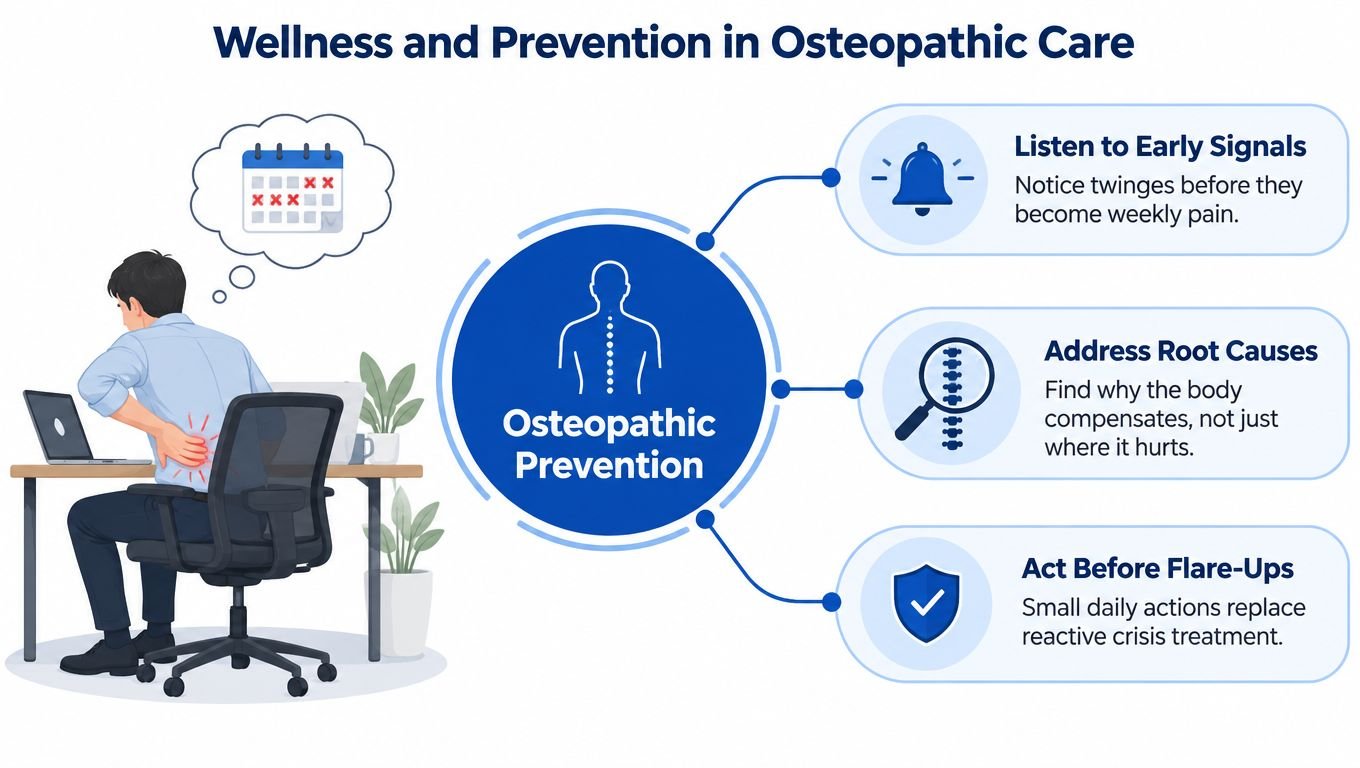
For the desk worker whose occasional back twinge is becoming a regular interruption, prevention doesn't mean booking treatment indefinitely. It means noticing the pattern before it starts dictating everyday decisions. Are you avoiding the stairs, leaving shopping bags in the car or giving up activities you used to enjoy?
Those changes are useful information. Rather than waiting for a severe flare, you can look at what your body currently tolerates and which demands have become difficult.
Look beyond the painful spot
In osteopathic care, an assessment considers how you move as a whole, rather than examining the sore area in isolation. For a neck complaint, that might include looking at shoulder movement, upper-back rotation and the way you reach towards your screen. A restriction elsewhere may be relevant, but it shouldn't be assumed to explain your pain without assessment.
Think of carrying a shopping bag with one handle caught on your wrist. You might change your grip, lift your shoulder or lean sideways to manage the load. Similarly, an osteopath may explore whether you're adapting around a stiff or uncomfortable area.
The practical approach combines awareness, assessment and everyday action.
Build a partnership, not a rescue plan
A useful prevention plan has room for both self-care and professional input:
- Notice changes in function. Difficulty turning to reverse the car or rising from a chair deserves attention, even when pain feels modest.
- Explore contributing demands. Discuss work tasks, previous injuries, sleep and the activities you've started avoiding.
- Choose achievable actions. An adjusted workstation, a tolerable movement routine or a clinical review may be more useful than another ambitious exercise programme.
Hands-on care can form part of that partnership, alongside movement advice and reassessment. It isn't a guarantee against future symptoms, and prevention shouldn't become a search for a perfectly aligned body.
A useful starting point: Ask what you want to do more comfortably, not just where you want the pain to disappear.
That gives treatment and home care a shared purpose, whether it's returning to gardening or getting through the workday with less hesitation.
Why Prevention Matters Across the Lifespan
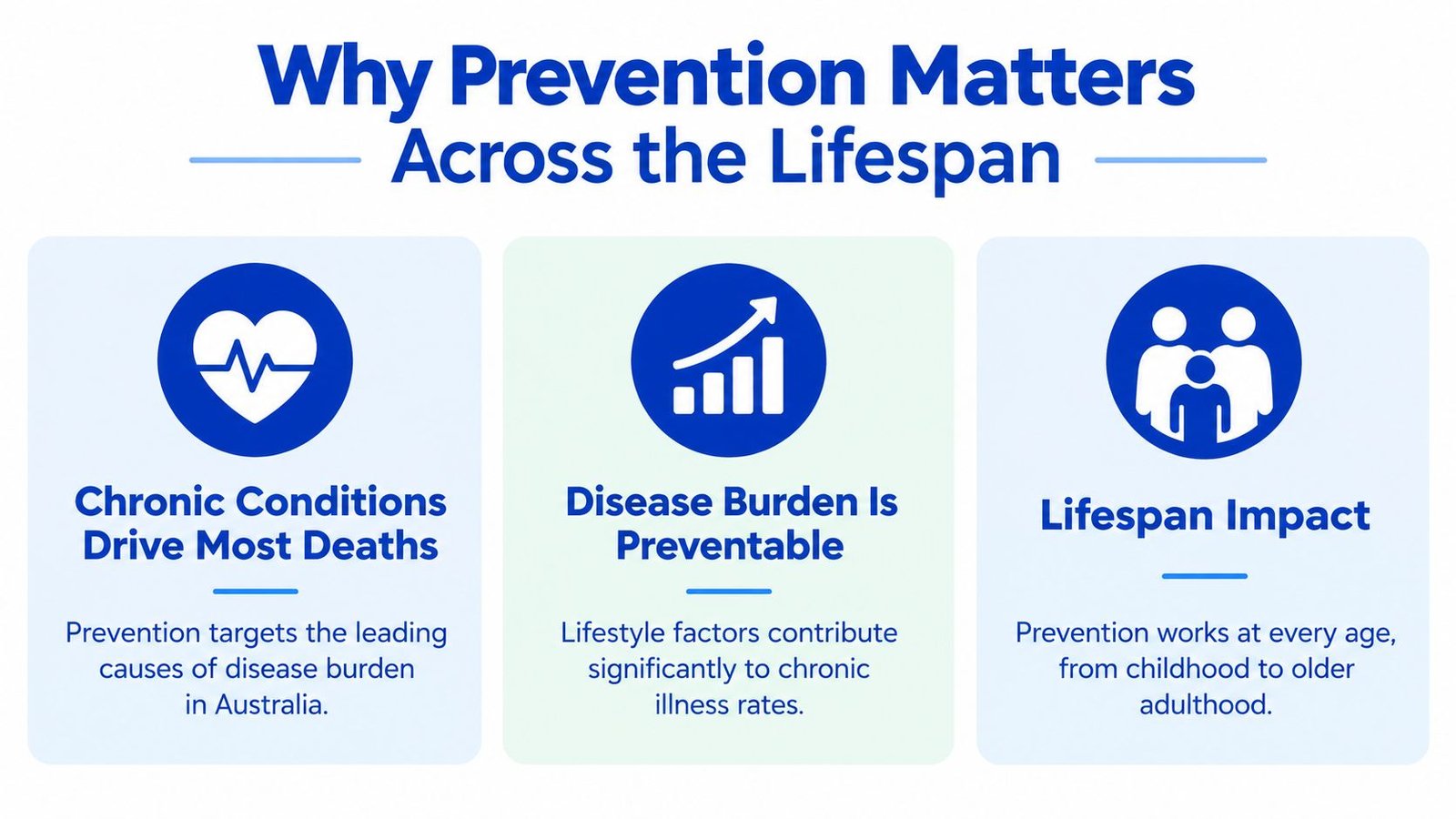
Prevention matters beyond individual aches and pains. Australia's National Preventive Health Strategy 2021–2030 reports that chronic conditions account for 87% of deaths, while around 38% of chronic-disease burden could be prevented by addressing modifiable risk factors, including physical inactivity, tobacco use and alcohol consumption (Australian Government prevention strategy).
Those figures don't mean an individual can prevent every illness by making better choices. They describe a national opportunity, one that also depends on healthier environments, accessible support and circumstances that make healthy behaviours possible.
Translate national prevention into everyday capacity
For someone managing back pain or joint stiffness, the connection is practical. If discomfort makes walking, shopping or leaving home harder, maintaining movement becomes both a musculoskeletal goal and a broader health priority.
The Australian Institute of Health and Welfare attributes 2.5% of Australia's total disease burden in 2018 to insufficient physical activity, including contributions to cardiovascular disease, diabetes and dementia (AIHW physical activity overview). This helps explain why activity matters beyond fitness or body weight.
The lifespan perspective is easier to understand when prevention is viewed as support for everyday living.
Choose goals that remain meaningful
The goal changes with the person and their stage of life.
| Everyday priority | A practical prevention focus |
|---|---|
| Managing desk-based work | Keeping movement available throughout the working day |
| Caring for family | Building tolerance for lifting, carrying and getting down to the floor |
| Living with joint limitations | Maintaining comfortable movement and useful strength |
| Staying independent later in life | Preserving the ability to walk, rise, reach and manage household tasks |
These aren't competing goals. A person may need several at once, particularly when work, caring responsibilities and health concerns overlap.
Prevention is about preserving options, not promising that ageing or illness can be avoided. Being able to choose a walk, visit a friend or manage your own groceries is a meaningful outcome, even if some discomfort remains.
For Bayside adults, that makes wellness less about performing a flawless routine and more about protecting participation in community and family life.
Building a Daily Movement Habit That Fits Your Day
You have a short break after lunch, but the walk you planned feels like too much today. A movement habit has a better chance of lasting when it can adapt to an ordinary day, including changes in energy, time and comfort.
Use the guidelines as a reference point
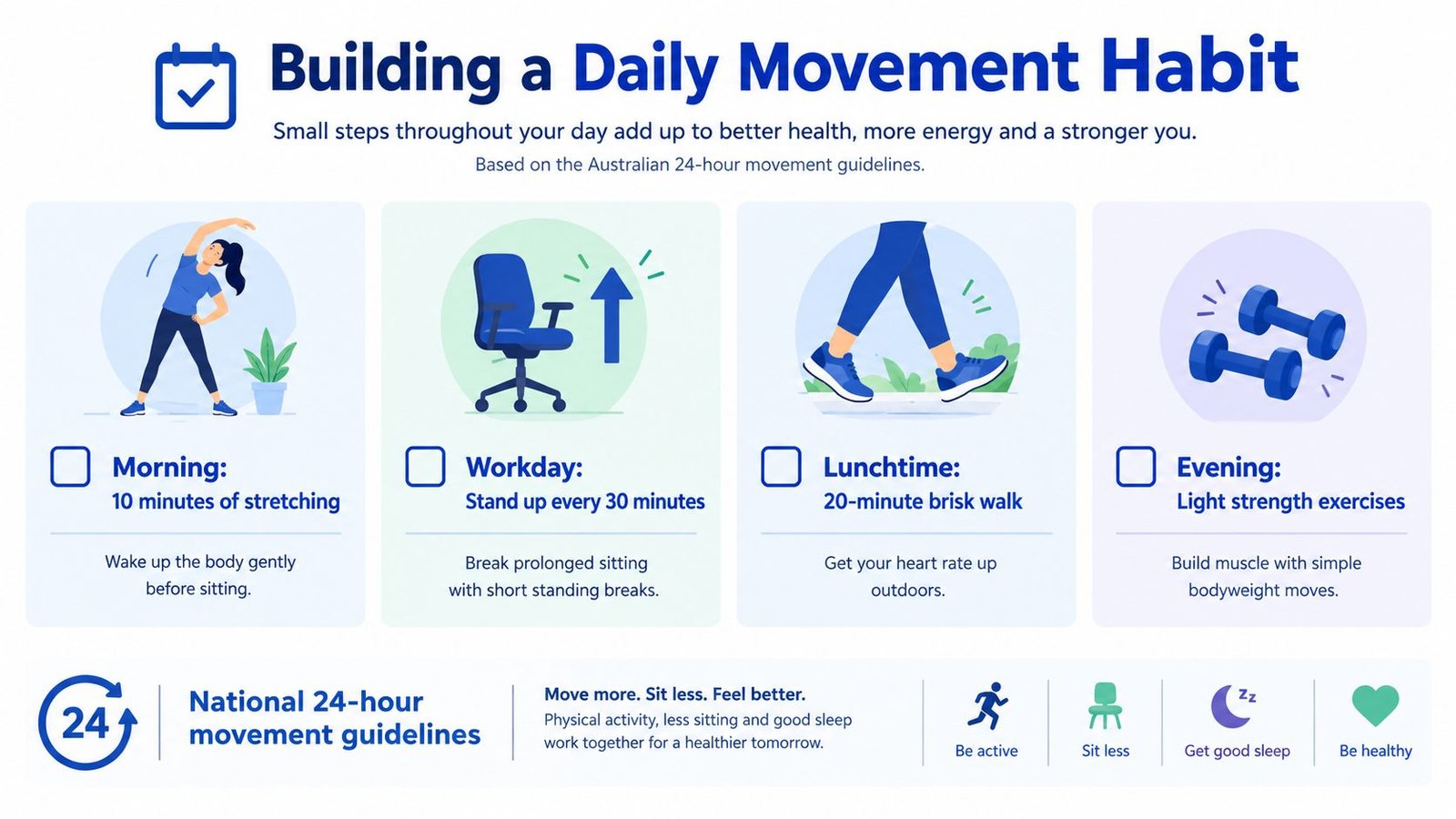
Australia's movement guidance recommends that adults aged 18–64 accumulate at least 30 minutes of moderate- to vigorous-intensity activity on most days, strengthen muscles on at least 2 days weekly, and include mobility, balance and coordination activities on at least 3 days weekly. It also recommends several hours of light movement and frequent breaks from sitting. The Department reports that 37% don't meet the activity component and 73% don't meet the strengthening component (Australian physical activity guidance).
These are population-level recommendations, not a starting target everyone must reach at once. They describe different kinds of movement, so a step count alone cannot show the whole picture. A comfortable walk, controlled chair rises and supported balance practice each serve a different purpose.
| Type of movement | An everyday example | What makes it distinct |
|---|---|---|
| Aerobic activity | A purposeful walk along a comfortable route | Sustained movement that challenges breathing |
| Strength work | Controlled chair rises or resistance-band exercises | Working muscles against resistance |
| Mobility and balance | Comfortable joint movements and supported balance practice | Exploring movement range and control |
| Light activity | Walking to another room or doing household tasks | Replacing some sitting with easy movement |
The infographic offers examples of how activity might fit across a day. Its timings are illustrations, not personalised prescriptions or additional national requirements.
Give movement a dependable cue
A walk after lunch can be easier to remember than a session left for an undefined time later. You might also keep a resistance band where you can see it, or stand and move after a phone call.
Choose a cue that already belongs to your routine, such as coffee, lunch or finishing work. On a demanding day, use a shorter, comfortable version rather than abandoning the habit altogether. If the same activity keeps getting missed, change its timing or format. That is useful information about fit, not a character flaw.
Start with a version you can repeat. Once it has a place in your day, you can gradually adjust the amount or difficulty according to how it feels and what your routine allows.
Graded Movement When the Body Already Hurts
Putting on shoes can hurt before the day's activity has even begun. For someone in that position, advice to exercise may feel disconnected from daily life. Chronic pain affects about 1 in 5 Australians aged 45 and over, and people experiencing it are five times more likely to be severely limited in daily activities than those without it (AIHW chronic pain data).

Graded movement starts with an activity that feels manageable, then adjusts in response to symptoms and recovery. It is less like following a fixed staircase and more like using a dimmer switch: increase the demand in small steps, and ease it back when the body needs less.
For an older adult, that could mean a short, level walk close to home. A desk worker might begin with comfortable chair rises rather than a demanding gym session. The useful starting point is an amount that leaves room for the rest of the day and feels repeatable, not the most someone can push through once.
Change one feature at a time. For example, extend the route, explore a little more movement range, or add resistance. Keeping the other features steady makes it easier to notice how the change affects symptoms.
A familiar ache that briefly increases and then settles towards its usual level differs from symptoms that keep worsening or make everyday tasks harder. This can guide monitoring, but it does not diagnose the cause or prove an activity is safe.
- Continue cautiously when manageable. Keep the activity at the same level while you observe your response.
- Ease the demand if recovery is difficult. Shorten the activity, use support, or return to a version that felt comfortable.
- Arrange an assessment for unfamiliar changes. New weakness, altered sensation, or substantially different pain should not be treated as an ordinary exercise response.
Capacity can shift from day to day. Poor sleep, a tiring shift, or fear of another flare may change what feels achievable. Adjusting the activity to match those limits is part of the process, not a failure.
Progress may first show up as less fear around a familiar movement, before you can do more of it.
If you watch the video, use it for general information, not as a replacement for an individual movement plan.
Self-Care Routines for Back, Neck and Arthritis
A stiff back after desk work, a sore neck while looking at a screen, or hands that ache during gardening can each call for a different routine. Australian data report that 15.7% of people aged 15 and over had back problems in 2022. Arthritis affected 14.5%, approximately 3.7 million people, and its prevalence reached 48.9% among people aged 75 and over (Australian Government older-adult movement guidance).
These examples are starting points to discuss with a clinician, not prescriptions for everyone with the same diagnosis. Match the movement to the task that matters to you, and keep the range comfortable.
For back stiffness, a desk worker might combine gentle hip movement, upper-back rotation and a walk on a familiar route. A smaller, comfortable bend is often a better starting point than forcing a deep stretch. Notice whether ordinary tasks, such as dressing, reaching towards a shelf or getting out of the car, feel different afterward.
Neck discomfort can be approached through the activity that brings it on. Adjusting screen height and supporting the forearms may reduce strain during desk work. An osteopath might also suggest controlled chin nods or shoulder-blade movements after assessing the person. The aim is a relaxed, measured movement, not holding the shoulders back as hard as possible.
A simple way to organise a working week is to connect movement with existing tasks:
| Everyday moment | Possible focus |
|---|---|
| Desk work | Change position and check whether screen placement or reaching feels uncomfortable |
| Home activities | Practise comfortable bending, turning or carrying relevant to daily tasks |
| Clinical review | Check technique, symptom response and whether the routine still suits your needs |
With arthritis, gentle joint movement, hand exercises and lower-limb strengthening can form part of a weekly routine. Gardening offers a practical example: switching between tasks may feel more manageable than doing prolonged kneeling, digging or gripping all at once.
On a more comfortable day, practise agreed strengthening movements without rushing. If symptoms flare, reduce demanding tasks and try a gentler version if it is tolerated. Swelling or a change in function deserves advice rather than an assumption that it is ordinary arthritis discomfort.
A routine can change as symptoms and daily demands change. Treatment appointments offer a chance to review the plan. Home care and clinical care work together: hands-on treatment does not replace the habits practised between visits, and those habits need not compete with treatment.
Fall Prevention That Starts Before the First Fall
Removing a loose rug is sensible, but it doesn't address every reason someone might fall. A person can have a tidy home and still feel unsteady when turning, stepping off a kerb or getting up after sitting.
Australian injury prevention information reports that roughly 400 older Australians are admitted to hospital because of falls each day, and that interactive exercise programmes combining physical and cognitive challenges have reduced fall rates by about 25% over 12 months (Public Health Association of Australia fall injury prevention statement). That programme finding doesn't guarantee the same result from unsupervised home exercises.
Start with the person, not the checklist
A useful assessment asks when you feel uncertain. Is it on stairs, in dim light, after illness or when carrying something? Fear of falling also deserves discussion, particularly if you've begun avoiding outings.
Prevention may involve several people and practical changes:
- A movement clinician. Assess walking, strength and balance, then select appropriate exercises.
- Your GP or pharmacist. Review medicines when dizziness or unsteadiness is a concern.
- An eye-care professional. Check vision and discuss difficulties judging steps or obstacles.
- You and your household. Review lighting, footwear, access routes and stable supports.
Build confidence with appropriate support
Supported sit-to-stands, a narrowed standing position or heel-to-toe walking may be options, but the starting difficulty should match your ability. Use stable support, not furniture that can slide or tip. If you're already unsteady, learn the exercise with professional guidance before attempting it alone.
Progression might involve improving control before reducing hand support. Adding a thinking task while moving requires further judgement and shouldn't be copied because an exercise programme used it.
Before a near-miss becomes an injury: Mention new unsteadiness, even if you don't consider yourself frail.
Strength and balance work are important, but they are part of a personal plan, not a replacement for vision checks, medication review or home safety.
When Self-Care Is Not Enough and What to Expect at Bayside
Self-care is reasonable when symptoms are familiar, manageable and not steadily restricting your life. It's less appropriate when you're repeatedly changing plans to avoid discomfort or your usual routine no longer helps.
Recognise when assessment matters
Arrange a clinical review for persistent pain that wakes you at night, symptoms travelling down a limb, unexplained joint swelling or a gradual loss of everyday ability. These symptoms don't identify a diagnosis by themselves, but they deserve more than another stretch.
- Seek urgent medical assessment. Sudden or progressive weakness needs prompt attention rather than a routine treatment booking.
- Use emergency care for serious neurological changes. New bladder or bowel control problems with back pain, or numbness around the groin or saddle area, require emergency assessment.
- Discuss ongoing limitations. Trouble walking, dressing or managing work is a valid reason to seek help even without severe pain.
Expect an assessment before treatment
At an osteopathic appointment, you can expect a discussion about your symptoms, health history and priorities, followed by an assessment of relevant movements. Tell the practitioner what you're worried about, especially if previous treatment or exercise has made you apprehensive.
The assessment may extend beyond the painful area. For a shoulder complaint, examining the rib cage and upper back can help the practitioner understand reaching and rotation, without assuming that a distant restriction is necessarily the cause.
If treatment is appropriate and you consent, options may include soft-tissue work, joint articulation or gentle mobilisation. You should also understand the proposed home plan and when it needs review.
Clinical care includes recognising limits. An osteopath may recommend GP assessment, another practitioner or further investigation when the findings suggest that hands-on care isn't the right next step.
Medicare Eligibility and Booking Your First Visit
Before booking, ask what costs apply and whether you need a referral for the funding arrangement you intend to use. Don't assume that having a chronic condition automatically makes an osteopathic appointment Medicare-rebatable.
Confirm the funding details first
Medicare may contribute to eligible osteopathic care under certain GP-managed chronic-condition arrangements. Ask your GP and the clinic which current plan or referral requirements apply to you, whether your referral remains valid and whether there will be a gap fee.
Older paperwork may use Chronic Disease Management terminology. Confirm the current requirements rather than relying on that label alone, and contact your private health fund separately if you intend to claim through your cover.
Prepare for a useful first appointment
When arranging the visit, briefly explain your main symptoms and any accessibility needs. Mention if you're concerned about particular movements or would prefer to discuss treatment options before hands-on care.
- Bring relevant documents. Include a referral if applicable, existing scan reports and information about previous treatment.
- Have health details ready. A medicines list and relevant medical history can help the assessment.
- Wear comfortable clothing. Choose something that allows you to move without feeling restricted.
- Name a practical goal. Comfortable stairs, easier desk work or returning to gardening gives the appointment direction.
You don't need to arrive with a finished exercise plan. The first step is understanding what's limiting you and agreeing on care that fits your daily life.
Bayside Osteopathic Health offers gentle hands-on care, whole-body movement assessment and practical self-care guidance for back, neck and joint discomfort. Visit Bayside Osteopathic Health to enquire about an appointment and discuss a wellness and prevention plan that respects your symptoms, confidence and everyday capacity.