

You've just left your first osteopathic appointment. The original pain may feel quieter, your body may feel unexpectedly heavy, or you may be wondering whether the ache beginning in the treated area is normal. Those reactions can all fit within what to expect after osteopathic treatment, but they don't all mean the same thing.
The first 72 hours are usually less about testing whether the treatment “worked” and more about observing how your body responds. Mild soreness, stiffness, tiredness, or a temporary increase in sensitivity can settle within 24 to 72 hours, according to Australian patient guidance from Healthdirect's osteopathy information. The useful question isn't whether you feel sore. It's whether the response is settling, staying manageable, and remaining consistent with the advice your osteopath gave you.
Table of Contents
- Walking Out of Your First Appointment
- The Four Responses Your Body Can Have
- Your First 72 Hours After Treatment
- What to Do and What to Skip at Home
- When Soreness Stops Being Normal
- Planning Your Next Visit
- Medicare and Coverage After Your Visit
- Putting It All Together
Walking Out of Your First Appointment
A 38-year-old office worker has just received gentle manual treatment for chronic mid-back tension. On the walk to her car, the tight band across her shoulders feels less constricted. She can turn her head more easily, but her posture feels unfamiliar, almost as though her head is sitting differently over her spine.
That first hour can feel surprisingly varied. Some people notice lightness, easier breathing, or a sense that a joint is moving with less resistance. Others feel mildly disoriented as their posture changes, particularly if they've been guarding an area for a long time. A treated region may feel pleasantly heavy, warm, or relaxed rather than immediately energetic.
You might also become aware of a secondary symptom that had been hidden behind the main complaint. When dominant pain eases, a dull awareness in the ribs, hips, neck, or lower back can become easier to notice. That doesn't automatically mean the treatment caused a new problem. It may mean your attention is no longer fixed on the strongest symptom.
The short debrief matters
Before you leave, your osteopath should review what was treated, confirm your movement or home-care plan, and explain whether mild soreness would be expected. Australian practice data found that most patients reported no adverse reaction or event, and no major adverse events were reported in that sample. Increased pain was the most common post-treatment reaction, and patients typically reached significant improvement after a small number of visits, with a median of 3 treatments in that research sample (Australian national osteopathic practice study).
Use the first hour as a transition period, not a performance test. Walk gently, avoid repeatedly checking your new range of motion, and follow the specific instructions from your practitioner. The response that follows usually falls into one of four broad patterns: relief, soreness, fatigue, or an emotional reaction. Some people experience more than one.
The Four Responses Your Body Can Have
A patient may leave a first appointment feeling better, then notice a different response later that day. The body does not follow one universal script. Judge your reaction by its intensity, pattern, and direction over time, rather than by whether it matches another patient's experience.
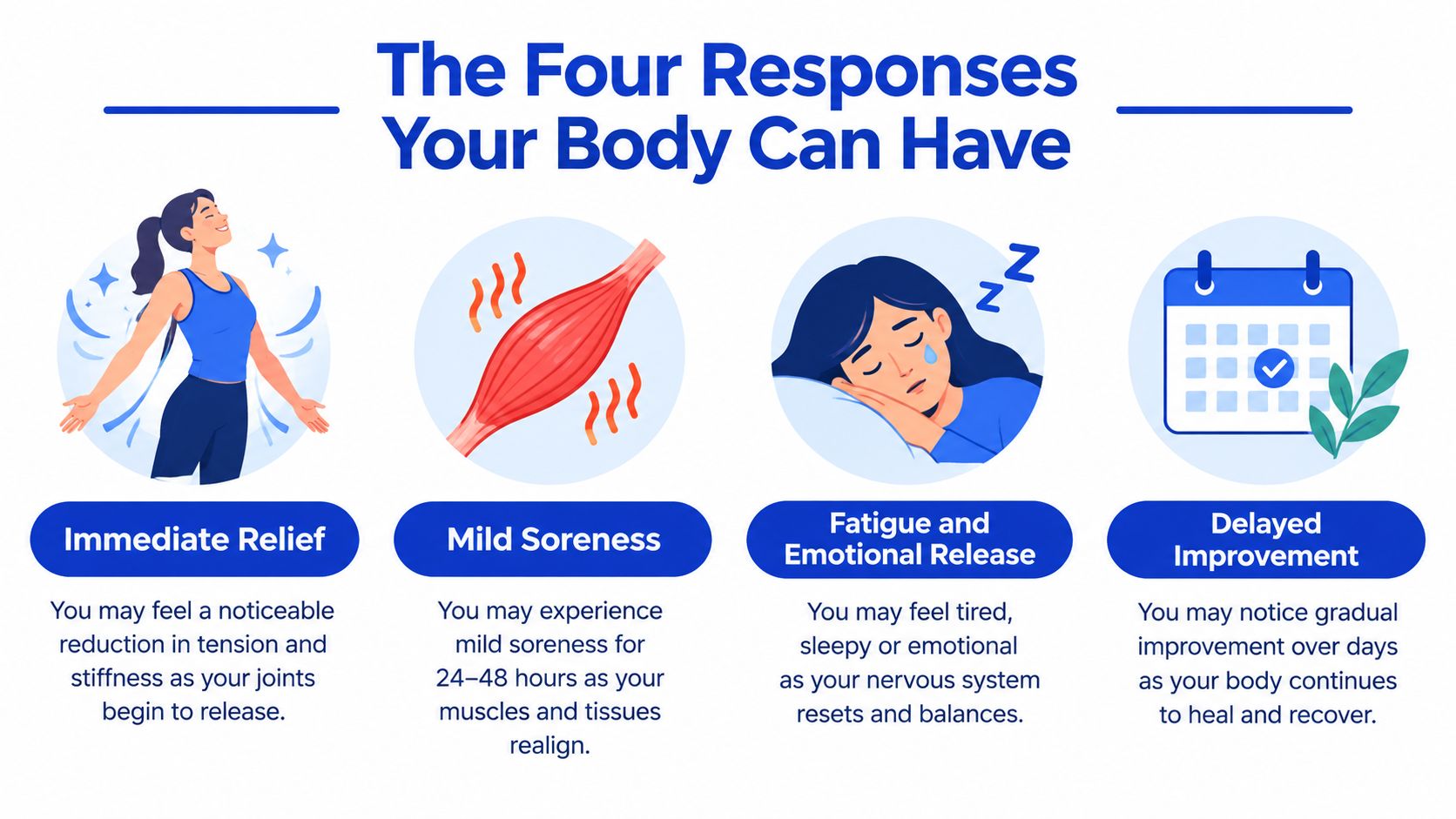
Immediate relief
Pain may reduce quickly, breathing may feel easier, or a stiff joint may move more freely. Reduced protective muscle guarding can make movement feel less restricted. Some patients also feel emotionally lighter when a familiar physical burden eases.
Delayed-onset soreness
A dull, generalised ache may appear later, similar to tenderness after unfamiliar exercise. Mild soreness during the first 24 to 48 hours is generally expected. Temporary soreness, stiffness, tiredness, or increased sensitivity usually settles within 24 to 72 hours, according to Healthdirect guidance.
Reduce strain while the treated tissues settle. Gentle ordinary movement is usually more suitable than forcing stretches into discomfort. Soreness should remain manageable and gradually become less intrusive. Sharp, escalating, or severe pain needs a follow-up call rather than further self-treatment.
Fatigue
Heavy limbs, sleepiness, or reduced interest in activity can follow treatment. Your nervous system may be shifting away from a guarded, high-alert state, while your body settles after hands-on work. Keep the rest of the day simple where possible, particularly after a first appointment.
Emotional release
Some people notice unexpected tearfulness, light-headedness, vivid dreams, or unusual emotional openness. Changes in physical guarding can feel emotionally noticeable because bodily tension and autonomic state are connected. Contact your practitioner if the reaction feels intense, persists, or worries you. You do not need to interpret it alone.
The technique used, your condition, and your baseline sensitivity all influence the response. This soft-tissue mobilisation techniques guide illustrates approaches that may contribute to different post-treatment sensations. Some patients experience one response, while others notice a combination.

Your First 72 Hours After Treatment
The most useful way to monitor recovery is to divide it into checkpoints. Don't expect a perfectly straight line. Symptoms can fluctuate during the day while still moving in a favourable direction overall.
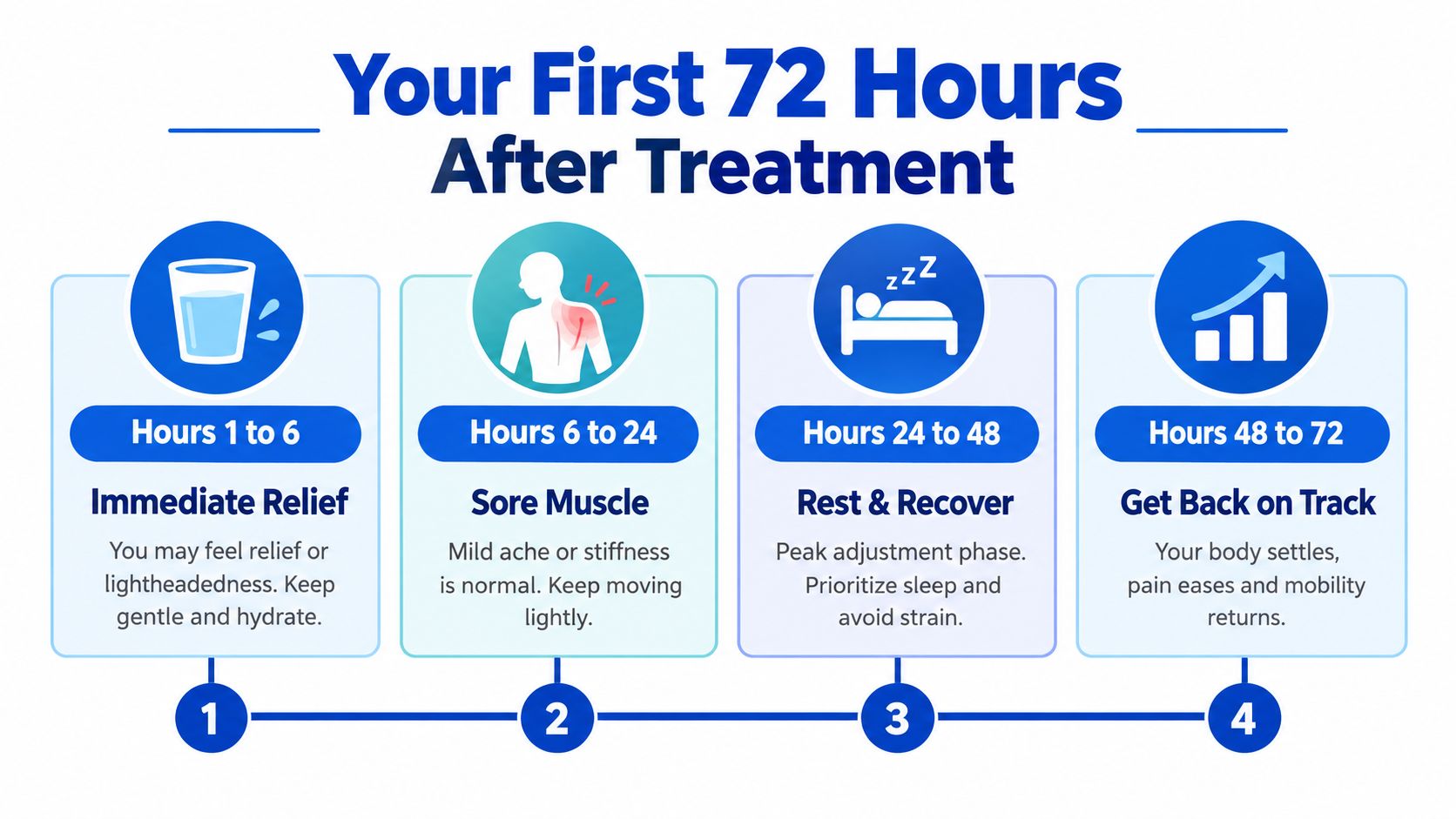
Hours 1 to 6
You may notice immediate relief, a looser treated area, or mild light-headedness. Keep movement gentle and drink regularly. A short walk is usually more useful than repeatedly bending, twisting, or stretching to see how far you can go.
Check-in question: Does the treated area feel at least slightly freer or calmer than it did before the appointment?
Hours 6 to 24
Some people feel relatively good at first and notice fatigue or a mild ache later in the day. Continue ordinary light activity, but avoid turning the evening into a test of strength. If you work at a desk, change position regularly instead of staying seated for a long uninterrupted period.
Check-in question: Is the discomfort mild and predictable, or is it becoming sharper and more difficult to control?
Hours 24 to 48
This is the period when delayed soreness may be most noticeable. Rest from demanding activity, sleep adequately, and use a comfortable heat source if your osteopath has recommended it and heat feels soothing. Don't force mobility through a rising pain response.
Check-in question: Is the soreness stable or beginning to ease, rather than continuing to build?
Hours 48 to 72
A normal adjustment response should start to taper. Reassess the original complaint without expecting complete resolution. The treated area may be clearly improved, unchanged, or slightly worse, and those patterns need to be interpreted alongside the quality and spread of the symptoms.
Check-in question: Is the pain localising and settling, or is it spreading beyond the treated region?
Your answers determine which home-care choices make sense. Gentle activity may help one person, while a quieter evening and earlier sleep may suit another. The next checklist gives you a practical way to choose without overreacting to every sensation.
What to Do and What to Skip at Home
The first 48 hours are a time for supportive habits, not rigid rules. Your osteopath's instructions take priority, particularly if you have an injury, inflammatory condition, neurological symptoms, or another health issue that changes how you should manage activity.
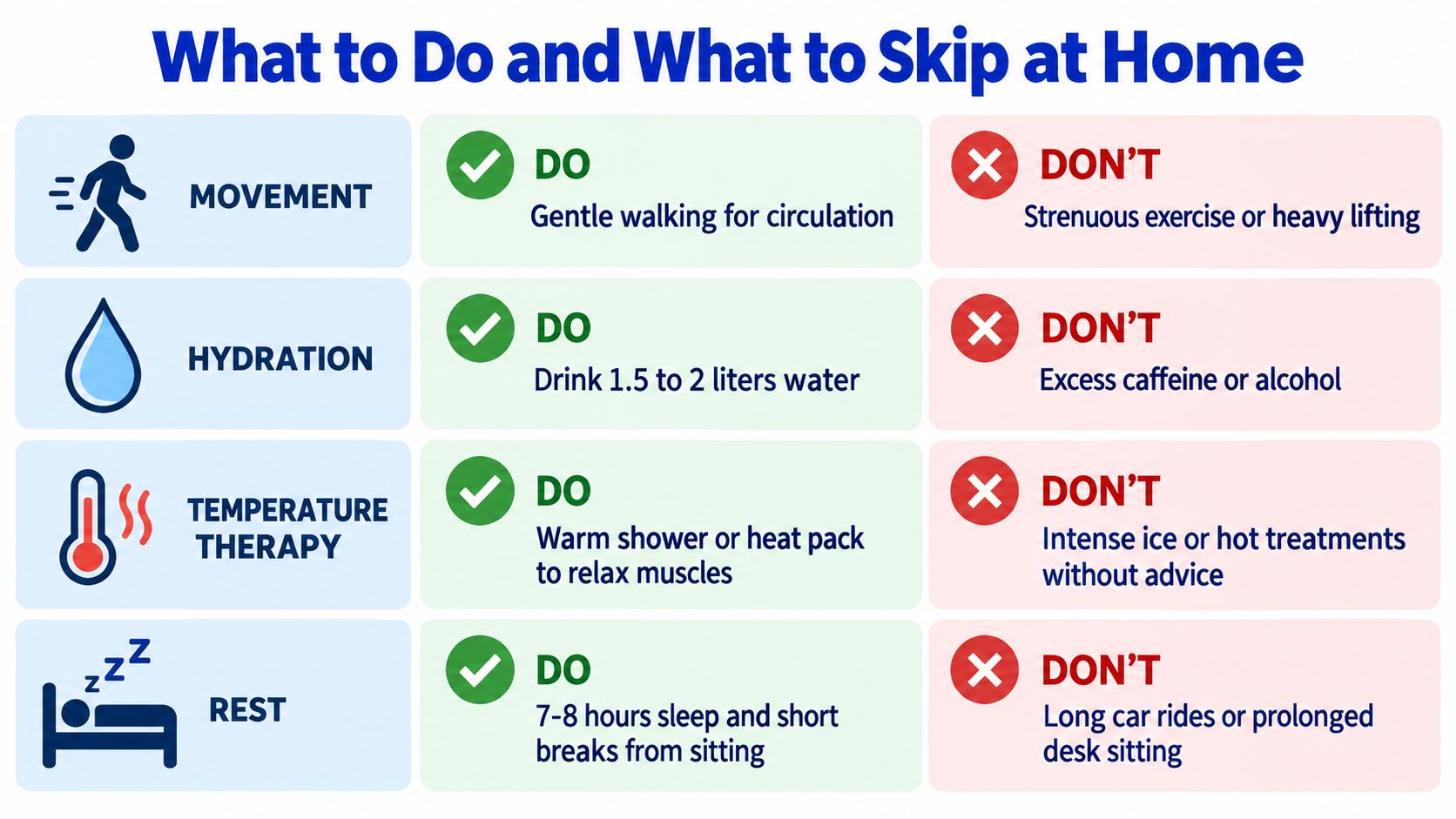
- Move gently: Walk, change positions, and use only light stretching that stays comfortable. Gentle movement can prevent you from becoming more guarded.
- Skip strenuous loading: Avoid heavy lifting, hard gym sessions, intense sport, and forceful stretching for the period your practitioner advised, often 24 to 48 hours for a first treatment.
- Drink regularly: Keep fluids available and drink consistently through the day. This supports normal hydration while your body settles after soft-tissue work.
- Don't use water as a cure-all: Extra fluid won't override poor sleep, excessive exercise, or a treatment reaction that's getting worse.
- Choose warmth for guarding: A warm shower or comfortable heat pack may relax tight muscles when heat feels helpful. Keep the temperature tolerable and avoid sleeping on an active heat pack.
- Use ice selectively: Ice may be appropriate for an inflamed or recently injured joint, but it isn't automatically better for ordinary post-treatment soreness. Ask your osteopath if you're unsure.
- Protect your sleep: Take short breaks from sitting and make the evening easier if fatigue appears. Long car trips and prolonged desk work can keep an irritated area loaded.
- Don't stay completely still: Total bed rest can increase stiffness and make it harder to judge whether ordinary movement is helping.
If your usual routine involves prolonged sitting, this posture and corporate ergonomics resource may help you adapt your workstation without turning posture into another source of tension.

When Soreness Stops Being Normal
Mild tenderness that resembles your original complaint can be expected during the early recovery window. It should remain manageable and begin to settle rather than intensify without a clear reason. The most useful rule is simple:
If symptoms are getting worse at 72 hours, call your osteopath.
Soreness that becomes stronger after the 24 to 72-hour period, spreads well beyond the treated area, or changes from a dull ache into sharp or shooting pain deserves follow-up. Increasing swelling is also a reason to contact the clinic, particularly when it doesn't match the expected response explained at your appointment.
Red flags need prompt attention
Contact your treating clinician if you develop:
- Sharp or shooting pain: This differs from a broad, exercise-like ache and may indicate irritation that needs assessment.
- Increasing swelling: Swelling that continues to grow rather than settle should be reviewed.
- Worsening headache or dizziness: Don't dismiss a new or escalating head symptom after treatment.
- New neurological changes: Numbness, marked weakness, altered coordination, or other new nerve-related symptoms warrant clinical advice.
- Loss of bowel or bladder control: Seek urgent medical attention rather than waiting for a routine follow-up.
Australian national survey data found adverse events among osteopathy users were uncommon, with 4 of 51 users reporting reactions including increased pain, soreness, tiredness, and neck cracking (Australian complementary therapy survey). That context is reassuring, but it doesn't replace individual assessment. A low rate in population data doesn't mean you should ignore a symptom that is severe, spreading, or progressively worsening.
Planning Your Next Visit
Follow-up timing should match the problem, the response to treatment, and the plan agreed with your osteopath. An acute presentation may need a review within several days, while a chronic or maintenance plan may leave more space between appointments. There isn't one correct schedule for every patient, and booking repeated treatment without reassessment isn't a substitute for a clear clinical plan.
At a follow-up, the practitioner is looking for change rather than repeating the previous session. They may reassess:
- Range of motion: Can you turn, bend, reach, or walk with less restriction?
- Symptom behaviour: Has the pain changed in intensity, location, timing, or triggers?
- Daily function: Are you sleeping more comfortably, sitting through work, or moving around home with less effort?
- Compensation: Has another area started working harder because the original region is moving differently?
Signs that recovery is on track
Improvement may be subtle. You might sit through a meeting without the familiar mid-back ache, wake with less stiffness, take a longer walk before symptoms appear, or recover more quickly after ordinary activity. These functional markers often tell you more than repeatedly rating pain in isolation.
If the original complaint is steadily improving, home exercises feel manageable, and no new concern has appeared, keep the planned review. Book sooner if symptoms return sharply, your function declines, the post-treatment response hasn't settled, or you're unsure how to progress activity.
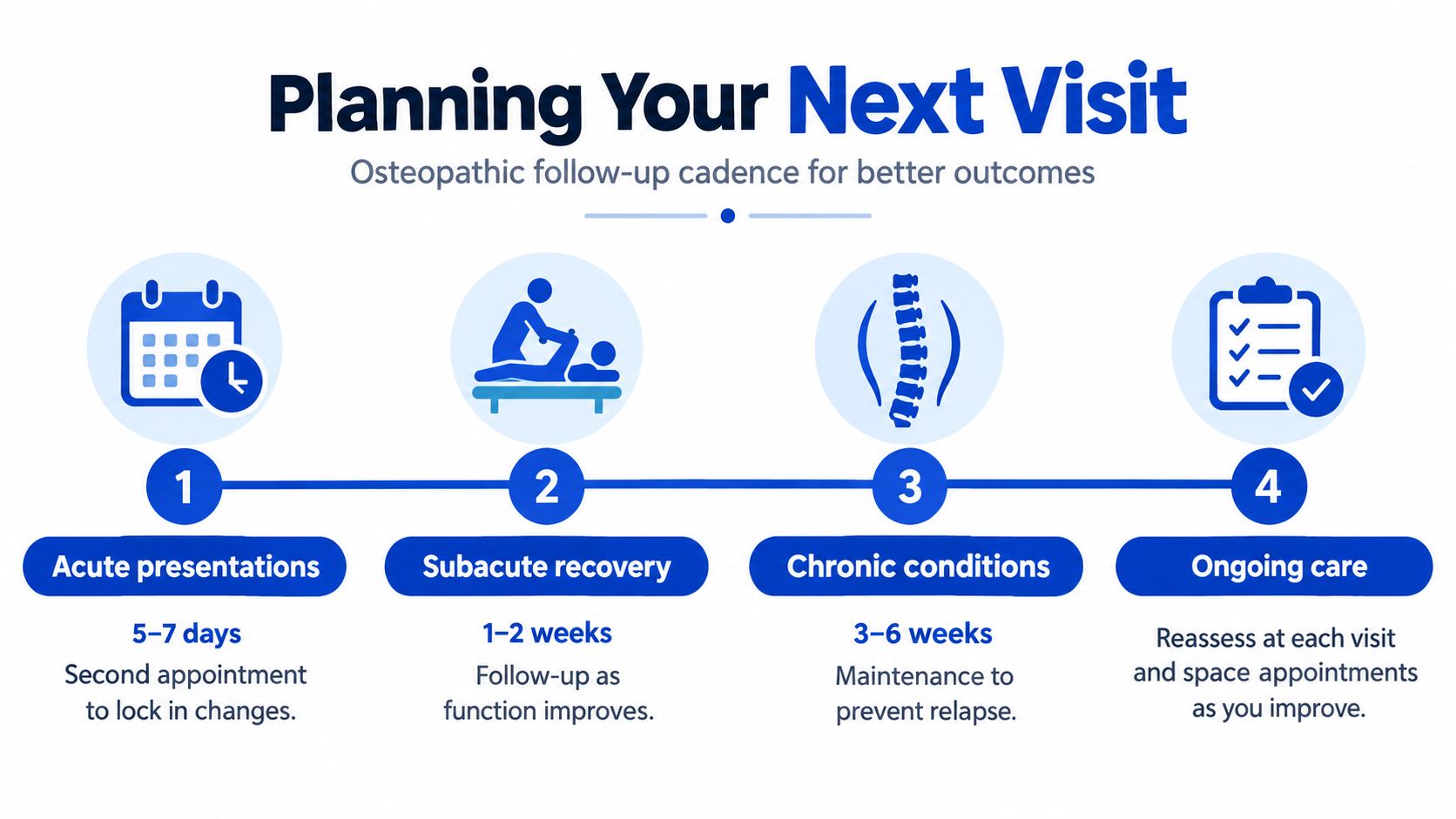
A follow-up should also refine your self-management plan. This rehabilitation and movement example reflects the broader principle, treatment works best when hands-on care and suitable activity support each other.

Medicare and Coverage After Your Visit
The amount you pay after an osteopathic appointment depends on the funding pathway. In Australia, Medicare generally does not cover osteopathy as a routine standalone service. A GP may arrange a Chronic Disease Management plan, which can provide access to up to five rebated allied health sessions per calendar year. A gap fee usually applies, and eligibility, referral paperwork, item codes, and rebate amounts must be confirmed for your circumstances.
Private health insurance commonly lists osteopathy under extras or ancillary services. Your policy may set an annual limit, a per-session cap, a waiting period, or provider requirements. Ask the insurer whether osteopathy is included and how much of the consultation fee may be claimable.
WorkCover, the Transport Accident Commission, and Department of Veterans' Affairs pathways may contribute when treatment relates to an accepted claim or eligible health-care arrangement. Approval and referral rules differ between schemes. Clinic administration should confirm the process before you book a course of visits.
| Coverage pathway | Typical session limit | Referral needed | Out-of-pocket expectation |
|---|---|---|---|
| Medicare through a GP-arranged Chronic Disease Management plan | Up to five rebated allied health sessions per calendar year | GP plan and referral requirements apply | A gap fee usually applies |
| Private health insurance extras | Depends on the policy's annual and per-session limits | Commonly no GP referral, but check the policy | Usually a co-payment after the insurer's benefit |
| WorkCover or Transport Accident Commission | Depends on claim approval and the treatment plan | Claim and insurer requirements may apply | May vary, including possible claim-related fees |
| Department of Veterans' Affairs | Depends on eligibility and approval | Referral or authorisation may be required | Confirm with the clinic and DVA pathway |
Before arranging follow-up care, ask the clinic for the consultation fee, applicable item code, referral requirements, and likely rebate. Confirm those details with your insurer, GP, claims manager, or DVA contact when relevant. Clear information lets you plan treatment around both clinical need and affordability.
Putting It All Together
Aftercare isn't a passive waiting period. It's a short partnership between you and the practitioner, where your observations help determine whether treatment should be continued, adjusted, or reviewed by another health professional.
The four common responses provide a useful map. Immediate relief may show up as easier movement or reduced guarding soon after the appointment. Delayed soreness can feel like a broad, dull ache while the body adapts. Fatigue may make the rest of the day feel slower, and emotional release can appear as unexpected tearfulness, light-headedness, or altered sleep experiences. None of these responses proves that treatment is working, and none automatically means something has gone wrong.
Use the timeline, not a single sensation
During the first six hours, stay gentle and observe whether the treated area feels freer or calmer. Between six and 24 hours, notice whether an ache remains mild and predictable. The 24 to 48-hour period may bring the most noticeable soreness, while the 48 to 72-hour window should show whether the reaction is tapering.
The most important distinction is direction. A normal response generally stays manageable and begins to settle within 24 to 72 hours. A response that intensifies at 72 hours, spreads beyond the treated area, becomes sharp or shooting, or arrives with neurological symptoms needs a call to the clinic. Loss of bowel or bladder control requires urgent medical attention.
Your job isn't to diagnose the reaction. Your job is to notice its pattern and report meaningful changes clearly.
Write down what changed, when it changed, and what activities affected it. “My back hurt more” is less useful than “the ache began that evening, stayed local, improved after warmth, and was easing the next morning.” That detail helps the osteopath decide whether to modify technique, change the home plan, alter the appointment timing, or recommend medical review.
Schedules, exercises, work habits, and coverage decisions should be discussed with your treating osteopath rather than improvised from a generic online checklist. The right plan may involve gentle movement, a quieter recovery period, a different treatment approach, or referral when the symptoms don't fit an expected musculoskeletal response.
Bayside Osteopathic Health provides gentle, hands-on osteopathic care for back, neck, joint, postural, and mobility concerns, with movement and home-care advice to support the hours between visits. Visit Bayside Osteopathic Health to discuss your symptoms, treatment plan, follow-up timing, and available Medicare options with the clinic team.