
You're probably reading this with at least one familiar annoyance in the background. A tight neck after a morning on the laptop. A sore lower back after unloading stock. A wrist that feels fine at breakfast and grumbles by mid-afternoon. Many treat those signs as normal wear and tear. They're not. They're usually your body's way of telling you that your work setup, movement pattern, or recovery routine needs attention.
From an osteopathic perspective, workplace injury prevention starts well before anyone fills out an incident form. It starts with how your joints move, how your muscles share load, how often you change position, and whether your job asks your body to repeat the same stress without enough support. Good prevention is practical. It's about changing the task, the tools, the layout, and your habits so your body doesn't have to absorb avoidable strain.
Table of Contents
- Rethinking Safety Beyond Just Being Careful
- Creating an Ergonomic Workspace for Desk Workers
- Mastering Safe Manual Handling for Physical Roles
- Building Daily Routines for a Resilient Body
- Your Role in Workplace Policies and Injury Reporting
- When to Seek Help A Guide to Osteopathic Care in Bayside
Rethinking Safety Beyond Just Being Careful
“Be careful” sounds sensible, but it's incomplete advice. If a desk forces you to hunch, if a storeroom layout makes you twist, or if a trolley wheel sticks every day, caution alone won't solve the problem. Your body will still pay for the setup.
That's why effective workplace injury prevention has shifted away from blaming individuals for every ache and toward improving the system around them. Australia's harmonised WHS approach around 2011 helped build a more consistent prevention framework across states and territories, and by 2023 the worker fatality rate was 1.5 deaths per 100,000 workers according to Safe Work Australia historical context referenced here. The useful takeaway isn't just the number. It's the pattern. Stronger regulation, risk management, and hazard control work better than reminders to “watch out”.
Practical rule: If the same job keeps irritating the same body part, assume the system needs changing before you assume the person needs more discipline.
In clinic, I often see people who know the “right” thing to do but still hurt. They know not to slouch. They know not to twist under load. They know they should take breaks. But knowledge doesn't help much when the laptop is too low, the work pace is rushed, or the task repeats for hours without variation.
From a musculoskeletal point of view, prevention works best when it reduces unnecessary load at the source. That might mean better screen height, improved lifting flow, a different shelf position, a trolley instead of carrying, or shorter bursts of repetitive work. Training still has a place, but it shouldn't be the first or only line of defence.
Creating an Ergonomic Workspace for Desk Workers
Desk work looks low risk until you add up the hours. A poor workstation doesn't usually create one dramatic injury. It creates repeated low-level strain through the neck, shoulders, wrists, mid-back, hips, and lower back. Over time, those small loads become the ache you notice every afternoon.
Evidence points in the same direction many clinicians see in practice. Multi-level interventions, including engineering controls such as ergonomic adjustments, are more effective than behavioural approaches like training alone, as discussed in this review of workplace prevention approaches. For desk workers, that means changing the setup is often more valuable than telling yourself to sit straighter.
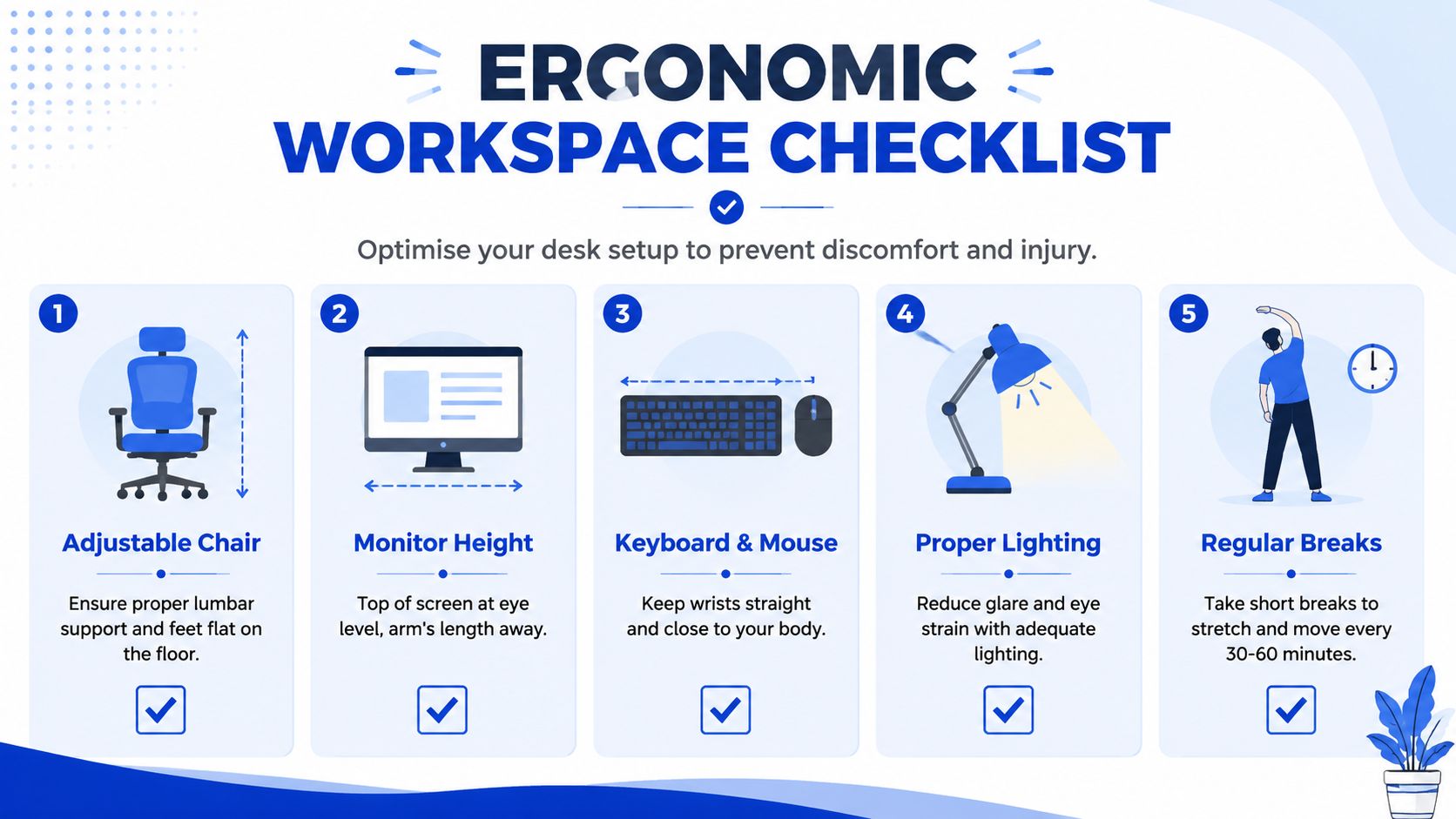
A quick visual checklist helps if you're adjusting your space today.
Start with the chair and the floor
Your chair is the base of the whole setup. Adjust it so your feet are flat on the floor. If they're dangling, use a footrest or a stable box. This gives your pelvis a more supported position and reduces the tendency to perch forward or collapse through the lower back.
The seat height should let your knees rest comfortably without pressure building at the front edge of the chair. Then check lumbar support. You want gentle support in the natural curve of your lower back, not a hard push that forces you rigidly upright.
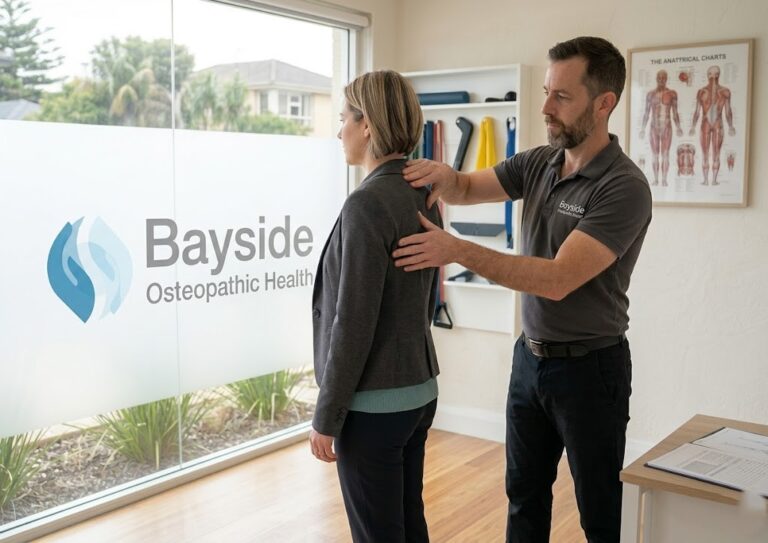
If you need a visual example of a desk posture setup, this corporate ergonomics image from Bayside Osteopathic Health shows the kind of neutral alignment generally recommended.
Set the screen and input tools to reduce reach and strain
Next, fix what your upper body is doing all day.
| Workstation element | What to check | Why it matters |
|---|---|---|
| Monitor | Top of screen near eye level, screen roughly an arm's length away | Reduces forward head posture and constant neck flexion |
| Keyboard | Close enough that elbows stay near your sides | Stops reaching and shoulder tension |
| Mouse | Beside the keyboard, not stretched away | Reduces load through the shoulder and wrist |
| Lighting | Enough light without screen glare | Helps prevent leaning forward and squinting |
Laptop-only work is one of the most common troublemakers. If you use a laptop for long stretches, add a separate keyboard and mouse and raise the screen. The problem isn't the laptop itself. It's the combined posture of looking down while your hands stay too high and too close.
A short demonstration can help you fine-tune the basics.
Make the setup usable in real life
A workstation isn't “ergonomic” if it only works when you remember perfect posture. It needs to support you on normal days, busy days, and tired days.
Use these checks:
- Place high-use items close: Keep your phone, notebook, water bottle, and documents within easy reach. Repeated small reaches matter.
- Centre the main screen: If you work from two monitors but use one far more often, place the main one directly in front of you.
- Build in posture changes: Sitting well helps, but staying in one position too long still stiffens the body.
- Reduce desk clutter: Twisting around coffee cups, chargers, and paperwork creates awkward movement you don't notice until your shoulder does.
Your best desk posture is the one you can maintain comfortably, then change regularly.
Mastering Safe Manual Handling for Physical Roles
For physically demanding work, the body isn't just present at work. It's the tool doing the work. Lifting, carrying, pushing, pulling, kneeling, reaching overhead, and repeating the same movement can all overload tissues if the job design is poor or the technique breaks down under fatigue.
Good manual handling starts before the object leaves the ground. A sound prevention plan uses a closed-loop process. Identify hazards through task observation, rank them by risk, implement controls, and then verify whether those controls work, as outlined in this strategic approach to injury prevention planning. That matters because the core problem is often the workflow, not just the lift itself.
Assess before you lift
Before you move anything, pause for a real assessment.
Ask yourself:
- What's the shape? Bulky or awkward objects create more strain than stable compact ones.
- Where am I taking it? A clear path matters as much as the pickup.
- Can I keep it close? Load held away from the body increases demand on the back and shoulders.
- Should this be pushed, carried, split, or moved with equipment instead? The safest lift is often the one you redesign.
If the item is unstable, the path is cluttered, or the destination requires twisting into a corner, fix that first. Workers often focus on “lifting properly” while ignoring the shelf height, poor grip points, rushed pace, or bad trolley access that creates the injury risk.
Use the brace and hinge pattern
For many everyday lifts, a useful cue is brace, hinge, lift, and turn with the feet.
- Brace: Gently tighten your trunk before the lift. Think of preparing your torso to stay steady, not sucking in your stomach.
- Hinge at the hips: Bend through the hips and knees instead of rounding through the spine to reach the load.
- Keep the object close: The further away it drifts, the harder your back and shoulders work.
- Drive through the legs: Let the larger muscles of the hips and legs do the heavy work.
- Pivot rather than twist: If you need to change direction, move your feet.
Here's where people often go wrong. They start in a good position, then lose it halfway through the job. The box is set too low in the trolley, the bag shifts, the shelf is off to one side, or they rush the final placement. Most strains happen in these messy middle moments, not during the idealised textbook lift.
Fix the task, not just the worker
From an osteopathic viewpoint, repeated manual work often creates predictable patterns. Tight hip flexors, overworked lower back muscles, irritated shoulders, and stiff mid-backs are common because the body keeps compensating around the same task.
The better prevention questions are practical:
- Could the load be broken into smaller parts?
- Could shelf height be changed to reduce floor-level lifting?
- Could a trolley, pallet jack, slide sheet, or team lift remove unnecessary strain?
- Could repetitive jobs be rotated to avoid hammering the same tissues all shift?
Pushing is usually kinder on the body than pulling because you can use your body weight and keep the load more controlled.
PPE still matters in the right setting, but it doesn't correct a poor layout or a bad sequence of movement. If the job keeps producing the same sore back or shoulder in multiple workers, the job needs redesign.
Building Daily Routines for a Resilient Body
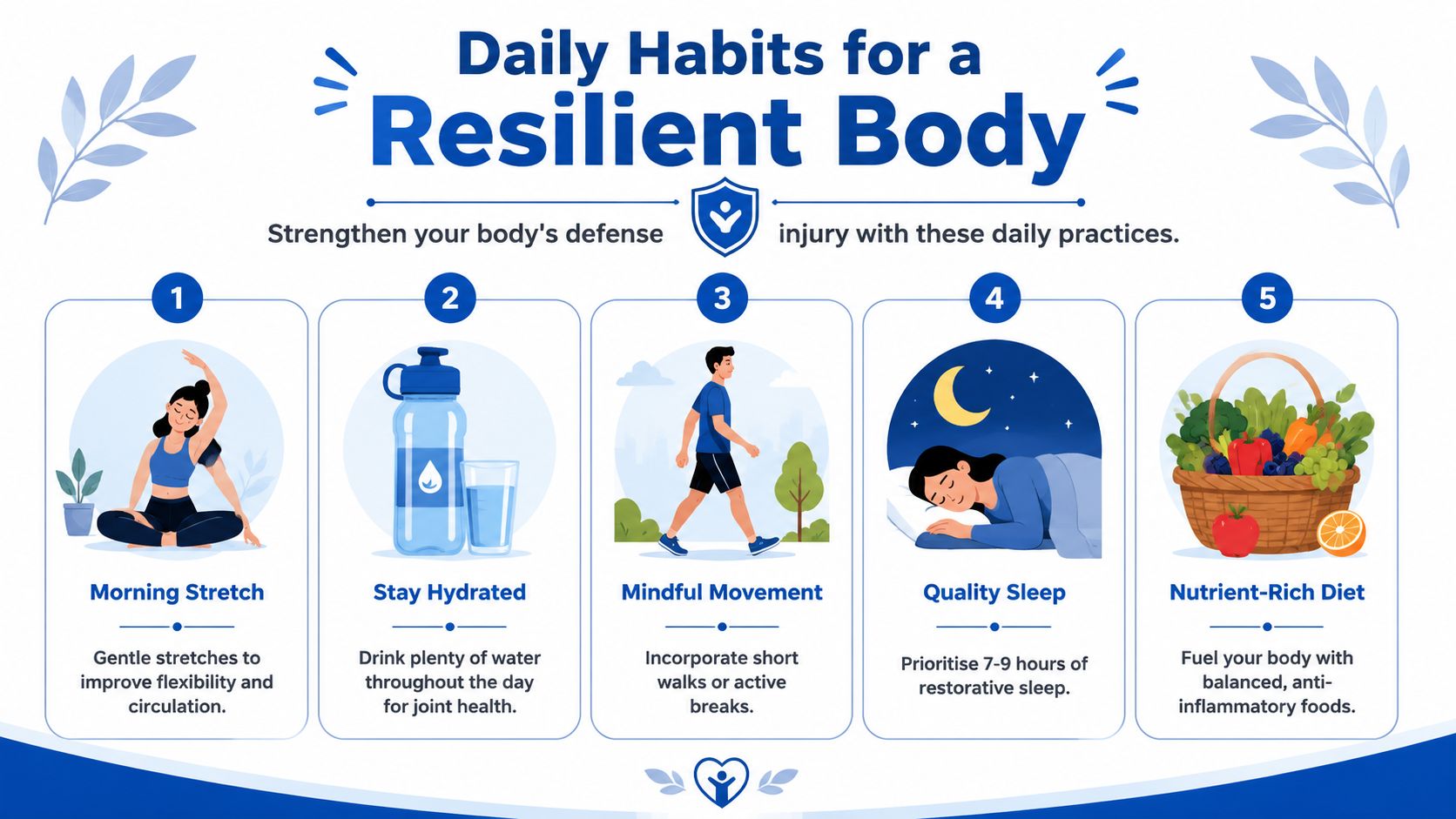
A safer work life isn't built only by chairs, checklists, or lifting drills. It's built by what you do between tasks and after the strain starts to whisper. Small daily habits are what stop a manageable irritation becoming a recurring problem.
Many people overcomplicate things. They think prevention requires long workouts, perfect posture, or a complete lifestyle overhaul. It usually doesn't. What works better is regular, realistic input that keeps joints moving, muscles sharing load, and fatigue from accumulating unnoticed.
Why small movement beats occasional effort
Your body likes variety more than intensity. If you sit for long blocks, stand up before you feel welded to the chair. If you stand all day, unload that posture with brief walking, calf movement, or a change in stance. If your job is repetitive, use your breaks to move in the opposite direction.
A practical support tool can help if you're rebuilding strength or mobility. This rehabilitation exercise image from Bayside Osteopathic Health reflects the kind of guided movement work many people benefit from when they've been stiff or sore for a while.

The daily aim is simple. Interrupt stiffness early. Once muscles fatigue and joints stiffen, your body starts borrowing movement from the wrong places. That's when the neck compensates for the upper back, the lower back compensates for the hips, and the shoulder compensates for the rib cage.
A simple workday reset
Try this short routine during the day:
- Neck reset: Gently draw your chin back to stack your head over your shoulders.
- Shoulder opener: Roll the shoulders up, back, and down, then lightly squeeze the shoulder blades.
- Chest stretch: Open the front of the chest, especially after computer work.
- Spinal extension: Stand and place hands on hips, then gently extend backward if comfortable.
- Hip and calf movement: Walk briefly, do a few calf raises, or shift through a small squat.
Hydration matters too. So does sleep. So does not treating pain as a test of character. If your body is under-recovered, your movement quality usually drops before your motivation does.
A resilient body isn't the one that never gets sore. It's the one that gets warning signs early and responds well.
Your Role in Workplace Policies and Injury Reporting
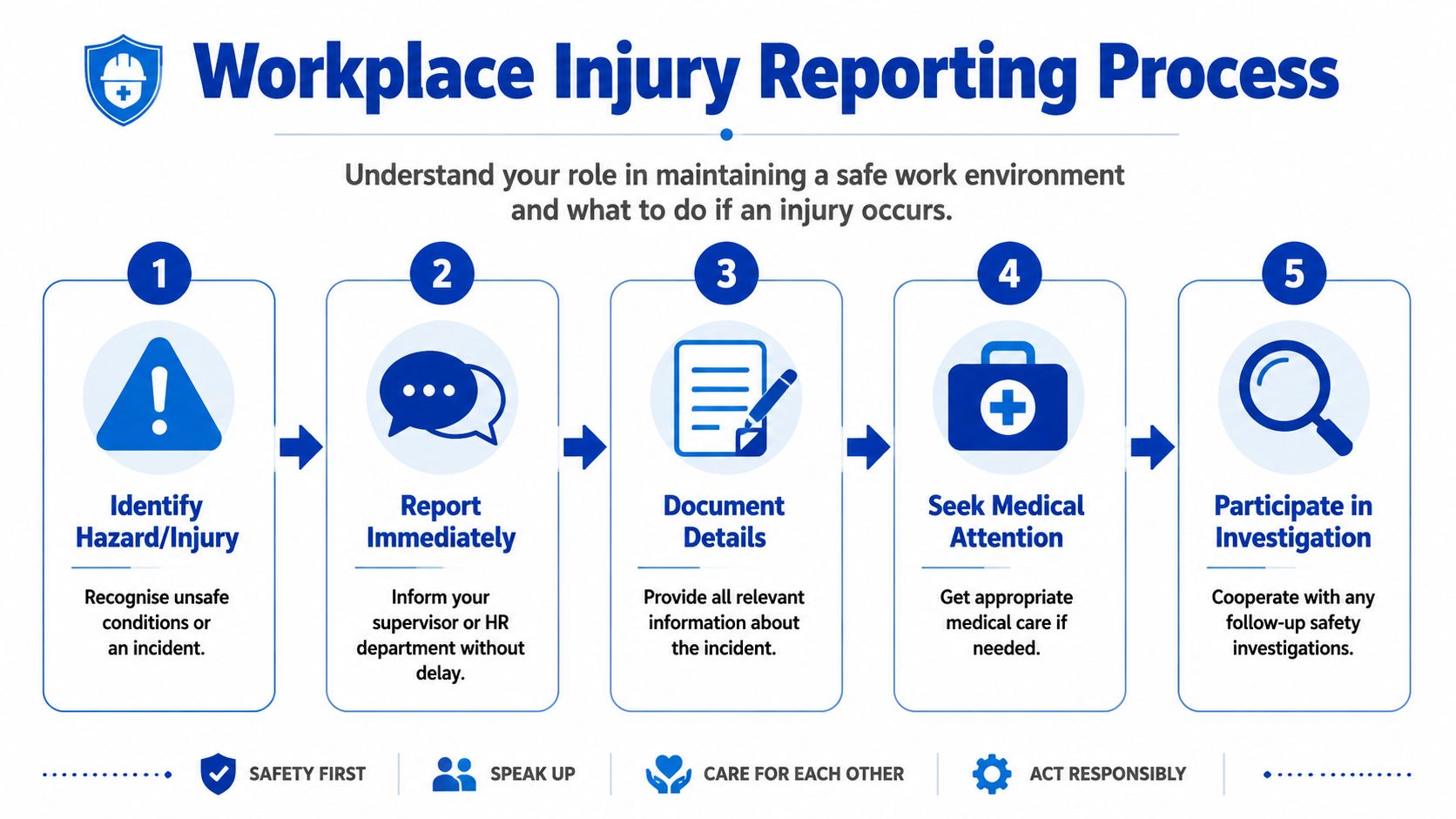
People sometimes treat reporting as paperwork after the incident. In practice, reporting is part of prevention. It's how workplaces notice patterns, fix hazards, and reduce the chance that a small issue becomes a larger injury.
That includes near misses. If a box nearly slips, a cable nearly trips someone, or a workstation regularly causes discomfort before anyone lodges a formal complaint, that information is valuable. It shows where the system is weak.
Why near misses matter
A near miss is often the last warning before an injury. Reporting it isn't overreacting. It's useful hazard data.
For workers, near-miss reporting helps answer practical questions:
| Situation | What reporting can reveal |
|---|---|
| Repeated slips or stumbles | Flooring, spills, footwear issues, poor housekeeping |
| Same body area getting sore | Awkward layout, repetitive strain, poor equipment position |
| Object almost dropped | Grip, storage height, packaging, load stability |
| Late-shift mistakes | Fatigue, staffing flow, unrealistic pace |
This is one area where tone matters. Reporting should be framed as contribution, not complaint. The point is to improve the task and protect the next person, not to assign blame.
What good reporting looks like
Best practice in workplace injury management includes immediate care, securing the scene, notifying supervisors, documenting what happened, investigating the cause, and creating a return-to-work plan where needed. Delayed or incomplete reporting is a major pitfall because it weakens root-cause analysis, as outlined in this seven-step workplace injury management guide.
A useful worker checklist is:
- Report promptly: Tell the right person as soon as possible, even if the injury seems minor.
- Be specific: Record who was involved, what happened, where it happened, and what you were doing.
- Note early symptoms: Don't wait until stiffness becomes lost time.
- Take part in follow-up: Your account helps identify what needs changing.
Reporting supports recovery too
Reporting isn't only about prevention before injury. It also improves the response after one. When documentation is accurate and early, workplaces can investigate properly, organise suitable duties, and support safer return to work.
The same source also notes that a systematic review compiling 100 studies found workplace safety interventions can reduce accidents and injuries. That fits what clinicians see regularly. Early action tends to keep minor issues minor. Delayed action gives them time to settle in.
When to Seek Help A Guide to Osteopathic Care in Bayside
Some aches improve once you adjust your desk, tidy the workflow, or change how you lift. Others don't. They linger, return, spread, or start interfering with sleep, exercise, driving, or concentration. That's usually the point where self-management needs backup.
From an osteopathic perspective, persistent work-related pain rarely comes from one isolated spot alone. The sore shoulder might connect to upper back stiffness and poor rib movement. The lower back pain might be driven by hip restriction, repeated bending mechanics, or a desk setup that keeps the pelvis tucked under all day. Hands-on assessment is useful because it looks at how the body is sharing load, not just where it hurts.
Signs self-management isn't enough
It's sensible to get professional help if any of these apply:
- Pain keeps returning: You improve for a few days, then the same problem flares again with normal work.
- Symptoms are spreading: Neck pain starts referring into the shoulder, or back pain starts affecting movement elsewhere.
- Rest isn't changing much: A lighter weekend doesn't settle it.
- Sleep or concentration is affected: Pain that follows you out of work usually needs a more direct plan.
- You're avoiding normal tasks: You've started changing how you drive, carry bags, exercise, or get dressed because of discomfort.
Those signs don't mean something dramatic is wrong. They do mean your body probably needs more than generic advice.
What an osteopathic assessment adds
Osteopathic care looks at the way your whole musculoskeletal system is functioning. A consultation usually involves discussing the pattern of symptoms, the demands of your job, and the movements or postures that aggravate things most. Then the assessment looks at joints, muscle tone, flexibility, movement control, and how different body regions are interacting.
Treatment may include gentle hands-on work such as soft tissue techniques, articulation, and mobilisation, alongside practical changes you can use at work and home. The point isn't to make you dependent on treatment. It's to reduce irritation, restore movement, and give you a clearer path back to comfortable activity.
A broader prevention view supports that early intervention matters. As noted earlier in the article's reporting section, a systematic review covering 100 studies found well-designed workplace safety interventions reduce accidents and injuries. In real life, seeking care for early symptoms is often part of that wider prevention picture.
If pain is changing how you move, your body is already adapting. Early care helps stop that adaptation becoming your new normal.
Medicare and local support
For some people with chronic conditions, there may be a pathway to allied health support through Medicare under a Chronic Disease Management plan, depending on eligibility and your GP's assessment. If you're trying to understand that process, this Bayside guide to allied health care plans gives a helpful local overview.

If you live or work around Bayside, getting care close to home often makes a difference. It's easier to follow through with appointments, easier to adjust your routine early, and easier to build advice into your actual work week rather than leaving it as a good intention.
Workplace injury prevention is never just about avoiding disaster. It's about making daily life more sustainable. Less strain at the desk. Better mechanics on the floor. Fewer recurring flare-ups. More confidence in how your body handles work.
If work is leaving you with recurring back, neck, shoulder, or joint pain, Bayside Osteopathic Health offers gentle, hands-on osteopathic care for people across the Bayside community. The team focuses on the root causes behind postural strain, stiffness, and movement-related pain, with practical advice you can use at work and at home. If you'd like support with recovery, prevention, or guidance on Medicare options where applicable, it's a straightforward place to start.