

You've probably had this happen at the worst possible moment, a jar won't budge, your mouse hand feels sharp and grumpy, or your wrist starts tingling just as you're trying to finish work. You don't need dramatic treatment for that kind of problem, you need a clear sequence that calms the tissue down, restores load tolerance, and gets the wrist moving well again.
Wrist pain treatment works best when it's matched to the pattern of pain, not just the location. A 2022 systematic review reported that wrist or hand pain affects about 19.1% of adults and is the third most common work-related injury (review summary). That's why a sore wrist deserves proper attention, but usually not panic.
For many people, the answer is conservative care first, then targeted hands-on treatment, then a gradual return to loading. That order matters. If you skip straight to bracing or painkillers, you can miss the driver, whether that's tendon irritation, nerve compression, joint stiffness, or a recent strain that hasn't been assessed properly.
Table of Contents
- When Your Wrist Starts Running Your Day
- Understanding the Wrist as a Small Busy Bridge
- The Most Common Causes of Wrist Pain
- Conservative First-Line Treatment You Can Start Now
- How Osteopathic Treatment Helps the Wrist
- Targeted Exercises and Stretches You Can Do at Home
- Red Flags, Recovery Timelines, and When to Seek Help
- How Bayside Osteopathic Health Can Help
When Your Wrist Starts Running Your Day
You go to twist open a coffee jar, and that little jolt of pain makes you stop. Later, typing feels fine for ten minutes, then the wrist starts to throb, or the base of the thumb feels hot and tight. By the afternoon, even scrolling on your phone can make you notice it more than you'd like.
That's the point where people usually begin guessing. Some think it must be “just a strain”, others worry they've damaged something serious, and many try to ignore it until the wrist starts shaping their day around it.
The better starting point is simpler. Wrist pain is common, manageable, and often responds to conservative care when the load is sequenced properly. The main job is to work out what's irritated, what the wrist can still tolerate, and what needs to be reduced for a short time without freezing the joint completely.
Practical rule: if a movement is reliably sharp, keep the wrist active in the parts that stay comfortable, and reduce the load that keeps provoking it.
A person with desk pain, a new parent lifting a child, and a tennis player with thumb-side soreness don't need the same plan. The treatment has to fit the pattern, which is why the details matter more than the label.
Understanding the Wrist as a Small Busy Bridge
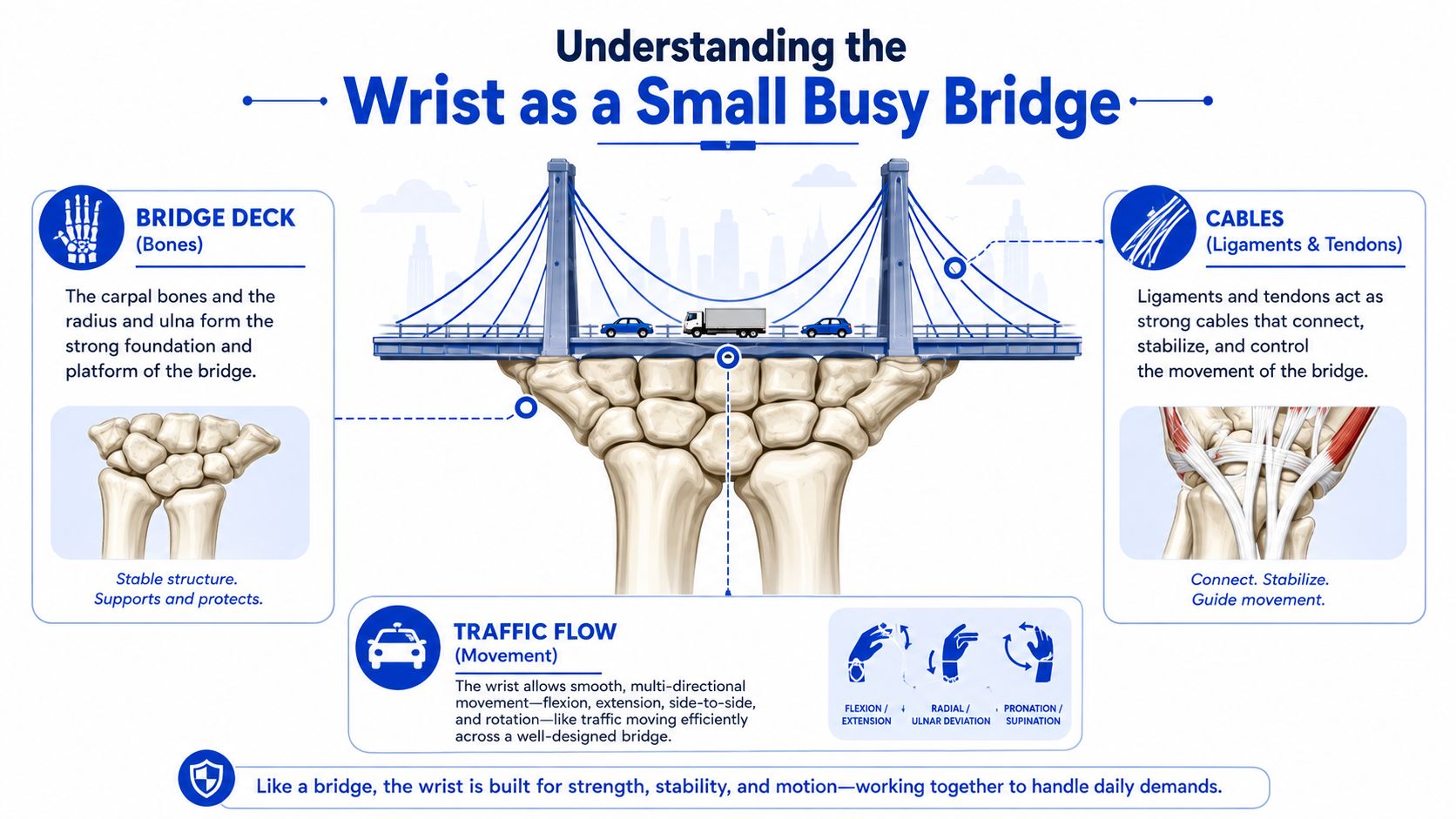
Think of the wrist like a small bridge with a lot of traffic. The carpal bones form the bridge deck, the ligaments help hold the structure together, and the tendons are the moving cables that let the fingers and thumb do their work. When the bridge is asked to carry more than it likes, or to hold awkward positions for too long, different parts start complaining in different ways.
The wrist is also crowded. The median nerve and ulnar nerve pass through narrow spaces, so swelling or awkward positioning can make them sensitive. That's why some wrist pain feels like aching, some feels stiff, and some brings tingling or numbness into the hand.
Why location matters
Pain on the palm side often points you towards structures that flex the wrist or pass through tight spaces. Pain on the back of the wrist is often more noticeable when you extend the wrist, lean on it, or do repeated loading. Thumb-side pain and little-finger-side pain can each suggest different tissues are involved, which helps a clinician decide whether the problem looks more like tendon irritation, joint irritation, nerve irritation, or a recent injury.
The important part is not to self-diagnose every detail with certainty. The point is to notice the pattern. If the wrist hurts only with gripping, that's different from pain with numbness, and both are different again from pain that started after a fall.
Pain location is useful, but it's only one clue. The load pattern, the onset, and the behaviour over the day usually tell the bigger story.
The Most Common Causes of Wrist Pain
The most useful way to think about wrist pain is by pattern, not by a long list of medical terms. Some wrists are grumbling because they've been overused. Others are complaining because a nerve is cramped, a joint is stiff, or an old injury never really settled.
Gradual overuse pain
This is the classic “it crept up on me” story. Typing, lifting, gripping tools, racket sports, and repetitive hand work can all irritate tendons and nearby tissues. People often notice aching, stiffness, or a weak grip that gets worse later in the day rather than all at once.
A prevalence review found a median short-term wrist-pain prevalence of 6% in the general population, 10% in physically demanding occupations, and 24% in sportspeople (prevalence review). That pattern makes sense in clinic, because workload changes how much the wrist has to absorb.
Nerve-related pain
If the wrist feels numb, tingly, or wakes you at night, nerves move higher on the list. Carpal tunnel syndrome is the best-known example, but the ulnar nerve can also become irritated, especially if the wrist is compressed, bent repeatedly, or kept in one position for too long.
Joint or injury-related pain
Pain that began after a twist, fall, or awkward lift may involve a sprain, a fracture, or an irritated joint. If the wrist feels stiff after previous injury, or painful with certain angles but not others, the joint surfaces or supporting structures may be driving the problem.
The key clue
The main question is not “What is the diagnosis?” right away. It's “What kind of behaviour does this pain have?” Pain that warms up, pain that spikes with gripping, pain that tingles at night, and pain that follows trauma all point in different directions.
Persistent, worsening, or unusual symptoms deserve a proper assessment, because self-diagnosis only goes so far.
Conservative First-Line Treatment You Can Start Now
A sore wrist often settles best when you change how much it has to do, rather than freezing it completely. Keep the joint moving through comfortable ranges, then trim back the actions that keep poking the sore area. If typing, lifting, or gym work brings on pain, lower the load, adjust the grip, or split the task into shorter blocks.
Desk work often needs small but specific changes. Keep the wrist closer to neutral on the keyboard and mouse, avoid letting the hand sit bent upward for long periods, and build in short pauses during repetitive work. That gives the tissues a chance to recover between bursts, instead of forcing them to absorb the same strain for hours. A useful visual reference for workstation setup is this posture and ergonomics resource.

What to try first
- Reduce the aggravator: shorten the task that triggers pain, then test it again later with less load.
- Use a night splint if the wrist is being bent during sleep: neutral positioning can reduce pressure on irritated tissues.
- Consider heat for stiffness, cold for a fresh flare: choose what eases the current symptom rather than following a rule blindly.
- Use pain relief carefully: over-the-counter options can help short-term comfort, but they don't fix the underlying load problem.
If the wrist is sore but still moves reasonably well, gentle movement usually helps more than keeping it still all day. A night splint can be useful for certain nerve or tendon problems, but long daytime immobilisation without a diagnosis can slow the recovery you are trying to get.
The aim is to give the wrist enough relief that it can start tolerating normal work again, while still asking it to do a little more each day.
How Osteopathic Treatment Helps the Wrist
A wrist that keeps flaring usually needs a broader check than the sore spot alone. The forearm, elbow, shoulder, neck, and upper back all influence how much force reaches the hand, so the assessment looks for the pattern behind the pain. That matters when the wrist has been rested but still keeps complaining once normal tasks return.
Hands-on treatment may include soft-tissue work, joint articulation, and gentle mobilisation around the wrist and the nearby chain of tissues. If protective tension or restricted movement is part of the picture, those techniques aim to reduce guarding and help the joint move more smoothly. In some cases, taping or dry needling may be considered, depending on the presentation and the clinician's assessment.

What a session usually feels like
You'll normally be asked how the pain started, what aggravates it, and whether there is numbness, loss of strength, or a past injury. Then the clinician checks movement, compares both sides, and may test areas above and below the wrist to see what else is contributing.
A splint or injection can still have a role in some cases, especially for nerve compression. For carpal tunnel syndrome, Australian guidance and evidence reviews support night-time neutral wrist splinting as an initial treatment because it reduces median nerve compression by avoiding excessive wrist flexion, and a review cited symptom relief of 79% at 6 weeks, 53% at 6 months, and 31% at 12 months after a single corticosteroid injection (carpal tunnel review). That is why conservative care usually comes first, and why injection is usually understood as short-term symptom control rather than a complete answer.
A practical treatment plan often combines local work, movement advice, and a home program. The hands-on treatment helps the wrist settle, the exercises rebuild tolerance, and the advice helps prevent the same flare-up from returning.
A supportive clinic approach like Bayside Osteopathic Health can fit into that model, especially when you want conservative care with clear exercise guidance.

Targeted Exercises and Stretches You Can Do at Home
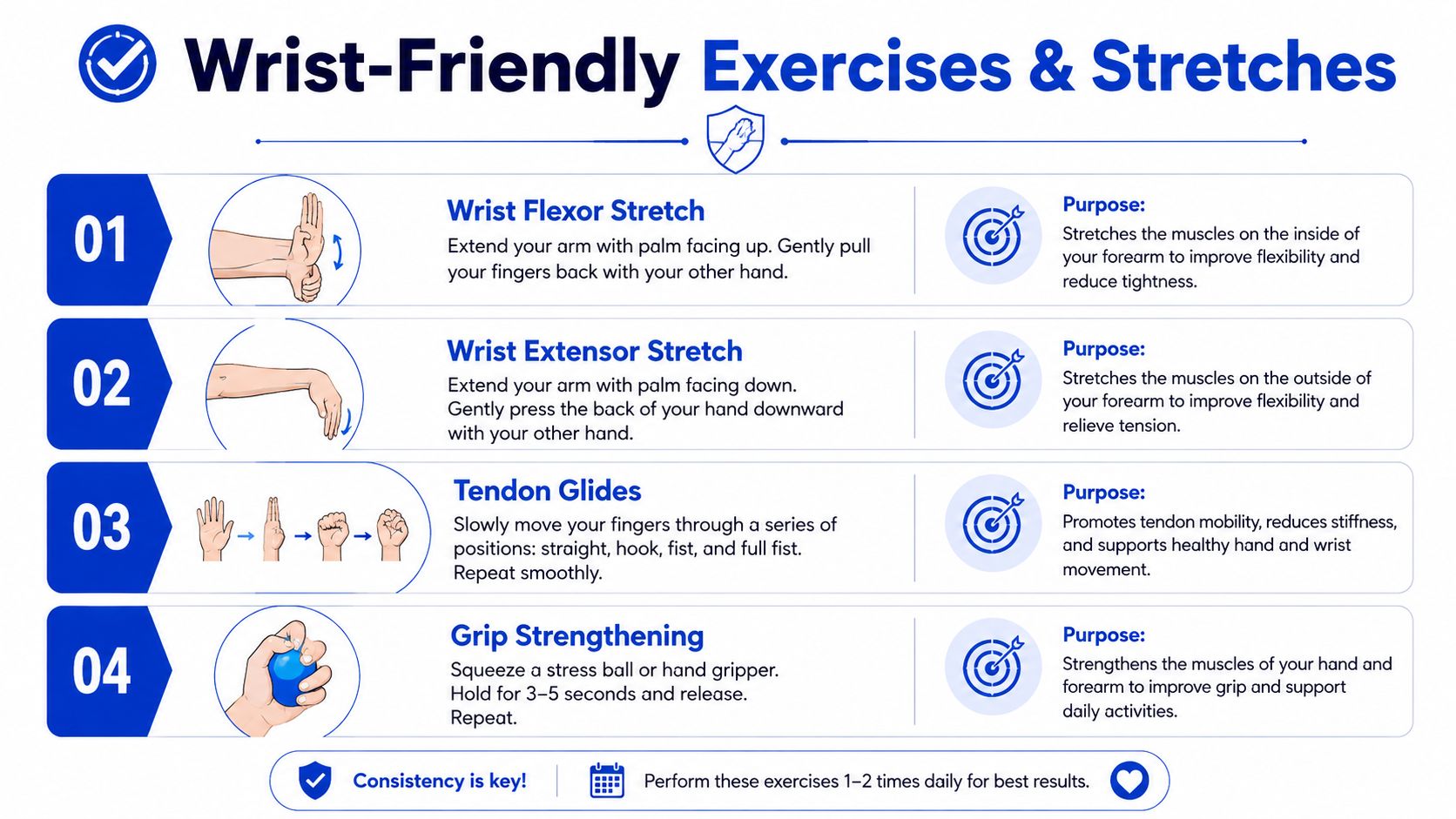
The aim here is to give the wrist a small, repeatable dose of movement that builds tolerance over time. If the wrist is highly irritated, keep the range tiny. If it settles quickly after movement, you can usually add a little more work without upsetting it.
A wrist often responds better to steady practice than to one big stretch. The tissues around it, tendons, joint capsule, and small forearm muscles, need clear movement signals so they can stop behaving as though every motion is a threat.
1. Wrist flexor stretch
Extend one arm in front of you with the elbow straight and the palm facing up. Gently pull the fingers back with the other hand until you feel a stretch through the inner forearm and wrist. Hold briefly, then ease off. The stretch should feel controlled, not sharp.
2. Wrist extensor stretch
Turn the palm down and let the other hand guide the fingers towards the floor. This usually feels different from the first stretch because it targets the top side of the forearm. Keep the movement smooth and avoid forcing the wrist into a deep bend.
3. Tendon glides
Make a loose hand, then move through an open hand, hook fist, full fist, and straight fist. This is often useful when the hand feels stiff or “sticky”, especially if a nerve or tendon does not like being held still for too long.
4. Gentle grip or isometric hold
Squeeze a soft ball, rolled towel, or folded sock lightly and hold without causing a pain spike. The purpose is to rebuild load tolerance, not to create fatigue. If gripping clearly worsens symptoms, reduce the effort or skip this one for now.
The wrist-friendly image below can help you match the written steps with a simple office-based routine.
The wrist-friendly video below can help you match the movements to the written steps.
How to dose the work
- Stretching: aim for a brief, easy stretch rather than a hard pull.
- Mobility work: use slow, controlled movement that does not trigger lingering pain.
- Strength work: keep the effort light at first, then increase only when the wrist settles well after exercise.
A useful rule is that movement should feel useful, not heroic. If symptoms rise and stay up for hours afterwards, the wrist has been given too much. If the wrist feels a little looser and the discomfort settles quickly, you are in the right zone.
Red Flags, Recovery Timelines, and When to Seek Help
Rest gets overused as a treatment because it feels safe, but it's only a short-term tool. The recent evidence picture is still mixed, and a 2024 scoping review found that injections, splinting, local exercise, and manual therapy are the most studied approaches, while global exercise and sensorimotor training are looked at far less often, which suggests graded rehabilitation is still underused (scoping review).
Get assessed promptly if you notice
- Significant trauma: a fall, a heavy twist, or any injury where the wrist changed shape.
- Visible deformity or marked swelling: especially if it appeared suddenly.
- Numbness that wakes you at night: particularly if it's recurrent or spreading.
- Grip weakness that's getting worse: especially if objects feel unreliable in the hand.
- Fever with joint pain: that combination needs medical review.
- Pain that steadily worsens over weeks: instead of settling, it keeps expanding.
Mild tendon irritation often improves gradually, not overnight. A sensible recovery plan usually means reducing the irritant, reintroducing movement, and rebuilding capacity in steps. If symptoms aren't shifting, or if they keep returning with ordinary tasks, the plan probably needs adjusting.
How Bayside Osteopathic Health Can Help
A consultation begins with a careful assessment of the wrist and the structures that affect how it moves and loads. From there, treatment combines hands-on care with a clear home program, so the plan matches the way your wrist is being used. If the pattern points to nearby joints, muscle tension, or load intolerance, the approach is adjusted around those factors instead of relying on a one-size-fits-all routine. Where eligible, Medicare guidance and Chronic Disease Management plans can be discussed during the booking conversation.
Bayside Osteopathic Health also takes a practical approach to ergonomics, movement, and return-to-activity planning. That means the wrist settles down and then rebuilds the strength and movement quality needed for typing, lifting, training, and everyday tasks. If you want care that connects assessment, treatment, and home exercise into one sequence, visit Bayside Osteopathic Health and book a consultation that suits your wrist, your work, and your routine.
If wrist pain keeps interrupting typing, lifting, training, or sleep, an assessment can give you a clearer direction. You'll receive a plan that brings together hands-on care, movement advice, and sensible next steps for your situation.