

You get out of bed and hesitate before taking your first steps. Your knees feel reluctant to straighten, or your fingers feel awkward around the kettle. Later, after sitting at your desk, that same stiffness returns. It's understandable to wonder whether you need more movement, more rest, or someone to check what's happening.
Understanding what causes stiff joints starts with noticing the pattern, not assuming it's ageing. How long the stiffness lasts, which joints are involved, and whether there's swelling or warmth can help you choose a sensible next step.
Table of Contents
- Why Your Joints Feel Stiff
- The Main Causes of Joint Stiffness
- How to Tell the Causes Apart
- When to Seek Professional Care
- Conservative Self-Management Strategies
- The Role of Osteopathic Care and Lifestyle Measures
- Putting It All Together
Why Your Joints Feel Stiff
Joint stiffness is a symptom, not a diagnosis. It describes difficulty moving freely, but it doesn't tell you which tissue is responsible or why movement feels restricted.
Think about the difference between a knee that feels awkward when you stand after a long meeting and swollen fingers that remain difficult to bend throughout the morning. Both experiences count as stiffness. They shouldn't automatically lead to the same explanation or treatment.
A joint is more than a hinge
A door hinge is a useful starting analogy, but a living joint is more complicated. Comfortable movement depends on the joint surfaces, its lining, surrounding soft tissues, and the muscles controlling movement. Structural changes, inflammation, and muscle guarding can all contribute to restriction.
This is why the familiar description of joints becoming worn out can be misleading. It encourages people to see every uncomfortable movement as further damage, even though the relationship between joint structure, symptoms, and activity needs individual assessment.
Age matters, but it isn't the whole explanation. Australian musculoskeletal guidance describes overlapping contributors, including cartilage disease, inflammatory swelling, reduced movement, and muscle or soft-tissue restriction. It also cautions against treating increasing age as a reason to assume movement is harmful, as outlined in the Australian Institute of Health and Welfare's musculoskeletal conditions overview.
Start with what you notice
Before deciding that a stiff knee needs stretching or a stiff hand needs rest, consider:
- Timing: Does it happen after sleep, after sitting, or following a demanding task?
- Location: Is the problem confined to a previously injured joint, or are several areas involved?
- Associated changes: Is there swelling, warmth, redness, or difficulty using the joint?
- Daily impact: Are you changing how you dress, walk, work, or climb stairs?
Practical rule: Describe what the joint does before deciding what to call the problem.
You don't need medical terminology to provide useful information. Saying that your hands remain difficult to close after breakfast is more helpful than saying you feel old or creaky.
The Main Causes of Joint Stiffness
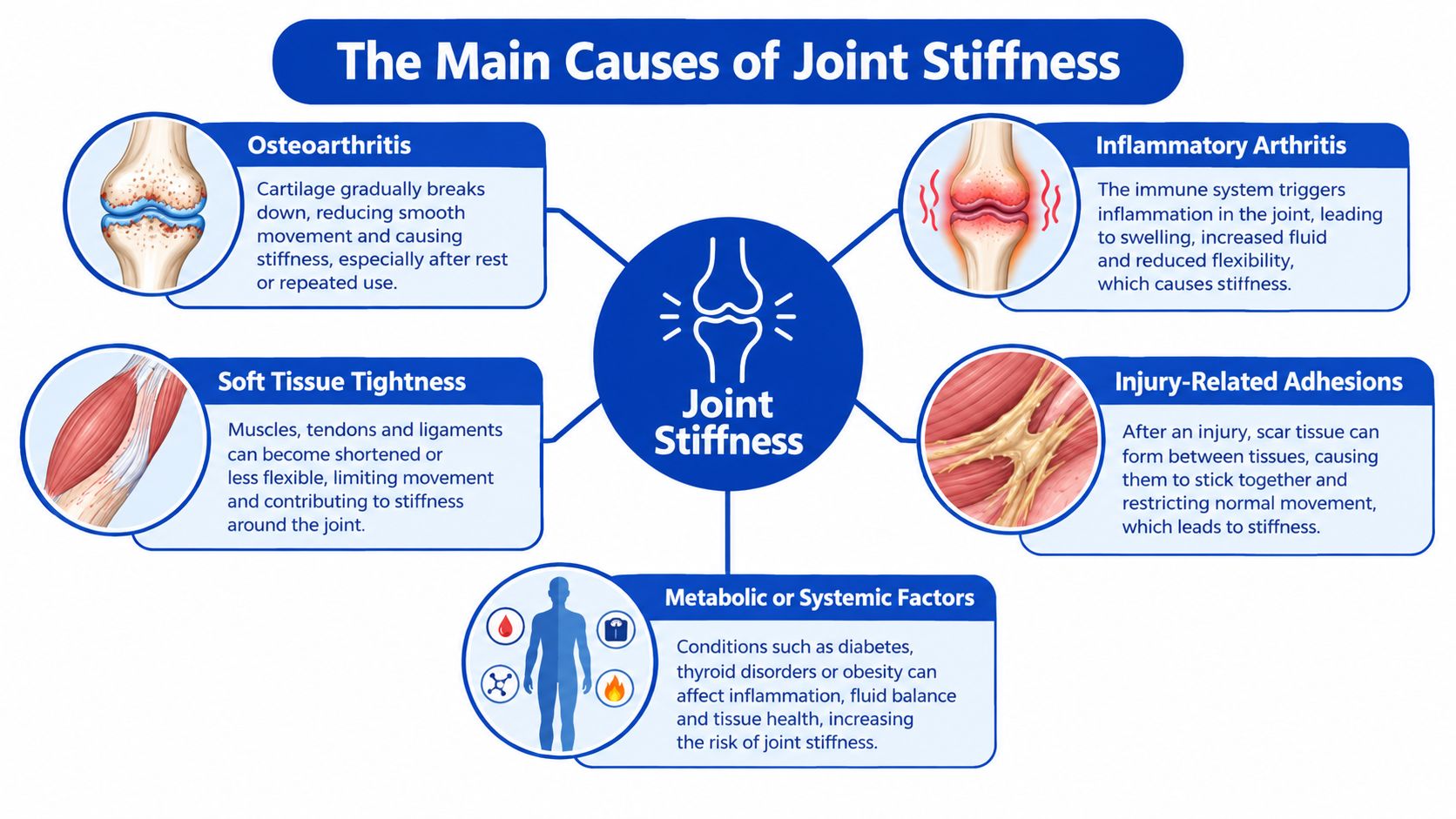
The main distinction is between changes within the joint and restrictions around it. These can overlap, so finding muscle tightness doesn't necessarily exclude arthritis.
The diagram below groups the main possibilities, rather than providing a way to diagnose yourself.
Osteoarthritis involves the whole joint
Osteoarthritis is Australia's most common disease-related cause of stiff joints. In 2022, an estimated 2.1 million Australians, or 8.3% of the population, had osteoarthritis, according to the Australian Institute of Health and Welfare's arthritis report.
Cartilage provides a smooth covering over the ends of bones. As it deteriorates, comfortable movement can become more difficult. However, cartilage isn't the whole story: changes in the joint lining, bone, and movement mechanics also contribute.
Comparing cartilage to worn tyre tread helps explain surface deterioration, but the analogy has limits. A living joint isn't a disposable machine part, and symptoms don't establish that the joint is beyond help.
For a knee-specific explanation, this guide to arthritis-related knee pain provides a useful starting point for discussing symptoms.
Inflammatory arthritis works differently
With inflammatory arthritis, inflammation within the joint is a central problem. In rheumatoid arthritis, immune activity affects the synovium, the tissue lining the joint.
An irritated lining can thicken and swell, making movement uncomfortable. Rather than imagining rough surfaces alone, think of trying to move a hinge surrounded by swollen material: restriction comes partly from what's happening around the moving surfaces.
Gout is another inflammatory possibility, involving uric-acid crystals. A joint infection can also cause inflammation, which is why a suddenly hot, swollen joint needs a different response from familiar stiffness after sitting.
Soft tissues, previous injury, and broader causes
Not every feeling of stiffness begins inside the joint. The following possibilities need context rather than assumptions:
- Soft-tissue restriction: Muscles and surrounding tissues can contribute to a feeling of tightness. The important question is whether this explains the whole problem or accompanies a joint condition.
- Previous injury: An injured joint may remain restricted or become painful with certain loads. Adhesions, meaning tissue sticking together, shouldn't be assumed from stiffness alone; an assessment needs to establish what is limiting movement.
- Systemic or metabolic factors: Some causes extend beyond a local joint problem. A clinician may need to consider your wider health rather than focusing only on the sore area.
Medication questions also belong in that broader review. If you suspect a connection between symptoms and a medicine, discuss it with your prescriber or pharmacist rather than changing treatment yourself.
The useful conclusion isn't that you need to identify the affected tissue unaided. It's that stiffness can have overlapping contributors, and a treatment chosen for one contributor may not address another.
How to Tell the Causes Apart
A symptom pattern can help you decide what needs assessment. It cannot reliably confirm a diagnosis at home.
The distinction matters in Australia: just under 3.7 million people, or 14.5% of the population, had arthritis in 2022. Osteoarthritis accounted for 57.0% of arthritis cases, while rheumatoid arthritis accounted for 13.9%, according to the Australian Bureau of Statistics arthritis release.
Inflammatory vs Mechanical Stiffness
| Feature | Inflammatory Arthritis | Mechanical/Osteoarthritis |
|---|---|---|
| Timing | Prolonged morning stiffness raises concern | Stiffness after inactivity can occur |
| Duration | Often more persistent after waking | Commonly shorter-lived |
| Response to movement | May ease with movement | May loosen initially but become uncomfortable with loading |
| Distribution | Several joints, particularly matching hands or wrists, can raise suspicion | Symptoms may relate more closely to particular joints and their loading history |
| Swelling | Persistent swelling needs medical assessment | Swelling can also occur, so it isn't diagnostic alone |
| Warmth or redness | Important clues requiring medical consideration | Shouldn't be dismissed as ordinary mechanical stiffness |
| Most useful next question | Are there signs of ongoing inflammation? | How do activity, injury history, and load relate to symptoms? |
These are tendencies, not rules. Osteoarthritis can involve inflammation, and an inflammatory condition can still feel better once you get moving.
Feeling better with movement doesn't prove that stiffness is purely mechanical.
For example, consider someone whose knee feels restricted after sitting but becomes uncomfortable again after demanding activity. That history gives a clinician different clues from someone whose hands are swollen on waking and remain difficult to use through the morning. Neither example is a diagnosis, and both deserve attention if symptoms persist.
Use a short symptom record
A useful record doesn't need a special app. Write down the following observations in a notebook or your phone:
- Morning function: Note what you struggle to do and when movement becomes easier.
- Joint distribution: Record whether symptoms affect matching areas or remain localised.
- Visible changes: Describe swelling, redness, or changes you can clearly observe.
- Activity response: Note whether sitting, walking, lifting, or repeated bending changes symptoms.
- General health: Tell your clinician if you also feel unwell or have other new symptoms.
Try to describe a typical day rather than testing the joint repeatedly to see how much it can tolerate. Your account of ordinary activities is valuable.
A clinician will interpret these observations together. A symptom that seems reassuring in isolation, such as movement-related relief, shouldn't outweigh persistent swelling or a concerning overall pattern. Equally, stiffness alone doesn't establish inflammatory disease.
When to Seek Professional Care
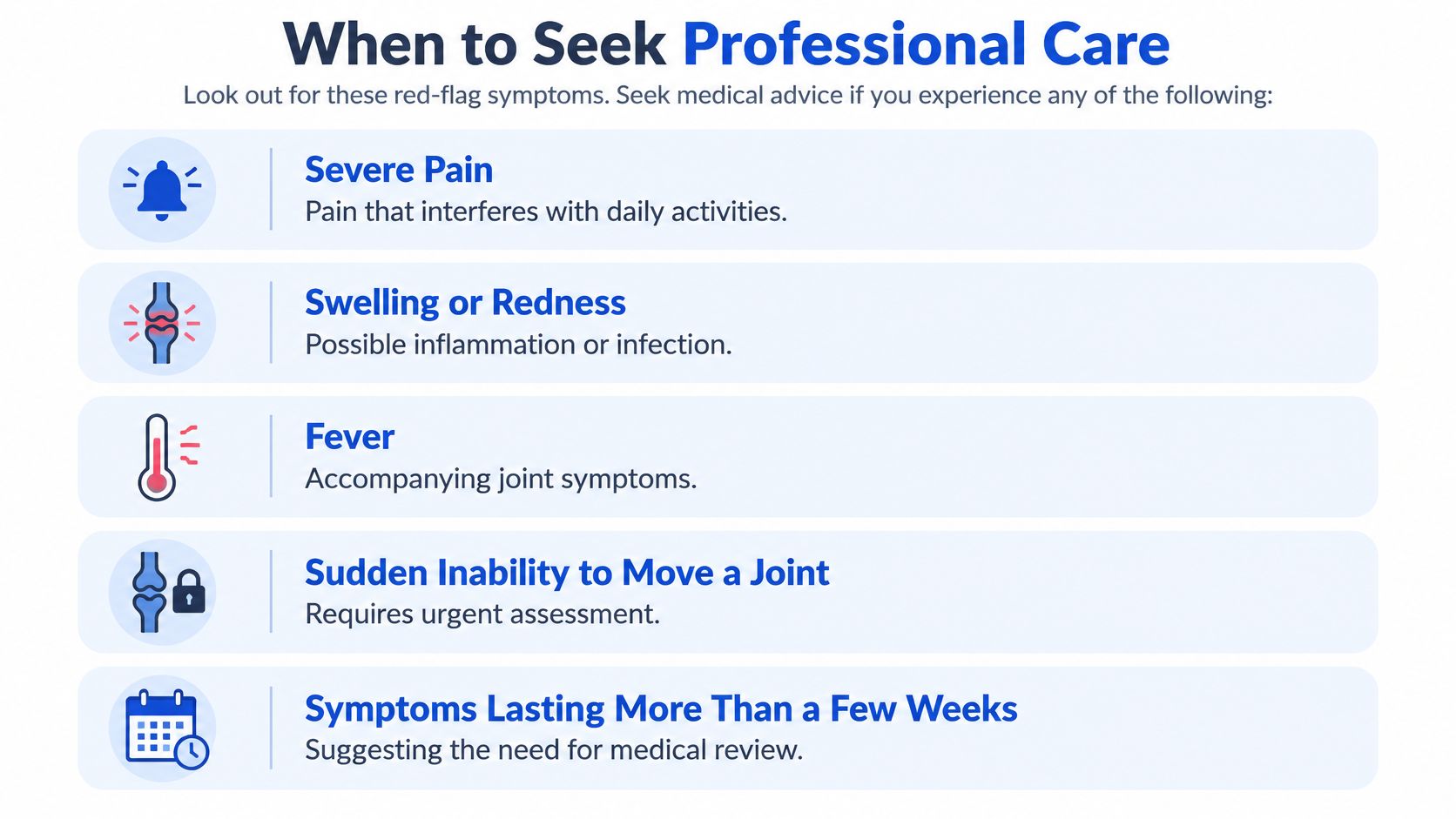
Seek urgent medical assessment for sudden severe joint pain, marked swelling, redness or heat, fever, or inability to use the joint. These warning signs can indicate problems that shouldn't wait for stretching or a routine hands-on appointment, as explained in Healthdirect's arthritis guidance.
The checklist below separates warning signs from symptoms that still need review but may not require emergency care.
When urgency matters
A suddenly painful, hot joint is not something to explain away as having slept awkwardly. Infection can rapidly damage a joint, and an acute inflammatory episode also needs appropriate assessment.
- Seek urgent care: Act promptly if the warning signs above appear, especially if symptoms worsen rapidly.
- Avoid forcing movement: Don't repeatedly stretch, manipulate, or heavily load a severely painful joint while arranging care.
- Choose medical assessment first: A routine osteopathic appointment isn't the appropriate first destination for a possible joint infection.
When to arrange a GP appointment
Prolonged morning stiffness warrants medical review, particularly when hands or wrists are affected symmetrically. Suspicion of inflammatory arthritis increases with morning stiffness lasting longer than one hour, symptoms persisting beyond six weeks, or involvement of five or more joints, as discussed in Australian Prescriber's guidance on suspected inflammatory arthritis.
Those features aren't thresholds you must reach before asking for help. Don't wait for symptoms to become longstanding if swelling is persistent or everyday function is deteriorating.
Assessment first: Persistent swelling and warmth shouldn't be managed solely with stretching or hands-on treatment.
Diagnosis begins with your history and examination. Blood tests and imaging can support the assessment, but they don't replace it or automatically settle every diagnostic question.
For milder symptoms without warning signs, cautious self-management may be reasonable while monitoring the response. Arrange assessment if stiffness keeps returning, follows an injury, disrupts daily life, or leaves you uncertain about what activity is appropriate. You don't need to arrive with a diagnosis; explaining what has changed is enough.
Conservative Self-Management Strategies
For stiffness without warning signs, start with comfortable movement and manageable loads, rather than forceful stretching or complete rest. The aim is to find an approach you can repeat without provoking a sustained worsening.
Exercise should be selected for your symptoms, not copied just because someone else finds it helpful.

Choose movement you can control
Begin with gentle movement through a comfortable range. Depending on the joint, that might mean slowly opening and closing your hand or bending and straightening your knee without forcing the end position.
The goal isn't to achieve the deepest possible stretch. Notice whether movement becomes easier and whether the joint remains settled afterwards.
- Break up static positions: If sitting regularly leaves you uncomfortable, vary your position and include comfortable movement during the day.
- Adjust irritating tasks: Modify activities that repeatedly provoke symptoms rather than repeatedly testing your tolerance.
- Build gradually: Choose a starting level you can manage consistently before increasing resistance or task demands.
These joint mobility exercise ideas can help you prepare questions for a practitioner about which movements suit you. An individual plan is particularly useful when pain, previous injury, or uncertainty makes exercise difficult.
Balance rest with progressive strength
Rest may temporarily reduce irritation during a flare, but it doesn't have to mean abandoning all activity. Consider reducing the provoking task while keeping other comfortable movements in your day.
For longer-term management, excess body weight, previous trauma, malalignment, and repetitive loading are recognised osteoarthritis risk factors. Practical measures include progressive strengthening, weight management where appropriate, and reducing repeated high-load exposure, as discussed in the AIHW evidence on osteoarthritis risk and management.
That might mean changing how you organise kneeling tasks, reducing repeated heavy lifting, or asking for help designing a strength programme. Weight-related conversations should be supportive and individualised, not presented as a complete explanation for pain.
Before following an exercise video, check whether its movements fit your assessment and current symptoms.
Treat demonstrations as options, not prescriptions. Stop if a movement produces sharp pain, increasing swelling, or a clear deterioration in function.
If you're considering heat for morning comfort, ask your practitioner whether it's suitable, particularly when the cause is unclear. A hot, visibly swollen joint needs assessment, not an assumption that more warmth is the answer.
The Role of Osteopathic Care and Lifestyle Measures
Osteopathic care fits best when its purpose is clear: assessing movement, addressing suitable musculoskeletal contributors, and helping you develop a practical activity plan. It shouldn't replace medical investigation when the symptom pattern suggests inflammatory disease or infection.
A hands-on consultation is one part of care, alongside your GP, relevant medical specialists, and exercise-based rehabilitation where appropriate.

What a useful consultation should address
Expect to discuss more than the location of discomfort. Bring your symptom record, injury history, current medicines, and examples of activities you've started avoiding.
A practical assessment should connect the examination with your goals. Being able to rise comfortably from a chair, manage a workday, or return to gardening provides a clearer treatment target than a vague promise to improve alignment.
Depending on suitability, care may include:
- Soft-tissue work: Hands-on techniques directed towards surrounding muscle tension.
- Joint articulation or gentle mobilisation: Controlled movement selected for the joint and your tolerance.
- Movement guidance: Exercises and activity adjustments linked to the difficulties you experience.
- Review and referral: Reconsidering the plan if symptoms change or medical assessment is needed.
This explanation of what osteopathy treatment involves can help you prepare for an appointment. Ask what each proposed technique is intended to address, what alternatives are available, and how progress will be reviewed.
Keep the claims proportionate
Hands-on care shouldn't be presented as regrowing cartilage, reversing autoimmune disease, or removing every cause of stiffness. The more useful question is whether the proposed care helps you work towards meaningful functional goals alongside any necessary medical treatment.
A whole-person approach also means recognising practical barriers. Someone who kneels throughout their working day needs different task advice from someone who avoids movement because they're frightened of damaging a joint.
Discuss what you can realistically change at home and work. A plan that relies on activities you can't perform, equipment you don't have, or routines you can't maintain needs adjusting.
If you're interested in Medicare support, ask the clinic and your GP about eligibility and applicable arrangements rather than assuming treatment is covered. Financial clarity, informed consent, and clear referral pathways are part of sensible care.
Putting It All Together
The most helpful answer to what causes stiff joints is rarely just age or wear and tear. The pattern of symptoms, examination findings, and effect on everyday life matter more than a label chosen at home.
Use your observations to choose the next step:
- Warning signs present: Seek urgent medical assessment.
- Persistent or unexplained symptoms: Arrange a GP review, especially when swelling or prolonged morning restriction is involved.
- Suitable mechanical symptoms: Discuss a movement and rehabilitation plan, with osteopathic care as an option where appropriate.
You don't need to push through every uncomfortable movement, and you don't need to give up activity altogether. Aim for a clear explanation, realistic goals, and a plan that can change as your symptoms change.
Bayside Osteopathic Health offers gentle osteopathic assessment, hands-on care, and practical movement advice for joint stiffness and arthritis-related discomfort. Visit the clinic to discuss an appointment focused on your daily movement difficulties and how osteopathic care may fit alongside any medical treatment you need.