
You wake up stiff again. Your lower back eases a little after a hot shower, but the ache returns by mid-morning. Or maybe it's your neck, the kind of tension that builds from desk work, poor sleep, stress, and too many hours looking down. You've heard osteopathy might help, but one question keeps stopping you from booking.
Can I get it bulk billed?
That's where many people get stuck. They've seen the phrase online, heard Medicare mentioned by a friend, or assumed allied health works much like a GP visit. Then they ring a clinic and find out the answer is more complicated than expected.
If you're trying to work out what osteopathy will cost, you're asking the right question. The billing side of care in Australia can be confusing, especially when words like bulk billing, Medicare rebate, CDM plan, and private health extras get used as if they all mean the same thing. They don't. If you want a clearer picture of the kinds of fees and payment pathways patients often ask about, this guide on osteopathy cost questions in Australia is a useful starting point.
Table of Contents
- Struggling with Pain and Worried About Osteopathy Costs?
- What Bulk Billing Really Means for Osteopathy
- How to Access Medicare Rebates for Your Osteo Treatment
- Common Misconceptions About Bulk Billed Osteopathy
- Exploring Your Payment Alternatives if You Are Not Eligible
- How We Support You at Bayside Osteopathic Health
Struggling with Pain and Worried About Osteopathy Costs?
A common situation goes like this. Someone has been putting up with back pain for months, or neck tension that keeps flaring after long workdays. They finally decide to look for help, search “bulk billing osteopath”, and assume they'll quickly find a clinic where Medicare covers everything.
Then the confusion starts.
One clinic says they accept Medicare referrals. Another says there's still a gap. A third explains that osteopathy isn't usually bulk billed in the same way as a GP. By that point, many people feel as if the system is designed to be hard to understand.
That frustration is reasonable. For patients, cost isn't a side issue. It affects whether you book, whether you continue care, and whether you stop after one appointment even when your body needs more support. People who search for a bulk billing osteopath are often trying to answer a more basic question first. Am I entitled to any Medicare help at all?
If you're already dealing with pain, unclear billing information can be enough to delay treatment for weeks or months.
The practical truth is that osteopathy in Australia sits in a more limited funding space than many people expect. Bulk billing can exist in some eligible circumstances, but it isn't the standard model for routine osteopathy visits. That's why it helps to separate the language around bulk billing from the language around Medicare rebates before you book.
What patients usually want to know
- Will I pay on the day? Some patients won't. Many will pay either a full fee or a gap, depending on the referral and the clinic's billing model.
- Do I need a GP referral? If you're hoping to access Medicare support, a GP referral pathway is often the key step.
- Is it worth paying privately? For many musculoskeletal problems, that comes down to the likely short-term improvement in pain and function, and whether treatment fits your broader plan.
What Bulk Billing Really Means for Osteopathy
The term gets used loosely online, but it has a specific meaning.
The simple definition
Bulk billing in osteopathy means the practitioner accepts the Medicare rebate as the full payment for that consultation. You don't pay an out-of-pocket fee at the point of care. Healthdirect notes that some osteopaths bulk bill while others charge a gap, and that Medicare rebates apply only in eligible circumstances, not for unrestricted routine osteopathy visits. You can read that directly in Healthdirect's overview of osteopathy and Medicare arrangements.
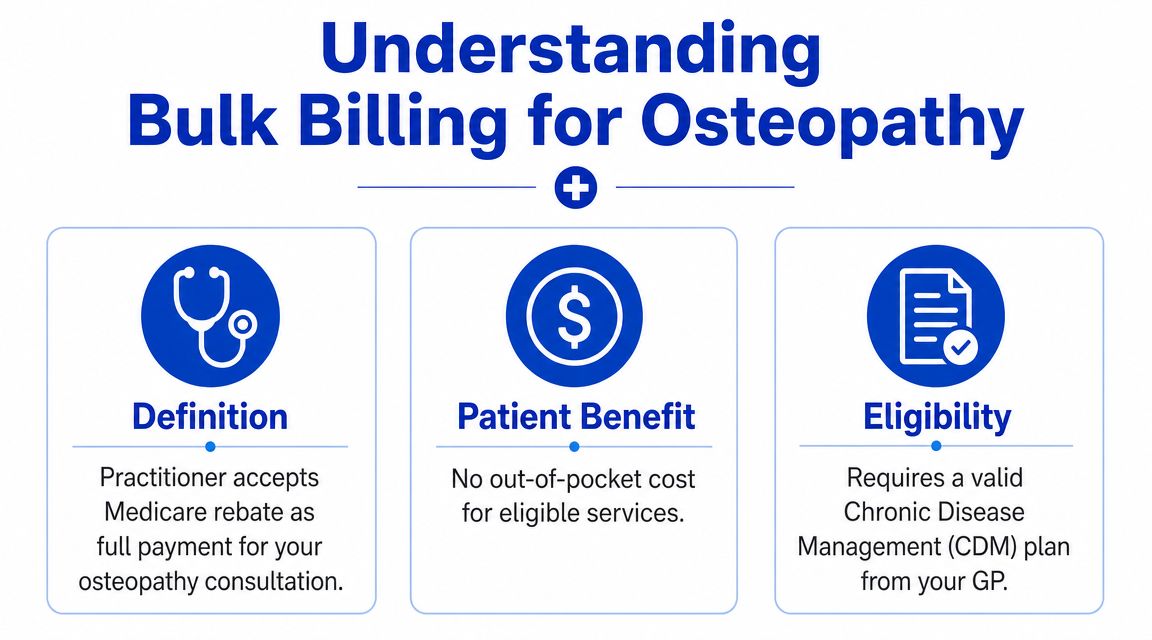
The easiest way to think about it is this. A Medicare rebate is like a contribution toward treatment. Bulk billing only happens when the clinic agrees to treat that contribution as the entire fee for the visit.
If the clinic charges more than the rebate, the remaining amount is the gap payment. That's still a Medicare-supported appointment, but it is not bulk billed.
Why it is less common than people expect
Osteopathy appointments aren't usually set up like high-volume GP consults. A proper osteopathic visit often involves history-taking, movement assessment, hands-on treatment, advice on activity, and a plan for what to do between appointments. Clinics have to cover practitioner time, reception support, treatment rooms, compliance tasks, and claim processing.
That's why the phrase bulk billing osteopath can be misleading if it creates the impression that most osteopathy is free at the point of care. In practice, clinics make different decisions about whether they can offer rebate-only treatment for eligible referrals.
A more accurate comparison looks like this:
| Billing model | What it means for the patient |
|---|---|
| Bulk billed osteopathy | The Medicare rebate is accepted as full payment, so there's no out-of-pocket fee for that eligible visit |
| Medicare rebate with a gap | The rebate is applied, but you pay the difference between the clinic fee and the rebate |
| Private appointment | You pay privately, sometimes with private health extras support if your policy includes osteopathy |
Practical rule: Don't ask only “Do you take Medicare?” Ask “Is this appointment fully bulk billed, or will there be a gap?”
That one question usually gives a much clearer answer.
How to Access Medicare Rebates for Your Osteo Treatment
If you're trying to reduce your out-of-pocket cost, the most common pathway is through a Chronic Disease Management plan, often arranged by your GP.
The pathway most patients use
In Australia, Medicare rebates for osteopathic treatment are capped at five sessions per person per year when you're referred by a medical practitioner under a Chronic Disease Management plan. The same Ahpra workforce analysis reports that the number of practising osteopaths increased by 31.1% over five years, rising from 2,294 in 2017/18 to a higher count by 30 June 2022, while the rebate cap remained unchanged. That combination helps explain why subsidised access exists, but is still limited in scope, as outlined in Ahpra's osteopathy workforce analysis and Medicare context.
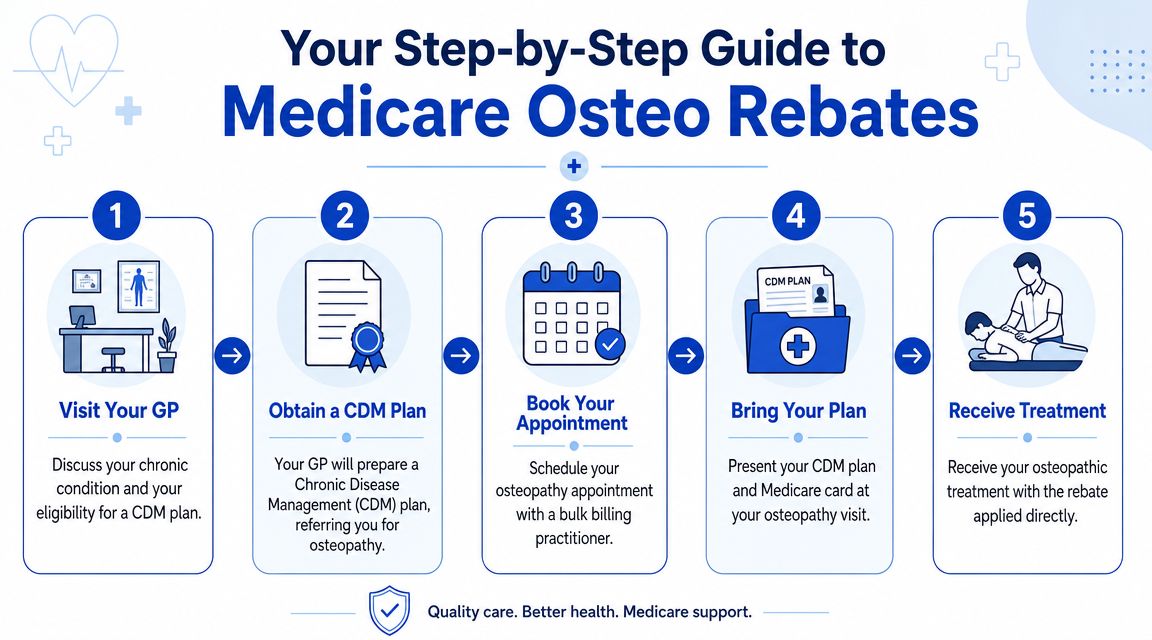
For most patients, the process looks like this:
- See your GP and discuss the condition you're managing.
- Ask whether a Chronic Disease Management plan is appropriate for your situation.
- Receive the referral paperwork if your GP determines you're eligible.
- Book with the osteopathy clinic and tell them you plan to use a Medicare referral.
- Check billing before the appointment so you know whether the clinic bulk bills or charges a gap.
That last step matters. Two clinics can both accept Medicare paperwork and still bill differently.
Other funding pathways can exist
Some patients may have access through other systems, such as compensable care arrangements or veteran-related pathways, depending on their circumstances. These pathways have their own eligibility rules, approvals, and administrative requirements. They aren't interchangeable with a standard Medicare referral.
That's why I usually suggest patients sort out three details before booking:
- Confirm the referral type. Bring the correct paperwork, not just a note saying you should see an osteopath.
- Check whether the clinic processes rebates directly. Some clinics handle the paperwork on the spot. Others may ask you to pay first and claim separately.
- Ask about your remaining subsidised sessions. Patients often don't realise these plans are limited and need to be used carefully across allied health care.
Bring your Medicare card, your referral paperwork, and your questions. Clear admin at the start makes treatment much smoother.
Common Misconceptions About Bulk Billed Osteopathy
A lot of patient frustration comes from assumptions that sound reasonable but don't match how the system works.
Myth and reality
Many people searching for a bulk billing osteopath are really asking whether they're eligible for any Medicare subsidy at all. In Australia, Medicare-funded osteopathy is usually limited to eligible chronic disease management pathways where rebates apply, and that distinction is often unclear in consumer content, as discussed in this piece on osteopathy, Medicare subsidy confusion, and patient expectations.
Here are the myths I hear most often.
Myth one, all osteopaths bulk bill.
Reality: some clinics may bulk bill eligible services, but many do not. Some accept Medicare referrals and still charge a gap.Myth two, a GP referral makes treatment free.
Reality: a referral may open the door to a rebate. It doesn't automatically mean there will be no out-of-pocket cost.Myth three, Medicare covers osteopathy whenever I need it.
Reality: access is limited and tied to specific eligibility pathways, not open-ended routine care.
For patients wanting a broader picture of what osteopathy involves beyond the billing questions, this overview of how osteopathy supports whole-body health and recovery can help put the financial side into clinical context.
The question to ask before you book
A good booking call is short and direct.
Ask:
- Am I eligible to use my referral here?
- Do you bulk bill this appointment, or is there a gap?
- What do I need to bring on the day?
Most billing problems happen before treatment starts. The patient assumes one thing, and the clinic means another.
The fix is usually simple. Confirm the exact billing model in plain language before you arrive.
Exploring Your Payment Alternatives if You Are Not Eligible
If you don't qualify for Medicare-supported osteopathy, that doesn't mean care is out of reach. It means you need to look at the other payment paths more realistically.
Private health extras
For many patients, the first alternative is private health extras cover. If your policy includes osteopathy, you may be able to claim part of the consultation cost. The key is to check the details of your own policy rather than assuming “extras” means full cover.
Look for:
- Annual limits so you know how much cover remains for the year.
- Per-visit benefits because the amount paid back can vary.
- Any waiting periods or restrictions that affect when you can claim.
This is one of the biggest practical differences between private health and bulk billing language. Private health usually means a contribution toward the cost. It rarely means the appointment disappears financially.
When self-funding still makes sense
Private payment can still be a sensible choice when the care is targeted and the goals are clear. Current evidence discussions suggest manual therapy can help with short-term pain and function for specific musculoskeletal conditions, which is why many patients see osteopathy as a reasonable expense for chronic pain, arthritis, or posture-related strain when ongoing support is useful. That nuance is reflected in this review of osteopathic manipulation and musculoskeletal care considerations.pdf).
That doesn't mean every problem needs long-term treatment. It does mean treatment tends to feel worthwhile when it is tied to a concrete goal such as:
- Moving with less pain during work, walking, lifting, or sleep
- Improving function so daily tasks stop feeling restricted
- Supporting an active plan that includes exercise, pacing, and home care
A poor reason to book is hoping for a miracle fix. A good reason is wanting practical help to reduce pain, restore movement, and make daily life more manageable.
How We Support You at Bayside Osteopathic Health
Patients usually feel better once someone explains the billing side in plain English. That's a big part of making care accessible. If you're attending with eligible paperwork, the first step is making sure the referral is current and the booking team knows which pathway you plan to use.
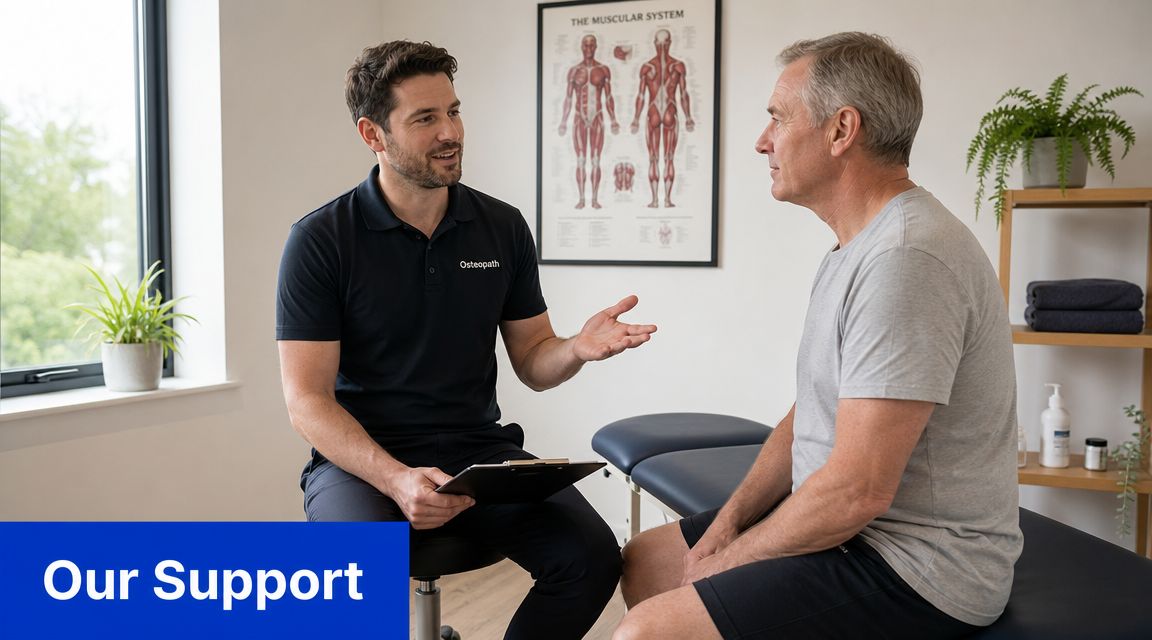
At Bayside Osteopathic Health, we help patients understand whether they're booking under Medicare-supported care, private health extras, or standard private payment. If you have a valid referral under the appropriate Medicare pathway, the team can explain how the rebate is processed and whether a gap applies for your appointment. That clarity matters because nobody wants to arrive in pain and sort out paperwork at the front desk under pressure.
Care works best when the financial side is predictable. That means asking questions early, bringing the right documents, and understanding whether you are booking a fully bulk billed appointment or a consultation with a rebate contribution. If you're looking for an experienced local clinic, you can learn more about finding an osteopath near you in Bayside.
The right next step is simple. If you think you may be eligible, check with your GP and then confirm the clinic's billing approach before booking. If you are not eligible, weigh the likely value of treatment against the cost, rather than assuming no rebate means no good option exists.
If you'd like clear advice about your options, Bayside Osteopathic Health can help you understand referrals, rebates, gap payments, and private booking choices before you attend, so you can make an informed decision and get started with confidence.