
Your back has been grumbling for weeks. Your neck feels tight by midday. Getting up from the desk, the car, or the couch takes that extra second because something just doesn't move the way it should. So, naturally, you open your phone and type “osteopath near me”.
That search sounds simple, but the results can be confusing. Some clinics look polished but tell you very little. Others mention Medicare or private health without explaining what that means. If you're in Bayside and you want careful, sensible help for pain or stiffness, the crucial question isn't just who is closest. It's who is properly qualified, who assesses the whole picture, and who offers a plan that makes sense for your body and your life.
In Australia, osteopathy is not an informal wellness service. It's a regulated health profession with accredited tertiary education pathways and ongoing professional standards, which helps make local care more reliable in community settings such as Bayside, as described by the Australian osteopathic education and regulation overview. That matters when you're choosing someone to assess and treat pain with hands-on care.
Table of Contents
- Your Guide to Finding Local Osteopathic Care
- Where to Begin Your Search for an Osteopath
- How to Evaluate an Osteopath's Qualifications and Approach
- Preparing for Your First Osteopathy Appointment
- Answering Your Practical Questions About Osteopathic Care
- Taking the First Step Toward Relief in Bayside
Your Guide to Finding Local Osteopathic Care
Individuals looking for an osteopath near me are usually not doing research for fun. They're sore, stiff, tired of waiting, and hoping the next appointment helps. The most useful place to start is with one clear fact. In Australia, osteopathy sits within a regulated professional framework, not outside it.

That means you can look for more than a pleasant website or a nearby address. You can expect that an osteopath has completed accredited tertiary education, entered practice through a formal pathway, and continues to meet professional standards. For local residents, that makes the search much less vague. You're not choosing between random manual therapy options. You're choosing between registered practitioners within an established Australian profession.
Why this matters in Bayside
Bayside patients often come in with familiar patterns. Office workers with postural strain. Adults with back pain that won't quite settle. Older locals dealing with joint stiffness or arthritis-related movement limitations. In those situations, people usually want two things at once. They want relief, and they want to understand what's driving the problem.
A thoughtful osteopathic approach looks at how the body moves as a whole. That doesn't mean every problem is complicated. It means the sore area is assessed in context, rather than treated in isolation.
Practical rule: Start your search by asking, “Is this practitioner properly registered, and do they explain how they assess the whole problem?”
What works and what doesn't
Some search habits help. Some don't.
- Useful: Looking for a clinic that explains assessment, treatment style, and follow-up advice.
- Less useful: Choosing the first listing purely because it's closest to home.
- Useful: Checking whether the clinic speaks clearly about conditions like neck pain, back pain, stiffness, mobility problems, and postural strain.
- Less useful: Assuming every hands-on provider offers the same training, standards, or scope.
The search gets easier once you know what to screen for. Proximity matters. Qualification matters more. Fit matters after that.
Where to Begin Your Search for an Osteopath
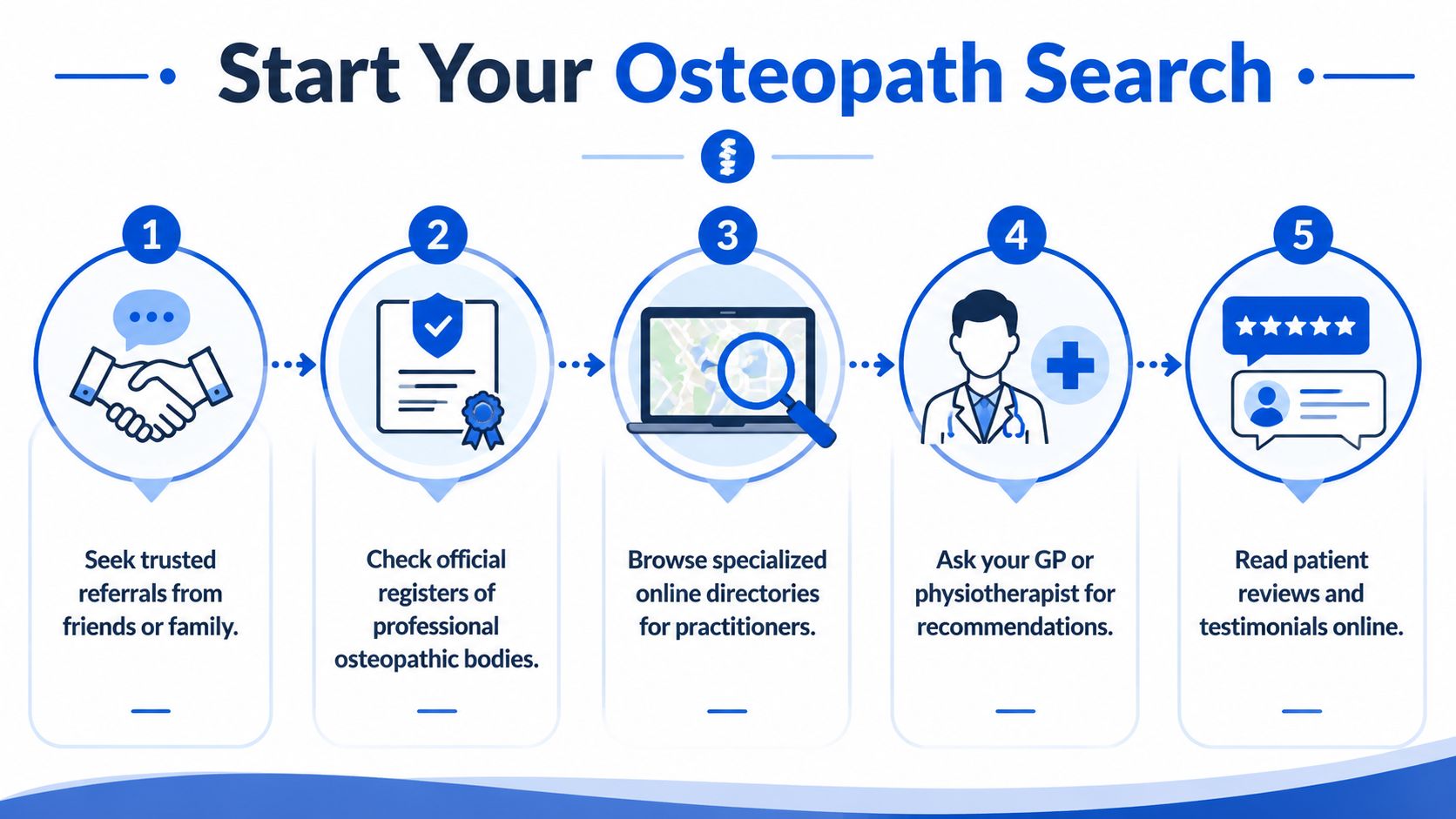
A good local search starts broadly, then narrows quickly. You want a shortlist, not a long scroll of half-relevant results. For those in Bayside, the simplest method is to combine trusted referrals, local search tools, and one formal safety check.
Start with real-world recommendations
Personal recommendations can be helpful, especially if they come from someone whose problem sounds like yours. A friend with recurring neck pain may value very different care from someone recovering from a sporting strain or managing arthritis.
You can also ask your GP or physiotherapist who they refer to when a patient wants hands-on musculoskeletal care. That doesn't mean you must book with that practitioner. It gives you a more informed starting list.
Use search tools properly
Google Maps is practical for local intent. It shows travel time, clinic hours, location, and reviews in one place. But don't stop at the map result itself. Open the clinic website and look for substance.
A useful listing usually leads to a website that answers basic questions clearly:
- Who treats you: Named practitioners with professional bios.
- What they treat: Clear mention of musculoskeletal concerns rather than vague promises.
- How they work: Assessment, hands-on care, and movement or self-management advice.
- What to expect: Booking details, appointment information, and payment information.
If you're comparing local options, clinics such as Bayside Osteopathic Health may appear in that search, alongside other nearby practices. The key is not the name alone. It's whether the clinic gives you enough information to judge safety, fit, and practicality.
Verify registration before you book
This is the step many people skip, and it's the one that matters most. In Australia, osteopaths are legally regulated health practitioners, and a practical way to search is to verify that the practitioner is registered with the Osteopathy Board of Australia and AHPRA, because registration confirms current competency, continuing professional development, and indemnity insurance, as noted in this Australian registration guidance for osteopath searches.
If a provider is hard to verify, don't book first and ask questions later.
A simple search sequence
- Ask around locally if you trust the person recommending them.
- Search your suburb and nearby areas using “osteopath near me” and review the map listings.
- Open clinic websites and look for practitioner names, treatment approach, and practical details.
- Check registration before confirming the appointment.
- Shortlist based on fit, not just distance.
That process cuts through most of the noise. It also helps you avoid the common mistake of treating convenience as the same thing as quality.
How to Evaluate an Osteopath's Qualifications and Approach
Once you've got a shortlist, the decision changes. You're no longer asking who exists nearby. You're asking who is right for your situation.
In Australia, osteopathy is a regulated health profession under AHPRA, which means your provider works within a national framework for education, safety, and conduct, as outlined in this overview of regulated osteopathic practice in Australia. That's the baseline. Registration tells you the practitioner meets professional requirements. It doesn't tell you whether their clinical style is a good fit for you.
What a good clinic website should tell you
A strong clinic website is clear without overselling. It should tell you what the practitioner treats, how they assess patients, and what a first consultation involves. If every sentence sounds promotional but says nothing concrete, that's a warning sign.
Look for specifics such as chronic back pain, neck pain, mobility restriction, postural strain, or arthritis-related stiffness. Also look for signs that the clinic values explanation, not just treatment. Patients do better when they understand why they hurt, what's being assessed, and what the plan is.
If you'd like a plain-English overview of this style of care, understanding osteopathy and its whole-body approach is a useful example of what that explanation should look like.
How to judge treatment philosophy
Two clinics can both be fully qualified and still feel very different in practice. One may focus narrowly on the sore spot. Another may look at movement patterns, work habits, previous injuries, and what your symptoms do across the day.
The second approach is usually more useful for persistent or recurring problems. If someone's lower back flares every week, the question isn't only where it hurts. It's what keeps loading that area, what isn't moving well, and what the person needs to change between appointments.
Good osteopathic care shouldn't leave you guessing why treatment is being done.
Reviews can help here, but read them carefully. Look for comments about communication, clarity, thoroughness, and whether the practitioner provided a plan. Be cautious with reviews that are all warmth and no detail. “Lovely clinic” is nice. “Explained my movement issues clearly and gave me practical advice” tells you more.
Osteopath Evaluation Checklist
| Quality Indicator | What to Look For |
|---|---|
| Registration | The practitioner can be verified as registered and practising within Australian standards |
| Practitioner bio | Clear training background, areas of interest, and a professional profile that sounds specific rather than generic |
| Assessment style | The clinic describes history-taking, movement assessment, and individualised care |
| Treatment approach | Hands-on care is paired with education, advice, or exercises rather than presented as a magic fix |
| Communication | The website explains common conditions and what patients can expect at appointments |
| Clinical reasoning | The clinic acknowledges when referral or further investigation may be needed |
| Practical fit | Location, appointment availability, payment information, and whether the clinic treats people with concerns like yours |
A qualified practitioner is the starting point. The right practitioner is the one whose reasoning, communication, and treatment style match what you need.
Preparing for Your First Osteopathy Appointment
Most first appointments feel easier once you know the rhythm of them. People often expect either something very medical and rushed, or something vague and overly “wellness” focused. A good osteopathy appointment usually sits in the middle. It should be professional, clear, and calm.
What happens when you arrive
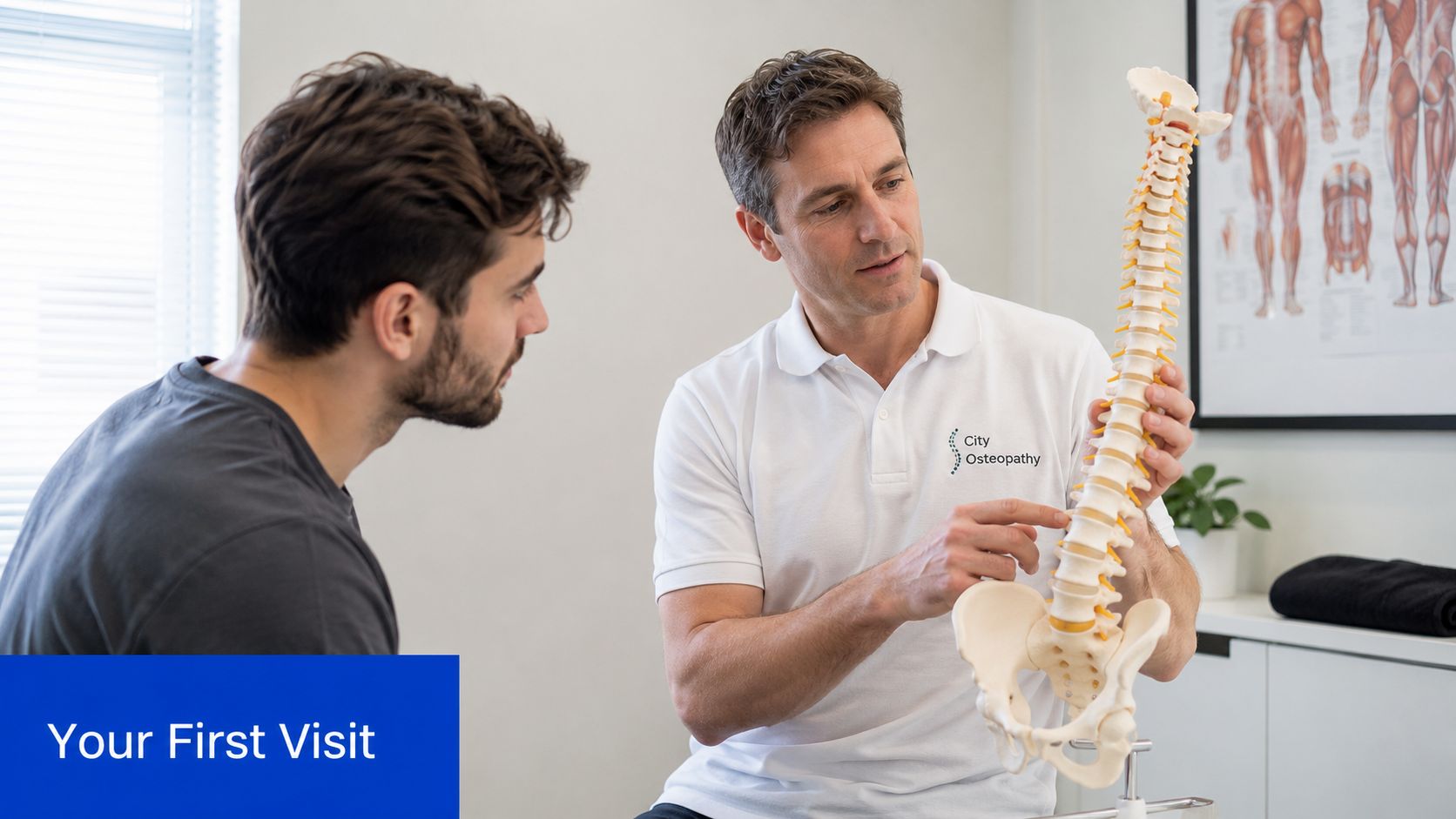
You'll usually begin with forms or a short intake process, then a conversation about what's been happening. That discussion matters. The osteopath isn't only asking where it hurts. They're looking at how it started, what aggravates it, what eases it, whether it travels, and how it affects daily activities like work, sleep, walking, lifting, or sitting.
From there, the appointment moves into assessment. That often includes posture, movement, and a gentle hands-on examination of the area involved and the surrounding regions that may be contributing. If your neck is sore, for example, your upper back, shoulders, and desk posture may all matter.
People are often surprised by how much of a first consultation is listening, observing, and testing movement. That's a good sign. Rushed treatment without a proper history rarely leads to good decisions.
What treatment usually looks like
When treatment is appropriate on the day, it commonly includes hands-on techniques such as soft-tissue work, articulation, mobilisation, and practical advice to support movement between visits. The aim isn't to do something dramatic. It's to reduce irritation, improve movement, and give your body a clearer path back to function.
For many musculoskeletal problems, care works best when treatment doesn't stop at the table. Home advice matters. So does a plan you can follow.
If you want to see the kinds of care commonly offered in a local clinic setting, osteopathic services in Bayside can give you a practical sense of what that may include.
A short visual explanation can also help if you're new to the process:
A first appointment should end with answers. What was found, what the likely driver is, what the next step is, and what you can do between now and the next visit.
What to bring and what to ask
A little preparation helps you get more out of the consultation.
- Bring relevant information: Scan reports, referral notes, or a medication list if they relate to the issue.
- Wear comfortable clothing: Something you can move in easily.
- Think about your pattern: When does the pain start, what makes it worse, and what are you no longer doing comfortably?
- Ask direct questions: What do you think is contributing? What are we trying to change first? What should I do at home?
That conversation should feel collaborative. You're not there to be passively “worked on”. You're there to understand the problem and start moving in a better direction.
Answering Your Practical Questions About Osteopathic Care
For many people, practical questions are the main sticking point. Not whether osteopathy exists, but whether it fits their budget, whether they need paperwork first, and whether it's suitable for the kind of pain they have.
Will Medicare or private health help with the cost
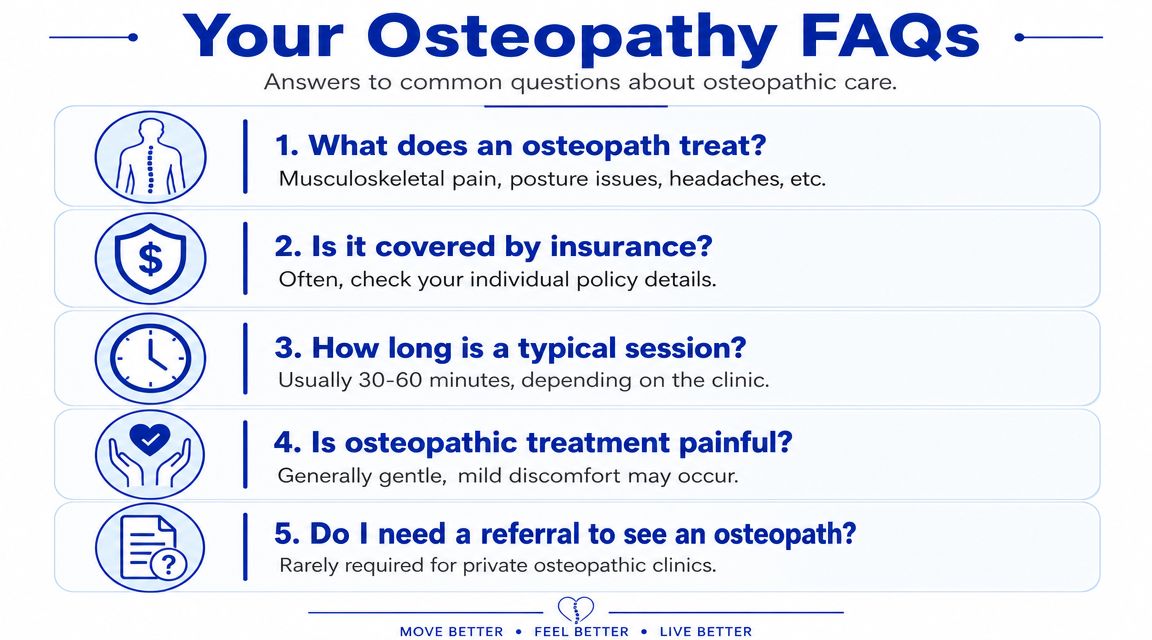
This is one of the biggest areas of confusion. In Australia, eligible patients under a Chronic Disease Management plan can receive Medicare rebates for a limited number of allied health visits per year, but a common mistake is assuming all osteopathy visits are covered, as explained in this guide to Medicare-linked allied health access and clinic quality markers.
That means two things. First, some patients may be able to access a rebate through a GP-arranged plan. Second, many appointments are still paid privately.
Private health is a separate question. Osteopathy is included in ancillary or extras-style cover, but the amount back depends on the individual fund and policy. There isn't one universal answer, which is why cost transparency matters so much.
Ask before you book: Do I need a GP plan for Medicare eligibility, and can you explain the likely out-of-pocket cost?
What kinds of problems do osteopaths commonly help with
People often search “osteopath near me” when they're dealing with ongoing musculoskeletal issues that haven't fully settled. Common reasons include:
- Back pain: Persistent tightness, recurring flare-ups, or pain linked to sitting, lifting, or bending.
- Neck pain and headaches: Often associated with desk work, posture, or upper back stiffness.
- Joint stiffness: Especially where reduced mobility is affecting walking, turning, reaching, or getting up comfortably.
- Postural strain: Typical in office workers, remote workers, and drivers.
- Arthritis-related movement limitations: Where the goal is often to move more comfortably and confidently.
The important point is fit. Osteopathy is often part of a broader musculoskeletal care pathway, especially when treatment includes movement advice and function-based goals rather than passive care alone.
Do you need a referral and how do you choose well
For private osteopathic care, people often book directly without a referral. If Medicare is part of the plan, your GP usually needs to organise the relevant paperwork and determine eligibility.
When comparing clinics, keep your attention on the basics that predict a better experience:
- Transparent intake: The clinic should explain how new patients are assessed.
- A written or clearly explained plan: You should leave knowing the next step.
- Measurable goals: Pain, movement, function, or activity tolerance should be part of the conversation.
- Referral pathways: If symptoms worsen or don't improve, the clinic should be willing to refer on when needed.
If you're still comparing treatment styles, osteopathy and physiotherapy compared in practical terms can help clarify which approach may suit your situation.
Cost questions deserve straight answers. So do treatment questions. If a clinic is vague on both, keep looking.
Taking the First Step Toward Relief in Bayside
A good search for an osteopath near me usually comes down to three decisions. Choose someone properly registered. Choose someone whose approach makes clinical sense for your problem. Choose someone who communicates clearly about the practical side of care, including what you may pay privately and whether any rebate pathway applies.
That last point matters more than many clinics admit. Cost transparency is a major decision factor for people living with ongoing back, neck, or joint pain. In Australia, osteopathy may sit within private health ancillary benefits, but rebates vary, and Medicare support is limited to specific situations such as Chronic Disease Management arrangements, as discussed in this practical overview of osteopathy costs and cover questions.
For Bayside residents, the right clinic should make the process feel simpler, not murkier. You should be able to ask how the practitioner thinks, what the first appointment involves, whether your symptoms are a good fit for osteopathic care, and what the likely next steps are if things improve slowly or not at all.
If you've been putting it off because the search feels unclear, start with clarity instead of urgency. Look for registration. Look for a whole-person assessment. Look for a plan you can understand and follow.
If you're ready to get moving again, Bayside Osteopathic Health offers gentle, hands-on osteopathic care for back pain, neck pain, joint stiffness, postural strain, and mobility concerns across the local community. You can explore the clinic, learn more about the practitioners, and see whether the approach feels right for your situation.