
Many patients are told to rest the sore arm, strap it, and wait for elbow pain relief to arrive on its own. That treats a tendon problem like a bruise. A quieter elbow this afternoon can still fail the next time you grip a kettle, and the tactic that numbs pain fastest is often the one that looks worst many months later.
I would judge every tactic by two questions. Does it only suppress pain, or does it rebuild what the tendon can tolerate? And does the result still look sound across a long recovery, not just a good fortnight? Most sore elbows are lateral (tennis elbow, outer elbow) or medial (golfer's elbow, inner elbow). The plan below is built for the outer-elbow tendon pattern, where the trial evidence is clearest. The same load rules help an inner-elbow tendon problem when the pain is not coming from the joint or a nerve.
Table of Contents
- Quick Relief Steps for the First Two Weeks
- Strengthening and Stretching Exercises That Build Tendon Capacity
- Changing Tasks and Workstations That Aggravate Your Elbow
- Injections, Physiotherapy and Waiting Compared
- What Osteopathic Treatment Adds for Elbow Pain at Bayside
- Red Flags That Need a Professional Assessment
- Build a Four-Week Home-Care Plan
Quick Relief Steps for the First Two Weeks
Approximately 1–3% of adults develop lateral epicondylitis each year, according to this RACGP review of lateral epicondylitis. Risk sits higher if you are 45–54, you smoke, you live with obesity, or you do at least two hours of repetitive movement a day. Pain on the outer elbow, a weaker grip, and trouble with repeated arm tasks are the usual picture. Symptoms often improve within 6–12 months, and no single treatment has been shown to change that course more reliably than conservative care or placebo. Eccentric strengthening improved pain and function at six weeks in at least one randomised trial. Surgery has not shown a reliable edge over natural recovery.
The RACGP HANDI recommendation on physiotherapy for tennis elbow supports staying active and strengthening through the wrist extensors and the rest of the upper limb rather than resting a frozen elbow. For the pain limit itself, I use the standard from symptom-guided loading programs: keep tasks at or below roughly 3/10. Under that line the tendon is being exercised. Over it, you are aggravating tissue faster than it can settle.
Hold that split in mind for the next fortnight, because every tactic below serves one of two goals. A cool pack, a strap and a shorter task block buy comfort this afternoon. Staying under the 3/10 ceiling while you keep using the arm is what feeds recovery across the 6–12 month window. Comfort is welcome, but only the second goal counts as treatment.
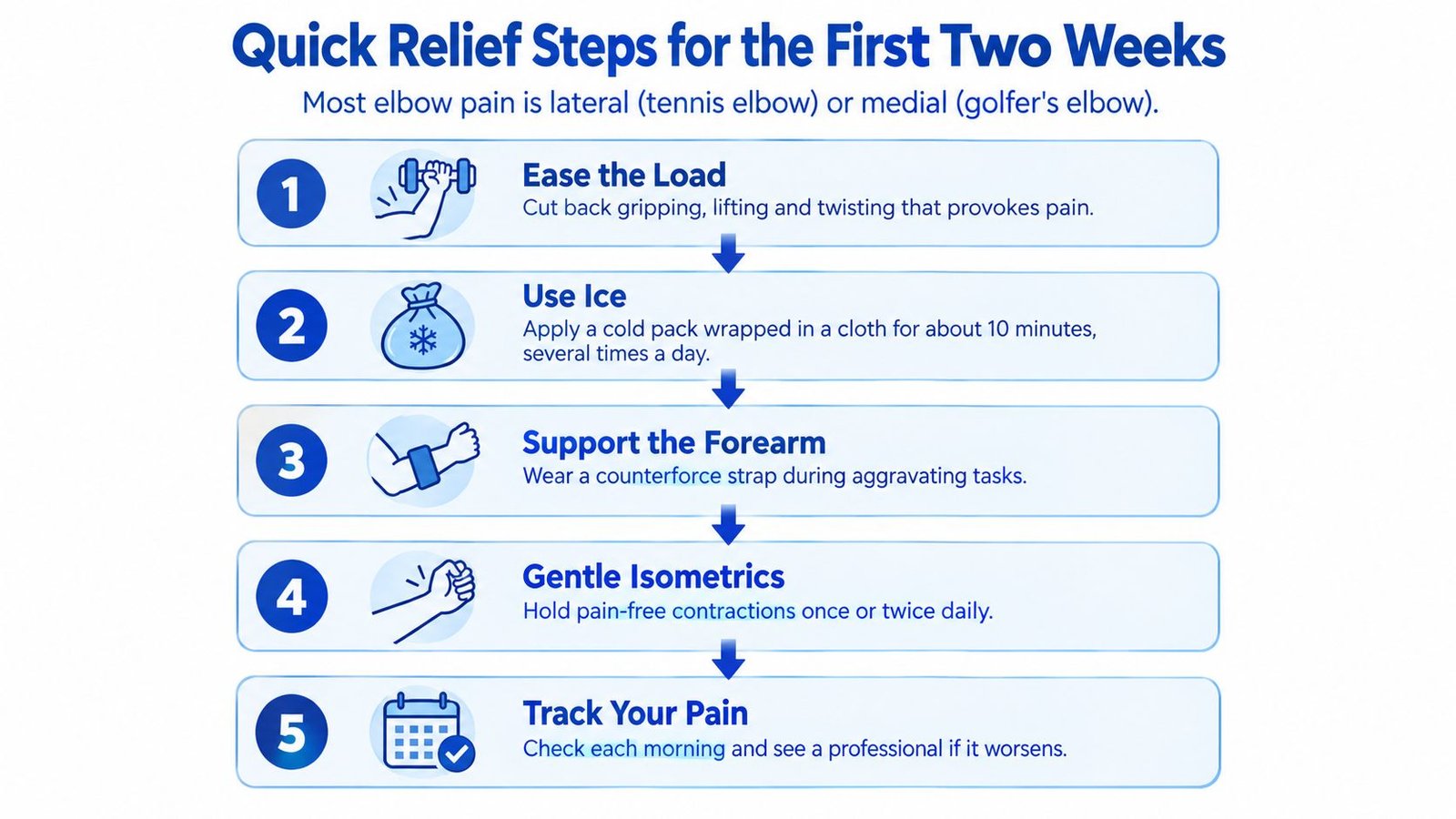
The first fourteen days
- Log three days of tasks. Note the job, the grip, and the pain score. You are hunting the one or two tasks that flare you, not labelling the whole arm as broken.
- Cap trigger tasks at 3/10. Under that line, the tendon is being loaded. Over it, you are picking at it.
- Break the aggravating job into short blocks. A pause between blocks beats one long bout that ends in a flare.
- Use a cool pack after a flare, not as treatment. Wrap it in a cloth and leave it on for about 10 minutes. It settles the ache. It does not repair tendon.
- Trial a counterforce strap only on the trigger task. Keep it if the score drops during that task. Take it off if it doesn't.
- Keep normal movement. Skip the sling, and don't rest the arm for days at a stretch. Comfortable movement protects the joint from stiffening.
- Check morning pain and grip on day 7. You want the morning score flat or lower, and a grip you can hold a little longer.
| Pain during activity | Action that day | Check |
|---|---|---|
| 0–3 out of 10 | Keep normal work and daily movement; add the strengthening program | Pain stays at 0–3 during the task |
| 4–6 out of 10 | Shorten or split the trigger task; take breaks; keep other arm use normal | Morning pain no worse than the day before |
| 7–10 out of 10 | Stop the trigger task for the day; cool pack for comfort; keep gentle movement | Pain drops below 6 within 2–3 days; if not, book an assessment |
Practical rule: A 0–3 task is a working task. A 7–10 task is finished for the day, even if the rest of the arm feels fine.
The routine is working when night pain eases and grip tolerance climbs from week to week. Ice that helps for an hour while the morning score stays put is comfort only. Treat it that way, and keep the tactics that move the morning number.
Strengthening and Stretching Exercises That Build Tendon Capacity
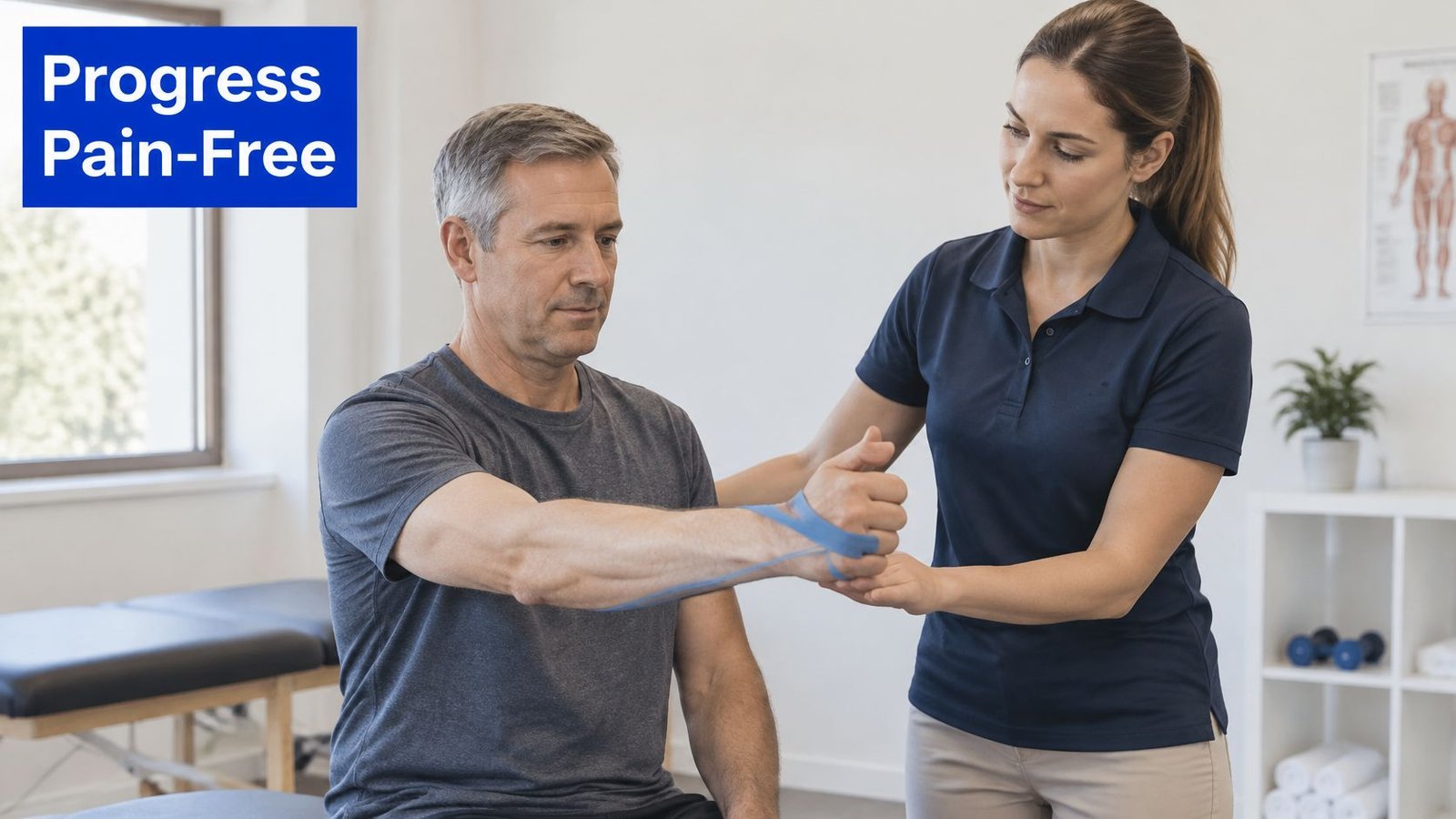
A tendon thickens its tolerance when you load it in doses it can settle from. Intensity is the wrong target. For Australian adults with lateral elbow tendinopathy, the first-line dose is progressive exercise about 2–3 sessions a week over 6–8 weeks, combined with activity changes and symptom-guided loading, as set out in this Griffith University evidence summary. In trials of people with about six weeks of symptoms, physiotherapy improved grip, pain, and function at six weeks compared with waiting. Pooled success versus wait-and-see was a risk ratio of 2.3 at 6–8 weeks, and only 1.1 at 52 weeks. The early gap shrinks. That is a reason to start exercise, not a reason to expect a miracle at one year.
Start with holds, then a slow lower, then grip and rotation. A light dumbbell, a water bottle, a towel, or a hammer handle is enough. Stretching stays comfortable and never sharp.
| Exercise | Starting dose | Progress when | Form note |
|---|---|---|---|
| Isometric wrist extension (palm down, push up against a table) | 5 x 30 seconds, once or twice daily | Holds 30 seconds with no pain increase | Push gently; wrist stays still |
| Eccentric wrist extension (palm down, lower a light weight, lift with the other hand) | 3 x 15, once daily | Pain under 3/10 during and next morning | Lower slowly over 3 seconds |
| Wrist flexor stretch (arm straight, palm up, gently bend wrist back) | 3 x 30 seconds, twice daily | Stretch feels comfortable, not sharp | Keep elbow straight and relaxed |
| Towel or putty grip squeeze | 3 x 10, once daily | Grip feels steady across the set | Squeeze to tolerance, not maximum |
| Forearm rotation with a hammer or light weight | 2 x 12, every second day | Movement is smooth and pain-free | Keep the elbow tucked at the side |
Move from isometrics or light isotonic wrist-extensor work toward real gripping. Reassess on pain, strength, and what tasks you can finish, not on a demand for zero pain.
The video shows the wrist-extensor lowering pattern. Match the tempo to the table, and stop the set if the next morning is worse than today.
Two errors that stall most people
The first error is adding weight the day the ache fades. Early ease is not new capacity. Hold the same load until the set and the next morning both stay inside your limit, then add a little.
The second is scrapping the program inside a fortnight. The protocol is built across 6–8 weeks. A short, specific session you finish beats an ambitious one you skip. If pain, grip, or task tolerance is not shifting across that window, the elbow needs a fresh look, because outer-elbow pain is not always a tendon.
Changing Tasks and Workstations That Aggravate Your Elbow
Say you carry two shopping bags, palm down, and the outer elbow bites halfway to the car. The elbow didn't suddenly fail. That grip, held long enough, did. Change the task before you chase another treatment.
Common triggers to audit this week:
- Palm-down shopping and heavy bags. The wrist extensors stay on for the whole walk.
- Vacuuming and gardening with a clenched hand. A tight grip on a thin handle multiplies load.
- Vibrating tools. Drills, impact drivers, and leaf blowers add shock on top of grip.
- A mouse parked far from your body. You reach, the wrist bends, and the forearm never rests.
At a desk, keep the elbows near a right angle, forearms supported, and wrists straight. Put the mouse at the same height as the keyboard. Hold the phone at eye level instead of pinning it between shoulder and ear.
A remote worker on a couch with a laptop for four hours is loading the elbow with an unsupported forearm and a bent wrist. Raise the screen, support the forearm on a cushion or desk, and split the session into 20-minute blocks. A tradesperson whose impact driver stays in the same fist all day should switch the carrying hand, fit a larger padded handle where the tool allows, and break repeated fixing into shorter runs. The same idea sits behind how to prevent repetitive strain: shorten the dose of the aggravating pattern, don't wait for the tendon to complain louder.
At night, don't bury the elbow into the pillow, and keep the arm supported so you aren't sleeping on the sore side.
Many people can change two or three things, not the whole job. Start with the single worst grip, then the mouse or tool handle, then which hand carries the load. Those three usually cut more tendon stress than a new chair.
Injections, Physiotherapy and Waiting Compared
Fast pain relief and a better elbow at one year are not the same outcome. A Brisbane community trial of 198 patients makes that split obvious.
| Option | Success at 6 weeks | Success at 52 weeks | Main trade-off |
|---|---|---|---|
| Wait and see | 27% | 90% | No procedure, but a slow start |
| Physiotherapy with home exercise | 65% | 94% | Needs 6–8 weeks of consistent exercise |
| Corticosteroid injection | 78% | 68% | Fast relief, weaker results at 52 weeks |
| Osteopathic manual therapy | Not reported | Not reported | Can support exercise; trials rarely isolate it for elbow pain |
The injection row is the only one that falls between the two time points. Waiting starts slowly and finishes strongly. Exercise starts better than waiting and finishes at a similar high rate.
An individual-patient analysis of two randomised trials, 383 participants, found corticosteroid injections statistically and clinically better at six weeks, then significantly worse than both wait-and-see care and physiotherapy at 52 weeks, in this Griffith University trial analysis. Australian guidance puts the injection effect at about 4–6 weeks of pain relief, with long-term results likely worse than natural improvement or physiotherapy. An injection can turn pain down without improving the tendon's course, and it can be tied to a poorer year.
When an injection is even a discussion
I would not use an injection as the plan. I would discuss one with a GP or specialist only when pain is severe and a hard deadline is real, and only beside an exercise program, never instead of one. Prolonged rest is the other trap. Comfortable movement stays in, and tasks that spike pain stay out.
If you need the arm quieter for a few weeks, say so. Don't pretend that quieter week is the tendon getting stronger.
Some people look at shockwave therapy after a solid block of exercise has not restored work tolerance. Treat that as an extra conversation with your clinician, not a shortcut around loading. Manual therapy can sit alongside exercise. These trials don't isolate it, so it shouldn't be sold as the thing that fixes the tendon on its own.
What Osteopathic Treatment Adds for Elbow Pain at Bayside
The sore spot is rarely the only stiff spot. Grip load travels through the wrist, the elbow, the shoulder, the upper back, and the neck. An osteopath checks how that chain moves, instead of rubbing the outer elbow and sending you home.

What the first visit actually covers
You start with the task and the pain pattern: what you grip, when it bites, and what the night is like. Next is a movement and grip check, including the neck and upper back if turning your head changes the arm. You should leave with a plain explanation and a home program that matches the holds, lowering work, and grip doses above, scaled to your 3/10 limit.
Hands-on care is specific. Soft-tissue work eases the forearm muscles that stay clenched. Gentle joint articulation at the elbow and wrist restores motion you have been guarding. Mobilisation of the neck and upper back is for restriction that is feeding the arm, not as a routine add-on.
What hands-on care cannot claim
Manual techniques may ease symptoms in the short term. No single hands-on method has been shown to be consistently better for chronic lateral elbow tendinopathy. I would use hands-on care to make the exercise tolerable, not as a replacement for it. Judge each appointment by whether it lets you load more within your 3/10 limit over the following days. Relief on the table is a bonus. The 6–12 month recovery window runs on loading, not on how the elbow feels when you walk out. At Bayside Osteopathic Health that means the treatment and the home loading are one plan.
On cost: Medicare eligibility depends on your circumstances and the type of plan involved, so ask the clinic which Medicare options, if any, apply to you before you book, and check your health fund's cover.
Red Flags That Need a Professional Assessment
Home care is for pain that is improving or holding steady. Anything on the list below needs a professional to look at the arm before you add more exercise.

- No change after 6–8 weeks of real loading. Consistent sessions, not a few tries, and the scores are flat.
- Night pain that wakes you. That is different from stiffness when you roll over.
- Numbness or tingling in the fingers. Think neck or a nerve, including the radial nerve, not only the tendon.
- Weakness that makes you drop objects. Grip failure needs checking, not a heavier squeeze.
- Swelling, redness, warmth, or fever. Those can mark an inflammatory or infective problem.
- A bump, a change in shape, or sharp pain after a fall. Don't load a possible fracture or tear.
- Pain spreading into the shoulder or neck. The elbow may be the messenger.
- Pain on the inner elbow. That is a different tendon pattern and a different exercise bias.
Outer-elbow pain can reflect a neck, nerve, joint, or inflammatory problem. Atypical symptoms are why the diagnosis should be reviewed rather than assumed. Start with your GP when the picture is unclear. Take a three-week log of tasks and pain scores so the visit is about your pattern, not a vague "it hurts when I use it".
Build a Four-Week Home-Care Plan
A home program only counts if you can measure it. In an Australian adherence study, participants completed 87% of prescribed exercise sessions, averaging five of seven a week, reported alongside a 12-month trial in this Griffith University conservative-care trial. In that trial, physiotherapy produced a greater reduction in the Patient-Rated Tennis Elbow Evaluation than prolotherapy at 12 weeks, even where later results drew closer. Early, frequent loading is the part you can copy at home. Don't judge the month as a failure, and don't jump the load the week the ache settles. A meaningful rehabilitation window runs about 6–12 weeks.
| Week | Focus | Sessions | Check |
|---|---|---|---|
| Week 1 | Settle pain, change trigger tasks, isometric holds | Daily | Morning pain at or under 3/10 |
| Week 2 | Add eccentric wrist extension at a light load | At least 3 a week | Pain under 3/10 during and next morning |
| Week 3 | Add grip work and increase load gradually | At least 3 a week | Grip tolerance rises; no night pain |
| Week 4 | Graded return to tasks; formal review | 2–3 a week | Pain and task tolerance falling; book assessment if no change by week 6–8 |
Week 1 is task change plus the tabletop holds, once a day. Week 2 adds the slow lower, 3 sets of 15, at least three days, still under 3/10 in the set and the next morning. Week 3 brings in the towel or putty squeeze and a small load increase, only if grip tolerance is rising and night pain has gone. Week 4 is a graded return to the trigger task, not a full dump of your old workload.
Keep one log: sessions finished, daily pain, and a grip note (a bag, a jar, a tool). That same page is what you take to a GP or physiotherapy visit. A written home exercise program beats a verbal list you half remember.
When you stop self-managing
At week 4, night pain and task pain should be falling. If nothing meaningful has changed by weeks 6–8, book an assessment rather than inventing a harder version of the same exercises.
Relief is the start of recovery, not the finish.
If any red flag applies, book a GP or specialist review first. If the elbow is stable but not improving, book an assessment that pairs hands-on care with a personalised home program, and check Medicare eligibility before the visit.
Bayside Osteopathic Health looks at elbow pain through how the arm, neck, and upper back share load, then combines gentle hands-on treatment with exercise and task changes you can run at home. If grip and lifting are still lagging, or you want a plan that separates a quiet week from real tendon recovery, visit Bayside Osteopathic Health to book and ask about Medicare cover before you attend.