
Your wrist is sore by mid-morning. Your forearm feels tight after a few emails. By the end of the day, your neck joins in, and now even scrolling on your phone feels irritating. That's how repetitive strain injury often starts. Not with one dramatic injury, but with a slow build of warning signs that people try to work through until simple tasks stop feeling simple.
The good news is that repetitive strain injury treatment usually doesn't begin with anything extreme. In most cases, recovery starts with a clear plan. Calm the irritated tissue down, stop feeding the problem, restore movement, rebuild tolerance, and change the setup that caused it in the first place. If you understand that sequence, treatment feels much less confusing.
Table of Contents
- What Is Repetitive Strain Injury and Why Does It Happen
- Your First Steps for RSI Relief at Home
- Targeted Exercises and Stretches to Restore Movement
- Creating a Strain-Free Workspace and Routine
- How Professional Hands-On Therapies Can Help
- Building Your Recovery Plan and When to See a Specialist
What Is Repetitive Strain Injury and Why Does It Happen
Repetitive strain injury, often shortened to RSI, is an umbrella term for pain and irritation that develops when the same tissues are loaded again and again without enough variation or recovery. It can affect muscles, tendons, tendon sheaths, and nerves. Common areas include the wrist, hand, forearm, elbow, shoulder, and neck.
A useful way to think about it is a rope rubbing over the same edge every day. One pass won't do much. Repeated friction starts to roughen the fibres. Keep going, and the rope begins to fray. Your body behaves in a similar way when a movement is repeated too often, held too long, or performed with poor support.
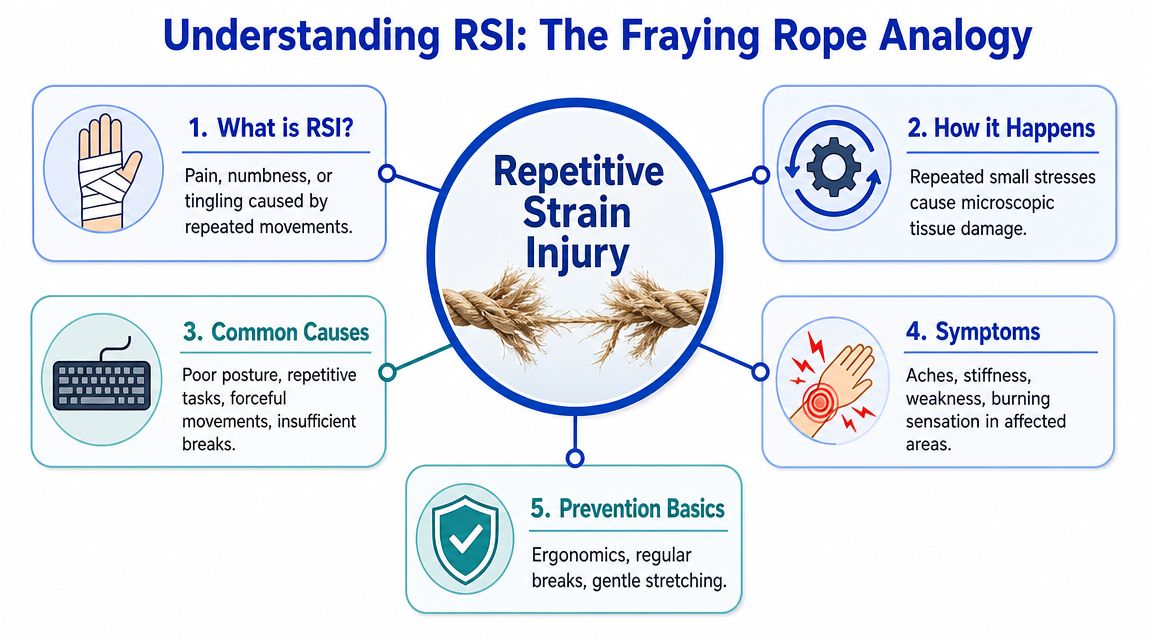
The fraying rope problem
Some RSIs are more specific, such as tendon irritation or carpal tunnel syndrome. Others are less tidy. A person may have aching, burning, tightness, weakness, or tingling without one neat diagnostic label. Both patterns are real. Both deserve attention.
Symptoms often creep in gradually:
- Aching after activity that settles overnight, at least early on
- Stiffness first thing or after work when tissues have been held in one position
- Tingling or numbness if a nerve is getting irritated
- Loss of grip or endurance when the forearm and hand have had enough
- Pain spreading up or down the arm because nearby areas start compensating
RSI usually isn't a sign that your body is fragile. It's a sign that the current load is more than the tissue can manage right now.
What tends to trigger it
The usual culprits are ordinary things done too often, too long, or with too little variation. Desk work is a classic example. So is heavy mouse use, prolonged laptop posture, phone scrolling, gaming, tool use, hairdressing, music practice, and repetitive lifting.
The biggest risk factors are usually a combination of load and context:
| Factor | Why it matters |
|---|---|
| Static posture | Holding the same position reduces movement variety and increases local fatigue |
| High repetition | Tissues don't get enough time to recover between efforts |
| Poor workstation setup | The wrist, shoulder, or neck works harder than it needs to |
| Forceful gripping | Tendons and forearm muscles stay under constant tension |
| Ignoring early symptoms | Mild irritation becomes a longer recovery problem |
This isn't a rare or trivial issue. In Australia, body stressing accounts for the largest share of serious workers' compensation claims, and there were 18,615 accepted claims involving injury from repetitive movement with low muscle loading in 2021–22, according to Safe Work Australia's workers' compensation statistics.
Your First Steps for RSI Relief at Home
You finish a normal workday, then notice your wrist or forearm is still throbbing an hour later. By the next morning, gripping a mug, using the mouse, or scrolling your phone all feel sharper than they should. That is usually the point where a simple strain starts needing a plan.
The first goal at home is to settle the flare without making the area weaker or stiffer. Good repetitive strain injury treatment starts with reducing irritation, keeping safe movement going, and avoiding the common mistake of swinging between overdoing it and total rest.

Use relative rest, not total shutdown
A common question is whether to stop completely or push through. In practice, relative rest works better for many RSI flares. That means you reduce or modify the activity that stirs symptoms up, while still using the area gently within a comfortable range.
The NHS advises against resting the affected area for more than a few days because too much rest can lead to weakness and stiffness, as explained in its guidance on repetitive strain injury. I see that trade-off often. Rest can calm things down in the short term, but too much of it makes the return to work, sport, or even normal daily tasks more frustrating.
Relative rest can look like:
- Shorter work blocks instead of one long typing session
- Changing the setup or tool such as using a more supportive mouse or adjusting desk height
- Rotating tasks so one joint or muscle group is not doing the same job for hours
- Pausing the clearest trigger like long gaming sessions, forceful gripping, or repetitive lifting
- Keeping easy movement going so the area does not become guarded
Practical rule: If an activity causes a clear spike in symptoms that lingers, cut it back. If gentle movement eases stiffness and settles soon after, keep it in.
A simple home care plan
For the first few days, keep the plan simple and repeatable.
Use ice if the area feels hot, irritated, or freshly aggravated after a task. Heat usually suits older, stiff, tight symptoms better, especially first thing in the morning. Some people do well with warmth before movement and a cool pack after heavier use. You do not need long sessions. A brief trial is enough to tell you whether it helps.
Short-term support can also be useful. A wrist splint, thumb support, or elbow strap can reduce aggravation while the tissue settles. The trade-off is that support should be temporary. If you rely on it all day for weeks, you can end up avoiding normal movement instead of rebuilding tolerance.
A steady at-home rhythm usually works better than a perfect one:
- Reduce the main trigger for a few days instead of pushing through it.
- Use symptom relief tools such as ice, heat, or a support if they clearly help.
- Keep gentle movement going in a pain-free or near pain-free range.
- Test the activity again gradually rather than returning to full volume at once.
If your RSI seems tied in with neck and shoulder tension, these neck pain relief exercises can be a useful starting point alongside local wrist or forearm care.
If you want a visual guide to gentle symptom management, this short video is a good place to start.
Targeted Exercises and Stretches to Restore Movement
Once the flare has settled a little, the next step is to restore movement without poking the injury. At this point, many people either do nothing, or do too much too soon. The middle ground works best. Gentle loading tells the tissue it's safe to function again.
The goal isn't to force a stretch. It's to improve tolerance. Start with light effort, small ranges, and clean technique.
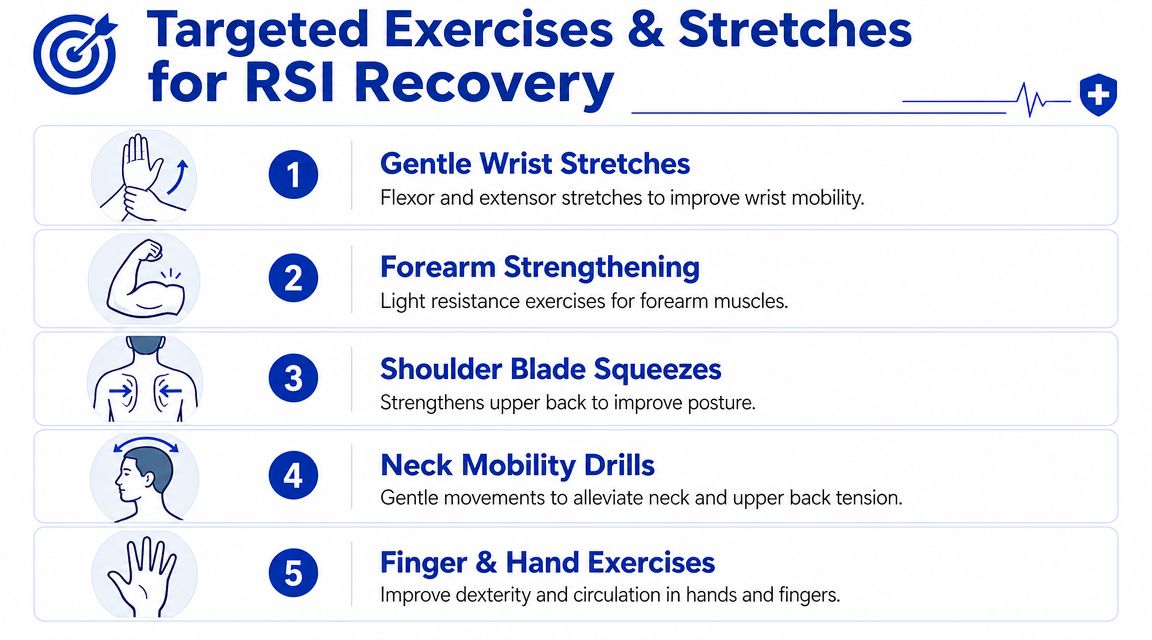
Wrist and forearm work
These drills suit common desk-related and gripping-related symptoms.
Wrist extensor stretch
Straighten the sore arm in front of you with the elbow soft, not locked. Bend the wrist so the fingers point down, then use the other hand to add a light stretch. You should feel it along the top of the forearm, not sharp pain in the wrist.
Progression
- Beginner: hold a light stretch briefly
- Intermediate: repeat it a few times through the day
- Advanced: add gentle forearm strengthening once stretching no longer flares symptoms
Wrist flexor stretch
Straighten the arm with palm up. Extend the wrist and fingers back with the other hand until you feel a stretch along the inner forearm.
Forearm strengthening
Use a very light object or no weight at all to begin. Rest the forearm on a table and slowly lift, then lower, the wrist. Start with controlled movement before adding resistance.
A few technical points matter more than people realise:
- Move slowly because fast reps often recruit more tension than control
- Stay below flare level because soreness that builds for hours afterwards is a sign the load was too high
- Train little and often because consistency beats occasional hard sessions
Neck and shoulder resets
Many hand and wrist complaints are made worse by a stiff upper back, rounded shoulders, or a neck that stays pushed forward all day. If the shoulder girdle isn't supporting the arm well, the forearm often picks up the slack.
Try these:
- Chin nod or neck retraction. Gently draw the head back as if making a double chin. Don't tip the head up.
- Shoulder blade squeeze. Draw the shoulder blades back and slightly down without arching the lower back.
- Gentle neck rotation. Turn the head left and right within a comfortable range.
- Median nerve glide. This should be taught carefully if nerve symptoms are present, because too much can irritate rather than help.
For people whose RSI overlaps with upper neck and shoulder tension, these neck pain relief exercises from Bayside Osteopathic Health can be a useful complement.
Keep exercises boring at first. Boring is good. Boring means repeatable, and repeatable is what helps tissue recover.
Creating a Strain-Free Workspace and Routine
A lot of RSI treatment fails because people focus only on the sore body part. They stretch the wrist, massage the forearm, maybe wear a brace, then sit back into the exact setup that irritated things in the first place. If the environment doesn't change, the tissue keeps getting the same message.
Australian workplace guidance has increasingly treated RSI as a systems problem, not just an individual one. WorkSafe Victoria's office health and safety guidance emphasises task variation, posture changes, and frequent micro-breaks. That shift matters. It means prevention isn't only about buying equipment. It's about changing how work is organised and how your body moves through the day.
What an ergonomic setup actually changes
A good setup reduces unnecessary strain. It doesn't create perfect posture, and it won't make you pain-proof. What it does is lower the background effort your muscles and tendons have to maintain for hours.
At a desk, the basics are straightforward:
| Workspace area | What to aim for |
|---|---|
| Monitor | Centre it in front of you so you're not constantly rotating or dropping your head |
| Keyboard and mouse | Keep them close enough that you're not reaching forward with the shoulders |
| Chair | Sit supported, with the shoulders relaxed rather than braced |
| Feet | Keep them supported so the rest of the body isn't working to stabilise you |
| Laptop use | Avoid long sessions hunched over the built-in screen and keyboard |
The same logic applies outside office work. A musician may need to change practice blocks. A tradesperson may need to vary grip and tool use. A hairdresser may need to change bench height or rotate tasks. Ergonomics is really load management made practical.
Micro-breaks and task variation matter more than people think
One of the most useful changes is also the least glamorous. Stop asking one area of the body to do the same thing for too long.
That can mean:
- Switching tasks regularly instead of batching all mouse-heavy work together
- Standing up briefly to reset the neck and upper back
- Changing hand position when safe and practical
- Using shortcuts or alternate input tools to reduce repetitive clicking
- Planning the day differently so the most aggravating tasks are split into smaller blocks
Some clinical commentary recommends building in frequent micro-breaks, with about ten minutes per hour often suggested as a practical benchmark for repetitive work. Even when people don't reach that exact pattern, the principle is sound. Variation protects tissue better than long unbroken effort.
How Professional Hands-On Therapies Can Help
Symptoms often reach a point where home care is no longer enough. A common pattern is wrist or forearm pain that settles for a day or two, then returns as soon as work, training, or device use picks up again. If the pain starts spreading, grip feels unreliable, or the sore spot keeps shifting, a proper assessment is usually the next sensible step.
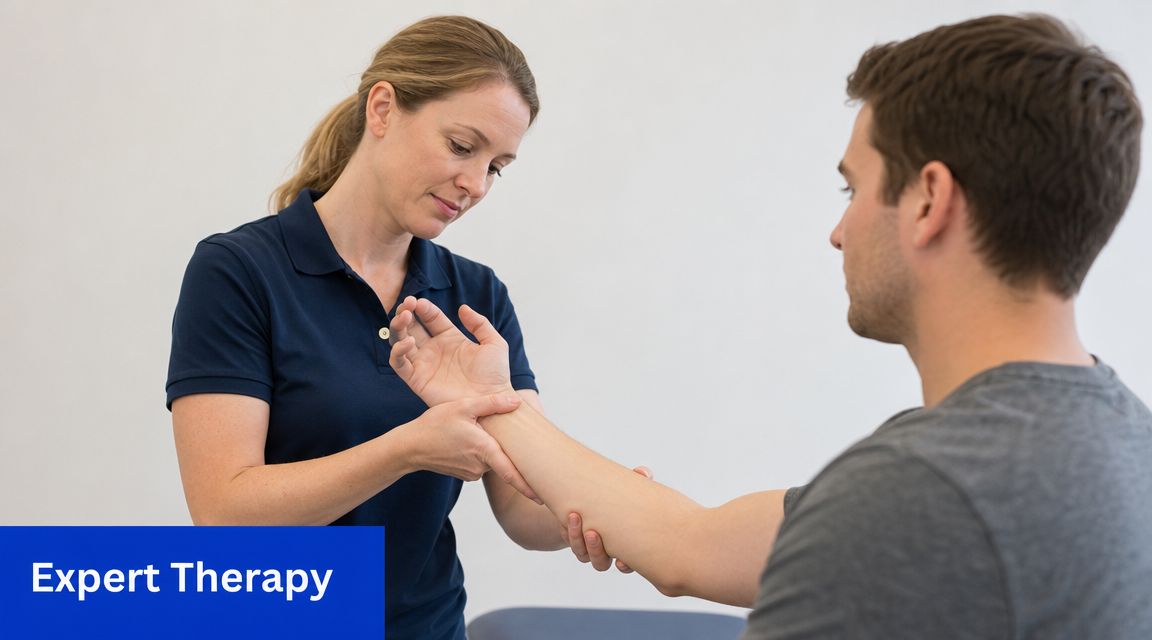
When self-care stops being enough
RSI is often a load problem across a chain, not just irritation at one painful point. The wrist may hurt first, but the forearm may be overworking, the shoulder may be poorly supported, the neck may be stiff, or the task itself may still be too dense and repetitive for the tissue to settle.
That is why hands-on care works best as part of a phased plan. First, calm the irritated area enough to make movement tolerable. Then identify what is keeping the tissue under strain. After that, rebuild capacity so the problem is less likely to return.
Australian workplace guidance supports that practical sequence. Reducing the aggravating task and changing the work setup matter, but persistent cases also benefit from skilled assessment of movement, tissue irritability, and possible nerve involvement. A useful example of that broader management approach appears in MaineHealth's explanation of repetitive strain injury management.
A good clinician should assess more than the sore area. They should work out:
- Which movements or positions trigger symptoms
- Whether the main problem looks like tendon, muscle, joint, or nerve irritation
- Which nearby areas are stiff, weak, or overworking
- How your work, sport, driving, sleep, or phone use may be adding load
- Why the symptoms keep flaring instead of settling
Hands-on treatment can reduce pain and improve movement, but lasting progress usually depends on changing the loading pattern as well.
What osteopathy adds
Different therapies can all help, but they have different strengths. Massage can be useful for short-term symptom relief and reducing muscle guarding. Physiotherapy often places a strong focus on rehabilitation and exercise progression. Osteopathy combines exercise advice and load management with hands-on treatment and a broader look at how the neck, shoulder, thoracic spine, elbow, wrist, and hand are working together.
In practice, an osteopathic session for RSI often includes testing painful movements, checking nearby joints, and assessing how you are using the whole upper limb during everyday tasks. Treatment may involve soft tissue work, joint mobilisation, articulation, and advice on pacing, positioning, or changing how a task is performed. The trade-off is simple. Passive care can help settle pain faster, but it should support active recovery, not replace it.
If you are weighing up which approach suits your situation, this guide to osteopathy vs physiotherapy explains the differences in practical terms.
One local option is Bayside Osteopathic Health, which provides hands-on osteopathic care, movement assessment, and self-management advice for people dealing with postural strain, joint stiffness, and repetitive use problems.
Building Your Recovery Plan and When to See a Specialist
You cut back for a few days, the pain settles, then it flares again the moment work gets busy. That stop-start pattern is common with RSI. Recovery usually goes better when there is a clear sequence: settle the irritation, restore movement, rebuild tolerance, then keep the problem from returning.
A simple framework works well here: Triage, Treat, Train, Thwart. It gives you a practical way to decide what to do now, what to add next, and when self-management is no longer enough.
Triage
Start by judging how reactive the area is today. Sharp pain, spreading symptoms, pins and needles, or new weakness are signs to reduce the aggravating task instead of pushing through and checking it repeatedly.
Useful questions include:
- Which movement, grip, or position brings symptoms on
- How long symptoms last once you stop
- Whether pain is staying local or travelling
- Whether sleep, grip strength, or coordination are changing
That snapshot matters. It helps you make sensible day-to-day decisions, and it gives a clinician much better information if you need an assessment.
Treat
Early treatment is about settling things without becoming reliant on passive fixes. Relative rest, temporary changes to workload, short-term support, and symptom relief strategies all have a place. The aim is to reduce irritation enough that you can start loading the area again in a controlled way.
For persistent cases, treatment usually follows a stepped approach. Conservative care comes first. Injections may help in selected situations, but they do not address the loading pattern that led to the problem. Surgery is usually reserved for uncommon cases where symptoms remain severe or there is a clearer structural issue.
A practical progression looks like this:
| Phase | Main focus |
|---|---|
| Acute flare | Calm symptoms and reduce aggravation |
| Early recovery | Restore comfortable movement and light use |
| Rebuild stage | Improve strength, endurance, and control |
| Return to normal use | Increase capacity and maintain better habits |
The trade-off is straightforward. If you rest too long, tissues lose capacity and ordinary tasks stay provocative. If you load too quickly, symptoms flare and confidence drops. Good treatment sits between those extremes.
Train
Once symptoms are less irritable, capacity becomes the main target. That means planned exercise with enough consistency to make a difference.
Desk-based workers often need endurance through the neck, shoulder girdle, and forearm, plus better variation during the day. Manual workers often need more grip tolerance, better force distribution through the upper limb, and changes to how repetitive tasks are performed. The exercises themselves matter, but so does matching them to the job or hobby that keeps stirring things up.
Recovery changes when your body can handle normal demand again.
Thwart
This stage is where relapse is prevented. Many people stop here too early because the pain has eased, but this is the point where the gains are protected.
To reduce the chance of another flare:
- Keep one or two key exercises in your weekly routine
- Review your setup after any change in desk, tools, hours, or workload
- Use pacing before symptoms spike
- Act on early warning signs such as tightness, tingling, or fatigue
- Get reviewed if the pattern shifts or becomes harder to settle
See a GP or specialist sooner if you notice persistent numbness, obvious weakness, loss of coordination, marked swelling, severe night pain, or symptoms that keep worsening despite sensible self-care. Those features need a closer look because not every arm or hand pain pattern is a straightforward RSI.
If you want hands-on assessment and a plan matched to your work and symptoms, an osteopath near you can help work out whether this is a load-management problem, a joint and soft tissue issue, or something that needs medical referral.
Australian patients can also ask their GP about a Chronic Disease Management plan if symptoms have become ongoing. In some cases, that can improve access to allied health care, including osteopathic treatment where appropriate.
If repetitive strain symptoms are making work, sleep, or daily tasks harder than they should be, Bayside Osteopathic Health offers hands-on care, movement assessment, and practical advice to help you reduce strain, restore mobility, and build a recovery plan that fits real life.