
If your knee or hip already aches, the usual line to "just move more" can sound careless. Rest feels safer. The gap is between those two instincts. Complete rest often stiffens the joint further, while a hard session can flare it for days. Useful joint pain relief exercises sit in the middle: enough load to feed the joint, not enough to irritate it.
Cartilage prefers repeated, gentle compression and release. Muscle around the joint takes some of the daily load. Blood flow improves when you keep a pace you can talk through. Over weeks, that mix usually eases morning stiffness more reliably than another day on the sofa.
Osteoarthritis affected an estimated 2.1 million Australians, or 8.3% of the population, in 2022, according to the Australian Institute of Health and Welfare osteoarthritis fact sheet. Prevalence was higher among females at 10% than males at 6.1%, and it commonly affects the hips, knees and ankles. Pain and stiffness rise with age, which is why a single circuit rarely fits every reader.
Match the exercise to the joint that complains, then use a clear stop-signal. The eight options below cover walking, water, cycling, tai chi, yoga, Pilates, strength holds, and daily mobility. Each has a starting dose, an easier version, and a reason to stop.
Table of Contents
- 1. Walking
- 2. Water-Based Exercise (Aquatic Therapy)
- 3. Stationary Cycling
- 4. Tai Chi
- 5. Gentle Yoga
- 6. Pilates (Modified Mat Pilates)
- 7. Isometric and Resistance-Band Strengthening
- 8. Range-of-Motion and Gentle Mobility Exercises
- Comparing the 8 joint-friendly exercises at a glance
- Building Your Routine, and Getting Extra Support
1. Walking
Walking is the aerobic option I start with for aching knees, hips and ankles, because the foot stays on the ground and the stride stays short. You are still bearing weight, so the joint gets the compression it needs, but you are not absorbing the repeated impact of running or a step class.
Say you can manage the shops but dread a long loop. Begin with 5 to 10 minutes on flat ground, most days. Add a couple of minutes only when the next morning feels no worse. Use the talk test: full sentences are fine, singing is not.
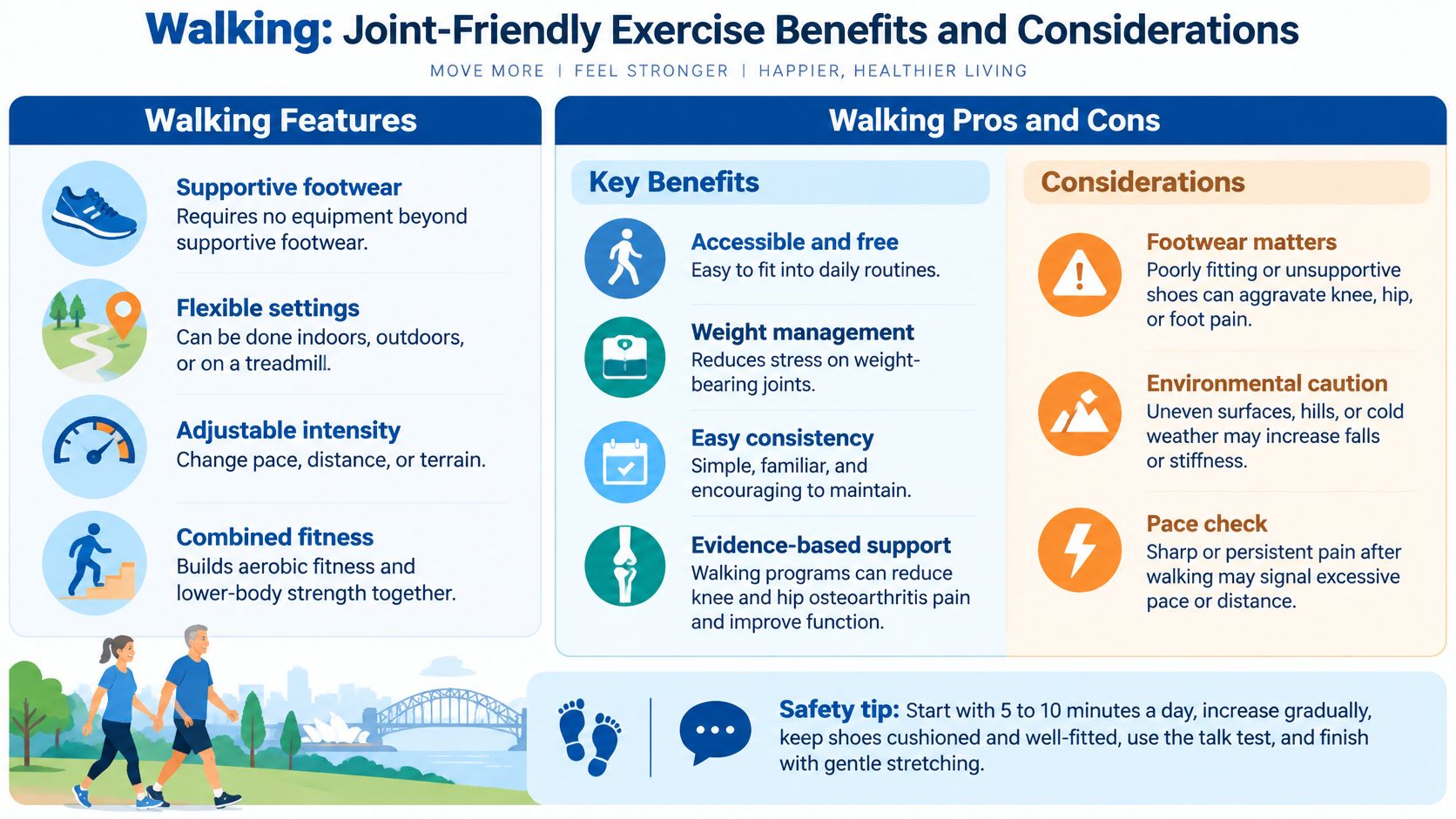
Nearly 9 in 10 Australians aged 65 and over, 89%, were insufficiently active in 2022 and also missed the muscle-strengthening part of the guidelines, the AIHW physical activity report notes. For that age group, insufficient activity means not completing at least 30 minutes on 5 or more days each week. Short walks are a practical way back toward that mark.
What to change when the knee objects
- Shoes: Cushioned, well-fitted pairs, replaced when the sole wears on one edge.
- Surface: Footpath or treadmill before hills, sand or uneven grass.
- Warm-up: Two minutes of slow steps, then a gentle calf and hip stretch after you finish.
- Stop-signal: Sharp pain under the kneecap, a hip that pinches with every step, or swelling that builds through the walk. Turn around. Do not "finish the loop" out of pride.
Community walking groups and the Arthritis Foundation's Walk With Ease style of session, with a warm-up and a cool-down, suit people who will not stick to a solo plan. What does not work is jumping from nothing to an hour because a good day felt easy.
2. Water-Based Exercise (Aquatic Therapy)
Pool work is the better aerobic choice when land walking loads a worn hip or a swollen knee too soon. Chest-depth or waist-depth water carries a large share of your body weight. You can bend, stride and turn while the joint stays supported, and the water resists you in every direction without a heavy weight in your hand.
Many therapy pools are warm, which loosens stiff muscle before you ask it to work. That matters on cold mornings, when a land session feels impossible before 10 am.
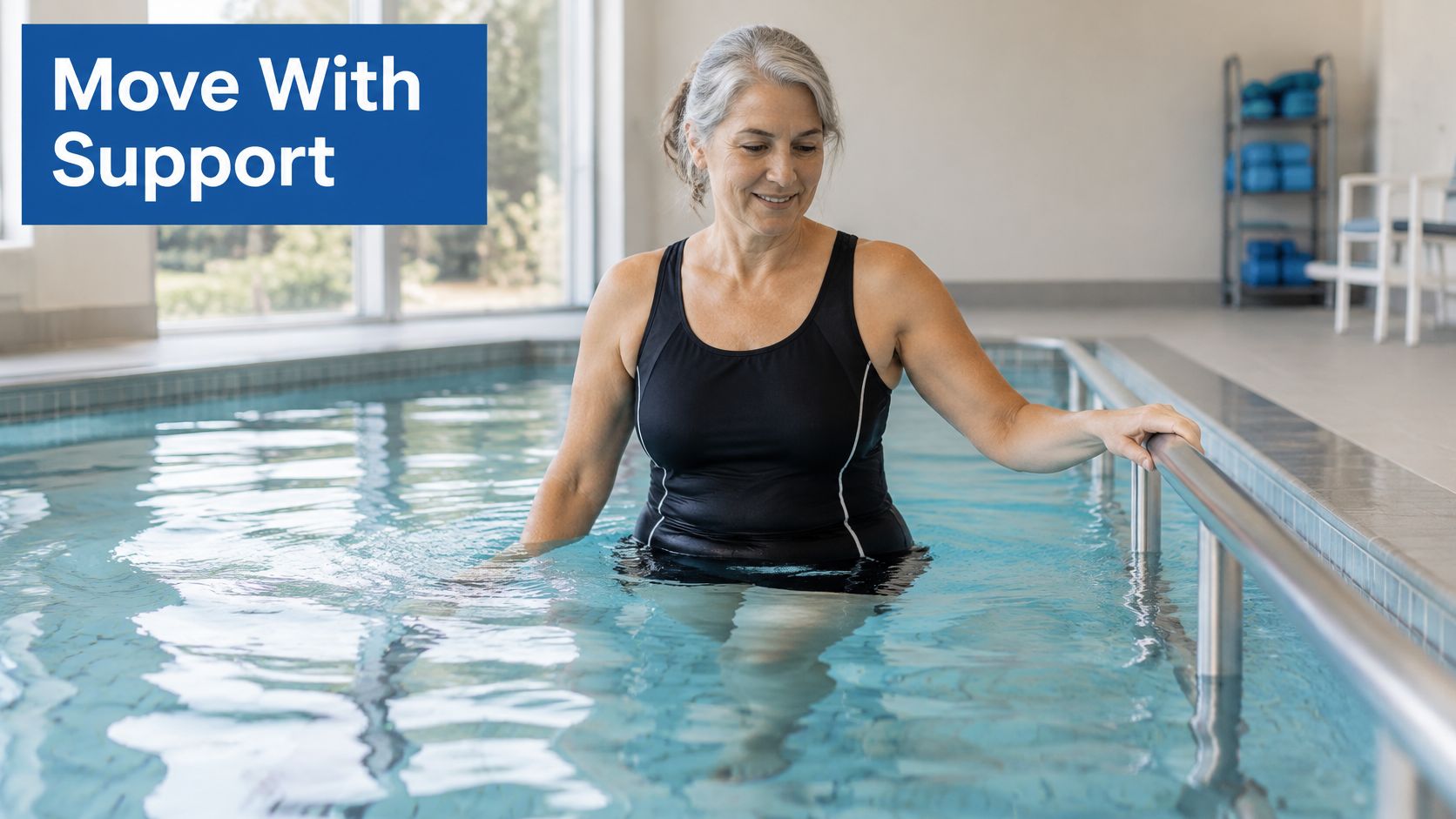
Flare-day choice: If the joint is sore but not hot or giving way, a slow pool walk often beats another rest day. Skip vigorous kicking if the hip pinches at the end of the kick.
A first session that stays kind
Keep the first visits to 20 to 30 minutes. Walk widths of the pool, march with high knees only as far as comfort allows, and draw slow circles with the ankle. Move inside a range you already own. The water should guide the limb, not yank it.
The Arthritis Foundation Aquatic Program, and similar classes run in community pools, give you an instructor and a rail. Physiotherapy and osteopathic rehab often use the same setting after a flare or surgery, because buoyancy lets you practise gait before full weight returns.
Stop if pain turns sharp, if you cannot put the foot down evenly, or if the joint is red, hot and swollen that day. A cold public pool with a slippery deck is a poor match for morning stiffness and uncertain balance. Warm water, a hand on the wall, and a shorter session win.
3. Stationary Cycling
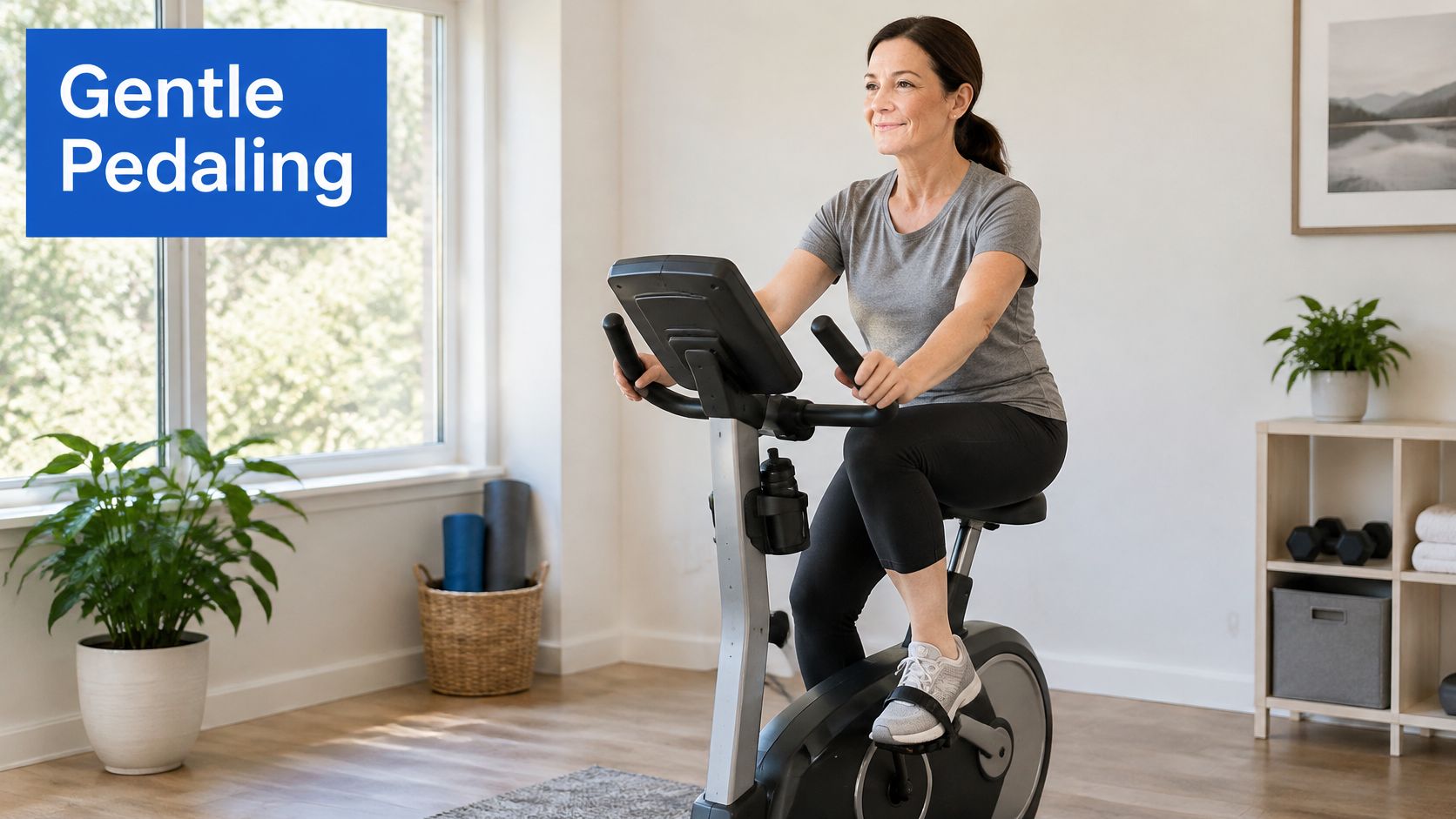
When standing hurts but the knee still bends, a bike lets you train the joint through a controlled arc while the seat carries your weight. Hips, knees and ankles share a smooth circle instead of a heel strike. Quadriceps, hamstrings and glutes do the work that steadies those joints on stairs.
Cardiac and arthritis rehab rooms use upright and recumbent bikes for this reason. If you sit at a desk all day, a low-resistance under-desk pedal for a few minutes is the same idea, scaled down.
Set-up that protects the knee
Set the seat so the knee stays slightly bent at the bottom of the stroke. A locked knee at the bottom is a common reason cycling "makes it worse". Start at low resistance for 5 to 10 minutes. Add time before you add gears. Keep the shoulders relaxed. Hunching over the bars just moves the ache into the neck.
A few minutes of backward pedalling, only if it feels easy, changes which part of the thigh works hardest. Skip it if the kneecap grinds.
Stop for stabbing pain at the front of the knee, a hip that catches at the top of the circle, or dizziness. Recumbent bikes suit people who cannot balance on an upright saddle or who need the back supported. What fails is cranking resistance so the workout "counts". Smooth circles at an easy gear build the joint up. Grinding a heavy gear does not.
4. Tai Chi
Tai chi suits a painful knee that also feels unsteady. The movements are slow weight shifts with soft knees, relaxed breathing and almost no impact. You train balance and coordination while the joint stays inside a small, repeatable range. It is one of the few practices that asks you to slow down on purpose.
Australian clinical guidance recommends land-based exercise, including walking, muscle strengthening and Tai Chi, for knee osteoarthritis, matched to preference, capability and the resources you have, as summarised in a survey of Australian physical therapists. In that survey of 1,064 therapists, 99% said they gave strengthening exercises all or most of the time, yet only 11% could name an accepted knee-osteoarthritis guideline. The movements are common. The dosing often is not. That is why a beginner class beats a random long form.
A short beginner video is enough to learn the stance before you join a group. Programmes such as Tai Ji Quan: Moving for Better Balance, used in senior centres, were built around fall prevention, which is the piece many knee patients also need. Pair that balance work with the progressions in our balance and stability exercises.
Practise 15 to 20 minutes on most days. Keep the knees soft. Never lock them as you shift weight. Use a chair or wall if a single-leg moment wobbles. Stop if the knee twists, the hip pinches, or you feel sharp pain rather than mild effort. Forcing a deep stance to look like the instructor is the mistake that undoes an otherwise gentle art.
5. Gentle Yoga
Gentle yoga is the mobility practice I favour when stiffness sits in the hips, the mid-back or the base of the neck, and a fast class would only make you brace. Restorative and chair styles use breath, props and small ranges. Depth is not the goal. Comfortable shape, held without strain, is.
Chair yoga in senior centres and rehab gyms is a fair model. A folded blanket under the knees, a block under the hand, or a strap around the foot lets the joint move without you hauling on it. Physical therapists often borrow the same shapes, a supported hip opener or a seated twist, to restore motion lost to sitting.
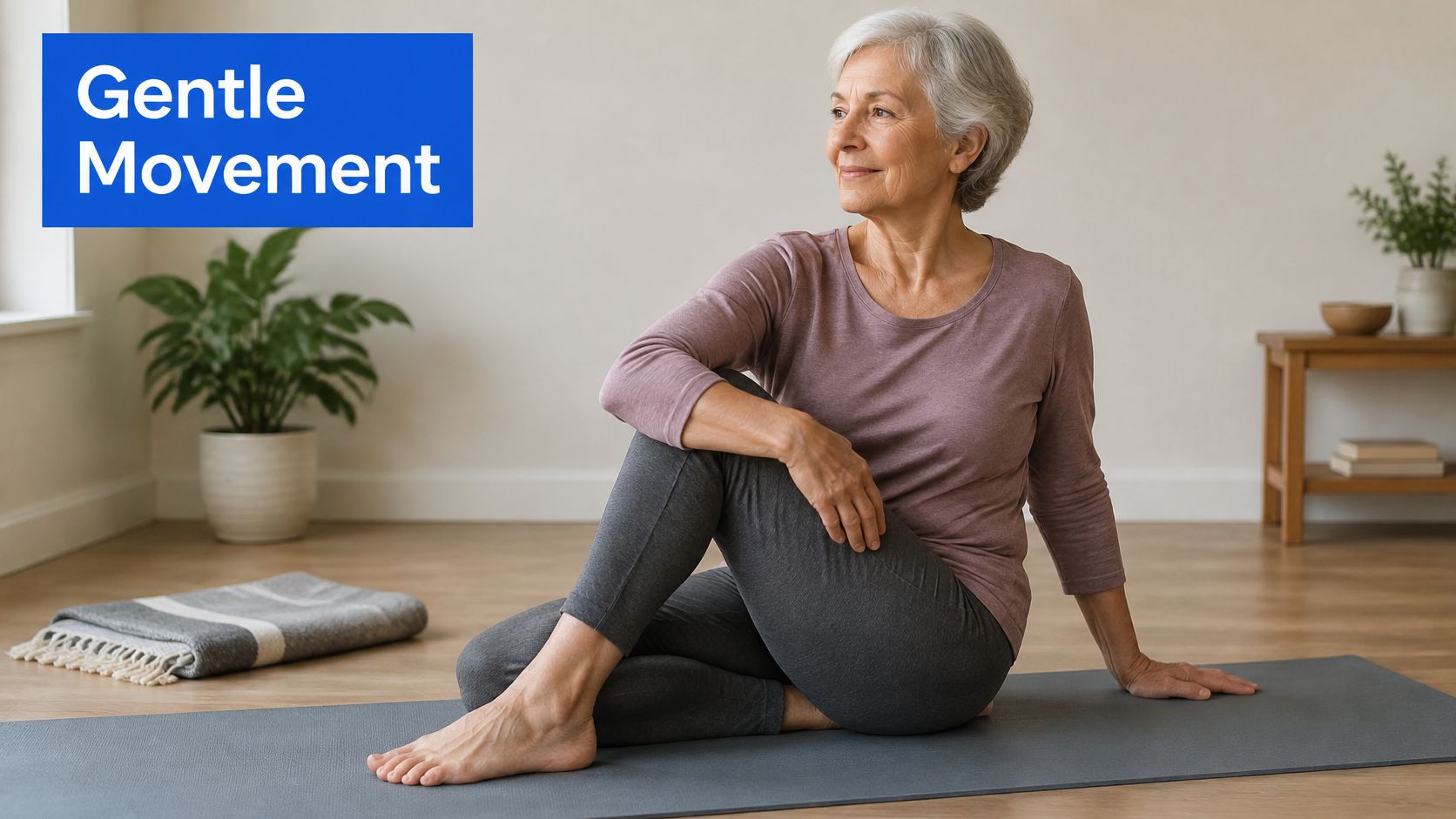
Choose the class label with care: gentle, restorative, chair or beginner. A "flow" class is a different workout, even if the room looks calm.
Tell the teacher about the joint before you start. In a hip-focused session, try a reclined figure-four only as far as the outer hip allows, then a knees-to-chest rock, five slow breaths each side. For the spine, a seated twist should rotate from the ribs, not by yanking the neck.
Stop any shape that produces sharp or joint-specific pain. Mild stretch that settles when you ease off is acceptable. Numbness, a pinch in the front of the hip, or pain that climbs through the hold is not. Props are not a concession. They are how you keep the exercise matched to a worn joint instead of to the person beside you.
6. Pilates (Modified Mat Pilates)
Modified mat Pilates is strength with the load kept low, aimed at the muscles that steady the spine, pelvis and hip. Pelvic tilts, leg slides and side-lying leg lifts teach you to move one segment while the rest stays quiet. People with back, hip or knee pain often feel less strain once that control shows up in walking and in getting out of a chair.
Physiotherapy clinics use this style for lower-back and pelvic work. Senior Pilates classes strip out the long-lever positions that overload a sore neck or a flexed wrist.
Both supervised and home-based exercise improve outcomes in knee osteoarthritis, but supervised exercise produced greater improvements in pain and disability than home exercise alone, with pooled effects of SMD -0.45 for pain and -0.28 for disability, in evidence summarised for the Osteoarthritis of the Knee Clinical Care Standard. Supervision here means exercise choice, dose and flare changes, not a pep talk. A hybrid works well: a few coached sessions, then a short home set. Our core stability exercises are a sensible home layer once the basics feel clear.
A starting trio
- Pelvic tilt: Lie with knees bent, gently flatten the lower back, hold two breaths, release. Eight times.
- Knee drops: Same position, lower one knee a short way out to the side, keep the other pelvis still. Six each side.
- Leg slide: Slide one heel away only as far as the back stays quiet, then draw it back.
Practise two or three times a week. A folded towel under the head or hips often removes the neck or back ache that makes people quit. Stop if pain shoots down a leg, the back locks, or you have to hold your breath to "engage". Speed and extra reps do not replace control.
7. Isometric and Resistance-Band Strengthening
When bending the joint hurts, strengthen it without bending it much. An isometric hold tightens the muscle while the joint stays still. A light band adds load you can grade by colour, not by ego. This is the strengthening half that walking alone does not cover, and it matters for knees, shoulders and hips that feel unreliable in daily tasks.
Quadriceps squeezes are a staple in knee osteoarthritis rehab. Lie or sit, tighten the thigh, press the back of the knee toward the surface, hold 5 to 10 seconds, repeat 5 to 10 times. You should see the kneecap draw slightly upward. Breathe. Breath-holding spikes effort and often spikes pain.
For a grumbly shoulder, a light band held at the elbow, rotating the forearm out a small distance, wakes the rotator cuff without a heavy overhead press. Stop if the pain is sharp at the front of the shoulder or if you shrug the ear toward the band.
A self-directed web exercise plan with text reminders, tested in 206 Australian adults with knee osteoarthritis over 24 weeks, improved exercise adherence by a mean 2.6 points on the Exercise Adherence Rating Scale (95% CI 0.8–4.4), in a trial published in JAMA Internal Medicine. Pain was tracked separately from whether people did the work. A simple log plus a reminder beats a perfect routine you abandon. If you want a written starting point, use a home exercise programme and review it around six and twelve weeks, not only when symptoms shout.
Choose the lightest band that still makes the muscle work by the last repetition. Confirm the menu with a clinician if pain is severe, new, or follows a sprain. What does not work is adding a harder band because last week's felt "too easy" while the joint is still warm and puffy.
8. Range-of-Motion and Gentle Mobility Exercises
Range-of-motion work is the daily base under every other exercise. Slow arcs, neck turns, shoulder circles, ankle pumps and seated knee straighteners, keep the joint lubricated and protect ordinary tasks: dressing, reaching a shelf, taking a stair. They are not a workout. They are how you stop a stiff morning from becoming a stiff week.
Office workers can do them at the desk. People with arthritis-related stiffness often do a shorter set before breakfast, when joints feel thickest.
Doses that stay inside comfort
- Each movement: 5 to 10 slow repetitions, smooth, not bounced.
- Neck and shoulders: Turn only as far as the movement stays even. Circles should be small if the shoulder clicks sharply.
- Ankles: Point and flex, then circle, especially if walking is your aerobic choice.
- Knees: Seated, straighten one leg as far as it goes without a jab, lower slowly.
- Spine: A gentle seated roll of the pelvis, or a small rotation, rather than a forced twist.
If extra or unusual pain lasts more than two hours after activity, the session was too much. Australian arthritis guidance calls this the two-hour pain rule, and it backs gentle movement in a flare while warning against force in the sore joint. Stop for pain that is unusual, sharp, or clearly worse than normal. A joint that is red, hot, swollen or severely painful is not a day for vigorous exercise.
The Arthritis Australia guidance on physical activity is the reference I use for that decision, not a push-through rule and not total rest. Set a reminder to move every 30 to 60 minutes of sitting. Mild discomfort that fades quickly can be normal adaptation. Pain that lingers, spreads or wakes you is a stop-signal, and the next session should be shorter or swapped for a supported version.
Comparing the 8 joint-friendly exercises at a glance
Match the row to the joint that flares. Knees often tolerate cycling and isometrics. Hips prefer water and tai chi. Shoulders need mobility before load. Ankles need range before speed. I would start at the lower time and hold it for a week.
| Exercise | Impact Level | Equipment Needed | Time Per Session | Best For |
|---|---|---|---|---|
| Walking | Low impact | Supportive footwear | Start with 5 to 10 minutes | Building aerobic fitness and supporting joint function |
| Water-Based Exercise (Aquatic Therapy) | Very low impact | Pool access | Start with 20 to 30 minutes | Exercising with significant joint pain or stiffness |
| Stationary Cycling | Minimal impact | Stationary bike | Start with 5 to 10 minutes | Building leg strength and fitness without standing |
| Tai Chi | Low impact | None; chair or wall for support if needed | 15 to 20 minutes | Improving balance, flexibility, and relaxation |
| Gentle Yoga | Low impact | Mat; optional blocks, straps, bolster, or chair | Start with 5 to 10 minutes | Gentle flexibility and mobility work adapted to different abilities |
| Pilates (Modified Mat Pilates) | Low impact | Mat; optional towel or cushion | Start with 5 to 10 minutes | Improving core strength, posture, and movement control |
| Isometric and Resistance-Band Strengthening | Very low impact | Resistance band for band exercises; none for isometrics | Start with 5 to 10 minutes | Strengthening muscles around painful joints |
| Range-of-Motion and Gentle Mobility Exercises | Low impact | None | 5 minutes daily | Easing stiffness and maintaining everyday mobility |
The lowest effective dose beats the most impressive session. Stop for sharp pain, new swelling, or pain clearly worse the next morning. A joint that is hot or gives way is not ready for more range.
Building Your Routine, and Getting Extra Support
Build a week you can repeat, not a perfect programme you abandon. Pick one aerobic option: walking, stationary cycling or water exercise. Pick one slower practice: tai chi, gentle yoga or modified Pilates. Add the range-of-motion set on the days you do nothing else. Start under what you think you can do. Add time or range only when the next day is no worse.
A workable first fortnight looks plain. Walk or cycle on three days, eight to twelve minutes. Do the slower practice twice, fifteen minutes, with a chair nearby. Spend five minutes on mobility every morning. Strength holds, the quadriceps squeeze or a light band, fit on two of the easier days. Write down what you did and how the joint felt two hours later. That log tells you more than a single "good" or "bad" label.
Exercise should ease stiffness across the week. Sharp pain, pain that keeps climbing, or pain that is still raised hours later is a signal to stop and get advice. Do not add load to prove you are improving.
Swap, do not quit, when a flare arrives. Shorter walks, slower arcs, a warm pool, or a hold with no movement still count. Force through a hot, swollen joint does not. If balance is poor, keep one hand on a bench for tai chi and for any single-leg moment. If grip or wrist pain rules out a band, stay with isometrics until that settles.
If flares keep shrinking what you can do, hands-on care can complement the home plan. At Bayside Osteopathic Health, arthritis and joint mobility care uses gentle joint articulation and movement coaching for arthritis-related stiffness. Treatment starts in the first session. We explain each technique, stay within your comfort, and send you home with a personalized plan and home-care exercises. We also prioritise prompt bookings when pain is acute or urgent. Osteopathic treatment should never be painful, though mild soreness can show up afterwards. Where it helps, we work with your GP or specialist.
You do not need all eight exercises at once. You need one option your knee or hip tolerates this week, a way to make it slightly easier tomorrow, and a reason to pause that you follow. If you want that plan checked against how you move, book an assessment, or join the newsletter for practical notes on osteopathy and everyday movement at Bayside Osteopathic Health.
Bayside Osteopathic Health offers gentle, hands-on osteopathic care for joint stiffness, arthritis-related discomfort and the movement limits that come with them, including soft-tissue work, joint articulation and a home plan you can repeat. If aching knees, hips or a stiff spine are steering your week, an assessment can match the exercises above to your joints and your current flare pattern. Visit Bayside Osteopathic Health to book or to join the newsletter for practical osteopathy and well-being notes.