
That persistent ache between your shoulder blades after a long day at the desk, the stiffness when you reach overhead, or the sense that your posture keeps collapsing by mid-afternoon often starts in the upper and middle back. This area supports the shoulder blades, helps the neck stay relaxed, and gives the thoracic spine enough control to handle sitting, lifting, reaching, and turning.
When these muscles lose endurance, other areas usually pay for it. The neck tightens, the chest feels stiff, and the shoulders drift forward. In Australia, back pain remains one of the most common long-term conditions, with the Australian Bureau of Statistics reporting that 25.0% of Australian adults had back pain in the 2022 National Health Survey. That's one reason upper middle back exercises have become such a standard part of conservative care.
From an osteopathic perspective, exercise works best when it matches the person in front of you. Some people need gentle activation before strengthening. Others need mobility, breathing control, or manual treatment first so the right muscles can switch on. The eight exercises below cover that full range, from very gentle options to stronger pulling movements, so you can choose what suits your symptoms, your joints, and your current stage of recovery.
Table of Contents
- 1. Prone Shoulder Blade Squeezes
- 2. Reverse Pec Deck Machine Exercise
- 3. Resistance Band Pull-Aparts
- 4. Bent-Over Dumbbell Rows
- 5. Face Pulls with Rope Attachment
- 6. Prone Snow Angels
- 7. Inverted Rows
- 8. Quadruped Scapular Reaches
- Upper Middle Back: 8-Exercise Comparison
- Your Path to a Stronger Back When to See an Osteopath
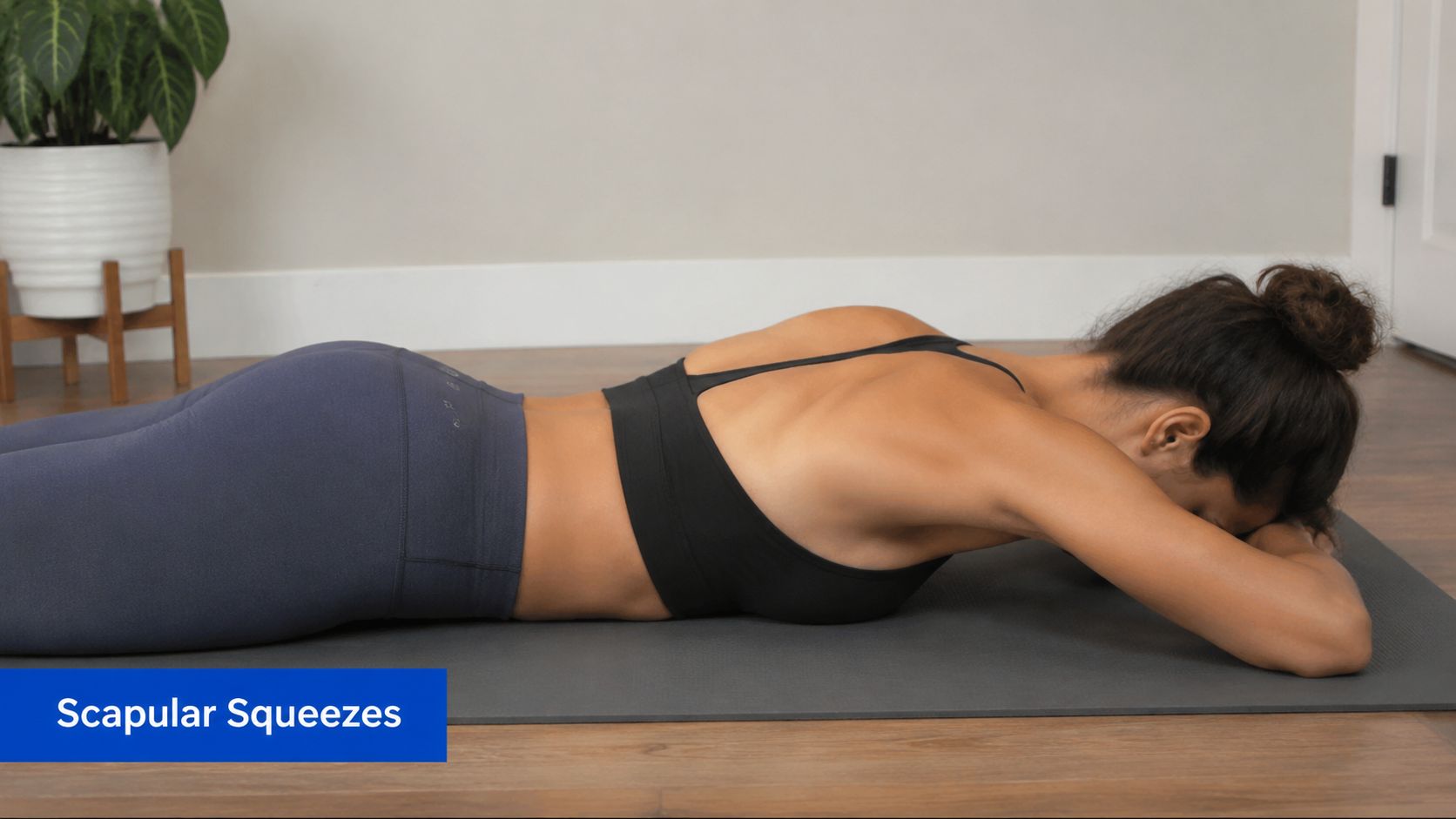
1. Prone Shoulder Blade Squeezes
This is one of the simplest upper middle back exercises, and it's often the right place to start when the area feels weak, irritated, or hard to control. Lie face down with your arms resting by your sides or bent gently near shoulder height. Without lifting the chest high off the floor, draw the shoulder blades slightly back and down, then relax.
For office workers with rounded shoulders, this can feel surprisingly hard. That's because the movement is small, but the demand on the rhomboids and middle trapezius is very specific. You're not trying to “pinch hard” with the neck. You're teaching the shoulder blades to sit better on the ribcage.
Why it works osteopathically
In clinic, I use this sort of movement when someone can't yet tolerate rows, bands, or gym work. It fits well after hands-on treatment because it reinforces a better resting position for the thoracic spine and shoulder girdle without adding much joint stress.
If you also carry a forward head posture, this exercise pairs well with broader postural work such as these practical strategies for forward head posture.
- Set-up: Rest your forehead on a folded towel so the neck stays neutral.
- Action: Gently bring the shoulder blades towards one another, then soften.
- Breathing: Breathe into the sides of the ribs instead of holding your breath.
Practical rule: If you feel more effort in the neck than between the shoulder blades, reduce the range.
A good real-world use is as a reset after computer work or driving. It won't build maximal strength, but it often improves awareness and endurance, which many people need before they need heavier resistance.
2. Reverse Pec Deck Machine Exercise
If your local gym has a reverse pec deck, this is one of the easiest ways to strengthen the upper middle back with controlled resistance. Sit tall against the pad, set the handles so your shoulders aren't overstretched at the start, and open the arms out and back with steady control. The machine guides the path, which helps people who struggle to keep their ribs, neck, and shoulders organised with free weights.
This movement suits people who want more support than a dumbbell row gives them. It's also useful after a period of pain, when confidence is low and technique falls apart under too much freedom.
Best use and common mistakes
The main osteopathic advantage is predictability. When someone has been guarding around the thoracic spine or shoulder blades, a machine can let them load the right area without worrying about balance or lower-back strain.
The common errors are easy to spot:
- Too much weight: The shoulders shrug and the movement turns into upper-trap gripping.
- Head poking forward: The neck starts doing work that should stay in the back of the shoulders.
- Rib flare: The chest lifts excessively and the thoracic spine loses control.
Done well, this feels broad and steady across the rear shoulders and between the shoulder blades, not sharp, pinchy, or neck-heavy.
For a Bayside gym-goer returning after a flare-up, I'd usually keep the first few sessions smooth and moderate rather than aggressive. This isn't the best choice for acute joint irritation in the shoulder, but it's often excellent once symptoms settle and you need a clean, repeatable strengthening pattern.
3. Resistance Band Pull-Aparts
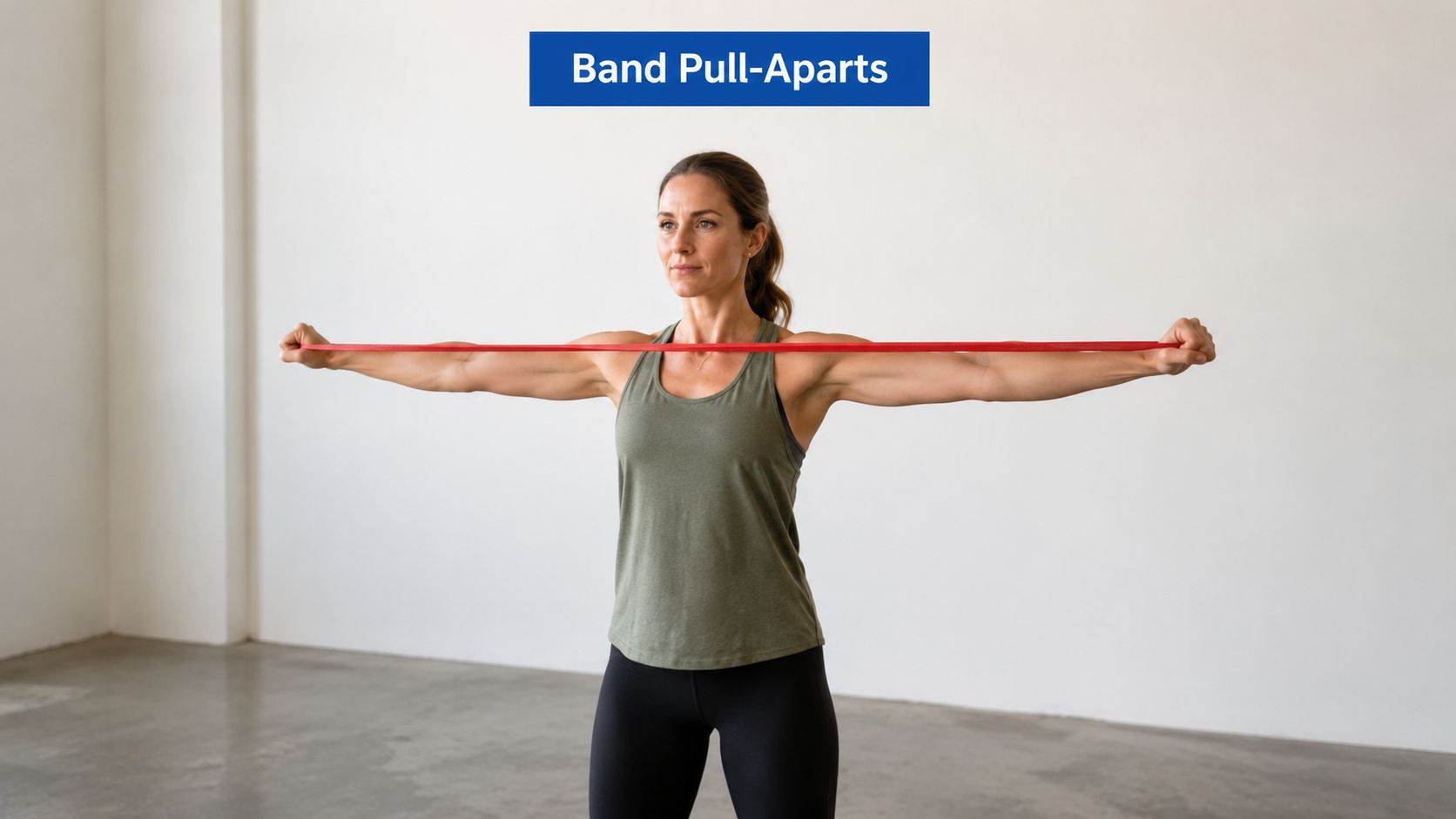
Resistance band pull-aparts are one of the most practical upper middle back exercises because they travel well, scale easily, and don't need much room. Hold a light to moderate band at about shoulder height, soften the elbows, and pull the band apart by moving the arms out while keeping the breastbone quiet and the neck relaxed.
For many people, this works better than fancy drills because they'll do it. It fits into lunch breaks, home programs, and the gap between appointments when you want a low-friction option.
Good modifications for arthritis and flare-ups
This is one of my preferred choices for older adults or anyone with arthritic stiffness because you can lower the demand without losing the pattern. Shorten the range. Use a lighter band. Perform the movement with the elbows slightly bent and the hands a little lower than shoulder height.
Australia's broader musculoskeletal burden helps explain why gentle, repeatable movements matter. The Australian Institute of Health and Welfare reports that 7.3 million people in Australia were living with a musculoskeletal condition in 2022, about 29% of the population, and these conditions accounted for 24% of the non-fatal disease burden in 2023.
- For desk strain: Do a few controlled reps after long periods of sitting.
- For arthritis: Use a soft band and stop well before pain builds.
- For shoulder stiffness: Keep the movement lower and slower.
What doesn't work is snapping the band apart or trying to turn it into a chest-opening stretch. The value is in controlled scapular movement. If the wrists ache or the fingers fatigue before the upper back works, loop the band around the hands rather than gripping it tightly.
4. Bent-Over Dumbbell Rows
If you want one exercise that gives you broad upper-back strength, this is hard to beat. Hinge at the hips, keep the spine long, let the dumbbells hang beneath you, and row the elbows back towards the ribs. The movement trains the upper and middle back alongside the lats and gives you strength that carries over to lifting, carrying, and pulling in daily life.
This isn't the first exercise I'd choose for everyone. But once someone has decent control and can hinge without provoking the lower back, rows become one of the most productive options in a program.
When heavier loading helps
The strongest case for rows is simple. In an ACE-sponsored EMG comparison, the bent-over row produced the highest activation in 3 of 5 measured back muscles and ranked second-best for the other 2. That makes it an efficient choice when you want broad recruitment rather than a tiny, isolated burn.
What works is a clean hinge, a quiet neck, and a brief squeeze at the top. What doesn't work is yanking the weight with momentum, rounding through the thoracic spine, or trying to pull the dumbbells too high.
A practical progression looks like this:
- Start lighter than your ego wants: Technique fails quickly when rows are too heavy.
- Use a bench if needed: One-hand supported rows reduce strain if your lower back tires first.
- Match load to recovery: If you've just had hands-on treatment and the tissues are still settling, hold off on heavy rows until your body feels ready.
This is a good exercise for someone moving from rehabilitation into full training. It's less ideal during an acute pain flare, especially if hinging forward itself is uncomfortable.
5. Face Pulls with Rope Attachment
Face pulls are one of the best choices when the upper back and the back of the shoulders need to work together. Set a cable at about upper-chest to face height, use a rope attachment, and pull the rope towards your face while letting the hands separate at the end. The movement should feel like the shoulder blades rotate and settle, not like you're wrenching the elbows back.
This exercise earns its place because it trains posture and shoulder mechanics at the same time. That makes it useful for people who carry tension from the base of the neck into the shoulders, especially after long hours at a screen.
A visual guide can help with timing and rope path:
How to make face pulls actually hit the upper back
The best face pulls are almost boring to watch. The ribs stay down, the chin stays level, and the rope comes back smoothly. If you lean away, jerk the cable, or shrug into the rep, the target area changes.
I often use this after treatment for neck and upper thoracic stiffness because it helps maintain improved shoulder blade motion without forcing a heavy load. It also pairs naturally with these neck pain relief exercises when the neck and upper back are both contributing.
Most people do face pulls too heavy. If you can't pause briefly at the end position, the load is probably excessive.
For a recreational athlete, face pulls work well in warm-ups and accessory blocks. For someone with acute shoulder irritation, cable height and range may need adjusting so the movement stays comfortable rather than pinchy.
6. Prone Snow Angels
Prone snow angels are gentler than they look. Lie face down, keep the forehead supported if needed, and slowly sweep the arms from your sides towards overhead in a wide arc, then return. The motion encourages the shoulder blades to upwardly rotate and the thoracic spine to participate without force.
This is a strong option when someone is stiff, guarded, or coming back from a flare-up. It blends mobility and low-load strength in the same drill, which is often exactly what the upper middle back needs.
When to use them after treatment
From an osteopathic perspective, this exercise is useful when manual treatment has improved movement, but the body still needs a safe way to keep that motion. It's especially helpful when the chest feels tight and the back of the ribcage feels hard to expand.
A few points matter more than reps:
- Support the head: A folded towel can stop the neck from overworking.
- Keep the range honest: Stop before the shoulders pinch or the lower back arches.
- Move slowly: Fast snow angels usually become arm swings, not quality scapular control.
This suits older adults and people with arthritis when the range is reduced and the pace is calm. It's not a strength-builder in the same way rows are, but it often restores confidence in overhead motion. In clinic, that matters because many people won't commit to strengthening until movement feels safe again.
7. Inverted Rows
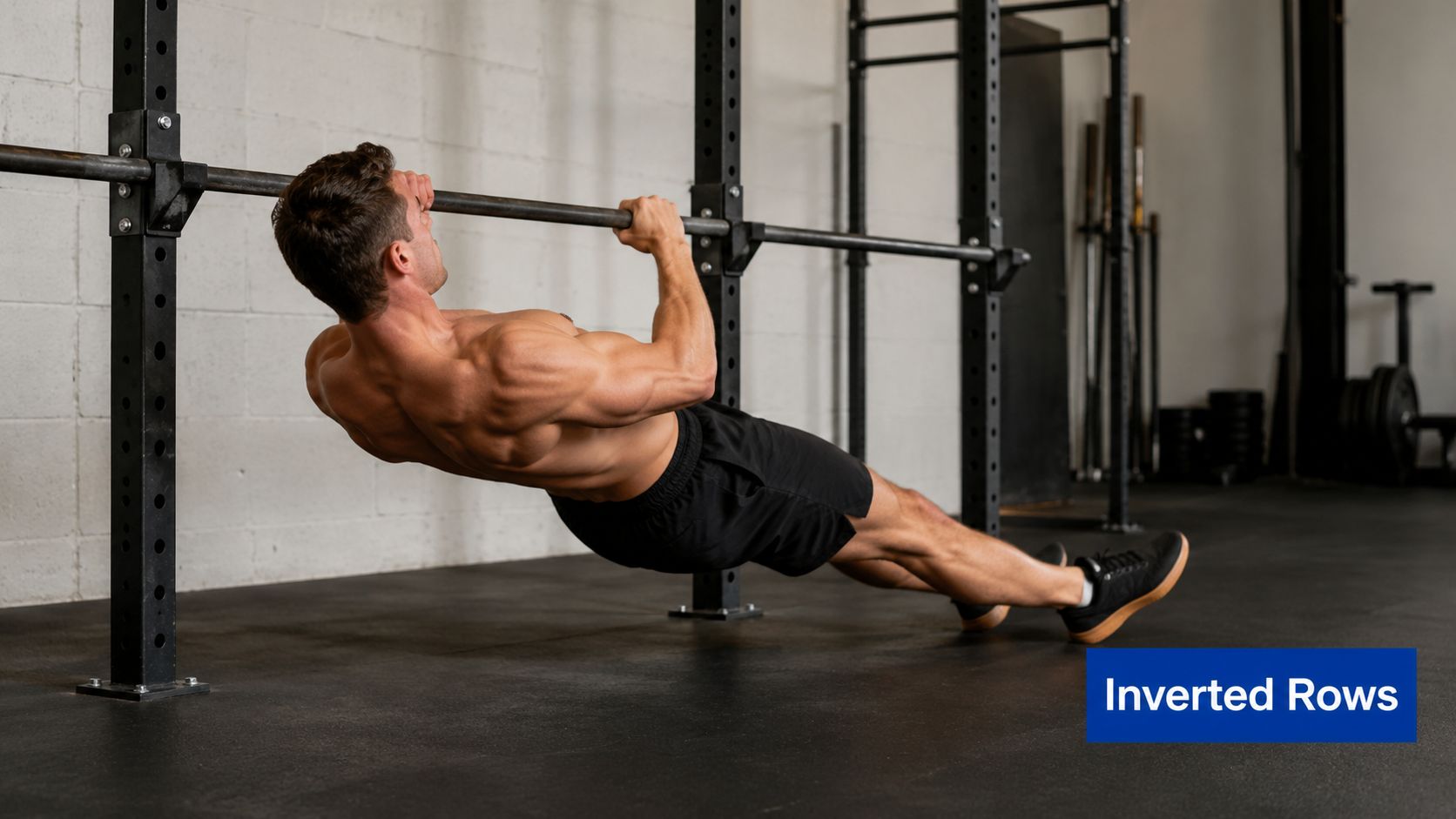
Inverted rows are a demanding bodyweight option. Set yourself under a fixed bar or Smith machine bar, hold the bar with the body in a straight line, and pull the chest towards the bar. Because the whole body has to stay organised, the upper back has to work alongside the trunk and glutes rather than in isolation.
That full-body demand is exactly why some people love them and others should leave them for later. If you already have decent strength and can control your shoulder blades under load, inverted rows are excellent. If your neck tenses, your lower back sags, or your elbows complain, they can become messy quickly.
Who should skip these for now
I wouldn't start an older adult with painful arthritic shoulders here. I also wouldn't choose this first for someone who's just had symptoms settle after a thoracic or neck flare. The load is adjustable by bar height, but it's still a stronger movement than it appears.
A better progression is often:
- Higher bar position: More upright body angle, less bodyweight to lift.
- Bent knees: Shortens the lever and makes control easier.
- Pause at the top: Briefly hold the shoulder blade position without craning the neck.
If you enjoy bodyweight training, this can pair nicely with guided movement work such as Pilates classes in Melbourne, especially when you're trying to improve trunk control as well as pulling strength.
What doesn't work is chasing difficulty too early. When the setup is too low, people usually compensate through the neck, elbows, or lower back. Better form at an easier angle is far more useful than a sloppy hard version.
8. Quadruped Scapular Reaches
This is one of the most overlooked upper middle back exercises, and for many people it's one of the most useful. Start on hands and knees with the spine neutral. Reach one arm forward without collapsing through the chest, then return. You can later add the opposite leg, but the arm reach alone is enough for many people at first.
The value here is control. Instead of training the shoulder blades in a rigid squeezed-back position, you teach them to stay stable while the arm moves. That's far closer to what real life demands.
Why this is often my starting point
In early rehabilitation, this is often the first exercise I prescribe because it's low-impact, easy to modify, and gives immediate feedback. If the trunk rotates or the chest drops, the person feels it straight away.
This also suits a broad group of people who are reluctant to exercise hard. That hesitation matters clinically. The verified brief notes that a 2024 Australian Institute of Health and Welfare report found 42% of adults over 65 in Australia avoid prescribed exercise due to fear of pain exacerbation, and a 2023 RACGP survey found 65% of Australian patients with chronic upper back pain request non-exercise, hands-on interventions first. The same brief notes that many online exercise lists don't offer enough pain-modified guidance, which is why gentler integrated options are so important in practice. The reference supplied for that gap is Healthline's upper back pain exercises page.
Start with the version you can control well. Progression only helps if the base movement stays clean.
A practical home version is to perform the reach near a mirror and watch whether the ribs twist. This isn't the flashiest exercise, but it often gives the best foundation for everything that comes later.
Upper Middle Back: 8-Exercise Comparison
| Exercise | Complexity 🔄 | Resources | Expected Outcomes ⭐📊 | Ideal Use Cases 💡 | Key Advantages ⚡ |
|---|---|---|---|---|---|
| Prone Shoulder Blade Squeezes (Scapular Retraction) | Low, simple isometric control | None (mat optional) | ⭐⭐ Improves scapular positioning and posture with consistent practice; limited hypertrophy | Office workers, beginners, post‑treatment home program | Low impact; easy to modify; reinforces manual corrections |
| Reverse Pec Deck Machine Exercise | Low–Moderate, machine guides technique | Gym machine required | ⭐⭐⭐⭐ High isolation strength and posture correction; measurable gains in weeks | Gym users, rehab with equipment, older adults needing controlled loads | Precise resistance control; safe isolation; efficient posture improvements |
| Resistance Band Pull‑Aparts | Low, easy progression and technique | Minimal, bands ($10–30), portable | ⭐⭐⭐ Improves scapular endurance and posture; modest strength gains | Home exercisers, budget‑conscious, frequent micro‑breaks | Highly accessible; progressive; low cost and portable |
| Bent‑Over Dumbbell Rows | Moderate, requires spinal control and technique | Dumbbells or gym access | ⭐⭐⭐⭐ Strong hypertrophy and functional strength; noticeable postural gains 4–8 weeks | Strength trainees, functional rehab, those seeking muscle development | Excellent overload potential; transfers to daily lifting tasks |
| Face Pulls with Rope Attachment | Moderate, requires cable setup and shoulder mechanics | Cable machine with rope | ⭐⭐⭐⭐ Excellent for shoulder health, external rotation and postural alignment | Athletes, shoulder rehab, gym users focused on injury prevention | Targets posterior shoulder complex; reduces injury risk; adaptable tempo |
| Prone Snow Angels (Prone Shoulder Blade Elevation) | Low, gentle full‑range movement | None (mat optional) | ⭐⭐ Improves shoulder mobility and coordinated activation; low strength effect | Early rehab, chronic pain management, older adults | Very low risk; combines mobility and gentle strengthening |
| Inverted Rows (Bodyweight Rowing) | Moderate–High, body control and setup required | Horizontal bar or rig | ⭐⭐⭐⭐ Strong bodyweight builder; rapid functional strength and endurance gains | Intermediate/advanced trainees, calisthenics, functional programs | High strength return for minimal equipment; scalable via leverage |
| Quadruped Scapular Reaches (Bird Dogs with Scapular Focus) | Low, controlled stability emphasis | None | ⭐⭐ Improves deep stabilizers, neuromuscular control and movement quality; subtle strength gains | Post‑treatment stability work, chronic pain, beginners | Safe for all levels; integrates core and scapular control; excellent osteopathy compatibility |
Your Path to a Stronger Back When to See an Osteopath
These exercises can make a real difference when they match your symptoms, your capacity, and your stage of recovery. If your upper back feels tight from sitting, a gentle option like prone shoulder blade squeezes, snow angels, or quadruped reaches may be the right start. If you're stronger and more settled, rows, face pulls, and machine work can build the endurance and strength that help posture last through the day.
The key is that not every sore upper back needs the same thing. Some people are weak through the middle trapezius and rhomboids. Others have enough strength but poor thoracic mobility, stiff ribs, irritated neck muscles, or shoulders that don't move well on the ribcage. In those cases, repeating exercises harder doesn't always fix the problem. It can just reinforce the compensation.
That's where an osteopathic approach helps. We don't only look at the spot that hurts. We assess how your thoracic spine moves, how your shoulder blades sit and glide, how your ribs expand with breathing, and whether your neck, lower back, or shoulders are taking over. Those details change which exercises are likely to help and which ones are likely to annoy things.
Hands-on treatment can also create a better starting point. If the joints through the upper back are stiff, the surrounding tissues are protective, or the shoulder girdle is moving unevenly, gentle mobilisation, articulation, and soft-tissue work can reduce the feeling of restriction. Then the right exercise becomes easier to perform well. That sequence matters more than many people realise.
This is especially true for people with arthritis, persistent postural strain, or pain that keeps returning after temporary improvement. You may need lower-load movement, more gradual progress, and clearer modification rules. You may also need to know when not to push. Sharp pain, increasing numbness, night pain, unexplained weakness, or symptoms that limit work, sleep, or daily tasks deserve assessment rather than guesswork.
Self-management is valuable, but it works best when it's specific. A personalised plan can tell you whether you need activation first, mobility first, strengthening first, or a blend of all three. It can also help you time exercise around treatment so you're not doing too much too soon or holding back longer than necessary.
If your progress has stalled, your symptoms keep returning, or you're unsure which of these upper middle back exercises fit your body, an osteopathic assessment can give you a clearer direction. The goal isn't just to reduce pain for a few days. It's to help you move with more ease, build confidence in your back again, and make your exercise routine work for you.
If your upper back, neck, or shoulders keep tightening despite stretching and exercise, Bayside Osteopathic Health can help you work out why. We provide gentle, hands-on osteopathic care with practical movement advice specific to your symptoms, your joints, and your daily routine, so you can build a stronger back with a plan that feels safe and realistic.