
Your back has been grumbling for months. Your neck tightens by the afternoon. Your hips feel stiff getting out of the car. Someone says, “You should try Pilates,” and that sounds sensible until you search for Pilates classes in Melbourne and get flooded with options.
Suddenly you're comparing reformer studios, mat classes, heated sessions, boutique memberships, app-based bookings, private instruction, and glossy promises about toning and sculpting. If you're already sore, stiff, or managing an old injury, that kind of choice doesn't feel exciting. It feels risky.
That's the part most studio marketing skips. Pilates can be useful for pain and mobility problems, but not every class is appropriate for every body. The safest question isn't “Which studio is popular?” It's “Which class can my body tolerate, learn from, and recover from?”
Table of Contents
- Finding the Right Pilates Class in a Crowded Melbourne Market
- How Pilates Can Help Your Pain and Improve Mobility
- Mat vs Reformer vs Clinical Pilates a Comparison
- How to Choose a Safe and Qualified Pilates Instructor
- Your Pre-Pilates Check An Osteopaths Role
- Supporting Your Progress and Managing Flare-Ups
- Frequently Asked Questions About Pilates in Melbourne
- Is Pilates good for chronic back or neck pain
- Should I start with reformer or mat Pilates
- Is heated Pilates a good choice for stiff joints
- How often should beginners do Pilates
- How do I know if a class is too hard
- Is Clinical Pilates better than general classes
- How much do Pilates classes in Melbourne really cost
- When should I get assessed before starting
Finding the Right Pilates Class in a Crowded Melbourne Market
A common pattern looks like this. Someone has persistent low back pain, shoulder tension, knee stiffness, or postural strain from office work. They've been told Pilates is “good for that,” so they open their phone and search for Pilates classes Melbourne. Within minutes, they're staring at dozens of studios and trying to guess which one is safe.
That confusion makes sense. Pilates demand surged sharply in Australia, with Forbes Australia reporting 250% growth in the 12 months to September 2022 on ClassPass data, making it the fastest-growing exercise genre, and Pilates venues working with ClassPass also increased by 50% in that period according to Forbes Australia's report on the Pilates boom. In a city like Melbourne, that kind of growth shows up as more choice, more marketing, and more variation in quality.
Melbourne's wider Pilates market is also substantial. IBISWorld estimated Australia's Pilates and Yoga Studios industry at $670.7 million in 2026, with 3,823 businesses nationwide, and reported business numbers grew at a 3.4% CAGR between 2021 and 2026, even while revenue declined at an estimated 3.9% CAGR over the five years through 2025–26, according to IBISWorld's Pilates and Yoga Studios industry profile.
Popular doesn't always mean suitable
If you're fit, pain-free, and confident with exercise, a busy group class may suit you well. If you have arthritis, reduced balance, recurring neck pain, or a back that flares when you twist, the wrong class can leave you sorer, more guarded, and less confident than when you started.
Practical rule: Choose Pilates by instruction quality, class style, and your current tolerance, not by décor, trends, or intro offers.
What to look for first
Before you compare suburbs or memberships, narrow the field with a few simple filters:
- Your main issue: Is it pain, stiffness, weakness, fear of movement, or general deconditioning?
- Your current tolerance: Can you get down to the floor easily? Kneel? Roll? Lie flat? Get up again without strain?
- The class environment: Do you need close supervision, slower pacing, or the option to stop and modify?
- The likely load: Is the class dynamic and athletic, or controlled and adaptable?
That shift in thinking changes everything. You stop shopping for the most impressive class and start looking for the one your body can use.
How Pilates Can Help Your Pain and Improve Mobility
Pilates gets marketed as a body-shaping workout, but that's only part of the story. For many people with pain or stiffness, its real value is that it trains control, awareness, and graduated loading. Those three things matter far more than whether a class feels intense.
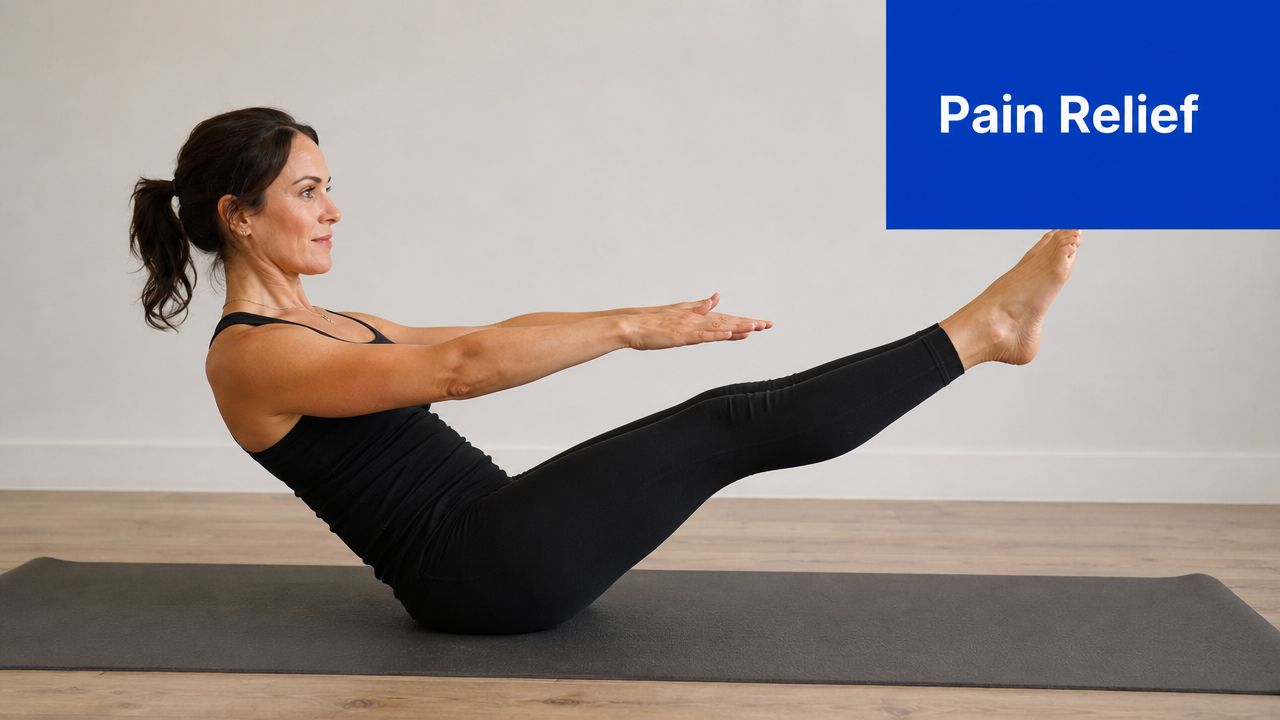
A key question often missed by studio marketing is whether Pilates is appropriate for people with persistent pain or arthritis. That matters in Victoria, where a substantial share of adults do not meet activity guidelines, making safe and accessible movement especially important, as discussed in this Victorian-focused Pilates suitability context.
It builds support, not just effort
When Pilates is taught well, it encourages you to organise movement around the trunk, pelvis, ribcage, and shoulder girdle rather than throwing your body through repetitions. People often describe this as “core work”, but clinically that phrase can be too vague.
A better way to think of it is an internal support system. Not a rigid brace, but a responsive one. Your deep trunk and hip muscles help create steadiness so the larger muscles can do their job without overgripping.
For someone with low back pain, that can mean learning how to hinge, rotate, breathe, and transfer weight without bracing every movement. For neck pain, it often means reducing the habit of leading everything with the upper traps and jaw. For stiff hips or knees, it can mean restoring confidence in simple controlled ranges before adding more challenge.
It improves body awareness
Pain changes behaviour. People guard, rush, hold their breath, or avoid one side without realising it. Pilates slows movement down enough for you to notice those patterns.
That matters because awareness often comes before improvement. If you can feel when you're gripping through your low back, collapsing through one hip, or shrugging during arm work, you've got a chance to change it.
A useful starting point is often simpler than people expect. Controlled pelvic movement, rib positioning, breathing, gentle spinal articulation, and supported leg work can all be more valuable than advanced choreography when pain has been persistent.
For readers dealing with low back irritation, these lower back pain relief exercises can help you understand the kind of gentle movement foundation that often pairs well with Pilates.
The best Pilates for pain doesn't feel impressive. It feels clear, repeatable, and manageable the next day.
It can restore trust in movement
People with chronic pain often stop moving in ways that once felt normal. They avoid bending, turning, pushing through the arms, or getting on and off the floor. Sometimes that's sensible in the short term. Over time, though, avoidance can make the body feel less capable.
Pilates can help reintroduce movement in a graded way. That might mean:
- Reducing fear of certain positions: such as lying on your back, rolling to the side, or shifting weight onto one leg
- Improving movement quality: so everyday tasks feel less abrupt and less effortful
- Rebuilding tolerance: with small, repeatable doses rather than pushing into a flare
What doesn't work
Pilates isn't automatically therapeutic just because it's low impact. It tends not to go well when:
- The class is too fast: You can't process cues, organise your position, and breathe properly.
- The instructor teaches one version only: No regressions, no options, no attention to symptoms.
- You chase fatigue instead of control: Burning muscles aren't the same as useful loading.
- Pain is treated as normal: Discomfort that settles is one thing. Sharp, escalating, or lingering pain is another.
For pain and mobility issues, the right dose matters more than the brand name on the studio wall.
Mat vs Reformer vs Clinical Pilates a Comparison
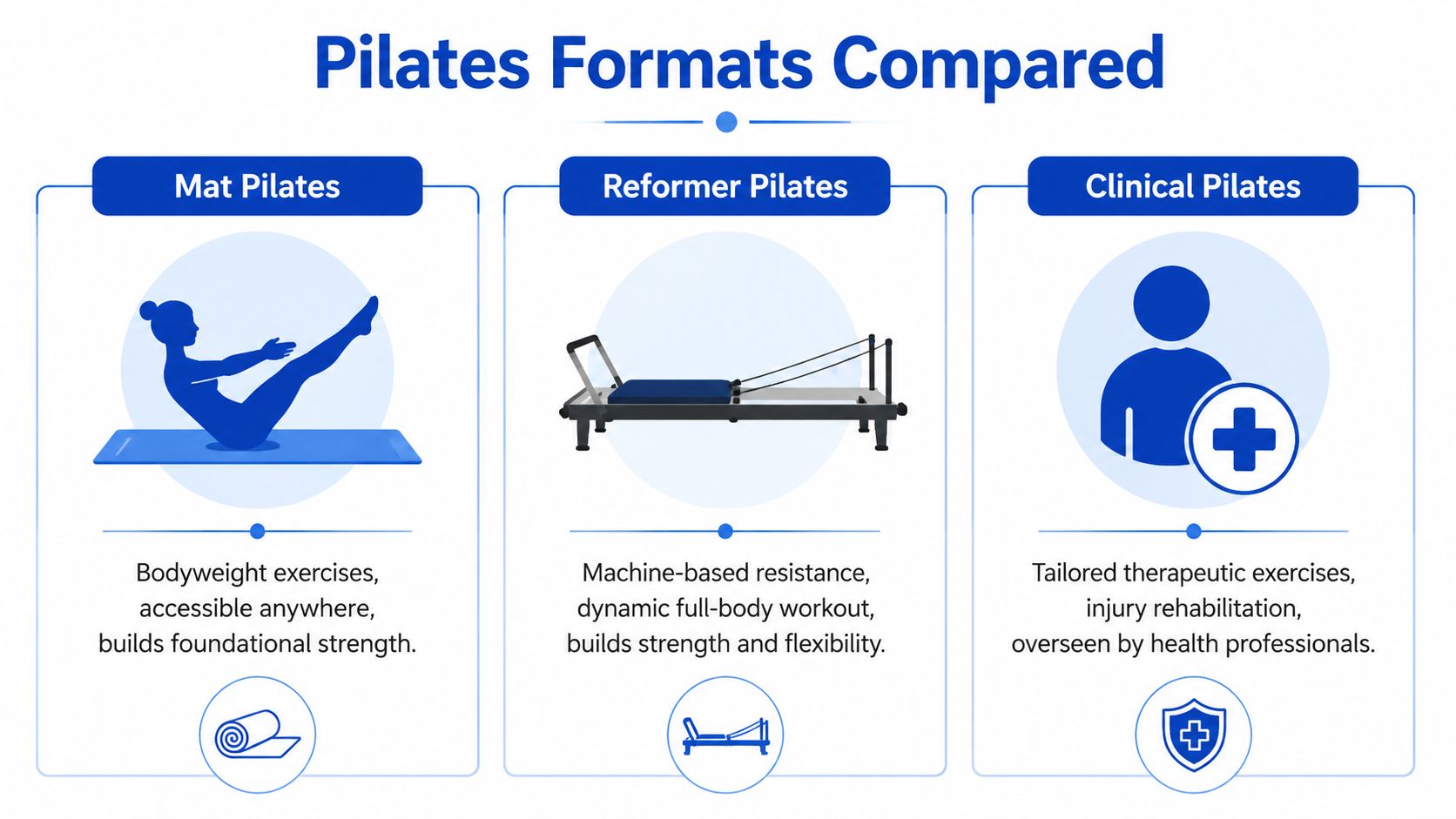
Not all Pilates classes ask the same things of your body. Melbourne studios offer reformer, mat, tower, chair, barrel, and heated formats, and those differences matter because the equipment and environment change the physical demand. Spring-assisted reformers and heated classes can place very different loads on the body, as noted in this overview of apparatus and heated Pilates formats.
The quick comparison
| Format | Main setup | What it tends to suit | Main trade-off |
|---|---|---|---|
| Mat Pilates | Floor-based, bodyweight and small props | Foundational control, general mobility, home practice | Getting to and from the floor can be difficult for some people |
| Reformer Pilates | Spring-based machine with carriage and straps | Assisted and resisted movement, leg and trunk work, variety | Easy to overdo if the class is fast or heavily choreographed |
| Clinical Pilates | Individually selected exercises, often in a health setting | Pain, injury rehab, mobility limits, careful progression | Less of a “drop-in fitness class” feel |
Mat Pilates
Mat work is often underestimated. People assume that because there's no machine, it must be easier. That isn't always true.
Without springs to assist you, mat exercises rely on body positioning, control, and endurance. For some people that's excellent. It can build awareness, improve trunk control, and strip movement back to basics.
It can also be a poor fit if you struggle with:
- Floor transfers
- Kneeling
- Lying flat
- Getting up after the session
- Neck strain during supine work
If your pain is mild and your mobility is reasonable, mat can be a solid place to start. If the floor itself is a barrier, it may not be the most practical first option.
A short demonstration can help you understand the feel of the method before you book:
Reformer Pilates
Reformer classes are popular because the machine creates both resistance and assistance. Springs can challenge muscles, but they can also help unload bodyweight and guide the path of movement.
That can be very useful for people who need support with standing work, leg strength, or controlled spinal and hip movement. It can also make exercise feel smoother and more accessible than floor work.
Still, reformer isn't automatically gentler. Problems usually arise when the class becomes performance-based. Fast transitions, complex choreography, jumping, unstable positions, or heavy spring loading can outpace your current capacity.
If you've got chronic pain, the question isn't whether a reformer class is “good”. It's whether that specific reformer class allows enough slowing down, cueing, and modification for your body.
Clinical Pilates
Clinical Pilates usually means exercise has been adapted around the person rather than the person being forced into the class. The emphasis is assessment, symptom behaviour, movement quality, and progression.
That makes it a better fit when you've got a history of flare-ups, an active injury, postural collapse under load, major stiffness, or uncertainty about what aggravates you. Exercises are chosen because they're appropriate, not because they're part of a preset sequence.
Which one is usually safest
The answer depends on the body in front of the instructor.
- Choose mat first if you move comfortably on the floor and need basic control without machine complexity.
- Choose reformer first if the machine helps you move with better support and less strain.
- Choose clinical Pilates first if pain, arthritis, injury history, or reduced mobility make standard classes hard to predict.
Heated Pilates deserves an extra note. Heat can make a class feel looser at the time, but it also changes exertion, hydration needs, and fatigue. If you're prone to dizziness, joint irritation, or overdoing things when you feel temporarily more flexible, heated sessions aren't usually the first place to start.
How to Choose a Safe and Qualified Pilates Instructor
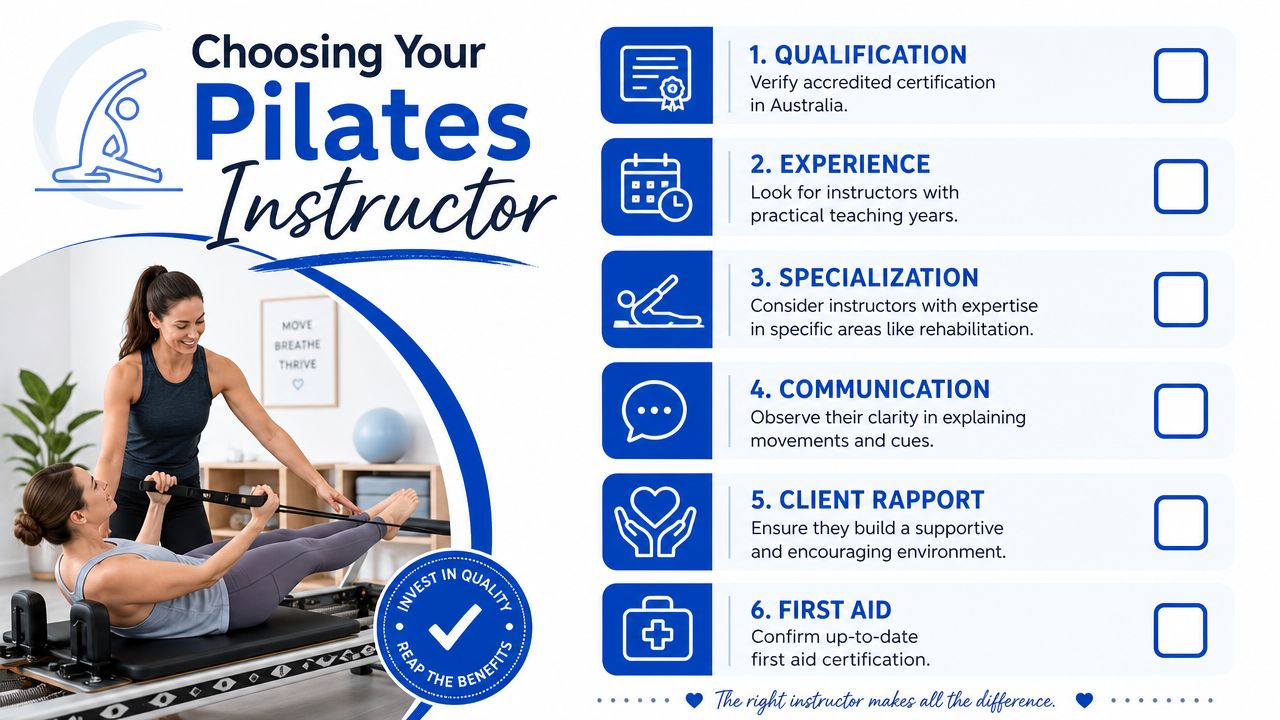
For someone with chronic pain, the instructor matters more than the mirrors, branding, or playlist. A polished studio can still run classes that are too large, too fast, or too generic for a sore body.
Melbourne's market includes both high-volume studios with broad access and smaller group or private formats. For clients with chronic pain, a lower instructor-to-participant ratio is the critical variable because it allows individual cueing and load management that large choreographed classes can't provide, as reflected in this Melbourne studio accessibility and service model example.
What a good instructor does in the first few minutes
A safe instructor doesn't just greet you and point at a reformer. They ask questions that change how they teach.
They should want to know whether you've got current pain, old injuries, arthritis, dizziness, balance concerns, recent surgery, or trouble getting on and off equipment. They should also ask what tends to flare you up. That one question often reveals more than a generic health form.
Good instructors also watch how you move before class intensity builds. They notice whether you grip through your neck, hold your breath, avoid one side, or struggle with simple transitions.
Questions worth asking before you book
Ask directly. You're not being difficult. You're screening for safety.
- How do you manage clients with injuries or persistent pain?
- Can the instructor modify exercises during class if something aggravates me?
- Is this class beginner-friendly in a real sense, or just open to beginners?
- How many people are usually in the room?
- Can I stop, rest, or substitute movements without pressure?
- Do you offer one-on-one sessions or an introductory assessment first?
If you're weighing broader treatment options alongside movement care, this guide on osteopathy vs physiotherapy and which is right for you can help clarify where Pilates instruction fits.
Red flags that shouldn't be ignored
Some warning signs are obvious. Others sound motivating until you're the one paying for the flare-up.
- Pain is brushed off: If the response to your concern is “You'll be right” or “Push through”, leave.
- There's no room for options: Every participant doing the same thing at the same speed is a problem if symptoms vary.
- The room moves too quickly: If transitions are rushed, your form usually deteriorates first.
- The instructor cues performance over control: Bigger isn't better if your spine, neck, or joints can't organise the load.
- You feel watched, not guided: Correction should be useful, calm, and specific.
A safe class feels adaptable. You should feel that the session can come down to meet you, not that you have to hide your symptoms to keep up.
What usually works better for painful bodies
If you've got long-standing symptoms, look for these features:
- Smaller groups: Better visibility, more correction, less rush.
- Introductory assessments or private onboarding: Helpful if you're unsure what you can tolerate.
- Clear modification culture: The instructor offers alternatives without making it awkward.
- Measured language: They talk about control, positioning, breathing, and pacing. Not punishment.
Plenty of people can do well in general Pilates classes. But when pain is part of the picture, the safest teacher is usually the one who can change the plan without making a fuss.
Your Pre-Pilates Check An Osteopaths Role
If you've had repeated flare-ups with exercise, a pre-Pilates assessment can save time and frustration. It isn't about being told not to move. It's about working out how to start with fewer setbacks.
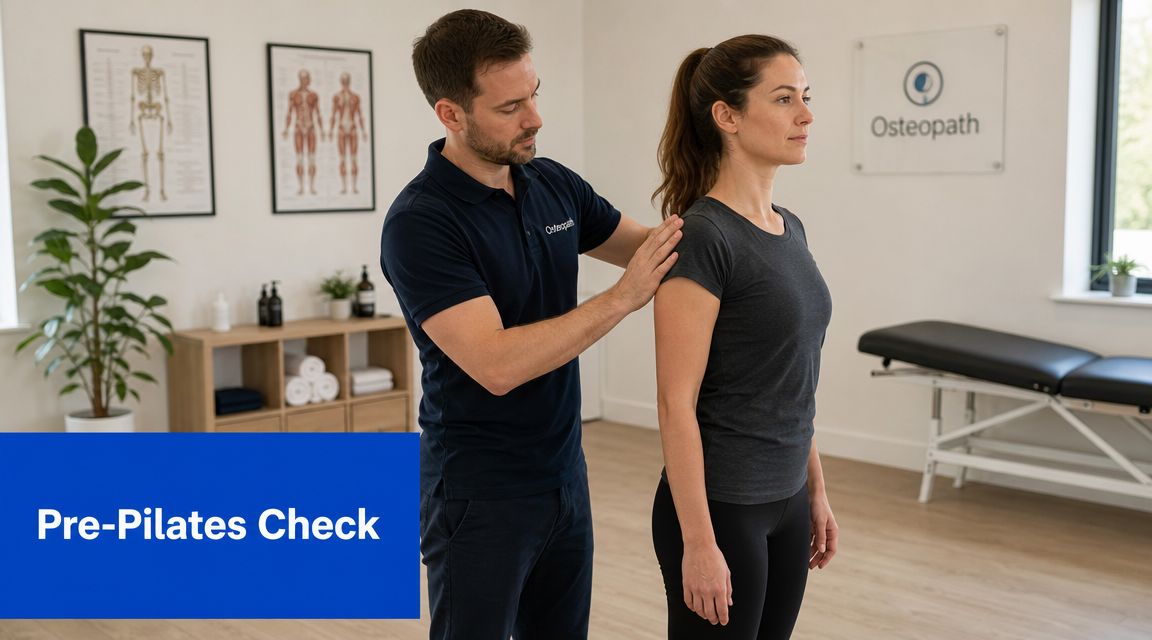
An osteopathic assessment usually looks at posture, joint mobility, movement habits, breathing pattern, balance between sides, aggravating movements, and what your symptoms do after activity. That matters because the issue is rarely just “weak core” or “tight hips”. More often, it's a combination of stiffness somewhere, compensation somewhere else, and a load your body isn't distributing well.
What the check can reveal
A person may present saying they want reformer Pilates for back pain. During assessment, the more relevant findings might be poor hip loading, thoracic stiffness, difficulty controlling rib position, or neck tension during simple arm movement. Those details change the advice.
An osteopath can help identify:
- Movements to approach carefully
- Positions that need support or modification
- Whether floor work is realistic
- Whether a group class is sensible yet
- What level of symptom response is acceptable after exercise
This is also where Bayside Osteopathic Health can fit as one care option. The clinic provides osteopathic assessment, hands-on treatment, and movement guidance designed to ease pain and improve mobility, which can help people decide whether they're ready for a general class or need a more gradual start. If you want a fuller picture of that approach, read more about understanding osteopathy and how it supports movement and recovery.
It gives you a more useful starting point
The best outcome from a pre-Pilates check is clarity. Not hype. Not fear. Clarity.
You might learn that mat work is fine but repeated roll-ups aren't. Or that reformer footwork feels good, but loaded spinal flexion doesn't. Or that your arthritis responds best to shorter sessions with slower transitions and rest breaks.
The right assessment doesn't delay progress. It reduces guesswork so your first month of Pilates is built around what your body can actually do.
It supports collaboration
If you choose to work with a Pilates instructor after an assessment, the information is practical. It can guide exercise selection, pacing, and modification. That often leads to a better class experience because the instructor isn't working blind, and you're not trying to decode every post-class ache on your own.
For many people, that's the difference between “Pilates didn't suit me” and “I finally found a version that worked.”
Supporting Your Progress and Managing Flare-Ups
Starting Pilates often brings a mix of useful muscle soreness, movement awareness, and occasional uncertainty. That's normal. What matters is how you respond.
A mild sense of having used new muscles usually settles. A flare-up is different. Pain becomes sharper, more protective, or lingers beyond what feels proportionate to the session. When that happens, don't assume Pilates has failed and don't force yourself back into the same class unchanged.
What to do after a class that felt fine
Keep the first few weeks boring. That's often the smartest approach.
- Note your response later that day: Some symptoms appear after you cool down.
- Check the next morning: Stiffness that eases with light movement is different from escalating pain.
- Repeat what was tolerated: Consistency beats novelty when you're building confidence.
- Tell the instructor what happened: Good instructors use that information to adjust the next session.
What to do if something flares
If an old back, neck, hip, or shoulder issue lights up, scale down rather than stopping all movement in panic. Often the better move is to pause the aggravating exercise, keep gentle motion going, and get the problem assessed so you can work out whether the issue was load, technique, speed, range, or class choice.
Hands-on osteopathic care can be useful here because it may help settle irritation, improve mobility in restricted areas, and make it easier to return to movement with a clearer plan. The aim isn't to make you dependent on treatment. It's to help you keep moving safely.
The long-term view
The people who do best with Pilates usually stop treating each class like a test. They treat it like practice.
That means adjusting load when life is stressful, choosing slower sessions during flare-prone periods, and accepting that progress with chronic pain is rarely linear. It can still be very worthwhile. It just needs patience and good judgement.
Frequently Asked Questions About Pilates in Melbourne
Is Pilates good for chronic back or neck pain
It can be, if the class matches your current capacity. People usually do better when the session is well supervised, paced properly, and modified around symptoms. Fast, generic classes tend to be less forgiving than slower, more individualised ones.
Should I start with reformer or mat Pilates
Start with the format that removes the biggest barrier for you. If getting to the floor is difficult, mat may be frustrating. If the machine feels intimidating and the class is highly choreographed, reformer may be too much. If pain is unpredictable, a more clinical or one-on-one start is often safer.
Is heated Pilates a good choice for stiff joints
Not always. Heat can make movement feel easier during the session, but it can also mask effort and increase fatigue. If you have arthritis, dizziness, reduced tolerance, or a history of overdoing things when you feel loose, start with a standard temperature class first.
How often should beginners do Pilates
For someone managing pain or stiffness, consistency matters more than intensity. Start with a frequency you can recover from and sustain. If you feel worse for days after each class, the dose is too high, the class is unsuitable, or both.
How do I know if a class is too hard
Look at your response during the session and the day after. Warning signs include breath-holding, loss of form, pain that builds as you continue, symptoms that remain aggravated, or needing several days to settle after each class. Challenge is fine. Lingering aggravation isn't.
Is Clinical Pilates better than general classes
Not better in every case. Better for some bodies. If you've got persistent pain, arthritis, an injury history, marked stiffness, or poor confidence with exercise, a more individualised setting is often a safer first step. If you're generally well and only mildly stiff, a standard class may be enough.
How much do Pilates classes in Melbourne really cost
The hard part isn't spotting the intro offer. It's understanding the ongoing cost. Studio marketing often highlights teaser pricing, while the true monthly spend may depend on class packs, membership tiers, booking limits, cancellation rules, and whether you need private sessions first, as discussed in this overview of real Pilates cost considerations in Melbourne. The right question is whether the format is affordable enough to continue consistently, not just whether the first week looks cheap.
When should I get assessed before starting
Get assessed first if you've got recurring flare-ups, significant stiffness, arthritis, pain that travels, recent injury, balance concerns, or no clear sense of what exercise aggravates you. That doesn't mean you're fragile. It means your starting point should be chosen with care.
If you're trying to work out whether Pilates is suitable for your back, neck, or joints, Bayside Osteopathic Health can help you make that decision with more confidence. An osteopathic assessment can identify what movements are likely to help, what may need modifying, and how to begin safely so you can move toward steadier, more comfortable progress.