

Persistent pain affects far more than a pain score: in 2016, almost 1 in 5 Australians aged 45 and over, about 1.6 million people, were estimated to have chronic pain, according to the Australian Institute of Health and Welfare. Treatment is rarely a choice between one tablet and one exercise. The useful question is which combination can help you sleep, move, work or take part in daily life, and how you'll know whether it's helping.
Table of Contents
- Chronic Pain Treatment Options Compared
- Why Persistent Pain Needs More Than One Fix
- Medicines That Help and Trials That Should Stop
- Injections and Procedures After a Clear Diagnosis
- Movement Manual Therapy and Osteopathic Care
- Psychology Sleep and Home Strategies That Stick
- How to Reach Care and Book the First Visit
Chronic Pain Treatment Options Compared
Chronic pain is pain that continues beyond the usual healing period, commonly more than three to six months. Australian care increasingly treats persistent pain as a mix of physical, emotional, movement-related and social factors, rather than a problem with one simple fix. There's no single best therapy for everyone, but comparing options by what they help you do can make the next step clearer.
| Approach | Main aim | Place in care | Choose it when |
|---|---|---|---|
| Non-opioid medicines | Ease pain enough to function | One part of an individual plan with non-drug care | Pain blocks sleep or activity and a review date is set |
| Opioid trial | Test pain relief and function under monitoring | Selected adults only after other options are optimised | Moderate or severe pain impairs life and stop rules are agreed |
| Exercise and graded activity | Rebuild strength, tolerance and confidence | First-line non-drug care | Deconditioning or fear of movement is limiting life |
| Allied health rehabilitation | Dose exercise and daily tasks | Physiotherapy, exercise physiology or occupational therapy | Walking, work or self-care capacity is falling |
| Psychological therapies | Support sleep, mood, pacing and pain education | CBT and relaxation alongside physical care | Avoidance, anxiety, low mood or poor sleep steer the week |
| Multidisciplinary pain programmes | Combine movement, psychology and medical review | Can outperform usual care for chronic low-back pain | Single treatments haven't restored participation |
| Interventional procedures | Target a specific pain source | After assessment, not the first step for most people | A clinician identifies a suitable diagnosis |
| Yoga, tai chi, hydrotherapy and massage | Offer a gentle entry, symptom relief and relaxation | Adjuncts named in Australian non-drug guidance | A tolerable way back into activity is needed |
| Osteopathic manual care | Support comfort and mobility with hands-on care | An adjunct judged by function and self-management | Stiffness or spinal and joint pain blocks the exercise plan |
Australian guidance lists medicines, psychological therapies, relaxation, physical activity and physiotherapy among chronic pain management options. It recommends considering non-drug approaches first, including strengthening, walking programmes, yoga, hydrotherapy, tai chi, massage and cognitive behavioural therapy (CBT), as well as coordinated care with allied health professionals. The Healthdirect overview of chronic pain management explains how these choices can form part of an individual plan.
Match the approach to the obstacle
Medicines may make movement or sleep more manageable, but they don't replace active care. Non-opioid medicines can be considered as one part of a plan, while opioids have a more restricted role and require clear monitoring. In either case, it helps to agree on the daily activity the medicine is meant to support and when you'll review its value.
Exercise and graded activity aim to rebuild tolerance gradually. A physiotherapist or exercise physiologist can help set a starting level, while an occupational therapist may help adapt tasks at home or work. CBT and relaxation address factors such as fear, mood and sleep that can shape how pain affects a person's week.
Multidisciplinary programmes combine medical, movement and psychological support. Procedures, including injections, are more specific: they need an assessment that identifies a suitable target. Massage and manual approaches, including osteopathic care, can be useful adjuncts, but the test isn't whether the session felt soothing alone. It's whether that relief helps you do more afterwards.
Choose by function: Circle two rows that fit your biggest limits, such as walking, sleep, work or stiffness. Bring those two goals to your next appointment.
Why Persistent Pain Needs More Than One Fix
Think of persistent pain as a smoke alarm. The original injury may have settled, but the nervous system can remain sensitive. Muscle tension, stress, disrupted sleep and protective habits may keep the alarm loud even when the original trigger has changed.
The scale of the issue helps explain why care often needs more than one kind of support. The Australian Institute of Health and Welfare's chronic pain summary estimates that almost 1 in 5 Australians aged 45 and over had chronic pain in 2016, about 1.6 million people or 19 per cent of that age group. Between 2006–07 and 2015–16, general-practice encounters involving chronic back pain or unspecified chronic pain rose by 67 per cent, or about 400,000 additional encounters for each condition. Chronic pain was relevant to almost 105,000 hospitalisations in 2017–18.
People aged 45 and over with chronic pain were also 2.7 times as likely to have pain medication dispensed as those without chronic pain. These figures describe a substantial need for care, not a reason to rely on medication alone. A GP may coordinate medical review with movement support, psychological care and practical self-management.
Measure life, not just pain
Suppose your back hurts most days and you've started avoiding walks. A useful plan can track pain interference, walking or lifting tolerance, sleep, work capacity and one personal goal. These measures give you and your clinicians a baseline, so you can judge change even if pain doesn't disappear.
A 2024 report on chronic pain in Australia found that 45 per cent of Australians with chronic pain said obtaining a diagnosis took longer than three years, according to Medical Journal of Australia Insight. Write down when your symptoms began, what makes them better or worse, and what you've already tried. That history can make a medical review more focused.
The goal isn't necessarily a pain score of zero. It's to turn down the alarm while rebuilding safe participation in the things that matter. Returning to suitable activity or work, when clinically safe, can be a more useful sign of progress than waiting for every symptom to vanish.
Hands-on care may sometimes ease symptoms in the short term. Treat that relief as a bridge: use the easier window to practise movement or resume a suitable task, rather than judging success by the session alone.

Medicines That Help and Trials That Should Stop
A pain medicine earns its place when it helps you function, such as making sleep, walking or work more manageable. Exercise, psychological care, social support and non-opioid treatment should be optimised first, with medicines chosen to fit your diagnosis and health circumstances.
Simple analgesics or topical products may help some people with joint pain. They still need a review date and a clear purpose. Ask what change you're looking for, how long to try the medicine and what to do if it doesn't help. Don't add or change prescribed medicines without discussing it with the prescriber.
Antidepressants are prescribed for selected chronic pain conditions, but they don't work equally well for every person or pain type. A University of Sydney review examined 26 systematic reviews covering more than 25,000 participants to assess antidepressants as chronic pain treatment, as described in its overview of the evidence. Ask which symptom the medicine is intended to change, such as pain, sleep or mood, and when the prescriber will assess the trial.
Agree on the opioid trial before it starts
Opioids have a limited, monitored role in chronic non-cancer pain. Australian guidance generally reserves a trial for carefully selected adults with moderate or severe pain that substantially affects function or quality of life and hasn't responded adequately to other care. The RACGP's evidence-based guidance for opioids supports setting targets for both pain relief and function before treatment begins.
The trial should include a review date and agreed stop rules. If meaningful improvement doesn't occur, or harms outweigh benefits, the plan should be reconsidered rather than continued by default. National Australian specialist pain service data reported that 27 per cent of patients stopped opioids during treatment, and a further 20 per cent reduced their dose by at least 50 per cent. In that source, opioid cessation, rather than maintenance, was associated with the greatest improvement in pain intensity, function and related psychological measures.
Bring a complete medicine list to the appointment, including non-prescription products. Don't start, stop or change prescribed medicines on your own. Before any opioid trial, make sure you can state the functional target, the review date and the conditions that mean the trial should stop.
Injections and Procedures After a Clear Diagnosis
A procedure is most useful when assessment points to a specific pain source. It isn't the first step for patients with persistent pain, and an injection shouldn't be chosen just because one area hurts. Your clinician should explain what diagnosis the procedure targets and how it fits into your broader plan.
Follow a clear decision sequence
- Start with assessment. Discuss the location and pattern of symptoms, how they affect daily tasks, and what care you've already tried. A clearly localised joint or nerve-related pattern may lead a clinician to consider a targeted procedure.
- Understand the proposed treatment. A corticosteroid injection may be considered for localised inflammation in a joint or soft tissue. A nerve block temporarily interrupts signals from a defined area and may help with diagnosis or provide short-term relief.
- Agree on what success looks like. Before proceeding, ask about the expected benefit window, possible risks, how many sessions are being proposed and what the next step will be if relief fades.
For example, a procedure might be considered if pain repeatedly prevents you from following a suitable movement plan and an assessment identifies a relevant target. It should then be judged by whether you can continue the plan, walk or manage work more comfortably afterwards, not by a temporary drop in pain alone.
A pain specialist may discuss longer-term options if conservative care hasn't restored function. Procedures carry their own risks, so ask questions until you understand the likely benefits and limits. For general information about arranging a local injection, see where to get a cortisone shot.
Movement Manual Therapy and Osteopathic Care
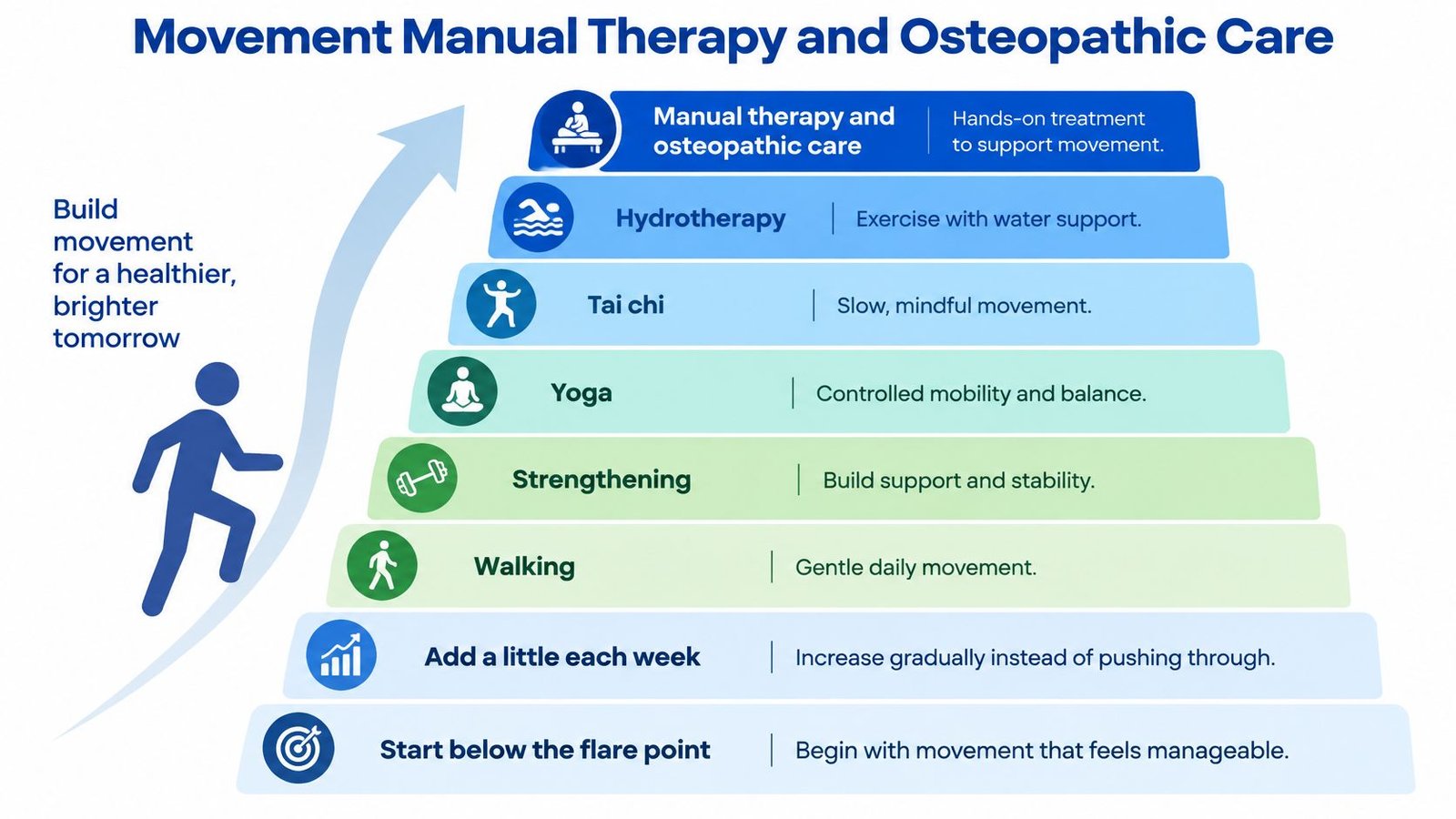
Graded activity means beginning below the point that reliably triggers a flare, then increasing movement gradually instead of waiting for pain to disappear. Walking, strengthening, yoga, tai chi and hydrotherapy are among the activities Australian guidance names for chronic pain management. A physiotherapist or exercise physiologist can help adjust the starting level to your current capacity.
The RACGP approach to pain management supports combining movement with psychological, social and non-opioid care. For chronic low-back pain, multidisciplinary biopsychosocial rehabilitation can reduce pain and disability more effectively than usual care or physical treatment alone. Outcomes vary with programme intensity, professional mix, patient circumstances and adherence.
Let function guide hands-on care
Manual therapy can be an adjunct for short-term symptom relief, but its longer-term value should be judged by what you can do and manage for yourself. Osteopathic care is a form of whole-person manual care for spinal, joint and movement problems. It isn't a cure for every cause of persistent pain, and it shouldn't stand alone when a person needs other assessment or support.
At Bayside Osteopathic Health, spinal pain treatment begins with a whole-body assessment to trace contributing factors rather than focusing only on the sore spot. The treatment plan is shaped by diagnosis, movement, lifestyle demands and goals, and it changes as the person's condition changes. Treatment can begin in the first session; the osteopath explains each technique, works within your comfort and provides a realistic recovery timeline during the first assessment.
Treatment shouldn't be painful, although mild temporary soreness may follow. Consider a stiff mid-back that eases after gentle mobilisation. If that change makes a daily walk possible, the session has helped create an opening for active care. Home movement is what continues between visits, so use any easier movement to practise a suitable exercise plan.
This video offers another way to think about movement and pain management.
Psychology Sleep and Home Strategies That Stick
Psychological care doesn't mean your pain is imagined. Pain can disrupt sleep, mood and confidence; in turn, poor sleep, low mood and fear of movement can make everyday activities harder to manage. CBT, relaxation and pain education can help you pace activity, respond differently to unhelpful thoughts and protect routines that support rest.
A psychologist may be worth asking about when fear, low mood or sleeplessness is steering much of your week. These strategies work alongside physical care rather than replacing it. Drug-free care is active care, built from skills and practice, not just waiting for symptoms to pass.
Build a routine that doesn't rely on a referral
You can start with manageable changes at home:
- Pace chores: Split a demanding task into smaller parts and take a brief planned rest before symptoms build, rather than doing everything on a good day and stopping for several days afterwards.
- Protect sleep: Keep a consistent wake time and create a wind-down hour. If you're stiff in the morning, a warm shower or heat may help you begin moving.
- Keep movement modest: Try a short walk on most days at a level you can repeat. Increase gradually instead of pushing through a flare.
- Track only three weekly measures: Record minutes walked, nights of reasonable sleep and one task you'd been avoiding that you completed.
These numbers can keep self-care connected to your priorities. If your main goals are walking farther and sleeping better, the weekly check gives you a practical way to notice whether your routine is helping, even when pain still varies.
Recovery also continues outside appointments. At Bayside Osteopathic Health, patients receive movement education, strengthening exercises and self-care knowledge to carry on between treatment visits. You can find more ideas in these self-management strategies. If your mood becomes unsafe, contact your GP or local crisis support immediately. This article isn't an emergency service.
How to Reach Care and Book the First Visit
The first useful appointment is usually with your GP, who can review the diagnosis, check for warning signs and help coordinate next steps. Specialist care can take time to arrange, so it helps to keep appropriate day-to-day support moving while you wait.
| Step | Who | Ask for | If you are waiting |
|---|---|---|---|
| 1. Medical review | GP | Diagnosis check, red flags, non-drug plan and Medicare eligibility | Don't start new medicines without advice |
| 2. Movement | Physiotherapist or exercise physiologist | Graded exercise and work or walking goals | Use a simple walking plan agreed with your GP |
| 3. Mind and sleep | Psychologist | CBT, relaxation or pain education | Practise pacing and a wind-down hour meanwhile |
| 4. Hands-on adjunct | Osteopath | Whole-body assessment within comfort | Consider a visit if stiffness blocks the exercise plan |
| 5. Specialist programme | Multidisciplinary pain service | Combined medical, physical and psychological care | Keep steps 1–4 active while waiting |
| 6. Review | GP again | Function targets and medicine review | Stop or change what isn't helping |
The 2025 National Pain Survey found that 18 per cent of respondents received a referral to multidisciplinary pain management, and 30 per cent of those referred never secured an appointment. That gap is one reason to continue suitable movement, GP review and other agreed support instead of putting your plan on hold while waiting for a specialist programme.
Make the first appointments practical
Bring a medicine list, a brief symptom history, what you've tried and two goals, such as sleeping better or increasing walking tolerance. Ask your GP whether you're eligible for a chronic condition management plan that may support a limited number of allied health visits, and confirm current eligibility and rebate rules with the GP and clinic. Check private health extras separately.
A desk worker whose neck stiffness interrupts work may need movement coaching and strengthening. An older adult with arthritis may prefer gentle mobility as part of a plan coordinated with their GP and specialist team. Someone with sciatica should have concerning symptoms screened before hands-on care is considered.
Seek urgent medical assessment rather than routine booking for new weakness, saddle numbness, bladder or bowel changes, fever, unexplained weight loss or pain following major trauma. For other situations, judge progress by sleep, walking, work tolerance or a safer medicine plan. Bayside Osteopathic Health prioritises prompt bookings for acute or urgent pain and welcomes enquiries about whether osteopathic care may be appropriate. You can also check Medicare chronic condition management information.
If persistent back, neck or joint pain is limiting your movement, Bayside Osteopathic Health offers gentle osteopathic assessment and hands-on care alongside movement guidance and practical self-care. Bring the activity you most want to regain to your first conversation, and visit Bayside Osteopathic Health to enquire about an appointment.