
In Australia, the cortisone injection cost can range from under A$100 to over A$300, and Medicare figures show patients paid an average A$84 out of pocket at a non-hospital facility versus A$146 at a hospital. That tells you the price isn't just about the injection itself. The setting, the billing method, and any extra appointments or imaging often shape the final bill more than people expect.
If you're in Bayside and weighing up a cortisone injection, you're probably not just asking, “How much is it?” You're also asking whether it's worth it, whether Medicare helps, and whether there's a gentler option if you'd rather avoid another needle. Those are sensible questions. For many people, the primary issue isn't the one-off fee. It's how often the pain returns, how many appointments follow, and whether the treatment genuinely fits their long-term plan.
Table of Contents
- What Is a Cortisone Injection and Why Is It Recommended
- Decoding the Cortisone Injection Cost in Australia
- Navigating Medicare and Private Health Insurance
- Important Questions to Ask Your Provider
- Beyond Injections Gentle Alternatives for Bayside Residents
- Making an Informed Decision for Your Health
What Is a Cortisone Injection and Why Is It Recommended
A cortisone injection is a targeted anti-inflammatory treatment. It places a corticosteroid medicine into an irritated joint, bursa, or nearby soft tissue to calm inflammation and reduce pain. Doctors commonly recommend it when swelling is a major driver of symptoms and simpler measures haven't given enough relief.
The goal is usually straightforward. Settle the flare, ease pain, and create a window where movement becomes easier again. That can matter if pain has started to interfere with walking, sleeping, lifting your arm, or getting through the day without guarding the area.
Common reasons it may be offered
A doctor may recommend a cortisone injection for problems such as:
- Arthritic joint pain where inflammation is contributing to stiffness and soreness
- Bursitis when a fluid-filled sac around a joint becomes irritated
- Tendon-related pain where local inflammation is part of the picture
- A stubborn flare-up that hasn't settled with rest, activity modification, or oral medication
What works well is matching the injection to the right diagnosis. If the pain is mainly inflammatory and localised, an injection can be useful. What doesn't work as well is using it as a catch-all answer for every painful shoulder, knee, hip, or spine complaint without first working out what structure is involved.
Practical rule: A cortisone injection can reduce inflammation, but it doesn't automatically fix the movement pattern, loading issue, or postural strain that caused the irritation in the first place.
What the procedure does and does not do
Many patients expect an injection to “fix” the problem. Sometimes it gives excellent short-term relief. But clinically, it's better viewed as a tool rather than a full plan. It may lower pain enough for you to move better, sleep better, or tolerate rehabilitation more comfortably.
It doesn't strengthen weak muscles. It doesn't improve joint control on its own. It also doesn't teach your body how to avoid re-irritating the same area once the relief wears off.
That distinction matters. If you only treat the inflammation and ignore the reason the tissue keeps being overloaded, the pain can return. That's often where people feel frustrated. They paid for a procedure, got some relief, then found themselves back in the same position months later.
Decoding the Cortisone Injection Cost in Australia
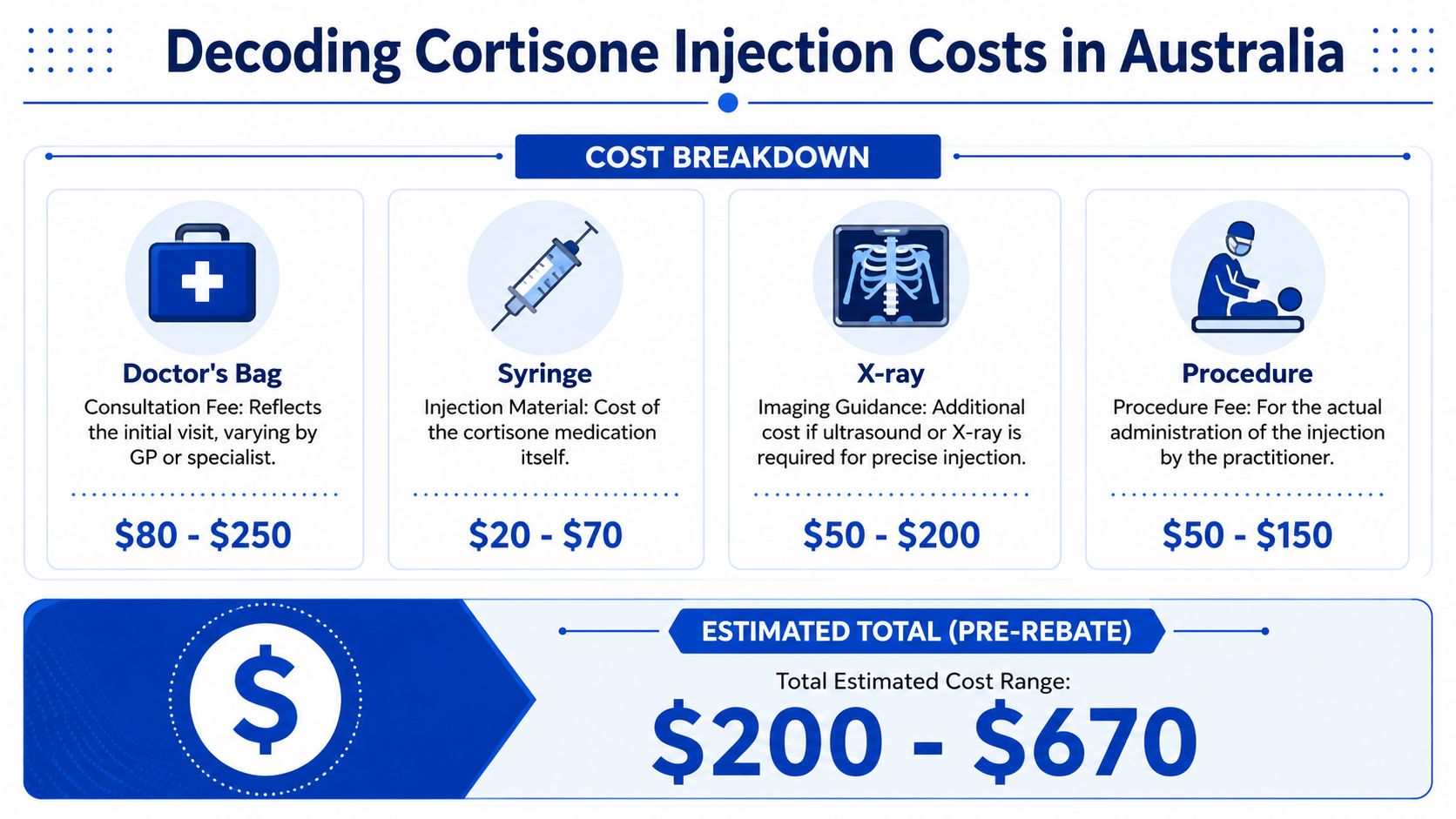
The hardest part about understanding cortisone injection cost is that there often isn't one neat number. Some clinics quote only the procedure. Others separate the consultation, the medication, and any imaging. A hospital bill can look very different again.
Why the treatment setting matters
One of the clearest cost drivers is where the injection is given. Medicare benefit data discussed by Healthline's review of cortisone shot costs shows an average patient cost of A$84 at a non-hospital facility and A$146 at a hospital. That's a gap of A$62, with hospital-based administration costing about 73.8% more on those figures.
For patients in Bayside, that matters more than most marketing pages suggest. If two providers are offering a similar medicine and a similar procedure, the setting alone can shift the price noticeably.
A practical takeaway is to ask where the injection will be performed before you focus on anything else. “Specialist rooms,” “day procedure centre,” and “hospital” can lead to very different costs.
What your bill may actually include
The total price often has several moving parts:
| Cost component | What it usually covers |
|---|---|
| Consultation fee | The assessment, diagnosis review, and decision to inject |
| Procedure fee | The actual administration of the injection |
| Medication cost | The cortisone and any local anaesthetic used |
| Imaging fee | Ultrasound or other guidance if the clinician uses it |
Some people are surprised when the injection itself seems affordable but the overall appointment isn't. That usually happens because the quote didn't include everything.
Ask for the total out-of-pocket figure, not just the procedure price.
If you'd like to compare costs with other non-surgical treatments people often explore for persistent pain, this overview of shockwave therapy cost can also help frame the broader decision.
Why one quote can differ from another
Price differences don't always mean one provider is overcharging or another is giving a bargain. Sometimes the quote reflects a different level of assessment, a different setting, or whether the appointment is bundled.
A few questions help clarify that quickly:
- Is the consultation separate? Some clinics bill the review and the injection independently.
- Is imaging included? If a provider recommends ultrasound guidance, ask whether that cost is already in the quote.
- Who is performing it? A GP, sports physician, or other specialist may structure fees differently.
- Are there follow-up fees? Some practices want to reassess you after the procedure.
The most useful mindset is to think in terms of value and fit, not just sticker price. A lower upfront quote isn't always cheaper if it leaves you paying for extra visits or still unsure what problem is being treated.
Navigating Medicare and Private Health Insurance
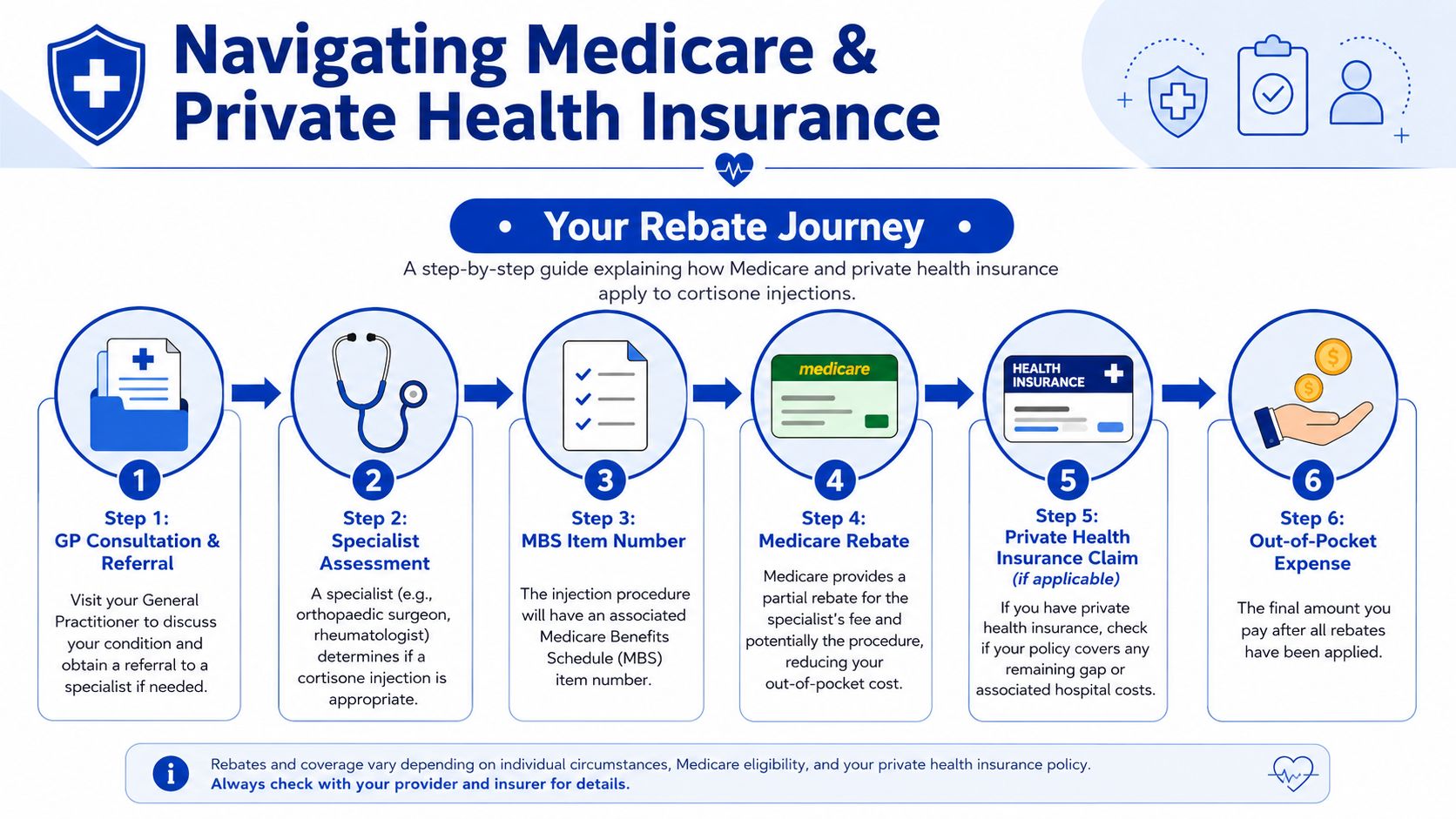
Medicare can help with cortisone injection costs, but it doesn't erase the whole bill in every situation. The key term patients need to understand is the schedule fee. That's Medicare's benchmark, not a promise that every provider will charge that amount.
How Medicare item 18213 fits in
According to Sesame Care's summary of cortisone injection billing, Medicare Benefits Schedule item 18213 covers injection or aspiration of a joint or bursa and has a schedule fee of A$65.85. The same source notes that patients on the Medicare Safety Net may have reduced out-of-pocket costs when the service is delivered under the item's billing rules.
That figure is useful because it gives you a public benchmark. It also explains why many patients still have a gap to pay. If a clinic or specialist charges above the schedule fee, the difference usually falls to the patient unless the service is bulk billed.
Where private health insurance may or may not help
Private health insurance adds another layer, which can often catch many people out. Some policies may help with hospital-related costs. They may be less helpful for a straightforward outpatient procedure done in consulting rooms. The answer depends on your cover, your excess, and where the injection happens.
Before you book, ask your insurer and your provider the same set of questions:
- Is this treated as an outpatient or hospital service?
- Will Medicare process part of the claim automatically?
- Is there a provider gap payment?
- Are there separate facility fees?
The schedule fee is the anchor. Your out-of-pocket cost usually depends on the private billing gap above it.
If you're already dealing with ongoing musculoskeletal pain, it also helps to ask whether spending on repeated procedural care is the best use of your health budget, or whether part of that money would be better directed toward rehabilitation, movement advice, and longer-term management.
Important Questions to Ask Your Provider
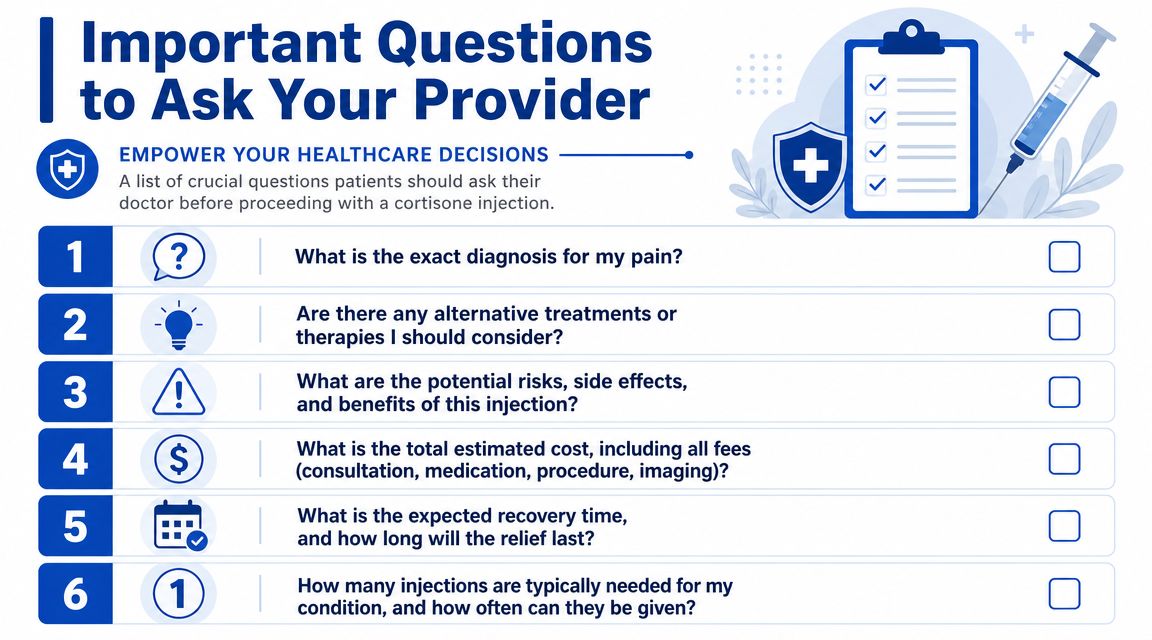
The best way to avoid cost surprises is to ask direct questions before the needle is ever opened. Patients who do this usually feel clearer not only about the price, but about whether the injection suits their diagnosis and goals.
Questions about diagnosis and suitability
Start with the clinical basics, not the payment details. A useful appointment often begins with questions like:
- What exactly are you treating? Ask whether the pain is coming from a joint, tendon, bursa, or another structure.
- Why is an injection the right option now? A good explanation should connect the treatment to your symptoms and examination findings.
- What are the risks for me personally? General advice is one thing. Your own history matters more.
A poorly targeted injection can leave you with the cost, the inconvenience, and very little benefit.
Questions about total cost and repeat treatment
Once the diagnosis is clear, move to the financial side. Ask for detail, not a rounded estimate.
- What is the full out-of-pocket amount? Include consultation, procedure, medication, and any imaging.
- Will Medicare apply, and how much is the likely gap? Reception staff can often tell you how the clinic usually bills.
- If the pain returns, what happens next? That's where long-term cost becomes clearer.
According to BetterCare's guidance on cortisone injection cost, the effects of cortisone injections usually last 3 to 6 months, and doctors often advise spacing them to no more than once every 3 to 6 months. That means some patients may need 2 to 4 treatments per year, which can make the annual cost much higher than the price of a single injection.
If a treatment may need repeating through the year, ask about the yearly cost, not just today's bill.
A final question is often the most important one: What are the alternatives if I want to avoid repeated injections? That opens the door to exercise-based care, hands-on treatment, load management, and other non-invasive options that may suit a chronic problem better.
Beyond Injections Gentle Alternatives for Bayside Residents
For some people, a cortisone injection is the right short-term step. For others, it becomes a cycle. Pain flares, an injection settles it, daily life improves for a while, then the irritation gradually returns. That pattern is often what pushes patients to look for something gentler and more sustainable.

Why some people look beyond short-term relief
Recent clinical guidance discussed by Yale Medicine's review of cortisone shots notes that repeated steroid injections may be used monthly in some cases, while also carrying risks such as tissue thinning and blood sugar elevation. That shifts the conversation. It stops being only about today's procedure fee and becomes a broader question about cumulative cost, repeated intervention, and diminishing benefit over time.
That doesn't mean injections are bad medicine. It means they need context. If the same shoulder, hip, or knee keeps becoming irritated, many patients benefit from asking what in their movement, workload, posture, or joint mechanics is keeping the problem alive.
What gentle hands-on care can offer
In such cases, osteopathic care can be useful. Rather than trying to mute inflammation alone, the aim is to assess how the body is moving as a whole and reduce the strain feeding the painful area.
That might involve:
- Soft-tissue work to reduce muscular guarding and ease tension around an overloaded region
- Joint articulation and gentle mobilisation to improve movement where stiffness is adding pressure elsewhere
- Practical movement advice so daily tasks don't keep provoking the same tissues
- Simple home strategies that support steadier progress between appointments
For a Bayside resident with posture-related neck tension, hip stiffness, or recurring shoulder irritation, that kind of approach often feels more manageable than repeating a procedure every time symptoms surge. People who sit at a desk all week, care for grandchildren, play golf, garden, or walk along the foreshore usually need a plan they can live with, not just a temporary reduction in pain.
If home movement is part of that plan, these neck pain relief exercises are a useful example of the kind of simple self-care that can support longer-term change.
When a non-injection plan makes practical sense
A non-injection plan can be especially sensible when:
- Pain keeps returning after short periods of relief
- The underlying issue looks mechanical rather than purely inflammatory
- You want to avoid repeated procedures if a gentler option is reasonable
- You need a broader strategy that includes mobility, strength, pacing, and hands-on care
The strongest long-term results usually come from matching the treatment to the problem. If a joint is acutely inflamed, an injection may help settle it. If the underlying issue is recurring overload, stiffness, poor movement habits, or unresolved strain patterns, a more complete plan often makes better practical and financial sense.
Making an Informed Decision for Your Health
A cortisone injection can be useful, but the right decision isn't about chasing the lowest quote. It's about understanding what you're paying for, what relief you're likely to get, and whether the treatment fits the problem you have.
For Bayside patients, the smartest approach is usually a simple one. Get a clear diagnosis. Ask for the full out-of-pocket cost. Find out whether the procedure is being done in rooms or in hospital. Then ask the question many people leave too late. If the pain comes back, what is the long-term plan?
Sometimes that plan includes an injection. Sometimes it includes hands-on care, better movement strategies, and a more gradual path back to comfort and confidence. Often, the best care isn't one thing on its own. It's a combination that reduces pain while also improving how your body handles everyday load.
If you're comparing local options, it helps to speak with an osteopath near you in Bayside about whether a gentle, non-invasive approach could support your goals before you commit to repeated procedures.
If you're dealing with ongoing joint, neck, back, or postural pain and want a gentler path forward, Bayside Osteopathic Health offers hands-on osteopathic care focused on easing pain, improving mobility, and helping you move with more comfort day to day.