

If both professions use their hands, both treat back pain, and both can make a joint click, what really separates them when you're choosing who to book? In Australia, the useful answer isn't a slogan about whole-person care or spinal alignment. It's what you can verify, the individual assessment you're offered, and whether the practitioner knows when hands-on care shouldn't come first. Understanding the difference between osteopath and chiropractor starts with those checks, not with a technique label.
Table of Contents
- Osteopathy and Chiropractic Side by Side
- How Each Profession Is Trained and Registered
- Treatment Philosophy and Hands-On Techniques Compared
- Conditions Each Profession Commonly Treats
- Safety, Red Flags and When to See a GP First
- Costs, Session Length and Medicare Options
- What to Expect at Your First Visit
- Book the Right Practitioner After Checking Registration
Osteopathy and Chiropractic Side by Side
In Australia, osteopathy and chiropractic are separate registered health professions, not two names for the same practitioner. They sit under the same national system, but each has its own registration board, its own professional standards, and a different education and clinical tradition behind it.
The workforces differ in size. The Ahpra workforce summary recorded 3,147 registered osteopaths as at 30 June 2022, and the same reporting shows chiropractic as the larger registered profession. Neither fact tells you which one will help your condition. What it does tell you is that both are regulated, so any practitioner's name can be checked on the public register before you book.
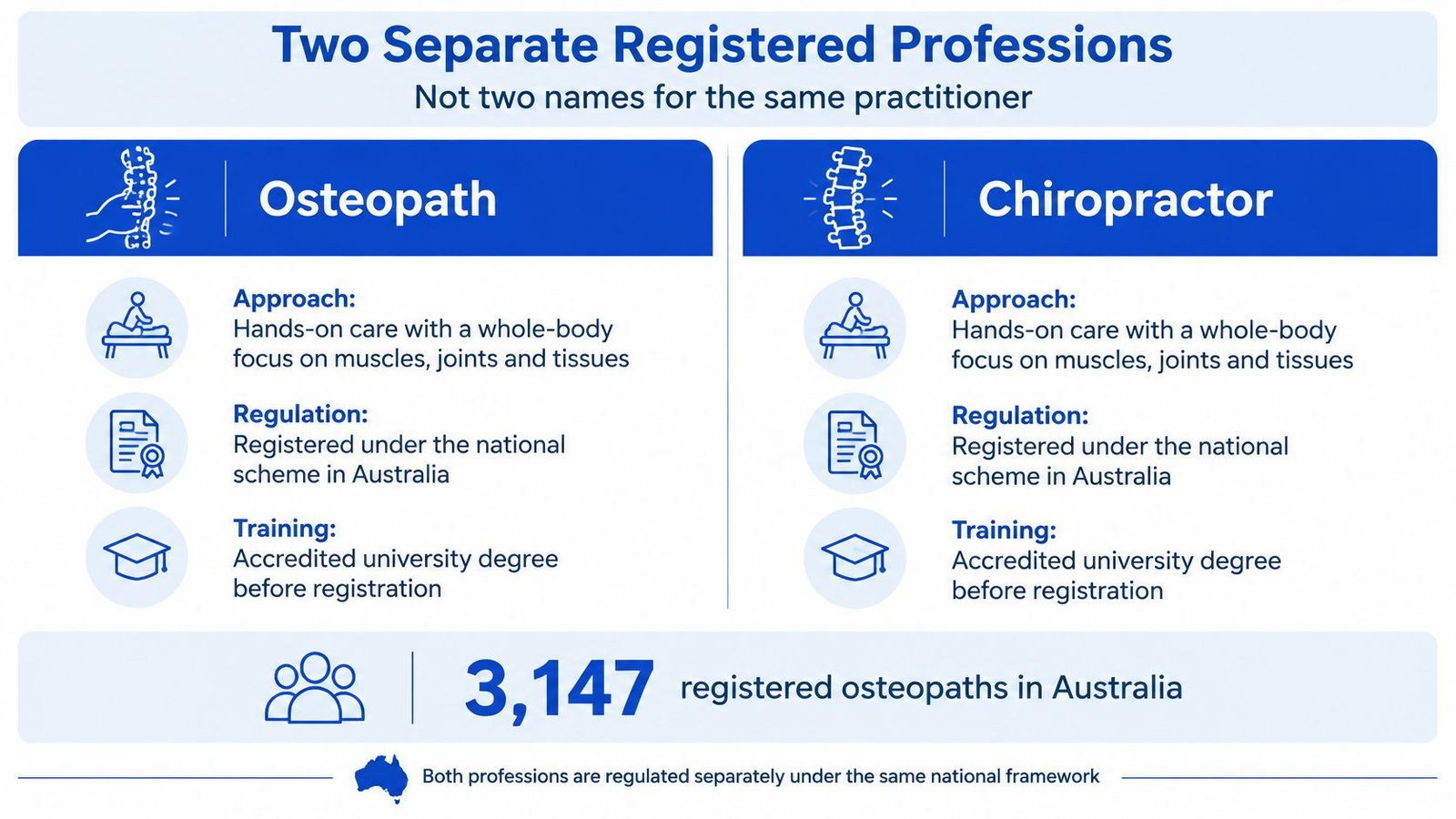
Osteopathy and Chiropractic Compared at a Glance
| Feature | Osteopathy | Chiropractic |
|---|---|---|
| Entry qualification | Bachelor or master of osteopathy, typically four to five years full-time | Bachelor or master of chiropractic, typically four to five years full-time |
| Core philosophy | Structure and function of the whole body are linked, and the body supports its own healing | Spinal alignment, joint motion and nervous system function are linked to health |
| Typical focus | Whole body, including muscles, joints, soft tissue and posture | Spine and joints, especially the neck and low back |
| Typical starting point | Assessment of movement and history, then hands-on treatment and self-care advice | Spinal assessment and examination, then adjustment or mobilisation and self-care advice |
Read the table as a map of emphasis and structure, not as a ranking. An osteopath may spend more time on soft tissue, posture and how nearby regions load a painful joint. A chiropractor may centre the examination on spinal segments and use a thrust technique earlier. Individual practitioners cross those lines often, and many blend the two approaches within a single consultation.
The overlap is large. Both professions commonly treat back, neck, headache and joint pain with hands-on methods, so the quality of the assessment in front of you matters more than the title on the door.
That overlap is why I wouldn't choose on philosophy alone. Ask what the practitioner found, why they've chosen that technique, what you'll do at home between visits, and when they'll review progress. A practitioner who answers clearly, and who tells you when hands-on care isn't the right first step, is worth more than any label on the door.
How Each Profession Is Trained and Registered
Both professions register nationally, so the practical distinction isn't that one is regulated and the other isn't. Osteopaths and chiropractors must both hold registration, meet continuing professional development requirements, carry professional indemnity insurance, meet recency of practice rules and comply with professional conduct standards.
The pathways into that shared framework are separate. Osteopathy qualifications are assessed through the Australian Osteopathic Accreditation Council, while chiropractic qualifications are assessed through the Council on Chiropractic Education Australasia, as described in Ahpra's registration standards. Each profession then works to its own National Board standards and competency expectations. If you want the detail behind the osteopathy pathway, read about osteopath qualifications in Australia before you compare clinic websites.
Training covers anatomy, physiology, pathology, clinical examination and supervised practice. The emphasis shifts between degrees, but neither title, on its own, tells you how carefully a particular practitioner screens for serious disease, explains risk, or writes a referral. That's what the register check and your first conversation are for.
Check the Register Before You Book
Do this before you rely on a biography, a social media profile, or a wall certificate.
- Search the exact name: Use the practitioner's full name on Ahpra's public register so you're looking at official registration information, not clinic advertising.
- Confirm the profession: Check the listing says osteopathy or chiropractic, because similar sounding titles and technique descriptions don't prove registration in that profession.
- Confirm current general registration: Make sure registration is current and general, not provisional, limited or lapsed, because that affects the practitioner's authority to practise independently.
- Read any conditions or restrictions: A condition may limit scope, require supervision, or set other practice requirements, so it should shape your questions before treatment.
- Match the person to the booking: Confirm the registered name matches the person you'll see, especially in a multi-practitioner clinic where appointments can be reassigned.
Registration confirms the practitioner meets the minimum requirements to practise. It doesn't guarantee that manipulation, mobilisation, or any other technique will help your condition. I would treat registration as the entry ticket, then judge the consultation on the history taken, the examination performed, the explanation given, and the willingness to refer when something doesn't fit a musculoskeletal pattern.
A practitioner who can't explain why a technique suits you, or who discourages GP involvement without a sound reason, hasn't passed that second test. The title and the register get them into the room. Their reasoning is what should earn your consent.
Treatment Philosophy and Hands-On Techniques Compared
Osteopathy traditionally frames the body as an interrelated system where structure and function affect each other. In practical terms, an osteopath treating low back pain may also examine hip rotation, thoracic stiffness, breathing mechanics, work posture and sleep position. The question is often, what's loading this area and what else is limiting movement?
Chiropractic traditionally places spinal joint motion and nervous system function at the centre of its reasoning. Modern chiropractors usually describe restricted segments, pain sensitivity and motor control in biomechanical and clinical terms. Older language about bones being out of place and needing to be put back is largely rejected in current evidence-informed practice, because imaging and clinical testing rarely support that simple story.
Neither philosophy should become a script. A sore neck from a new pillow, a stiff arthritic hip and a disc-related leg pain need different reasoning, even if the same practitioner treats all three in one morning.
Common Techniques by Profession
| Technique | Osteopathy | Chiropractic | What the patient feels |
|---|---|---|---|
| High-velocity low-amplitude thrust | Used selectively, mostly spine and pelvis | Core technique, mainly spine | Short, quick push; a click may or may not occur |
| Soft-tissue and myofascial work | Common | Used as an adjunct | Pressure and stretching of muscle and fascia |
| Muscle energy technique | Common | Used selectively | Gentle contraction against resistance, then a stretch |
| Joint mobilisation | Common | Common | Slow, rhythmic movement within a comfortable range |
| Cranial and visceral techniques | Taught in some programs, limited evidence | Rarely used | Light pressure over the skull or abdomen |
| Instrument-assisted adjustment | Rarely used | Used in some clinics | Handheld device delivers a light, quick impulse |
| Flexion-distraction | Rarely used | Used for some disc-related low back pain | Gentle table-based stretch of the lumbar spine |
Both professions use high-velocity low-amplitude thrust, so a click doesn't tell you which profession you're seeing. Both also use mobilisation, exercise advice and soft-tissue work, though the mix differs by training, patient preference and the tissue being treated.
Clinical judgement: The technique label matters less than the reason the practitioner chose it, the force they plan to use, and what they'll do if you don't respond.
Force should match the person. A thrust that suits a healthy adult with a stiff thoracic segment may be a poor choice for an older adult with fragile bones, someone taking anticoagulant medication, or a patient who's anxious about neck treatment. Slower mobilisation, muscle energy work and progressive exercise often achieve the movement goal without the same load.
Sound also misleads patients. A click can occur with a thrust, but it's not proof that a joint was realigned or that treatment worked. Judge the session by whether movement improves, pain settles, function returns, and the plan helps you do more between visits. If a practitioner sells the noise as the result, ask what measurable change they're aiming for at review.
Conditions Each Profession Commonly Treats
The waiting rooms overlap heavily. Both professions commonly see low back pain, neck pain, headache, joint stiffness and posture-related strain, so your diagnosis alone rarely settles the choice. The more useful difference is what surrounds the hands-on work: exercise, education, load management, medical coordination, or more of the same technique.
For most musculoskeletal conditions, staying active and building capacity do the heavy lifting. Manual therapy can reduce pain enough to help you move, sleep, or start an exercise program, but it works best as a supporting option inside a broader plan.
Common Conditions and Evidence for Hands-On Care
| Condition | Evidence for hands-on care | Usually combined with |
|---|---|---|
| Acute low back pain | Moderate; manipulation and mobilisation give short-term benefit | Exercise and activity advice |
| Chronic low back pain | Moderate; benefits often modest and short-lived | Exercise, education and self-management |
| Neck pain | Moderate for short-term relief | Mobility and strengthening exercises |
| Tension-type and cervicogenic headache | Limited to moderate; some trials show benefit | Posture work and exercise |
| Sciatica | Limited; manipulation alone is not well supported | Medical review and exercise |
| Hip or knee osteoarthritis | Modest short-term pain relief | Exercise, which is the primary treatment |
| Pregnancy-related back and pelvic pain | Limited data; practitioner should have antenatal training | Physiotherapy or GP coordination |
| Infant colic and paediatric care | Limited and contested | Paediatric GP review first |
Say two people arrive with chronic low back pain. One sits for long shifts, has lost hip strength and fears bending. The other has night pain, unexplained weight loss and a past cancer history. The first may suit a short course of manual therapy with graded exercise. The second needs medical assessment first. Same body region, completely different starting point.
That logic applies across the table. Sciatica involves nerve-related leg pain, so strength, sensation and reflex changes matter more than whether a lumbar thrust is available. Osteoarthritis responds best to progressive loading, weight management where relevant and activity pacing, with hands-on care used to settle symptoms. Headache care needs screening for pattern change and neurological signs before anyone treats the neck.
Be cautious with promises. Hands-on care often gives short-term relief, and chronic pain usually changes gradually as strength, sleep, stress and daily load improve. A practitioner who promises to cure arthritis, permanently fix posture, or resolve infant colic with certainty is going beyond what the evidence supports. Look instead for a review point, a functional goal such as walking further or sitting through work, and a plan that changes if you aren't progressing.
Safety, Red Flags and When to See a GP First
Patients often ask which profession is safer. That question assumes safety sits in the title, but it sits mainly in screening, technique selection, informed consent and referral. The Ahpra public register lists registered practitioners, their profession, registration status, and any conditions or restrictions on practice, and Ahpra states that its role is to protect the public by ensuring only suitably trained and qualified practitioners are registered. Compare the individual's assessment and explanation of risk, not a blanket claim about either profession.
The image below reflects the right first step when symptoms don't fit a simple musculoskeletal pattern, a proper medical history and review.

Spinal manipulation by either profession is generally low risk for suitable patients, but it isn't risk-free. Temporary soreness or stiffness is the common downside. Serious adverse events are rare, and the most discussed concern is cervical artery dysfunction linked to neck manipulation, with ongoing debate about true frequency and causation. If you're weighing that risk in detail, read about whether an osteopath can damage your back and discuss your own history before consenting.
Red Flags That Need Medical Review
See a GP first, or seek urgent care where symptoms are rapidly worsening, if you have any of the following:
- Systemic illness: Unexplained weight loss, fever, feeling unwell, or night pain that lying down doesn't ease.
- Cauda equina warning signs: Bladder or bowel changes, numbness in the groin or inner thighs, or progressive leg weakness.
- Trauma or bone risk: Significant trauma, suspected osteoporosis, or pain after a fall that isn't settling.
- Medication and bleeding risk: Anticoagulant use, which needs careful screening before stronger techniques.
- New neurological symptoms: Dizziness, double vision, drop attacks, slurred speech, marked weakness, or rapidly worsening pain.
The short video below gives a visual overview of why those questions come before treatment, not after a technique has already been applied.
Older adults and people with osteoporosis or blood-thinning medication need more careful screening and often gentler methods. A good practitioner asks about those factors before treatment, explains alternatives, and refers on when a red flag appears. If your history is brushed aside so treatment can start quickly, I would pause the appointment and get a GP opinion first.
Costs, Session Length and Medicare Options
Fees vary because each clinic sets its own prices. Location, appointment length, practitioner experience and what the visit includes all shift the figure, so a generic price list is a poor guide. Ask the clinic directly before you book.
An initial consultation runs longer than a follow-up because it has to cover history, examination and first treatment in one sitting. Follow-ups are shorter and priced lower, which is why the per-visit fee drops after the first appointment. A sensible course is several sessions over weeks with an agreed review point, rather than an open-ended commitment purchased before anyone knows how you respond.
Session Fees, Medicare and Extras at a Glance
| Item | Osteopathy | Chiropractic | Notes |
|---|---|---|---|
| Initial consultation | Longer appointment, priced above a follow-up | Longer appointment, priced above a follow-up | Covers history, examination and first treatment |
| Follow-up session | Shorter appointment, priced below the initial visit | Shorter appointment, priced below the initial visit | Treatment plus a progress check |
| Typical course | Several sessions over weeks | Several sessions over weeks | Set by the condition and your response |
| Medicare rebate | Only under a GP referral, for the services it specifies | Only under a GP referral, for the services it specifies | The referral letter states which services and how many visits it covers |
| Private health extras | Often claimable | Often claimable | Per-visit benefit and annual limit set by your fund and level of cover |
Medicare is the part patients most often misread. A standard osteopathy or chiropractic consultation carries no automatic rebate; one applies only when a GP referral provides for it, and the referral letter states what is covered and for how many services. Ask the clinic what the referral includes and what gap you will pay at each visit. This guide to Medicare cover for osteopathy explains how the rebate side works before you attend.
Private health extras sit separately from Medicare. Many funds pay a benefit toward both professions, up to an annual limit that depends on your level of cover. Check your remaining limit before committing to a course, because a benefit paid on the first visit tells you nothing about what is left for the fourth and fifth.
Ask Before You Pay
- What's the initial consultation fee and what does it include?
- What's the follow-up fee?
- How many sessions do you expect before review?
- Is a Medicare rebate available under this referral, and what does it cover?
- Will my fund pay a benefit, and what's my remaining extras limit?
Clear answers protect you from the most common cost problem in manual therapy, paying for visit after visit without a test of whether the plan is working.
What to Expect at Your First Visit
A first visit should feel like a clinical assessment, not a race to the treatment table. The practitioner needs enough history to screen for red flags, enough examination to form a working explanation, and enough discussion for you to consent with a clear picture of the options.
The process map below sets out the sequence in a simple form, from documents through to an agreed plan.
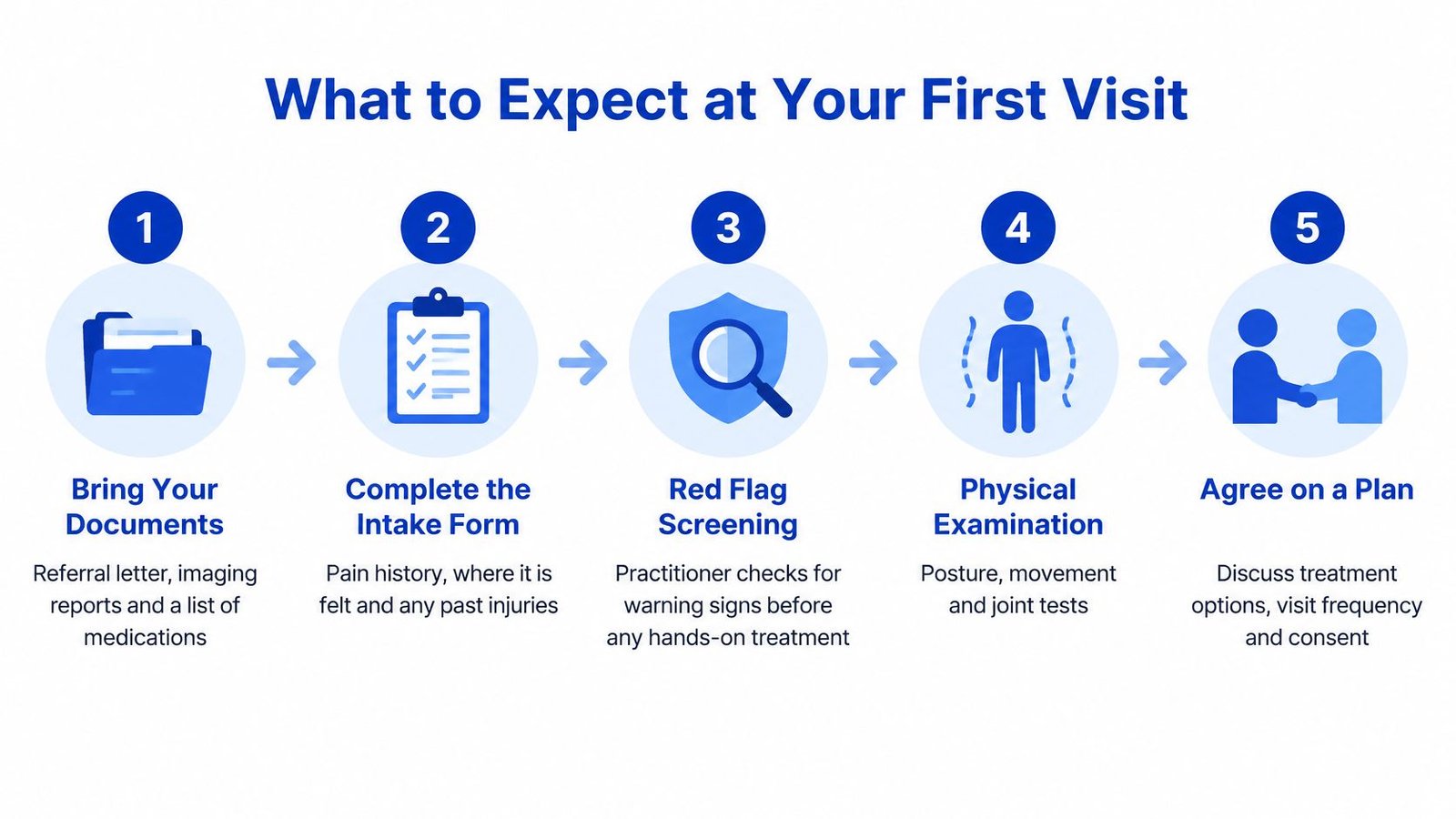
The Appointment in Order
- Bring your documents: Take any referral letter, imaging reports and a current medication list so the practitioner can screen safely and avoid duplicating tests.
- Complete the intake form: Record where you feel pain, when it started, past injuries, general health and what you want to get back to doing.
- Talk through the history: Discuss onset, aggravating activities, sleep, work demands and previous treatment, because those details often explain the load on the painful area.
- Undergo the physical examination: Expect posture, movement, joint and muscle testing and hands-on palpation, with each test explained in plain language before it's performed.
- Hear the working explanation: The practitioner should outline the likely cause, what's uncertain, and whether hands-on care suits this stage or a referral should come first.
- Discuss options and give consent: You'll cover expected benefits, risks and alternatives, including exercise, watchful waiting, or GP review, before treatment begins.
- Receive treatment if appropriate: Treatment may include hands-on techniques, and you can ask questions, request a gentler approach, or stop at any point.
- Leave with a plan: Take home self-care advice, activity guidance and exercises, plus a review date and the measures that will show whether you're progressing.
A chiropractor may discuss spinal imaging more often during assessment, while an osteopath may ask more about whole-body factors such as breathing, digestion, workload and movement habits. Those are tendencies, not rules. What matters is whether the practitioner can connect each question and test to your presentation.
Wear clothing that lets the practitioner assess the area and lets you move comfortably. Speak up if you need a chaperone, prefer not to undress, or don't want a particular technique. Those preferences should be accommodated without argument.
I would leave wary if treatment starts before a history is taken, if imaging is ordered without a clear clinical reason, or if you're sold a long prepaid plan on day one. A careful first visit earns trust through reasoning, not urgency.
Book the Right Practitioner After Checking Registration
Start with your situation, then match it to the assessment and treatment style you need. The difference between osteopath and chiropractor becomes practical at this point, because preference, risk profile and the wider care plan often matter more than professional tradition.
Which Option Fits Which Situation
| Situation | Usual starting point | Reason |
|---|---|---|
| Back or neck pain, no red flags, wants hands-on care with exercise | Either profession | Evidence is similar; assessment quality matters most |
| Prefers whole-body, soft-tissue approach | Osteopath | Broader focus on muscles, joints and posture |
| Prefers spine-centred manipulation | Chiropractor | Spinal focus and thrust techniques are central |
| Joint stiffness or arthritis, older adult | Either, with an exercise plan | Exercise is the foundation; hands-on care supports it |
| Office-related posture strain | Either | Movement advice and workplace changes matter most |
| Pregnancy-related back or pelvic pain | Practitioner with antenatal training | Pregnancy needs specific screening |
| Any red flag symptom | GP first | Medical review must come before hands-on care |
| Child or infant | GP first | Paediatric review is needed before any treatment |
For uncomplicated back or neck pain, either profession is a reasonable starting point. Choose the practitioner who takes a thorough history, examines the relevant region, gives you something active to do, and sets a review date. If you strongly prefer broad soft-tissue work across the whole body, osteopathy usually fits that preference. If you want care centred on spinal segments and thrust techniques, chiropractic usually fits better.
Arthritis and persistent joint stiffness need a different lens. Hands-on care may settle pain and improve confidence, but the plan lives or dies on progressive exercise, strength work and daily activity. Ask how the practitioner will measure progress. Walking distance, sit-to-stand capacity, grip function, sleep quality and time spent at a desk are more useful than a vague promise to keep you aligned or balanced.
Office posture strain is similar. A short course of treatment won't outweigh long hours in one position without breaks, so look for movement advice, desk setup changes you can realistically maintain, and exercises that fit your day. The best plan is the one you'll repeat on a busy Tuesday, not the longest list of stretches.
Pregnancy, infancy and childhood need tighter boundaries. Choose a practitioner with relevant antenatal or paediatric training, expect coordination with your GP or midwife, and get medical review first for a child or infant. Gentle technique alone isn't a substitute for developmental, obstetric, or paediatric screening.
What I Would Ask on the Phone
Keep the call short and specific. Ask how the practitioner screens for red flags, what the first assessment covers, whether they regularly treat your condition, and how they decide between thrust techniques, mobilisation and exercise. Ask when they refer to a GP, physiotherapist, or specialist. A confident practitioner answers those questions plainly and doesn't treat referral as failure.
Also ask what happens if you don't improve. A reasonable answer names a review point, a change in plan, further investigation, or referral. An answer built only around booking more sessions, buying a package, or attending indefinitely for maintenance should make you cautious. Maintenance care may suit some people with recurrent symptoms, but it should follow a demonstrated response and a discussion of cost, not precede any evidence that treatment helps you.
Bayside Osteopathic Health offers hands-on osteopathic care for back, neck, joint and arthritis-related pain, combined with movement advice and home self-care in a personalised plan, and the team can explain Medicare options where they apply. Treat that as one local osteopathy option, and apply the same registration, assessment and review tests you'd apply anywhere else.
A Short Booking Sequence
- Complete the register check using the practitioner's full name and listed profession.
- Ask how they screen for red flags and what the first assessment covers.
- Ask for the expected number of sessions, the review point and the fees.
- Book the first visit and bring your referral, imaging reports and medication list.
After the first visit, judge the fit by clarity. You should know the working explanation, why each technique was chosen, what to do at home, what improvement to watch for, and when the plan will be reconsidered. If you don't, ask once and expect a direct answer. Good manual therapy isn't mysterious, and your consent shouldn't rest on trust alone when a practitioner can explain the reasoning in ordinary language.
Choose the person, not just the profession. Verify registration, protect the GP-first situations, prefer exercise and self-management alongside hands-on care, and stop any plan that can't show you progress. That's the safest way through the choice, whichever title is on the door.
If you've checked registration, ruled out red flags, and want osteopathic care that combines hands-on treatment with movement advice and practical home self-care for back, neck, joint or arthritis-related pain, book a first visit with Bayside Osteopathic Health. Bring your referral, imaging reports and medication list, and ask the team to explain your assessment findings, expected sessions, fees and any Medicare options that apply before treatment begins.