
You stand up after a long meeting and the hip catches. Or the ache starts halfway through a walk that used to feel easy. Maybe it's worse at night when you roll onto one side, or it feels stiff and grumpy for the first few steps after sitting. Hip pain has a way of making ordinary life feel negotiated.
What many individuals seek is one clear answer. One stretch, one treatment, one scan, one injection. In practice, hip pain treatment usually works better when it's layered and progressive. Australian evidence around hip osteoarthritis supports exercise therapy, while manual therapy is generally used as an addition rather than a stand-alone fix, which is why a combined plan often makes more sense than chasing a single remedy (Australian review of hip pain management).
A good plan should tell you what to do today, what to watch over the next week or two, and when it's time to get hands-on help. If you're looking for an osteopath near you in Bayside, it helps to understand what a practitioner is assessing and why.
Table of Contents
- Your Guide to Navigating Hip Pain
- First Steps to Assess Your Hip Pain
- Effective Self-Care for Immediate Relief
- The Osteopathic Approach to Hip Treatment
- A Progressive Plan to Rebuild Hip Strength
- Prevention Tips and When to Seek Further Help
Your Guide to Navigating Hip Pain
Hip pain can come from several places, and the location matters. Pain at the front of the hip may behave differently from pain on the outside of the hip or pain that feels like it's coming from the buttock or low back. That's one reason people get confused. They search for “the best hip pain treatment” and get advice that doesn't match the way their symptoms behave.
The more useful question is this. What stage are you in right now? If the hip is newly irritated, the job is to calm it. If it's been dragging on for weeks or months, the job is usually to restore movement, rebuild strength, and change the loads that keep provoking it.
Practical rule: Match the treatment to the behaviour of the pain, not just the place you feel it.
That's how I'd want a new patient to think about it. Not as a mystery to fear, but as a problem to sort through in order. First, screen for warning signs. Next, figure out the general pattern. Then use simple self-care to reduce irritation. If it's not settling, bring in a practitioner who can assess the hip in the context of the pelvis, lower back, knees, and walking pattern.
A lot of frustration comes from doing one helpful thing in isolation. Stretching without strength. Rest without movement. Hands-on treatment without home exercises. Or trying to push through pain because stopping feels like failure. Lasting improvement usually comes from combining the right pieces at the right time.
First Steps to Assess Your Hip Pain
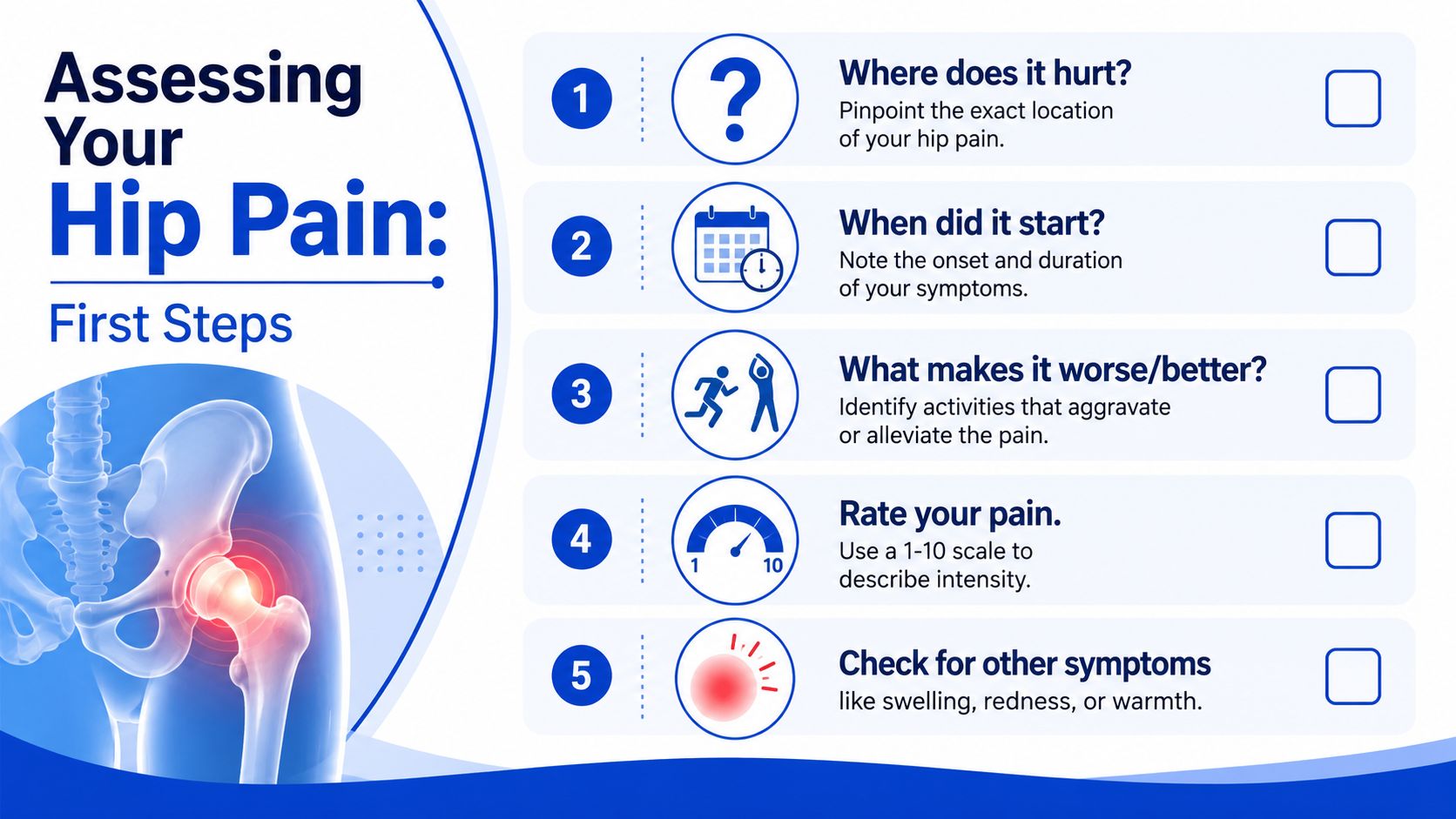
Before you choose any hip pain treatment, get clear on what the symptoms are doing. You don't need to diagnose yourself. You do need to notice patterns.
Start with the pain pattern
The simplest self-check is to answer a few plain questions.
- Where is it sore: Is the pain in the groin or front of the hip, on the outside of the hip, deep in the buttock, or spreading down the thigh?
- When did it begin: Did it start after a clear incident, after a training change, or did it creep in gradually?
- What stirs it up: Sitting, standing, stairs, walking, lying on one side, getting out of the car, or crossing your legs?
- What settles it: Gentle movement, changing position, warmth, slowing down, or complete rest?
- How irritable is it: Does it ease quickly when you stop, or does it flare and stay sore for hours?
That information matters because different hip problems often leave different fingerprints. Side hip pain that's worse lying on that side often behaves differently from front-of-hip stiffness that's grumpy after inactivity. Pain in the buttock with back stiffness may involve the lower back or pelvis as much as the hip joint itself.
A simple note in your phone can help. Track the location, your aggravating activities, and whether the pain is sharp, dull, stiff, or catching. That gives you something more useful than “it just hurts”.
Know the red flags
Some symptoms need a GP review promptly rather than a trial of home care.
Seek urgent medical assessment if you have any of the following:
- You can't bear weight: If the leg suddenly won't take your weight, especially after a fall or twist.
- Pain came on suddenly and is severe: A dramatic change deserves medical review.
- Fever or feeling unwell with hip pain: That combination shouldn't be ignored.
- Visible swelling, redness, or unusual warmth: Especially if the area is acutely tender.
- A major injury or significant fall: Even if you're trying to walk through it.
- Night pain that is intense and unrelenting: Particularly if it doesn't change with position.
- Rapid loss of movement: If the hip suddenly becomes hard to move in several directions.
If the story doesn't fit a simple mechanical flare-up, don't try to be brave with it. Get it checked.
Bring useful information to your appointment
If you do see a practitioner, come in with observations rather than guesses. This helps far more than trying to label yourself with arthritis, bursitis, tendonitis, or “a bad hip”.
A short checklist to bring:
| What to note | Why it helps |
|---|---|
| Pain location | Helps separate front, side, and back-related patterns |
| Triggering tasks | Shows which loads the hip isn't tolerating |
| Morning versus evening symptoms | Gives clues about stiffness and irritability |
| Sleep disturbance | Often changes management advice |
| What you've already tried | Prevents repeating unhelpful approaches |
You don't need a scan before first-line care in every case. But you do need a clear picture of how the pain behaves.
Effective Self-Care for Immediate Relief
You wake up, swing your legs out of bed, and the hip grabs on the first few steps. By lunchtime it eases a little, then flares again after a long sit or a bigger walk than usual. That pattern is common, and it often responds best to a simple plan. Settle the irritation, keep the joint moving, then build back up in stages.
The mistake I see most often is swinging between overdoing it and shutting everything down. Hips usually prefer a middle ground. The goal is to reduce irritation without making the area stiffer, weaker, or more sensitive. If you are new to osteopathic care, this outline of how osteopathy looks at movement and recovery as a whole gives helpful background, but the first steps at home are usually quite straightforward.
Start with a 24 to 48 hour reset
Use the first day or two to calm the hip, not to test it.
- Choose heat for stiffness: Heat often suits a hip that feels tight, guarded, or hard to get moving in the morning.
- Choose cold for an irritated flare: Cold can help after a sharp aggravation, especially if the area feels reactive after activity.
- Trim, don't cancel, daily movement: A shorter walk is often better tolerated than a complete stop, provided symptoms settle soon after.
- Change positions early: If sitting low, crossing legs, or lying on the sore side stirs it up, adjust before the pain ramps up.
- Reduce deep hip bend and compression: Very low chairs, deep squats, and long periods curled up can irritate some hips.
Go by response, not by theory. If the hip feels easier 20 to 30 minutes later and no worse that evening, that choice was probably reasonable.
Pick movements that calm the joint
Early exercises should feel controlled and repeatable. They are not meant to be a workout. They are a way to restore comfortable movement and show the hip it can still tolerate load.
Pelvic tilts on your back
Lie on your back with knees bent. Gently roll the pelvis so the lower back flattens into the floor, then release. This can ease protective tension around the low back and pelvis.Small hip rotations
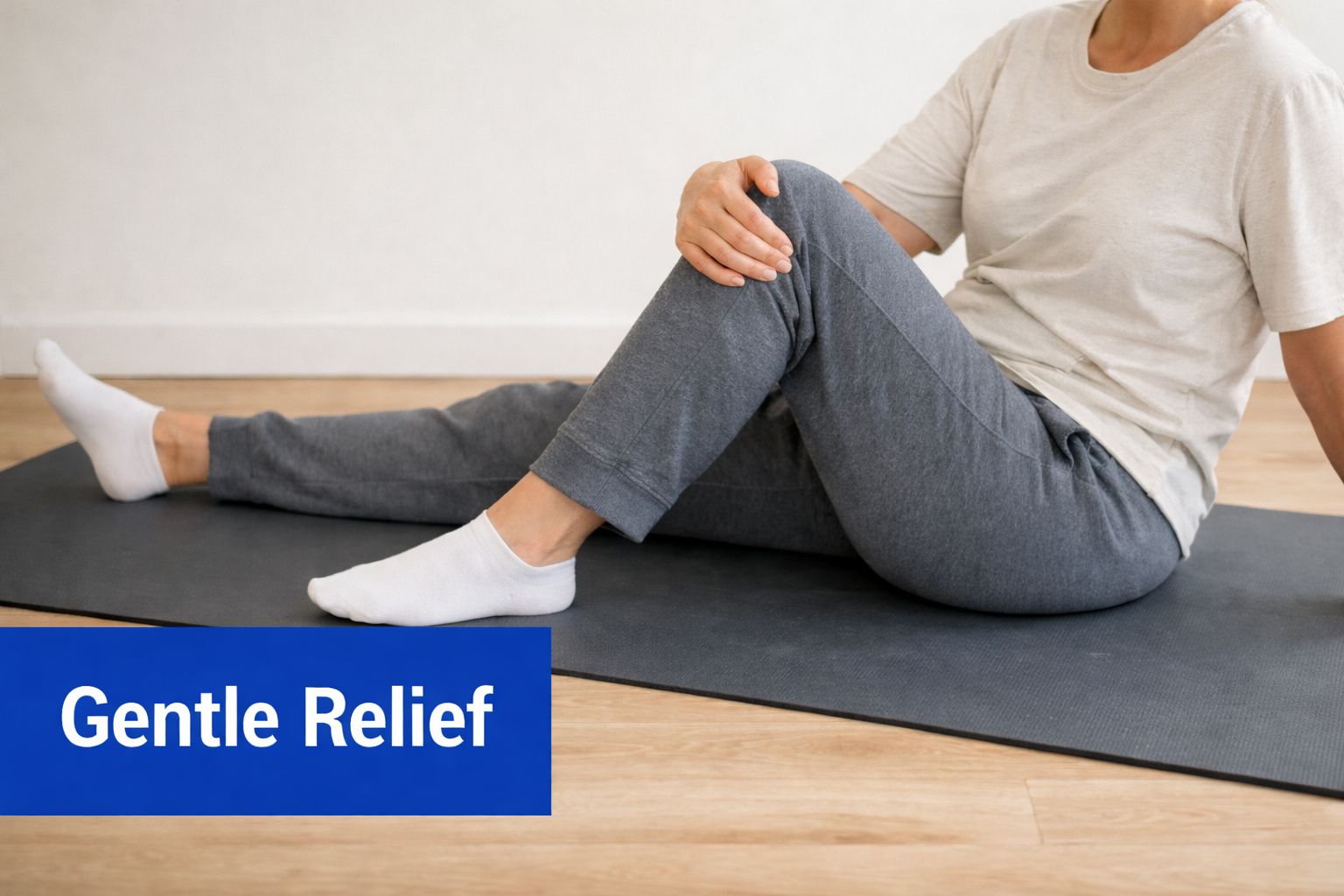
Stay on your back with knees bent and let both knees drift a short distance side to side. Keep the movement easy and symmetrical. This often helps a stiff, guarded hip settle.Single knee to chest, within comfort
Bring one knee toward the chest until you feel a mild stretch or the start of resistance. Stop well before any pinch at the front of the hip.Supported standing weight shifts
Hold a kitchen bench or counter and gently shift weight from one leg to the other. This is useful when the hip has become wary of walking or standing on one leg.
A mild pulling sensation is acceptable. Sharp pain, catching, or a clear increase in limping means the exercise is too much for now.
Judge progress by what happens later
The hip's response over the next day matters more than how brave you can be in the moment. A useful rule is this: if symptoms settle during the session and stay steady or improve afterward, continue. If the hip feels more irritable for hours, reduce the range, do fewer repetitions, or leave that exercise out.
That is the roadmap at this stage. Calm it down, keep it moving, and only then add more load.
Use the video as a movement guide
If you'd rather follow along than decipher written instructions, this movement demo is a useful starting point:
If a video helps you get started, treat it as a guide rather than a prescription. Some hips tolerate rotation well but dislike flexion. Others are the opposite. If one movement clearly settles the area, keep it. If another repeatedly stirs things up, stop forcing it and choose the variation your hip handles better.
The Osteopathic Approach to Hip Treatment
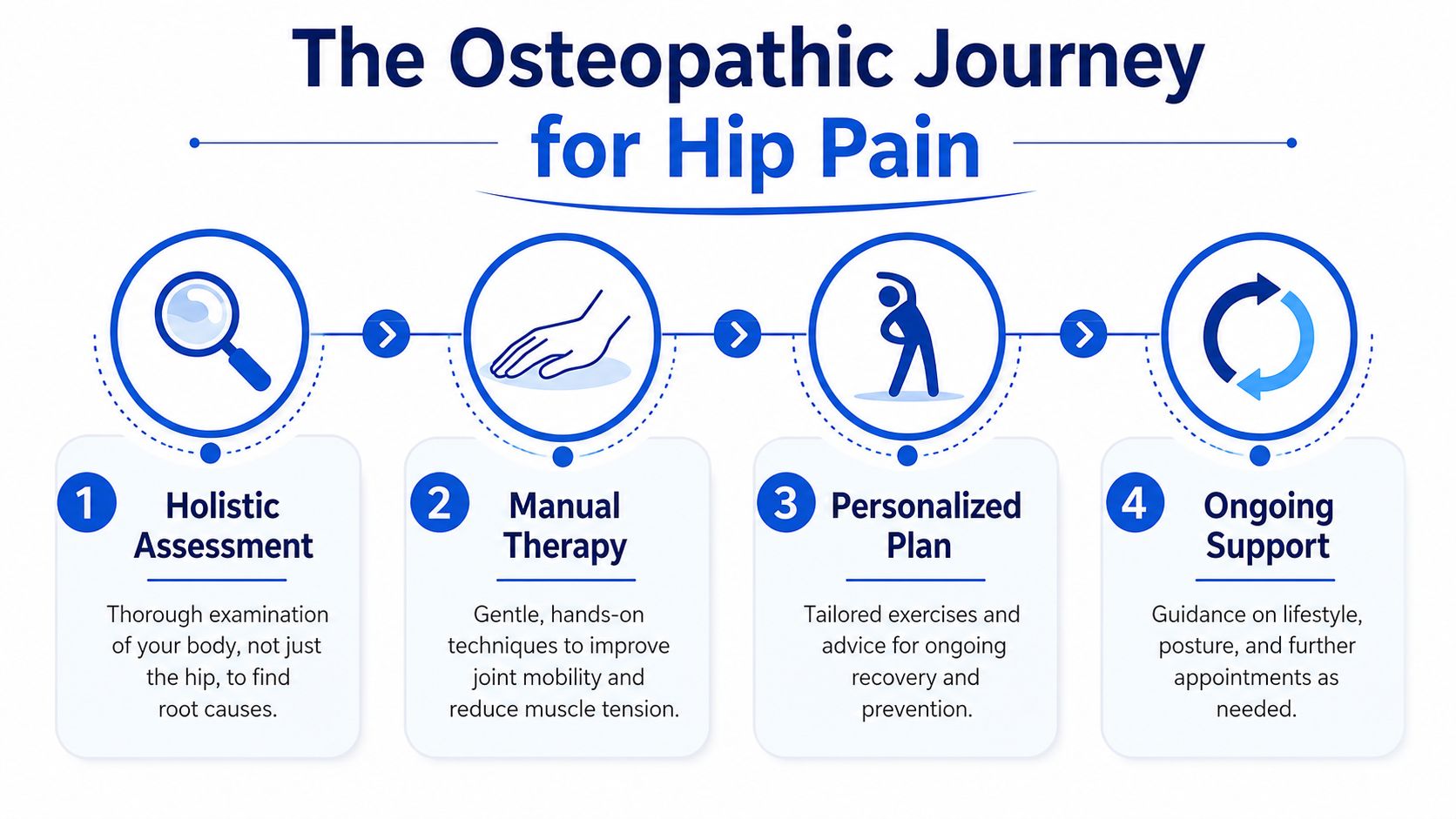
A hip rarely works in isolation. When someone comes in with hip pain, the hip joint is only part of the story. The pelvis, lower back, gluteal muscles, walking pattern, and even foot mechanics can all change how the hip is being loaded.
That whole-body view is what makes osteopathic care useful for many persistent cases. If you're unfamiliar with it, this overview on understanding osteopathy and how it approaches whole-body movement gives the broader context.
What gets assessed beyond the hip
A proper assessment usually looks at more than where you point.
An osteopath may check:
- Hip joint movement: Not just whether it moves, but which directions reproduce symptoms.
- Pelvic control: Poor control here often changes load through the side of the hip.
- Lower back contribution: Some “hip pain” is partly driven by the lumbar spine.
- Glute strength and timing: Weak or underactive glutes can make walking, stairs, and single-leg tasks harder on the hip.
- Daily aggravators: Sitting setup, training changes, side-sleeping habits, long drives, or carrying a child on one hip.
Treatment aimed only at the sore spot often misses the underlying reason for its persistent irritation.
What treatment can look like
Hands-on care for hip pain treatment is usually practical and targeted. Depending on the presentation, that may include soft-tissue work for guarded muscles around the hip and pelvis, joint articulation to improve comfort in restricted directions, and gentle mobilisation to restore more natural movement.
The treatment shouldn't feel like something being “done to you” while you lie there passively hoping for a cure. The better model is collaborative. Manual therapy helps reduce pain and improve movement quality, then exercise and load advice help you keep the gains.
One option people in the area sometimes use is Bayside Osteopathic Health, where treatment commonly combines hands-on care with movement advice and home exercises. That sort of blended plan is often more useful than relying on manual treatment alone.
Why this approach suits stubborn lateral hip pain
For pain on the outside of the hip, passive care often isn't enough. Lateral hip pain commonly responds better to a plan that combines load management, movement correction, and progressive strengthening.
An Australian study summary on gluteal tendinopathy reported that a structured physiotherapy program had a 77% success rate at 8 weeks and 78% at 52 weeks, compared with 58% and 57% for corticosteroid injection, and 29% and 52% for no treatment (Australian summary of treatment outcomes for lateral hip pain). The program included load management, exercises for the hip abductors, extensors, and external rotators, and advice to avoid compressive positions like lying on the affected side, deep squatting, or sitting cross-legged.
That doesn't mean injections never have a role. It does mean many people with side hip pain need a plan that changes loading and builds tissue capacity, not just a short-term pain reduction strategy.
A Progressive Plan to Rebuild Hip Strength
Relief is only the first phase. If the hip has been sore for a while, you need enough strength and control to handle walking, stairs, getting up from chairs, lifting, and longer periods on your feet. Otherwise, the pain settles for a week, then returns as soon as life gets busy again.
Phase one calm things down
In the early stage, keep the exercises simple and regular.
A good short list is:
- Bridge holds: Lie on your back, knees bent, feet on the floor. Lift your hips a small amount and hold briefly if comfortable.
- Supported marching: Standing at a bench, slowly lift one knee, then the other, without leaning heavily to one side.
- Clam variations with light effort: Side-lying or modified versions can help, provided they don't aggravate side hip pain.
The aim isn't fatigue. It's cleaner movement and a hip that feels more trustworthy.
Phase two rebuild control
Once the hip tolerates gentle work, shift toward exercises that ask the glutes and pelvis to manage load better.
Try combinations like these:
| Exercise | What it trains | What to watch |
|---|---|---|
| Sit-to-stand from a chair | Functional leg strength | Avoid collapsing inward at the knee |
| Standing hip abduction | Side hip control | Don't hitch the pelvis |
| Step-ups to a low step | Balance and loading | Keep the movement slow and even |
| Mini squat to a bench | Hip and thigh strength | Stop before pinching or sharp pain |
At this stage, form matters more than depth. A smaller, controlled squat is better than a deep, messy one that reproduces the same problem.
Build strength in a way the hip can absorb. Don't jump from rest straight back to full effort.
Phase three return to everyday loading
When symptoms are more settled, make the exercises look more like life. That may mean walking a little farther, carrying shopping, using stairs with control, or returning to gym work with modified range and tempo.
A simple way to think about progress:
- Weeks 1 to 2: Settle irritation, improve tolerance to gentle mobility, reduce obvious aggravators.
- Weeks 3 to 6: Add foundational strengthening and practise single-leg control in low doses.
- Week 7 onward: Progress to more functional movements and gradually restore normal activity.
That timeline isn't a guarantee. Some hips move faster, some need longer. The important part is the sequence. Calm, then control, then capacity.
If pain spikes at each progression, don't assume the plan has failed. Often the jump was just too large. Reduce the dose, simplify the task, and build again.
Prevention Tips and When to Seek Further Help
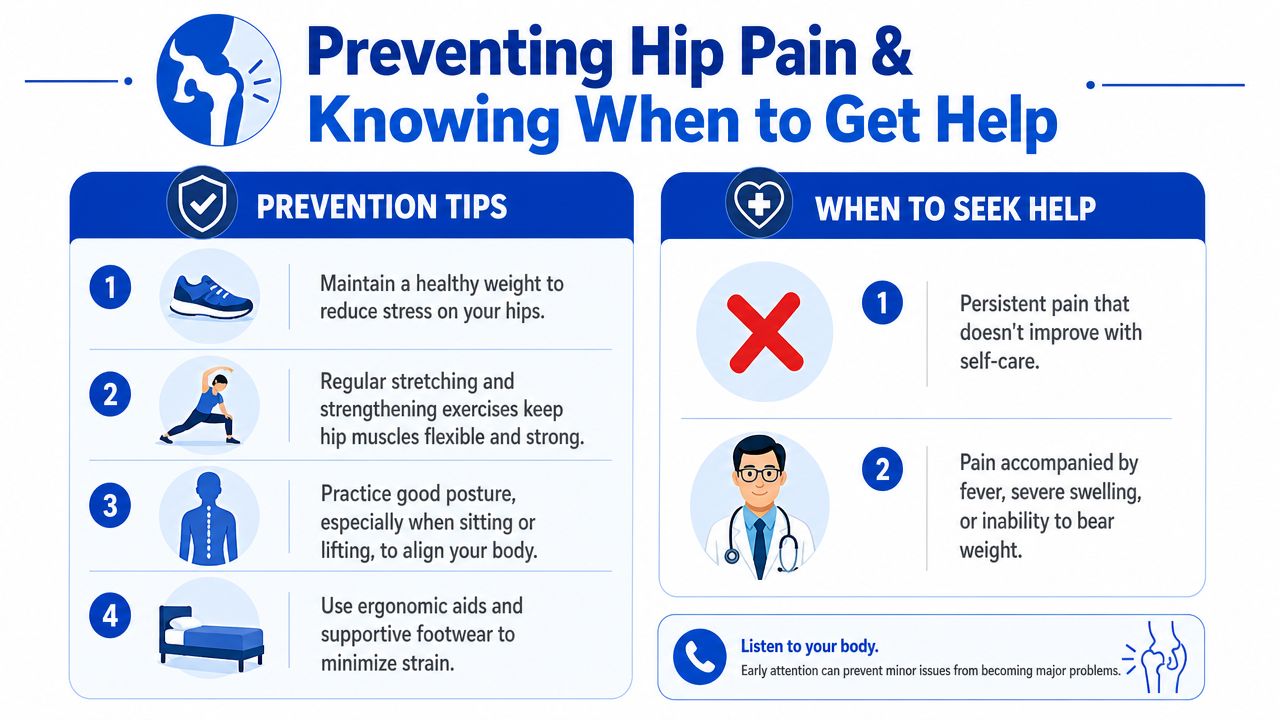
A common pattern I see is this. The sharp flare settles, walking gets easier, and then the hip slowly drifts back into trouble because daily habits never changed. Prevention is less about doing more and more about removing the small loads that keep irritating the joint or surrounding tissues.
Prevention that fits real life
The goal is to keep the hip moving well enough, often enough, that it does not stiffen up between bursts of activity. That looks different for different people.
For office workers, long periods in one position are often the main aggravator. Sitting itself is not always the problem. Staying there for hours, especially slouched or shifted onto one side, often is.
Useful changes include:
- Break up desk time: Stand up, walk to the printer, refill a water bottle, or do a short mobility reset before stiffness builds.
- Set up the workstation well: Keep both feet supported, avoid crossing into the same posture all day, and sit evenly through both hips.
- Use small movement breaks: A few sit-to-stands, a short walk, or gentle hip extension can keep the joint from becoming irritable by the end of the day.
For older adults, prevention usually depends on regular movement that the hip can tolerate week after week. Big efforts once in a while are less helpful than steady walking, pool exercise, light strength work, and balance practice that can be maintained.
Footwear, stairs, getting in and out of the car, carrying shopping, and how you turn during daily tasks all matter. These details sound minor, but they often decide whether the hip settles or keeps flaring.
When conservative care needs a rethink
Self-care and osteopathic treatment work best when they are helping you move from one stage to the next. If the hip is no longer progressing, the plan needs reviewing rather than repeating.
Arrange further assessment if:
- Pain is not improving after a fair trial of sensible conservative care
- Walking distance keeps dropping instead of improving
- Sleep is being disrupted by hip pain
- Resting pain becomes more noticeable
- You cannot load the leg with confidence
- The pattern of pain becomes unclear, changes quickly, or no longer behaves like a straightforward mechanical problem
At that point, a GP may suggest imaging if it will change management, and referral can be appropriate. In some cases, the issue is persistent tendon irritation, joint osteoarthritis, referred pain from the low back, or a combination of more than one problem. End-stage joint disease is a different category again, and that is where surgical opinion may enter the picture after non-operative care has been properly tried.
If you are considering injections, use them as part of a broader plan rather than seeing them as the whole treatment. This guide to cortisone injections for hip and musculoskeletal pain explains where they may help, their limits, and the questions worth asking before going ahead.
Medicare and referral pathways in Australia
Some people can access osteopathic care through a GP Management Plan under Medicare. Eligibility depends on your overall health picture and your GP's assessment.
That pathway can be useful when hip pain sits inside a longer-term problem such as arthritis, reduced mobility, or several musculoskeletal issues being managed together. It does not replace a proper assessment, but it can make ongoing care more practical.
Ask for more help once the hip stops responding to reasonable care, not after months of pushing through worsening pain.
If your hip pain is starting to affect walking, sleep, exercise, or getting comfortable after sitting, Bayside Osteopathic Health offers osteopathic assessment and hands-on care alongside practical exercise and self-management advice. If you're unsure where to start, booking an assessment can help clarify what's driving the pain and what the next step should be.