
You push up from your favourite chair, and for a moment your knees protest, your back feels stiff, and the walk to the kitchen takes more concentration than it used to. The trip to the shops is still possible, but you're planning where to rest, which kerbs to avoid, and whether you feel steady enough today. If that sounds familiar, you're not alone, and you don't have to accept shrinking movement as inevitable. Learning how to improve mobility in elderly adults starts with a safe, personal pace, not a generic routine copied from someone fitter or younger.
Table of Contents
- Why Mobility Matters as We Age
- What the Australian Guidelines Recommend
- Assessing Your Starting Point Safely
- Building a Gentle Exercise Program
- Daily Habits and Home Safety for Better Mobility
- How Osteopathic Care Complements Your Plan
- Red Flags and When to Seek Help
Why Mobility Matters as We Age
Margaret still wants to walk to the local shops, carry a light bag home, and get into the garden without worrying about getting back up again. Lately, though, rising from a low lounge takes two attempts, and turning quickly in the hallway makes her grab the wall. Nothing dramatic has happened. That's often how mobility changes begin, through small tasks that become harder.
Mobility is more than exercise fitness. It's the mix of strength, balance, coordination, joint range, stamina, and confidence you need to rise from bed, shower safely, manage stairs, get in and out of a car, and keep participating in community life. When one part slips, other parts are asked to compensate, and daily life can start to narrow.
How Small Changes Can Cascade
Avoiding a walk because your hip aches can lead to more stiffness the next day. Sitting for longer reduces leg strength, which makes standing harder, which then lowers your confidence to leave the house. Over time, that cycle affects independence, mood, and safety, even if you still consider yourself generally well.
Consider these common early signs:
- Chair difficulty: You need your arms to push up, or you rock forward several times before standing.
- Shorter outings: You choose closer destinations because walking, kerbs, or uneven ground feel tiring.
- Turning caution: You hold furniture when changing direction or feel unsteady in the shower.
- Giving up tasks: Gardening, hanging washing, or visiting friends starts to feel like too much effort.
This isn't about occasional stiffness after a busy day. Australian Bureau of Statistics data from the 2022 Survey of Disability, Ageing and Carers recorded 2.3 million people aged 65 and over with disability, equal to 52.3% of all older Australians, and among them, 78.9% reported a mobility limitation. Those figures show why early, practical action matters before limitations become severe.
Improvement doesn't require pushing through pain or copying a neighbour's program. It requires the right challenge, repeated consistently, at a level your body can recover from.
A safety first approach doesn't mean doing almost nothing. It means matching the task to your current ability, progressing in small steps, and paying attention to pain, dizziness, and confidence along the way. When movement feels manageable, you're far more likely to keep doing it, and consistency is what helps preserve walking, transfers, shopping, and social participation.
What the Australian Guidelines Recommend
Australian guidance gives older adults a useful target, but it works best as a framework rather than a pass or fail test. You're building toward a combination of movement types because each one protects a different part of mobility. Walking supports stamina, strengthening helps you rise and climb, and balance work helps you stay steady when you turn, step, or recover from a trip.
The infographic below summarises the three core elements to aim for over a week.
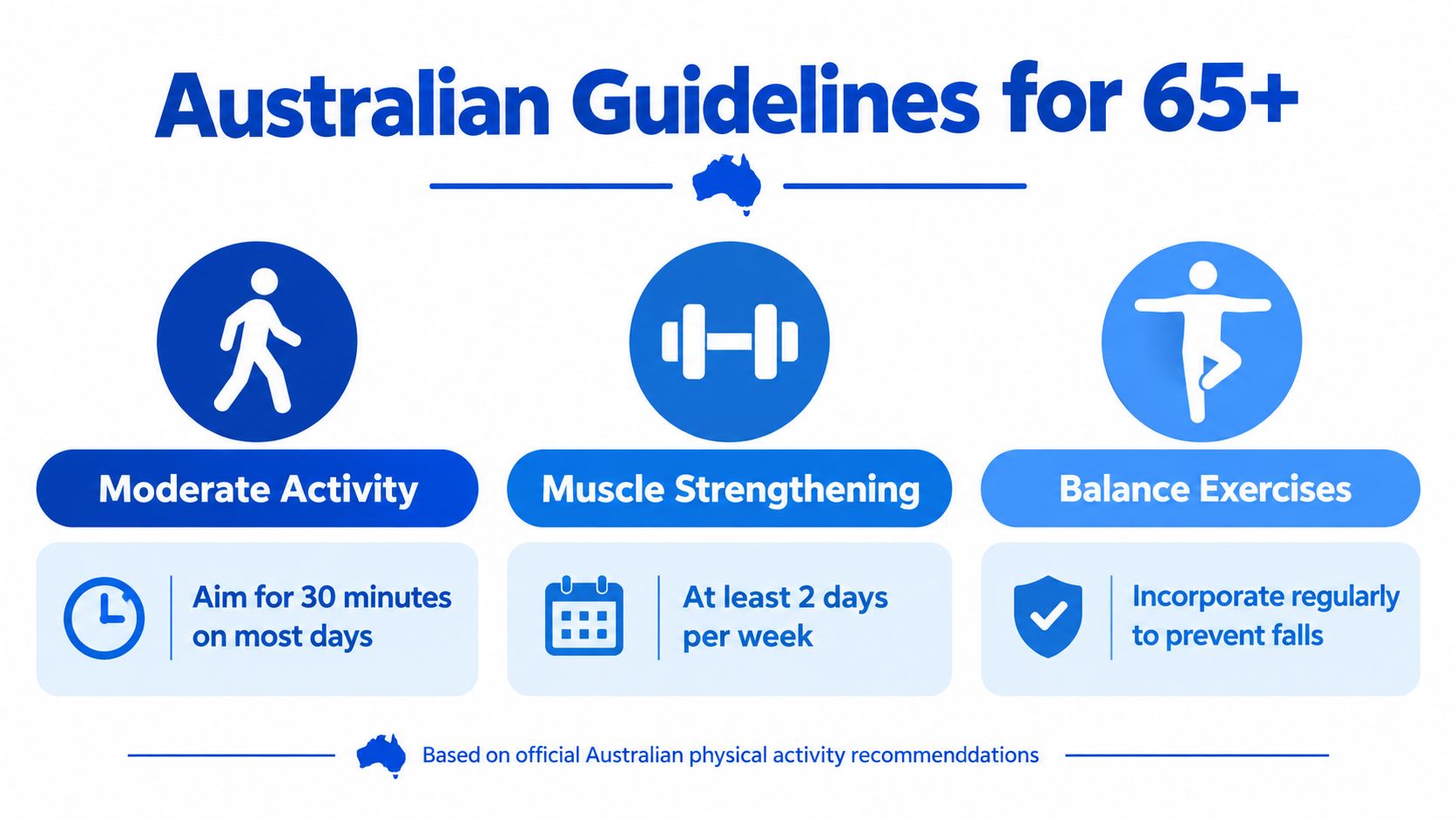
According to Department of Health physical activity guidance for older Australians, people aged 65 and over should undertake at least 30 minutes of moderate to vigorous intensity physical activity on most days, perform muscle strengthening activities on at least 2 days each week, and complete functional activities targeting mobility, balance and coordination on at least 3 days each week. The same guidance also supports several hours of light intensity activity each day and breaking up prolonged sedentary periods.
Why Walking Alone Is Not Enough
Walking is valuable, accessible, and often enjoyable, especially around Bayside paths and parks. It doesn't, on its own, sufficiently challenge the leg and hip strength needed for chair rises, nor does it train reactive balance when your foot catches on a lip in the pavement. That's why a plan for how to improve mobility in elderly adults needs all three components working together.
| Component | What It Supports | Everyday Example |
|---|---|---|
| Moderate activity | Stamina and walking capacity | Walking to the shops without needing to stop as often |
| Muscle strengthening | Rising, lifting, and stair climbing | Standing from a chair with less arm help |
| Balance and coordination | Steadiness, turning, and fall prevention | Changing direction in the kitchen with control |
Participation gaps show why structure matters. The Department of Health guidance linked above also notes that 57% of Australian adults aged 65 and over did not meet the physical activity component, while 84% did not complete enough muscle strengthening activity. The strengthening gap is particularly important, because weakness is often the hidden reason transfers and stairs become difficult.
Don't treat the guideline dose as your starting dose if you're frail, deconditioned, or returning after illness. Start below it, build gradually, and adapt intensity for chronic conditions, pain, or disability. A smaller amount done safely and repeated is a better foundation than one ambitious week followed by soreness and avoidance.
Assessing Your Starting Point Safely
A patient in her seventies once told me she felt perfectly steady, right up until we timed her getting out of a chair. She needed both armrests and a few slow attempts for five repetitions, and none of that had registered with her until the watch was running. Self-assessment is useful, but the gap between how movement feels and how it performs is what a proper screen exposes.
A short screen gives you three things: a realistic starting intensity, the supports to keep within reach, and a baseline that lets you measure progress rather than guess at it.
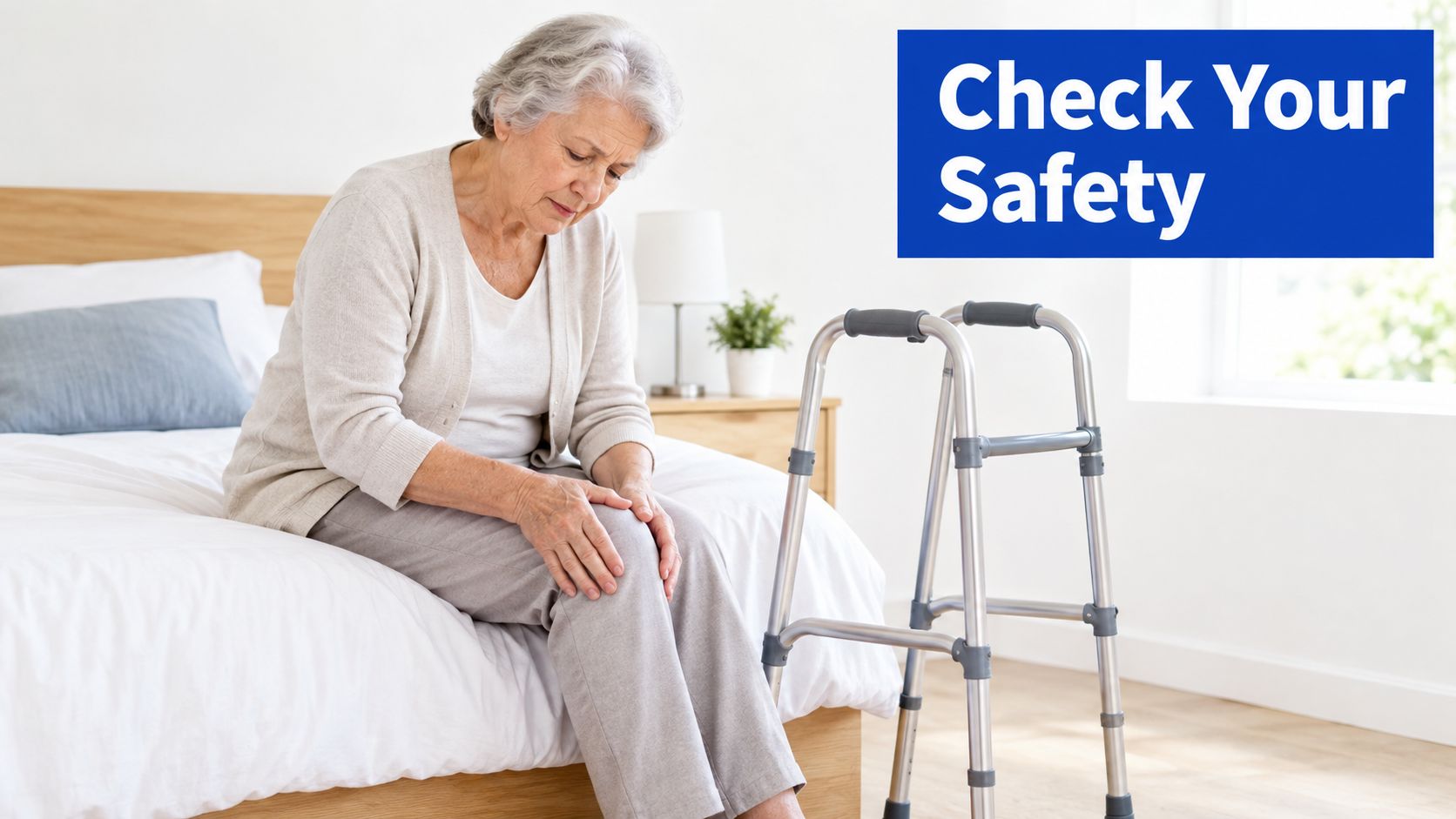
Stiffness or pain on first movement, including knee discomfort like this, is information to record before you begin.
The NSW physical activity guidelines for older adults describe a sensible starting protocol: check falls history, dizziness, cardiovascular symptoms, medication effects, footwear, vision, and access to a stable support surface, then establish baseline function with the Timed Up and Go, the five times sit to stand, gait speed, and a single leg or tandem stance.
Run those checks at home with someone nearby and a firm chair placed against a wall. Before testing anything, ask whether you have fallen or nearly fallen recently and what you were doing, whether standing makes you dizzy or light effort leaves you breathless, whether any medication could dull alertness or drop blood pressure, whether your glasses are current for distance and steps, and whether you own firm closed shoes and a rail or bench to hold. Your answers set how cautiously to proceed.
Watching yourself rise, walk, turn, and sit again usually reveals more than asking whether you feel fit. If the picture stays unclear, a structured functional movement screening organises those observations and pinpoints which deficits to train first.
Practical rule: If a test itself feels unsafe, stop. The result you need is already clear, and supervised assessment is the safer next step.
Treat the outcome like a traffic light. Steady walking, easy chair rises, and no recent falls or symptoms is green: a gentle home program with support nearby is reasonable. Slowed times or mild unsteadiness is amber, calling for a cautious start and regular rechecks. Marked weakness, fear of falling, or pain limiting basic transfers is red, and professional assessment comes before any progression. Matching your plan to what the screen shows protects your confidence as well as your body.
Building a Gentle Exercise Program
Combine three ingredients rather than relying on stretching or walking alone. Aerobic movement builds endurance, progressive resistance builds the strength to rise and climb, and task specific balance work trains the exact movements that keep you independent. The infographic below sets out how those pieces fit together in a gentle program.
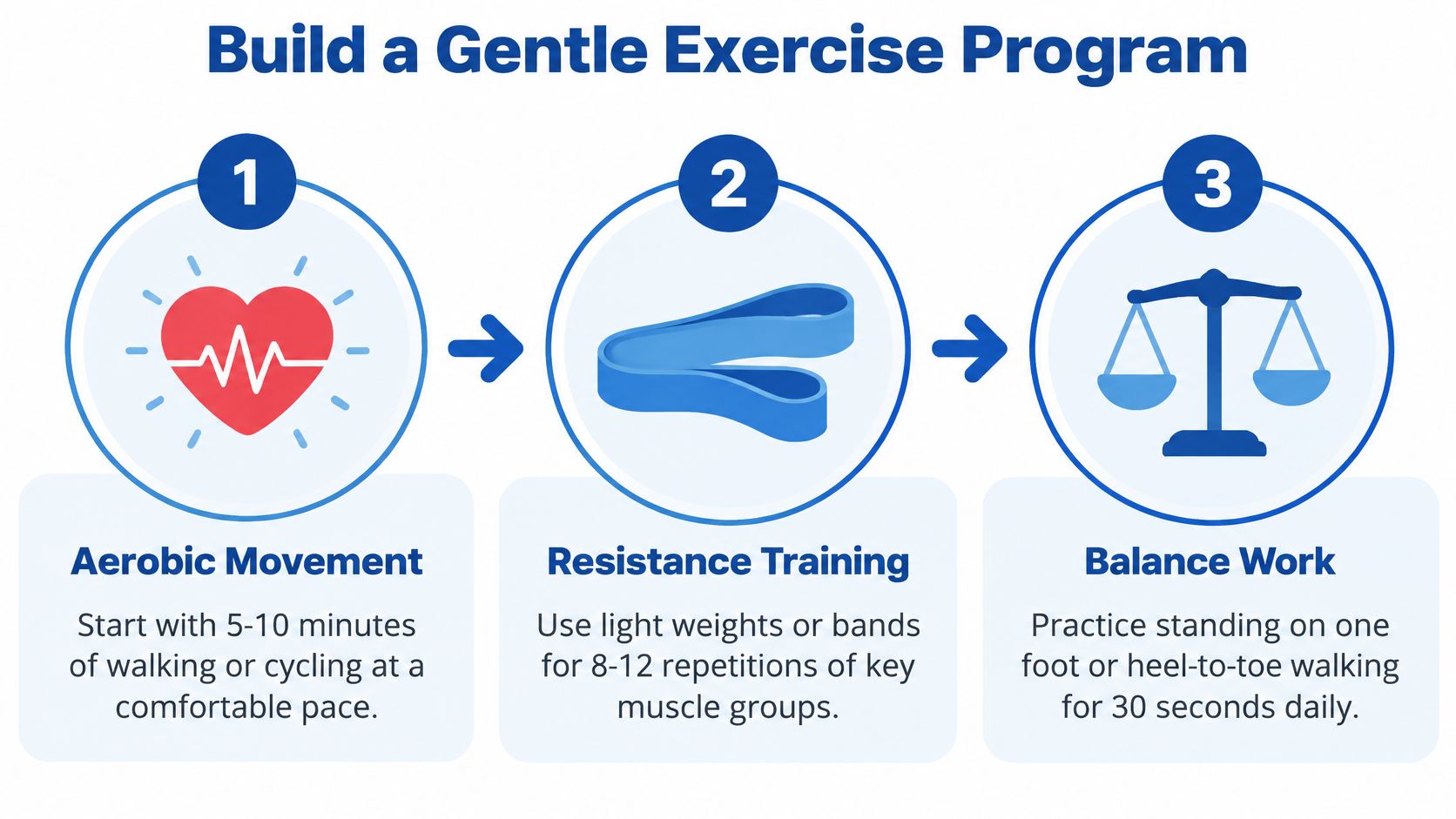
The evidence for combining components is strong. An Australian led evidence synthesis on physical activity and falls prevention reported that exercise reduced fall rates by 23% overall, while programs meeting a 3 hour weekly threshold and incorporating balance plus functional training achieved a 42% reduction compared with control. That doesn't mean you should jump straight to that volume. It means targeted, sufficiently challenging practice matters more than unstructured activity alone.
Start With Tasks That Matter to You
Choose the daily tasks that are currently difficult, then train their components. If rising from a chair is the problem, practise sit to stand repetitions from a firm chair, using arm support at first if needed. If kerbs trouble you, build leg strength and controlled stepping before tackling bigger steps outdoors.
Useful foundational exercises include:
- Sit to stand: Sit tall, feet under knees, lean slightly forward, and stand slowly, then sit with control rather than dropping back.
- Heel raises: Hold a bench, rise onto your toes, pause briefly, and lower slowly to strengthen calves for walking and balance.
- Multidirectional stepping: Step forward, sideways, and backward within reach of support to train reactions in different directions.
- Controlled turning: Practise small, deliberate turns instead of pivoting quickly, especially in tight spaces.
The video below demonstrates gentle movement ideas you can adapt with support nearby, stopping any exercise that provokes dizziness or sharp pain.
How to Progress Without Overdoing It
Progress only when technique stays stable. You can reduce hand support gradually, narrow your base of support, add repetitions, or increase light resistance, but change one variable at a time so you know what your body tolerated. Add dual task challenges, such as counting while walking, only after basic movement is controlled.
Frail or deconditioned adults should begin below guideline targets and build gradually, with supervision where balance is poor. Record what you completed, any near falls, pain response, and confidence, then reassess regularly and adjust the program. Mild effort and temporary muscle tiredness can be normal, but limping, escalating joint pain, or needing to recover for days suggests the step up was too large.
Daily Habits and Home Safety for Better Mobility
The shakiest steps often happen outside the exercise session: the first walk to the bathroom at night, the turn at the kitchen bench, the reach for a low cupboard after two hours in a recliner. Capacity built in practice fades quickly if the rest of the day teaches your joints to stay still. Spread movement through ordinary tasks, and standing up becomes rehearsed rather than a small event.
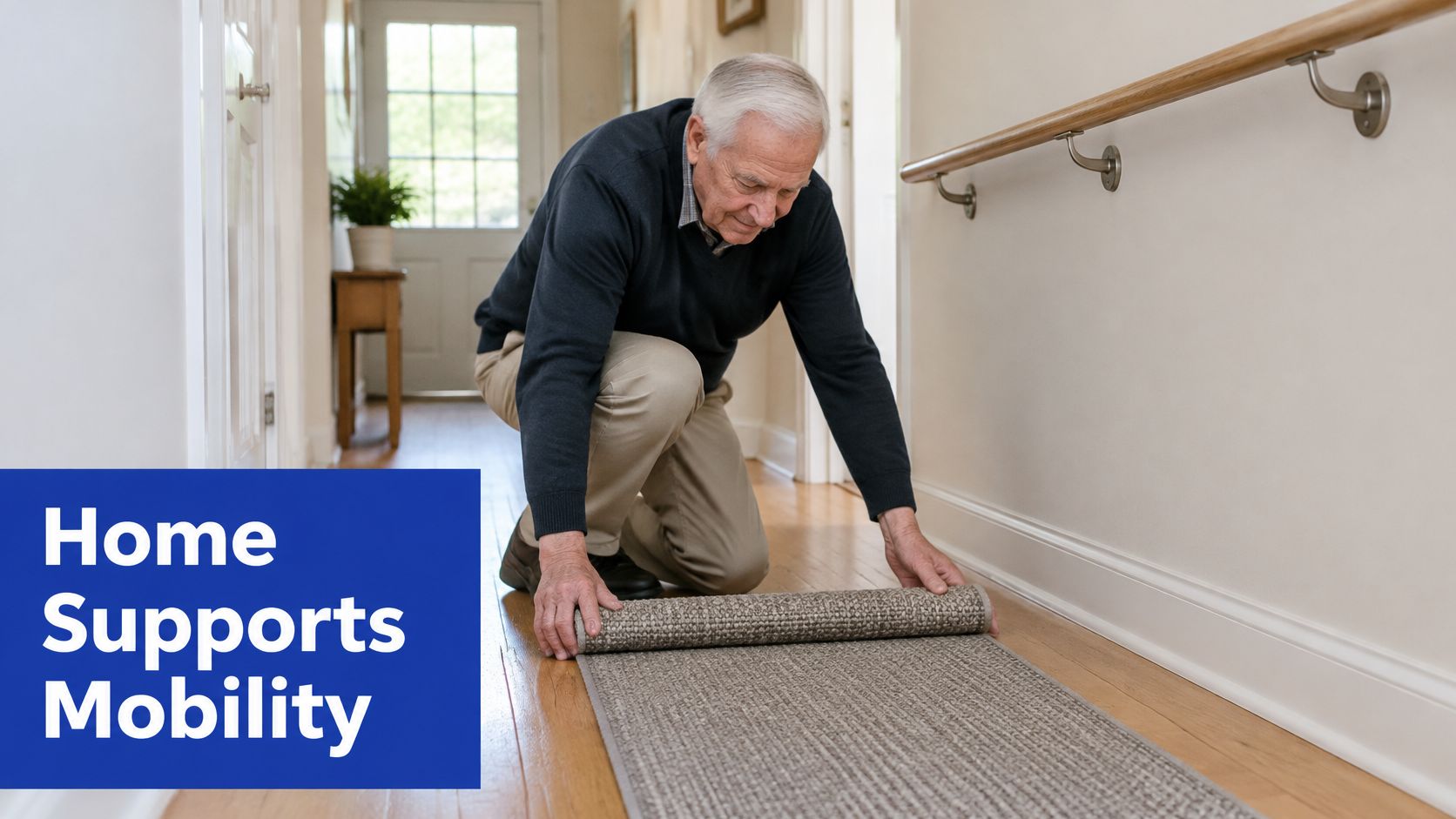
Start with the route you take when tired or half awake. Walk it once in daylight and look for anything that makes you shorten your stride, twist around an obstacle, or reach past your balance. Then set changes to match risk: a confident walker may only need clearer floor space and brighter lamps, while someone who has had a near fall needs firmer seating, support near transfers, and a plan for carrying items.
| Pressure point | Safer setup | Match it to your risk |
|---|---|---|
| Bed to bathroom at night | Night lights, clear path, lamp within reach | Keep a stick or frame parked consistently if waking unsteady |
| Shower and toilet transfers | Grab rails, dry floor, items within easy reach | Sit to dry or dress if one leg balance feels unreliable |
| Kitchen and laundry | Frequent items between knee and shoulder height | Use a trolley or ask for help rather than carrying hot or heavy loads |
| Hallways and living room | Flat mats, cords lifted, firm chair with arms | Remove small rugs entirely if feet shuffle or catch |
Footwear does quiet work here. Firm closed shoes with a low heel give better floor contact than loose slippers or socks on timber. Use any walking aid every time it is needed, including short distances, because the “just this once” trip is often the risky one. If a task needs both hands, change the task: take smaller loads, make two trips, or slide items along a bench.
Pace is a safety tool. Stand, pause until your head clears and your feet feel planted, then step. Turn by taking small steps around the space instead of swivelling on one planted foot. For a room by room version you can pair with your exercise routine, these fall prevention strategies help translate the audit into daily practice.
A safer home does not need to look clinical. It needs to make steady movement the easiest choice at the moments you are least steady.
How Osteopathic Care Complements Your Plan
A 72-year-old who has stopped her morning walks because her hip aches after two blocks is a common presentation in clinic. Her legs are still reasonably strong. The problem is that pain has shrunk her world, and every week she avoids walking, her capacity shrinks with it.
Hands-on care can change that starting point. Exercise builds capacity, but pain and stiffness often stop people from beginning or progressing, and addressing those restrictions can make the strengthening and balance work possible again. Osteopathic assessment looks at how the body moves as a whole: a stiff ankle changes how the knee and hip load during walking, while a painful lower back makes bending and reaching feel risky, so those movements get avoided and stiffen further. Knowing which restriction drives the pattern shapes what to treat first and what to train.
Treatment depends on your presentation. Soft tissue work can ease muscles that guard a sore joint, and slow joint articulation or mobilisation can improve comfortable range without forcing movement. Movement advice covers the practical side, including chair rise technique, walking routines, pacing, and self care between sessions. For arthritis-related stiffness and reduced mobility, Bayside Osteopathic Health provides gentle joint articulation, soft tissue treatment, and targeted movement coaching, and this overview of what osteopathy treatment involves explains the approach before you decide whether it suits your goals.
Be clear about the trade-off. Manual therapy can make movement more comfortable, but it cannot build strength or reactive balance on its own. Those gains come from progressive practice, and a trustworthy practitioner will explain that openly instead of promising that passive care alone will restore mobility. If a clinic suggests otherwise, ask how the hands-on work connects to your exercise program.
Some osteopathy services may be accessible under certain Medicare arrangements where eligibility criteria are met, and private health cover varies between funds and policies. Check both before booking so there are no surprises. Bring a list of medications, any relevant scans, and the specific daily tasks you want to improve. Those goals should drive the plan.
Red Flags and When to Seek Help
More exercise isn't always better. That assumption can lead people who already feel unsteady to attempt unsupervised balance challenges, progress too quickly, or ignore symptoms that need medical review. Risk matched care is safer and, in practice, more effective because you keep training instead of stopping after a scare or injury.
Seek prompt medical review if you notice unexplained falls, fainting or near fainting, chest pain or pressure, new breathlessness with light activity, or a sudden decline in walking or transfers. New leg weakness, major changes in sensation, unexplained weight loss, or pain that rapidly escalates also deserve assessment rather than a wait and see approach. Don't drive yourself if you feel faint or acutely unwell.
Match the Program to Your Fall History
Australia's updated falls guidance summarised in this 2025 community care falls prevention fact sheet recommends ongoing balance, mobility and strength exercise for everyone, community or home exercise for lower risk people, and supervised, individually customised programs for those who have fallen at least once in the previous year. The stakes are clear because falls affect about one in four Australians aged over 65 annually.
Use that guidance as a decision pathway:
- No recent falls and steady movement: Supported home or community exercise may suit you, with periodic reassessment.
- One recent fall or marked fear of falling: Choose a supervised program designed for your needs rather than progressing alone.
- Recurrent falls or difficulty rising: Get professional assessment first, including review of medications, vision, strength, and home hazards.
- Dizziness or cardiovascular symptoms: Pause balance training and seek medical advice before continuing.
A fall risk score alone doesn't tell the whole story. Two people with similar scores can need different programs depending on whether the main problem is weakness, pain, medication effects, poor vision, or unsafe home setup. Matching the intervention to the type of risk is the practical core of how to improve mobility in elderly adults safely.
If you're unsure which pathway fits you, err on the side of assessment. A short professional review can clarify what you can do confidently at home, what needs supervision, and what should wait. That's not a setback. It's how you protect momentum.
If stiffness, arthritis related discomfort, or fear of falling is limiting your walking, chair rises, or confidence around the home, Bayside Osteopathic Health offers gentle hands on treatment, whole body assessment, and practical movement guidance suited to your goals. Book a visit through Bayside Osteopathic Health to discuss a safe, personalised plan that helps you move more comfortably and stay active in Bayside life.