
93.9% of Australian adults with arthritis reported bodily pain in the previous four weeks, according to the Australian Bureau of Statistics 2020–21 health survey. That measures bodily pain, not pain in a particular joint, but it makes an important point: arthritis care needs to address how people feel and function, not just what appears on a scan.
Joint pain relief usually comes from a manageable combination of movement, pacing and symptom support. The useful question isn't which remedy wins. It's which starting activity you can tolerate, what might help you do it, and how you'll recognise when the plan needs changing.
Table of Contents
- Which Joint Pain Relief Options Work Best
- Matching Relief to Your Joint
- How Much Discomfort Is Acceptable
- A Home Routine to Start This Week
- Pacing Activity Across the Week
- Where Hands-On Care Fits in Your Plan
- Confirm Your Next Step for Joint Pain Relief
Which Joint Pain Relief Options Work Best
Graded strengthening and activity form the foundation; weight reduction can help when excess weight loads the joint, hands-on care and packs offer symptom support, medicines may help disabling flares, and suitable aids can improve stability or distribute load.
| Option | Best suited for | Evidence | Effort | Key caveat |
|---|---|---|---|---|
| Graded strengthening and activity | Knee and hip osteoarthritis | Strong support as core care | Moderate, ongoing | Tailor the movement to your ability and symptoms |
| Weight reduction | Knee or hip pain with excess weight | Strong for knee osteoarthritis | High, ongoing | Combine nutrition support with exercise |
| Manual therapy, including osteopathy and massage | Muscle soreness and stiffness accompanying joint pain | Mixed, with possible short-term benefit | Low physical effort per session, repeat appointments may be needed | An adjunct, not a substitute for active care |
| Heat or cold packs | Morning stiffness or a familiar flare | Limited, short-term symptom support | Low | A comfort measure, not a fix |
| Pain medicines, topical or oral | Flares that interrupt daily tasks | Medicine-specific benefit and risk | Low administration effort | Review suitability and side effects with your GP or pharmacist |
| Braces, insoles or walking aids | Instability or uneven loading | Mixed and device-specific | Low to moderate | Have a clinician check the fit and response |
The Evidence column describes how consistently an approach is supported, not whether it will work for every person. These are practical categories rather than a formal grading system. The Effort column distinguishes something simple to use from a continuing commitment, but low effort doesn't necessarily mean low cost.
Give conservative care a fair trial
Approximately 3.7 million Australians, or 15% of the population, were living with arthritis in 2022, according to the Australian Institute of Health and Welfare. That broad group includes different diagnoses and levels of disability, so no single remedy suits everyone.
The Australian Knee Osteoarthritis Clinical Care Standard clinician fact sheet states that approximately 9 in 10 people with knee osteoarthritis can manage without joint replacement and recommends, where appropriate, monitored weight reduction of at least 5–10% over 20 weeks alongside exercise and nutrition support.
That isn't a reason to postpone necessary assessment. It means routine imaging needn't be the entry ticket to treatment, and surgery isn't the automatic next step after a painful week.
A single option rarely does every job. Strengthening builds capacity; an appropriate support may make that strengthening easier to begin.
Practical rule: Start with a movement-based option and add a support that solves a specific obstacle, rather than trying every remedy at once.
Matching Relief to Your Joint
Find the row that most closely matches your sore joint, choose a starting movement, and adapt it to your symptoms and preferences. A generic exercise sheet is a starting point, not an instruction to force a movement that clearly doesn't suit you.
| Joint | Common pattern | Start with | Watch for |
|---|---|---|---|
| Knee | Osteoarthritis or a sore, unstable knee | Sit-to-stand from a firm chair; bridges if comfortable | Avoid deep loaded bends during a flare; get recurrent giving way assessed |
| Hip | Osteoarthritis or groin or outer-hip ache | Bridges and comfortable side-lying hip lifts | Persistent or unexplained night pain needs medical review |
| Hand | Stiff fingers or thumb joints | Gentle grip and finger movements; wall push-ups only if hand loading is comfortable | Sudden swelling or redness needs same-day GP assessment |
| Lower back | Persistent ache limiting movement | Comfortable walking and gentle pelvic tilts | New leg numbness or weakness needs review |
| Shoulder | Stiffness limiting overhead reach | Supported pendulum swings and small shoulder circles | Locking or sudden loss of movement needs review |
Make the movement fit
For a sore knee, use a stable chair that doesn't sink beneath you. Lean forward from the hips, use your hands if needed, and stand without dropping heavily back into the seat. A higher chair can make the movement more manageable.
For a stiff shoulder, rest your other hand on a bench and let the affected arm hang comfortably. Allow a gentle sway rather than actively swinging the arm into pain. Bigger circles aren't automatically better.
Hand exercises need particular care. Wall push-ups load the wrists and thumbs, so skip them if those are the painful areas and begin with unloaded finger opening and closing instead.
Understanding what causes stiff joints can help you describe the pattern: whether stiffness follows rest, accompanies swelling, or changes once you get moving.
These patterns don't establish a diagnosis. Groin pain, for example, isn't always hip osteoarthritis, and back pain isn't always coming from a spinal joint. If symptoms change, several joints become newly affected, or a movement repeatedly aggravates the problem, arrange an assessment rather than replacing it with a harder exercise.
How Much Discomfort Is Acceptable
If exercise hurts, have you damaged the joint? Not necessarily. Pain alone doesn't prove new tissue damage, but it also shouldn't be ignored or treated as something you must push through.
With an established, assessed condition, a mild, temporary ache can occur when you begin an unfamiliar activity. The more useful questions are whether it changes your movement, whether it settles afterwards, and whether your usual activities become harder.
The Australian Institute of Health and Welfare's chronic musculoskeletal conditions report identifies education, self-management, physical activity and appropriate weight management as core components of care. That supports a gradual plan, not a universal pain score that everyone must stay beneath.
Modify ordinary discomfort, assess unusual symptoms
There's no single numerical pain threshold suitable for every diagnosis. Mild, familiar discomfort that settles back towards baseline by the following day is a useful monitoring guide, provided your clinician hasn't given you different restrictions.
| Sign | Usually means | Next step |
|---|---|---|
| Ache that remains elevated the following day or worsens after repeated sessions | The activity dose may exceed current tolerance, though other causes are possible | Reduce the load and seek advice if it doesn't settle |
| Sudden swelling, heat or redness in a joint | Possible inflammation or infection | See your GP the same day |
| Persistent night pain or unexplained weight loss | Needs medical assessment; these symptoms aren't diagnostic on their own | Book a GP visit promptly |
| Sudden loss of function, locking or giving way | Possible structural or mechanical problem | Arrange medical review; seek urgent assessment if you can't use the limb |
| Fever with a hot, swollen joint | Possible joint infection | Seek urgent care today |
Suppose chair rises leave your knee more achy than usual. Try a higher seat, fewer repetitions or a smaller range rather than abandoning all activity. If the knee becomes hot and swollen, however, that's a different situation and deserves assessment rather than another exercise adjustment.
Sharp pain, a new limp or a feeling that the joint won't support you are reasons to stop that particular movement. They aren't invitations to test your determination.
Keep moving within tolerance, but let changes in symptoms and function, not fear or a rigid pain target, decide when you need help.
New bladder or bowel dysfunction, numbness around the saddle area, or rapidly worsening leg weakness with back pain requires emergency assessment.
A Home Routine to Start This Week
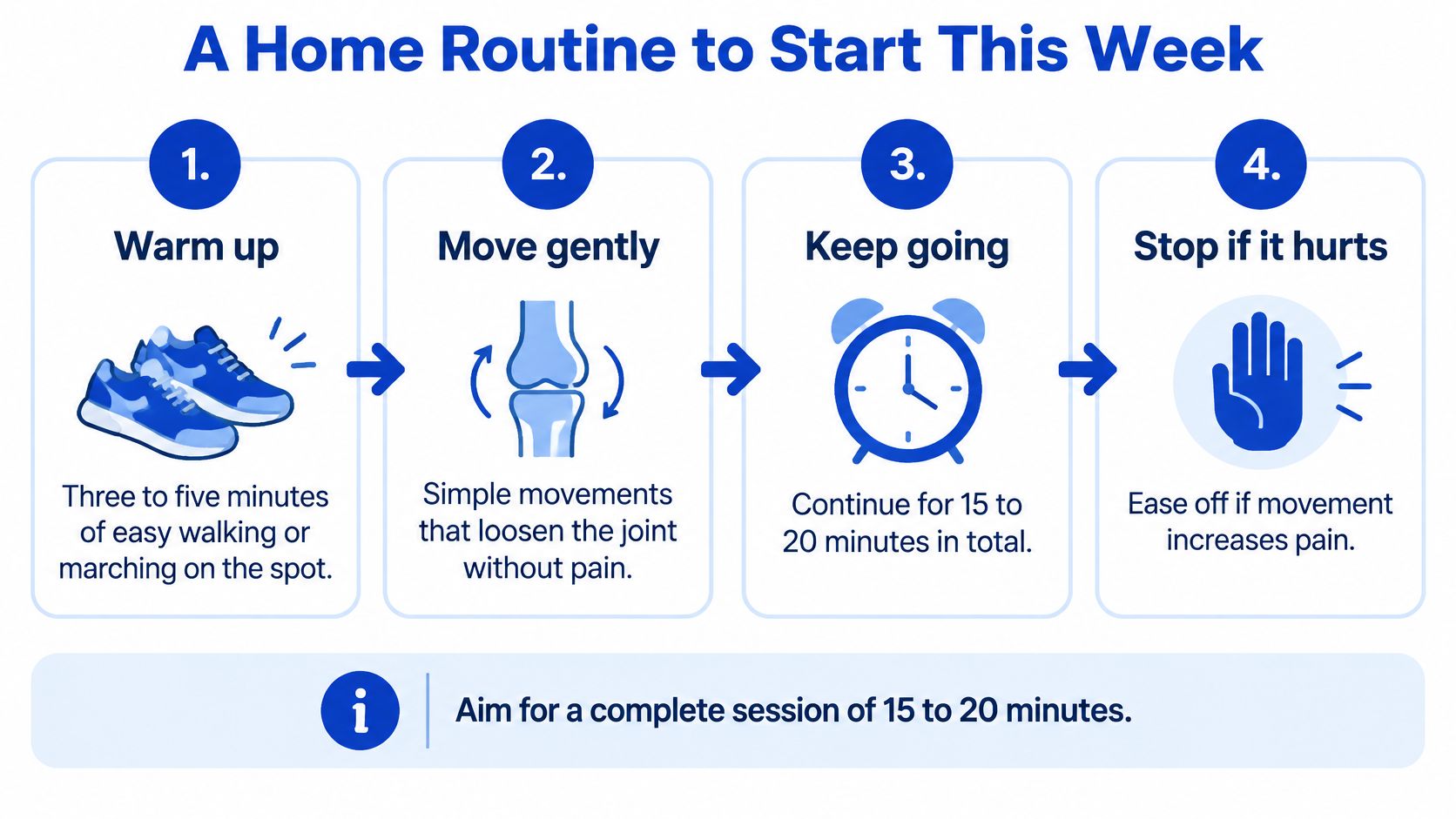
Begin with a short, unhurried session that leaves you able to carry on with ordinary activities. Choose exercises for your affected area rather than performing every exercise listed below, and get individual advice first if you've had recent surgery, a significant injury or unexplained symptoms.
This visual outlines the flow of a simple session. Treat it as an overview, not a requirement to complete a particular duration.
Work through a comfortable session
Warm up before asking for effort. Walk around the room or march gently beside a stable bench until movement feels easier. Don't rush straight into strengthening because you're short on time or the morning is cold.
Move the affected joint through a comfortable range, using slow seated knee bends, finger opening and closing, or small shoulder circles. This lets you check how the joint feels today; avoid stretching forcefully to reach yesterday's range.
Choose an appropriate strengthening movement. Try controlled chair rises for the legs, a small bridge for the hips, or a wall push-up if your hands and shoulders tolerate loading. Finish while you can still maintain steady technique, rather than continuing until you're shaking or compensating.
Check your symptoms before and after the strengthening. Notice the location and character of discomfort, not just its intensity, and stop the exercise if you develop sharp pain, instability or a new symptom.
Ease out of the session. Finish with a gentle walk and relaxed breathing instead of immediately tackling a demanding household job. Cooling down is also a chance to notice whether you're moving normally or protecting the joint.
Write down what you did and check how you feel the next morning. Record the chair height, exercise variation and any difficulty with everyday tasks, because those details help you adjust the next session.
A firm chair, clear floor space and supportive footwear are more useful than complicated equipment. Keep a bench within reach if balance is uncertain, and avoid floor exercises if getting down or up is difficult.
For movement ideas you can adapt to your ability, explore these joint mobility exercises. Don't add every new exercise at once, because you'll lose track of which movement suits you.
The video below is an additional movement resource. Watch before following along, and leave out anything that doesn't match your symptoms or current advice.
A productive session doesn't need to feel strenuous. You may notice mild muscle tiredness or easier movement, but you shouldn't finish with an increasingly irritated joint or reduced ability to manage the rest of your day.
Pacing Activity Across the Week
| Day | Activity | Duration | Pacing rule |
|---|---|---|---|
| Strength days, such as Monday, Wednesday and Friday | Selected chair rises, bridges or suitable wall push-ups | A short session with rests before technique deteriorates | Repeat a manageable dose before making it harder |
| Walking days, such as Tuesday and Thursday | Flat-ground walking at a comfortable pace | A route you can finish without a sustained symptom increase | Shorten the route if pain or swelling builds |
| Gentle day, such as Saturday | Comfortable range-of-motion movements and an easy walk | Brief and relaxed | Allow recovery without spending the whole day still |
| Review day, such as Sunday | Review activity, sleep, stiffness and daily tasks | Enough time to identify a pattern | Progress only when your response has remained settled |
Treat this as an example schedule, not a minimum quota. Gardening, shopping, caring duties and physical work count towards your activity load too.
Progress by function, not enthusiasm
The Australian review of chronic pain care in Pain Management Nursing describes an estimated 3.24 million Australians living with chronic pain, a broader category than joint pain alone, and supports graded activity, self-management and regular review rather than medication escalation in isolation.
Start with a practical goal, such as walking to the local shops or rising from the dining chair more comfortably. Then track whether your plan helps you do it.
- Walking tolerance: Can you cover your usual route with fewer pauses?
- Chair rises: Are you using less assistance or moving more confidently?
- Sleep and work: Are symptoms interrupting these less often?
- Rescue medicine: Has your need changed, without altering prescribed treatment on your own?
If the week has been comfortable, lengthen a walk slightly or add a little strengthening, not both together. If sleep worsened or symptoms persisted, hold or reduce the workload while you identify what changed.
A common trap is doing far more on a good day, then resting completely after the resulting flare. Keep an easier version available: a shorter route, a higher chair or a lighter household task.
A sore week calls for a smaller dose and a fresh look at the plan, not an automatic return to bed rest.
Keep a brief written record over several weeks, including unusually demanding days. If your function isn't improving, symptoms are progressing or medicine use is increasing, arrange a review rather than repeatedly adjusting the programme yourself.
Where Hands-On Care Fits in Your Plan
Hands-on treatment has a useful role when stiffness or surrounding muscle soreness makes movement difficult. Its purpose is to help you participate more comfortably in an active plan, not to promise that a joint has been repaired.
An assessment may include watching how you walk, rise from a chair or reach overhead. Those ordinary tasks can reveal useful treatment targets without assuming that posture or another body part is necessarily the cause of your pain.

What a considered appointment involves
At Bayside Osteopathic Health, spinal pain assessment starts with the whole body rather than only the painful spot. We consider contributing factors such as hip and trunk movement, walking patterns and the demands of your work or daily activities.
Our approach to osteopathy for arthritis includes gentle joint articulation and movement coaching to help manage arthritis-related stiffness. Soft-tissue work, joint articulation and guided movement are selected to suit the person rather than applied as a fixed sequence.
During the first appointment, we explain each technique, work within your comfort level and provide a personalized plan with home-care exercises. Treatment should never be painful, although mild temporary soreness may occur afterwards. Tell your practitioner immediately if a technique feels sharp, unsettling or more intense than you're comfortable with.
Judge the result by what changes afterwards
Most patients at our clinic notice meaningful improvement within one to three sessions, depending on the nature and duration of their condition. That's an expectation for our service, not a guarantee for every joint problem or a deadline for recovery.
Useful changes might include easier dressing, more comfortable chair rises or being able to perform your exercises with less guarding. Feeling looser briefly can be welcome, but it isn't enough on its own to justify an unchanged course of treatment.
Before continuing, make sure you understand:
- The purpose: Which limitation is the treatment trying to improve?
- The connection: What movement or daily task will you practise between visits?
- The review point: What would lead to changing the plan or referring you for medical assessment?
Hands-on care can make movement more approachable. Continuing exercise, pacing and self-care gives you a way to use that opportunity outside the treatment room.
Confirm Your Next Step for Joint Pain Relief
Choose a manageable movement option and give it a consistent place in your routine. Keep the plan simple enough that you can tell whether it helps before adding another support.
You don't need to wait for complete pain relief to recognise progress. Easier walking, less hesitation when standing and fewer interruptions to daily tasks are worthwhile changes, even when some discomfort remains.
Make the decision from your response
Use these checks to decide what happens next:
- Symptoms settle: Familiar discomfort returns towards baseline rather than remaining intensified after activity.
- Function improves: An everyday task becomes easier, steadier or less interrupted.
- Warning signs are absent: There's no new hot swelling, sudden loss of function, fever or other concerning change.
If the routine remains difficult despite sensible adjustments, book a clinical review. Take your activity notes and describe what you want to regain, whether that's comfortable shopping, gardening or getting through a workday.
For ongoing care, understand the proposed approach, when progress will be reviewed and the fees before committing. We can explain applicable Medicare pathways, and our osteopaths are recognised by major private health funds; eligibility and benefits still need to be checked for your circumstances.
New severe or rapidly worsening pain needs timely assessment, not another trial of the routine. A fever with a hot, swollen joint requires urgent medical care, and emergency neurological symptoms shouldn't wait for a manual therapy appointment.
We welcome enquiries about acute pain, sports injuries and whether osteopathic care is suitable, and prioritise prompt bookings for acute or urgent pain. That booking policy doesn't replace emergency care when warning signs are present.
Bayside Osteopathic Health offers gentle hands-on care alongside movement education and practical self-management guidance for joint pain and stiffness. Visit Bayside Osteopathic Health to enquire about an assessment and discuss a plan that fits your symptoms, daily activities and goals.