
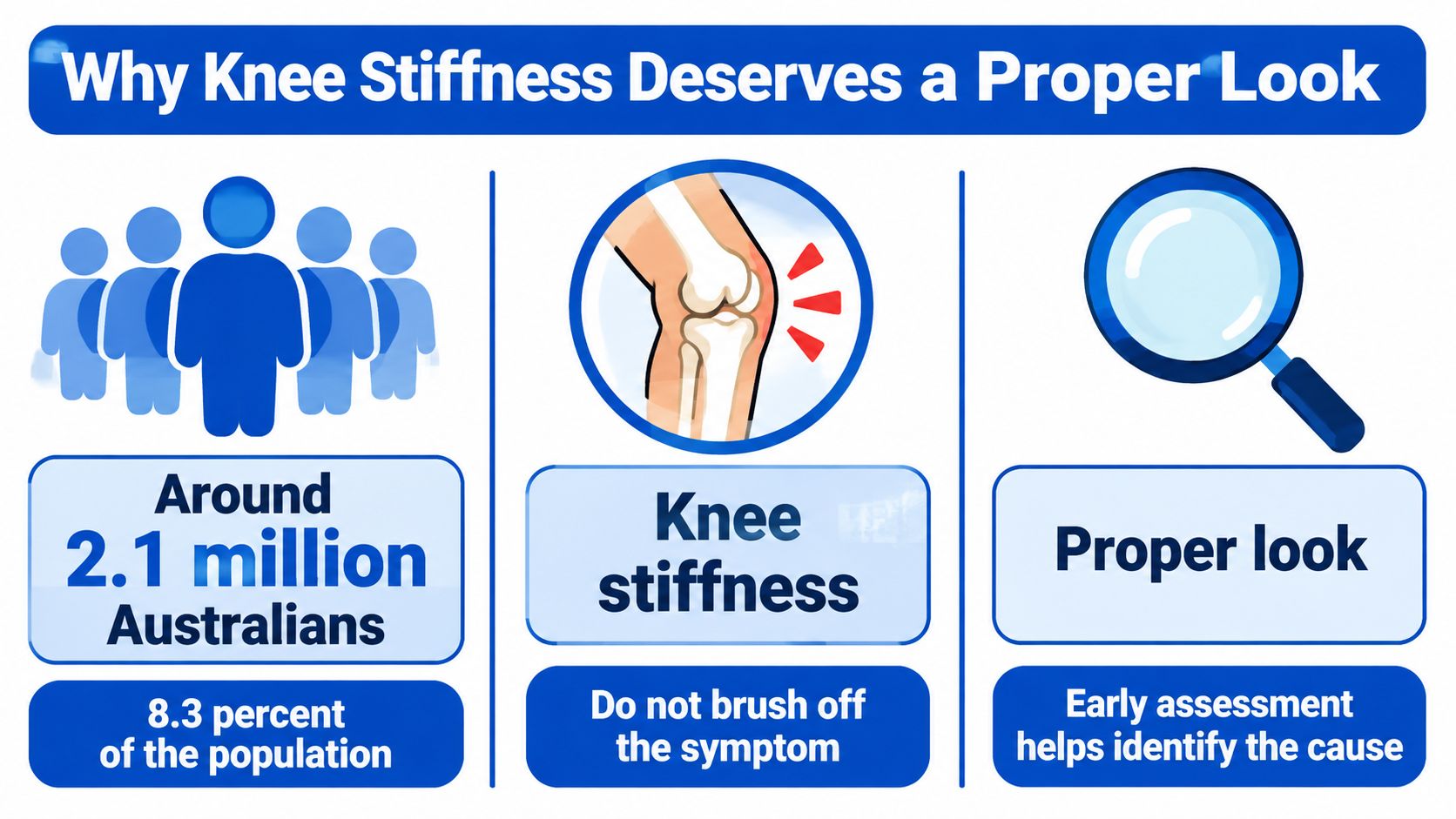
Around 2.1 million Australians, or 8.3% of the population, were living with osteoarthritis in 2022, according to the Australian Institute of Health and Welfare. That's a measure of osteoarthritis across the body, not knee stiffness alone, but it puts a familiar complaint into perspective. Recurring knee pain and stiffness deserves an explanation, not an automatic assumption that you're getting older.
Table of Contents
- Why Knee Stiffness Deserves a Proper Look
- Match the Knee Pattern and Decide on a Scan
- What the First Osteopathic Assessment Checks
- Exercise and Gentle Hands-On Care Together
- How to Progress Knee Strength at Home
- Choose Urgent Care or a Bayside Assessment
Why Knee Stiffness Deserves a Proper Look
Say you get out of the car after driving to the shops. Your knee feels reluctant to straighten, your first steps are awkward, and then walking becomes easier. By the time you reach the entrance, you're wondering whether there's anything worth mentioning at an appointment.
That pattern matters. So does the difference between a knee that gradually loosens and one that physically won't straighten. The word stiffness can describe both, even though they call for different decisions.
A stiff hinge isn't the same as a blocked hinge
Think of a gate that moves reluctantly when you first open it, then swings more freely. A knee that eases with gentle movement can feel similar. But if something stops the gate halfway, pushing harder isn't the answer, just as forcing a knee that's locked isn't sensible self-care.
The analogy describes the feeling, not the diagnosis. A knee is a living joint influenced by muscles, joint tissues, previous injuries and the demands you place on it. Feeling stiff doesn't tell you which structure is responsible.
The infographic highlights why persistent symptoms deserve attention, although its population figure refers to osteoarthritis generally rather than everyone experiencing knee stiffness.
Notice what your knee stops you doing
Osteoarthritis can involve pain, stiffness and difficulty moving after rest or activity. However, it isn't the only explanation for a knee that feels tight, sore or unreliable.
Useful observations are concrete: whether you avoid kneeling, use your arms to rise from a chair, or take stairs differently. Our explanation of what causes stiff joints gives broader context when the problem isn't confined to your knee.
A useful distinction: Feeling reluctant to move is different from being unable to move. Tell your clinician which one you mean.
Recurring symptoms, particularly in older adults, can be clinically meaningful. You don't need to wait until everyday tasks become difficult before arranging an assessment, and assessment doesn't commit you to scans, ongoing treatment or surgery.
Match the Knee Pattern and Decide on a Scan
Knee pain and stiffness patterns and next steps
| Pattern | Key clues | Likely picture | Next step |
|---|---|---|---|
| Activity pain at age 45 or older | Morning stiffness under 30 minutes, crepitus, bony enlargement, reduced bend | Clinical knee osteoarthritis | Clinical assessment and exercise; no routine scan |
| Catching or locking after a twist | Joint-line tenderness, swelling after sport, cannot fully straighten | Meniscal irritation or tear | Clinical review; urgent if the knee stays locked |
| Knee pain with hip or low-back symptoms | Hip stiffness, back pain, or nerve-like symptoms | Referred pain | Assess hip and spine as well as the knee |
| Stiffness well beyond 30 minutes | Hot swollen joint, several joints, or feeling systemically unwell | Inflammatory or other medical cause | Prompt GP review, not a wait-and-see exercise plan |
| Giving way after a twist or blow | Swelling within hours, instability | Ligament sprain | Early assessment; urgent if unable to bear weight |
| Front-of-knee ache with stairs, sitting or running | Load-related, no true locking | Patellofemoral or overuse load | Load management and progressive strengthening |
| Stiffness after sitting or driving | Eases once moving, desk-related | Postural and soft-tissue restriction | Movement breaks; hands-on care if it persists |
These are working patterns, not diagnoses. Your clinician interprets them alongside your history, examination and general health. The Australian Institute of Health and Welfare's arthritis information provides context for assessment, including the typical osteoarthritis presentation of activity-related pain in someone aged 45 or older, with morning stiffness lasting less than 30 minutes.
Read the whole pattern, not one symptom
A gradual onset of activity-related aching, brief morning stiffness and reduced bending can fit osteoarthritis. Crepitus, the grinding or crackling you may feel during movement, can support that picture, but a noisy knee alone doesn't establish the diagnosis. Your clinician also considers previous injury, work demands, body weight and the activities you've stopped doing.
A twisting injury tells a different story. Pain along the joint line, swelling and catching may raise suspicion about the meniscus, the cartilage cushioning within the knee. However, catching doesn't automatically mean a tear, and a tear doesn't automatically mean an operation.
True locking means the knee remains physically unable to straighten, rather than briefly feeling stiff or painful as you start moving. Don't repeatedly force it straight or test it with deep squats. That needs prompt medical assessment.
Giving way after an injury also needs clarification. Your knee may buckle because pain inhibits your muscles, or because an injured ligament isn't providing its usual restraint. An examination helps distinguish these possibilities and determines whether further investigation is needed.
Location can be misleading
Pain felt at the knee doesn't always begin there. If hip movements reproduce the familiar knee pain, or back symptoms accompany tingling or altered sensation, the assessment should extend beyond the knee itself. Treating only the sore spot can miss a contributor.
Front-of-knee pain during stairs, running or prolonged sitting often suggests a load-related patellofemoral problem. Here, the useful questions include whether you've recently increased hills, running distance, stair use or gym work. The answer may involve adjusting that demand and rebuilding strength rather than searching immediately for structural damage.
Stiffness after desk work or driving can also reflect prolonged positioning and reduced movement. Still, don't assume that improvement with walking proves the problem is purely postural. Several knee conditions can feel easier once you get moving.
A hot, swollen knee, prolonged stiffness, several affected joints or feeling generally unwell shifts the decision towards medical assessment. That's not a pattern to manage solely by stretching harder or booking hands-on treatment.
The scan verdict
A useful examination usually comes before a scan. The Australian Commission on Safety and Quality in Health Care's Osteoarthritis of the Knee Clinical Care Standard recommends clinical assessment rather than routine imaging for a typical osteoarthritis presentation, with X-ray preferred when imaging is warranted.
That can feel surprising. An MRI produces detailed pictures, so it's understandable to expect it to give the best answer. But an image can show structural changes that don't explain how much pain you feel, how confidently you walk or what treatment will help you function.
A clinical diagnosis isn't a guess made because scanning is unavailable. Your clinician uses the pattern of symptoms, examination findings and the absence or presence of concerning features to make a reasoned judgement. They should explain that judgement and tell you what would change the plan.
More detailed pictures aren't automatically more useful. The important question is whether the result would change your care.
Routine X-ray, MRI and ultrasound aren't necessary just because a knee hurts. Imaging becomes more useful when the presentation is unusual, an alternative diagnosis is suspected, or the examination raises concern about significant injury or other pathology.
When the plan needs to change
Recent trauma, substantial swelling, rapidly deteriorating function, fever, inability to bear weight or a knee that won't straighten justify prompt medical review. Urgent review doesn't always mean an urgent MRI. A doctor first decides what needs excluding and which investigation, if any, will answer that question.
Likewise, an initially reasonable conservative plan needs a review point. If you're doing the agreed rehabilitation but remain severely limited, repeating the same approach indefinitely isn't enough. Persistent severe functional impairment despite appropriate non-surgical management warrants specialist or multidisciplinary assessment.
Say your initial goal is to walk comfortably to the local shops. If that remains out of reach despite a well-supported programme, the next conversation should address why, whether the diagnosis still fits, and whether referral is appropriate.
Use your matching row to choose a next step, not to label yourself with a meniscal tear or arthritis. Overlapping symptoms are common enough that the examination matters more than a single clue.
What the First Osteopathic Assessment Checks
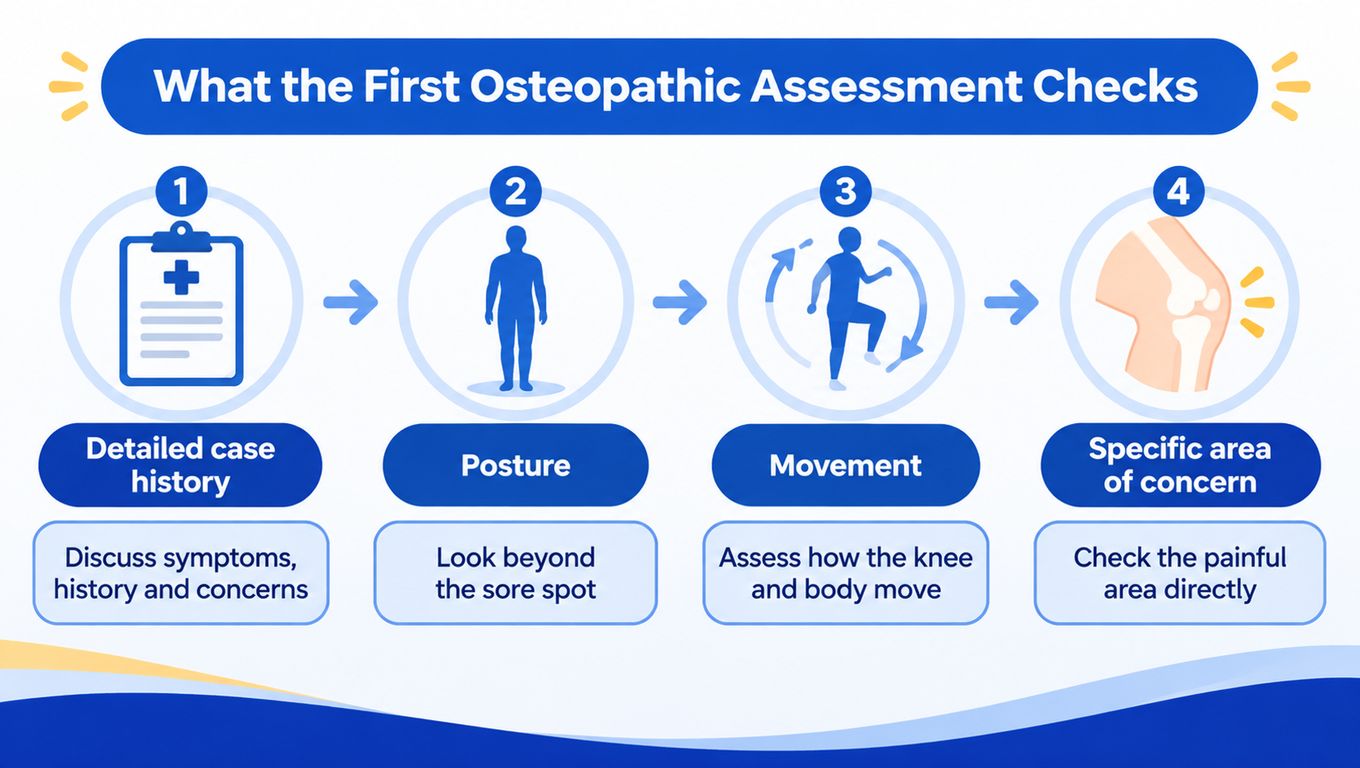
A useful assessment looks beyond the tender spot without losing sight of it. At Bayside Osteopathic Health, the initial visit includes a detailed case history and physical assessment of posture, movement and the specific area of concern.
This overview shows the main components of that assessment.
From your story to a working explanation
Take the history. We ask how the pain began, whether swelling appeared quickly, and what you mean by catching, locking or giving way. Describe how long morning stiffness lasts and whether the knee behaves differently after rest, walking or sport.
Watch relevant movements. Walking, standing and, where comfortable, a squat or step-down can show how you manage load. You won't be asked to push through a movement that feels unsafe just to complete a test.
Compare movement on both sides. Knee bending and straightening matter, but so do hip and ankle movement. Differences can help explain why an everyday task feels awkward, although not every asymmetry needs correcting.
Check where the familiar pain comes from. The assessment may include the hip or spine when your symptoms suggest referral. For a sporting injury, we also consider muscle imbalances, joint restrictions and movement patterns that may have contributed.
Agree on expectations. During the first assessment, your osteopath gives a realistic recovery timeline. A recent strain and long-standing osteoarthritis shouldn't receive the same forecast, and the plan should include what progress would look like.
Think of a sticking driveway gate beside an uneven path. Checking only the hinge misses how someone approaches and pushes it. Similarly, limited ankle movement or poor control at the hip may influence how you load your knee with each step.
Our explanation of functional movement screening gives further context for examining movement rather than judging the knee in isolation.
Bring the tasks you want back
Tell us what matters to you: getting downstairs without hesitation, gardening, returning to bowls or keeping up on a family walk. Specific goals make it easier to choose meaningful exercises and judge whether the plan is helping.
Bring details of previous injuries, current exercise, medicines and any GP or specialist advice. Existing reports are useful if you have them, but your account of what aggravates and eases the pain is equally important.
The accompanying video provides another way to explore movement assessment.
Exercise and Gentle Hands-On Care Together
Active care is the foundation of knee osteoarthritis management. The Royal Australian College of General Practitioners' plain-language guideline strongly recommends land-based exercise, including progressive strengthening, walking and activities such as Tai Chi, alongside weight management where appropriate.
The same guidance supports gradual activity: available evidence doesn't show that exercise increases structural disease progression in established knee osteoarthritis. That doesn't mean every exercise or starting dose suits every knee. It means a painful joint isn't automatically a joint that should be rested indefinitely.
Make movement manageable
A useful programme starts with what you can tolerate and builds towards what you need. Someone struggling to rise from a chair may begin with supported standing movements, while someone wanting to return to longer walks needs a plan that develops walking capacity.
Strengthening the quadriceps and other lower-limb muscles helps you manage everyday loading. Walking maintains useful activity, while alternatives such as cycling may make movement more comfortable when impact is irritating.
Where excess body weight is contributing to knee demand, weight management can form part of care without becoming a condition you must meet before receiving help. Practical support should consider your health, preferences and circumstances rather than reducing the discussion to a number on the scales.
The treatment target: Make useful movement easier to perform, then build enough capacity to keep doing it.
Where hands-on care fits
Soft-tissue work, joint articulation and gentle mobilisation can be used alongside exercise to help settle guarding and make movement more tolerable. They're supportive measures, not a way to rebuild cartilage or replace a medical diagnosis.
Our treatment should never be painful, although mild temporary soreness may follow a session. Tell your osteopath if you're bracing, holding your breath or feeling sharp pain so the approach can be adjusted.
Patients receive movement education, strengthening exercises and self-care knowledge to continue recovery between appointments. The useful outcome isn't just feeling looser on the treatment table, it's being able to load the knee more comfortably during tasks that matter.
Medication can be discussed with your GP or pharmacist when symptoms interfere with activity or sleep. Surgery remains an option when severe functional impairment persists despite appropriate conservative management, not an inevitable consequence of discovering arthritis.
The plan should leave you knowing what to practise, what response is acceptable and when to seek review. Comfort and confidence should support activity, rather than becoming dependent on repeated passive treatment.
How to Progress Knee Strength at Home
Use this as a gentle starting framework, not a personalised prescription. It's suitable only when you can bear weight, the knee isn't locked, and there's no fever, rapidly increasing swelling or recent injury needing assessment.
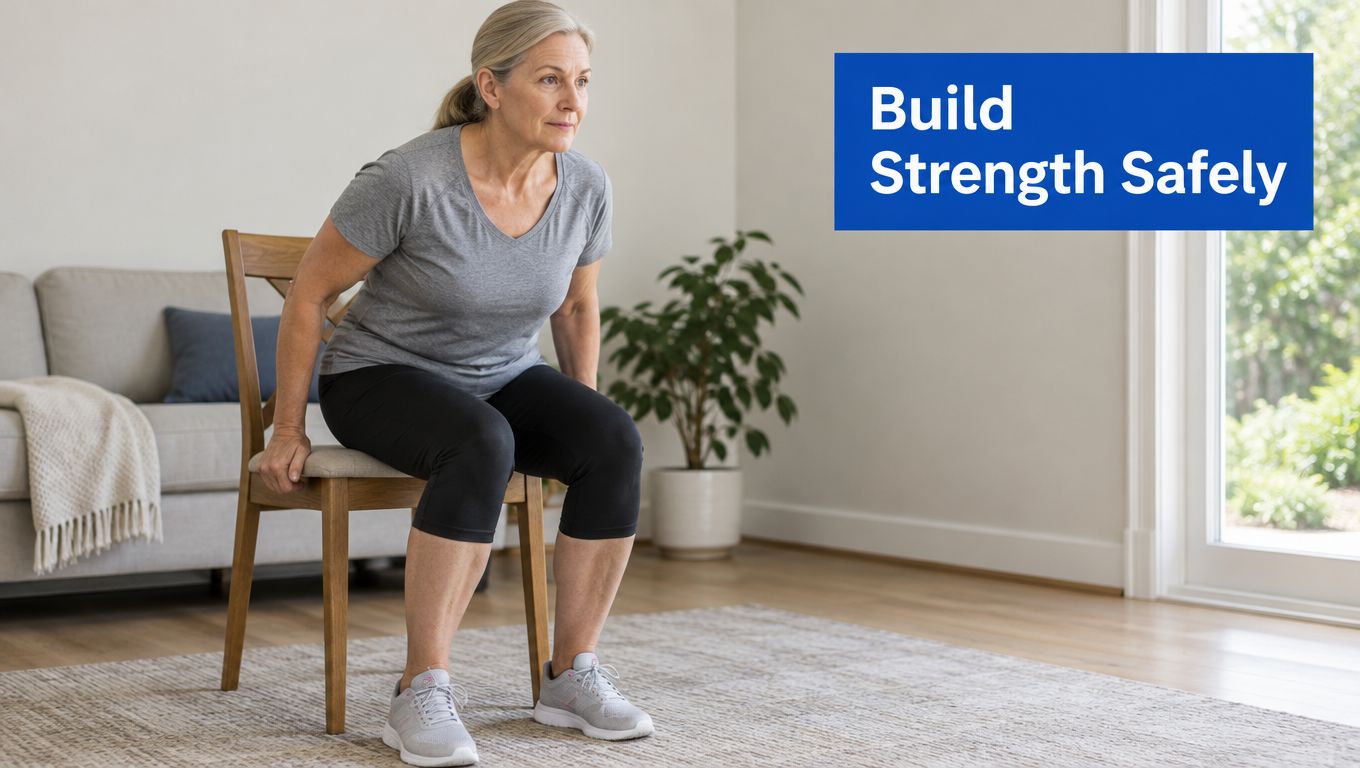
A firm chair and clear floor space are useful starting equipment.
Build from comfortable movement
Begin with short, flat walks. Choose a route you can shorten easily and finish before you develop a sharp pain spike or limp. Judge the dose partly by how your knee feels the following morning, not just during the walk.
Practise gentle bending and straightening. Lying or sitting, slide your heel towards you and away again for a small, comfortable set. With your heel supported on a folded towel, let the knee relax towards straight without forcing it; stop if you feel pinching or a hard block.
Contract the thigh muscles. With your leg supported, gently tighten the front of your thigh, hold briefly, then fully relax. Repeat while you can maintain the contraction without pain, cramping or holding your breath.
Add chair rises. Use a firm chair against a wall, with your feet planted. Stand and sit slowly for a manageable set, using your hands if needed; stop before fatigue makes you drop into the seat or markedly shift away from the sore side.
Progress to a low step. Once ordinary tasks feel settled, practise a controlled step-down beside a rail. Keep the movement shallow initially and stop if the knee buckles or you can't control the descent.
Increase one demand at a time. Extend walking gradually rather than adding distance, hills and speed together. If impact aggravates the knee, try comfortable cycling or Tai Chi instead.
Include the hip when relevant. For stair, running or sporting goals, side-lying leg raises may complement knee exercises. Keep your pelvis steady and use a small controlled range; reduce the effort if it reproduces knee pain.
Let the next-day response guide you
If symptoms are only mildly increased and settle readily, hold the current level rather than progressing. If you're clearly worse the following day, reduce the range, repetitions or walking distance.
Stop and seek assessment for true locking, giving way or pain that keeps climbing despite reducing the load. Our home exercise programme guidance explains how individual exercise plans fit into care.
Keep a simple log:
- Exercise completed: Record the movement and amount.
- Next-day pain: Note whether it's better, unchanged or worse.
- Function marker: Track a task such as getting out of a chair or using stairs.
Choose Urgent Care or a Bayside Assessment
Choose same-day medical care for danger signs, and planned conservative care for a stable, load-related pattern without those signs. An urgent osteopathic booking isn't a substitute for medical assessment of a potentially serious knee problem.
Urgent care or planned care at a glance
| Sign | Lane | Action |
|---|---|---|
| Fever with a hot, swollen knee | Lane one | Same-day medical care |
| Knee too painful to bear weight | Lane one | Same-day medical care |
| Knee locked and will not straighten | Lane one | Same-day medical care |
| Major trauma to the knee | Lane one | Same-day medical care or emergency care |
| Swelling worsening quickly | Lane one | Same-day medical review |
| Activity-related pain with morning stiffness under 30 minutes | Lane two | Planned conservative care and booked assessment |
| Load-related ache without danger signs | Lane two | Home progression and planned assessment if not improving |
Don't leave a stable but troublesome knee until you can barely use it. The AIHW osteoarthritis fact sheet recorded 40,255 knee replacements with osteoarthritis as the principal diagnosis in 2012–13. That historical figure illustrates the potential burden of severe disease, not your personal likelihood of surgery or proof that earlier treatment prevents it.
Our Arthritis & Joint Mobility care uses gentle joint articulation and movement coaching to help manage arthritis-related stiffness. We welcome enquiries about acute pain, sports injuries and whether osteopathic care is appropriate, and prioritise prompt bookings for acute or urgent pain.
Bring the pattern that best describes your knee and the activities you want to regain. If a danger sign appears, contact a GP or emergency service that day rather than continuing home exercises.
Bayside Osteopathic Health offers whole-body movement assessment, gentle hands-on care and practical exercise guidance for knee pain and stiffness. Visit Bayside Osteopathic Health to enquire about an assessment and bring details of your symptoms, previous injuries and the everyday tasks you'd like to manage more comfortably.