
You're halfway down the station stairs with a bag in one hand, the other reaching for the rail, and your knee aches on every step. Going up felt manageable. Coming down doesn't. That pattern is useful information, because knee pain going down stairs often reflects how well your thigh muscles brake your body weight, not just what's sore. This guide helps you match the pattern to a likely cause, change how you descend today, and build control over the next few weeks. It won't diagnose you, and it's candid about that limit.
Table of Contents
- Matching Your Stair Pain to Its Likely Cause
- Why Going Down Stairs Loads the Knee Differently
- How to Descend Stairs with Less Pain
- Immediate Relief During a Flare
- Strengthening Exercises and How to Progress Them
- Red Flags That Need Prompt Assessment
- Book a Stair Pain Assessment This Week
Matching Your Stair Pain to Its Likely Cause
| Likely cause | Pain location | Stair pattern | Other clues |
|---|---|---|---|
| Patellofemoral pain | Behind or around the kneecap | Worse on long descents and squatting | Ache after sitting with the knee bent; clicking is common |
| Knee osteoarthritis | Diffuse, around the whole joint | Worse first thing and after rest | Stiffness, swelling; more common from about age 45 |
| Meniscal tear | Joint line, inner or outer | Catching or locking on the step | Often follows a twist; swelling after injury |
| Quadriceps or patellar tendinopathy | Above or below the kneecap | Sharp when the tendon is loaded | Tender at the tendon tip; pain with jumping |
| Iliotibial band irritation | Outer side of the knee | Pain at a set point of bend | Often worse with running; outer knee tender |
| Referred hip or ankle limitation | Knee ache with stiff hip or ankle | Poor control on the way down | Reduced hip control or ankle movement |
Read the stair pattern column first, then check whether the location fits. Pain that builds through a long descent and lingers after sitting bent points in a different direction from pain that's worst on the first steps after rest. A knee that catches mid-step tells a different story again, even if both knees hurt in roughly the same spot.
How to Use This Table Without Overreading It
Treat the table as a pattern guide, not a diagnosis. Two causes can overlap, and a stiff ankle or weak hip can make a kneecap problem feel worse on stairs than it does on flat ground. If your symptoms fit the osteoarthritis row, our guide to knee osteoarthritis symptoms and patterns explains the stiffness and swelling clues in more detail.
A self-check can narrow the pattern. It can't tell you what's happening inside the joint.
Certain clues shift the picture toward a clinical assessment rather than self-management. Watch for these:
- Swelling that keeps returning: Especially after minor activity.
- Locking or catching: The knee gets stuck or won't straighten fully.
- Giving way: You don't trust the leg to hold you on a step.
- Pain at night: Pain that wakes you or doesn't settle with rest.
Before any visit, record one specific detail: the exact step on which pain starts. Note whether it's step two or step twelve, whether a rail changes it, and whether the first descent of the day differs from the last. That single observation helps a clinician judge whether load, fatigue, stiffness or control is driving your symptoms, and it's far more useful than saying stairs hurt in general.
Why Going Down Stairs Loads the Knee Differently
Think of lowering a heavy box down a ramp on a rope. The person holding the rope doesn't lift the box. They pay the rope out slowly, braking its weight the whole way down, and that's where the effort sits.
Your quadriceps do the same job on stairs. As you descend, they lengthen while controlling your body weight, so the knee bends under load instead of straightening to push you up. The Australian Commission on Safety and Quality in Health Care physiotherapist quick guide notes that pain, stiffness, reduced range of motion and impaired muscle function can make this braking task particularly provocative, and identifies going up and down stairs as an activity in which osteoarthritis pain commonly worsens.
The image below captures that braking effort, even though the load looks different from a staircase.
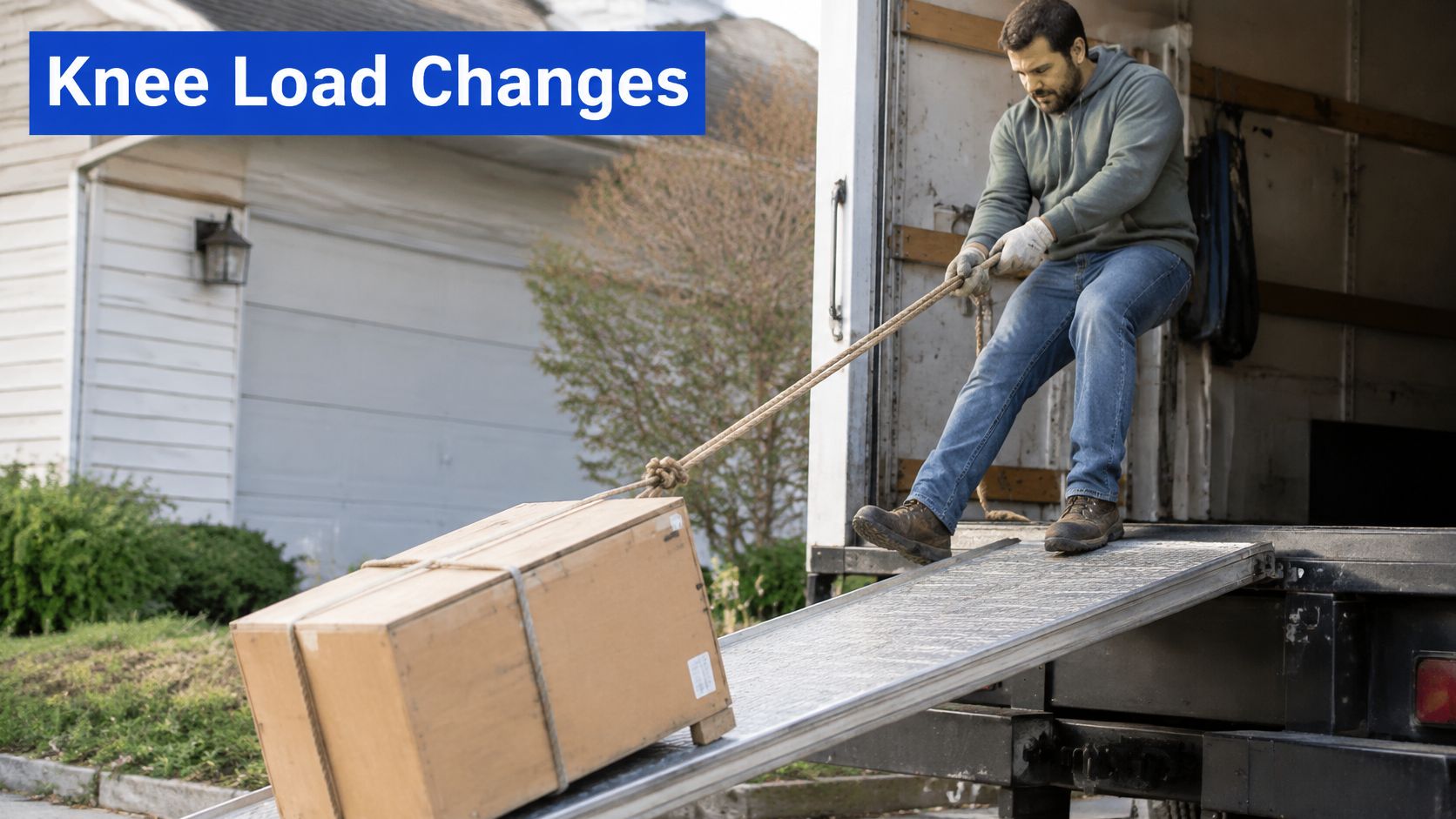
Descent loads the knee more than level walking. A joint with irritated cartilage, some swelling or weak quadriceps has less margin to absorb that load, so symptoms often appear on stairs before they trouble you on flat ground. You're not imagining the difference.
Stair Pain Is a Marker, Not a Diagnosis
Stair pain tells you a high-demand task exceeds what your knee currently tolerates. It doesn't name the cause by itself, which is why rubbing the sore spot rarely fixes the problem. The cause comes from your history and how you move.
Try three quick checks at home this week:
- Down versus up: Is descent clearly worse than climbing?
- Rail test: Does using a handrail ease it noticeably?
- Chair test: Does lowering slowly into a chair reproduce it?
If all three answers are yes, braking control is likely part of your picture, whatever the underlying cause turns out to be.
How to Descend Stairs with Less Pain
Before you start, check the warning signs covered later. If your knee locks, gives way, or your calf is swollen, warm or painful, skip this technique and get assessed instead. If there's no handrail, steady yourself on a wall or sturdy support, and keep both hands free for balance rather than carrying bags.
The illustration below summarises the sequence before the detailed steps.
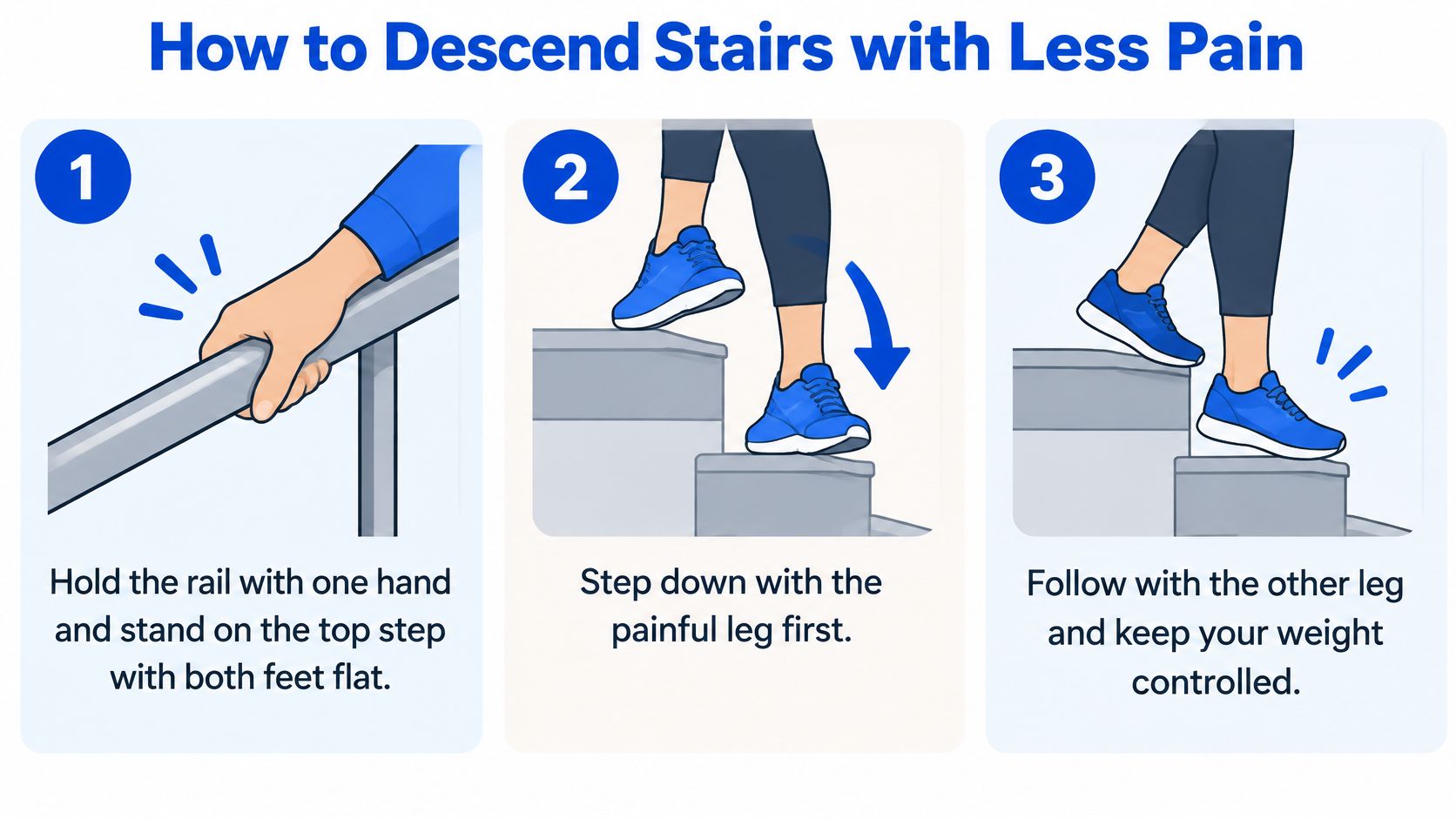
The Six Steps
- Hold the rail with one hand and stand on the top step with both feet flat. The rail takes part of the load off your knee and gives you a steady reference point. Don't lean heavily, just share the work.
- Step down with the painful leg first, placing the whole foot on the next step. This keeps your stronger leg up top doing the controlled lowering. It reverses on the way up, where the good leg leads and does the lifting.
- Lower your body slowly, letting the thigh control the descent. Slow lowering shares braking across the quadriceps instead of dropping your weight onto the landing leg. Rushing is the most common reason this technique fails.
- Keep the knee tracking over your second toe. Letting it collapse inward adds twisting through the joint. A quick glance down as you lower is enough to check.
- Let the good leg stabilise the landing, then bring the other foot level. Two feet per step feels slow, but it resets your balance before the next descent. Speed returns as control improves.
- Pause on the landing and check the pain. Mild achiness that settles within a day is acceptable. Sharp pain that climbs step by step means stop, reduce the step count and recheck tomorrow.
The short video below shows the pacing and foot placement at normal speed, so you can compare it with your own staircase.
Watch for common slips. Leaning forward shifts load onto the kneecap, stepping with your heel hanging off the edge reduces control, and carrying a load that hides the rail removes your safety net. Make two trips with lighter bags instead.
Immediate Relief During a Flare
A flare doesn't mean you've damaged something new. It usually means the last few days asked more of the knee than it could handle. Change the dose for several days, not your whole routine.
Adjust the Load First
- Cut stair trips, don't stop moving: Combine errands so you aren't going up and down repeatedly. Use a ground-floor room or a lift where one's available.
- Keep short flat walks: Level walking maintains mobility without the braking demand. Short and frequent beats one long outing.
- Avoid kneeling and deep squatting: Long periods in deep bend compress the kneecap and often prolong a flare. Use a low stool for garden or floor tasks instead.
Settle Pain and Stiffness
If the knee's swollen after activity, apply a cold pack for 10 to 15 minutes with a thin cloth between pack and skin. If morning stiffness is the main problem, warmth before you get moving usually helps more. Don't use both on the same day and expect to know which one worked.
Choose supportive shoes with firm soles rather than slippers or soft, flat shoes. A firm sole gives your foot a stable base, which improves knee tracking on steps. Keep the same pair by the stairs during a flare so you aren't descending in socks.
Morning check: Note whether next-morning pain is the same, better or worse. That trend tells you more than how the knee feels at 9 pm.
Talk with a pharmacist or GP about pain relief options, especially if you take blood thinners or have kidney or stomach problems. Over-the-counter choices interact with common medicines, so don't guess.
What Not to Do
- Don't push through sharp pain: Escalating pain is a stop signal, not a test of resolve.
- Don't fully rest for weeks: Prolonged rest weakens the very muscles that brake you on stairs.
- Don't wear a restrictive support without advice: A brace that limits movement can mask a control problem you need to retrain.
Strengthening Exercises and How to Progress Them
These exercises build quadriceps and hip control for braking. The table is the core of the programme, so start there and pick three exercises rather than attempting all six on day one.
| Exercise | Starting dose | Progress when | Stop if |
|---|---|---|---|
| Sit-to-stand from a chair | 2 sets of 8 | Pain settles within a day; lower the chair height | Pain stays longer than 2 hours |
| Band terminal knee extension | 3 sets of 10 | Settles within a day; use a stronger band | Sharp pain behind the knee |
| Straight leg raise | 3 sets of 10 | Easy for 3 sets; add an ankle weight | Cannot lift the leg without a lag |
| Low step-down | 2 sets of 6 each leg | Easy; raise the step height gradually | Knee buckles or pain climbs |
| Partial wall sit | 2 holds of 20 seconds | Easy holds; increase depth slowly | Kneecap pain that lasts for hours |
| Single-leg balance | 3 holds of 20 seconds each side | Steady; close eyes or stand on a soft pad | Ankle instability or near falls |
Aim for three to five days per week, combined with daily walking on flat ground. Use a kitchen chair with armrests for sit-to-stands, a loop resistance band anchored to a closed door for knee extensions, and the bottom step of your staircase for step-downs. You don't need gym equipment to start.
The 2-Hour Rule Decides Progression
Australian guidance gives you a practical benchmark. The Australian Institute of Health and Welfare musculoskeletal conditions report describes the RACGP 2-hour pain rule, where more-than-usual or unusual pain persisting beyond two hours after exercise means the workload was probably excessive, so the next session should use less intensity, fewer repetitions or more recovery. The same report estimated 2.1 million Australians, 8.3% of the population, were living with osteoarthritis in 2022, including approximately 10% of females and 6.1% of males, which is why graded loading advice matters at population scale.
Apply it. If pain settles within two hours and next-morning pain is no worse, keep the dose. If a full week settles well, increase load slightly every one to two weeks, perhaps two extra repetitions or a lower chair. If next-morning pain worsens, drop back one step rather than abandoning the programme.
Progress on next-day response, not on whether today's session felt completely pain-free.
Match the Emphasis to Your Cause
Tendon problems respond to slow, heavy loading and isometric holds such as the wall sit, progressed gradually. Osteoarthritis programmes emphasise pacing, graded strength and weight management where relevant, since national guidance lists those together. Our collection of joint pain relief exercises shows variations if a starting dose feels too hard or too easy.
A physiotherapist or exercise physiologist can tailor the dose, particularly for the wall sit and balance work if you're unsure. A working programme looks like this: pain stays at or below your baseline, sessions feel steadier, and stairs feel easier over four to six weeks. If nothing changes in that window despite consistent effort, the cause needs a closer look.
Red Flags That Need Prompt Assessment
Don't self-manage if any of these apply. Seek prompt care instead:
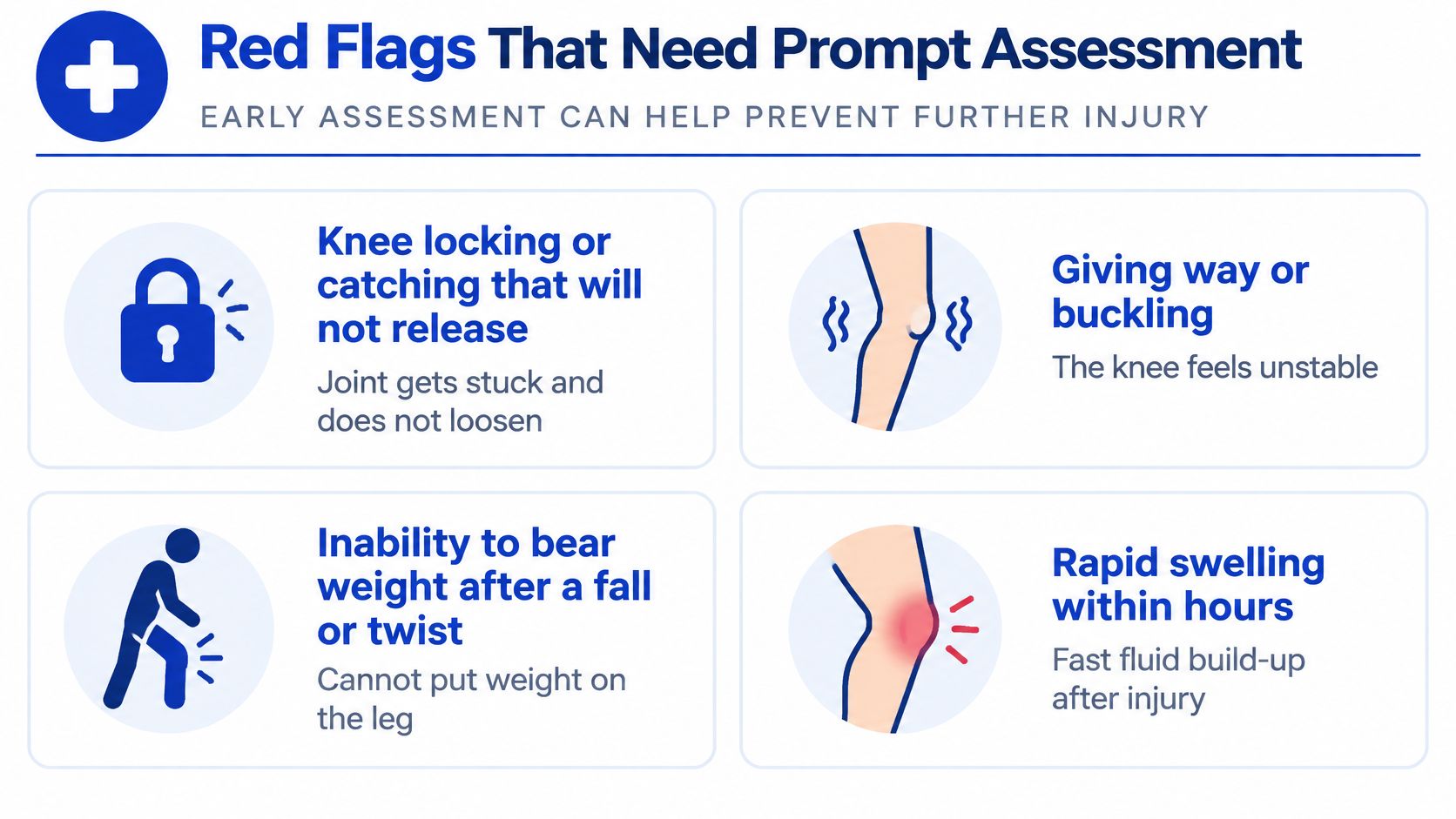
- Locking or catching that won't release: The knee gets stuck and doesn't loosen.
- Giving way or buckling: The leg collapses or feels untrustworthy on a step.
- Inability to bear weight after a fall or twist: You can't put weight through the leg.
- Rapid swelling within hours of injury: Fast fluid build-up suggests significant internal injury.
- A hot, red knee with fever: This combination needs same-day medical review.
- Calf pain, swelling or warmth: This needs urgent care for a possible clot.
- Numbness or weakness down the leg: New nerve symptoms shouldn't wait.
- Pain that wakes you at night: Or pain still worsening over two weeks despite modified stairs.
The checklist below covers the first four signs for quick reference.
Why These Signs Change the Plan
It's tempting to assume stair pain is just wear and tear you should push through. Locking, buckling and rapid swelling point to mechanical or internal problems that strengthening won't fix and might aggravate. A hot, red, feverish knee or a swollen, warm calf isn't a musculoskeletal training issue at all.
The deciding question: Can this be managed at home for two weeks, or does someone need to examine the knee?
For milder stair pain without these signs, work through the self-care and strengthening steps for two weeks while tracking your morning response. If you're assessed at Bayside Osteopathic Health, the initial assessment includes a detailed case history and a physical assessment of posture, movement and the specific area of concern. Our practitioners have clinical experience in spinal health, sports injury rehabilitation, postural correction and chronic pain management, so hip and ankle contributions get checked alongside the knee itself.
Book a Stair Pain Assessment This Week
The stairs at the station have become the part of the day you plan around. You slow on the landing because the knee warns you on the way down. Descent is a braking test: the front of the thigh has to slow your body weight while the knee bends under load. A home check can show which step hurts and whether the pain is sharp, achy, or only while you lower. It cannot show whether the limiter is the joint, a tight band on the outside of the thigh, or a muscle that cannot control that brake.
If two weeks of easier stairs and strengthening have not changed the pattern, book an assessment rather than adding more exercises. You can book with Bayside Osteopathic Health with flexible booking. Prompt bookings are prioritised for acute or urgent pain. Enquiries are welcome about acute pain and sports injuries, and about whether osteopathic care is right for you, before you commit to a visit.
What the first visit is looking for
The assessment covers the sore knee and the factors that feed it: muscle imbalances, joint restrictions, and the way you lower yourself. A chair sit and a controlled step-down show whether the brake fails early, late, or only as the foot lands. You receive a realistic recovery timeline in that first assessment. The plan is shaped by the findings, how you move, what your days demand, and what you want to return to.
Care combines soft-tissue work and joint mobilisation with movement education, strengthening, and self-care you continue at home. Treatment should never be painful. Mild temporary soreness can follow a session. How those parts fit is set out in our overview of knee pain treatment options. A simple acute strain may resolve in two to four visits. Most sporting injuries see significant functional improvement within three to six sessions. Your timeline comes from the assessment, not from those typical ranges alone.
Bring these three things
- Your stair note: Which stairs hurt, and the step where pain starts on the way down.
- Your current exercises: What you are doing, how often, and how the knee feels the next morning.
- Your medicines list: Including anything you take for pain.
That note lets the visit examine your descent instead of rebuilding it from memory. You leave knowing how to use your own stairs that evening: a slower brake, a shorter step, or a pause if the knee is irritable.
Bayside Osteopathic Health offers knee assessment and hands-on care, plus a graded strengthening plan matched to how your knee behaves on descent. Book your first visit through Bayside Osteopathic Health and bring the step where pain starts.