

9 in 10 people with knee osteoarthritis can manage without joint-replacement surgery, according to the Australian Commission on Safety and Quality in Health Care. That changes the starting question from “Will I need an operation?” to “What can help me move more comfortably now?”
Knee pain treatment options range from strengthening and movement coaching to medicines, injections and surgery. The right choice starts with identifying the cause, then building a plan around what you can do, what's limiting you and which symptoms need medical attention. Hands-on care, including osteopathy, can be considered along the way, but it shouldn't replace an active rehabilitation plan.
Table of Contents
- Treatment Options for Knee Pain at a Glance
- Common Causes of Knee Pain and Their Signs
- Red Flags That Mean You Need a Medical Referral
- How to Start Knee Strengthening Without Making It Worse
- Weight, Medicines and Injections as Add-On Treatments
- Realistic Results From Non-Surgical Care and Surgery
- Osteopathy and Cover Before Your First Visit
Treatment Options for Knee Pain at a Glance
For most adults with knee osteoarthritis, exercise comes first, alongside weight management when appropriate. Medicines and hands-on treatments may help manage symptoms, while surgery is a later consideration for persistent, severe limitations.
The comparison below mainly applies to osteoarthritis. A newly injured, locked, or hot, swollen knee requires assessment rather than choosing a treatment from the table.
Knee pain treatment options compared
| Option | Role in care | Best suited for | Cost or access |
|---|---|---|---|
| Land-based exercise, including strengthening, walking and Tai Chi, with cycling or yoga for some | First-line care | Most adults with knee osteoarthritis | Walking and home exercises need little equipment; ask for supervised-session fees |
| Weight management | Long-term first-line care when appropriate | Adults who are overweight or obese | GP support or dietitian consultation; check referral requirements and fees |
| Education and self-management | Core partner to exercise | Everyone managing ongoing symptoms | Included in clinical consultations and home advice |
| Osteopathic manual therapy | Optional adjunct for stiffness and pain, not a substitute for exercise | People seeking hands-on care alongside movement advice | Ask about consultation fees, extras cover and referral eligibility |
| Low-dose oral NSAIDs | Short-term flare management | Selected patients after a safety review | GP or pharmacist advice; prescription requirements depend on the medicine |
| Topical NSAIDs | Brief trial for localised symptoms | Selected patients where appropriate | Pharmacy access; check suitability with the pharmacist |
| Intra-articular corticosteroid injection | Short-term symptom relief | People needing flare control after clinical assessment | Ask whether consultation, injection and imaging attract separate fees |
| PRP injection | No clear recommendation for or against | People considering it after discussing uncertainty | Request a written quote and confirm any rebate before proceeding |
| Knee arthroscopy | Not recommended for uncomplicated osteoarthritis | A separate surgical indication requires specialist assessment | Specialist consultation and hospital arrangements |
| Joint replacement | Later option for severe, persistent disability | People not adequately helped by comprehensive conservative care | GP referral and public or private hospital assessment |
Cost isn't the same as value. A treatment that briefly reduces pain but leaves you without a workable movement plan may be less useful than coaching that helps you walk, climb stairs and manage symptoms independently. Ask what each appointment is intended to change.
Combine treatments around a practical goal
Say your main problem is getting out of a low chair. Your plan might combine progressive leg strengthening, adjustments to chair height and temporary symptom relief that makes practice possible. The important outcome is whether that task becomes easier, not how many treatments you receive.
Treat this table as a map, not a menu. Options are usually layered around a shared functional goal rather than tried as unrelated purchases.
Common Causes of Knee Pain and Their Signs
Consider a hypothetical walker who assumes that every ache means arthritis. An assessment instead identifies pain around the kneecap during stairs and squatting, with reduced hip and thigh strength contributing to the difficulty. Their treatment needs to address how they tolerate those movements, rather than focus only on an arthritis label.
Where pain occurs, how it began and what provokes it help guide assessment. These clues aren't enough to diagnose yourself, and more than one problem can be present.
Common causes of knee pain and their signs
| Cause | Typical features | Key difference |
|---|---|---|
| Knee osteoarthritis | Gradual pain, stiffness after rest and difficulty on stairs | May affect both knees; age and excess weight can contribute |
| Patellofemoral pain | Pain around or behind the kneecap with stairs, squatting or prolonged sitting | Kneecap-loading activities reproduce symptoms; marked swelling suggests looking further |
| Meniscal tear | Catching, locking or swelling, sometimes after twisting | Mechanical symptoms may follow an injury, although tears can also develop gradually |
| Ligament sprain | Pain and instability after a fall or pivot | A clear injury event and a sense of giving way |
| Patellar tendinopathy | Pain below the kneecap during jumping or other loading | Focal tenderness over the patellar tendon |
| Bursitis | Localised tenderness and swelling at the front or side | Swelling is concentrated over a bursa rather than throughout the joint |
| Referred pain from the hip or lower back | Knee pain accompanied by hip or back symptoms | The knee examination may not explain the symptoms; another region needs examination |
Use patterns without jumping to conclusions
Clicking alone doesn't establish a meniscal tear, and pain on stairs doesn't automatically mean osteoarthritis. A clinician checks movement, strength, tenderness, swelling and stability, then considers whether imaging would change the plan.
Strengthening often forms part of rehabilitation for several of these conditions, but the loading strategy must match the diagnosis. A sensitive tendon may need carefully adjusted loading, while an acutely unstable knee needs an injury assessment before challenging exercises.
Bring a clear description to your appointment: point to the painful area, explain the movement that triggers it and describe any swelling or injury. Locking, inability to bear weight and other warning signs need more urgent attention.
Red Flags That Mean You Need a Medical Referral
Osteoarthritis is not the only possible cause of knee pain, so some symptoms need assessment before any self-management begins. The RACGP guideline for knee and hip osteoarthritis identifies sudden severe pain, a locked knee, major swelling, fever and inability to bear weight as reasons for medical assessment.
Use these warning signs to decide when an exercise appointment isn't the right first step.
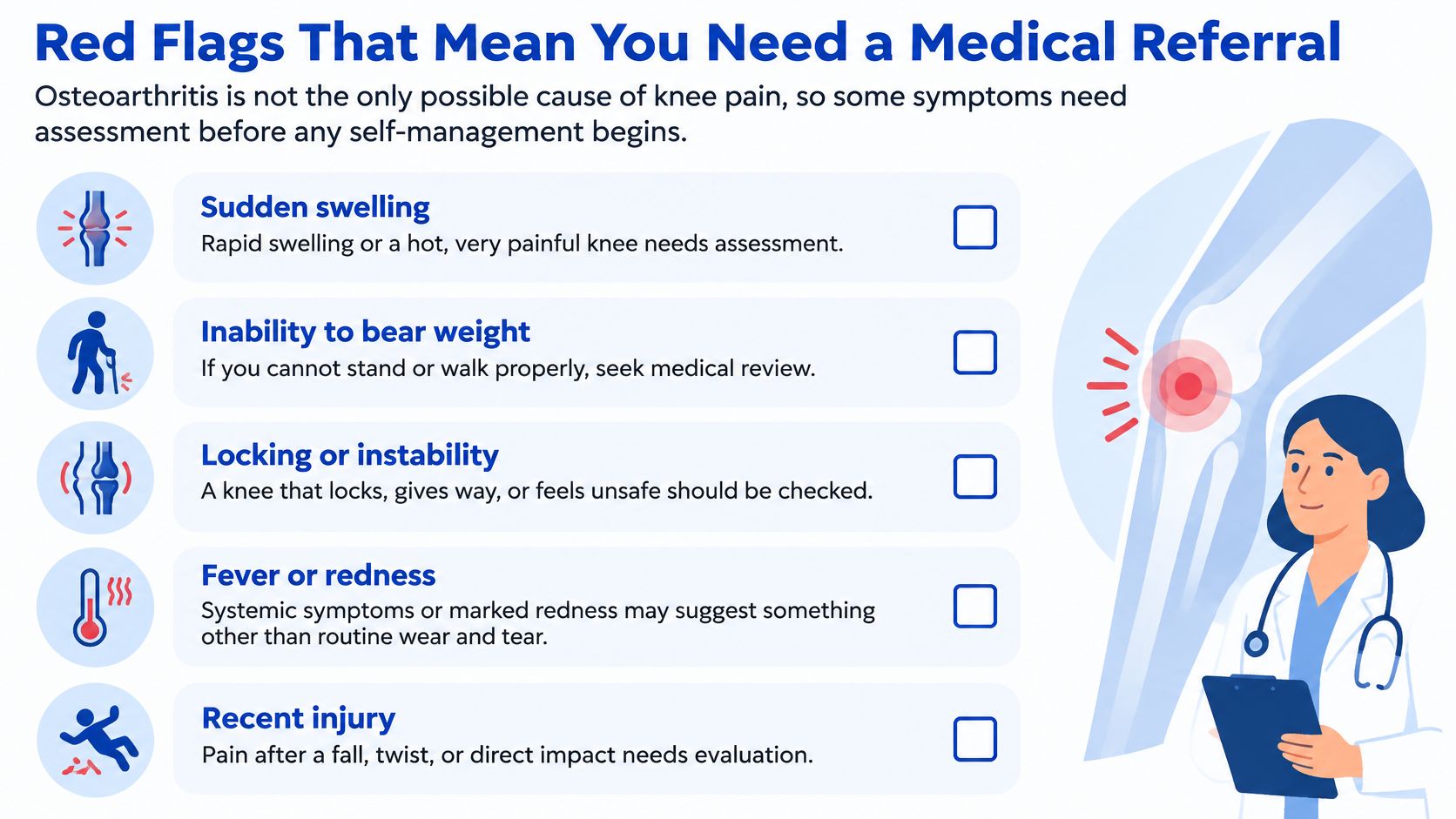
Symptoms that need checking
- Sudden severe pain or rapid swelling: Especially concerning after an injury or when the knee becomes very hot.
- A locked knee: Being physically unable to straighten or bend it is different from ordinary clicking.
- Fever with redness or swelling: A hot, painful joint with systemic illness needs urgent assessment.
- Inability to bear weight: Don't force yourself to walk through it.
- Repeated giving way: Instability can cause falls and needs investigation.
- One-sided calf pain or swelling: This can indicate a blood clot and warrants urgent medical assessment.
- Unexplained weight loss or unrelenting night pain: Arrange medical review rather than assuming routine arthritis.
How quickly to seek help
Seek same-day medical care for fever with a hot, swollen knee, sudden inability to bear weight or severe, rapidly developing symptoms. A persistently locked knee also needs urgent review; don't try to force it straight.
Arrange prompt GP assessment for repeated giving way, concerning symptoms after an injury or pain that keeps worsening. If calf symptoms occur with breathlessness or chest pain, seek emergency help.
For ongoing pain without red flags, book a routine review when a properly followed exercise and self-management plan isn't helping. Your GP can direct you to a physiotherapist, sports medicine physician or orthopaedic specialist according to the findings.
Most knee pain isn't an emergency, but warning signs shouldn't be left until the next routine treatment appointment.
How to Start Knee Strengthening Without Making It Worse
Land-based exercise is recommended for knee osteoarthritis regardless of age, pain intensity or X-ray findings, so an abnormal scan is not a reason to stop moving. The RACGP exercise guidance recommends tailoring activity to your capability, preferences and resources, then adjusting frequency, duration and intensity.
Pain during movement doesn't automatically mean damage. It does mean you need a sensible starting dose and a way to judge your response.
Build a repeatable starting routine
Record your baseline. Note how far you can comfortably walk, how stairs feel and whether getting out of a chair requires your arms. Describe your pain consistently, using words such as mild, moderate or severe, so you can compare sessions.
Choose an activity you can sustain. Progressive strengthening, walking and Tai Chi are useful options; stationary cycling or Hatha yoga may suit some people. Choose something accessible rather than a program that requires travel or equipment you won't use.
Start below your limit. Try a short, comfortable walk or sit-to-stand practice from a firm chair secured against a wall. Use the chair arms if needed, move with control and stop before fatigue makes your technique deteriorate.
Change one part of the workload. You might walk a little farther, practise more often or use a slightly lower chair. Don't increase every variable together, because you won't know which change triggered a flare.
Check the response during and after activity. Mild, familiar discomfort can be acceptable when your movement stays controlled and symptoms settle afterwards. Reduce the load if soreness lingers beyond your usual recovery, changes your walking or increases with each session.
A flare and a warning sign aren't interchangeable. A familiar ache after doing more than usual calls for adjusting the workload; sharp new pain, locking, major swelling or inability to bear weight calls for assessment.
- Review function before progressing. Increase the challenge when your current routine feels manageable and your usual symptoms remain stable. If progress stalls, ask a clinician to check technique, exercise selection and other contributors rather than pushing harder.
The visual below summarises the progression from gentle movement to consistent activity.
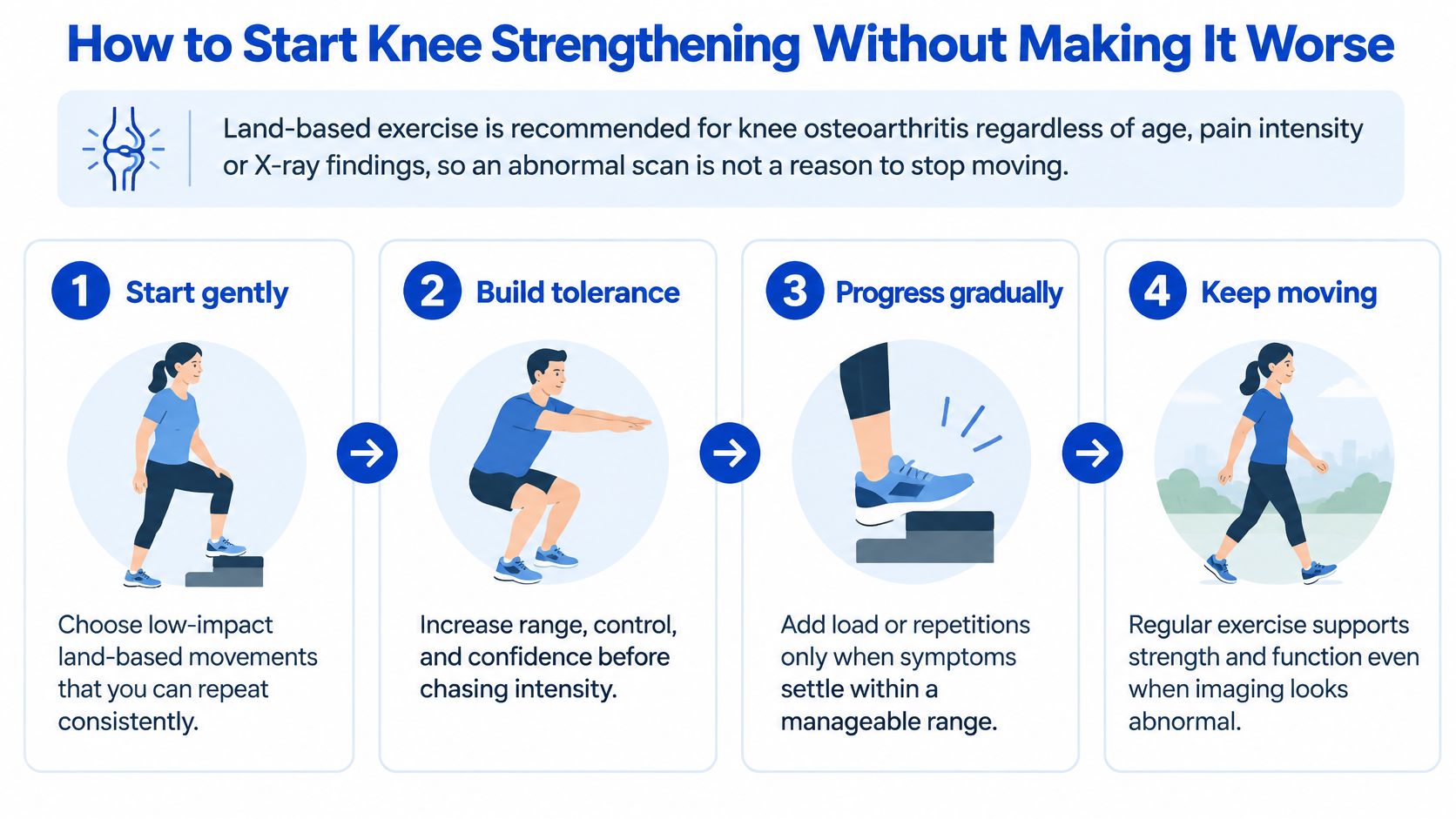
Make the exercise fit your life
Stronger quadriceps and hip muscles help control the leg during walking, stair climbing and standing from a chair. The aim isn't to erase every sensation immediately, but to make everyday loading more manageable.
A useful home exercise program should explain the movement, how to adjust its difficulty and what to do when symptoms increase. Ask for a demonstration and practise it during the appointment so you leave confident about technique.
Practical rule: Choose a dose you can repeat comfortably enough to build consistency. Exhausting yourself in an occasional session isn't the goal.
Your program can use a hallway, a stable chair or a nearby walking route. Age, transport, fitness and local facilities should shape the delivery, not exclude you from active care.
Weight, Medicines and Injections as Add-On Treatments
For people with knee or hip osteoarthritis who are overweight or obese, the RACGP plain-language guidance identifies a loss of at least 5% of body weight as a long-term management target. Weight isn't the sole explanation for knee pain, and this target isn't relevant to everyone.
Reducing excess body mass decreases loading during daily activity. Pairing weight management with strengthening and low-impact aerobic exercise supports physical capacity rather than treating weight loss as a stand-alone solution.
Choose symptom relief for a specific purpose
Oral non-steroidal anti-inflammatory drugs, or NSAIDs, can be considered at low doses for short-term flares in selected patients. A GP or pharmacist should review your medicines and kidney, stomach and heart history before you use them, because an everyday pharmacy product isn't automatically safe for you.
Topical NSAIDs can be tried briefly for localised symptoms where appropriate. Stop and seek advice if they cause problems, and discontinue an ineffective trial rather than applying the product indefinitely.
| Add-on | When it may make sense | Main limitation |
|---|---|---|
| Oral NSAID | A short-term flare after a safety assessment | Adverse effects and interactions can limit use |
| Topical NSAID | A brief trial for localised pain | It may not provide useful relief |
| Corticosteroid injection | A flare or need for rapid symptom control | Relief is short-term; repeated injections require caution |
| PRP injection | An informed discussion about an uncertain option | RACGP guidance has no clear recommendation for or against |
A corticosteroid injection goes into the joint to help control symptoms; it doesn't replace rehabilitation. If you're considering it, clarify the referral process, clinician and fees when deciding where to get a cortisone shot.
Questions to take to your GP
- Weight: Is my weight a meaningful factor in my symptoms?
- Pattern: Is this a flare or a longer-term change that needs reassessment?
- Safety: Can I safely take an anti-inflammatory medicine with my health history and current prescriptions?
The useful add-on is the one with a clear purpose, an agreed review point and a plan for what happens if it doesn't help.
Realistic Results From Non-Surgical Care and Surgery
Surgery is for selected patients with persistent severe disability who do not get adequate relief or function from conservative care. A difficult scan alone doesn't describe how much help you need with walking, sleep, work or daily tasks.
Australian practice has moved away from routine arthroscopy for uncomplicated osteoarthritis. Medicare claims cited in the national knee osteoarthritis clinical-care standard infographic show that arthroscopy rates among Australians aged 45 years and older fell from 404 per 100,000 people in 2015 to 216 per 100,000 in 2022, a reduction of approximately 47%.
Track progress by stage, not a promised deadline
There's no universal recovery timetable for chronic knee pain. A practical sequence is more useful than assuming everyone should improve at the same speed.
| Indicative stage | Main work | What to review |
|---|---|---|
| Establish the plan | Confirm the likely cause, choose tolerable exercise and agree on symptom management | Can you perform the exercises confidently? |
| Build capacity | Progress strengthening and suitable aerobic activity | Is walking or chair rising becoming easier? |
| Apply gains | Practise stairs, work tasks and valued activities | Are you doing more with manageable symptoms? |
| Maintain or escalate | Continue effective care or seek further assessment | Are major limitations persisting despite a workable plan? |
The progression below shows where surgical assessment fits.
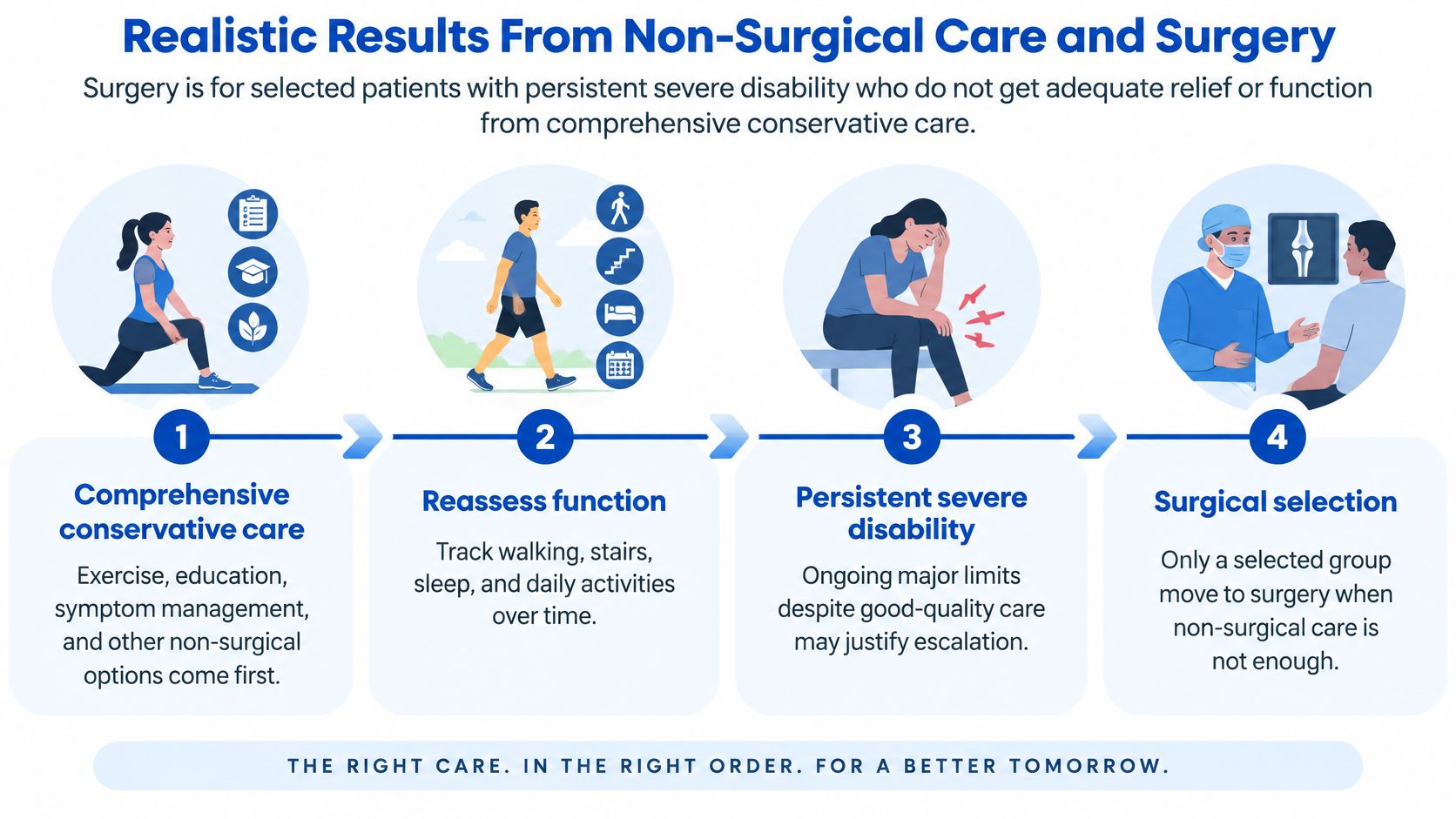
Understand what success can look like
Meaningful progress might mean finishing the shopping without needing to sit down, using stairs with less hesitation or returning to gardening. Some discomfort can remain even when function improves, and a setback doesn't automatically mean treatment has failed.
Measure what your knee lets you do, not only how it feels at its worst moment.
Arthroscopy and joint replacement are different procedures with different purposes. The recommendation against routine arthroscopy for uncomplicated osteoarthritis shouldn't be interpreted as a recommendation against all knee surgery.
If severe restrictions continue despite an appropriate conservative plan, discuss specialist review. You don't have to keep repeating ineffective treatment indefinitely, and considering surgery isn't a failure of effort.
Osteopathy and Cover Before Your First Visit
Osteopathy is a hands-on approach that may include soft-tissue work, joint articulation and gentle mobilisation, together with assessment of how you move. For knee pain, its appropriate role is an optional addition to active care, with a clear purpose such as making a restricted movement more comfortable to practise.
It shouldn't be presented as a way to rebuild cartilage, reverse osteoarthritis or replace progressive strengthening. Before agreeing to treatment, ask how the hands-on component connects to your everyday goals.
A knee examination should consider symptoms and movement rather than treating a painful spot in isolation.
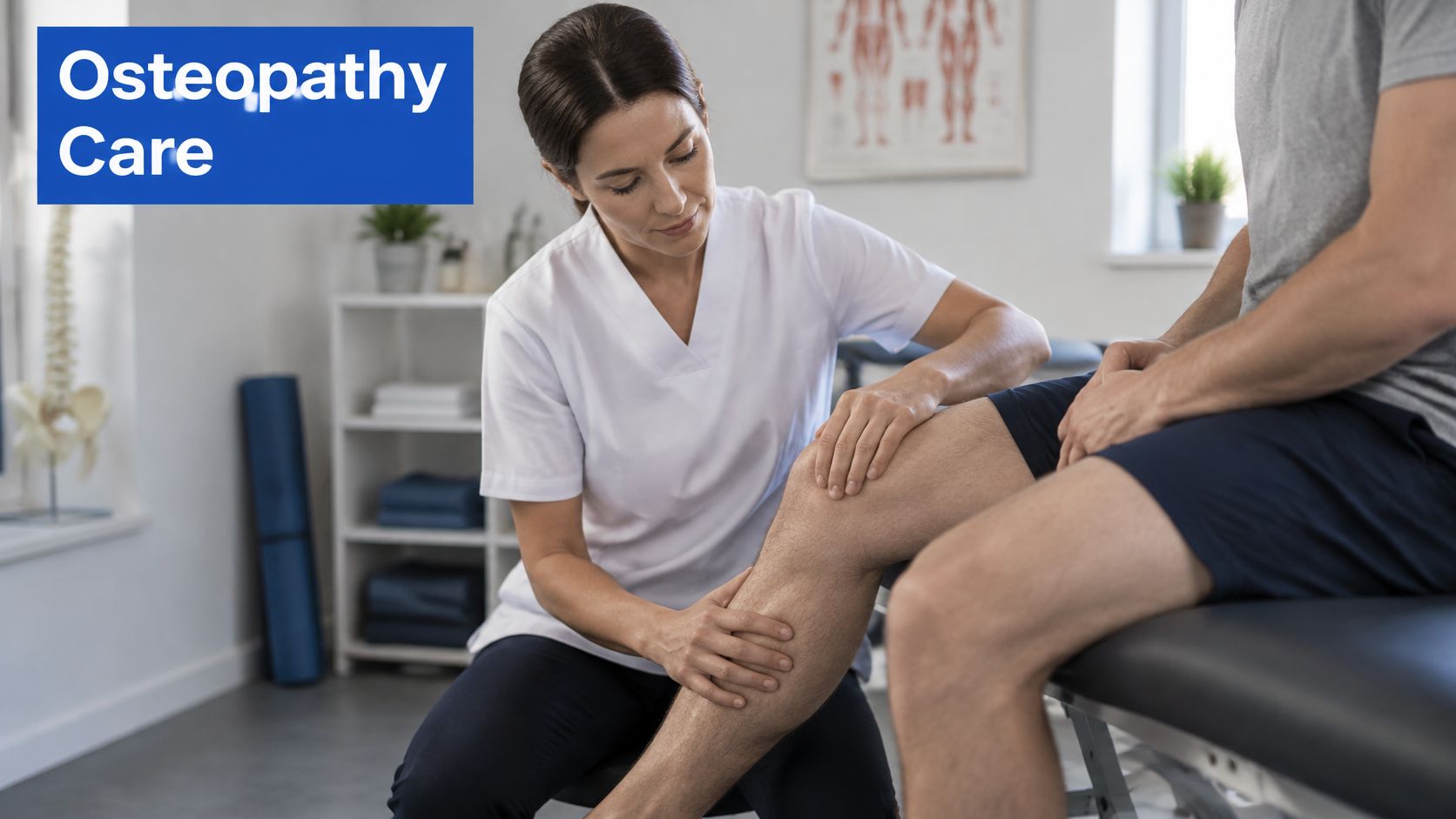
What a useful appointment should include
Your practitioner should ask how the pain began, what makes it worse, what you've already tried and whether you have warning signs. They may assess the knee alongside hip movement, lower-back symptoms, foot mechanics, walking and a task such as sitting down and standing up.
Hands-on treatment may then target sensitive or restricted tissues around the joint. You should also leave with movement advice that you understand, not just instructions to return when the relief wears off.
- An explanation: Ask what the examination suggests and what remains uncertain.
- A home plan: Request exercises matched to your current ability and available equipment.
- A response strategy: Know what to change if symptoms flare.
- A review method: Agree on a functional task that will show whether care is helping.
Be realistic about hands-on relief
People respond differently to manual therapy. Don't interpret a comfortable session as proof that the underlying joint condition has changed, and don't accept a guaranteed outcome.
A useful test is whether treatment helps you participate in the active part of your plan. If you feel temporarily looser but can't walk farther, practise exercises or manage daily tasks more comfortably, discuss changing the approach rather than continuing automatically.
For a local option, Bayside Osteopathic Health assesses whole-body movement and develops personalised plans combining hands-on treatment, movement advice and practical home strategies. Its practitioners can also discuss Medicare arrangements where applicable, but eligibility and rebates should be confirmed before booking.
The following video is available for additional context; your own treatment still needs an individual assessment.
Check cover before committing
Don't assume that a GP referral automatically makes osteopathic treatment free or covered. Medicare access depends on the applicable GP-led chronic-condition referral pathway, provider eligibility and your circumstances; confirm current requirements with your GP, Services Australia and the clinic.
Private health extras are a separate check. This guide to osteopathy and private health insurance can help you prepare your questions, but your fund must confirm your own benefits, recognised-provider requirements and remaining entitlement.
Ask the clinic for the full appointment fee and expected out-of-pocket amount. If you're unsure about cover, resolve it before treatment rather than relying on a general statement that rebates may apply.
Prepare for a useful first visit
Take these questions to any provider:
- Treatment direction: Is the plan exercise-led, and what will I practise at home?
- Payment: What does each session cost, and what rebate has been confirmed?
- Progress: How will we decide whether treatment is helping and when to change course?
Before the appointment, note your usual pain pattern, comfortable walking tolerance and the daily task you most want to improve. Bring your medicine list, any GP letter and existing scans or reports. You don't need to arrange new imaging to attend unless a clinician recommends it.
Bayside Osteopathic Health offers movement assessment, gentle hands-on care and personalised home strategies for people managing knee pain. To discuss an exercise-led plan and whether osteopathy could be a useful add-on, visit Bayside Osteopathic Health and ask about an initial assessment, appointment fees and any referral requirements.