

You might be here because a knee hurts every time you stand up, your fingers feel stiff around a coffee mug, or your hip seems to argue with you on the stairs. Maybe you've already tried resting it, pushing through it, or taking the odd tablet, and you're still wondering why the pain keeps coming back.
That uncertainty can be frustrating. Osteoarthritis often feels inconsistent. Some days are manageable. Other days, a short walk or a trip to the shops can leave a joint sore and grumpy for hours. The good news is that osteoarthritis pain management usually isn't about finding one perfect fix. It's about building a personal toolkit that helps you stay active, calm flare-ups, and keep doing the things that matter to you.
Table of Contents
- Understanding Osteoarthritis and Why It Hurts
- The Three Pillars of Osteoarthritis Pain Management
- How Hands-On Therapies Like Osteopathy Can Help
- Medical and Procedural Options When Needed
- Practical Home Strategies and Gentle Exercises
- Building Your Long-Term Plan and Accessing Care
- Frequently Asked Questions About Osteoarthritis
Understanding Osteoarthritis and Why It Hurts
Osteoarthritis is often described as "wear and tear", but that phrase is a bit too simple. A better picture is a road surface that slowly becomes rougher over time. It doesn't go from smooth to broken overnight. Small changes build up. The cushioning becomes less even, the edges can thicken, and the whole area becomes less efficient at handling load.
In Australia, osteoarthritis affects an estimated 2.1 million people and accounted for more than 1.0 million hospitalisations over the decade to 2021–22, which is one reason understanding day-to-day management matters so much because there is no cure and care focuses on reducing pain and preserving function, as noted in this overview of osteoarthritis pain relief.
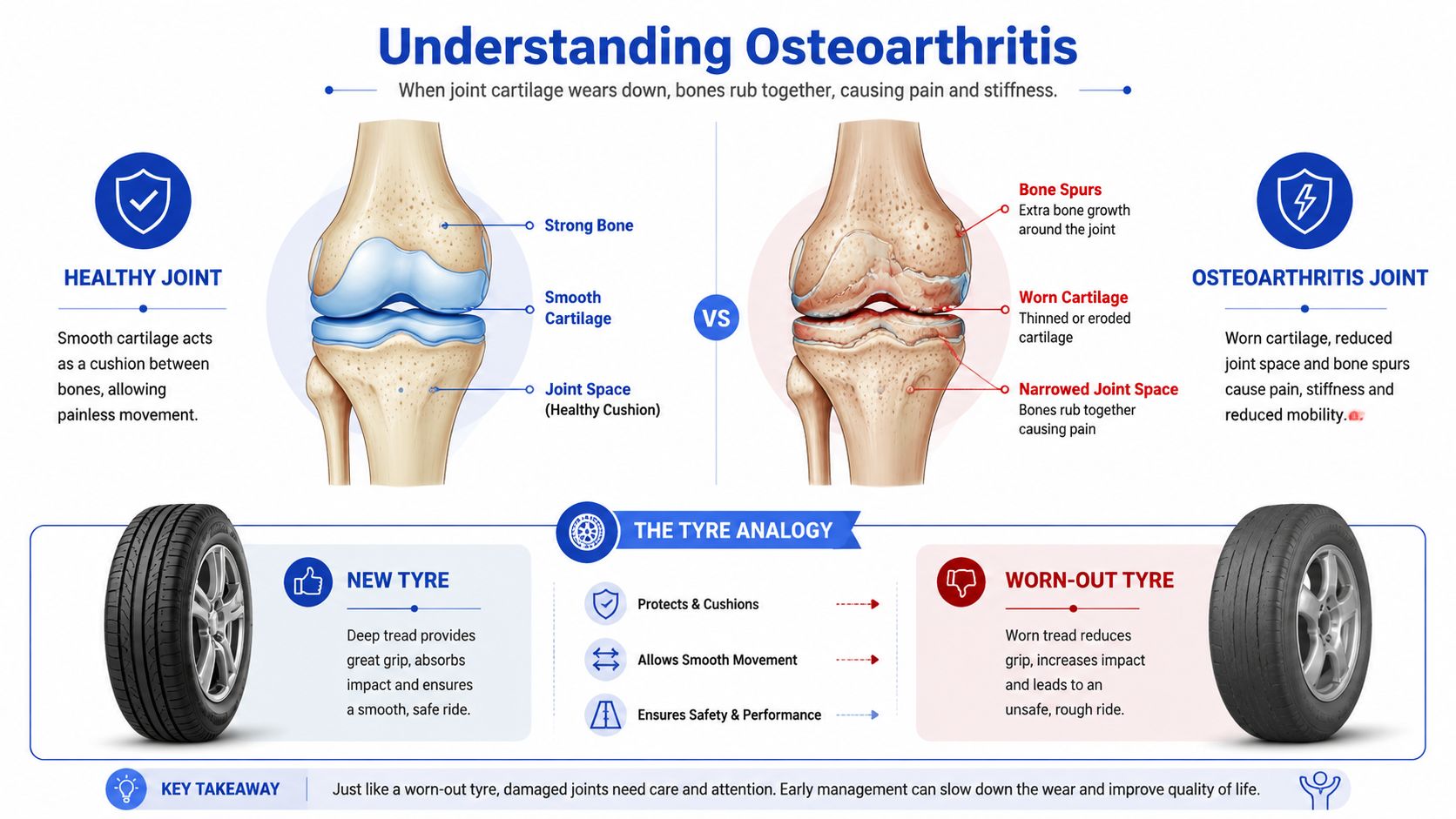
What is actually happening inside the joint
Think of joint cartilage like the tread on a car tyre. When the tread is healthy, the ride is smoother and forces are spread more evenly. As the tread wears down, the ride becomes rougher and the tyre handles bumps less well. In osteoarthritis, the joint's cartilage changes, the bone underneath can react, and the joint lining and capsule can become irritated.
That matters because the pain doesn't come from one single structure. Muscles around the joint often tighten to protect it. The joint capsule can stiffen. Swelling may come and go. You can also develop altered movement patterns, such as limping on one side or gripping through the toes to protect a sore knee.
Osteoarthritis pain is not simply a bone rubbing on bone story. It's a whole-joint and whole-body problem.
Why the pain can feel bigger than the scan
Many people get confused when an X-ray doesn't seem to match how they feel. That's because pain is influenced by more than visible joint change. The nervous system can become more sensitive. A stiff hip can irritate the lower back. A sore knee can make the calf and thigh work harder than usual. After a while, even normal activities may start to feel threatening to the body.
This is why osteoarthritis pain management usually works best when you combine several approaches. If the problem involves load, stiffness, muscle tension, confidence, sleep, and movement habits, then treatment has to address more than one thing too.
A useful way to think about it is this. Your joint is like a busy intersection with rough road, tense traffic lights, and drivers who have become jumpy. Smoothing one part helps, but the biggest improvement comes when you calm the whole system.
The Three Pillars of Osteoarthritis Pain Management
When people ask what helps over time, I come back to three foundations. Not because they're fancy, but because they keep showing up in good care plans. These are the parts that support almost every other treatment.
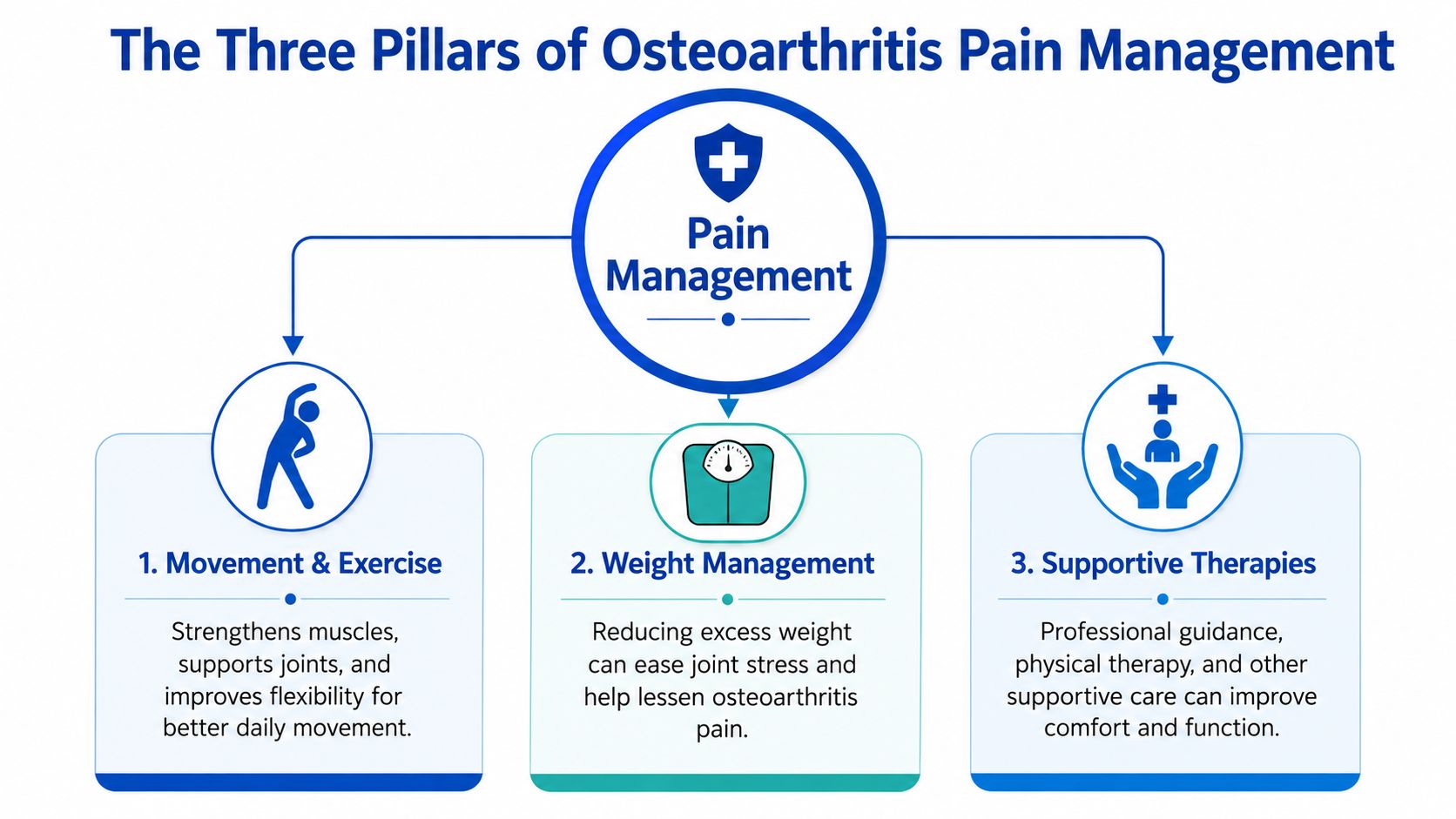
Movement and exercise
This is usually the pillar people fear most, especially when movement already hurts. But a sore joint often behaves like a rusty hinge. Gentle, regular use tends to help it move more freely than complete rest does.
The International Association for the Study of Pain reports that long-term exercise-based therapy combined with pain education can produce about 25% pain reduction, and explains that strengthening and aerobic exercise help by reducing mechanical joint stress while improving function in its fact sheet on pain in osteoarthritis.
That doesn't mean you need hard workouts. It means the joint usually benefits from the right dose of movement. For one person, that's walking in short blocks. For another, it's hydrotherapy, cycling, sit-to-stands, or a home strengthening plan.
Weight management
If your osteoarthritis affects a weight-bearing joint such as the hip, knee, foot, or lower back region, body weight can change how much force that area has to absorb. This isn't about blame. It's about mechanics.
For some people, even modest changes in load can make movement easier. That can create a helpful cycle. Walking feels better, so activity becomes more realistic, which then helps function further. Weight management is most useful when it's practical, kind, and paired with movement, not treated as a lecture.
Knowledge and self-management
This pillar often gets overlooked because it sounds less tangible. Yet it's one of the most powerful. When you understand why a flare-up happens, you're less likely to panic and stop everything. When you know the difference between soreness and harm, you're more confident with exercise. When you can pace your week, you're less likely to overdo a good day and pay for it the next morning.
Here are the self-management habits I find most useful:
- Track patterns: Notice what tends to trigger stiffness, swelling, or next-day pain.
- Plan activity in blocks: Break long jobs into shorter bursts with rests in between.
- Keep a flare-up plan: Have simple steps ready, such as reducing load for a day, using heat or cold, and returning to movement gradually.
- Ask questions: If you don't understand your diagnosis or options, bring that into the room with your practitioner.
Practical rule: Build your plan around what you can repeat on an ordinary week, not what you can force through on one determined day.
These three pillars are the base of a strong toolkit. Tablets, injections, braces, and hands-on care can all have a place, but they work best when they support these foundations rather than replace them.
How Hands-On Therapies Like Osteopathy Can Help
Hands-on care can be useful, but it helps to see it clearly. Osteopathy, physiotherapy, and some forms of manual therapy don't remove arthritis from a joint. What they can do is make the joint and the surrounding tissues easier to work with, so you're more comfortable doing the things that keep you well.
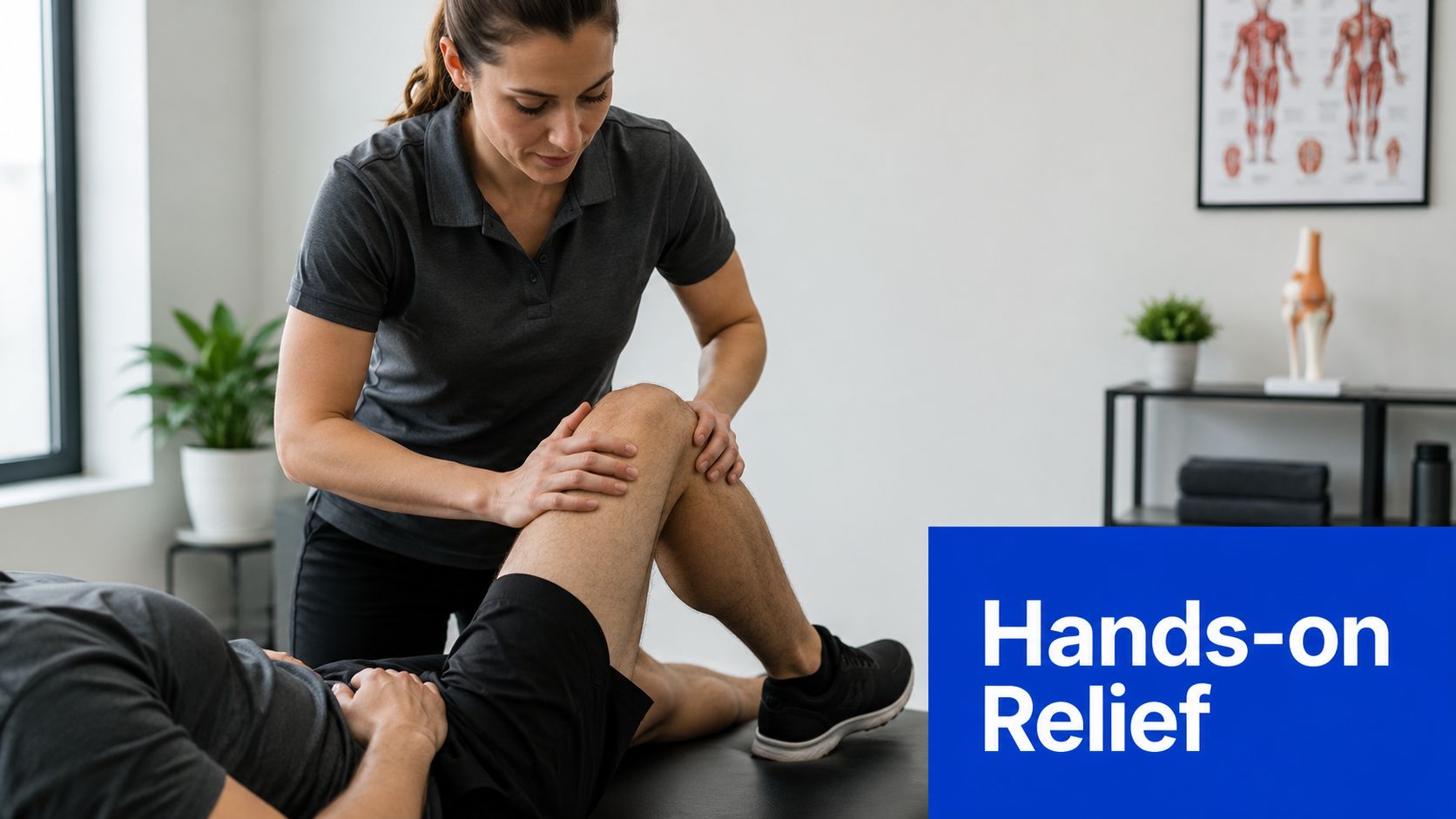
What hands-on care can do well
A stiff arthritic joint rarely exists in isolation. If your knee is sore, the thigh may tighten, the calf may overwork, and the hip may lose some range. If your hand joints ache, you might start gripping differently through the wrist and forearm. Hands-on treatment can target those secondary problems.
An osteopath may use gentle mobilisation, soft-tissue work, stretching guidance, and movement advice to help with:
- Reducing stiffness: A joint that moves a little more freely is often less guarded.
- Settling muscle tension: Tight muscles can add compression and discomfort around an already sensitive joint.
- Improving confidence with movement: If the body feels less braced, exercise usually feels less daunting.
- Spotting compensation patterns: Sometimes the bigger issue isn't just the sore joint, but how the rest of you is working around it.
If you'd like a plain-language overview, this guide to understanding osteopathy and how it supports movement and health explains the broader approach.
Where it fits in your toolkit
The key is to treat hands-on care as a support, not a passive cure. A good session should make it easier for you to walk, strengthen, stretch, sleep, or manage a flare-up. It should open a window of opportunity.
A review of non-pharmacological approaches and integrative options noted that evidence for some hands-on treatments is mixed, while options such as mindfulness may help as part of a broader program. That's a sensible way to think about osteoarthritis care generally. Choose low-risk tools that fit your goals, and combine them rather than expecting one technique to do everything.
In practice, that might mean an osteopathic session to improve hip mobility, followed by a simple glute-strengthening plan and changes to how you pace hills or stairs. That's often where people feel progress. Not from one dramatic intervention, but from several small changes lining up.
Medical and Procedural Options When Needed
Sometimes self-management and hands-on care aren't enough on their own. A joint may flare badly. Sleep may be disrupted. Walking may become difficult for a period. That's when medical options can play an important role.
Australian clinical care standards recommend non-surgical care first, reflecting better outcomes from combining movement-based therapy with self-management support and a shift away from routine opioid use for osteoarthritis pain, as outlined in this summary of osteoarthritis treatment approaches.
Starting with lower-risk options
For many people, treatment starts with medicines that aim to reduce pain enough for normal activity to continue. In guideline-based care for knee osteoarthritis, topical NSAIDs and paracetamol are recommended ahead of stronger escalation, while oral NSAIDs, COX-2 inhibitors, opioids, and injections are considered more carefully depending on symptoms and risk, according to this clinical review of knee osteoarthritis management.
That order matters. If a gel helps enough, you may avoid the wider body effects of stronger medicines. If a short-term injection settles a flare, it may create the breathing room needed to get back to walking or strengthening.
Osteoarthritis Treatment Options Compared
| Treatment | How It Works | Best For | Key Considerations |
|---|---|---|---|
| Topical NSAID gel | Targets pain relief at the sore joint area | Localised joint pain, especially when you want to limit whole-body medicine exposure | Often used before oral options |
| Paracetamol | Symptom relief | Mild pain or as part of a broader plan | May help some people more than others |
| Oral NSAIDs or COX-2 inhibitors | Reduce pain and inflammation more broadly | People who need stronger short-term relief | Need discussion with a GP or pharmacist, especially if you have other medical conditions |
| Intra-articular corticosteroid injection | Calms an irritated, painful joint for a period | Moderate-to-severe pain flare, especially when it blocks rehab | Best seen as an add-on, not the whole plan |
| Opioids | Stronger pain relief medicines | Usually not a routine option for osteoarthritis | Limited benefit for OA pain and higher risk profile |
| Joint replacement surgery | Replaces the damaged joint surfaces | Severe pain and loss of function when conservative care no longer helps enough | Usually considered after non-surgical options have been tried |
Some people also want to understand the practical side of injections before discussing them with their doctor. This page on cortisone injection costs and related considerations can help frame those questions.
When medical treatment works well, it usually creates room for movement. It doesn't replace the need for movement.
If surgery is eventually discussed, try not to hear that as failure. For the right person, at the right time, it can be a very reasonable step. The important question is whether you've built enough support around it before and after, so the outcome isn't resting on the operation alone.
Practical Home Strategies and Gentle Exercises
Daily habits often decide whether osteoarthritis feels manageable or exhausting. The aim at home isn't to be perfect. It's to keep the joint moving, calm irritation when it spikes, and make ordinary tasks less aggravating.
A practical visual guide can help you organise the basics.
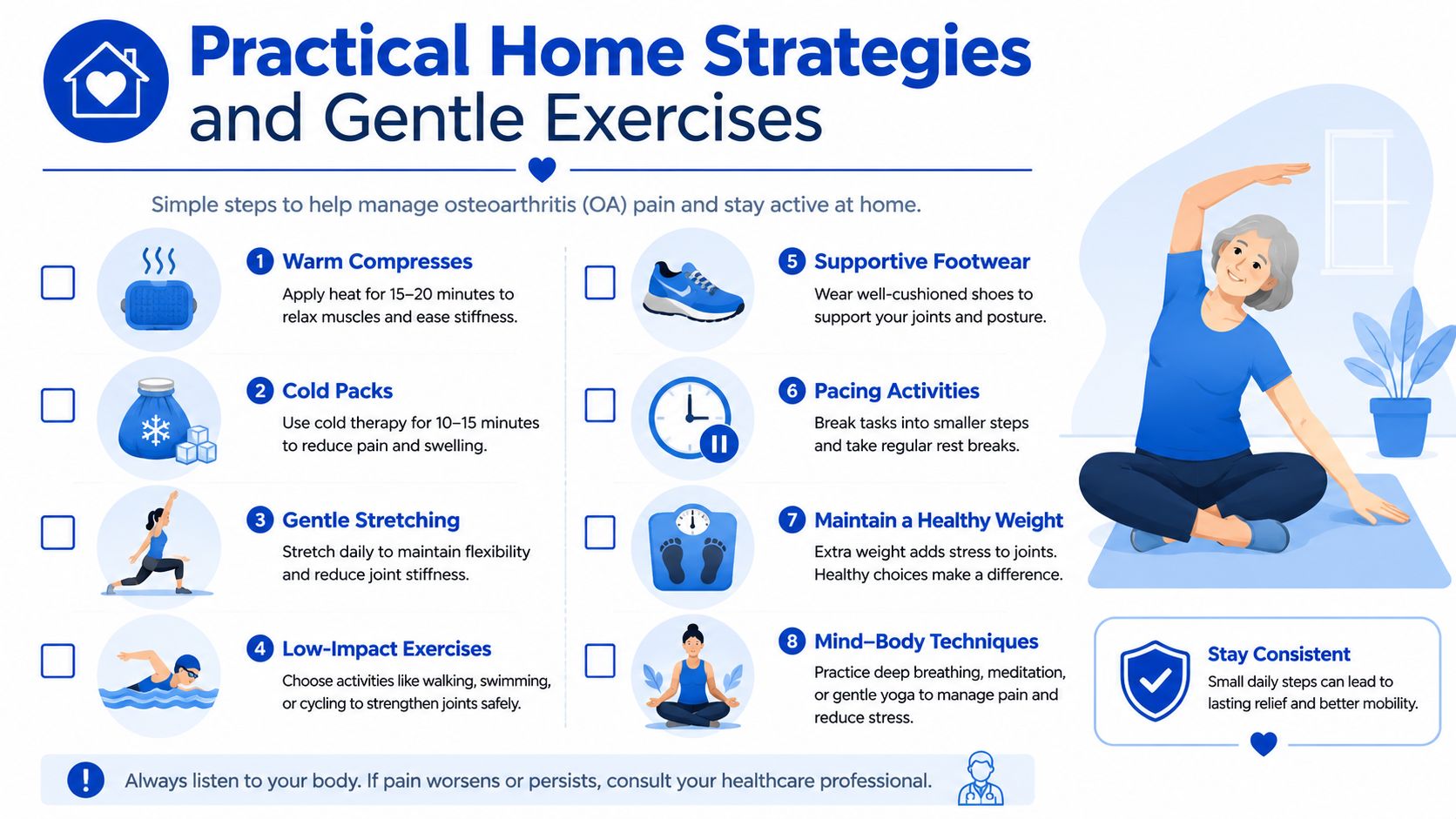
Simple ways to settle a sore joint at home
Start with the low-tech tools. They often work surprisingly well.
- Use warmth for stiffness: A heat pack or warm shower can help a joint feel looser before activity.
- Use cold for swelling: If a joint is hot, puffy, or flared after activity, a cold pack may settle it.
- Wear supportive footwear: Shoes with decent cushioning and stability can reduce irritation, especially for knee, hip, or foot symptoms.
- Modify the environment: A rail, jar opener, long-handled tool, shower chair, or firmer dining chair can save a lot of repeated strain.
- Pace jobs: Split gardening, housework, or shopping into chunks instead of doing it all at once.
If you're exploring broader self-care approaches, this page on natural pain solutions for everyday aches and persistent pain may give you a few more ideas to discuss with your practitioner.
Gentle exercises to get you started
A short, regular routine usually beats a long, occasional one. Move within a comfortable range, and expect mild effort rather than sharp pain.
Seated knee extension
Sit tall in a chair and slowly straighten one knee, then lower it. This helps wake up the thigh muscles without much joint load.Sit-to-stand from a chair
Use your legs to stand, then sit back down with control. If needed, use the armrests lightly. This mimics a real-life task and builds useful strength.Standing hip abduction
Hold the bench and move one leg out to the side without leaning. This targets hip support muscles, which often help knees and lower back too.Calf raises
Holding a support, rise onto your toes and lower slowly. Helpful for ankle strength, balance, and walking push-off.Heel slides on the bed
Lying down or sitting with legs out, slide the heel towards you and away again. Good for a stiff knee or hip.Gentle walking or cycling
Short, manageable sessions are often enough. The trick is consistency, not intensity.
If you'd prefer to follow along visually, this short movement video is a useful starting point:
Aim for the "just enough" zone. Too little and the joint stiffens. Too much and it complains. The sweet spot is repeatable movement.
A simple rule helps here. If pain during exercise is manageable and settles back to your usual baseline by the next day, the dose is often acceptable. If you're clearly worse the following day, trim the amount and try again.
Building Your Long-Term Plan and Accessing Care
The hardest part of osteoarthritis pain management isn't usually learning one exercise or choosing one treatment. It's staying organised across months and years. Your toolkit needs to change as symptoms, routines, work, sleep, and confidence change.
A major evidence gap exists for long-term osteoarthritis pain control because 80% of pain-management trials lasted less than one year, which is one reason sustainable self-management matters so much in real life, as discussed in this review of long-term osteoarthritis pain management evidence.
Your toolkit needs regular tuning
Think of your plan like a small set of adjustable tools, not a fixed recipe. On a good month, the focus may be walking, strengthening, and maintaining momentum. During a flare, the focus may shift to load reduction, topical relief, a review with your GP, and temporary hands-on support.
A useful long-term plan often includes:
- One core movement habit: such as walking, cycling, swimming, or a home strength routine.
- One flare-up plan: what to reduce, what to keep doing, and when to ask for help.
- One professional check-in point: GP, osteopath, physio, or specialist review when progress stalls.
- One realistic goal: getting back to the shops, gardening for a set period, or climbing stairs more comfortably.
If you're in Australia, it's also worth asking your GP whether you're eligible for a Chronic Disease Management plan. For some people, that can support access to allied health services with Medicare rebates. The details depend on your circumstances, so it's best discussed directly with your doctor.
When to seek help sooner
Most osteoarthritis symptoms can be managed without panic, but some changes need prompt medical review.
Seek urgent medical advice if you develop:
- A hot, very swollen joint that came on quickly
- Fever or feeling unwell along with joint pain
- Sudden inability to bear weight
- A major injury followed by severe pain or marked swelling
- Night pain or unexplained worsening that doesn't fit your usual pattern
Those situations may involve something other than a routine osteoarthritis flare.
Frequently Asked Questions About Osteoarthritis
Is osteoarthritis the same as rheumatoid arthritis
No. Osteoarthritis is mainly a condition involving joint structure, load, and gradual degenerative change. Rheumatoid arthritis is an autoimmune condition, where the immune system drives inflammation in the joints. They can both cause pain and stiffness, but they're not the same illness and they aren't managed in the same way.
Do foods or supplements help
People often ask about specific diets, turmeric, glucosamine, or fish oil. Some people feel better with dietary changes or supplements, especially if those changes help weight management or overall inflammation-related habits. But results vary, and supplements aren't a magic bullet. It's wise to discuss them with your GP or pharmacist, particularly if you take other medicines.
Should I worry about clicking joints or weather pain
Clicking or popping on its own isn't always a problem. If it isn't painful and the joint isn't locking or giving way, it's often just joint movement, tendon movement, or pressure changes.
Weather is a common question too. Many people feel their joints are more painful in cold, damp, or changeable conditions. Even if the exact reason isn't always simple, the experience is real for many patients. On those days, extra warm-up time, heat, gentle movement, and pacing usually help more than trying to tough it out.
Is rest better when my joint is sore
Short-term rest can help during a flare, but complete rest for too long usually backfires. Joints stiffen, muscles weaken, and confidence drops. Better outcomes are typically achieved with a temporary reduction in load followed by a gradual return to comfortable movement.
Can I still exercise if I have osteoarthritis
Usually, yes. In fact, exercise is often one of the most useful parts of osteoarthritis pain management. The key is choosing the right type, dose, and progression for your current situation.
If you'd like help building a practical osteoarthritis toolkit, Bayside Osteopathic Health offers gentle, hands-on osteopathic care alongside movement advice and self-management support. The focus is on helping you move more comfortably, understand what your joints are doing, and create a plan you can stick with over time.