

Some parents arrive at this question in the middle of the night. Your baby feeds, dozes, wakes, cries, arches, or seems to prefer looking one way, and you find yourself wondering if something feels a bit off. Not dramatic. Just enough to keep tugging at your attention.
That instinct is worth listening to calmly, not fearfully. If you're looking for an osteopath for a newborn, it helps to know what this kind of care is, what it may realistically help with, and how to choose someone qualified in Australia.
Table of Contents
- Welcoming Your Newborn and Wondering How to Help
- What Is Gentle Newborn Osteopathy
- Common Reasons Parents Seek Osteopathic Support
- Safety, Evidence, and Regulation in Australia
- Your First Visit to a Paediatric Osteopath
- How to Choose a Qualified Newborn Osteopath in Bayside
- Frequently Asked Questions About Newborn Osteopathy
Welcoming Your Newborn and Wondering How to Help
In the early days, many worries don't arrive as emergencies. They arrive as patterns. Your baby only seems comfortable on one shoulder. Feeding feels awkward on one side. Nappy changes bring tears. You notice your newborn's head always turns the same way, or they seem hard to settle no matter how gently you hold them.
That can leave parents in a difficult space. Your baby may look healthy, and yet something doesn't feel easy. You might hear advice from family, your maternal child health nurse, your GP, or other parents, and not all of it lines up neatly.

Some families explore newborn osteopathy because they want a gentle, hands-on assessment of how their baby is moving and settling. They aren't looking for magic. They're looking for clarity. Is this a feeding issue, a positioning issue, muscle tension, normal newborn adjustment, or something that needs another kind of support?
Parents are often most reassured when someone can explain what they're seeing in plain language and tell them what to monitor, what to try at home, and when to seek more help.
A good osteopath for a newborn doesn't replace your GP, paediatrician, lactation consultant, physiotherapist, or child health nurse. They can be one part of the picture. For many parents, that's the most helpful way to think about it. Not as a cure-all, but as a careful assessment focused on comfort, movement, symmetry, and how your baby is adapting after birth.
What Is Gentle Newborn Osteopathy
Newborn osteopathy is a very light-touch form of hands-on assessment and treatment. The simplest way to picture it is this: the osteopath acts like a body detective, looking for areas where your baby seems to move less freely or hold tension.
This is quite different from what many people imagine when they hear the word osteopathy. Adult treatment may involve joint mobilisation or stronger manual techniques. Newborn care doesn't look like that. There are no forceful movements and no “cracking”.
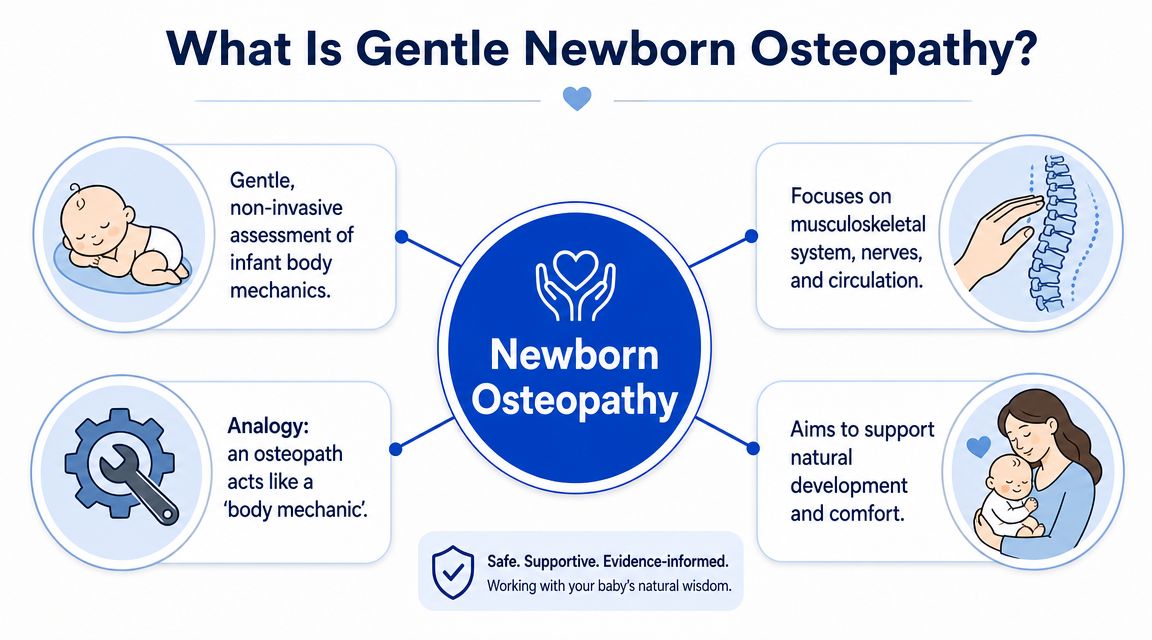
What the osteopath is feeling for
During an assessment, the practitioner usually observes simple things first. How your baby lies. Which way they prefer to turn. Whether one side seems easier than the other. How their neck, jaw, shoulders, ribcage, and body move during ordinary handling.
Then they use their hands to feel for areas of restriction or tension. In plain terms, they are asking questions like these:
- Does the neck turn evenly or is one direction noticeably harder?
- Does the baby seem comfortable during handling or do certain positions bring fussing?
- Is there asymmetry in the head, body, or posture?
- Could muscle tension be affecting function such as feeding position or head turning?
A broader introduction to this hands-on approach is explained in Bayside Osteopathic Health's guide to understanding osteopathy.
What treatment feels like
Treatment is usually subtle. It may look like cradling, gentle holding, light pressure, or carefully guided positioning. Parents sometimes expect to see a dramatic technique. Instead, they often see something that looks almost quiet.
Later in the appointment, it can help to watch a simple visual explanation like this:
Practical rule: If a practitioner describes newborn treatment in the same way they describe adult treatment, ask more questions.
The aim isn't to “fix” a baby in the mechanical sense. The aim is to support easier movement, less strain, and better comfort where musculoskeletal tension seems to be part of the picture. That can be useful when a baby has a clear positional preference or seems uncomfortable in certain movements, but it should always sit within sensible, evidence-aware care.
Common Reasons Parents Seek Osteopathic Support
Parents rarely book because their baby has a neat label. They book because daily tasks feel harder than expected. Feeding takes repeated retries. One side is easier than the other. The baby always looks right, or always looks left. A flat spot starts to become noticeable in photos.
Feeding and body comfort
A newborn may struggle to latch comfortably for many reasons, and not all of them are musculoskeletal. Sometimes the issue relates more to feeding technique, milk transfer, oral function, or breastfeeding support than to body tension alone.
That said, body comfort matters during feeding. If a baby dislikes turning one way, stiffens through the neck, or seems unsettled in certain positions, parents often seek osteopathic input alongside help from a lactation consultant, GP, or child health nurse.
Positional preference and head shape
This is one of the clearest areas where an osteopath for a newborn may be part of the support team. Some babies develop a strong preference for turning their head one way. Over time, that can contribute to flattening of the head shape or ongoing asymmetry.
For infant torticollis and plagiocephaly, osteopathic care focuses on reducing tissue tension in areas such as the neck, especially the sternocleidomastoid muscle, and the cranial base. This approach is described as an adjunct to conservative care like home positioning, awake tummy time, and stretching, with physical therapy alone showing improvement in up to 90% of cases in the cited teaching materials from the pediatric osteopathic newborn module.
A practical comparison can also help when parents are deciding which clinician to see first. This overview of osteopathy vs physiotherapy can clarify how the approaches may overlap.
After birth intervention or a difficult start
Another common question is timing. Parents often wonder whether to seek an assessment after forceps or vacuum delivery, after time in special care, or when feeding and head-shape concerns begin soon after birth.
In those situations, what matters most is not assuming every unsettled baby needs hands-on treatment. Some babies improve with positioning, time, feeding support, and routine follow-up. Others benefit from an assessment because the pattern persists.
A helpful way to think about common reasons for booking is below:
| Concern parents notice | Why they may seek osteopathic support |
|---|---|
| Feeding seems awkward in one direction | To assess neck, jaw, and body comfort during positioning |
| Baby strongly prefers one side | To assess asymmetry and movement restriction |
| Early flat spot concerns | To support a broader plan that includes repositioning and tummy time |
| Stiffness or discomfort during handling | To see whether musculoskeletal tension is contributing |
Osteopathy makes the most sense when the concern is specific and observable, not when it's treated as a blanket answer for every newborn behaviour.
Safety, Evidence, and Regulation in Australia
It is 2 am, your baby only settles when held a certain way, and someone suggests osteopathy. The first question for many Australian parents is simple. Is it safe, and how do I know the practitioner is properly qualified?
In Australia, osteopaths are regulated health practitioners. They are registered through AHPRA under the National Registration and Accreditation Scheme, introduced in 2010. That means there are legal standards for registration, professional conduct, continuing professional development, and complaints handling, as outlined in this overview of osteopathic treatment of infants in Australia.
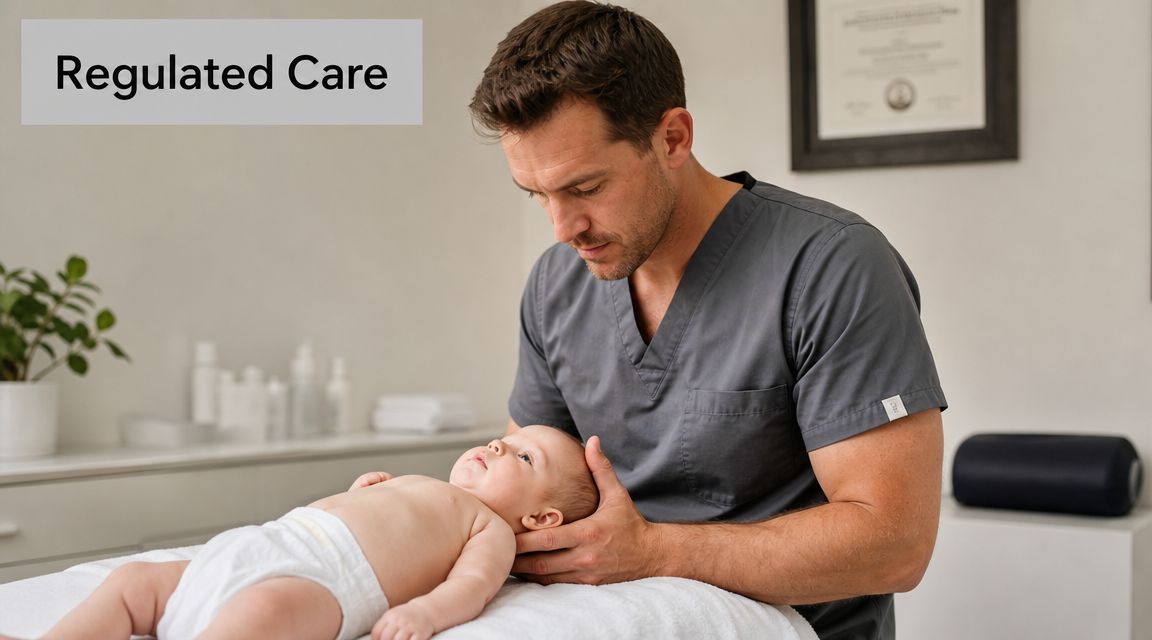
That regulatory framework matters. It gives parents a clear place to check registration and a formal system of accountability. It does not answer a separate question, though. How much newborn experience does this particular osteopath have?
AHPRA registration tells you the practitioner is recognised and regulated. Infant experience still needs to be checked directly. A good question is whether the osteopath regularly assesses newborns, understands normal infant variation, and refers to a GP, paediatrician, child health nurse, lactation consultant, or physiotherapist when the concern sits outside musculoskeletal care.
What the evidence can realistically tell parents
Research in this area is still developing. Much of it is observational, which means it can describe who was treated, what parents reported, and whether adverse events were recorded, but it cannot show with certainty that treatment caused the change.
For parents, that distinction matters. Observational research is a bit like keeping a careful diary of what happened in clinic. It can be useful and reassuring, especially for safety monitoring, yet it is not the same as a high-quality trial comparing one approach against another.
The most reasonable reading of the evidence is cautious and practical. Newborn osteopathy may be more relevant when a baby has a clear positional or musculoskeletal pattern, such as a strong head-turning preference, body asymmetry, or discomfort during handling. The evidence becomes much less clear once the concern shifts to broad problems like unsettledness, reflux, sleep, or colic on their own.
Safety in practice
Gentle infant osteopathic care should involve careful history-taking, observation, and light hands-on assessment. Parents should expect explanations in plain language, not grand promises. If a baby has red flags such as fever, breathing difficulty, poor weight gain, lethargy, persistent vomiting, seizures, or signs of dehydration, medical assessment comes first.
The safest care usually looks collaborative. One clinician may assess feeding, another may monitor weight gain, and another may check musculoskeletal comfort and movement. For a newborn, that team approach works much like several people checking different parts of the same map. Each person sees something important, and the clearest picture comes from putting those pieces together.
A sensible way to judge whether care is appropriate
Parents do not need to become experts in research methods overnight. A few practical questions go a long way:
- Is the osteopath AHPRA-registered?
- Do they regularly work with newborns?
- Do they explain what osteopathy may help with, and where the limits are?
- Do they look for signs that another health professional should be involved?
- Do they avoid claiming to treat every common newborn issue?
Clear, regulated, infant-focused care should feel measured, transparent, and calm. That is usually a good sign you are in the right place.
Your First Visit to a Paediatric Osteopath
It often starts like this. You arrive with a nappy bag, a feeding question, and a baby who is either fast asleep or crying the moment you put them down. Many parents expect a formal treatment straight away. In practice, a first visit is usually slower and more like a guided check-in, with time to understand what life has looked like at home.
The osteopath will usually ask about pregnancy, labour, birth, feeding, sleep, settling, and the pattern you have been noticing. Small details can be surprisingly helpful. A baby who always looks over one shoulder, feeds more easily on one side, or becomes upset during tummy time gives clues in the same way a few puzzle pieces start to show the picture.
What happens in the room
The assessment is usually done where your baby is calmest. That may be on the treatment table, on your lap, or in your arms. A newborn does not need to stay still and "perform" for the appointment to be useful.
Observation often comes first. The osteopath may watch how your baby lies, turns, feeds, stretches, or settles, then gently check movement through the head, neck, shoulders, trunk, and hips. The aim is to see how your baby moves and where they may be guarding, not to force anything.
The pace should feel calm and ordinary. Babies feed during visits. They cry, pause, cuddle, wriggle, and fall asleep. A paediatric osteopath works with that rhythm rather than against it.
What treatment may involve
If hands-on treatment is appropriate, it is usually very gentle and often brief. It may include light contact, soft tissue work, supported positioning, or small assisted movements. Good care also includes clear explanation. You should come away understanding what the osteopath has found, what seems less likely, and whether another professional should also be involved.
Home advice is often one of the most useful parts of the visit because it gives you simple things to try in your normal routine. That may include:
- Positioning suggestions: small changes during cuddling, carrying, feeding, or supervised awake time
- Tummy time ideas: easier starting positions if your baby becomes upset quickly
- What to watch for: signs of improvement, or signs that mean you should check back with your GP, maternal child health nurse, or paediatrician
Parents often ask how many appointments are usually needed. There is no set number for every baby. Some families come for one assessment and a plan to try at home. Others return for a short review if the problem is improving but not fully settled yet. A measured practitioner should explain why a follow-up is suggested and what change they hope to see by then.
If you are booking locally, it can help to review clinics that offer paediatric osteopathy in the Bayside area and ask how often they assess newborns.
A simple rule can help here. If the plan sounds vague, open-ended, or too certain, ask for specifics. A clear answer should explain the goal of care, what progress would look like, and when medical review would be the better next step.
How to Choose a Qualified Newborn Osteopath in Bayside
Choosing a practitioner matters more than choosing a label. Two clinics may both offer infant osteopathy, but the quality of assessment, communication, and clinical judgement can be very different.
What to check first
Start with the basics that you can verify.
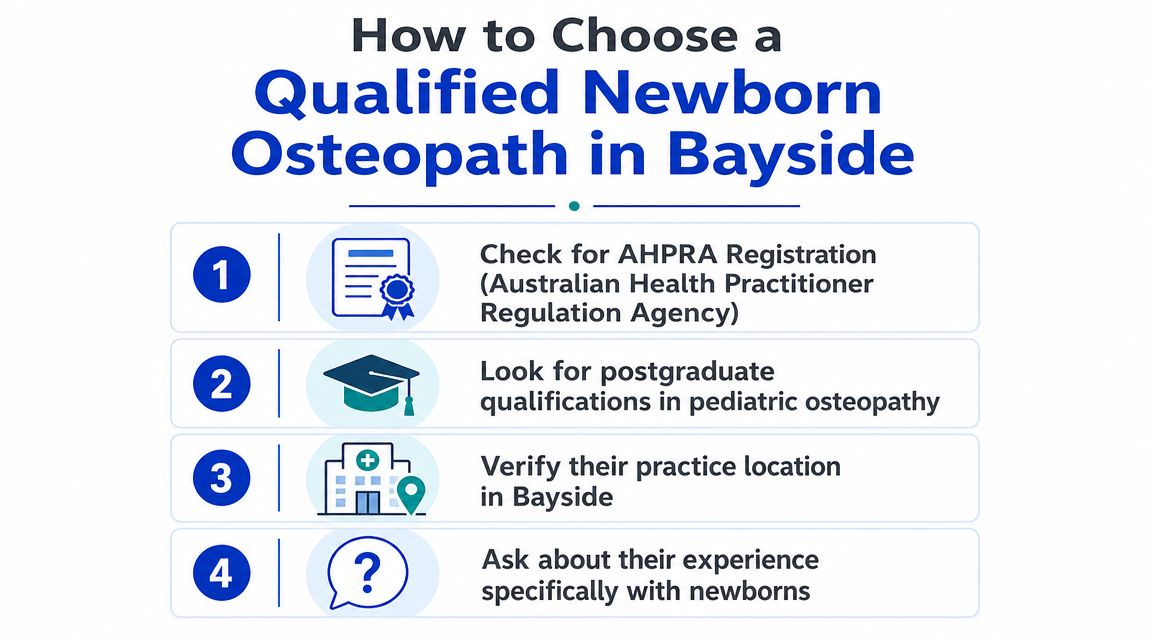
- AHPRA registration: Make sure the practitioner is currently registered as an osteopath in Australia.
- Newborn experience: Ask whether they regularly assess babies, not just adults and older children.
- Clear communication: They should explain findings in everyday language and say when osteopathy isn't the main answer.
- Willingness to collaborate: A good practitioner works alongside GPs, paediatricians, lactation consultants, maternal child health nurses, and physiotherapists when needed.
Locally, a practical starting point is reviewing clinics that offer osteopathic care in the Bayside area. Bayside Osteopathic Health is one local option among them for families seeking osteopathic assessment for babies and newborns.
Questions worth asking before you book
Some questions quickly tell you whether the clinic is a good fit.
| Question | What a useful answer sounds like |
|---|---|
| Do you see many newborns? | Specific, calm, and experience-based |
| How do you decide if a baby is suitable for osteopathic care? | Mentions assessment, limits, and referral when needed |
| Do you work with other health professionals? | Open to shared care, not territorial |
| What should we try at home first? | Includes practical advice, not just booking pressure |
A common parent concern is timing. After an assisted delivery or with early head-shape concerns, a good practitioner should explain how osteopathy fits into ordinary Australian postnatal care, including when to monitor and when to seek assessment, as discussed in this guidance on supporting your baby's health with osteopathic care.
Red flags to avoid
Trust your instincts if something sounds too broad or too certain.
- Big promises: Be wary of anyone claiming to cure colic, reflux, sleep issues, or feeding problems across the board.
- Pressure to commit: You shouldn't be pushed into a long prepaid plan before your baby has even been assessed.
- Dismissal of medical care: If a practitioner discourages you from seeing your GP, paediatrician, or lactation consultant, that's a concern.
Frequently Asked Questions About Newborn Osteopathy
Is osteopathy painful for a baby
A newborn session should be gentle. Treatment is usually light and carefully adapted to the baby's comfort. Babies may cry during an appointment, but crying doesn't automatically mean the treatment is painful. Sometimes they're hungry, tired, overstimulated, or object to being handled.
What can an osteopath for a newborn realistically help with
The clearest fit is usually when there is a noticeable movement or positional issue, such as a head-turning preference, early asymmetry, or body tension affecting comfortable handling. For broader issues like sleep, colic, reflux, or feeding, the picture is less clear and often needs input from other professionals too.
How soon should I book after birth
That depends on what you're seeing. If your baby has a clear positional preference, feeding seems physically awkward, or head-shape concerns are starting to emerge, an early assessment may be sensible. If the issue is mild and improving with positioning and routine support, monitoring first may also be reasonable.
How many sessions does a baby usually need
Some babies are seen for only a small number of visits, particularly when the issue is straightforward and parents have good home guidance. The exact number should depend on response, not on a fixed package.
What should I look for after treatment
Look for practical changes. Easier turning, better tolerance of certain positions, less fussing during handling, or more even movement are the kinds of signs parents often monitor. Sometimes change is quick. Sometimes the main benefit of the visit is clarity about what to do next.
When should I seek medical advice first
Seek medical advice promptly if your baby seems unwell, lethargic, has feeding decline, breathing difficulty, fever, vomiting that concerns you, poor weight gain, or a sudden change in behaviour. Osteopathy is not a substitute for medical assessment when red flags are present.
If you'd like a gentle, evidence-aware assessment for your baby, Bayside Osteopathic Health offers osteopathic care that can sit alongside your GP, maternal child health nurse, lactation consultant, or paediatrician. A thoughtful appointment should leave you with clearer answers, practical next steps, and a better sense of whether hands-on care is appropriate for your newborn.