

Most guides to the osteopath vs chiropractor question open with a technique: one profession adjusts, the other mobilises. So here's a better question. If the title on the door tells you almost nothing about how thoroughly you'll be assessed, how quickly you'll be referred on when something isn't adding up, or what you'll pay at the desk, why would you choose on the title at all?
Both professions are hands-on, degree-level and nationally regulated in Australia. That makes a practical comparison easier: a set of checks you can run in about ten minutes before booking, covering who's registered, what they'll examine, when they'll send you to a GP, and what the visit will cost you.
Work through those in order and the decision usually makes itself.
Table of Contents
- Osteopath and Chiropractor Compared at a Glance
- How Each Approach Treats Your Body
- Conditions Where Each Practitioner Is a Common Choice
- What Medicare and Private Cover Will Actually Pay
- Red Flags That Need a GP or Emergency Care First
- Choosing and Verifying Your Practitioner
Osteopath and Chiropractor Compared at a Glance
Osteopathy and chiropractic are both nationally regulated, degree-level manual health professions in Australia, so the choice depends far less on the title than on technique emphasis, the condition you're bringing in, and how the care gets paid for. The table sets them side by side on the points that change a decision.
Osteopathy and chiropractic side by side
| Aspect | Osteopathy | Chiropractic | What this means for you |
|---|---|---|---|
| Regulation | Protected title under the National Law, registered with Ahpra | Protected title under the National Law, registered with Ahpra | Check the public register before booking |
| Training | Degree-level qualification | Degree-level qualification | Judge the individual practitioner, not the title |
| Core focus | Whole-body structure and function | Spinal alignment and nervous system function | Overlap is large for back and neck pain |
| Common techniques | Soft-tissue work, joint articulation, mobilisation, stretching | Spinal adjustments and mobilisation | Ask which techniques the plan includes |
| Typical reasons for visits | Back, neck and joint pain, arthritis, posture strain | Back and neck pain, sciatica, headaches | Match the condition rather than the label |
| Medicare | Only through an eligible chronic-condition care plan and referral | Same care plan and referral rules apply | Referral and care plan decide eligibility |
| Private health cover | Commonly covered, with annual rebate limits | Commonly covered, with annual rebate limits | Confirm your limit and the gap you'll pay |
Read the first three rows and you'll see why the technique argument goes nowhere. Regulation, training and the Medicare rules are shared ground. Both titles are protected under the National Law, both require a degree-level qualification, and both sit inside the same care plan rules when Medicare is involved.
The rows that move a decision are the middle three. Technique emphasis is where the professions diverge, and it's a preference you're allowed to have. The condition matters more than the label, because an arthritic hip responds to different handling than a stiff mid-back. Your cover decides what the visit costs, and it's the row people check last when they should check it first.
A sensible order: name the condition you're treating, confirm both professions are plausible for it, then ring your fund about the rebate. Before any of that, look the practitioner up on the public Ahpra register and confirm their registration is current.
How Each Approach Treats Your Body
How can two appointments for the same stiff, aching lower back feel different, yet follow a similar path?
An osteopathic session usually begins with a history that looks beyond the sore spot, including your work set-up, past injuries and the movements that worsen the pain. The practitioner assesses how you bend, twist and walk, and how your joints and muscles move together. Treatment may use soft-tissue work, joint articulation, gentle mobilisation and stretching, followed by home-care guidance. You can read more about what osteopathic treatment involves.
A chiropractic session also starts with a history and physical assessment, often examining spinal joints individually. Treatment may centre on adjustments, controlled movements applied to specific joints, alongside mobilisation or exercise advice. Some chiropractors also work on surrounding soft tissue.
The infographic shows both appointment sequences step by step.

The stages have plenty in common: both approaches begin with a history and examination, use hands-on treatment, and may finish with home-care advice and a point to review progress. A clicking sound can occur during some joint techniques in either profession. It is joint cavitation, not the treatment itself, and does not need to happen for care to be useful.
The useful question: a technique label says less about care quality than the assessment, the plan that follows, and whether the practitioner explains when another kind of care is more appropriate.
Both professions are regulated nationally under Ahpra. Workforce size, however, is not a measure of how well an individual practitioner assesses your needs or plans care. The Chiropractic Board of Australia workforce statistics recorded 5,968 registered chiropractors in its 2020–21 snapshot. That figure describes workforce size for that period, not the quality or suitability of treatment. A professional title is a starting point for checking registration, not a verdict on the care you will receive.
Three questions for the first session
- What are you assessing? A clear answer should explain which movements, joints or muscles are being examined and what the findings may mean.
- What will treatment involve? Ask which area is being treated and what techniques the practitioner proposes. The explanation should make sense to you.
- How will we review progress? Agree on a practical change you can notice, such as walking more comfortably, sleeping better or sitting longer before the ache returns.
Conditions Where Each Practitioner Is a Common Choice
People often arrive with a named problem rather than a preference between professions. This list pairs common presentations with the choice most practitioners would make first, and the alternatives worth raising with your GP.

Common conditions and the usual first choice
| Condition | Common first choice | Alternatives to discuss |
|---|---|---|
| Chronic low back pain | Osteopath or chiropractor | GP-led plan, exercise-based management |
| Acute low back pain | Osteopath or chiropractor after screening | GP, physiotherapist |
| Sciatica and nerve referral pain | Either, after medical screening | GP, physiotherapist |
| Neck pain and stiffness | Osteopath or chiropractor | Physiotherapist |
| Arthritis-related joint pain | Osteopath | GP, structured exercise program |
| Pregnancy-related pelvic or lower back strain | Osteopath | Obstetric care team |
| Desk and screen posture strain | Either | Ergonomic assessment |
| Sports injury and training soreness | Osteopath | Sports physiotherapist |
| Headaches linked to neck tension | Chiropractor | GP, for other headache types |
How to read the columns
The first column is a common choice, not a rule. It reflects who usually treats that presentation, not a claim that the other profession can't help. The second column is your conversation material for a GP visit, and it matters when symptoms are new, severe, changing, or coming with anything neurological.
Sciatica and nerve referral pain sit in a category of their own. Numbness, pins and needles tracking down a leg, or weakness in a foot change the order of events: medical screening comes before hands-on treatment, because the assessment findings decide whether manual care is appropriate at all. The same applies to any problem without a diagnosis yet. Get assessed first, then treat.
Some of these presentations are ones we handle often. Our Osteopathy & Spinal Health service treats acute and chronic lower back pain, sciatica and nerve referral pain, mid-back and thoracic tension, neck pain with cervical stiffness, disc bulge and disc herniation, and sacroiliac joint dysfunction. Our Pregnancy & Postural Support care covers pelvic discomfort and lower back strain during and after pregnancy. Most desk-related postural cases respond well within three to five sessions.
If you'd prefer to hear two practitioners talk through the decision rather than read it, this short comparison covers similar ground.
Use this list to orient yourself, not to settle the argument. The steps in the final section are what turn it into a decision.
What Medicare and Private Cover Will Actually Pay
A Medicare rebate for an osteopath or a chiropractor works like a concession that opens only at one counter. That counter is an eligible chronic-condition care plan, not the fact that your back hurts. Pages that compare the two jobs often skip this and talk as if the title on the door sets the bill.
The MBS osteopathy item lists a fee of $74.55 and a benefit of $63.40. It covers up to five allied-health services per calendar year, and only for a patient whose chronic condition and complex care needs are managed under an eligible multidisciplinary care plan. From 1 July 2025, new allied-health referrals for these chronic-condition services must follow updated referral requirements. Referrals already in place continue until they expire.
The out-of-pocket cost is the gap between that listed benefit and the fee the practice charges. AHPRA registration tells you the practitioner may provide the service. It does not tell you the gap.
Medicare and private cover routes for allied-health visits
| Funding route | Listed fee | Benefit | Limit or condition |
|---|---|---|---|
| MBS osteopathy item | $74.55 | $63.40 | Up to five services per calendar year under an eligible multidisciplinary care plan |
| Private health cover | The practitioner's private fee | A rebate set by the fund and the policy | Annual rebate limits apply, separate from the Medicare cap |
The gap between Medicare and private cover
These are two different funding systems. Mixing them up is how people get billing surprises. Medicare eligibility rests on the care plan, the referral, whether the practitioner can claim the item, the item rules, and the yearly service limit. Private cover is a contract between you and your fund. The yearly rebate usually runs out on its own timetable, even when treatment is still underway.
If you want the detail on how funds treat these visits, read whether osteopathy is covered by private health insurance before you call your fund.
Bulk billing is not uniform across the two professions either. For Medicare-subsidised chronic-disease-management services in 2019, AIHW's analysis of allied-health items reported bulk-billing rates of 74.4% for chiropractic and 30.5% for osteopathy. Those rates reflect referrals, fees, availability and patient preference. They are not evidence that one treatment works better than the other. On that question the published comparisons are limited, and a higher bulk-billing rate is a weak stand-in for better care.
What you pay depends on your policy, your fund's annual limit and whether you hold a current referral. Osteopaths at Bayside Osteopathic Health are recognised by major private health funds. Checking your own fund's limit before the first visit removes most of the guesswork.
Before you commit, ask for a written estimate with four items: the expected number of visits, the out-of-pocket cost per visit, the cancellation rules, and a lower-cost alternative such as GP-led care or a supervised exercise program. A practice that will not put those four things in writing is showing you how it handles money. That says more about the care pathway than the professional label does.
Red Flags That Need a GP or Emergency Care First
The question people ask is whether osteopaths and chiropractors are interchangeable for chronic back or neck pain. The better question is who screens you properly before either pair of hands touches your spine. On that measure, the title on the door is a weak proxy for quality.
There's plenty of overlap in real-world use. A national survey reported in BMC Public Health found that 16.1% of Australian adults had used chiropractic care and 4.6% had used osteopathy within 12 months. Both are degree-level, statutorily regulated occupations. The same survey flagged a relatively small osteopathy sample, which is a good reason not to over-read the differences in reported adverse events between the two.
Some symptoms take priority over any manual treatment. Book a GP or emergency assessment first if you have:
- New numbness, weakness or tingling in the legs or arms, especially if it's getting worse
- Changes to bladder or bowel control, or numbness around the saddle area
- Unexplained weight loss, or fever alongside back pain
- Pain after a fall or trauma, or a history of cancer
- Pain that is progressive or doesn't ease at night
- New neurological symptoms, such as dropped foot or unsteady walking
What a responsible practitioner does
Age and general health raise the stakes. Older adults, and anyone with a condition that could be systemic, warrant a lower threshold for medical referral rather than a longer course of hands-on treatment.
At the first visit, a careful practitioner screens for serious conditions, completes a functional assessment rather than a quick poke, sets measurable goals, and discusses expected benefits and risks in plain language. When symptoms fall outside musculoskeletal care, the answer is a referral to a GP or emergency service. We'll refer patients onward to another discipline when that discipline is better suited to their needs, and that includes sending you back to your GP.
The practical rule: if a red flag is present, book the medical assessment first and treat manual therapy as an option that comes later.
Choosing and Verifying Your Practitioner
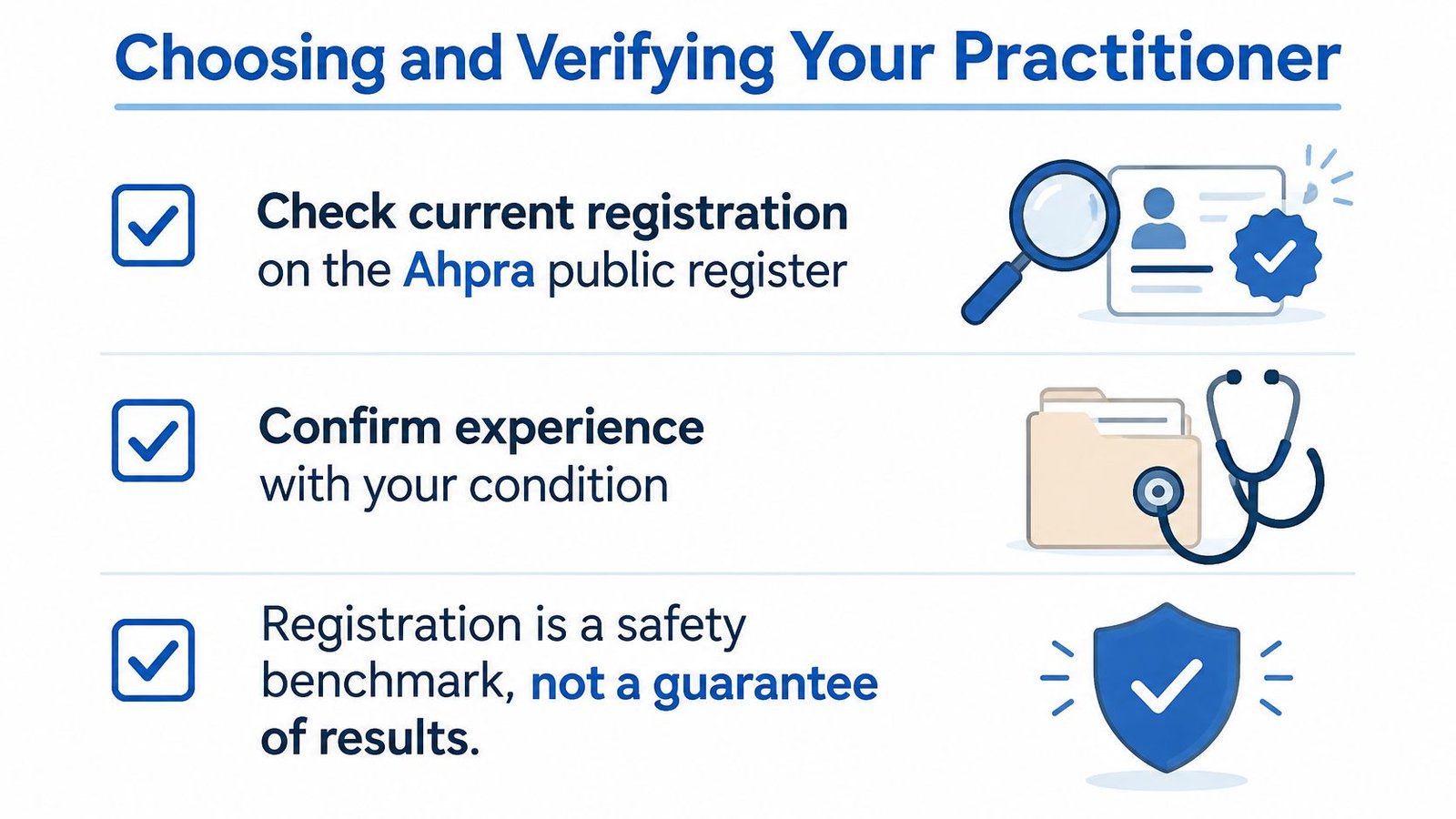
A professional title tells you which registration rules apply, but it cannot tell you whether a practitioner's approach suits your needs. In Australia, osteopaths and chiropractors are separate nationally regulated professions, and both titles are protected under the National Law. Check the practitioner's current registration on the public register. Then ask about their experience with your condition. The Ahpra FAQ on regulated professions explains the role of Ahpra and the National Boards; it does not determine which profession is clinically superior. Your choice should reflect the assessment, your preferences, any contraindications and the practitioner's scope of practice.
Six things worth checking before you book
- Current registration: Search the public register by the individual practitioner's name rather than relying on a clinic website badge.
- Experience with your condition: Ask whether they commonly treat it and what a typical course of care involves.
- Depth of assessment: Look for a history and movement examination that consider your symptoms and how you move, rather than a quick postural scan.
- A realistic recovery timeline: Ask when you might expect a change and what the practitioner would do if you do not improve.
- Communication with your GP: Ask whether they will coordinate with your GP if you have other health conditions, take medication or need imaging considered.
- Comfort with the techniques proposed: If you are uneasy about manipulation, ask what other approaches may be suitable.
Every osteopath at Bayside Osteopathic Health holds a university qualification in osteopathic medicine and is registered with AHPRA. The guide to osteopath qualifications in Australia explains the training pathway.
Which practitioner suits which situation
If you prefer soft-tissue work, gentle joint mobilisation and a whole-body assessment, an osteopath may suit you. This approach can be a preference when pain is linked to arthritis, during pregnancy, or when symptoms affect several areas and you want them considered together.
If you specifically prefer spinal adjustments and your assessment identifies restricted movement in particular spinal joints, a chiropractor may suit your preference. You can discuss other options or change practitioners if the approach does not feel right.
If your condition is undiagnosed, see your GP before starting manual treatment. New, unexplained or changing symptoms need medical assessment before a treatment plan.
There is no single verdict based on professional title alone. Evidence does not establish one profession as the better choice for everyone. Focus instead on whether the practitioner assesses your needs, explains their reasoning, respects your preferences and recognises when another type of care is more appropriate.
The first booking, step by step
- Check current registration on the Ahpra public register for the individual practitioner.
- Ask about experience: How often do they treat your condition, and what outcomes do they commonly see?
- Confirm the paperwork: Ask whether a GP referral or care plan is needed for any Medicare contribution, and check whether your private health policy covers the visits.
- Request a written estimate of the proposed number of sessions, out-of-pocket cost per visit and cancellation rules.
- Ask what to expect: The practitioner should explain each technique, work within your comfort level, provide a plan and discuss home-care exercises. At Bayside Osteopathic Health, treatment starts in the first session, and the practitioner explains the techniques and adapts them to your comfort.
- Ask how progress will be reviewed and when the practitioner would refer you elsewhere. A clear answer helps you judge whether the plan is working for you.
If you are comparing an osteopath and chiropractor for back, neck or joint concerns, Bayside Osteopathic Health assesses how your body moves as a whole and gives you a realistic recovery timeline. Its osteopaths use soft-tissue work, joint articulation and guided movement strategies, and can explain when another discipline may be better suited to your needs. Contact the clinic by phone on 0419 110 004 or email hello@baysideosteopathic.com.au to ask about acute pain, sports injuries or whether osteopathic care may be right for you. The team prioritises prompt bookings for acute or urgent pain and can help you find a suitable appointment time.