
That ache has been hanging around for weeks. Maybe it started as a stiff neck after long days at a desk, a low back that complains every morning, or a shoulder that never quite settled after gardening, golf, or lifting something awkward. You know you should get help, but then you hit the next problem. Do you book an osteopath or a physiotherapist?
Their inquiries aren't driven by a love for comparing health professions. They ask because they want the right kind of help first. They want to know who's more likely to give gentle hands-on relief, who'll focus on exercises, and who's the better fit for a body that feels tight, sore, or out of balance.
That's where the osteopath vs physiotherapist question usually gets oversimplified. It gets reduced to clichés that don't help much when you're the one in pain. The more useful question is this: what is your main goal right now? If you want hands-on care and a broader look at how your whole body is moving, one path may suit you better. If you want a structured rehabilitation plan aimed at strength, movement and return to a specific activity, the other may make more sense.
In Australia, both osteopaths and physiotherapists are regulated allied health professions. That matters. You're not choosing between a qualified clinician and an unregulated alternative. You're choosing between two legitimate professions with different emphases, different clinical habits, and often a different feel in the treatment room.
The best choice isn't about which profession is “better”. It's about which one matches your symptoms, your preferences, and the kind of recovery you're looking for.
Table of Contents
- Introduction
- Understanding Core Philosophies and Training
- Treatment Techniques A Side-by-Side Comparison
- What Conditions Do Osteopaths and Physiotherapists Treat
- What to Expect During Your First Appointment
- How to Choose the Right Practitioner for Your Needs
- Navigating Costs Medicare and Private Health Insurance
- Frequently Asked Questions
- Do I need a GP referral to see an osteopath or physiotherapist?
- Is treatment painful?
- Which is better for back pain?
- Will I get exercises from an osteopath?
- Will a physiotherapist use hands-on treatment?
- How many sessions will I need?
- Can older adults see an osteopath?
- What if I'm still not sure which one to choose?
Introduction
A common scenario goes like this. Your back has been sore for months. It's not dramatic enough for emergency care, but it's draining. You're moving less freely, sleeping poorly, and getting irritated by simple tasks like driving, working, or standing in the kitchen. A friend says, “See a physio.” Someone else says, “Try an osteopath.” Neither answer tells you what will best suit you.
For some people, the priority is gentle relief. They want someone to assess the whole body, use hands-on treatment, and help them understand why the same area keeps flaring up. For others, the priority is rebuilding function. They want a clear rehab plan, targeted exercises, and a pathway back to sport, walking, work, or post-surgical recovery.
Practical rule: Choose based on the kind of help you need most right now, not on a label you heard years ago.
That distinction matters more than old myths. An osteopath doesn't only deal with “bones”, and a physiotherapist doesn't only hand out exercises. There's overlap. Both assess movement. Both can use manual therapy. Both aim to reduce pain and improve function. But the emphasis is often different, and that emphasis shapes your first appointment, your treatment plan, and how involved you'll be in exercises between visits.
If you've been stuck on the osteopath vs physiotherapist decision, the clearest way forward is to match the practitioner to your goal. Do you want hands-on care first for persistent stiffness or chronic low back pain? Do you need a more structured rehabilitation approach after an injury or procedure? Once you answer that, the choice usually becomes much simpler.
Understanding Core Philosophies and Training
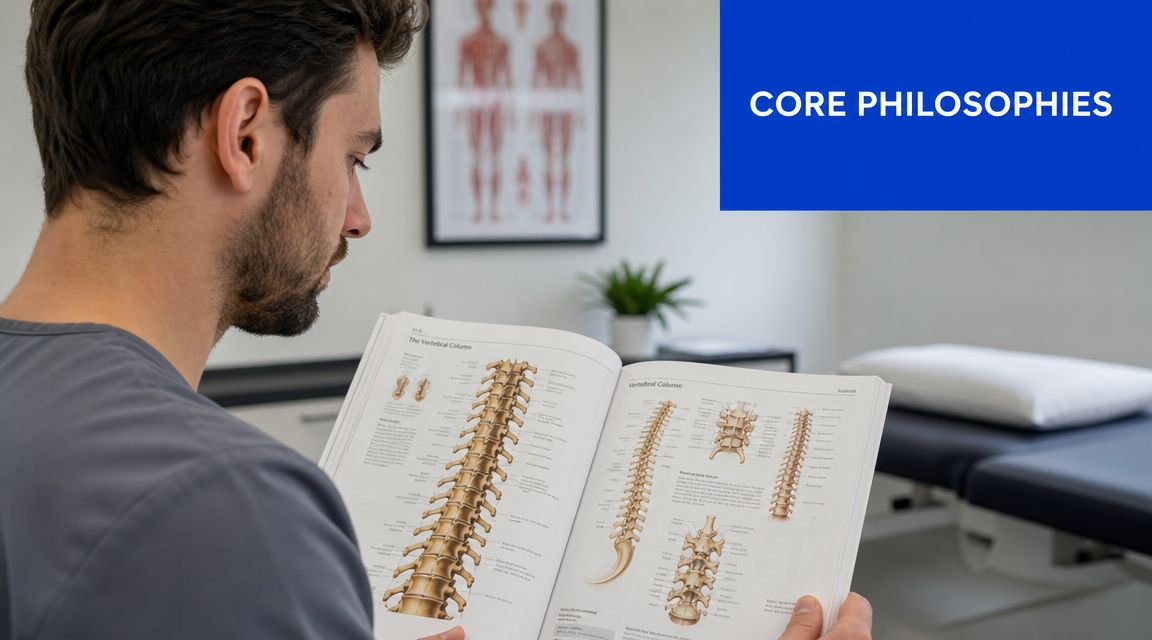
How the two professions tend to think
The biggest difference in the osteopath vs physiotherapist comparison is often not the treatment tool itself. It's the lens the practitioner brings to your problem.
Osteopathy usually starts with a whole-body question. If your neck hurts, the osteopath may also look at your upper back, rib movement, posture, breathing mechanics, hips, and the way you load your body through daily habits. The thinking is that structure and function are closely linked, so pain in one area may reflect strain or restriction elsewhere. If you'd like a broader overview of that approach, this guide to understanding osteopathy and whole-body care is a useful reference.
Physiotherapy usually starts with a function question. What movement is limited? What tissue or joint is likely involved? What needs to improve so you can return to walking, running, lifting, climbing stairs, or sport? The focus is often more tightly linked to rehabilitation, physical capacity, and restoring a specific activity.
Neither philosophy is superior by nature. They result in different clinical priorities.
Training and regulation in Australia
In Australia, both professions sit within the same national regulatory framework. That gives patients a strong baseline of accountability and professional standards.
According to this Australian comparison of osteopathy and physiotherapy, osteopaths are registered under the National Registration and Accreditation Scheme and must complete at least 420 hours of supervised clinical practice during an approved qualification, while physiotherapists are registered through the same scheme but are trained in a broader clinical rehabilitation model that commonly includes exercise prescription, education, and manual therapy.
That's why the primary distinction is usually treatment emphasis, not legal scope in a simplistic sense. Osteopathy is typically more hands-on and manual. Physiotherapy is typically more exercise- and function-rehab oriented.
Patients often notice this difference quickly. One clinician may spend more time treating with their hands. The other may spend more time testing movement and building a rehab plan.
There's also a practical access difference in Australia. A comparison citing Ahpra notes that more than 5,000 osteopaths were registered in Australia in 2020, while the physiotherapy workforce was substantially larger. For patients, that often shows up as stronger physiotherapy presence in hospitals, sports settings, and larger rehab networks, while osteopathy remains a smaller but established manual therapy profession.
Treatment Techniques A Side-by-Side Comparison
When patients ask about osteopath vs physiotherapist, they usually want to know one thing. What will the treatment feel like?
Here's the short version.
| Aspect | Osteopathy | Physiotherapy |
|---|---|---|
| Primary emphasis | Hands-on assessment and manual treatment of the body as a connected system | Rehabilitation of movement, strength, and physical function |
| Typical starting point | Broader look at posture, mobility, tension patterns, and how one area affects another | Closer focus on the injured or limited area and the task you want to return to |
| Common techniques | Soft-tissue work, joint articulation, gentle mobilisation, movement advice | Exercise prescription, movement retraining, education, manual therapy, rehab progression |
| Patient involvement between visits | Often includes self-care advice, stretches, movement changes, pacing | Often includes a structured home exercise program and graded activity plan |
| Best suited to | People wanting hands-on care first, especially when pain feels linked to overall movement patterns | People needing targeted rehab for a specific injury, surgery, or functional goal |
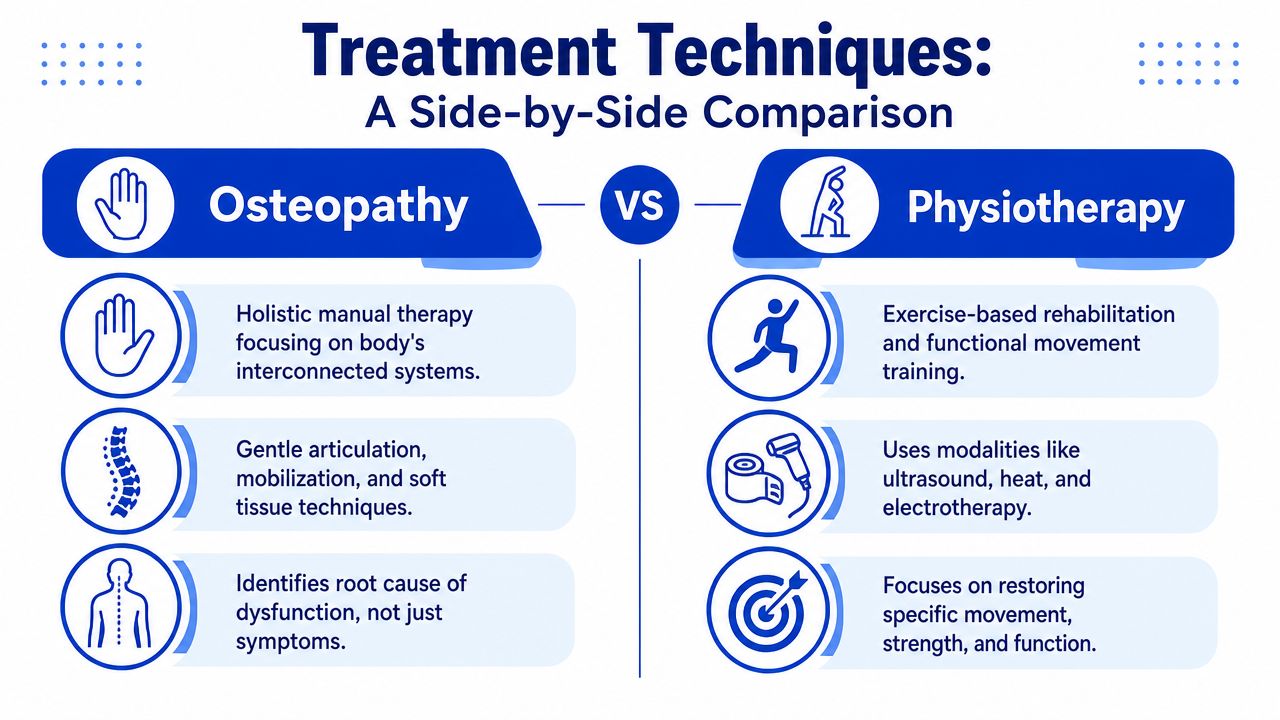
What osteopathic treatment often looks like
An osteopathic session often includes a lot of manual contact. That can mean soft-tissue work to reduce muscle guarding, joint articulation to improve motion, and gentle mobilisation when an area feels stiff or compressed. The treatment usually aims to settle irritation, improve movement quality, and reduce the sense that the body is “stuck”.
This is often a good fit for people who say things like:
- “Everything feels tight, not just one spot.” The pain may be local, but the tension pattern feels broader.
- “I want someone to work through it with their hands first.” Some people respond better when treatment begins with manual care rather than exercise volume.
- “I'm sore, stiff, and cautious about vigorous rehab at the start.” Early comfort can matter.
What physiotherapy often looks like
A physiotherapy session often leans more heavily into active rehabilitation. You may still receive hands-on treatment, but it's commonly paired with exercise prescription, movement drills, and practical loading advice. The goal is to improve how you move and what you can do.
That often suits people dealing with:
- A clear injury target, such as an ankle sprain, knee pain with running, or shoulder weakness.
- A performance goal, like returning to sport, building strength, or preparing for an event.
- Post-surgical rehab, where progressions, function milestones, and exercise adherence matter.
Some patients don't need “more treatment”. They need the right dose of movement, in the right order, with the right technique.
Where the overlap matters
The overlap is bigger than many people expect. Both professions can use manual therapy, education, and movement advice. The more useful distinction is the balance between them.
If your main goal is relief through hands-on care with whole-body assessment, osteopathy may feel like the more natural first step. If your main goal is retraining function with a structured exercise pathway, physiotherapy often fits more neatly.
What Conditions Do Osteopaths and Physiotherapists Treat

There's plenty of overlap in the conditions both professions see. Back pain, neck pain, headaches linked to tension, joint stiffness, and general movement restriction can sit in either clinic. The more useful question isn't “Who treats this condition?” It's “Who is likely to approach this condition in the way I want?”
When an osteopath is often a strong first choice
Osteopathy is often a good first option when your pain feels persistent, mechanical, and linked to the way your whole body is moving.
Examples include:
- Chronic back or neck pain where stiffness, posture, desk work, or repeated strain seem to be part of the picture
- Postural discomfort that builds over the day rather than appearing from one single injury
- General joint restriction where you feel less mobile, less comfortable, or less balanced than usual
- Older adults with stiffness who want a gentler, hands-on starting point
These patients often want relief first, followed by manageable movement advice rather than a heavily exercise-led opening phase.
When a physiotherapist is often a strong first choice
Physiotherapy is often the better first port of call when the problem is tied to rehabilitation after a specific event or with a clear performance aim.
That includes:
- Sports injuries where return to training matters
- Post-surgical recovery where rebuilding strength and confidence is central
- Movement deficits such as weakness, loss of control, or difficulty with a specific task
- Neurological or complex functional rehab, where movement retraining is a major part of care
In these cases, the patient usually needs more than symptom relief. They need progression.
If your main question is “Why does this area keep tightening up?”, an osteopathic lens may help. If your main question is “How do I get back to doing this safely?”, physiotherapy may be the cleaner fit.
The overlap case of back pain
Back pain sits right in the middle. Both professions commonly treat it. The difference is often what you want from the first phase of care.
If your low back pain has become chronic and you want hands-on care first, osteopathy may feel more aligned. If you want a structured strengthening and movement plan from the outset, physiotherapy may be the better match. The condition is the same. The treatment emphasis changes.
What to Expect During Your First Appointment
The first appointment often decides whether you feel understood. It also tells you very quickly whether the clinician's style matches what you were hoping for.
If you see an osteopath first
An osteopathic first visit often begins broadly. You'll usually be asked about the main pain point, but also about when it started, what aggravates it, what eases it, how you sleep, how you sit, move, and work, and whether the problem seems to shift into nearby areas.
The physical assessment may include posture, spinal or joint movement, tissue tension, and how different parts of your body work together. Even if your pain is in one area, the osteopath may check areas above and below it. That can feel surprisingly thorough to patients who expected a very local assessment.
Treatment on the first day often includes hands-on techniques if appropriate. You may leave with a small amount of movement advice, pacing guidance, or simple home care suggestions rather than a long exercise sheet.
If you see a physiotherapist first
A physiotherapy first visit often feels more task-focused. The clinician will still take a full history, but the questions may centre more on the injured area, what function has been lost, and what you need to get back to. That could be walking comfortably, lifting at work, running, or recovering after surgery.
The physical exam may include strength testing, range of motion, balance, control, and movement patterns linked to your main complaint. The physiotherapist is often looking for measurable limitations that can be improved over time.
In many cases, you'll leave with a home exercise program or a very clear rehab direction. You may also receive hands-on treatment, but it's often part of a broader plan rather than the entire focus.
What matters most
The best first appointment is the one that fits your needs.
- If you want to feel listened to in a whole-body way, osteopathy may fit better.
- If you want a rehab roadmap with specific goals, physiotherapy may fit better.
- If you're unsure, ask the clinic how the practitioner typically approaches your exact problem before booking.
How to Choose the Right Practitioner for Your Needs
The simplest way to answer the osteopath vs physiotherapist question is to stop asking which profession is better and start asking what kind of help you want first.
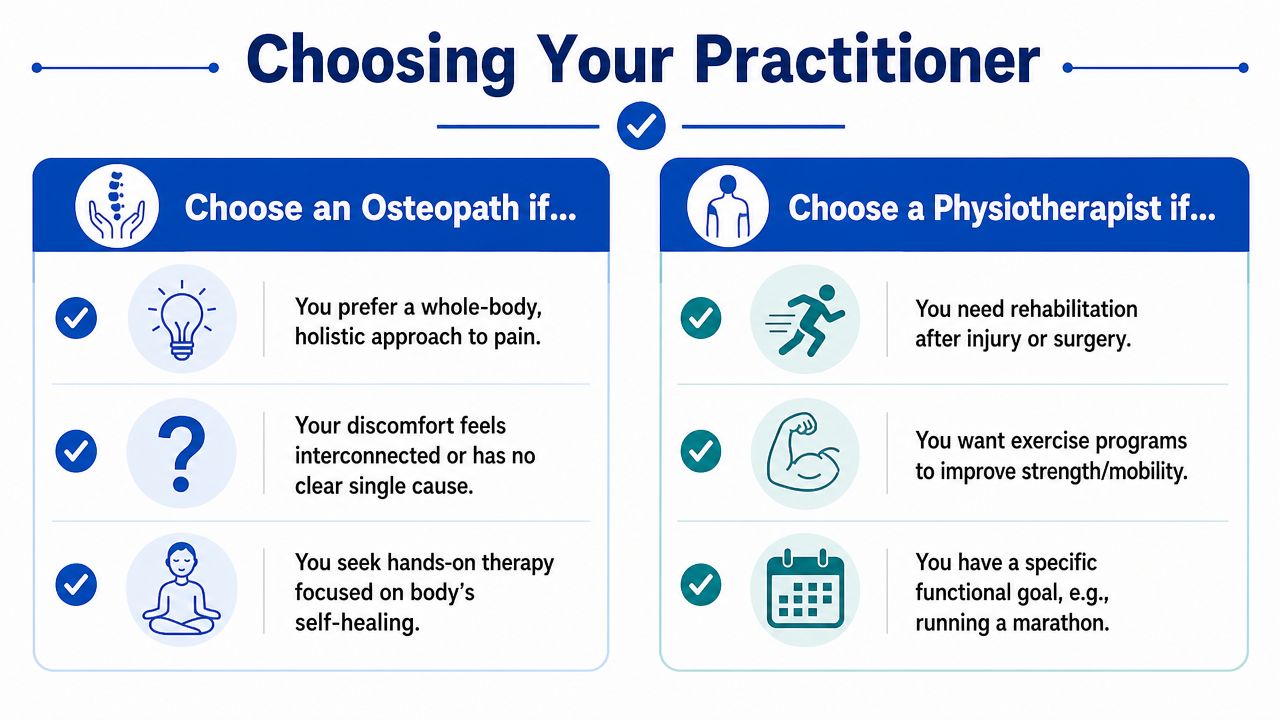
Choose an osteopath if your goal is hands-on relief first
An osteopath may be the better fit if the problem feels broad, layered, or hard to pin to one single structure.
Consider osteopathy if:
- You want a whole-body assessment. Your pain may be in one spot, but you suspect posture, stiffness, old compensations, or movement habits are feeding into it.
- You prefer hands-on treatment. You want manual therapy to play a central role, especially early on.
- Your symptoms are persistent rather than dramatic. This is common with chronic back pain, neck pain, desk-related strain, and general mobility restriction.
- You feel exercise-only care would be too much too soon. Some people need comfort and movement ease before they're ready for more active loading.
For local patients who are specifically searching for a practitioner with that style of care, browsing options for an osteopath near Bayside can help narrow the field.
Choose a physiotherapist if your goal is rehab and performance
A physiotherapist may be the better fit if you need a plan built around function, progression, and physical goals.
Consider physiotherapy if:
- You're recovering from a specific injury. You want clear loading advice and staged rehab.
- You've had surgery or a significant flare-up. Function is the priority.
- You want exercises prescribed and progressed. You like having a structured plan to follow at home or in the gym.
- Your goal is performance-based. You want to return to sport, walking tolerance, lifting, or a measurable activity target.
If you have chronic low back pain
This is the area where patients often feel most confused. A commonly overlooked question in Australia is whether someone with chronic low back pain who wants hands-on care first should choose an osteopath or a physiotherapist. A useful discussion of that issue notes that both professions are regulated allied health professions in Australia, and that access decisions are often shaped by symptoms, goals, referral pathways, and coverage rather than any simple hierarchy of care in this article on differences between osteopaths and physiotherapists.
In practice, that means this:
When low back pain has become chronic, the best first clinician is often the one whose treatment style you're most likely to engage with.
If you know you want manual treatment and a broader movement assessment, osteopathy may be the smarter first booking. If you know you want exercise progression and a function-first plan, physiotherapy may suit you better.
Sometimes the right answer is both
The two professions can complement each other well. Hands-on treatment may reduce pain and improve movement comfort, while rehabilitation work can build resilience and confidence over time.
That combination can be especially useful when someone starts with pain relief needs and later shifts toward stronger long-term function.
Navigating Costs Medicare and Private Health Insurance
Cost matters because it affects whether people start care and whether they can stick with it long enough to benefit.
Private health cover
For many Australians, private health extras may help with rebates for both osteopathy and physiotherapy. The exact rebate depends on your insurer, your level of extras cover, and whether you've served any waiting periods. It's worth checking your fund before your appointment so you know what to expect.
Medicare access
Medicare access for both professions is limited and targeted rather than broad, not general open-ended coverage for any musculoskeletal complaint. In practice, this often means patients need to explore specific pathways rather than assuming every visit will be covered.
If you're trying to understand whether you may be eligible for subsidised care, this page on Medicare-related osteopathy options and bulk billing pathways gives a practical overview to discuss with your GP and clinic.
What to ask before booking
A quick phone call can save confusion. Ask:
- Whether rebates are available on the day through private health claiming
- Whether you need a referral for your particular funding pathway
- What the initial appointment includes, especially if you're comparing a hands-on consultation with a rehab-focused one
The key point is simple. Don't choose based on assumptions about coverage. Choose based on clinical fit first, then confirm the payment pathway.
Frequently Asked Questions
Do I need a GP referral to see an osteopath or physiotherapist?
Usually, no. Many people book directly with either profession. A referral may matter if you're accessing a specific funding pathway or coordinating care through another clinician.
Is treatment painful?
It shouldn't feel harsh or uncontrolled. Some techniques can feel tender, especially if tissues are already irritated, but good treatment is usually adapted to your comfort, age, condition, and tolerance. If you prefer gentler care, say so early.
Which is better for back pain?
Neither is automatically better. It depends on what you want. If you want hands-on care and a broader movement assessment, an osteopath may suit you. If you want a structured rehabilitation plan with exercises and progression, a physiotherapist may fit better.
Will I get exercises from an osteopath?
Often, yes. Osteopaths commonly give movement advice, stretches, posture guidance, and self-care strategies. The difference is usually one of emphasis. Exercise may support treatment, rather than being the main event from day one.
Will a physiotherapist use hands-on treatment?
Often, yes. Physiotherapists may use manual therapy as part of care, especially when it helps reduce pain or improve movement enough for rehab to progress more comfortably.
How many sessions will I need?
That depends on the problem, how long it's been there, how irritable it is, and what your goals are. Acute issues may settle quickly. Longer-standing problems often need a staged approach. A good clinician should explain the likely plan clearly after assessment.
Can older adults see an osteopath?
Yes, many do. This can be a good option for stiffness, reduced mobility, postural strain, and general mechanical aches, especially when a gentler hands-on approach is preferred.
What if I'm still not sure which one to choose?
Start with your main goal. If you want relief through hands-on treatment and a whole-body perspective, book an osteopath. If you want targeted rehab and exercise progression, book a physiotherapist. If your needs change, care can be adjusted.
If you're dealing with ongoing back pain, neck tension, joint stiffness, or posture-related discomfort and want a gentle, hands-on approach, Bayside Osteopathic Health offers personalised osteopathic care for the Bayside community. The focus is on easing pain, improving mobility, and helping you move with more comfort and confidence through individualized treatment, practical advice, and supportive ongoing care.