

That sharp pull from your lower back into the buttock, thigh, or calf can make ordinary life feel oddly complicated. Sitting through a work call hurts. Driving becomes a problem. Sleeping turns into a cycle of shifting position and waking up sore. Many people arrive at this point wondering whether they've “done something serious” or whether they just need to stretch more and wait it out.
Sciatica sits in that uncomfortable middle ground where the pain can feel dramatic, but the right next step isn't always obvious. Osteopathy can help, but it's important to be honest about what it can and can't do. Good care for sciatica isn't about chasing the painful spot in the leg. It's about working out why the nerve is irritated, easing the surrounding strain, helping you move better, and knowing when conservative treatment is appropriate and when it isn't.
Table of Contents
- Easing the Shooting Pain of Sciatica
- Understanding Sciatica from an Osteopathic Perspective
- Your Osteopathic Treatment Journey for Sciatica
- Realistic Outcomes and Essential Self-Care Strategies
- When You Should Seek Other Medical Care
- Your First Appointment at Bayside Osteopathic Health
- Frequently Asked Questions About Osteopathy for Sciatica
Easing the Shooting Pain of Sciatica
Sciatica often doesn't feel like ordinary back pain. It tends to announce itself as a shooting, burning, or electric-type pain that travels down the leg, sometimes with tingling, numbness, or a sense that the leg just doesn't feel normal. For some people, sitting is the main aggravating factor. For others, it's standing up straight, turning in bed, or trying to put on socks.
That pattern matters. When pain radiates below the buttock and into the leg, it suggests nerve irritation rather than a simple muscular ache. That doesn't automatically mean the problem is severe, but it does mean treatment should be thoughtful and specific.
An osteopathic approach starts with a simple question. What is provoking the nerve, and what is keeping it irritated? Sometimes the lower back is the main driver. Sometimes the pelvis, hip, surrounding muscles, or movement habits are adding to the load. The goal isn't to force the body. It's to calm the system, improve motion where it's restricted, and help you move without constantly provoking symptoms.
Practical rule: If the pain is travelling, treatment should look beyond the sore area.
Osteopathy for sciatica can be useful when it's applied gently and paired with a broader management plan. That often includes hands-on care, movement advice, pacing, and exercises chosen for your presentation rather than generic stretches from the internet. It's not a magic fix, and it shouldn't be sold that way. But for many people, it offers a calm, structured way to reduce irritation and start moving with more confidence again.
Understanding Sciatica from an Osteopathic Perspective
Sciatica is commonly talked about as if it's a diagnosis on its own. In practice, it's better understood as a symptom pattern caused by irritation of the sciatic nerve or the nerve roots that contribute to it.
Sciatica is a symptom, not a diagnosis
A simple way to think about it is the garden hose analogy. If a hose has a kink, the water flow changes. With sciatica, the nerve signal is the “flow”, and irritation somewhere along that pathway can create pain, numbness, tingling, or weakness further down the line.

The irritation can come from different places. Disc-related irritation is one possibility. So are narrowing around the nerve, local muscle tension, or movement patterns that keep loading the area poorly. That's why two people can both say “I have sciatica” and still need different advice.
In Australia, low back pain affects about 4.0 million people according to the Australian low back pain evidence summary and guideline discussion. In that same context, conservative care sits firmly within primary care management, and manual therapy is used as part of a non-pharmacological approach for nerve-related back pain.
Why osteopaths assess more than the painful leg
From an osteopathic perspective, the painful leg is only part of the picture. The body works as a linked system. If the lower back is stiff, the pelvis isn't moving well, the hip is compensating, and the surrounding muscles are guarding, the nerve can stay sensitised even if the original trigger is settling.
That's why the assessment usually looks at:
- Lumbar movement that may be restricted, guarded, or painful in certain directions
- Pelvic and hip mechanics that may be increasing load through the lower back
- Muscle tone and protective tension around the buttock, hamstrings, and lower back
- Nerve sensitivity shown by how symptoms respond to position and movement
- Daily habits such as sitting tolerance, lifting, commuting, and sleep posture
Osteopathy for sciatica is less about “putting something back in place” and more about reducing the factors that keep the area irritated. Manual treatment can help ease guarding and improve mobility, but it works best when it's tied to a plan that restores normal movement and confidence.
If you're comparing treatment styles, this guide on osteopathy vs physiotherapy can help clarify how the approaches differ and where they overlap.
The key question isn't “Can someone treat my sciatica?” It's “What is driving it, and is conservative care the right fit?”
Your Osteopathic Treatment Journey for Sciatica
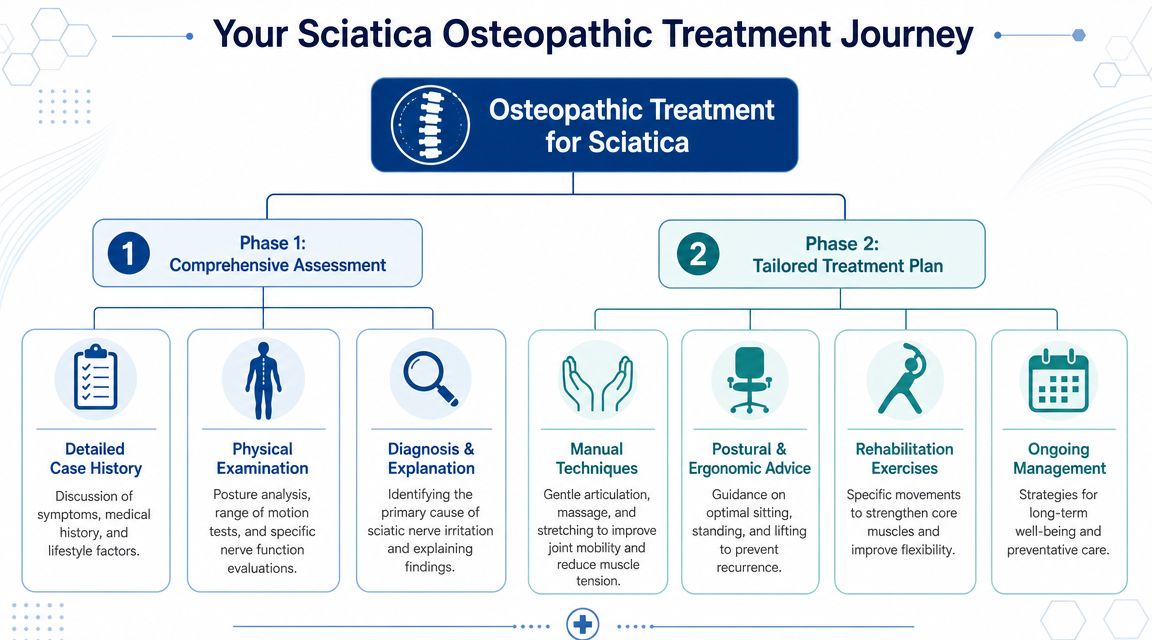
A first appointment for sciatica usually feels more like an investigation than a treatment session. That's a good thing. Nerve pain responds better when the plan matches the pattern.
What happens in the assessment
The consultation usually begins with a detailed case history. The important questions aren't just “Where does it hurt?” but also when it started, whether the pain travels below the knee, what makes it worse, what eases it, and whether there are any warning signs that need medical referral.
Then comes the physical assessment. That often includes observing posture, walking, how you sit and stand, how the spine and hips move, and how the symptoms behave with certain positions. Nerve-related symptoms often have a distinct mechanical pattern. Some movements aggravate them quickly. Others reduce them.
A typical osteopathic assessment may include:
- Movement testing to see which directions are limited or provocative
- Palpation to identify areas of muscle guarding and joint stiffness
- Orthopaedic and neurological screening where appropriate
- Functional questions about work setup, driving, lifting, training, and sleep
The aim is to identify the most likely driver, not to apply every possible technique.
A short visual overview can help make the process clearer:
What treatment usually involves
Hands-on treatment for sciatica is usually gentler than people expect. It may involve soft-tissue work to reduce protective tension, joint articulation or mobilisation to improve movement through the spine, pelvis, or hip, and carefully chosen advice to reduce repeated aggravation between sessions.
Common parts of treatment include:
- Soft-tissue techniques around the lower back, buttock, and hip to settle overactive muscles
- Gentle joint mobilisation where stiffness is contributing to poor movement mechanics
- Position-based relief strategies so you know how to sit, stand, or lie more comfortably
- Rehabilitation advice to restore movement rather than rely on passive treatment alone
Some people are suitable for a more direct manual approach. Others aren't, especially if the area is highly irritable. In those cases, the session may focus more on calming symptoms, modifying activity, and introducing only a small amount of hands-on care initially.
One practical point matters here. Good osteopathy for sciatica should adapt to irritability. If treatment consistently flares symptoms hard and leaves you worse for days, the dose, technique, or even the treatment direction needs review.
Realistic Outcomes and Essential Self-Care Strategies
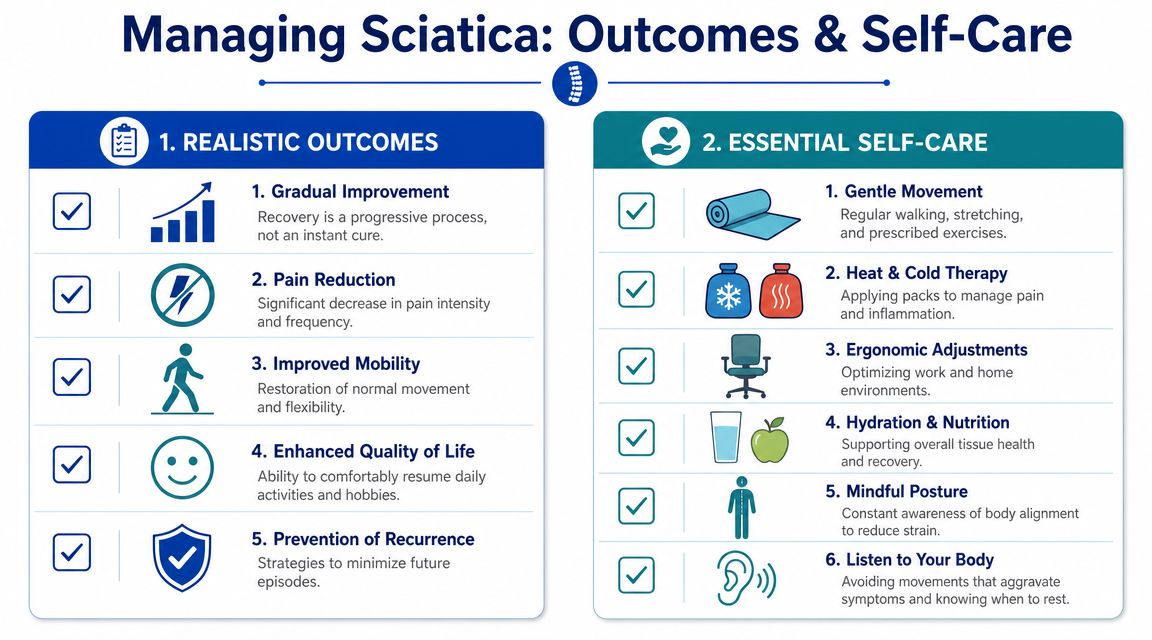
The most useful expectation is this. Recovery usually isn't a straight line, and it rarely feels like a single “fix.” More often, progress shows up as smaller gains that build over time.
What progress usually looks like
Early improvement may mean the pain is less sharp, doesn't travel as far, or settles faster after sitting. You might still feel symptoms, but they become less dominant. That's often a better sign than waiting for complete pain disappearance before you trust the process.
A realistic view of osteopathy for sciatica is that it can help modulate symptoms and improve movement confidence, but it tends to work best alongside active care. That's also the key message in this discussion of manual therapy as an adjunct to graded exercise and self-management. Hands-on care can create a window where movement becomes easier. The exercise and self-management side helps keep that window open.
Relief matters, but the real target is better function with less irritation.
Simple self-care that supports recovery
The best self-care is usually plain and repeatable. Many find calm, regular movement more beneficial than aggressive stretching or complete rest.
A few useful principles:
- Keep walking if tolerated. Short, frequent walks often help more than one long session.
- Change position earlier. Don't wait until the pain is intense before getting up from sitting.
- Use symptom-guided movement. Gentle mobility can help. Forcing through sharp leg pain usually doesn't.
- Treat exercises as dosage, not a test. The right amount leaves you looser or steadier, not significantly flared.
Home strategies often work best when they're matched to your presentation. Some people respond well to extension-based movements. Others need flexion relief, hip mobility work, nerve sliders, or simple load management first. Generic “sciatica stretches” can be hit and miss because not all radiating leg pain behaves the same way.
If you want a starting point for movement at home, these lower back pain relief exercises can support the broader rehab side of care.
A practical self-check table can help:
| Symptom response | What it usually means | Better next step |
|---|---|---|
| Symptoms ease during gentle movement | Load is often tolerable | Repeat in small doses |
| Symptoms spike sharply into the leg | The area may be too irritated | Reduce range, force, or frequency |
| Back feels stiff but leg pain reduces | Often a positive direction | Continue cautiously |
| Pain worsens for hours after exercise | Dose was likely too high | Simplify and reassess |
When You Should Seek Other Medical Care
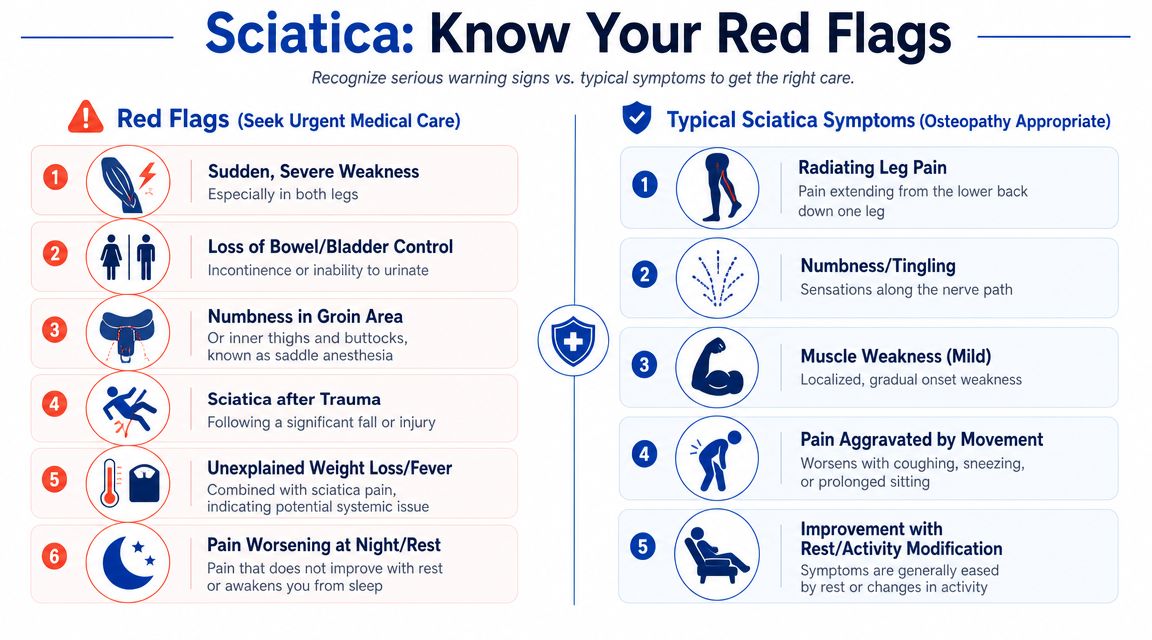
Not every case that feels like sciatica should be managed conservatively. A safe osteopathic approach includes knowing when to stop, refer, or advise urgent medical review.
Red flags that need urgent attention
Some symptoms suggest something more serious than routine nerve irritation. These include progressive motor loss, saddle anaesthesia, and changes to bowel or bladder function, which are highlighted in this summary of red flags that require immediate medical escalation.
Seek urgent medical care if you notice:
- Worsening weakness in the leg or foot, especially if it's progressing
- Numbness in the groin, inner thighs, or buttocks
- Loss of bladder or bowel control, or difficulty starting urination
- Sciatica after major trauma
- Fever, unexplained weight loss, or a known cancer history with new severe symptoms
Why this matters in osteopathic care
Manual therapy is not the right first step when those warning signs are present. Conditions such as cauda equina syndrome need immediate medical assessment, not watchful waiting and not hands-on treatment.
That's why a proper assessment is never just about pain relief. It's also about triage. If you've been advised to consider injections or you're trying to understand where they fit within broader care, this overview of cortisone injection options may help frame that discussion alongside GP or specialist advice.
Good conservative care includes recognising when conservative care isn't enough.
Your First Appointment at Bayside Osteopathic Health
You wake up, swing your legs out of bed, and that familiar line of pain shoots from the low back into the leg. By the time you book an appointment, the usual questions are practical ones. Will the assessment make things worse, and will you leave with a clear plan rather than vague advice?
The first visit is designed to answer those questions properly.
What to bring and expect
Bring any scan reports, referral letters, or test results you already have. A brief timeline also helps. When the pain started, where it travels, what stirs it up, what settles it, and whether you have noticed any numbness or weakness gives a much clearer picture than trying to remember every detail on the spot.
At Bayside Osteopathic Health, the first appointment usually includes:
- A detailed case history covering the pain pattern, daily aggravating factors, work and activity demands, and relevant health history
- A physical assessment of spinal movement, hip and pelvic mechanics, nerve sensitivity, and how your symptoms respond to certain positions or tests
- Clinical screening to confirm whether osteopathic care is appropriate and whether anything needs medical review instead
- A clear explanation of what is most likely driving the symptoms and what the first stage of care should focus on
If hands-on treatment is suitable on the day, it usually starts with low-force techniques matched to your irritability level. That may include soft tissue treatment, gentle joint articulation or mobilisation, and advice on sitting, walking, sleeping positions, and pacing through the day.
Some people need treatment straight away. Others need a quieter first session with more emphasis on assessment, reassurance, and a few simple changes at home. That choice depends on how reactive the nerve is, how much pain you are in, and how your body responds during the examination.
How planning and follow-up work
A good first appointment should leave you knowing what we are treating, what we are watching closely, and what would count as early progress. For some patients, progress means less leg pain. For others, it means they can sit longer, walk more comfortably, or stop flaring up every evening. The target is not always instant pain relief. It is steady change in the right direction.
Treatment planning often covers:
| Part of the plan | What it helps answer |
|---|---|
| Initial treatment approach | What can be done now without stirring symptoms up |
| Home advice | What to do between visits to keep things settling |
| Review timing | When to reassess and whether the response is heading the right way |
| Referral pathway | What happens if symptoms persist, worsen, or do not fit the expected pattern |
That referral pathway matters. If your presentation changes, if pain becomes harder to settle, or if the clinical picture does not match routine sciatica, further medical input may be the right next step. Good care is not about pushing manual treatment longer than it makes sense. It is about choosing the right step at the right time.
Some Australian patients may also be eligible for Medicare support for osteopathy through a Chronic Disease Management plan arranged by their GP. Eligibility depends on your circumstances, so it is sensible to ask your GP or the clinic team if that may apply to you.
Frequently Asked Questions About Osteopathy for Sciatica
Does osteopathic treatment for sciatica hurt
It shouldn't feel aggressive. Some techniques create a temporary sense of stretch, pressure, or mild soreness afterwards, but treatment should be adapted to your irritability level. In acute or sensitive cases, gentler care is often the better option.
How many sessions will I need
There isn't one fixed number that suits everyone. The right plan depends on how long the symptoms have been present, how irritable the nerve is, whether there's weakness, what aggravates it daily, and how well you can tolerate movement and exercise. The useful question isn't “How many sessions?” but “Are we seeing the right direction of change?”
Can osteopathy cure sciatica
Sometimes symptoms settle fully with conservative care. Sometimes osteopathy helps reduce pain, improve movement, and support rehab without being a stand-alone cure. That's especially true when the nerve remains sensitive and daily load still needs to be managed.
Is it the same as chiropractic treatment
There can be overlap in manual techniques, but the consultation style and treatment emphasis may differ. Osteopaths often assess the broader mechanics of the spine, pelvis, hips, soft tissues, and daily movement patterns, then combine hands-on care with advice and rehabilitation.
Should I rest until it goes away
Usually, no. Complete rest often makes people stiffer, more guarded, and less confident to move. Relative rest is different. It means reducing aggravating activities while keeping safe, manageable movement in your day.
What's the biggest mistake people make
Trying to force relief. That can mean over-stretching, sitting too long and then “pushing through”, or assuming every leg pain pattern needs the same exercise. Sciatica usually responds better to measured, well-chosen loading than to extremes.
If sciatic pain is making sitting, walking, working, or sleeping harder than it should be, Bayside Osteopathic Health offers gentle, hands-on osteopathic care with a practical focus on assessment, symptom relief, movement, and knowing when referral is needed. Booking an appointment is a simple way to find out whether conservative care is the right fit for your symptoms.