
You've been at the kitchen table after work, one hand on your lower back, copying a hamstring stretch from your phone. You lean a little further, hold your breath, and the next morning you are stiffer than when you started. If you want to improve flexibility for beginners without stirring up a sore neck, a cranky hip, or an arthritic knee, that pattern has to change.
Stretch tolerance is a skill you monitor, not a depth you chase. A useful stretch is mild tension you could hold while talking. It should not still hurt two hours later, and it should not leave you stiffer the next morning. Those two checks decide whether you repeat the dose, trim it, or stop.
The weeks below suit adults who sit for long stretches, live with back, neck, or joint pain, or are starting again after a break. You train slow movement and comfortable holds inside an ordinary week of walking and light strength.
Table of Contents
- A Weekly Schedule That Builds Flexibility Gradually
- Signals to Ease Off, Keep Going or Stop
- Warm-Up and Stretch Steps for Your First Session
- Modifications for Arthritis, Back Pain and Older Beginners
- Breathing Recovery and Progressing One Change at a Time
- When to See an Osteopath Instead of Pushing On
A Weekly Schedule That Builds Flexibility Gradually
Start this week with three short sessions, not one long session on Sunday. Each session pairs slow joint movements with short holds, and it trains two different skills. Mobility is controlled movement through the range a joint already has, and you build it with slow repetitions. Flexibility is the ability to settle into a comfortable end position and stay there, and you build it with static holds. Beginners need both, and neither improves if you only chase a longer hold.
That work belongs inside a normal activity week, not instead of one. The Australian Institute of Health and Welfare reports that in 2022, 37% of Australian adults aged 18-64 did not meet the physical-activity component of national guidelines, and 73% did not complete sufficient muscle-strengthening activity. The guidelines ask adults to accumulate 150-300 minutes of moderate activity, or 75-150 minutes of vigorous activity, each week, plus muscle-strengthening on at least 2 days. A walk, two strength movements, and the holds below fit that frame. A single floor session does not.
Four stages you can follow
| Stage | Frequency | Hold per stretch | Reps per side | Effort level |
|---|---|---|---|---|
| Weeks 1-2 | 3 days a week | 20 seconds | 2 | Mild tension |
| Weeks 3-4 | 4 days a week | 20-30 seconds | 3 | Mild tension |
| Weeks 5-8 | 4-5 days a week | 30 seconds | 3-4 | Mild tension |
| Week 9 onward | 5 days a week | 30 seconds | 4 | Mild tension, never pain |
Every row stays at mild tension. If you have to grit your teeth, you have left the stage, even if the clock says you are due to move on.
I would stay on a row until two things are true. You finish every repetition with your breathing unchanged, and by the end of the week one everyday task, such as tying a shoe or reaching a shelf, feels slightly easier. If either fails, repeat the row. A written home exercise programme makes the days visible, so you don't add a fifth session because the calendar looks empty.
Practical rule: Move to the next stage only when yesterday's session still feels repeatable this morning.
Signals to Ease Off, Keep Going or Stop
This plan is for joints that are calm enough to move. Arrange a clinical check, and don't start on your own, if any of these are true.
- A hot joint: The joint is red, hot, or swollen.
- Night pain: Pain wakes you from sleep.
- Nerve-type symptoms: Pain travels down a limb, or you notice numbness or tingling.
- A recent event: You've had an injury or surgery and haven't been cleared for free movement.
- Walking has changed: You can't walk with your usual pattern.
If none of those apply, judge every session with a time limit. Arthritis Australia advises a gentle warm-up, tells you to avoid a joint that is red, hot, swollen or unusually painful, and says to reduce the workload when additional pain lasts longer than two hours. That two-hour line sorts sensation into three zones. Normal tension eases within about a minute of the hold. Discomfort that fades inside two hours means the dose was a notch high. Pain still present after two hours means the workload was too much.
Match the signal to the next action
| Signal | What it usually means | What to do |
|---|---|---|
| Mild stretch tension that eases within a minute | Normal tissue response | Hold the same range and continue |
| Discomfort that lasts up to two hours after a session | Dose is slightly high | Reduce reps for a few days |
| Pain lasting longer than two hours | Workload too high | Reduce range and repetitions, then rebuild |
| Joint that is red, hot or swollen | Possible inflammation | Skip that joint and seek clinical advice |
| Sharp or radiating pain, numbness or tingling | Possible nerve irritation | Stop and arrange clinical assessment |
| Stiffness worse the next morning | Session too demanding | Halve reps for three days |
Before you begin, ask one question. Would I be comfortable doing this again tomorrow? If the honest answer is no, halve the session before you start.
A stiffer morning than your usual baseline means yesterday asked too much. Halve the repetitions for three days, keep the same range, then add one repetition back only when the morning feels like your normal. Don't "make up" the missed reps on day four.
Flare-ups need a pause, not a deeper angle. Stop the stretching programme, keep small joint movements that don't provoke the joint, and return at the previous stage once the joint has settled. Stretching into a flare is how a manageable week turns into a lost fortnight.
Warm-Up and Stretch Steps for Your First Session
Short sessions stick because they fit a real day. The Australian Institute of Health and Welfare's risk-factor reporting found that in 2014-15, 75% of Australians aged 65 and over were insufficiently active, meaning they did not complete at least 30 minutes of moderate-to-vigorous activity on 5 or more days each week. Later figures show the same gap in another form. In 2017-18, 73% of Australians aged 65 and over had done some exercise in the previous week, yet 82% still did not meet the physical-activity guideline. A few minutes, repeated, beats a heroic session you abandon.
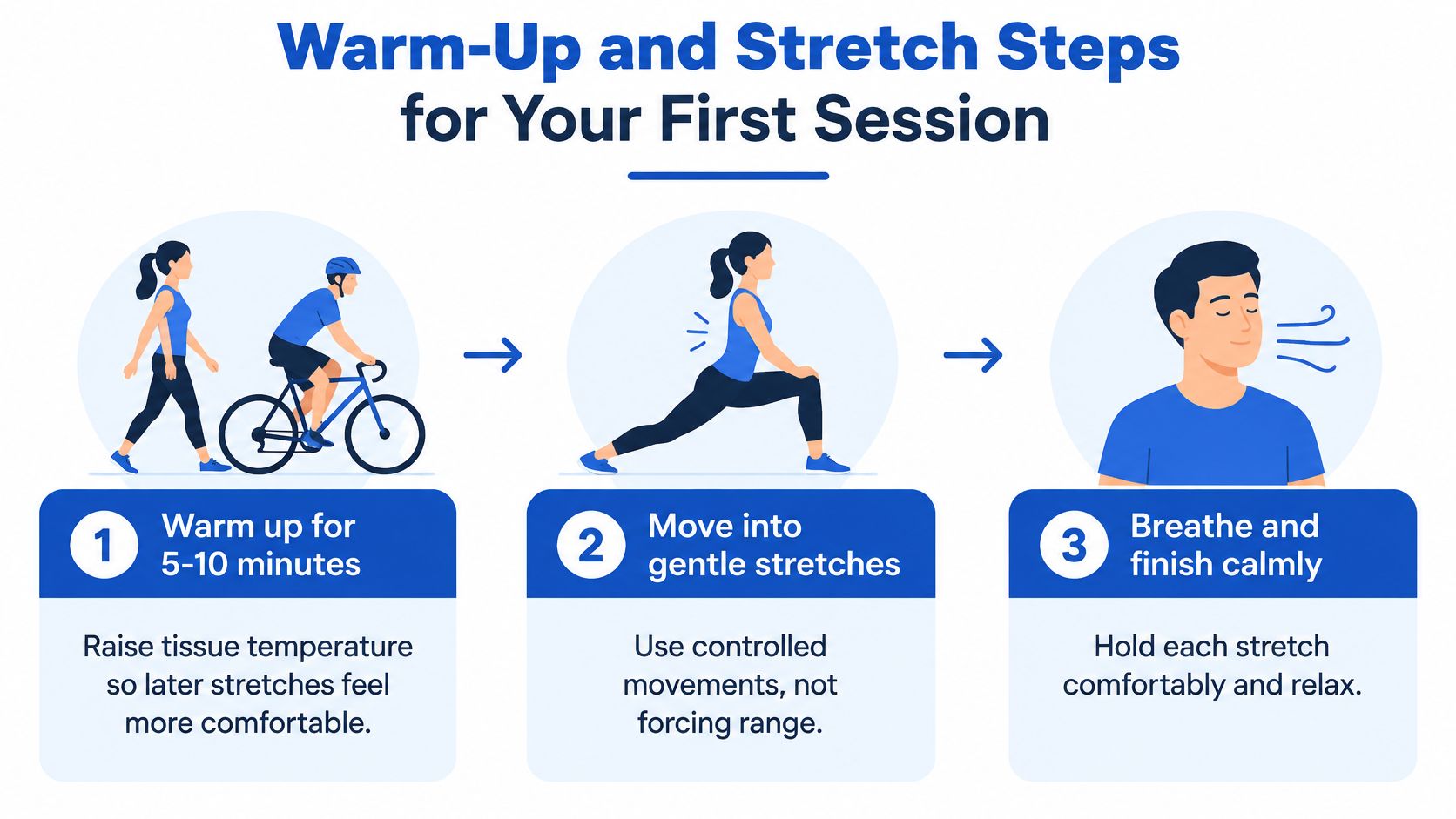
Six steps for week one
- Warm the tissues for 5-10 minutes. Easy walking or slow cycling on a stationary bike raises temperature so the later holds feel less abrupt. The usual slip is stretching cold muscles straight out of a chair, which makes mild tension feel like a strain.
- Add 5-8 dynamic repetitions. Leg swings holding a bench, arm circles, and a slow trunk turn stay inside a comfortable range. Keep the motion smooth. Bouncing at the end of the swing is the mistake that turns a warm-up into an irritation.
- Pick two or three tight areas only. Hamstrings, hip flexors, calves, chest, and upper back cover most beginners. Trying to stretch the whole body in week one is how sessions blow out and form drops.
- Enter until you feel mild tension, then hold about 20-30 seconds. Breathe in a steady rhythm and don't chase a deeper angle mid-hold. Holding your breath is the tell that the position is too far.
- Repeat each side two to four times. Start at two. The fourth repetition is for a side that still feels easy, not for a side that already complained.
- Close with 60 seconds of slow breathing and write one baseline. Comfortable squat depth, how far a hand reaches up the back, or walking stride length. Measure the same way again after four to six weeks. Guessing from memory is how people decide they've failed when they've gained a few centimetres of easy reach.
A good first session has no sharp pain and no bouncing. You should stand up feeling loosely warm, not "worked". If one area niggles, drop it next time and keep the others.
The baseline is a function, not a party trick. Easier stairs beat a lower hand on a toe touch.
Modifications for Arthritis, Back Pain and Older Beginners
Floor work is optional. A chair, a wall, and a kitchen bench cover the same regions when kneeling or lying down is unrealistic. Healthdirect's guidance for older adults says to start gradually, that even a few minutes help at first, and that gentle stretching or bending comes after light activity, with holds generally of 10-30 seconds and no bouncing. The options below stay inside that dose.
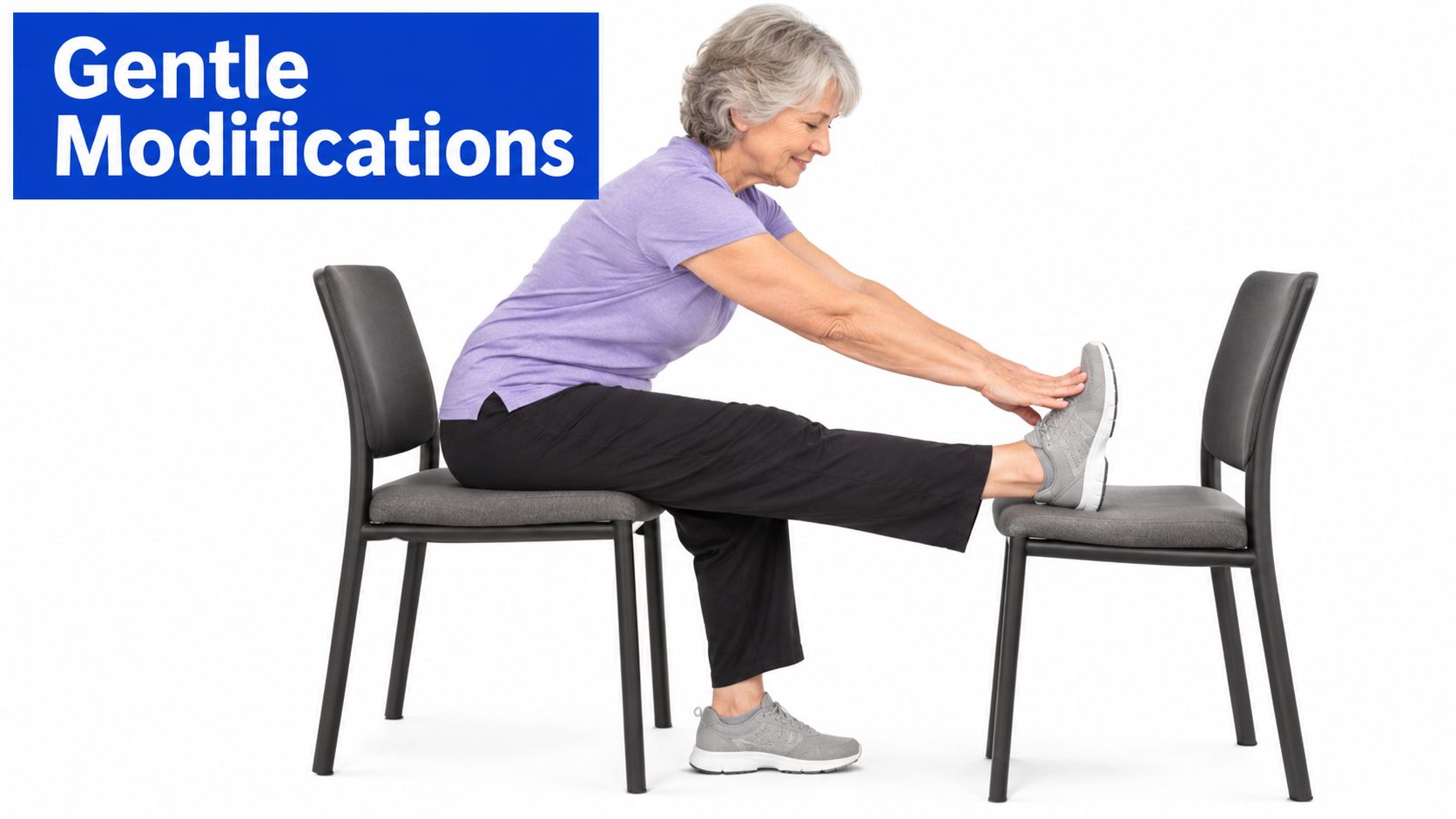
A seated hamstring stretch is the clearest floor-free substitute, with one leg supported and the other foot flat.
Match the setup to the limitation
Arthritis in knees, hands, or wrists responds better to slow range of motion after a warm-up than to a long end-range hold. Open and close the hands, bend and straighten the knees through a smaller arc, and stop short of the angle that bites. If a joint is red, hot, or swollen, leave it out.
If you can't get on the floor, use a seated hamstring with the heel on a second chair, a calf stretch with hands on the wall, a chest opener in a doorway, and a seated trunk turn. The wall or bench is there so you don't sway. Stop if you must hold your breath to stay upright.
Desk stiffness is usually hip flexors and chest, built by hours of sitting, not by one missing yoga class. A short hip-flexor kneel beside the bench and a doorway chest opener, repeated as a brief reset each hour, beat one long evening session. Sharp pain or tingling ends the reset immediately.
Older beginners and anyone unsteady should start seated or at the bench. Five minutes of comfortable joint movement, then two or three patterns such as sit-to-stand, supported heel raises, a reach, and a trunk turn, then slow holds around 20 seconds. The test isn't how far you fold. It's whether reaching a shelf, turning to check traffic, and rising from a chair without your hands feel easier. Our mobility guidance for older adults sets those daily tasks as the point of the work.
Back pain gets gentle movement only, with no forced end range, judged by whether extra pain is gone within two hours. Radiating pain, numbness, or night pain means stop and get assessed.
The short video shows a calm pace for supported movement. Use it as a timing reference, not as a target range.
Substitutions by beginner situation
| Situation | What to practise | Dose | Stop when |
|---|---|---|---|
| Arthritis in knees, hands or wrists | Slow range of motion after a warm-up, using a smaller range | About 20 seconds, fewer reps than the week-1 row | Joint is red, hot or swollen, or extra pain lasts over two hours |
| Cannot get on the floor | Seated hamstring with the leg on a chair, wall calf stretch, doorway chest opener, seated trunk rotation | 20 seconds, 2 reps per side | You must hold your breath or cannot stay steady |
| Desk posture stiffness | Hip-flexor and chest openers plus a short hourly reset | Brief holds through the day instead of one long session | Sharp pain or tingling |
| Older beginner or poor balance | 5 minutes of seated or bench-supported joint movement, then 2-3 patterns: sit-to-stand, supported heel raises, reaching, trunk rotation, then slow stretches | Holds around 20 seconds, no bouncing | You wobble, hold your breath, or feel pain |
| Back pain | Gentle movement only, no forced end range, judged with the two-hour rule | Start below the week-1 row | Pain radiates, numbness, or night pain |
Flexibility on its own isn't the aim. Success is easier dressing, easier stairs, and a walking stride that doesn't shorten by the afternoon.
Breathing Recovery and Progressing One Change at a Time
The stage table only works if you change one thing at a time and let the week settle.
- Hold the current days and ranges for two weeks. Then add one day. Then add one repetition. Only after that, lengthen the hold toward 30 seconds. Two changes in one week make it impossible to know which one irritated you.
- Keep your walking and your strength days. Stretching doesn't stand in for moderate or vigorous activity across the week, or for muscle-strengthening on at least two days. Weave the holds around those, after a walk or at the end of the strength session.
- Leave space between efforts. In weeks 1-2, put at least one day between flexibility days. Leave at least 48 hours between unfamiliar higher-load strength sessions so the new stimulus isn't stacked on sore tissue.
- Breathe four counts in and six counts out during each hold. Let the position settle on the out-breath. Don't use the exhale as an excuse to sink into a deeper angle.
- Warm the joints before, and don't sit straight down after. A warm shower or a heat pack, then the easy 5-10 minute walk, is enough when you feel creaky beforehand. Afterward, take a short walk around the house rather than dropping into the couch, which lets tissues cool in a slumped position.
- Treat a short night as a reason to repeat the same stage. Tightness after poor sleep is often unfinished recovery. Progress when you could repeat yesterday without dread, and when stairs, dressing, and walking feel no harder than they did last week.
Repeat a stage you already own. Adding range on a tired day is how people lose a fortnight.
If joints feel fine but motivation is the problem, shrink the session to the warm-up plus one hold per side. A smaller session you finish still counts. A perfect session you skip doesn't.
When to See an Osteopath Instead of Pushing On
Keep going on your own when discomfort stays mild, symptoms settle within the day, and your baseline, squat, reach, or stride, is easier at four weeks. Book a clinician when pain lasts beyond two hours after sessions across several days, when pain stops normal movement, when symptoms travel into a limb, or when stiffness has built since you started. Waiting for it to "stretch out" in those cases usually lengthens the problem.
The first visit is an assessment, not a test of how far you can bend. The initial assessment includes a detailed case history and a physical assessment of posture, movement, and the specific area of concern. You leave with a realistic recovery timeline from that first assessment, based on how long the problem has been there and what your week demands.
What the first visit covers
Treatment starts in that same session. Every technique is explained, work stays inside your comfort level, and you go home with a personal plan and home-care exercises you can do between visits. We adjust the hands-on work from your feedback during the appointment, so a tender hip doesn't get the same pressure as a stiff mid-back.
Booking is straightforward. Call, email, or use the contact form, and briefly describe your condition so we can match you with a practitioner and set aside time for the first session. If you are unsure whether self-guided work is still appropriate, our guide on when to see an osteopath sets out the situations where an assessment is the safer next step.
Bring your stage notes if you have them. Which holds you used, what the two-hour check showed, and how the next morning felt. That record is more useful than trying to remember a month of good and bad days in the waiting room.
Bayside Osteopathic Health offers gentle, hands-on osteopathic care for back, neck, and joint stiffness, with movement advice you can use between visits. If your beginner flexibility plan keeps stalling on pain, swelling, or a range that will not settle, an assessment can set a dose that matches your joints. Visit Bayside Osteopathic Health to book a first session and describe what has been limiting you.