
Joint mobilisation is a hands-on technique in which a practitioner moves a joint passively, slowly and repeatedly through part of its range to ease pain and stiffness. Nothing is thrust, nothing is forced, and you don't have to do anything except stay relaxed while the clinician controls the movement.
Which raises the question most explanations skip. If the movement is so gentle, why does the same technique settle one person's shoulder and leave another sore for two days? The movement isn't the active ingredient by itself. The dose is: how far into the range it's taken, how fast it's applied, how many repetitions are used, and which direction the joint surface is glided. Two practitioners can put their hands on the same knee and deliver completely different treatments.
Mobilisation suits joints that are stiff, guarded, or painful at a specific point in their range. It doesn't suit a hot swollen joint, a suspected fracture, or pain that's escalating without explanation, and any therapist who skips that distinction is leaving out the part that matters most.
Table of Contents
- Joint Mobilisation Defined in Plain Terms
- How Practitioners Grade Movement Dose
- What Happens in a Joint Mobilisation Session
- Realistic Results and How Long They Last
- Cost, Access and Choosing a Practitioner
- Screening, Warning Signs and Next Steps
Joint Mobilisation Defined in Plain Terms
A joint does two jobs at once. It hinges, and its surfaces slide across each other by a few millimetres while it hinges. That second job, known as accessory movement, is often the first thing to shut down after an injury, a flare of arthritis, or a few weeks of protective guarding, and it's why a knee can feel locked even when the muscles around it are soft to touch.
Australian clinical guidance defines joint mobilisation as a manual-therapy technique built on repetitive, passive, low-velocity movements applied at varying amplitudes and at different points through a joint's range of motion, as set out in the RACGP guideline for knee and hip osteoarthritis. Nothing about it is quick. Think of easing a stuck drawer along its runners rather than yanking it open: the runner is the joint surface, and the job is to remind it which direction it travels.
The hands are usually placed to control one joint surface against the other, not to push the limb through range, and the position of the therapist's hands tells you very little about what's happening inside the joint.
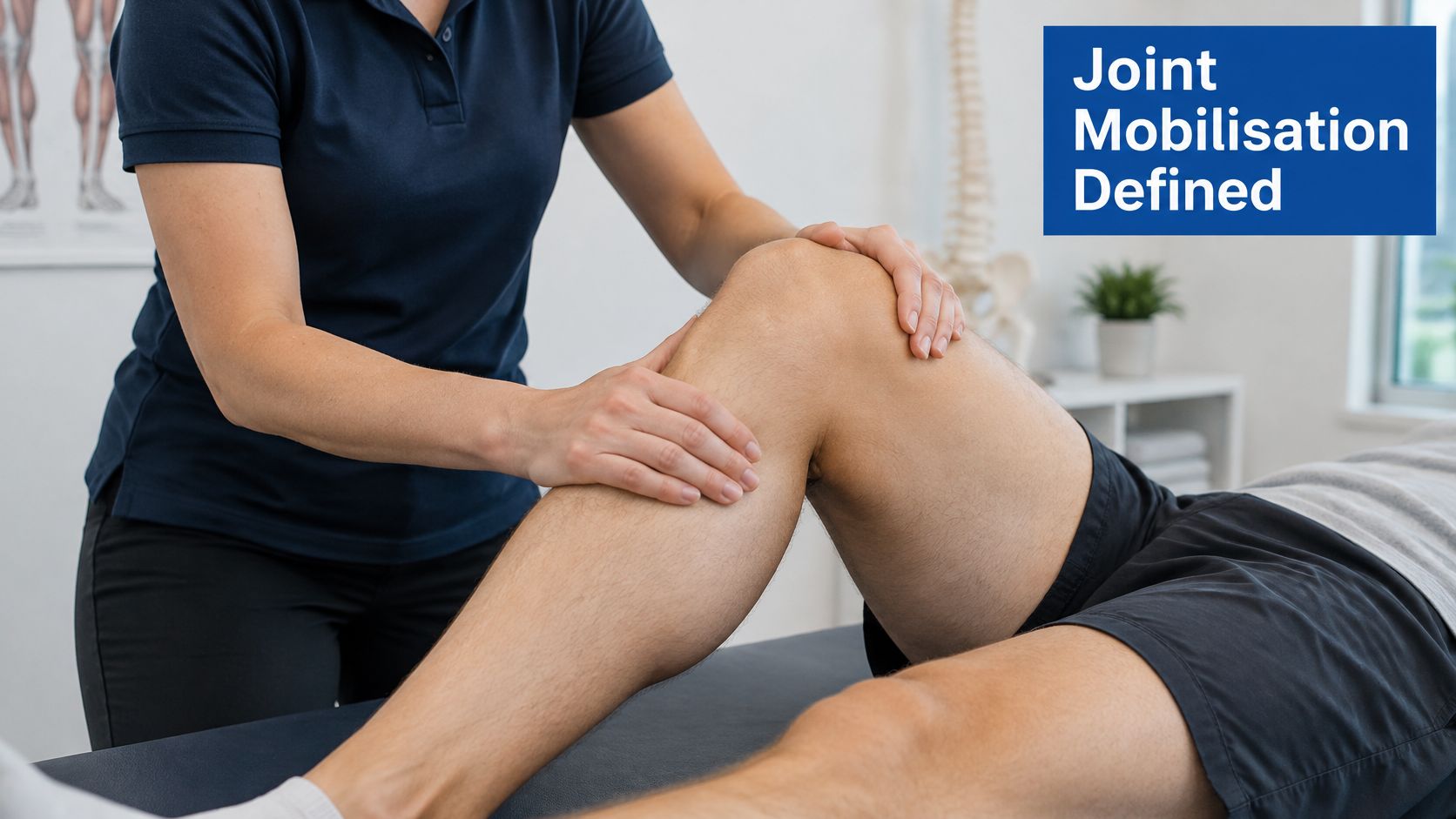
The contrast that matters is with manipulation. Where mobilisation is graded and repeated, manipulation is a single forceful, small-amplitude, high-velocity movement, usually delivered near the end of range.
| Feature | Joint mobilisation | Manipulation |
|---|---|---|
| Movement speed | Low velocity, controlled | High velocity thrust |
| Amplitude | Small to large, graded | Small amplitude |
| Position in range | Anywhere through the available range | Usually near end of range |
| Movement pattern | Repeated oscillations or sustained glides | Single forceful thrust |
The Australian guideline is candid about the limits. For some people with knee or hip osteoarthritis, a short course of manual therapy is permitted, but only as an adjunct to active management such as exercise, never as a replacement for it. The supporting evidence is rated low to very low quality, any benefit is expected mainly in the short term, and clinicians are asked to weigh cost and access. If you've ever wondered whether you were receiving mobilisation or the sharper thrust of manipulation, the practical difference comes down to speed and intent, and we break it down further in our guide to mobilisation versus manipulation.
Here's a test you can apply to anything you're offered. If the technique is passive, slow and repeated, it's mobilisation. If it's one quick movement with a pop, it's manipulation.
How Practitioners Grade Movement Dose
Practitioners don't have one technique. They have a dial, and the dial is what makes mobilisation useful across wildly different presentations. Australian physiotherapist Geoffrey Maitland formalised this in the 1960s, when he set out four mobilisation grades and one manipulation grade and drew a clear line between physiological movement and accessory movement.
| Grade | Amplitude and position | Typical use |
|---|---|---|
| Grade I | Small oscillations at the start of range | Pain-dominant, highly irritable joints |
| Grade II | Large oscillations within the available range | Pain with protective muscle guarding |
| Grade III | Large oscillations up to the limit of range | Stiffness with reduced range |
| Grade IV | Small oscillations at the end of range | Stiffness with end-range restriction |
| Grade V | Small-amplitude high-velocity thrust (manipulation) | Fixed restriction, and only when assessment supports it |
Read the table again and notice what's missing: force. A grade IV isn't "harder" than a grade II in any meaningful sense, it's placed differently and used for a different clinical picture. The same shoulder might get grade II on a bad week and grade IV three weeks later, once the guarding has settled and the assessment shows end-range loading is appropriate.
What decides the dose on the day
Irritability comes first. How long does it take for the joint to settle after activity, and how much activity does it take to flare? A joint that's still sore from yesterday's walk gets a small, gentle oscillation at the start of range, not a stretch into the stiff end. Direction comes second, because a joint can be restricted in one glide and perfectly free in another, and moving the wrong way feels immediately wrong to the patient. Response comes third, and it overrules both.
Practical rule: If the joint is angrier the next morning, the grade was too high or the direction was wrong. That's information about the dose, not a failure of the treatment.
The evidence is honest about all this. A PEDro-indexed systematic review of mobilisation for patellofemoral pain screened 361 articles and selected 12 randomised trials involving 499 participants for detailed review. Pain and function improved within treatment groups, and the strongest short-term between-group findings came when mobilisation was directed at the knee complex and combined with other interventions. The review still concluded that the independent effect of mobilisation remained uncertain, because the trials differed too much in method to compare cleanly. Start gentle, increase only when the joint tolerates it, and step back when pain rises.
What Happens in a Joint Mobilisation Session
What should you expect when a practitioner moves a joint for you? A session follows a clear sequence: the practitioner assesses the problem, explains the approach, applies a carefully chosen movement dose, then checks how you respond. The hands-on part may take only a few minutes, while the assessment and reassessment take longer.
Joint mobilisation is a clinician-guided movement of a joint through part of its available range. The practitioner may use repeated oscillations or a sustained, slow glide, as healthdirect's overview of physiotherapy describes. At Bayside Osteopathic Health, an initial assessment includes a detailed case history and a physical assessment of posture, movement, and the area of concern before treatment is selected.
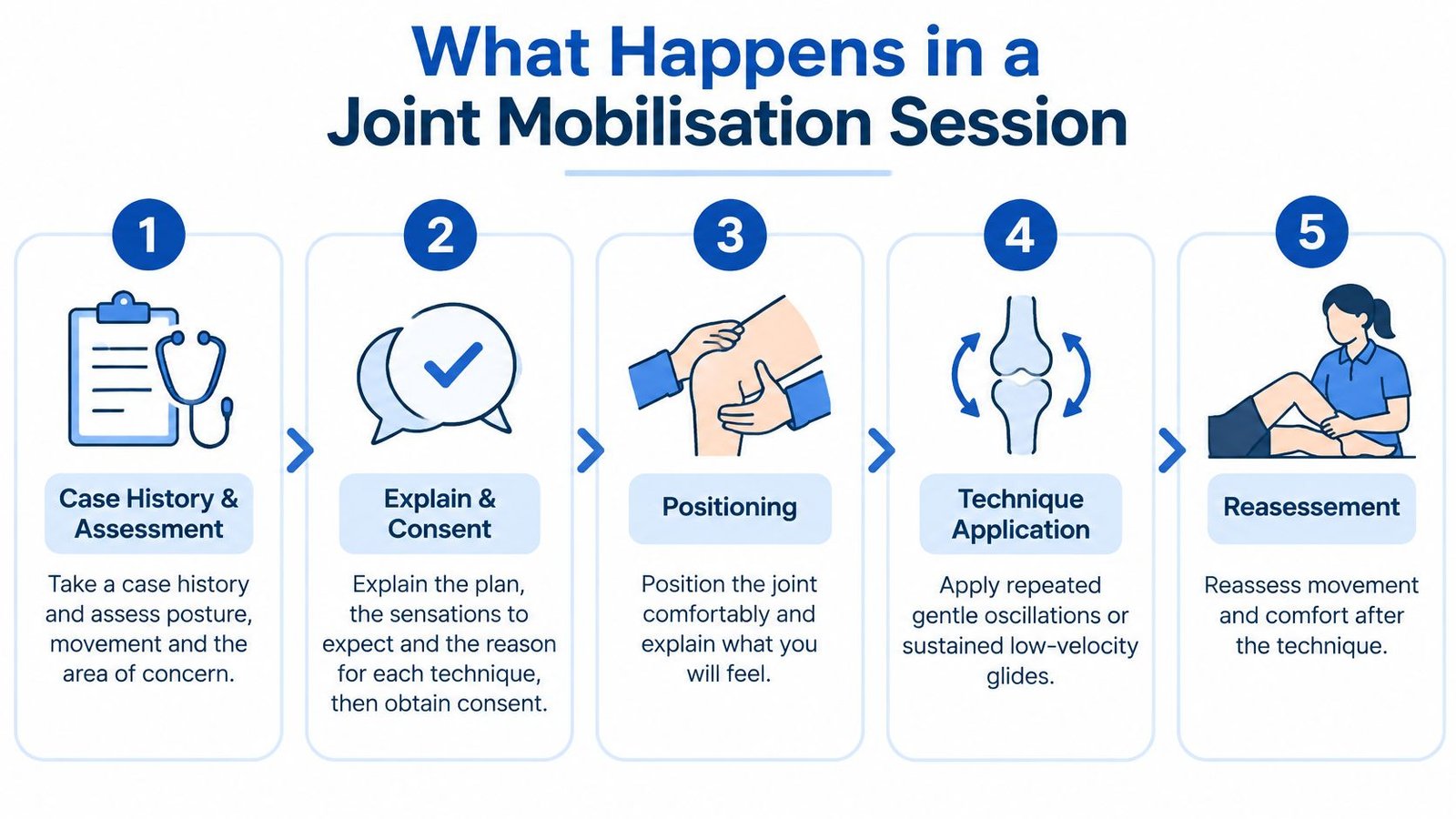
- Case history and assessment. You describe what hurts, when it hurts, and what has changed. The practitioner observes your movement, checks posture, and assesses the specific area. This helps distinguish the painful spot from a joint restriction that may be contributing to it.
- Explanation and consent. The practitioner explains what they plan to do, why they chose it, and what it should feel like. Clear communication can help you relax, while unexplained contact on a sore joint may make you tense.
- Positioning. The joint is placed in a relaxed position so the practitioner can control its movement. If your muscles have to hold the joint up, it is harder to guide the movement precisely.
- Choosing the grade. The movement dose depends on the joint's irritability and your symptoms that day, rather than a fixed protocol. A dose that felt comfortable during a better week may irritate the joint during a flare.
- Applying the movement. The practitioner uses slow, repeated oscillations or a sustained glide, paying attention to your response and the joint's movement. The same direction and force can settle one joint but aggravate another, so your comfort helps guide the dose.
- Reassessing immediately. You repeat a relevant movement, such as bending forward, walking, or lifting your arm. A change on the treatment table matters most if it also helps with a movement you need to do.
- Home advice. You may be given exercises and guidance on what to do if symptoms flare. A few practical steps are easier to follow than a long list.
What a session actually feels like
You may feel mild pressure, a stretch, or a dull ache. It should settle within minutes. The movement is often repetitive, and you may hear no sound at all. A crack is not required for mobilisation to be useful.
For low back pain, the Australian Commission on Safety and Quality in Health Care's low back pain clinical care standard quick guide frames manual therapy, including joint mobilisation, as time-limited. It is used for short-term symptom relief while self-management and active care take over.
A useful immediate response is less pain or easier movement, without a delayed flare the next day. Persistent neurological symptoms, unexplained severe pain, trauma, fever, or progressive loss of function call for medical assessment rather than another round of mobilisation.
Realistic Results and How Long They Last
What should joint mobilisation change, and what should it not? It cannot reverse cartilage damage or push cartilage back into place. A joint's movement may feel easier when pain and protective muscle guarding settle, giving you more room to practise active tasks such as walking, reaching or exercising. That change is not proof that the joint has been structurally repaired.
The need for practical options is widespread. Approximately 2.1 million Australians were estimated to have osteoarthritis in 2022, representing 8.3% of the population, according to AIHW musculoskeletal data. A better week can feel encouraging, but it does not mean the joint has been “put back”. The aim is to use any easing to support movement and daily activity.
| Presentation | Current guidance | What to expect |
|---|---|---|
| Knee or hip osteoarthritis | Short course alongside exercise, not instead of it | Possible short-term easing only |
| Low back pain | Time-limited, inside a broader care package | Short-term relief while self-management builds |
| Patellofemoral pain | Used with other interventions | Gains within treatment groups, independent effect still uncertain |
| Shoulder stiffness | Studied alongside advice and exercise | Pain, function and active range of motion are assessed over several months |
The dose matters as much as the movement itself. A gentle glide may settle one joint and irritate another. The practitioner should adjust the pressure, direction and amount of movement to your response, rather than assuming that more force will produce a better result. What to expect after osteopathic treatment explains the practical responses you might notice after a visit.
How progress is actually judged
The low back pain clinical care standard quick guide for physiotherapists places joint mobilisation within care that includes advice, exercise and review. It describes hands-on treatment as an adjunct for short-term relief. Studies of shoulder mobilisation alongside advice and exercise commonly assess pain, function and active range of motion over several months. These outcomes help show whether a change matters beyond the treatment table.
The useful question is whether you can reach the top shelf, sit through a meeting, or walk to the shops with less difficulty.
After a course of treatment, consider whether pain has eased, movement feels freer and those changes carry into exercise and daily tasks. A temporary improvement can create an opportunity to build strength and manage activity. The movement dose should be reviewed against that real-world response: if symptoms flare or daily function does not improve, the approach may need adjusting. Lasting progress depends on what you are able to do between visits, not just on how far the joint moved during treatment.
Cost, Access and Choosing a Practitioner
Hands-on treatment costs time and money, and Australian guidance asks clinicians to weigh both when recommending a short course of manual therapy. That's not a reason to avoid it. It is a reason to be deliberate about who you see and what you expect from the first three visits.
Start with regulation. Physiotherapy and osteopathy are regulated professions in Australia, which means your practitioner holds registration you can check independently, and you can read more about what that training involves in our guide to osteopath qualifications in Australia. Ask directly whether they have training in graded mobilisation, and whether they'll tell you which grade they're using and why. A practitioner who can't answer that is either working from habit or hoping you won't ask.
Fees vary by clinic, by session length and by whether a GP care plan, private health cover or a referral-based rebate applies. Ask the clinic for its fee schedule and ask your insurer what your extras cover includes before you book, because nobody at the front desk can guess your policy.
Questions worth asking before you book
- How long is the first appointment? An assessment with a case history, a movement exam and treatment needs a proper slot, not ten minutes squeezed between two other patients.
- How many sessions before we reassess? You want a number and a review point, not an open-ended course.
- What will you measure? Range, a functional task, or a pain score at a set time of day. Any of those works. "How you feel overall" doesn't.
- What do I do between visits? There should be an answer, and it should be short enough to do.
Our treatment plans are shaped by the diagnosis, the movement assessment, lifestyle demands and recovery goals, which is why two people with the same diagnosis can end up with very different session counts.
The signal that a plan is working isn't a good hour on the table. It's fewer limits across a week: driving further before the ache starts, standing through a full meeting, sleeping without waking to shift position. If those numbers aren't moving after a short course, the plan needs changing, not extending.
Screening, Warning Signs and Next Steps
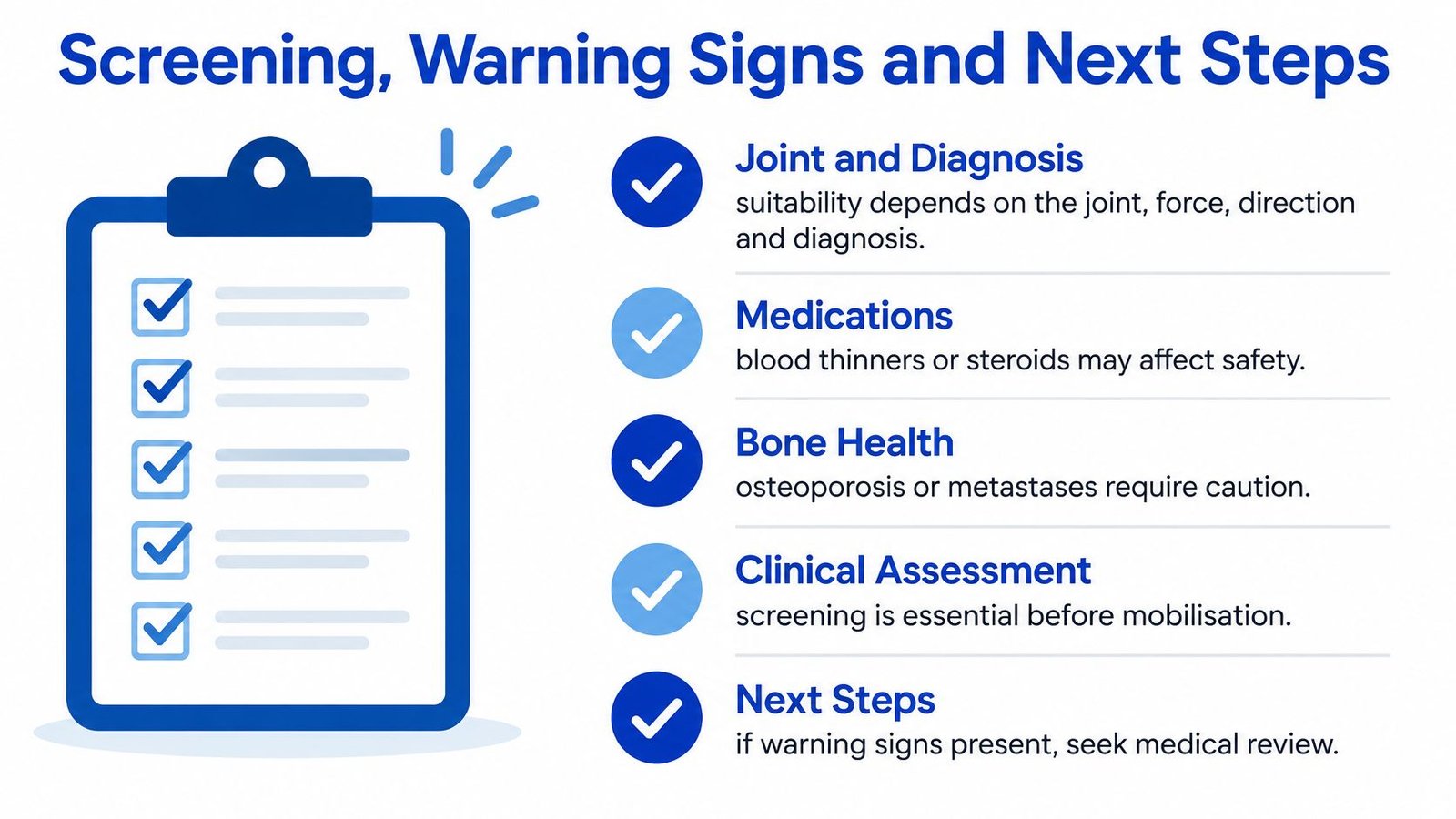
Gentle doesn't mean universally safe. Suitability depends on the joint, the force, the direction, the diagnosis, your medications, your bone health and a proper clinical assessment, and no amount of slow, careful hand placement substitutes for that screen.
This matters in Australia because musculoskeletal problems rarely arrive alone. AIHW analysis reports that 79% of Australians with arthritis and 65% of those with back pain or back problems had at least one other chronic condition, and that 69% of people aged 75 and over live with a musculoskeletal condition, compared with 23% of adults aged 25 to 44, according to the AIHW musculoskeletal conditions summary. Older patients managing three or four conditions need clear triage, not a generic promise of safe mobility.
What to raise before your first session
Say it out loud, even if it feels unrelated to your knee or your neck. Osteoporosis and any known fracture risk change how much load is sensible. Inflammatory arthritis in an active flare behaves differently from mechanical stiffness. Recent surgery needs the surgeon's protocol respected. Neurological symptoms such as numbness, pins and needles, or weakness need assessment before anything is mobilised. Unexplained swelling, fever or infection anywhere near the joint means a medical review first. A history of cancer and any blood-thinning medication belong on the list too.
| Sensation or sign | Usually expected | Get medical review |
|---|---|---|
| Pain during treatment | Mild pressure or stretch | Sharp or escalating pain |
| Soreness afterwards | Mild, settles soon after | Persists or grows |
| Numbness or weakness | None | New or spreading |
| Swelling | None | Unusual or warm swelling |
| Dizziness | None | Any dizziness or visual disturbance |
| Neurological symptoms | None | Persistent or progressive |
A warning sign means a medical review, not another appointment to repeat the same technique. The RACGP guideline reports a very low risk of harm for manual therapy in knee and hip osteoarthritis, and it still recommends using it only as an adjunct to active care, with the evidence quality labelled very low. Low risk is not no risk, and the screen is what separates the two.
When mobilisation is worth discussing
Three conditions, all practical. Your pain or stiffness limits a movement you need. No warning signs are present. And you're willing to pair treatment with exercise and self-management rather than relying on the table alone. Miss the third, and the first two rarely deliver much.
Every visit should include three pieces of information back to you: the grade used, the reason for it, and how your response will be measured next time. Patients get movement education, strengthening exercises and self-care knowledge precisely so that progress continues after the appointment ends.
Then the next step is small and specific. Book an assessment and bring your full medical history and every medication you take, including anything over the counter. If you have arthritis, recent surgery or several chronic conditions, ask your GP for input before you start. And this week, before you see anyone, write down the three movements or activities your joint is currently limiting. That list is the only outcome measure that matters.
Joint stiffness that shapes your week deserves a proper look rather than a guess, and Bayside Osteopathic Health provides hands-on osteopathic care that includes gentle joint mobilisation, soft-tissue work and movement advice built around a full assessment of how you move. We plan treatment around your diagnosis, daily demands and recovery goals, and we send you home with exercises and self-care you can keep using between visits. Book an assessment at Bayside Osteopathic Health and bring that list of movements you want back.