
If you're reading this, there's a good chance you've already tried the usual first steps. You've rested the sore heel, stretched the calf, changed shoes, rubbed the shoulder, maybe even stopped the activity you enjoy for longer than you wanted. But the pain is still there each morning, or it flares every time you return to walking, running, lifting, or reaching overhead.
That pattern is common with long-standing tendon and fascia problems. By the time people start searching for shock wave therapy Melbourne, they usually aren't looking for a miracle. They want a treatment that makes sense, feels manageable, and gives them a realistic path forward when standard care hasn't shifted the problem.
For many people in Melbourne, shock wave therapy can be that next step. It's a non-surgical treatment that uses acoustic pressure waves to stimulate tissue that has stalled in a chronic pain cycle. It isn't right for every diagnosis, and it isn't a stand-alone fix, but it can be a very useful tool when it's matched to the right condition and combined with a proper rehabilitation plan. If you're also comparing treatment styles, our guide to understanding osteopathy and whole-body care helps explain how this fits into broader musculoskeletal treatment.
Table of Contents
- A Modern Solution for Stubborn Pain
- Understanding Shock Wave Therapy
- The Science Behind the Healing Process
- Conditions Treated and Its Effectiveness
- Your Treatment Journey What to Expect Step-by-Step
- Costs and Choosing a Clinic in Melbourne
- Your Questions Answered and Next Steps
A Modern Solution for Stubborn Pain
You wake up in Hampton or Sandringham, put your foot on the floor, and feel that sharp pull in the heel again. Or you reach for a seatbelt and the shoulder catches in the same spot it has for months. By the time pain has started dictating simple movements, patients are usually not looking for a trend. They want a treatment that fits real life, has a clear purpose, and does not leave them sidelined.
Shock wave therapy has earned a place in musculoskeletal practice for that reason. It is a modern option for persistent tendon and fascia pain, especially when rest, stretching, or massage have not changed much. It first came into medicine through treatment for kidney stones and was later adapted for musculoskeletal conditions. That long clinical history matters. It gives Melbourne patients a treatment that is well known in practice, not a new device being used without a clear rationale.

In clinic, the appeal is practical. Sessions are brief. No incision is involved. Patients can often walk out and get on with the day, with a few sensible modifications. For Bayside residents balancing commuting, school drop-off, desk work, and weekend sport, that low-disruption profile is often part of the decision.
Used well, shock wave therapy is not a shortcut. It is a tool.
The patients who tend to get the most from it are the ones with a clear diagnosis and a plan around the treatment. Heel pain can come from plantar fasciopathy, fat pad irritation, nerve irritation, or referred pain. Shoulder pain can involve the rotator cuff, bursa, joint, or neck. If the diagnosis is wrong, the machine does not fix that. A proper assessment still comes first, and in many cases that sits alongside hands-on care, exercise, and load management, much like a broader osteopathic approach to musculoskeletal health.
A simple rule applies. Shock wave therapy tends to make the most sense when pain has become stubborn, the tissue is not tolerating load well, and standard care on its own has stalled. It can be very helpful, but it is not for every painful area and it does not produce instant results after one session. Setting that expectation early usually leads to a better experience and better decisions about whether it is worth trying.
Understanding Shock Wave Therapy
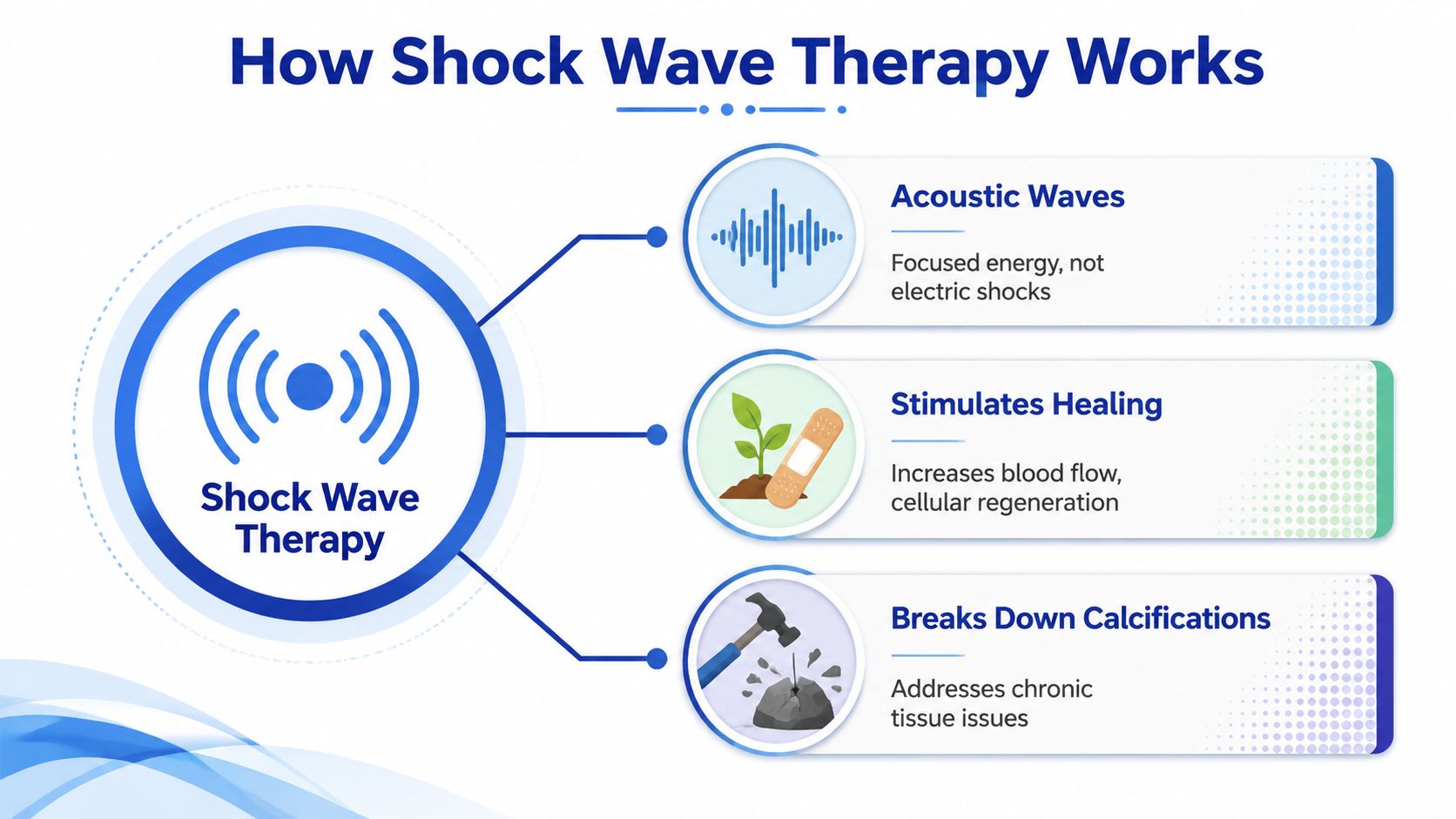
Shock wave therapy sounds more intimidating than it is. The name makes some people think of electricity, but that isn't what this treatment uses. Shock wave therapy uses acoustic pressure waves, which means it's a mechanical treatment rather than an electrical one.
A simple way to think about it is targeted sound energy. A handheld device delivers repeated pulses into the irritated tissue. Those pulses create a controlled mechanical stimulus in an area that has often become stuck in a chronic, underperforming healing state.
Radial and focused in plain English
You may hear two main terms in Melbourne clinics.
- Radial shock wave is commonly used in outpatient musculoskeletal care. The energy spreads more broadly from the treatment head and is often used for tendon and fascia problems closer to the surface.
- Focused shock wave concentrates energy more precisely into a target area. Some clinics use it for different clinical goals or deeper structures.
For most patients, the distinction matters less than the clinic's reasoning. The useful question isn't "Which machine is better?" It's "Why is this device being chosen for my diagnosis, and how does it fit with the rest of my rehab?"
What the treatment is trying to do
When a tendon or fascia has been painful for a long time, the issue often isn't merely that it needs more rest. Chronic tissue can become disorganised, sensitive, and poorly tolerant of load. Shock wave therapy is used to apply a controlled stimulus that may help restart a more productive healing response.
That is why practitioners often use it for long-standing overuse problems rather than fresh injuries. In Melbourne practice, it's typically positioned for chronic tendon or fascia problems present for more than 6 weeks, with short-course care delivered in compact outpatient sessions, according to local clinical guidance discussed in this Melbourne overview of shock wave treatment parameters.
It isn't an electric shock, and it isn't random vibration. It's a targeted mechanical treatment used to provoke change in tissue that has stopped adapting well.
Patients usually feel the treatment as a rapid tapping or pulsing sensation. Some areas are more sensitive than others. That doesn't mean something is wrong. It usually means the tissue is reactive, which is exactly why dose, diagnosis, and clinician judgement matter.
The Science Behind the Healing Process
The biology sounds technical, but the core idea is simple. Shock wave therapy creates a brief, controlled mechanical stress in the tissue. The body then responds to that stress with local changes that may help reduce pain and support repair.
One Australian sports medicine explanation describes this as rapid pressure changes producing cavitation, which means tiny microbubbles form and collapse in the tissue environment. That process creates controlled microtrauma, which can increase blood flow and stimulate repair, as explained in this Australian commentary on how shock wave therapy works.
What cavitation means for a patient
You don't need to remember the term. What matters is the effect. The treatment isn't trying to damage healthy tissue in a harmful way. It's trying to deliver a mechanical signal strong enough to wake up a sluggish healing response.
That matters most in chronic problems where the tissue has become painful, stiff, and poorly responsive to loading. In those cases, the body sometimes needs a stronger nudge than stretching or hands-on treatment alone can provide.
The two changes clinicians care about
The same Australian explanation links shock wave therapy to two effects that are relevant in clinic:
- Substance P modulation, which relates to short-term pain reduction.
- Neovascularisation, which refers to new blood vessel formation that may support tendon repair.
One helps explain why some people notice a settling of symptoms fairly early. The other helps explain why the bigger gains, when they happen, are usually gradual rather than immediate.
Shock wave therapy works best when patients see it as a tissue stimulus, not a passive cure.
That's also why results are often better when treatment is combined with sensible load management. If a painful tendon gets a good stimulus in clinic but is then overloaded, underloaded, or ignored between visits, progress is less predictable. The biological effect and the rehab plan need to pull in the same direction.
Why improvement can feel delayed
Some patients expect to walk out pain-free after one appointment. That can happen occasionally, but it isn't the right expectation. Tissue adaptation usually takes time. The pattern clinicians often look for is reduced irritability, better tolerance to daily activity, and gradual return to loading.
Australian commentary notes that improvement is often seen over 2–3 sessions when shock wave is combined with a broader rehabilitation program. That timeline makes sense biologically. The treatment starts a response, but the body still has to do the work of adapting.
Conditions Treated and Its Effectiveness
Shock wave therapy is usually considered for chronic soft-tissue pain, especially when symptoms have hung around despite sensible conservative care. In practice, the best matches are often tendon and fascia problems rather than vague, poorly defined pain.
Where it tends to fit best
The conditions below are the ones patients most commonly ask about in clinic.
| Condition | Commonly Affected Area | Primary Symptom |
|---|---|---|
| Plantar fasciitis or plantar heel pain | Underside of the heel or arch | First-step pain, tenderness with walking |
| Achilles tendinopathy | Back of the heel or lower calf | Pain with walking, running, or calf loading |
| Tennis elbow | Outer elbow | Pain with gripping, lifting, or wrist use |
| Patellar tendinopathy | Front of the knee below the kneecap | Pain with jumping, stairs, or squatting |
| Rotator cuff tendinopathy | Shoulder | Pain with reaching, lifting, or lying on the side |
| Calcific tendon problems | Often shoulder | Painful movement and local tenderness |
These are broad categories, not self-diagnoses. Heel pain can come from more than one structure. Shoulder pain can come from the neck, joint, bursa, or tendon. That's why assessment comes first.
If your pain also overlaps with hip or referred leg symptoms, our guide to hip pain treatment options can help you understand when the problem may sit outside the usual shock wave therapy picture.
What the evidence says in practice
The strongest way to think about effectiveness is not "Does it work?" but "For which condition, under which protocol, and by how much?" That's a more honest clinical question.
A Cochrane review of rotator cuff disease included 9 trials and found data from 612 participants for function and 608 participants for pain. Compared with placebo, shock wave therapy improved function by 7.9 points on a 0 to 100 scale and reduced pain by 0.78 points on a 0 to 10 scale. In one shock-wave group, 58/150 participants reported success versus 35/137 in the placebo group. The reviewers concluded there were “very few clinically important benefits” overall and that safety remained uncertain in that review context, as reported in the PubMed record for the Cochrane review.
That doesn't mean shock wave therapy is useless. It means the treatment is condition-specific and protocol-sensitive. Some patients do improve. Some improve modestly. Some don't respond much at all. The key clinical lesson is that shock wave therapy shouldn't be sold as a universal fix for every painful tendon.
Good candidates usually have a clear diagnosis, symptoms that have persisted, and a rehab plan that deals with the cause of overload as well as the sore tissue itself.
In day-to-day practice, what works best is a tight match between diagnosis, stage of injury, dose of treatment, and follow-up exercise. What works poorly is using shock wave as a substitute for proper assessment, or using it on pain that isn't coming from the tissue being treated.
Your Treatment Journey What to Expect Step-by-Step
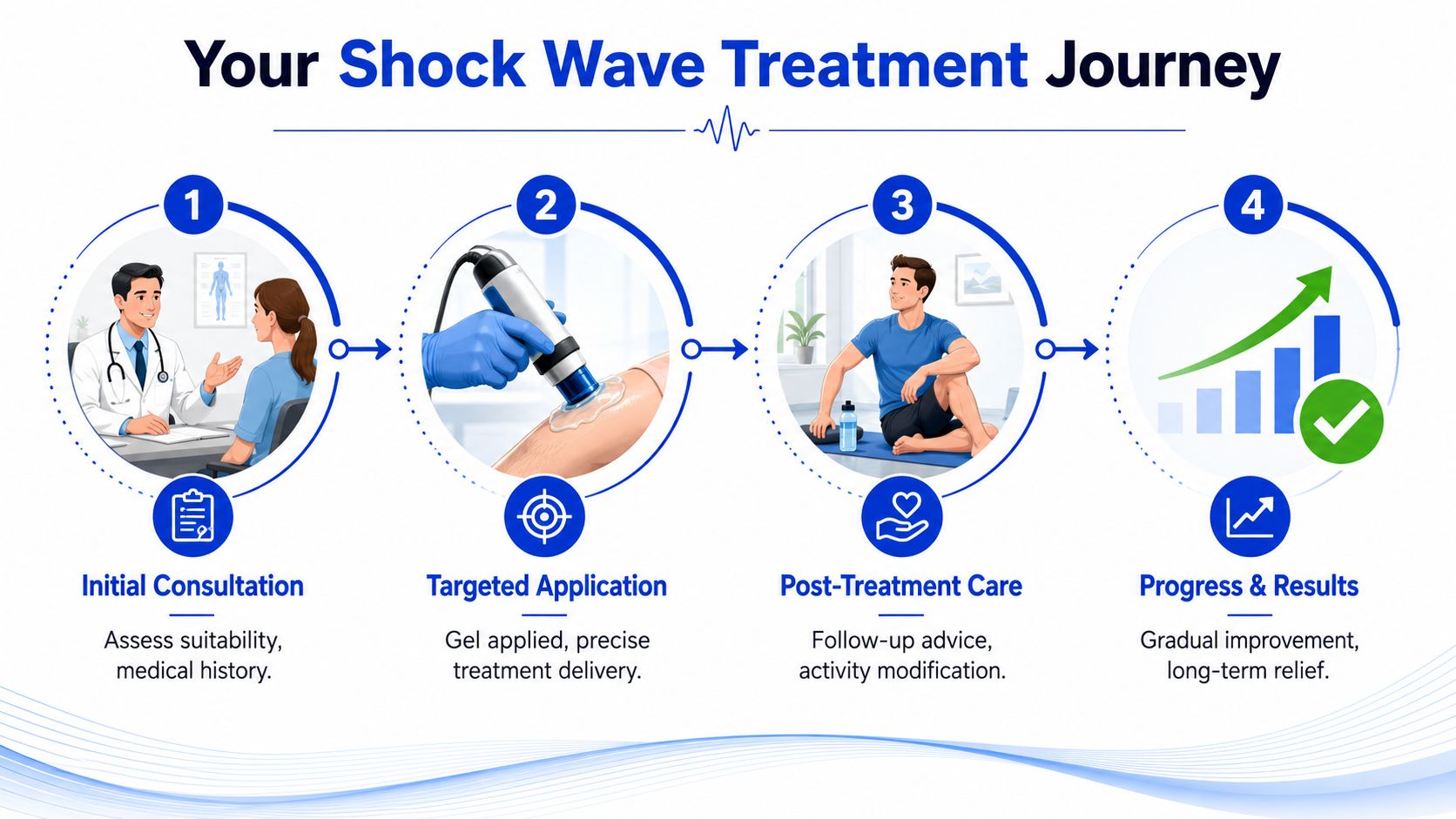
Patients often feel more comfortable once they know exactly what a shock wave appointment involves. The process is usually simple, but it should never feel rushed or automatic. The treatment works better when the diagnosis is clear and the target area is chosen carefully.
Early in your journey, it's helpful to see the full flow visually.
Who tends to be a good candidate
Local Melbourne guidance commonly positions shock wave therapy for chronic tendon problems that have been present for more than 6 weeks, rather than very recent flare-ups. That usually includes people who have tried some combination of rest, exercise, footwear changes, hands-on treatment, or activity modification without enough progress.
It also needs a safety screen. A clinician should ask about your medical history, medications, previous injections, and whether the diagnosis is solid. Some situations need more caution or a different treatment choice, particularly if there are broader medical factors involved.
What happens in the room
A typical session starts with confirmation of the target tissue. Your practitioner should palpate the area, assess aggravating movements, and decide exactly where treatment will be applied. Then gel is placed on the skin, and the handheld applicator is positioned over the treatment site.
In Melbourne clinic descriptions of radial extracorporeal shockwave therapy, the treatment is delivered via a handheld probe. The actual energy-delivery phase usually takes about 5–10 minutes per treatment site, and a common protocol involves 2,000 shocks to the area, according to this Melbourne clinic description of RESWT appointments.
The sensation is usually described as uncomfortable but tolerable. Sensitive, irritated tissue can feel sharp or intense at first. Good clinicians adjust dose, pressure, and positioning so that the treatment is challenging without becoming excessive.
For a look at the equipment and treatment feel, this short clip is useful:
Aftercare and the first few days
After treatment, individuals can generally walk out and continue with normal daily activity. The key point is not to confuse "I can function" with "I should go straight back to high-load sport."
Melbourne clinic guidance commonly advises patients to avoid high-impact activity for 24–48 hours after treatment. That gives the tissue time to settle before you challenge it again. Gentle movement is usually fine, and your practitioner should tell you what to keep doing, what to reduce briefly, and when to progress loading.
A sensible post-treatment plan often includes:
- Relative calm, not bed rest. Keep moving, but don't test the area aggressively.
- Clear exercise guidance. Continue or restart the loading program your clinician has prescribed.
- Symptom monitoring. Mild soreness can happen. A strong flare that lingers should be reviewed.
- Review of progress. Improvement is usually judged by function and load tolerance, not just tenderness on the day.
The whole journey should feel structured. You should know what tissue is being treated, why it's being treated, how many sessions are being considered, and what success will look like in your day-to-day life.
Costs and Choosing a Clinic in Melbourne
You have probably reached the point where the pain has dragged on long enough, and now the practical questions matter. How much will this cost, how many visits are likely, and which clinic will assess the problem properly rather than just apply a machine for ten minutes.
Cost matters. So does the quality of the decision behind the treatment.
In Melbourne, shock wave therapy is usually offered as a short treatment series for the right tendon or fascia presentation, not as an open-ended plan with no review point. Local Melbourne guidance commonly describes a small number of sessions for persistent cases, with progress checked over the first few appointments. That is the useful way to budget. Ask what is included in the fee, how the diagnosis is made, and what happens if your response is slower than expected.
If you're comparing fees locally, our page on shockwave therapy cost in Melbourne explains session pricing, consultation structure, and how treatment planning is usually approached.
A lower fee can still be good value if the diagnosis is already clear and the clinician is adjusting treatment based on your response. A higher fee may make sense if the appointment includes reassessment, exercise review, and a broader rehabilitation plan. The problem is paying for repeated sessions without a clear reason.

What to ask before you book
A good clinic should be able to answer straightforward questions clearly.
Consider asking:
- Who will assess and treat you. An osteopath, physiotherapist, or podiatrist with regular musculoskeletal experience should be able to explain why shock wave therapy fits your presentation.
- How the diagnosis has been reached. You want to hear a clear clinical reason, not a vague statement that it helps "inflammation" or "tightness."
- What else is part of the plan. For many patients, shock wave therapy works best alongside loading advice, activity modification, and follow-up review.
- How improvement will be measured. Useful markers are walking distance, first-step pain, training tolerance, stair pain, sleep disruption, and flare frequency.
- When they would stop or change course. If the treatment is not helping, the plan should change. Repeating the same session without reassessment is poor care.
For Bayside residents, logistics are part of the decision. A clinic that is easy to get to, offers suitable appointment times, and can combine assessment, hands-on care, exercise advice, and shock wave therapy in one place often makes adherence easier. Bayside Osteopathic Health is one local option for patients in the Bayside area who want an osteopathic assessment before deciding whether shock wave therapy is appropriate.
Choose the clinic that explains the diagnosis in plain language, gives you a realistic cost outline, and sets clear expectations about what improvement should look like in daily life.
Your Questions Answered and Next Steps
The final questions are usually the practical ones.
Common questions
Is it painful?
It can be uncomfortable, especially over irritated tendon or heel tissue. The treatment is generally well-tolerated because it is brief and the clinician can adjust the intensity.
How quickly will I see results?
Some people notice an early change in irritability, while others improve more gradually. The more useful measure is whether walking, lifting, training, or daily movement starts becoming easier over time.
Is it covered by Medicare or private health in Australia?
Coverage depends on your practitioner type, your referral pathway if one exists, and your private health extras. The safest approach is to ask the clinic exactly how appointments are billed and then check with your insurer if needed.
Shock wave therapy in Melbourne is best viewed as a focused tool for specific chronic tendon and fascia problems. It isn't magic, and it isn't for every diagnosis. Used well, it can help move a stubborn condition forward with minimal downtime and a clear rehabilitation path.
If you're in the Bayside area and want to know whether shock wave therapy suits your condition, book a consultation with Bayside Osteopathic Health. A proper assessment can tell you whether your pain is a good match for treatment, what results are realistic, and what plan will give you the best chance of lasting improvement.