

Shockwave therapy in Australia typically costs A$100 to A$300 per session, and a full course of 3 to 5 sessions often totals A$300 to A$1,500. This is the amount to plan around, as shockwave therapy is generally paid out of pocket rather than through a standard Medicare subsidy.
If you're reading this with stubborn heel pain, a cranky Achilles, tennis elbow that won't settle, or a shoulder that keeps catching every time you reach overhead, the money question is usually close behind the pain question. You want to know whether shockwave is worth trying, whether the quoted fee is reasonable, and whether the number on the website is the number you'll end up paying.
That uncertainty is common. The problem isn't just the session price. It's the gap between a simple ad that says "from A$100" and the actual cost of getting assessed, treated across several visits, and figuring out whether any rebate applies to the consultation side of care.
Table of Contents
- An Honest Look at Shockwave Therapy Costs
- Understanding Shockwave Therapy and Why It Is a Course
- The Typical Shockwave Therapy Cost in Australia
- Key Factors That Determine Your Final Price
- A Cost and Recovery Comparison with Alternative Treatments
- Navigating Insurance, Medicare, and Rebates
- Your Next Steps Questions to Ask Before Booking
An Honest Look at Shockwave Therapy Costs
A common scenario in clinic is this. Someone books because heel pain, elbow pain, or a stubborn tendon problem has dragged on for months, and they want to know one thing before they commit. What is this likely to cost from start to finish?
That is the right question to ask.
In Australia, shockwave therapy is usually paid out of pocket, and clinics often advertise a per-session fee first. That number matters, but it rarely reflects the full spend. The total can also include an initial consultation, review appointments, exercise prescription, and any rebate that reduces your gap. The Australian MBS online listings for allied health items are a useful reference point for understanding why treatment costs and rebates are often discussed separately.
A clearer way to budget is to ask for the likely cost of the full course, not just the per-appointment price. That matters because patients are not only paying for a machine being switched on for a few minutes. They are paying for assessment, clinical reasoning, dose adjustment, and a plan that is reviewed as symptoms change.
What patients often get wrong about pricing
The comparison that causes the most confusion is clinic versus clinic on session fee alone. A lower advertised price can still leave you with a higher total bill if the first appointment is billed separately, if review consultations are added on, or if the diagnosis was not clear enough at the start to guide treatment well.
Condition type matters too. A recent, straightforward tendon complaint is different from a long-standing case with several pain drivers, reduced strength, or irritated nerves. If symptoms also involve referral down the leg, for example, the plan may need broader assessment before shockwave is even the right fit, which is why some patients benefit from an assessment approach more like this osteopathy treatment for sciatica and related leg pain.
Short version. The cheapest first visit is not always the lower-cost treatment plan.
What helps when budgeting
Ask three direct questions before you book:
- What is the likely total cost for my condition over the expected course of care?
- Does the first appointment include both assessment and treatment, or assessment only?
- Will I have any rebates available through Medicare or private health, and what gap should I expect to pay?
A transparent clinic should be able to answer those without vague language. If the answers are clear at the start, patients can make a sensible decision and avoid bill shock later.
Understanding Shockwave Therapy and Why It Is a Course
A patient with stubborn plantar heel pain often comes in hoping one strong treatment will sort it out. That is understandable. In practice, shockwave is usually prescribed more like a treatment course than a single event, because the tissue response builds over time.

What shockwave therapy does
Shockwave therapy delivers acoustic energy into a painful or slow-to-recover area. The aim is to stimulate change in tissue that has stalled, particularly in long-standing tendon and fascia problems. Patients usually notice two parts to that process. Pain can settle, and the tissue can become more tolerant to loading as the course progresses.
Clinical sources commonly describe the intended effects in terms of pain modulation and local healing responses, including changes linked with blood vessel growth, as outlined by the International Society for Medical Shockwave Treatment. That is why a proper plan is based on dosage across several appointments rather than a once-off machine session.
Shockwave also works best when it sits inside a broader musculoskeletal plan. If pain is being driven by more than one issue, such as tendon overload plus altered movement or nerve irritation, the assessment matters just as much as the device. That is often the case in presentations that overlap with osteopathy treatment for sciatica and related leg pain.
Why one session usually isn't enough
The main reason is simple. Tissue adaptation is gradual.
A single shockwave session may reduce symptoms for some patients, but lasting change usually needs repeated exposure at the right intensity, with enough time between sessions for the tissue to respond. That is the trade-off. Fewer visits can look cheaper at the start, but they may not give the treatment enough opportunity to work.
This matters financially as well as clinically. Patients are not just paying for minutes on a machine. They are paying for diagnosis, safe dosing, review of response, and adjustments to the plan if the tissue is too irritable, not improving, or turning out not to be the right indication for shockwave in the first place.
Good shockwave care is usually straightforward. The diagnosis is clear, the expected number of sessions is discussed early, and the patient knows that progress is usually measured across weeks, not one appointment.
That course-based structure is the reason total cost matters more than the headline session fee. If a clinic discusses shockwave as a series, with assessment and follow-up built into the plan, the pricing conversation tends to be clearer and more honest from the start.
The Typical Shockwave Therapy Cost in Australia
A patient books after seeing a low advertised session price, then finds out the first visit is longer, follow-up reviews are billed separately, and the tendon needs several weeks of care. That is where cost confusion usually starts.
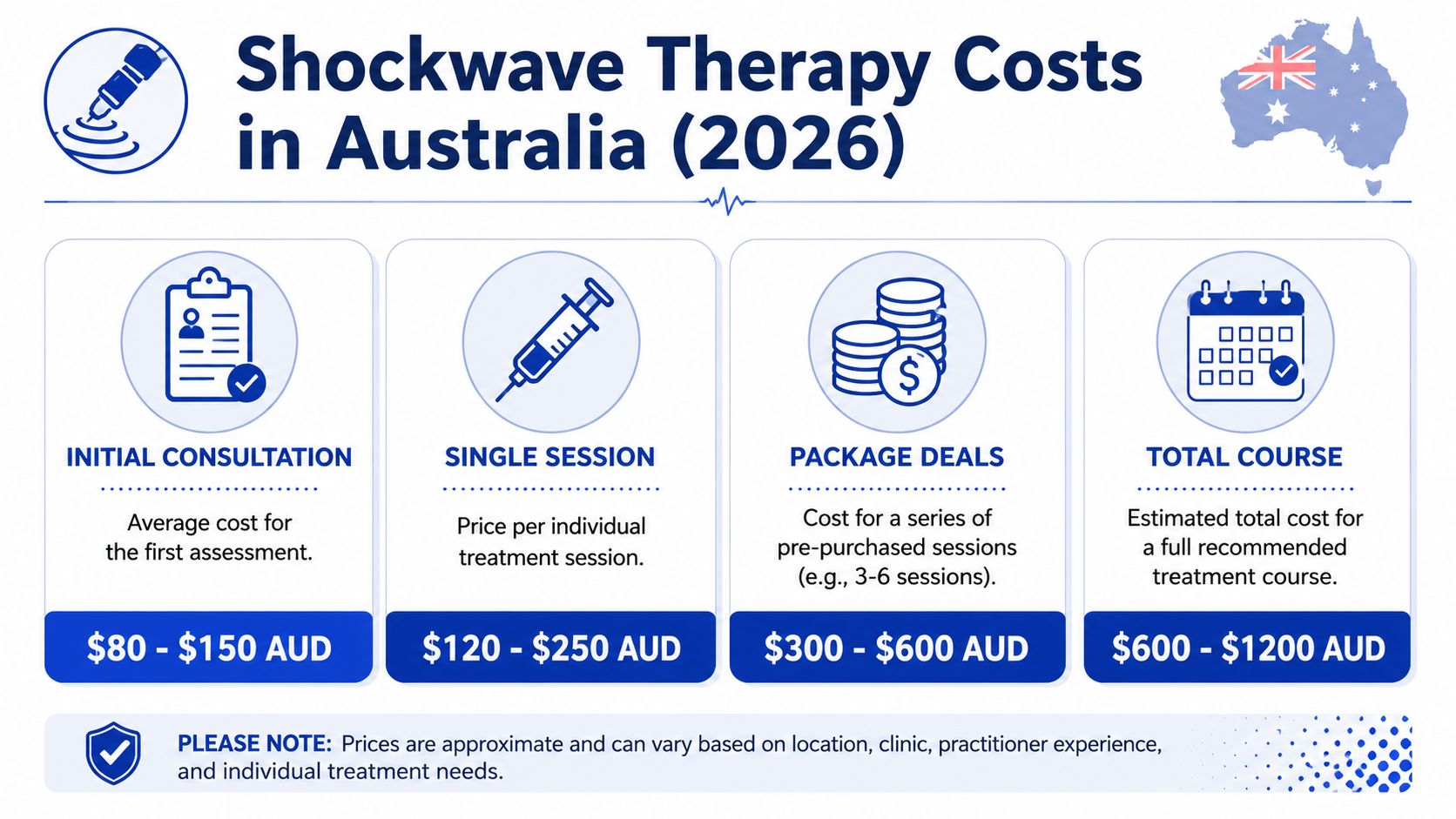
The numbers most patients should use
The useful question is not, "What does one session cost?" The useful question is, "What will this whole course likely cost me out of pocket?"
In Australia, shockwave is commonly priced as a private service, so patients often pay a session fee and then claim back any eligible private health rebate afterward. Clinics also vary in whether the initial consultation is bundled into the first treatment or charged separately. For that reason, the actual comparison point is the all-in figure for assessment, treatment sessions, and review appointments.
A practical market range for the treatment session itself is often around A$100 to A$300 per visit, and many clinics recommend a series rather than a once-off treatment. The Australian pricing examples discussed by The House of Mouth show the same pattern. The headline session fee matters, but the expected number of visits usually has a bigger effect on the final spend.
For many patients, a realistic budget is the cost of several appointments across a few weeks, not one machine-based treatment on its own. If a clinic advertises a low entry price, ask whether that figure covers the assessment, whether review fees apply later, and how many sessions are commonly recommended for your condition.
The infographic above may show different example bands. Treat those as broad guides only. A written quote that sets out the likely course cost is far more useful.
What a real course can look like
Costs differ because conditions differ.
A plantar heel pain case may look straightforward at first, but the treatment plan changes if the main driver is plantar fascia irritation, fat pad sensitivity, calf restriction, training load, or footwear. Tennis elbow may need fewer reviews if symptoms are localised and the diagnosis is clear. Achilles tendinopathy often ends up costing more overall because the shockwave sessions are only one part of the plan. Load management and exercise progression usually matter just as much.
This is why I advise patients to compare inclusions, not just price tags. A lower quote can still become the more expensive option if it leaves out reassessment, progress reviews, or changes to the program when the tissue is not responding as expected.
| Cost question | Why it matters |
|---|---|
| Per-session fee | Gives a starting point, but does not show the full spend |
| Expected number of sessions | Has the biggest effect on total out-of-pocket cost |
| Initial consultation cost | Some clinics bill the assessment separately |
| Review or follow-up fees | These can add up across a treatment course |
| Imaging or referral needs | Some cases need extra investigation before treatment continues |
A clear quote should answer one practical question: if your treatment goes to plan, what is the likely total cost from first appointment to final review?
That answer helps patients budget properly and compare clinics on something more meaningful than a single advertised price.
Key Factors That Determine Your Final Price
Two clinics can both offer shockwave therapy and still quote very different fees. That doesn't automatically mean one is overpriced or one is better. It usually means the underlying cost structure and service model are different.
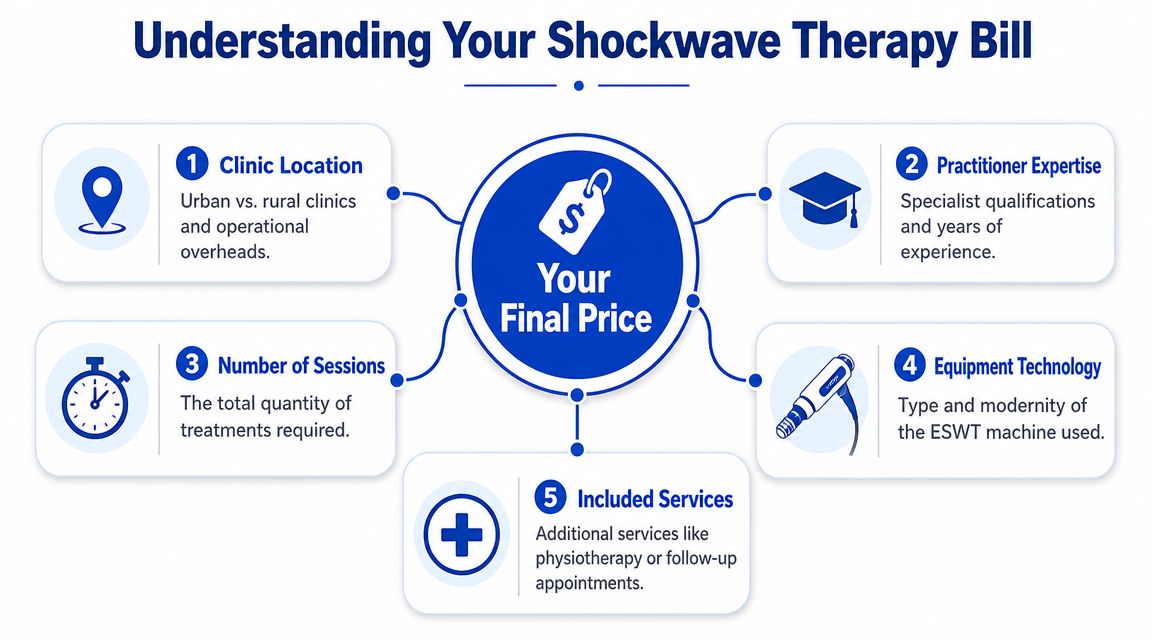
Technology changes the fee
One of the least visible drivers of shockwave therapy cost is the machine itself. Clinical ESWT devices can range from roughly $3,000 for basic radial systems to $39,000+ for advanced focused systems, and that difference affects how clinics price sessions and packages, as described in this overview of shockwave equipment costs and alternatives.
Radial and focused systems aren't just marketing labels; they represent different device classes, capital costs, and treatment positioning. A clinic that has invested heavily in a focused unit will usually need different pricing to recover that cost than a clinic using a lower-capex radial system.
That doesn't mean the more expensive machine is always the right choice. It means the technology should match the condition being treated.
Clinical factors that change the quote
Beyond the machine, several practical variables influence what you pay.
- Clinic location: Rent, staffing, and overheads differ across suburbs and regions. Those operating costs show up in healthcare pricing.
- Practitioner expertise: You're not only paying for the device. You're paying for diagnosis, clinical judgement, and knowing when shockwave isn't the right fit.
- Number of sessions needed: A straightforward, localised tendon issue usually creates a different bill from a chronic, irritated area with multiple aggravating factors.
- Included services: Some clinics fold shockwave into a broader consultation. Others bill the treatment separately from assessment, exercise advice, or review.
- Treatment complexity: A small superficial area is not always managed in the same way as a deeper or more irritable structure.
A common issue from a patient's perspective is buying the cheapest advertised session with no clarity on plan, review points, or expected course length. Low transparency often leads to more frustration than savings.
A better standard is to expect a quote that answers these points:
- What technology is being used.
- Whether the practitioner believes you're a good candidate.
- How many sessions are reasonably expected.
- What other parts of care are bundled in.
- When progress will be reviewed.
A fair quote doesn't just tell you the price. It explains the reasoning behind it.
If a clinic can't explain that logic in plain language, it's harder to judge value.
A Cost and Recovery Comparison with Alternative Treatments
Shockwave therapy makes the most sense when you compare it with the other realistic options a patient might consider for chronic tendon or heel pain. Not every case needs it. Not every case should avoid it. What matters is understanding the trade-offs.
How shockwave sits beside other options
Shockwave entered mainstream care partly because it offered a lower-cost alternative to surgery for persistent musculoskeletal problems. In the plantar fasciitis literature, health-economic studies cited annual treatment costs of US$192 million to US$376 million in 2007, which helps explain why non-surgical options attracted attention, as discussed in this plantar fasciitis evidence review.
The same evidence base noted clinically meaningful improvement after shockwave over 3 to 12 weeks, which fits with what patients often find hardest at the start. The value isn't judged by the first appointment. It's judged by what happens after a complete and appropriate course.
If you're also weighing injection-based care, it's worth reading a more condition-specific discussion of cortisone injection options and considerations, because the right comparison depends on the tissue involved and the recovery goal.
Why cheapest up front isn't always cheapest overall
The table below keeps the comparison practical rather than promotional.
| Treatment | Typical Upfront Cost (AU) | Recovery Time | Invasiveness | Long-Term Outlook |
|---|---|---|---|---|
| Shockwave therapy | Often a moderate out-of-pocket cost across a treatment course | Usually gradual, often building over weeks | Non-invasive | Can suit chronic tendon and heel pain when a structured course is completed |
| Cortisone injection | Varies by provider and setting | May feel faster in the short term for some problems | Minimally invasive | Can be useful in selected cases, but isn't automatically the best long-term tendon strategy |
| Physiotherapy or exercise-based rehab | Usually spread across multiple visits over time | Often gradual and load-dependent | Non-invasive | Often valuable, especially when the key issue is strength, load tolerance, or movement strategy |
| Surgery | Usually the highest total treatment burden | Recovery is often longer and more restrictive | Invasive | Appropriate for selected cases, but usually not the first option for many chronic soft tissue conditions |
A few practical patterns tend to hold true:
- Shockwave fits the middle ground: It's more involved than a single passive treatment, but far less invasive than surgery.
- Rehab still matters: Shockwave doesn't replace sensible loading, footwear changes, or activity modification when those factors are relevant.
- Injections have a place: They can be appropriate, but they shouldn't be treated as the automatic benchmark for value.
Patients usually do best when they compare options by outcome pathway, not just by opening price.
Navigating Insurance, Medicare, and Rebates
A common scenario goes like this. Someone budgets for a single shockwave session, then finds out the first visit includes an assessment fee, the treatment is usually delivered as a course, and any rebate may apply to only part of the appointment. That is why the total treatment spend matters more than the advertised session price.
What Medicare usually means in practice
In most Australian clinics, shockwave therapy itself is an out-of-pocket treatment rather than a standard Medicare-funded item. For budgeting purposes, patients should assume they will be paying privately unless the clinic has clearly explained otherwise.
The confusion usually sits around the consultation, not the machine. In some settings, part of the broader appointment may fall under a Medicare-supported care plan if you are eligible, but that does not automatically make the shockwave component claimable.
Ask the clinic a direct question: What part of this appointment, if any, is claimable through Medicare, and what will I still pay myself?
That wording gets a much clearer answer.
How to check private health properly
Private health extras can reduce the gap, but only if the claim category matches what the clinic is charging for. I tell patients to avoid asking, "Is shockwave covered?" Funds often answer that too broadly to be useful.
Ask these instead:
- What service category am I claiming under? You need the consult or treatment category, not just the name of the machine.
- What item number applies? A clinic should be able to give you the item number or claiming code for the appointment.
- What rebate amount should I expect? Ask for the likely dollar rebate, not just whether you are covered.
- What annual limits or caps apply? Extras benefits can run out.
- Does the rebate apply to the consultation only, or also to the device-based treatment? That detail often changes the gap you pay.
The main cost question is usually the full course, not a single visit. The fee that affects decision-making is the total out-of-pocket cost after assessment fees, follow-up appointments, rebates, and the expected number of sessions, as discussed in this overview of shockwave therapy pricing in Australia: https://lmdpodiatry.com/how-much-does-shockwave-therapy-cost/
If you are comparing providers, ask for the fee outline in writing before you book. A transparent clinic should be able to explain the likely course cost, what can be claimed, and what remains private. That is also easier to sort out when speaking with an osteopath near you who can explain treatment fees clearly.
Your Next Steps Questions to Ask Before Booking
The best way to avoid surprise costs is to ask better questions before your first appointment. Patients don't need to become experts in shockwave technology. They just need enough clarity to judge whether the recommendation is sensible, transparent, and worth the spend.
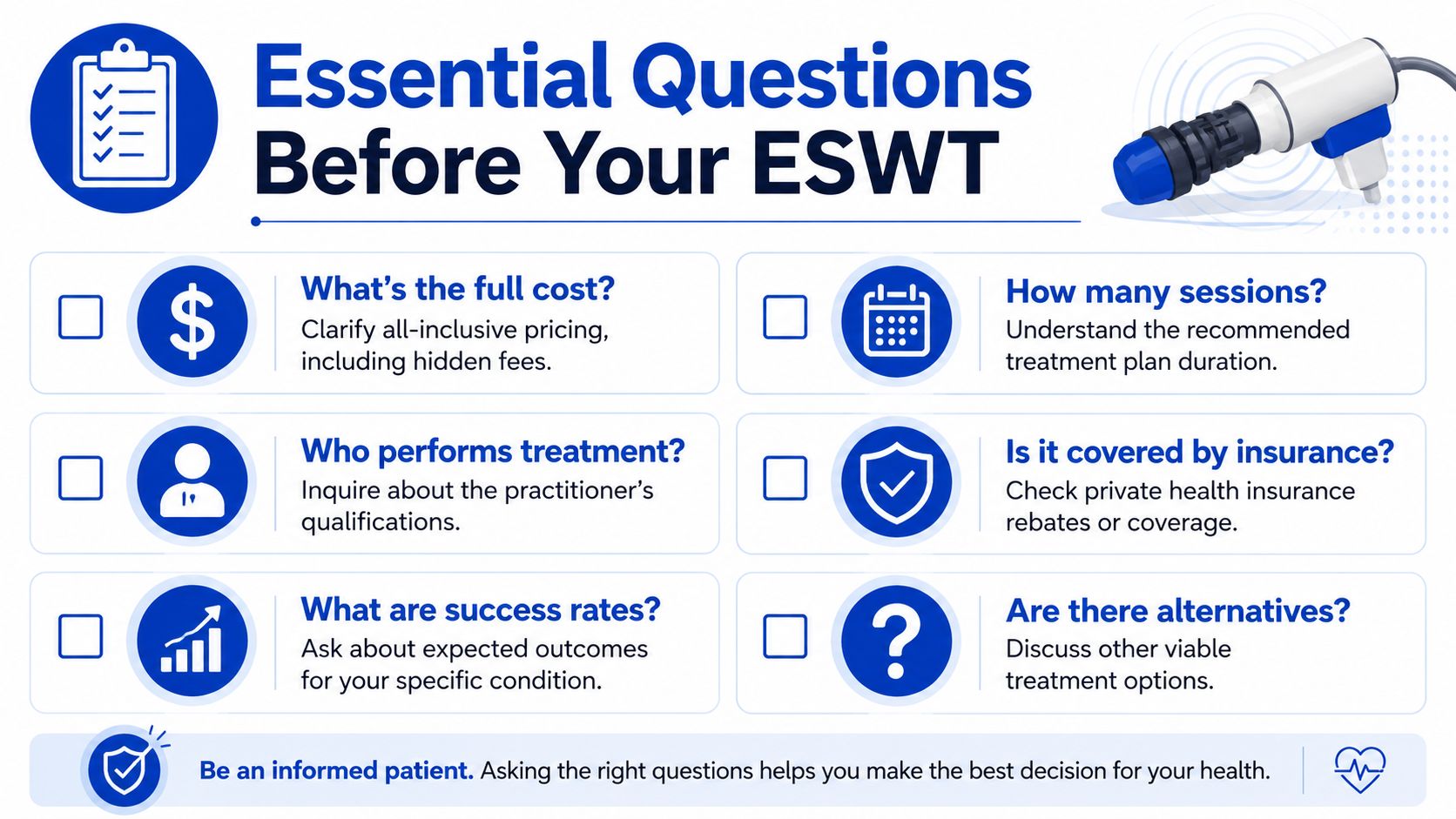
The questions that protect you from bill shock
Take this checklist with you when you're comparing clinics:
- What's the full expected cost? Ask for the likely range for the whole course, including assessment and reviews.
- How many sessions do you expect for my condition? Not an exact promise. A reasonable estimate.
- Is the first appointment assessment only, or does it include treatment? That single detail changes the first bill.
- What type of machine do you use? You don't need a technical lecture, but you do want a plain-language explanation.
- Who performs the treatment? Qualification and clinical experience matter.
- What will tell us it's working? A clinic should be able to describe what progress looks like.
- What happens if I don't improve as expected? Good care includes a review point, not endless repeat visits.
- Can I use private health, and what item number do I need? This should be easy for the clinic to answer.
If you're also trying to compare local practitioners more broadly, a practical starting point is to look for an experienced osteopath near you and then ask these questions directly before committing.
What a transparent clinic should answer clearly
A trustworthy clinic doesn't get defensive when you ask about fees. It should be comfortable explaining the treatment plan, the expected number of visits, what is and isn't included, and why shockwave is being recommended in the first place.
If a clinic can explain the diagnosis, the rationale, the likely course, and the costs in plain English, you're much more likely to feel confident about the decision.
That confidence matters. People handle treatment far better when they know what they're paying for and why.
If you'd like clear advice on whether shockwave is suitable for your pain, and what the likely total out-of-pocket cost may be in your case, Bayside Osteopathic Health can help you talk through the options in plain language. The goal is simple: a sensible diagnosis, transparent pricing, and a treatment plan that matches your condition rather than a one-size-fits-all package.