

You wake up already calculating the day around your pain. Can you sit through that morning meeting without your back tightening? Will the drive to school pickup flare your neck? Will you be able to walk along the foreshore later, or will your hip decide for you?
That's how persistent pain often works. It doesn't only hurt. It narrows your choices, chips away at confidence, and makes ordinary tasks feel like negotiations with your own body. Many people in Bayside come in after trying a few different things on their own. A heat pack here, stretching there, maybe a supplement a friend recommended. Sometimes one piece helps, but the overall picture still feels messy.
Natural pain solutions can play a valuable role, but they work best when they're organised into a plan instead of collected at random. That's where a more integrated approach can make a real difference.
Table of Contents
- Living with Pain Is More Than Just a Symptom
- A Smarter Framework for Natural Pain Relief
- The Pillars of Natural Pain Management
- How Osteopathy Integrates Your Pain Relief Plan
- When to See a Professional About Your Pain
- Your Next Steps for Pain Relief in Bayside
- Taking Control of Your Comfort and Wellbeing
Living with Pain Is More Than Just a Symptom
For many people, pain starts as a local problem and becomes a whole-life problem. A sore lower back changes how you sleep. Poor sleep makes you more sensitive the next day. Then you move less because you're guarding, and that stiffness feeds the cycle again.
In clinic, this often shows up in familiar ways. The office worker who now stands through half the day because sitting is aggravating. The parent who avoids the floor because getting back up hurts. The older adult who isn't just bothered by knee or hip pain, but by the loss of trust in their own movement.
If this sounds familiar, you're not overreacting and you're not alone. In Australia, the 2017 to 2018 National Health Survey estimated that 3.7 million people, or about 15% of the population, were living with chronic back problems. The same summary notes that low back pain alone contributed 7.6% of total disease burden in 2018 according to Australian back pain burden figures cited in this health summary.
Pain affects function first. People often notice it in the tasks they stop doing before they think of it as a health pattern.
What pain often steals first
- Ease of movement. You begin planning around stairs, long drives, gardening, exercise classes, or even carrying groceries.
- Mental bandwidth. Constant discomfort pulls attention away from work, family, and rest.
- Confidence. Many people become unsure whether movement will help them or make things worse.
Natural pain solutions matter because they can support mobility, reduce tension, and help people re-engage with daily life. But they need to be matched to the person in front of you, not copied from a generic list online.
The practical shift that helps
The goal isn't to chase a pain-free moment at any cost. The better goal is to build a body that feels safer, moves more comfortably, and recovers more reliably.
That usually starts when you stop asking, “What's the one thing that will fix this?” and start asking, “What combination of care makes my body work better day to day?”
A Smarter Framework for Natural Pain Relief
Natural pain relief works best when you treat pain like a system problem, not a single sore spot. If you only focus on the symptom of the day, you end up playing whack-a-mole. The neck settles, then the shoulder tightens. The back improves, then the hip starts complaining because the underlying movement pattern never changed.
A better model is to think of your body like a garden. If one plant looks weak, you don't just trim the leaves and hope for the best. You look at the soil, water, sunlight, crowding, and root health. Pain is similar. The tender area matters, but so do sleep, stress, strength, posture habits, breathing pattern, workload, and recovery.
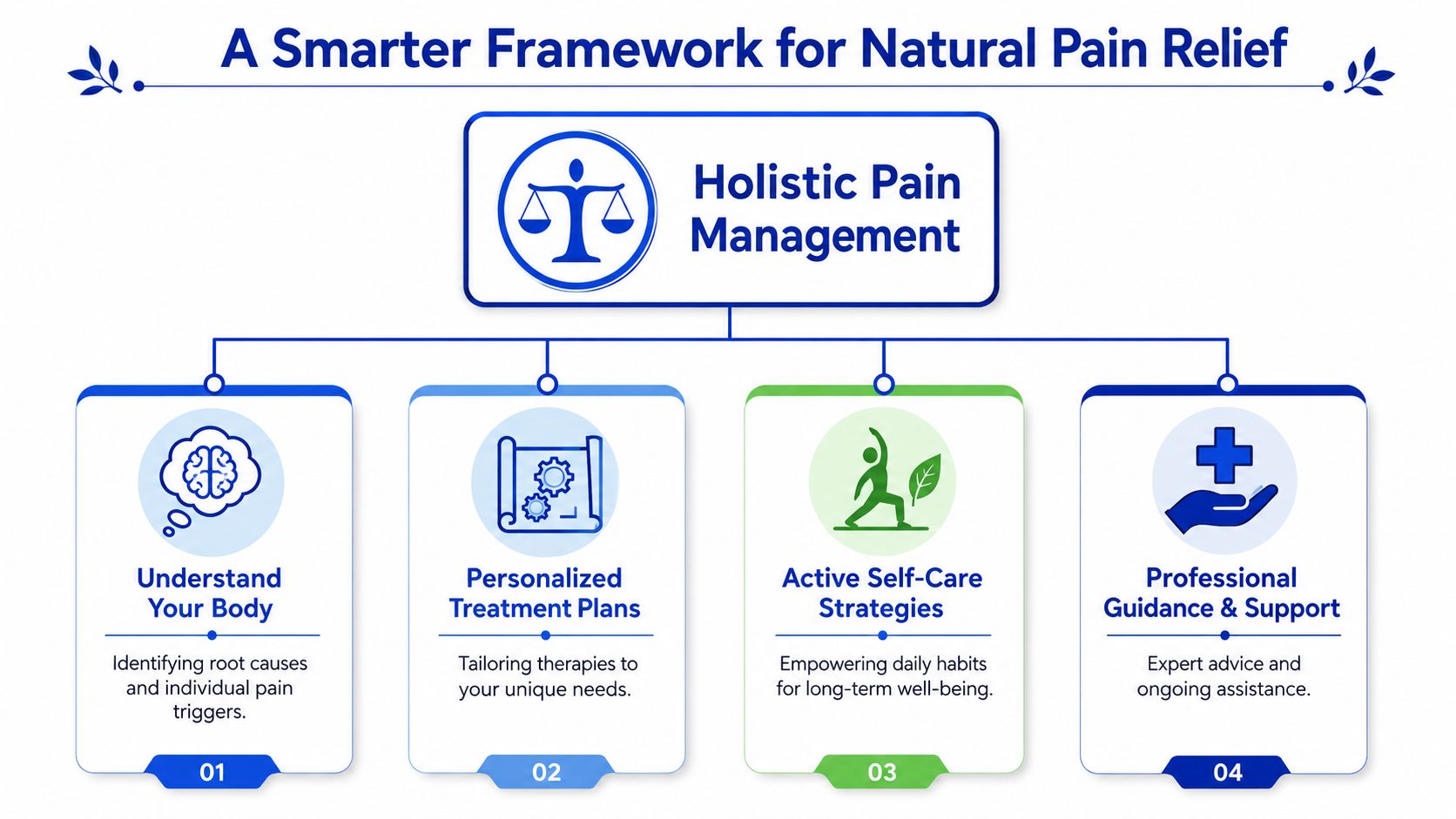
Four parts of a useful framework
| Pillar | What it asks | Why it matters |
|---|---|---|
| Understand your body | What triggers the pain, eases it, or keeps it going? | Pain management improves when the pattern is clear. |
| Use tailored treatment | Which hands-on care, exercise, or recovery strategies suit you? | The right tool depends on the person, not the trend. |
| Build active self-care | What can you do daily that supports progress? | Relief lasts longer when you can influence it between appointments. |
| Get professional guidance | Is this straightforward musculoskeletal pain or something needing medical review? | Good triage prevents wasted time and unsafe self-treatment. |
Many people get stuck because they pick only one of these. They try stretching without understanding their aggravating habits. Or they have hands-on therapy but don't change the daily load that keeps re-irritating the area. Or they buy supplements without checking whether they suit the rest of their care.
Practical rule: If a natural remedy only helps for a few hours and nothing in your routine changes, it's probably acting as a temporary modifier, not a lasting solution.
What usually doesn't work
A scattered approach often fails for predictable reasons:
- Random swapping. Changing pillows, chairs, shoes, supplements, and exercises every few days makes it hard to know what's helping.
- Over-resting. Rest can be useful in the short term, but too much usually leads to more stiffness and less confidence.
- Pushing through hard flare-ups. Aggressive exercise during an irritated phase often teaches the body to brace more, not less.
The smarter path isn't complicated. It's coordinated. You assess the drivers, choose a few strategies that fit together, and review them as your body changes.
The Pillars of Natural Pain Management
Some natural pain solutions are helpful because they reduce sensitivity. Others help because they improve mechanics. The most reliable plans usually combine both.
Movement That Calms Rather Than Provokes
Movement is often the first pillar because the body generally responds well to safe, regular input. But not all movement has the same effect. There's a big difference between “doing exercise” and using movement as treatment.
Walking, gentle mobility drills, strength work, hydrotherapy, and guided yoga can all be useful. The right question is whether the activity leaves you looser and more capable afterwards, or more guarded and irritated later that day. That response tells you far more than the label of the exercise.
For lower back pain, many people do better with simple, repeatable exercises they can fit into daily life rather than long, heroic routines. If you want a starting point, these lower back pain relief exercises are a practical example of the kind of simple movement work that can support home care.
Signs a movement plan is on the right track
- It feels manageable. You can repeat it without dreading it.
- Symptoms settle within a reasonable window. Mild effort is fine. Lingering aggravation suggests the dose is wrong.
- Function improves. You sit longer, walk easier, or turn more freely even if pain hasn't vanished.
Manual Therapies That Support Better Movement
Hands-on care can help when tissues are tight, joints feel restricted, or the nervous system is stuck in a guarded mode. In osteopathy, treatment might include soft tissue work, joint articulation, gentle mobilisation, and advice on how to move more comfortably afterward.
The key trade-off is this. Manual therapy can create a valuable opening, but it usually isn't enough on its own. If treatment eases the area but you return to the same loading pattern, workstation setup, or movement habit without support, the old pattern often returns.
That's why useful hands-on care should answer two questions. First, what changed today? Second, how do we help your body keep that change?
Good manual therapy should make your next helpful movement easier, not replace movement altogether.
Lifestyle Inputs That Quiet the System
Pain doesn't live only in joints and muscles. Sleep disruption, stress load, long periods of sitting, low activity variation, and rushed recovery can all turn the sensitivity dial up.
This is also where people often experiment with supplements, herbal products, or topical remedies. That can be reasonable, but it shouldn't be casual. In an Australian study, 29% of chronic pain sufferers reported using natural products in place of pain medicines like NSAIDs, and 87% used these products for multiple health reasons, which raises the chance of unintended interactions according to this Australian chronic pain and natural product study.
A few practical points matter here:
- Natural doesn't always mean simple. Ingredients can overlap across products.
- Substitution needs thought. Replacing medication without guidance may create a different problem rather than solving the first one.
- Patterns matter more than fads. Regular sleep, varied movement, and stress regulation often make more difference than chasing the newest capsule or powder.
Simple Self-Care Tools That Earn Their Place
Self-care tools should be judged by usefulness, not novelty. Heat packs, cold packs, relaxation breathing, pacing, gentle stretches, and short movement breaks can all help if they match the phase you're in.
A simple way to sort them is to ask what the tool is for:
| Tool | Best used for | Less useful when |
|---|---|---|
| Heat | Stiffness, guarding, general tension | The area feels hot, freshly aggravated, or highly inflamed |
| Cold | Short-term calming after a flare or overload | You use it to avoid all movement for the rest of the day |
| Breathing and down-regulation | Stress-related tension, rib and neck tightness, bedtime settling | You expect it to correct a strength or mobility deficit |
| Pacing | Boom-bust patterns where good days lead to overdoing it | It becomes another form of fear-based avoidance |
People often want a single favourite remedy. Most chronic pain doesn't work that way. Better results usually come from a short list of tools, each with a clear job.
How Osteopathy Integrates Your Pain Relief Plan
When pain has several drivers, someone needs to connect the dots. That's where osteopathy can be especially useful. Rather than treating the sore area in isolation, an osteopath looks at how the body is functioning as a whole and which parts of the plan need the most attention first.
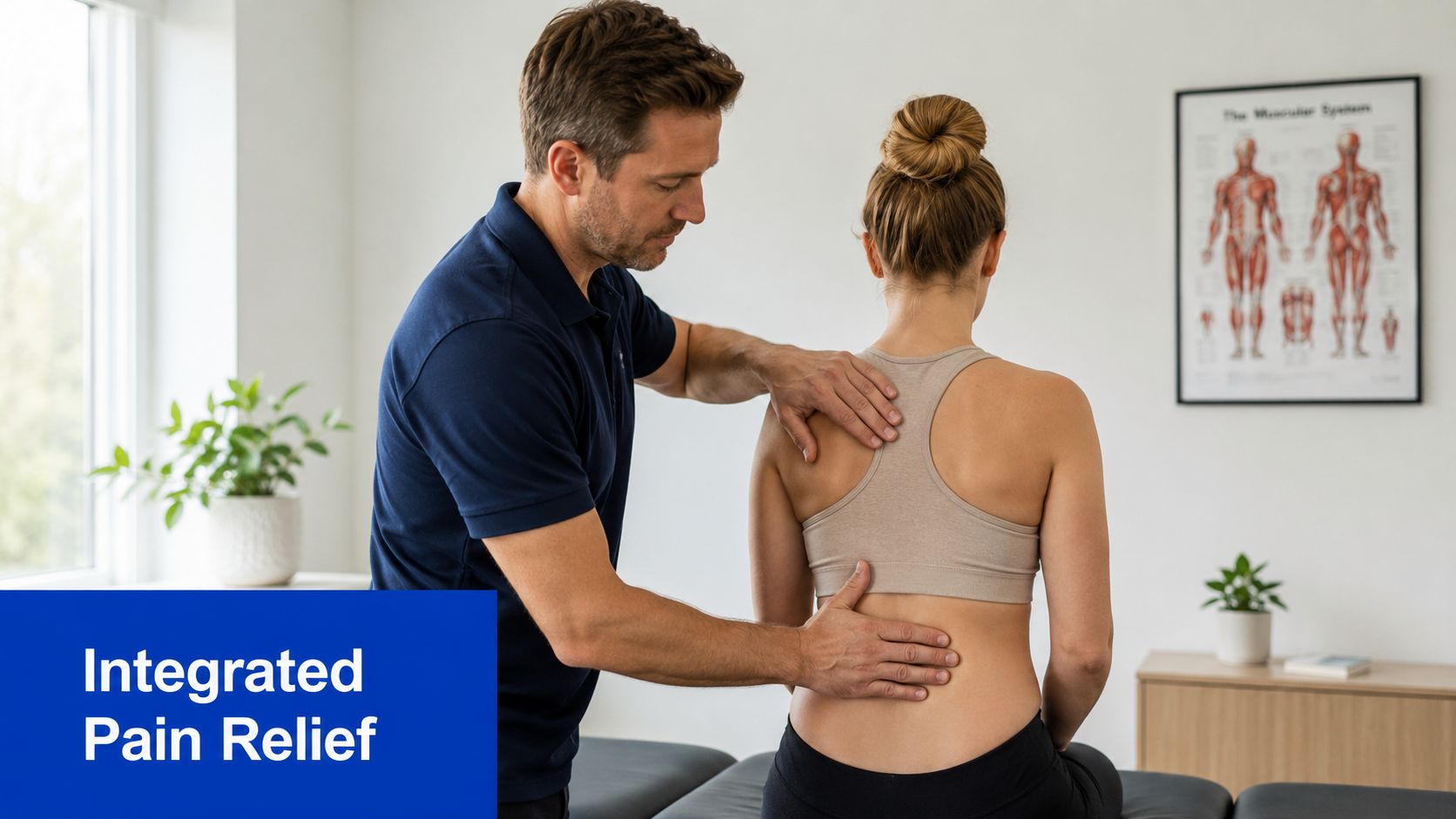
The Osteopath as a Coordinator
Think of an osteopath less as a one-off fixer and more as a coordinator for your musculoskeletal care. The job isn't only to reduce discomfort on the day. The job is to work out why a problem keeps reappearing, what's maintaining it, and which inputs are likely to help you move forward.
That can include assessing joint motion, muscle tension, load tolerance, movement habits, work setup, exercise history, and recovery capacity. From there, the plan becomes more coherent. One person may need manual treatment plus gradual strengthening. Another may need pacing, walking progression, and workstation changes. Another may need referral for medical review before any treatment plan proceeds.
For readers who want a broader overview of the profession itself, this guide to understanding osteopathy and whole-body care explains the principles in more detail.
What Integration Looks Like in Practice
A useful pain plan usually has three layers.
- Settle the area. Reduce irritation and guarding with hands-on treatment, temporary activity modification, and simple symptom-relief strategies.
- Restore movement. Reintroduce safe range, coordination, and confidence in the painful area and related regions.
- Build resilience. Add strength, routine, and daily habits so the body copes better with work, parenting, sport, or long periods at a desk.
Bayside Osteopathic Health provides osteopathic care that may include soft-tissue work, articulation, gentle mobilisation, movement advice, and home-care guidance as part of that broader process.
Some people find it helpful to see what this kind of hands-on approach looks like in practice:
The most effective plan is often the one where each part supports the others. Treatment creates room. Exercise keeps it. Daily habits stop the same strain from rebuilding.
That integrated view is one reason osteopathy fits well within natural pain solutions. It doesn't ask you to choose between hands-on care and self-management. It ties them together.
When to See a Professional About Your Pain
A common mistake is assuming that because pain is common, it's always safe to self-manage. It isn't. Many aches and strains do respond well to conservative care, but some symptoms need proper medical review before you rely on home remedies or manual treatment.
That matters because musculoskeletal pain is so widespread. Chronic musculoskeletal conditions affect 7.3 million Australians, and clearer guidance on when to self-manage versus when to seek review meets a real safety need according to this summary on triage and red-flag pain guidance.
Pain That Usually Suits Early Conservative Care
In many cases, it makes sense to start with a measured, sensible plan if the pain is mechanical and uncomplicated. Examples include stiffness after long desk hours, mild flare-ups linked to gardening or lifting, or recurring tension patterns that improve with movement and rest.
These situations often suit:
- Gentle activity modification. Reduce aggravating loads without becoming inactive.
- Simple symptom relief. Heat, short walks, mobility drills, or posture changes.
- Early assessment if it lingers. If it's not settling, an examination can stop guesswork.
Red Flags That Need Medical Review
Some symptoms need a stronger response. Seek prompt medical attention if you have pain with any of the following:
- Progressive numbness or weakness. Especially if it's affecting grip, walking, or balance.
- Changes in bladder or bowel control. This is not a wait-and-see issue.
- Pain after significant trauma. A fall, collision, or heavy impact needs proper assessment.
- Unexplained weight loss, fever, or feeling systemically unwell. Pain paired with broader health changes needs medical review.
- Pain that is constant, severe at night, or not eased by rest or position changes. Mechanical pain usually changes with movement or posture.
- New chest pain, shortness of breath, or pain spreading in an unusual pattern. That needs urgent medical attention.
- A history that increases concern. If you have a significant medical history and your pain feels different, don't assume it's routine.
If your symptoms are unusual, escalating, or affecting basic body functions, the safest natural step is getting the right diagnosis.
Good care starts with good triage. Natural pain solutions are most helpful when they're used for the right problem, at the right time.
Your Next Steps for Pain Relief in Bayside
It's easier to act when you know what the first appointment will involve. For many people, booking care is less about commitment and more about uncertainty. They don't want more vague advice. They want a clear assessment, a sensible plan, and practical next steps.
What to Expect at Your First Appointment
A good initial consultation should feel structured, not rushed. The practitioner will usually ask how the pain started, what aggravates it, what eases it, how it behaves across the day, and whether there are any warning signs that need referral.
Then comes the physical assessment. That may include posture, joint motion, muscle tension, basic strength, and how you move through the actions that matter to you. The point isn't to collect interesting findings. It's to build a plan that matches your goals, whether that's getting through desk work more comfortably, returning to walking, or managing arthritis-related stiffness.
Useful first steps often include:
- A clear explanation. You should leave understanding the likely drivers of the problem in plain English.
- One or two home strategies. Not an overwhelming list. Just the actions most likely to help now.
- A timeframe for review. Enough structure to track progress and adjust if needed.
If you're looking locally, this page for finding an osteopath near Bayside is a practical place to start.
Medicare Pathways and Practical Access
For some patients, Medicare support may be available through a Chronic Disease Management plan arranged by a GP. Eligibility depends on your circumstances and your doctor's assessment, so it's worth asking whether you qualify.
The practical steps are straightforward:
- Book with your GP and discuss your ongoing condition and current management needs.
- Ask whether a Chronic Disease Management plan is appropriate for your situation.
- Bring the referral details to your osteopathy appointment if a plan is arranged.
- Confirm fees and rebates in advance so you know what to expect.
If Medicare doesn't apply, private health extras may still help depending on your cover. Either way, the aim is the same. Make care accessible enough that you can follow through on a plan, not just think about one.
For Bayside residents, convenience matters more than people realise. The best treatment strategy is still vulnerable to missed appointments, long travel times, and a plan that doesn't fit real life. Local, practical care tends to be easier to maintain.
Taking Control of Your Comfort and Wellbeing
Pain can feel chaotic, but good management usually isn't. It becomes clearer when you stop treating every flare as a separate emergency and start seeing the broader pattern. How you move, recover, work, sleep, and respond to stress all shape how pain behaves.
That's why natural pain solutions work best as a coordinated approach. Movement helps, but only if it matches your capacity. Hands-on treatment helps, but it needs to lead into better function. Self-care tools help, but only when you know what each one is for. Professional guidance helps by sorting out what is safe to manage, what needs closer attention, and how the pieces fit together.
A lot of people wait until pain becomes severe before seeking help. Often, the better time is earlier, when the body is still adaptable and the pattern is easier to interrupt. Small changes made consistently tend to beat dramatic efforts that only last a week.
You don't need to do everything at once. You do need a plan that makes sense for your body, your life, and your goals. That's where confidence starts returning. Not because pain vanishes overnight, but because you understand what you're dealing with and what to do next.
If you're ready to move from trial-and-error to a more structured path, professional support can help you build a plan that's calm, practical, and sustainable.
If you'd like support putting these ideas into practice, Bayside Osteopathic Health offers appointments for people dealing with back, neck, and joint pain who want a whole-body, hands-on approach combined with practical self-management guidance.