

Nearly half of Australians aged 75 and over, 48.9%, reported arthritis in 2022, according to the Australian Institute of Health and Welfare. That makes joint pain familiar, but it doesn't make every painful knee, stiff knuckle or aching back the same problem.
Arthritis pain symptoms are clues, not a diagnosis. Where pain occurs, when stiffness appears and whether a joint feels warm can help explain what's happening. The aim isn't to diagnose yourself. It's to recognise when sensible self-management is appropriate and when a medical assessment should come first.
Table of Contents
- Arthritis Pain Symptoms at a Glance
- Why Each Type of Arthritis Hurts Differently
- Telling Mechanical and Inflammatory Pain Apart
- How Arthritis Pain Changes Joint by Joint
- Red Flags That Need Medical Review Now
- Self-Management and Osteopathic Care That Help
- Book the Right Assessment Before You Treat
Arthritis Pain Symptoms at a Glance
In 2022, 14.5% of Australians had arthritis, according to the Australian Bureau of Statistics. Arthritis is a group of conditions, so its pain does not follow one predictable pattern.
Common symptoms include aching, stiffness, swelling and reduced movement. A knuckle that resists bending, a knee that makes standing from a chair difficult, or a joint that changes suddenly during a flare can each offer clues about what is happening.
The type of arthritis can shape those clues. In a 2017–18 survey, osteoarthritis made up 62.0% of reported arthritis cases and rheumatoid arthritis 12.7%, according to the AIHW chronic musculoskeletal conditions report. These historical figures are not a current breakdown of every arthritis type.
Main arthritis types and their pain patterns
| Arthritis type | Share of cases | Who it usually affects | Core pain pattern |
|---|---|---|---|
| Osteoarthritis | Largest share in the 2017–18 survey | Adults, with risk increasing with age | Ache with loading, stiffness after rest, sometimes grinding |
| Rheumatoid arthritis | Smaller share in the 2017–18 survey | Women more often than men | Warm, swollen joints and prolonged morning stiffness |
| Gout | Not separately reported in the survey figures above | Men, and women after menopause | Sudden, severe pain in a joint, often the big toe |
| Psoriatic arthritis | Not separately reported in the survey figures above | People with psoriasis, though joint symptoms can precede recognised skin disease | Joint pain with skin or nail changes; swollen fingers or toes |
| Ankylosing spondylitis | Not separately reported in the survey figures above | Often begins in younger adults; more often recognised in men | Inflammatory pain in the lower back and buttocks that may ease with movement |
Treat the table as a guide to patterns, not a way to diagnose yourself. Symptoms can overlap, and a person may have more than one condition. A newly hot, swollen joint still needs attention even if osteoarthritis has already been diagnosed.
Pain intensity is only one clue. A severe knee ache does not by itself show how much inflammation is present, while a milder ache may warrant assessment if swelling persists or movement is getting harder.
To describe a symptom clearly, note where it is, how long it lasts and what changes during a flare. For example, does discomfort follow activity, continue at rest or feel worst after waking? Is there puffiness, redness, warmth or a visible change in shape? These observations help a clinician understand the pattern.
Why Each Type of Arthritis Hurts Differently
Say your knee aches after stairs, while someone else's knuckles feel swollen before they've even got out of bed. Both experiences can involve arthritis, but the tissues and processes producing the pain may differ.
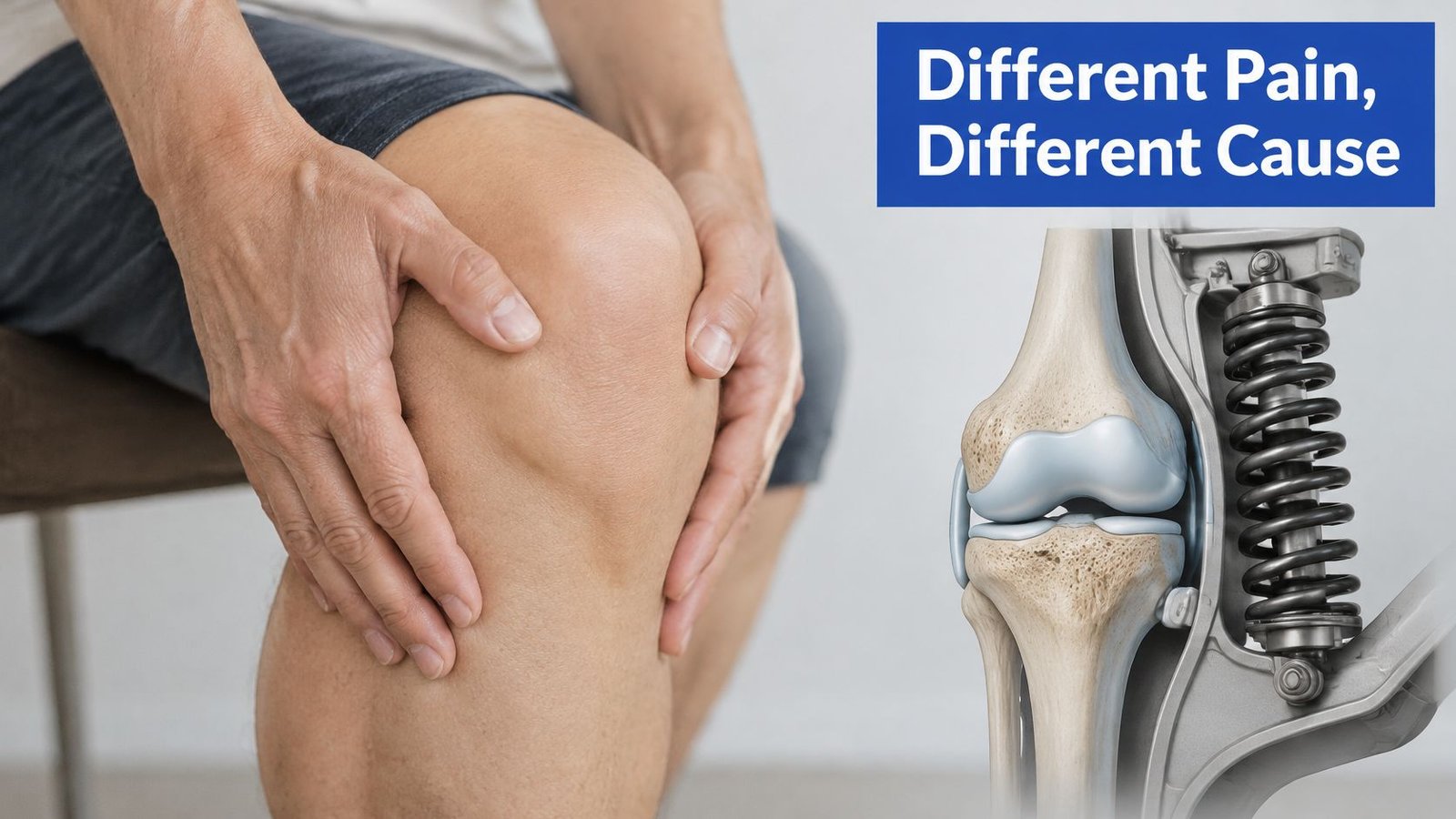
The illustration below offers a simple way to picture a load-bearing joint.
Load sensitivity versus inflammation
A joint is a little like a car's suspension: cartilage helps distribute load, rather like a shock absorber, while bone provides the supporting structure. The comparison isn't exact. Osteoarthritis affects the whole joint, not just a cushioning layer, and pain doesn't mean bones are rubbing together.
In osteoarthritis, changes in cartilage, bone and surrounding tissues can make the joint more sensitive to loading. Stairs or a long walk may produce a dull ache, while sitting still can leave the joint temporarily stiff. Grinding, weakness or a feeling of instability may accompany the pain.
Australian estimates for 2022 included approximately 2.1 million people with osteoarthritis and 514,000 with rheumatoid arthritis, within an estimated 3.7 million people with arthritis, as summarised by Healthdirect's arthritis guidance.
Rheumatoid arthritis works differently. Think of an immune alarm that keeps sounding when it shouldn't: the immune system drives inflammation in the joint's synovial lining. That helps explain warmth, soft swelling and stiffness that isn't tied to how much work the joint has done.
This video provides another visual introduction to arthritis.
Why the mechanism matters
Osteoarthritis and rheumatoid arthritis can coexist, and ongoing inflammation can also damage joint structures. Neither condition can be reliably identified by how the ache feels in isolation.
Practical distinction: Pain after loading suggests a different problem from persistent joint warmth and swelling, even when both are described as aching.
Pain at rest can occur in more advanced osteoarthritis, so it doesn't automatically establish an inflammatory diagnosis. However, new rest pain, progressive loss of function or persistent inflammation deserves assessment rather than dismissal as ordinary wear and tear.
Telling Mechanical and Inflammatory Pain Apart
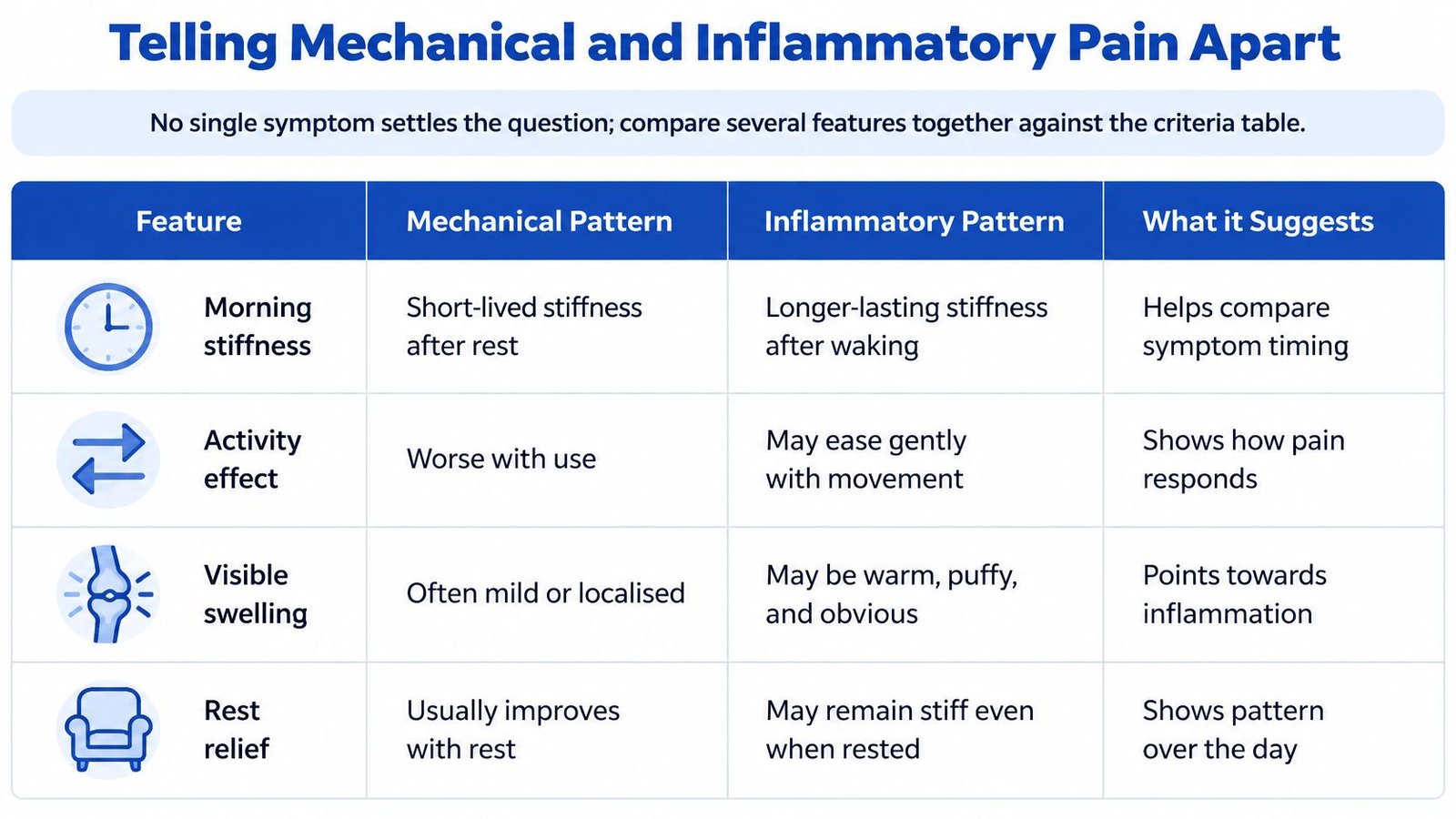
No single symptom settles the question. Clinicians compare several features together, including onset, stiffness, swelling and the effect on everyday activity.
Mechanical pain is generally linked to loading or movement. Inflammatory pain may remain troublesome when the joint hasn't been used. These are useful patterns, not separate boxes into which every person fits neatly.
Mechanical versus inflammatory pain patterns
| Feature | Mechanical pattern | Inflammatory pattern | Clinical pointer |
|---|---|---|---|
| Morning stiffness | Usually relatively short-lived | Often more prolonged after waking | Record how long it takes to move comfortably |
| Onset | Commonly gradual | Can develop over weeks to months | A changing pattern deserves review |
| Effect of activity | Often worse with sustained use and eased by unloading | May persist at rest and ease with gentle movement | Compare both activity and recovery |
| Joint signs | Bony enlargement, creaking or grinding | Warmth, redness or soft swelling | Persistent warmth and swelling favour assessment |
| Joints involved | May be unevenly distributed | Can involve matching joints on both sides | Matching hand or foot swelling is important |
| General symptoms | Usually local symptoms | Fatigue, feeling unwell or fever may accompany pain | Whole-body symptoms broaden the possible causes |
The visual comparison highlights the same practical observations.
Which clues deserve more attention?
Symmetry, warmth and whole-body symptoms are particularly useful to mention at an appointment. Matching swollen knuckles on both hands tell a different story from an isolated finger joint that has gradually become hard and enlarged.
Morning stiffness also needs context. Brief difficulty getting moving after sitting isn't the same experience as struggling through much of the morning with swollen hands. Describe what you can't do during that period, such as fastening buttons or holding a cup, rather than only saying you feel stiff.
The AIHW rheumatoid arthritis information identifies morning stiffness lasting more than an hour, or swelling and tenderness in three or more joints for at least six weeks, as important assessment clues. These aren't instructions to wait until a threshold is reached before seeking help.
Older adults may have mixed features. A knee can be load-sensitive while the hands have a separate inflammatory problem. A clinician needs to assess each pattern rather than assume one explanation covers every joint.
Record what happens naturally. Don't repeatedly squeeze, twist or stress a painful joint to test whether it is arthritic.
When inflammatory features persist, the useful next step is a GP review, not increasingly elaborate self-testing.
How Arthritis Pain Changes Joint by Joint
Hands and knees often make arthritis noticeable because we use them throughout the day. Yet the same description, such as a deep ache, means more when you know which joint hurts and which task provokes it.
In the hands, the precise joint matters. Hard enlargement near the fingertips suggests a different pattern from soft, matching swelling around the knuckles. In the knee, stairs, rising from a chair and prolonged standing help reveal how the joint responds to load.
Typical arthritis patterns by joint
| Joint | Typical arthritis pattern | Pain location and feel | Clue that matters |
|---|---|---|---|
| Hands and fingers | Osteoarthritis at fingertip joints and thumb base; rheumatoid arthritis can affect knuckles in both hands | Aching, swelling, weaker grip | Bony lumps suggest osteoarthritis; matching soft swelling suggests inflammation |
| Knee | Osteoarthritis is common, including at the inner knee | Ache on stairs, stiffness after sitting, sometimes night ache | Giving way or locking needs assessment |
| Hip | Osteoarthritis may be felt in the groin, thigh, buttock or knee | Difficulty with socks, turning in bed or walking | Knee pain can originate in the hip |
| Neck and low back | Spinal osteoarthritis; inflammatory spinal arthritis can affect the lower back | Stiffness and ache; inflammatory symptoms may ease with movement | Night waking plus prolonged morning stiffness deserves review |
| Big toe and feet | Gout; rheumatoid arthritis can affect forefoot joints | Sudden throbbing, redness or swelling; forefoot pain on loading | A newly hot, swollen toe shouldn't be assumed to be gout |
| Shoulder | Osteoarthritis or rheumatoid arthritis, with possible rotator cuff overlap | Pain overhead or when lying on the affected side | Restricted movement in several directions may suggest joint involvement |
Our guide to arthritis pain in the knee offers more detail about knee symptoms and movement difficulties.
Why the sore spot can mislead
Hip pain is a useful example of referred pain, discomfort felt somewhere other than its source. Someone may seek help for a painful knee while also finding it increasingly difficult to put on socks because the hip has become stiff.
Shoulder symptoms create another common confusion. Pain when reaching into a cupboard can arise from the joint, nearby tendons or both. The movement that hurts is useful information, but it doesn't identify the tissue by itself.
- Describe the task: Mention stairs, gripping, reaching or rolling in bed.
- Describe the restriction: Explain whether pain stops you or the joint physically won't move further.
- Mention nearby symptoms: Include groin discomfort with knee pain, or arm symptoms with neck pain.
Location narrows the possibilities. It doesn't replace an examination of the surrounding joints and tissues.
Red Flags That Need Medical Review Now
A hot, red, swollen joint with fever or feeling unwell needs urgent same-day medical assessment. Joint infection is one possible cause, and it can resemble an arthritis flare. Don't wait for a routine hands-on treatment appointment.
Urgency depends on the pattern and your overall condition, not only on whether you can tolerate the pain. A new symptom in someone with an existing arthritis diagnosis still needs to be considered on its own merits.
Choose the appropriate level of care
- Emergency or urgent same-day assessment: Seek urgent care for a hot, swollen joint with fever, chills or significant illness. Sudden severe pain with inability to bear weight, particularly after injury, also needs urgent assessment.
- Same-day or next-day medical review: Arrange prompt review for a sudden, severe attack in an individual joint, including a red, throbbing big toe. Gout is possible, but infection and other causes must be considered, especially with a first attack.
- Early GP appointment: Book promptly for persistent swollen joints, matching hand or foot symptoms, or prolonged morning stiffness. Don't postpone the appointment because symptoms fluctuate or painkillers make them manageable.
- Prompt review for associated symptoms: Tell your GP about unexplained weight loss, night sweats, persistent fatigue, a rash, eye redness or bowel symptoms. Back pain that began in younger adulthood and comes with marked morning stiffness also deserves discussion.
A painful red eye or changes in vision require urgent assessment, rather than waiting to see whether joint symptoms improve. Likewise, back pain with new bladder or bowel control problems, numbness around the groin or progressive leg weakness needs emergency care.
Why an assessment is more than a blood test
There isn't a single test that settles every suspected rheumatoid arthritis diagnosis. A clinician combines your symptom history with examination findings and, when appropriate, blood tests and imaging.
This matters when symptoms are intermittent. You might arrive on a relatively comfortable day, even though your hands were visibly swollen earlier. Photographs of a flare and a clear description of what happened can help communicate the pattern.
Safety rule: A red flag is a reason to get assessed, not proof that you have a dangerous condition.
Avoid trying to settle the diagnosis by taking leftover medication, forcefully stretching the joint or waiting for another attack. If you're unsure which service to use, seek medical advice about urgency rather than assuming a routine appointment is sufficient.
Self-Management and Osteopathic Care That Help
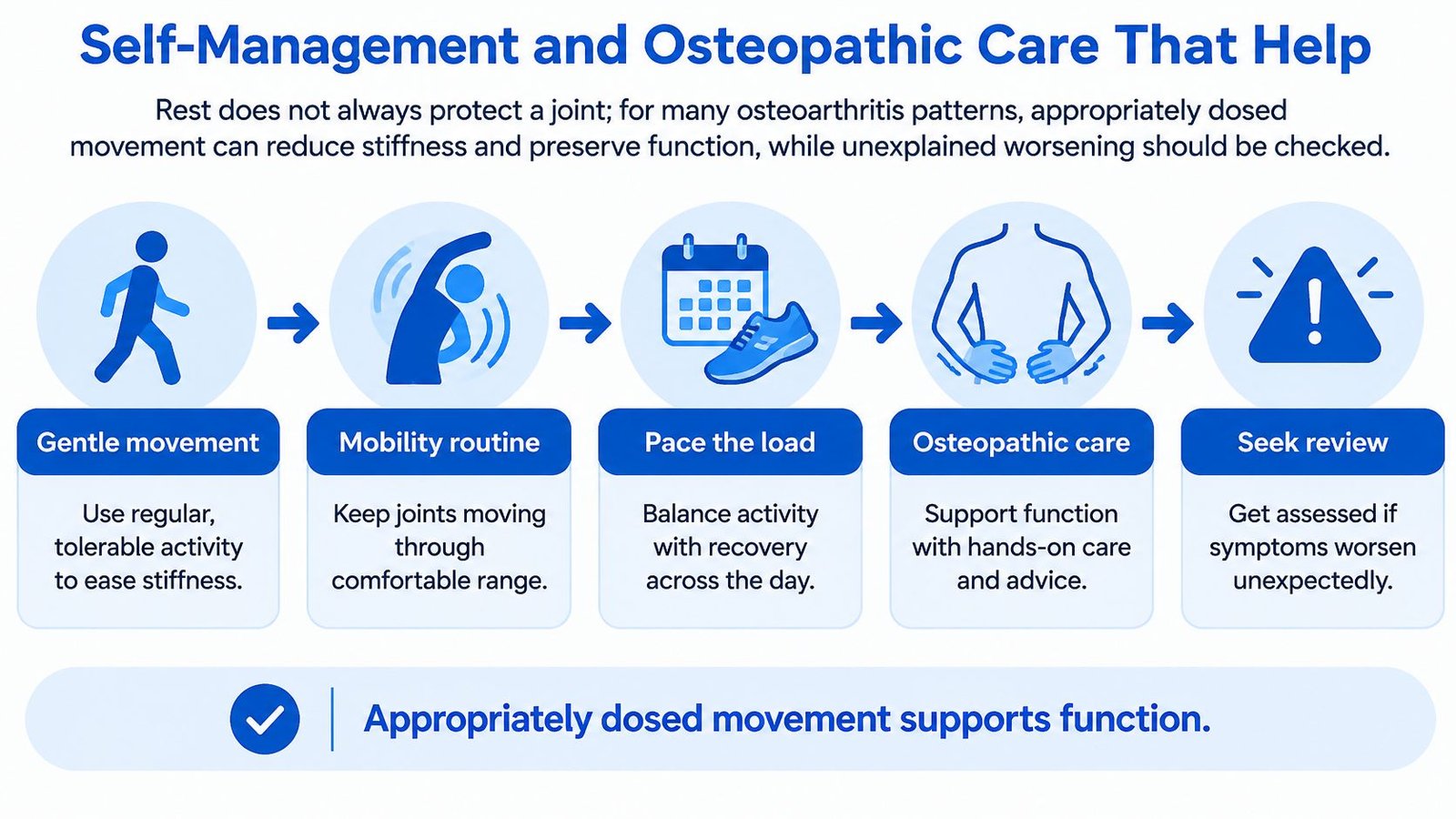
Rest doesn't always protect a joint. For many osteoarthritis patterns, tolerable movement helps reduce stiffness and preserve function, while prolonged inactivity can make everyday movement harder. The AIHW osteoarthritis guidance helps explain why pain with activity and stiffness after rest can occur together.
That doesn't mean you should push through any pain. The useful approach is graded activity, matching the amount of movement to your current capacity and adjusting it according to your response.
Use a next-day check
- Start below your aggravation point. Choose a comfortable walk, gentle cycling or a manageable household task rather than testing your maximum.
- Use short bouts. Spread activity across the day instead of doing everything during a brief period of feeling better.
- Check the response afterwards. Notice your symptoms that evening and the following morning.
- Adjust the next attempt. If you remain noticeably above your usual baseline, reduce the duration, resistance or overall load.
- Stop for warning signs. A newly hot or markedly swollen joint, fever or unexpected deterioration needs medical review.
Your response during activity is only part of the picture. Recovery towards your usual baseline by the next day is a practical guide, not a guarantee that a particular activity is suitable. Sharp pain, locking or a major change in walking shouldn't be ignored because you plan to check again tomorrow.
The process below brings movement, pacing and review together.
Where hands-on care fits
Osteopathic care may include gentle soft-tissue work, joint articulation and mobilisation, alongside movement advice. The aim is to support comfort and function, not to regrow cartilage or replace medical treatment for inflammatory disease.
At Bayside Osteopathic Health, we work closely with each arthritis patient's GP and specialist team where appropriate. Treatment should never be painful, although mild temporary soreness may follow a session. Our joint pain relief information explains this supportive approach.
At home, use warmth for stiffness or a wrapped cold pack for local discomfort if it feels helpful. Protect your skin and avoid applying heat to an unexplained hot, swollen joint.
Strength work can support everyday tasks, while pacing helps avoid repeated cycles of overdoing activity and then stopping altogether. If weight management is relevant, discuss achievable support with your clinician rather than treating weight loss as a prerequisite for receiving care.
Book the Right Assessment Before You Treat
Choose medical or urgent care first when red flags apply. For a stable, apparently mechanical pattern, a GP can help clarify the cause, with osteopathic care joining the plan where appropriate.
You don't need to arrive knowing the name of your condition. A useful appointment begins with a clear account of what changed and what you can no longer do comfortably.
Bring information that helps decisions
- Onset and daily pattern: Note when symptoms began, whether they were sudden or gradual, and when they're worst.
- Morning stiffness: Record how long it takes to move normally after waking.
- Joint map: List affected joints and whether matching joints on both sides are involved.
- Triggers and relief: Include activity, rest, sleep position and anything you've tried.
- Medical background: Bring current medicines, previous injury details and relevant family history, including arthritis or psoriasis.
- Symptom diary: Keep a brief record while awaiting the appointment, including swelling photographs when useful. Don't delay urgent care to complete it.
A clinician will usually take a history and examine movement, tenderness and swelling. Blood tests may help investigate inflammatory disease, while an X-ray or ultrasound may be useful when it would clarify the diagnosis or change management. Not every painful joint needs every test.
What to expect from an osteopathic assessment
Our initial assessment includes a detailed case history and physical assessment of posture, movement and the specific area of concern. We consider how surrounding areas contribute, and communicate with your GP where appropriate.
The guide Can an osteopath diagnose arthritis? explains how osteopathic assessment fits alongside medical diagnosis. Suspected inflammatory disease or urgent symptoms require the appropriate medical pathway, not hands-on care alone.
We prioritise prompt bookings for acute or urgent pain, but this doesn't replace emergency assessment. We also welcome enquiries about whether osteopathic care is right for you.
Take the appropriate next step this week: arrange medical assessment for unexplained or changing symptoms, or discuss supportive care once the pattern is medically understood.
Bayside Osteopathic Health offers gentle, individualised assessment, hands-on care and practical movement advice for arthritis-related stiffness and discomfort. Visit Bayside Osteopathic Health to enquire about an appointment and discuss how osteopathic care could fit alongside your GP or specialist's plan.