
In 2023 and 2024, back pain was the fifth most common reason people presented to Australian emergency departments, accounting for almost 155,000 presentations, as The Age reported using Australian health data. That figure tells you two things at once. Back pain is common enough to fill hospital waiting rooms, and most of the people in those waiting rooms go home with nothing more dangerous than a strained segment and advice to keep moving.
The gap between "very common" and "occasionally serious" is exactly where most red flag lists fail. They hand you a flat checklist, so a twinge at 2 am reads the same as a numb saddle. This article sorts the same warning signs into three tiers: call Triple Zero (000) now, get seen the same day, and book a GP review within days. Find the tier that matches your whole pattern, not a single line item.
Table of Contents
- Back Pain Red Flags at a Glance
- What Back Pain Red Flags Actually Mean
- Emergency Red Flags That Need Triple Zero Now
- Same-Day and Prompt Review Patterns
- Why One Symptom Rarely Means Serious Disease
- What Red Flags Look Like in Everyday Situations
- Choose Your Next Step Tonight
Back Pain Red Flags at a Glance
Most back pain is mechanical. A joint, a disc, a muscle group got loaded awkwardly, and the result is stiff, sore and self-limiting. Keep moving gently and it usually eases over days to weeks. The complication is the small minority that isn't mechanical, because fracture, infection, cancer and nerve compression all announce themselves through back pain first.
Three levels of urgency
Emergency. Nerve function is under threat right now. The response is a Triple Zero (000) call or a direct trip to an emergency department, not the next available appointment.
Same day. Something needs assessing today, either in an emergency department or with an urgent GP slot, because infection or a fracture is a real possibility that won't improve by waiting a week.
Prompt. A GP review within days, sooner if symptoms are building. This tier is for patterns that raise a question without demanding an immediate answer.
Readers going through a red flag list often land in none of these tiers. They're in the fourth, unlisted group: mechanical pain that's sore, stiff to get moving and slowly improving, and that responds to movement rather than investigation.
How to read the table
| Red flag symptom | Possible serious cause | Urgency | What to do |
|---|---|---|---|
| New loss of bladder or bowel control | Cauda equina syndrome | Emergency | Call Triple Zero (000) now |
| Unable to pass urine (retention) | Cauda equina syndrome | Emergency | Call Triple Zero (000) now |
| Numbness in the saddle area, groin or inner thighs | Cauda equina syndrome | Emergency | Call Triple Zero (000) now |
| Sudden leg weakness, foot drop or loss of limb movement | Severe neurological deficit | Emergency | Call Triple Zero (000) now |
| Back pain with fever of 38°C or higher, chills or feeling very unwell | Spinal infection | Same day | Emergency department or urgent GP review |
| New severe pain after a fall from height, car crash or direct blow | Spinal fracture | Same day | Emergency department assessment |
| Progressive numbness, pins and needles or weakness in the legs | Nerve compression | Prompt | GP review within days |
| Unexplained weight loss with ongoing back pain | Possible malignancy | Prompt | GP review this week |
| New or worsening pain with a previous cancer diagnosis | Spinal metastasis | Prompt | GP review this week |
| Severe pain at rest or at night that position does not ease | Infection, tumour or inflammatory disease | Prompt | GP review this week |
| New pain with osteoporosis or long-term corticosteroid use | Compression fracture | Prompt | GP review this week |
Match your symptoms to the most urgent row that fits, then take that action. If two rows seem to apply, say new leg weakness alongside a fever, treat the more urgent one as your answer. You don't need to work out which cause is most likely. That's the clinician's job, and it rests on examination, reflexes, sensation and history rather than how loudly the pain is shouting.
The rule that settles it: when two rows match, act on the more urgent one. Uncertainty always points upward, never down.
One row needs a footnote. Occasional night pain is common and, on its own, doesn't belong in an urgent tier. What earns a prompt review is severe pain at rest or at night that changing position doesn't ease, particularly alongside a cancer history, unexplained weight loss, fever or significant trauma.
And the catch-all. If this pain feels different from your usual back pain, or you're worried, getting checked is a reasonable choice regardless of which row fits. You don't need permission to ask.
What Back Pain Red Flags Actually Mean
A red flag is a symptom or a piece of history that raises the possibility of serious spinal pathology and changes what happens next. It isn't a diagnosis and it isn't a prediction. Think of a smoke alarm: it tells you to go and look, not which appliance is burning, and one alarm going off doesn't prove the house is on fire. Clinicians use flags the same way, as a reason to ask more questions, examine more carefully and consider a scan that otherwise wouldn't be justified.
What clinicians actually screen for
Five serious causes sit behind the checklist. Spinal fracture, most often a compression fracture in bone thinned by osteoporosis or long-term corticosteroid use. Spinal infection, such as discitis or an epidural abscess. Cancer in or near the spine, whether primary or spread from elsewhere. Cauda equina syndrome, the compression of the nerve bundle at the base of the spinal canal. And significant or progressive nerve compression, where weakness or numbness is worsening rather than settling.
The prevalence context matters more than any single flag. Fewer than 1% of acute low back pain presentations in Australian primary care are attributed to spinal fracture, malignancy, spinal infection or cauda equina syndrome, and RACGP guidance on imaging in adults with acute low back pain notes that the Australian Commission on Safety and Quality in Health Care considers imaging important when serious pathology is suspected but not indicated for more than 95% of people who lack relevant warning features.
That's the balance in one line: most back pain isn't dangerous, and the small group with credible flags needs prompt medical assessment rather than routine hands-on care alone. The same guidance advises immediate emergency department referral when assessment suggests cauda equina compression, spinal infection, an acute high-impact fracture or a severe neurological deficit, and says imaging should never delay that referral.
Mechanical pain versus pain that needs checking
| Feature | Everyday mechanical pain | Pain that needs checking |
|---|---|---|
| Onset | Often after lifting, twisting or unaccustomed activity | Often without a clear mechanical cause |
| Response to movement | Changes with position and eases with rest | Constant and unrelieved by rest or position |
| Night symptoms | Settles once comfortably positioned | Severe pain that wakes you or is worst at night |
| Systemic signs | None | Fever, chills, night sweats, unexplained weight loss |
| Nerve symptoms | Occasional fleeting pins and needles | Progressive weakness, numbness or bladder and bowel change |
| Trajectory | Gradually improving over days to weeks | Worsening or unchanged after several weeks |
| Relevant history | No major illness | Previous cancer, osteoporosis, corticosteroids, recent infection |
Red flags are risk indicators, not verdicts. A clinician weighs the whole pattern, the timing, the examination and the history before deciding between a scan, a referral and a sensible conservative plan.
Emergency Red Flags That Need Triple Zero Now
This is the tier where minutes count, and it's also the tier people talk themselves out of. The pain is bearable, the tingling is mild, the bladder thing is probably a urinary tract infection. That reasoning is how a treatable nerve injury becomes a permanent one.
What cauda equina syndrome actually is
Below where the spinal cord ends, a bundle of nerve roots continues down the spinal canal. Anatomists named it the cauda equina, Latin for horse's tail, because that's what it looks like. Those roots carry the signals for bladder control, bowel control, sensation around the groin and saddle area, and much of the strength in your legs.
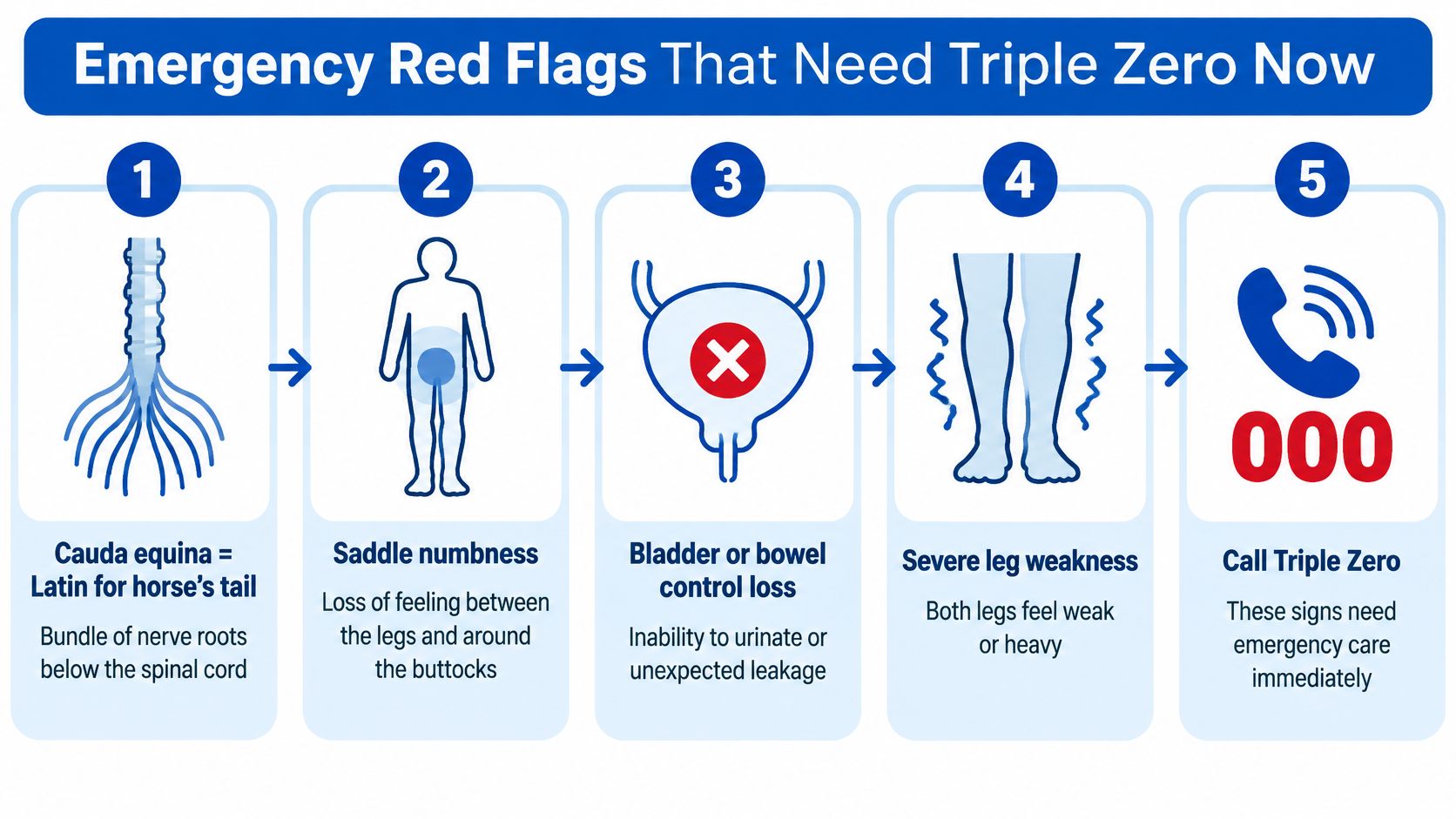
When that bundle is suddenly compressed, usually by a large disc herniation but sometimes by a tumour, abscess, blood clot or fracture, the signals stop arriving. Healthdirect's back pain guidance is direct about the pattern: new or worsening back pain with bladder or bowel dysfunction, urinary retention, saddle-area numbness or progressive leg weakness is an emergency, and urgent assessment should not be delayed for osteopathic treatment, exercise or routine imaging.
The specific signs to act on are new difficulty starting the urine stream or complete retention, loss of bladder or bowel control, numbness or altered feeling in the perineum, groin and inner thighs, weakness in one or both legs or a foot that drops, and spreading loss of sensation or movement. A bladder that feels full but won't empty is the classic presentation and the one most often dismissed as unrelated.
Decompression is time-critical. Delay can mean permanent bladder, bowel or walking problems, and no painkiller or manual therapy session buys that time back.
Your five steps if this is happening now
- Call Triple Zero (000) or go straight to an emergency department. Say the words: I have back pain with new bladder or bowel changes and saddle numbness.
- Don't drive yourself. Arrange someone else or wait for the ambulance, because weakness can progress mid-journey.
- Note when each symptom started and how fast it's changing. A timeline of hours versus days changes the urgency and helps the team.
- Take your medication list and identification. Steroids, blood thinners and recent procedures all matter to the assessment.
- Don't wait for a booked appointment or for scans first. Cancel the physio, osteo or massage session. Imaging happens at the hospital, not before it.
If a clinician has told you to watch and wait, and any of these signs appear, that advice is superseded.
Same-Day and Prompt Review Patterns
The middle tiers work differently from the emergency tier. There's no single dramatic sign to catch your attention. Instead you're reading a combination of features, and the combination is what earns the appointment.
The same-day tier
Fever with back pain is the classic pairing. Healthdirect's guidance on low back pain names fever of 38°C or higher, feeling unwell, susceptibility to infection or intravenous drug use, previous cancer, unexplained weight loss, osteoporosis, significant trauma, older age and corticosteroid therapy as reasons for prompt medical review or targeted investigation, and explains that a meaningful screen is triggered by combinations of systemic or structural risk factors rather than pain intensity alone, as set out in Healthdirect's low back pain advice.
A fever moves you from prompt to same day, because infection can seed a disc or the epidural space, and that's a condition where a day or two of waiting changes the treatment and the outcome. Recent surgery, a weakened immune system or injecting drug use raises that suspicion further.
New severe pain after a fall from height, a car crash or a direct blow also belongs here. A fracture is possible in a healthy spine and considerably more likely in bone thinned by age or steroids. Go and get it looked at the same day rather than booking something for next week.
The prompt review tier
Everything else in the middle band fits a simple test: does a second risk feature stack on top of the first? A previous cancer diagnosis plus new pain that won't ease with position changes is a prompt review this week. Osteoporosis, older age or long-term corticosteroid therapy plus even modest trauma, such as a slip in the garden, makes a compression fracture plausible enough to warrant assessment.
Progressive leg numbness, pins and needles or weakness that hasn't reached the point of sudden paralysis still needs a GP within days, because the direction of travel is the concern. So does unexplained weight loss alongside ongoing pain.
Pain intensity on its own doesn't trigger an infection, cancer or fracture investigation. One mild item, such as age or an occasional uncomfortable night, usually waits on the wider pattern. Two or more risk features together justify the review and, only then, targeted imaging. Scans are not routinely useful for uncomplicated low back pain and can expose you to radiation without changing management, but they become appropriate once neurological deficits, bladder or bowel changes or fracture risk are present.
Why One Symptom Rarely Means Serious Disease
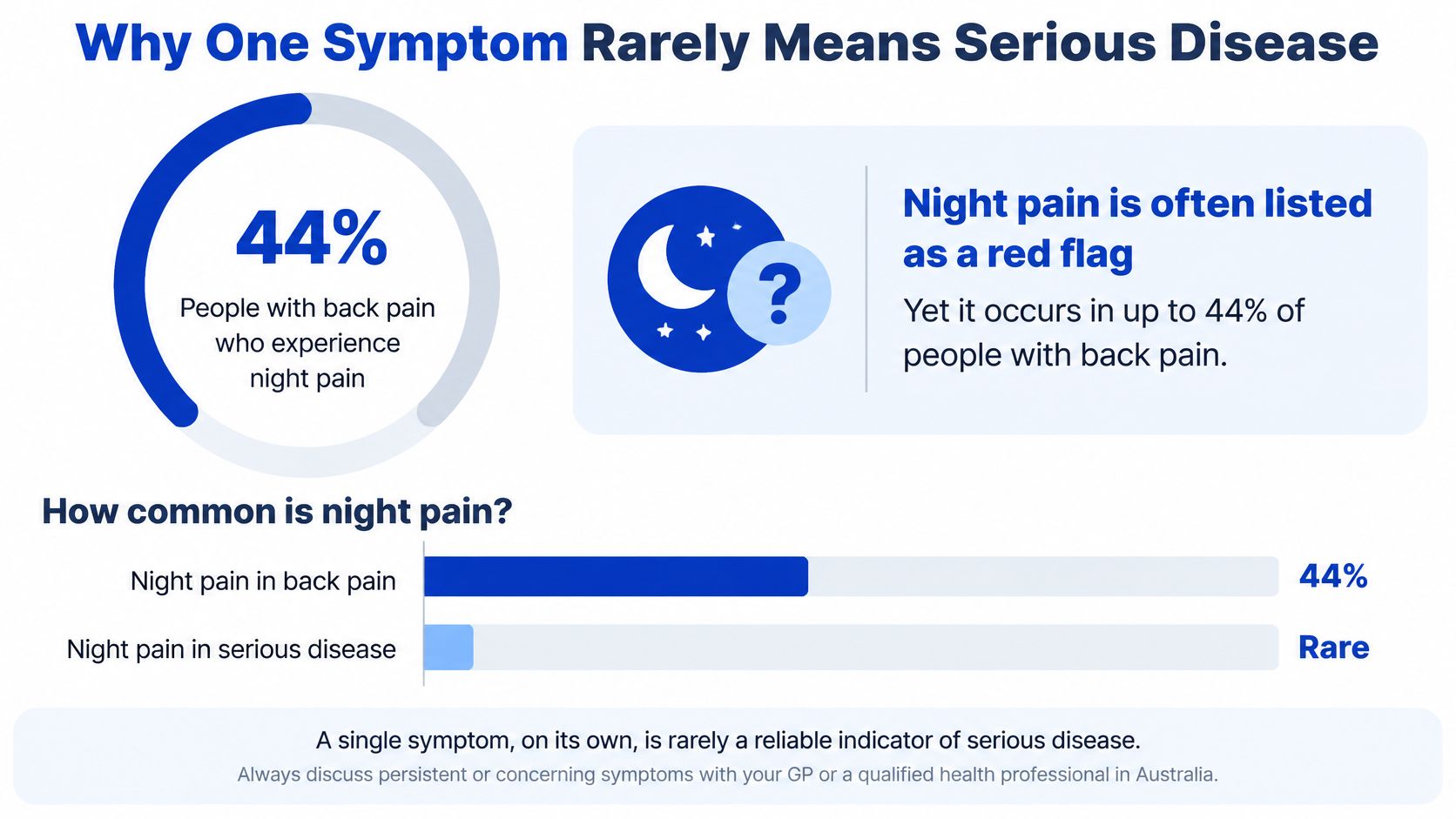
Night pain sits near the top of almost every red flag list, and it's the one that gets people out of bed at 2 am searching. Here's where the numbers turn interesting. A 2018 review in the Australian Journal of General Practice reported that night pain may occur in up to 44% of people with back pain, while serious pathology is present in fewer than 1%.
The same review notes that disc herniations appear on imaging in approximately 22 to 40% of asymptomatic adults, which tells you something important about what a scan can and can't do for you.
Read those findings together and the logic falls out. A symptom that turns up in nearly half of everyone with back pain can't, on its own, separate the rare dangerous causes from the common harmless ones. Night pain is worth mentioning, and worth pairing with questions about weight loss, fever, cancer history and how the pain behaves. It doesn't establish cancer or infection by itself.
Why a common symptom makes a weak test
A screening question is only useful if a positive answer narrows things down. Ask "does your back hurt?" and everyone with a strain says yes, so the answer tells you nothing. Ask "can you feel your saddle area normally?" and a yes is reassuring because the people who say no need urgent imaging.
Clinicians are running that calculation constantly. They combine timing, progression, examination findings such as reflexes, strength and sensation, and history features like cancer, steroid use or trauma. The pattern carries the signal. A single checkbox mostly carries noise.
Two mistakes that both cost you
The first is ignoring a true emergency because the pain is manageable. Nerve compression doesn't have to hurt badly to damage function, and a numb saddle with urinary retention can sit alongside a 4 out of 10 ache. Severity isn't the measure here.
The second is demanding a scan for one isolated mild symptom. Imaging for uncomplicated back pain mostly turns up age-related changes that would be there whether or not you were in pain, generates anxiety, and doesn't change what you do next.
Genuine reassurance comes from a proper assessment, not from hoping a symptom away or from buying certainty with a scan you didn't need.
Apply the same test to several mild flags together. Older age, ordinary night discomfort and a short flare after gardening usually still add up to mechanical pain. When what drives chronic back pain over months has more to do with load, sleep, strength and stress than with anything on an emergency list, the useful conversation is about those factors. The pattern that changes the action is two or more stronger features stacking: past cancer plus unrelenting pain, steroid use plus a fall, fever plus feeling systemically unwell.
A screen that finds nothing worrying is a good outcome, not a wasted appointment.
What Red Flags Look Like in Everyday Situations
Four short scenarios show how the tiers behave in real life. In each one, notice that the pain score is never the deciding factor.
The treated cancer history. A 58-year-old with breast cancer in remission five years ago develops two weeks of worsening upper back pain that no longer eases when she lies down. The cancer history plus persistent, unrelieved pain is the pattern, not the intensity. That earns a prompt GP review this week and targeted imaging, and it may well turn out to be nothing related to her cancer.
The furniture move. A 34-year-old office worker strains her lower back shifting a couch. The pain is stiff and positional, worse on standing up from a chair, better once she's walking. There's no fever, no weight loss, no leg weakness and no bladder change, and it improves steadily across ten days. This is mechanical pain following its normal course, and the right response is gentle movement, not a scan.
The garden slip. A 72-year-old on long-term prednisolone catches his foot and lands heavily, then feels a sudden severe band of mid-back pain that doesn't settle. Corticosteroid use, likely osteoporosis and a fall combine into a same-day presentation, where imaging confirms a compression fracture. Any one of those three features alone would be less concerning. Together they change the tier.
The saddle numbness. A 45-year-old notices numbness across the saddle area and can't start his urine stream, on a background of two days of low back pain. That's an emergency row and a Triple Zero call. He's assessed and decompressed the same day, and his bladder function recovers.
What each case hinged on
- Case one: a history feature plus a trajectory that didn't settle, which is a prompt review and targeted imaging.
- Case two: a clear mechanical trigger plus steady improvement over days, which needs no investigation at all.
- Case three: three risk factors stacking, which moves a modest fall into same-day territory.
- Case four: two neurological signs together, which is the one pattern where hours matter.
The lesson across all four is blunt. The symptom pattern decides the tier, and pain intensity barely features in the decision.
For the leg-dominant version of case two, where pain tracks down one leg without any of the emergency features, the useful next step is understanding treatment for sciatica pain rather than imaging.
Choose Your Next Step Tonight
Tonight's decision is simpler than the symptom list makes it look. Match what you feel right now to one of four rows, then do only that row.
- Symptoms match an emergency row. Call Triple Zero (000) now. Don't wait for a booked appointment and don't wait for a scan.
- Symptoms match a same-day row. Get to an emergency department or an urgent GP today, and don't drive yourself if your legs feel weak.
- Symptoms match a prompt row. Book a GP this week, and ask for an earlier slot if weakness, fever or pain is building.
- Nothing matches, and the pain is positional and slowly easing. Stay active with simple movement rather than resting in bed. If gentle activity is where you're starting, these back pain relief at home strategies are a sensible first step.
At the GP, report when the pain started, whether changing position alters it, any history of cancer, corticosteroid use or osteoporosis, fever, weight change, and any bladder, bowel or leg symptoms. Expect questions plus a check of strength, reflexes and sensation. Those details let the clinician separate a pattern that needs urgent review from ordinary mechanical pain.
Once a clinician has screened out the red flags, conservative care is reasonable, and hands-on treatment helps rather than delays. At Bayside Osteopathic Health, spinal pain treatment starts with a whole-body assessment to trace the contributing factors rather than treating only the site of pain. The initial assessment includes a detailed case history and a physical assessment of posture, movement, and the specific area of concern. The clinic prioritises prompt bookings for patients with acute or urgent pain, then builds a plan that combines soft-tissue work, joint mobilisation and practical home-care strategies. Book an assessment and the osteopath gives a realistic recovery timeline during that first visit.