

You stand up from the couch, take two steps, and a sharp streak shoots from your lower back into your buttock and down your leg. Sitting is uncomfortable. Walking feels awkward. Rolling over in bed suddenly takes planning. For many people, that's the moment they start searching for the best treatment for sciatica pain.
That reaction makes sense. Sciatica can feel dramatic, and when pain runs down the leg it often creates a different kind of worry than an ordinary back ache. People commonly wonder if they've “slipped a disc”, whether they should stay in bed, or if they need a scan straight away.
The reassuring part is this. Sciatica is usually manageable, and the most effective care often follows a clear sequence rather than one magic fix. In practice, the right approach starts with understanding what's irritating the nerve, then using sensible home care, then moving into targeted treatment if symptoms persist or interfere with normal activity.
Sciatica is also a symptom pattern, not a diagnosis by itself. The pain tells you a nerve is irritated. It doesn't yet tell you why. That distinction matters, because the best treatment depends on the source of the problem, how severe it is, and whether there are any warning signs that need urgent medical attention.
Table of Contents
- That Shocking Pain Down Your Leg An Introduction
- What Is Sciatica and What Causes It
- Your First Steps At Home for Sciatica Relief
- A Guide to Professional Sciatica Treatments
- Red Flags When to Seek Urgent Medical Care
- The Bayside Osteopathic Health Approach to Sciatica
- Your Personalised Path to Recovery
That Shocking Pain Down Your Leg An Introduction
A new sciatica episode often starts in an ordinary moment. You bend to pick something up, spend too long at your desk, or wake after a poor night's sleep and notice pain tracking into the leg. What catches people off guard isn't just the pain itself. It's how quickly everyday movement starts to feel uncertain.
That uncertainty is understandable. Leg pain, tingling, or weakness can make people assume the worst. But most cases don't begin with surgery, and they don't improve because someone lies still and waits. They improve when the problem is assessed properly and managed in the right order.
Sciatica is upsetting, but it usually responds better to a calm, structured plan than to panic, complete rest, or chasing quick fixes.
The practical question isn't just “What's the strongest treatment?” It's “What's the right treatment at this stage?” Early on, that may mean changing positions, keeping movement gentle, and avoiding aggravating activities. If symptoms linger, the next step is targeted professional care that matches the cause.
A good treatment pathway should help you decide what to do today, what to monitor over the next several days, and when to seek extra help. That's how most clinicians think through sciatica in practice, and it's the approach that tends to give patients the most clarity.
What Is Sciatica and What Causes It
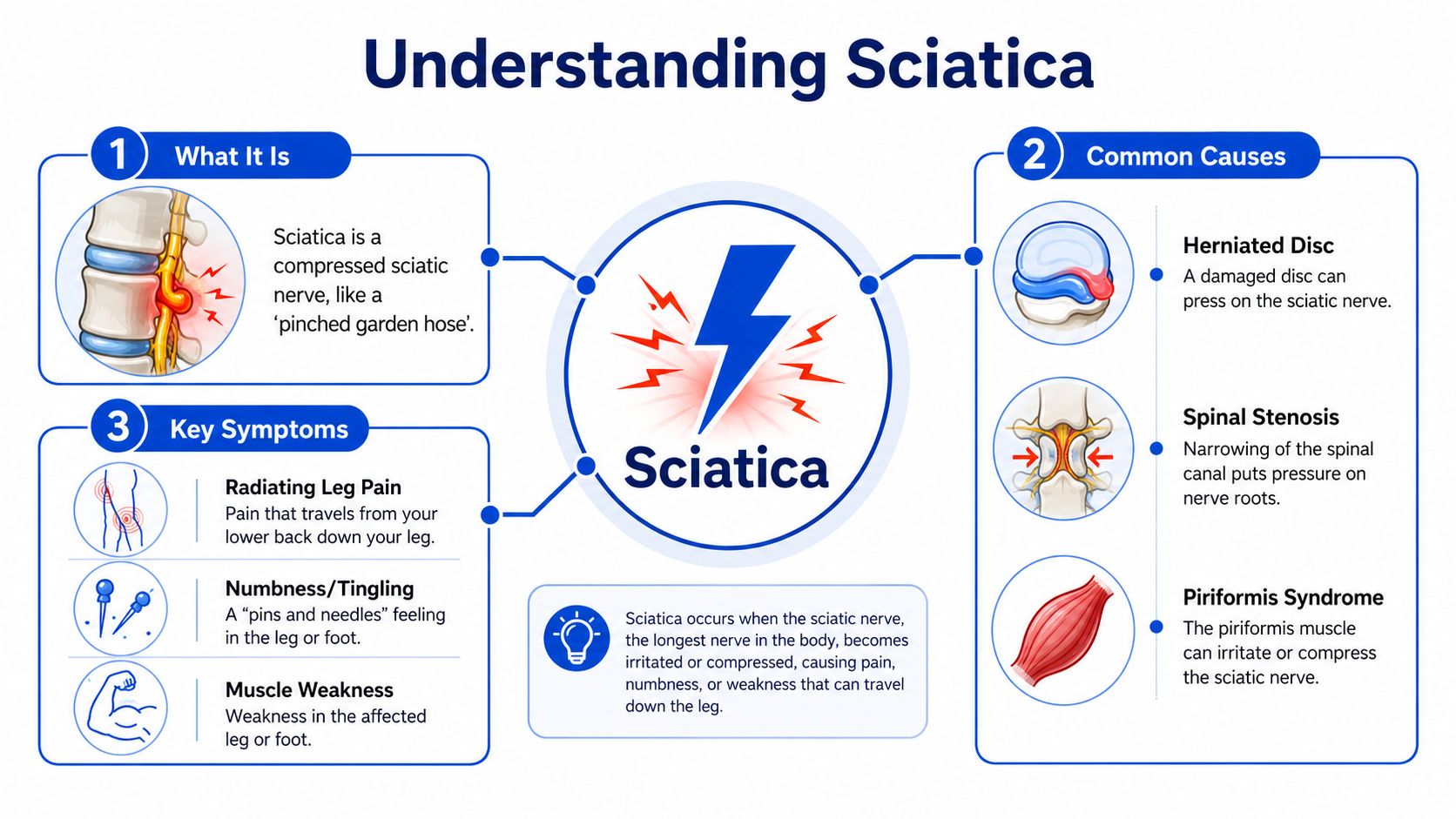
Sciatica describes pain and other nerve symptoms that travel along the path of the sciatic nerve, usually from the lower back or buttock into the leg. Some people feel sharp pain. Others describe burning, tingling, numbness, or a sense that the leg just doesn't feel normal.
A pinched nerve is the core problem
The simplest way to understand sciatica is to think of a garden hose with a kink in it. When the hose is pinched, flow is disrupted. With sciatica, the sciatic nerve or one of its roots is irritated or compressed, and the nerve starts sending pain or altered sensation down the leg.
That's why sciatica isn't the same as local muscle soreness. The pain radiates because a nerve is involved. The leg may hurt more than the back, which surprises many people the first time it happens.
Common reasons the nerve gets irritated
Several different problems can create that “kink in the hose” effect.
Herniated disc
A disc in the lower spine can bulge or protrude and irritate a nearby nerve root. This is one of the more familiar causes people hear about.Spinal stenosis
This means narrowing around the spaces where nerves travel. In some people, that narrowing contributes to nerve irritation, especially during walking or standing.Piriformis-related irritation
In some cases, deep buttock muscles can contribute to irritation around the sciatic nerve, creating pain that mimics classic sciatica.Joint and movement strain
Sometimes the main driver isn't a dramatic injury. It's a combination of spinal stiffness, poor load tolerance, prolonged sitting, and irritated surrounding tissues.
The key point is that the best treatment for sciatica pain depends on which of these patterns is driving your symptoms. A disc-related flare may respond well to movement modification and graded rehab. A stiffness-dominant presentation may need more mobility work and postural change. A heavily inflamed nerve root may need symptoms calmed first before stronger exercise begins.
Australian guidance also supports a practical approach to management. Better Health Channel notes that prolonged bed rest should be avoided and that gentle exercise, posture changes, and physical or manual therapies are important parts of professional sciatica care.
Clinical mindset: Don't just ask where it hurts. Ask what position, movement, or load keeps irritating the nerve.
That question usually gives the treatment plan its direction.
Your First Steps At Home for Sciatica Relief
Early home care should do two things. It should calm the irritation, and it should stop you from making the flare worse through fear, over-resting, or trying aggressive stretches too soon.

Start with comfort, not complete rest
If the pain is fresh and intense, a short period of easing off is reasonable. What usually doesn't help is staying in bed for long stretches and waiting for the nerve to settle on its own. An older Australian review of sciatica care aligned first-line management with staying active, using analgesics only if needed, and prioritising education, noting little difference in pain or function between bed rest and remaining active over time. You can read that summary in the Australian primary care review on sciatica management.
In practical terms, that means:
Change positions often
Don't sit, stand, or lie in one position for too long if it clearly ramps the leg pain up.Use relative rest
Reduce the movements that sharply aggravate symptoms, but keep small amounts of walking or gentle movement in your day if you can tolerate it.Aim for calmer symptoms, not zero symptoms
Early progress often looks like pain becoming less sharp, less constant, or less likely to travel all the way down the leg.
Use simple symptom-guided strategies
Home care works best when it's conservative and repeatable.
Try ice or heat based on what feels better
Some people prefer ice during a fresh flare because it can feel soothing over painful areas. Others relax more with gentle warmth once the area feels tight and guarded.Find a relieving position
Lying on your back with knees supported, or on your side with a pillow between the knees, often reduces tension. The right position is the one that settles the leg, not the one that looks most therapeutic.Take short walks
Brief, easy walks are often better than one long walk that flares symptoms later in the day.Choose gentle mobility over forceful stretching
If a stretch reproduces sharp leg pain, back off. The nerve usually responds better to gradual loading than to aggressive pulling.
If you want a starting point for movement, these lower back pain relief exercises can help you explore gentle options without overdoing it.
Practical rule: If an exercise leaves your leg pain significantly more irritable afterwards, it's too much for this stage.
A short guided routine can also help you move without guessing:
When home care is enough and when it is not
Good home management should create some sense of direction. You should feel that symptoms are becoming more manageable, or that you're learning which positions and activities help. If instead the pain keeps escalating, the leg feels weaker, or daily function is shrinking rather than expanding, it's time for professional assessment.
That's often the point where people stop asking for a single remedy and start asking a better question. What's driving the nerve irritation, and what kind of care matches that pattern?
A Guide to Professional Sciatica Treatments
Once home care has shown you part of the pattern, the next step is choosing treatment that fits the cause, the severity, and how much the pain is limiting daily life. Professional care for sciatica usually starts with conservative treatment, not because every case is mild, but because many cases improve when the nerve is given less irritation and the body is helped back into normal movement. The NIH StatPearls review on sciatica describes early management in that direction, with movement-based care commonly used before more invasive options are considered.
What matters in clinic is sequence. Calm the irritation. Restore movement. Build tolerance. Escalate only if progress stalls or the clinical picture calls for more.
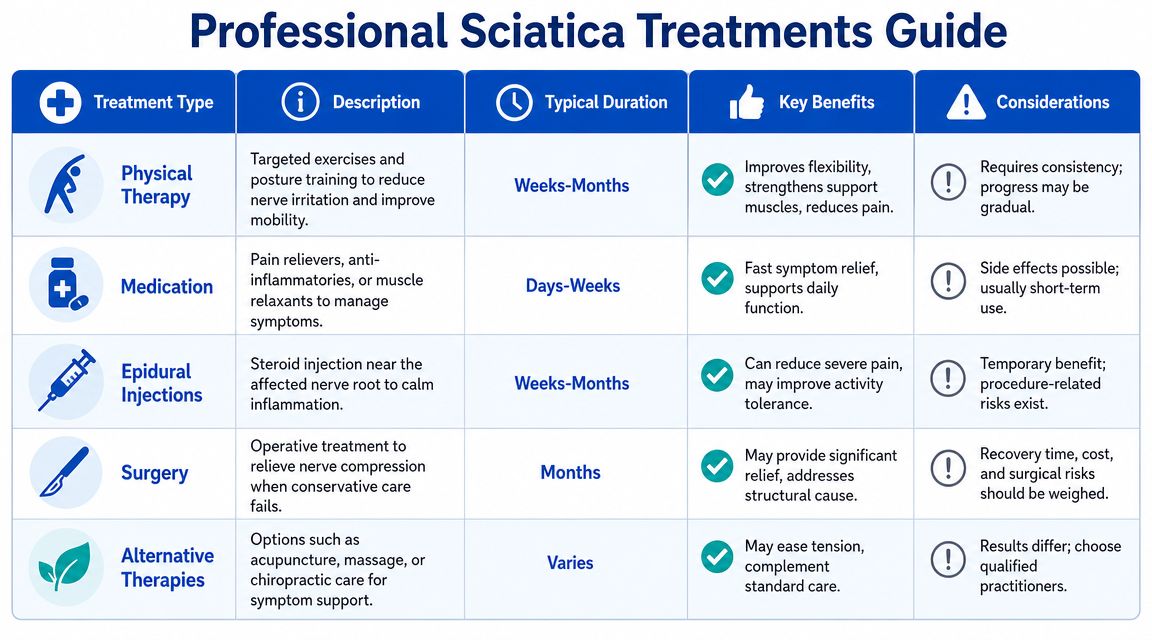
| Treatment | Main goal | Best fit | Main limitation |
|---|---|---|---|
| Osteopathic and manual therapy | Reduce mechanical strain and improve movement | Pain linked to stiffness, guarding, joint restriction, or overload | Needs to be paired with self-management |
| Exercise rehabilitation | Build tolerance and restore function | Most non-surgical cases once symptoms are manageable | Too much, too soon can flare symptoms |
| Medication | Ease pain enough to function | Short-term symptom control | Doesn't correct the underlying driver |
| Epidural injection | Reduce nerve-root inflammation | Persistent radicular pain limiting rehab | Relief is often temporary |
| Surgery | Remove or decompress the source of severe nerve pressure | Selected cases with ongoing disability or urgent indications | Invasive and not first-line for routine cases |
Osteopathic and manual therapy
Hands-on treatment can be useful when the back, pelvis, and surrounding muscles have become protective and stiff around an irritated nerve. That may include soft tissue treatment, joint articulation, gentle mobilisation, and clear advice on which movements to keep, change, or pause for now.
I usually explain manual therapy as a way to create a better starting point for recovery. If someone is too guarded to walk comfortably, too stiff to bend, or too sore to begin exercise with confidence, reducing that mechanical strain can make the next step possible. On its own, though, hands-on care rarely holds for long. It works best when paired with movement and a plan at home.
For readers considering hands-on care, osteopathy for sciatica treatment focuses on assessment, movement restoration, and symptom-guided care.
Exercise rehabilitation
Exercise is usually the treatment that changes the long-term picture. The aim is not to force stretching through nerve pain. The aim is to help the body tolerate sitting, walking, lifting, and daily activity again without repeatedly flaring the leg.
A good rehab plan is graded. Early on, that may mean gentle mobility work, short walking intervals, and basic trunk control. Later, the focus often shifts to hip strength, leg strength, and improving tolerance for the tasks that matter to that person, whether that is desk work, parenting, gym training, or sleep.
Here, trade-offs are important. Too little movement can leave the area more sensitive and deconditioned. Too much, too soon can keep the nerve irritated. The right dose is the one that improves function without causing a significant flare afterwards.
Medication options
Medication can help if pain is disrupting sleep, stopping you from walking, or making it impossible to engage in rehab. In that setting, it can be useful support.
It is not a full treatment plan.
Pain relief may create enough breathing room for better movement and better function, which is often the main reason to use it. If medication becomes the whole strategy, the underlying mechanical and functional problems are often left unchanged.
Relief matters, but relief alone isn't the same as recovery.
Injections
For ongoing radicular leg pain that has not settled enough to allow progress with conservative care, an epidural corticosteroid injection may be considered. The main goal is to reduce inflammation around the nerve root and create a window where walking, sleeping, and rehabilitation become more manageable.
That window has to be used well. If pain drops for a short period but strength, movement, and activity tolerance do not improve, symptoms can return in the same pattern. In practice, injections are usually best viewed as an adjunct to rehabilitation rather than a standalone fix.
Surgery
Surgery is considered for a smaller group of patients. It is usually discussed when symptoms remain significantly disabling despite a well-managed trial of conservative care, or when there are concerning neurological changes.
The decision is not based on pain alone. It depends on the cause of the sciatica, the level of function lost, the scan findings, and whether weakness or other nerve signs are progressing. For the right case, surgery can be appropriate. For routine sciatica without those features, earlier conservative care is usually the better first path.
Red Flags When to Seek Urgent Medical Care
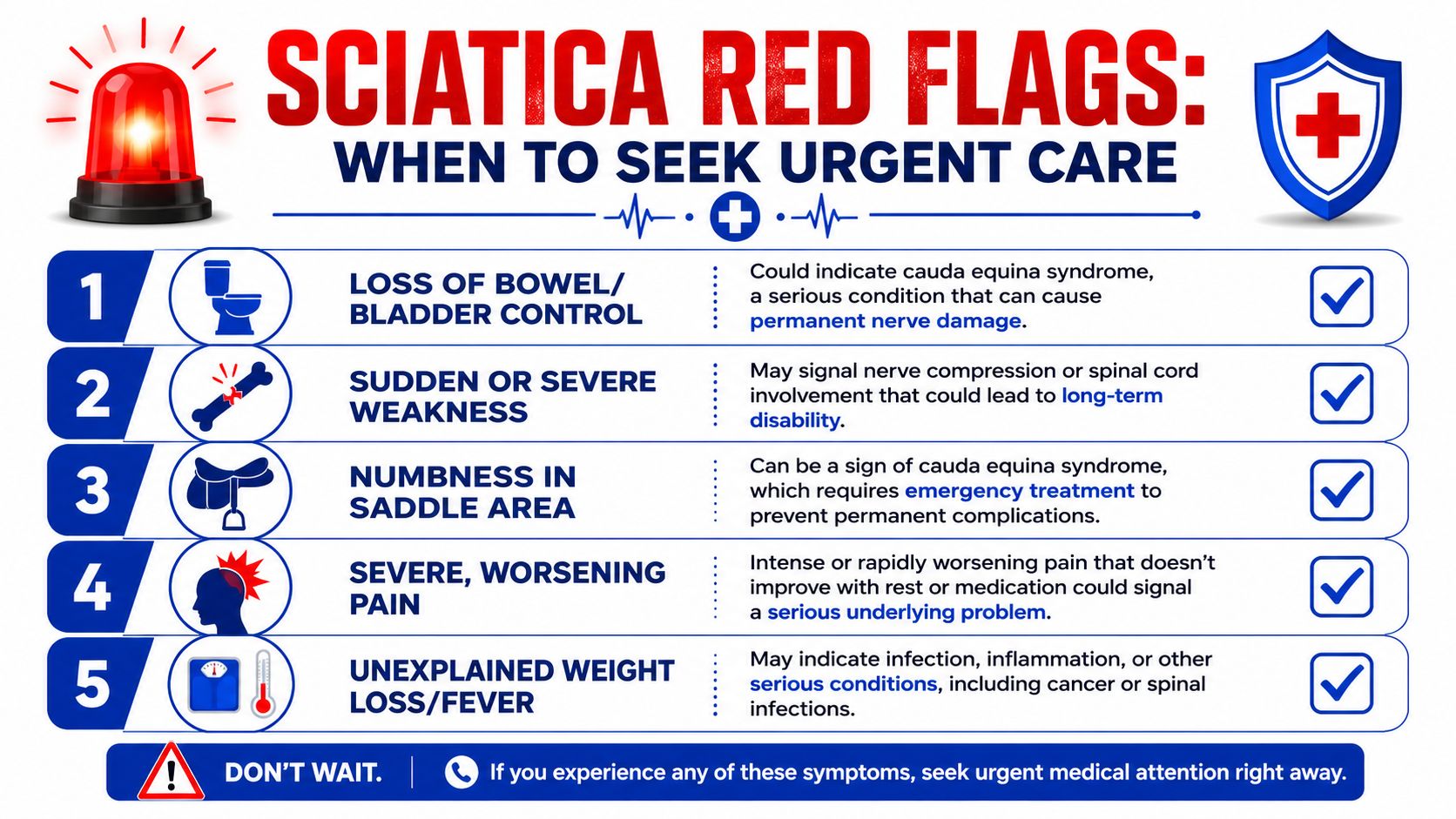
A typical sciatica flare can be painful, limiting, and still safe to manage through the usual stepwise care pathway. A smaller group of symptoms changes that pathway straight away. If any of the warning signs below appear, the right move is urgent medical assessment rather than home care, stretching, or waiting to see how the week goes.
Symptoms that need urgent review
Seek urgent medical attention if you develop any of the following:
Loss of bladder or bowel control
This can point to significant nerve compression and needs immediate assessment.Numbness in the saddle area
Reduced feeling around the inner thighs, buttocks, genitals, or groin is not typical sciatica and should be treated seriously.Rapidly worsening weakness
If the leg starts giving way, you cannot lift the foot properly, or strength is clearly dropping, get reviewed promptly.Severe and escalating pain with major functional decline
Pain that surges quickly and leaves you struggling to stand, walk, or change position normally needs prompt medical review.Sciatica with unexplained fever or unexplained weight loss
That pattern raises concern for causes other than a routine mechanical flare.
I tell patients to pay close attention to change, not just intensity. Strong pain on its own is common in sciatica. Strong pain plus altered bladder function, saddle numbness, or progressive weakness is a different situation.
If your symptoms are painful but do not include these red flags, the next step is usually careful conservative care and close monitoring. A structured plan that starts with self-management, activity modification, and the right progression of treatment is often the safest place to begin. Our guide to natural pain management options for back and nerve pain can help you understand those early options.
Red flags do not mean the worst is happening. They mean timing matters, and urgent assessment gives you the best chance of protecting nerve function.
The Bayside Osteopathic Health Approach to Sciatica
A good osteopathic approach begins with identifying why the nerve is irritated, not just confirming that it is. That means listening closely to how the pain started, where it travels, which positions aggravate it, whether there's numbness or weakness, and how your back, hips, and pelvis are moving together.
Assessment comes before treatment
At Bayside Osteopathic Health, sciatica care starts with a hands-on and movement-based assessment. The aim is to work out whether the pattern looks more disc-related, stiffness-dominant, posture-driven, load-related, or in need of medical referral. That keeps treatment matched to the presentation rather than generic.
Two people can both say “I've got sciatica” yet require very different advice. One may need more unloading and position change. Another may need progressive strengthening. A third may need co-management with a GP because the nerve pain has become persistent.
Treatment aims to reduce pressure and restore movement
Osteopathic treatment often uses gentle soft-tissue work, articulation, mobilisation, and movement coaching to settle protective tension and help the body move more freely. The purpose isn't to chase pain around the leg. It's to reduce the mechanical strain that keeps provoking it.
For persistent radicular pain, some people may also be considering injections. That can be reasonable in selected cases, but the earlier section's evidence still applies. Short-term anti-inflammatory relief is most useful when it's combined with exercise-based care rather than treated as a complete solution.
The strongest plans usually include home advice as well. That may mean modifying desk setup, breaking up sitting time, changing lifting habits, using walks strategically, or replacing aggressive stretches with exercises better suited to the stage of recovery.
Your Personalised Path to Recovery
The best treatment for sciatica pain isn't one product, one stretch, or one procedure. It's the treatment that matches the cause, the stage of irritation, and the way your symptoms behave day to day.
For many people, the path is straightforward. Start by calming the flare without shutting your life down. Keep movement gentle and regular. Watch for patterns. If symptoms aren't easing or normal activity keeps shrinking, get assessed so the treatment can become more specific.
That stepwise approach gives you something much more useful than generic advice. It gives you a practical decision-making framework. You know what to try at home, what professional options do, and when symptoms cross the line into urgency.
If you're looking for broader ways to support recovery and reduce ongoing pain sensitivity, these natural pain solutions may also be useful.
If your leg pain keeps returning, or you're not sure whether you're dealing with routine sciatica or something that needs a closer look, Bayside Osteopathic Health offers assessment and gentle osteopathic care to help identify the driver of the pain and guide the next step.