
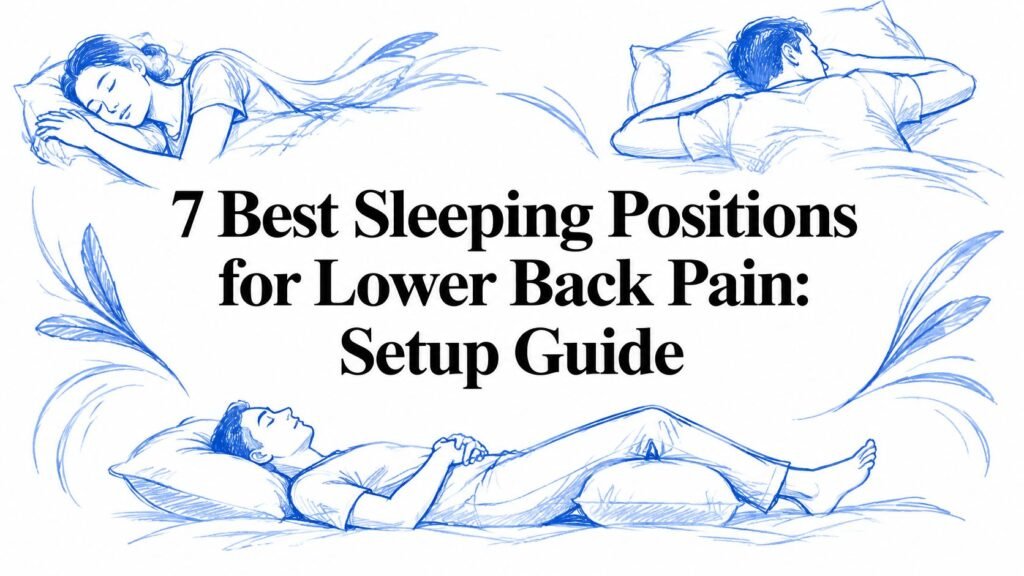
You wake up stiff after a full night's sleep and immediately blame the mattress. Getting out of bed takes an awkward shuffle, yet your back loosens once you start moving. Before you replace the bed, check what happens to your legs, pelvis and lower back when you settle down.
A top knee dropping forward can twist your pelvis. An unsupported leg or an uncomfortable arch can leave you struggling to relax. These positions don't necessarily damage your back, but sustained discomfort can interrupt sleep and make mornings harder.
The best sleeping positions for lower back pain are the ones that help you rest without increasing symptoms. The evidence review supporting Australia's Low Back Pain Clinical Care Standard recommends choosing the position most comfortable for you, rather than prescribing a universal posture.
Start with pillows you already own. The setups below explain where each support goes, how to judge its size and which symptoms mean it isn't suitable. Pillow thickness should match your body and mattress, not a fixed measurement. Persistent or worsening pain needs assessment, even when a different sleeping position provides temporary relief.
Table of Contents
- 1. Side-Lying with a Pillow Between the Knees
- 2. Back Sleeping with a Pillow Under the Knees
- 3. Back Sleeping with a Lumbar Support Roll
- 4. Semi-Fetal Side-Lying
- 5. Side-Lying Hugging a Body Pillow
- 6. Prone Sleeping with a Pillow Under the Pelvis
- 7. Semi-Reclined Back Sleeping on an Adjustable Bed
- How the seven sleeping positions compare for lower back pain
- Choosing the Right Position and Knowing When to Get Help
1. Side-Lying with a Pillow Between the Knees
Side-lying is a useful starting point if your top leg usually falls towards the mattress. Supporting that leg can reduce the pull through your pelvis without forcing your back into a rigid position.
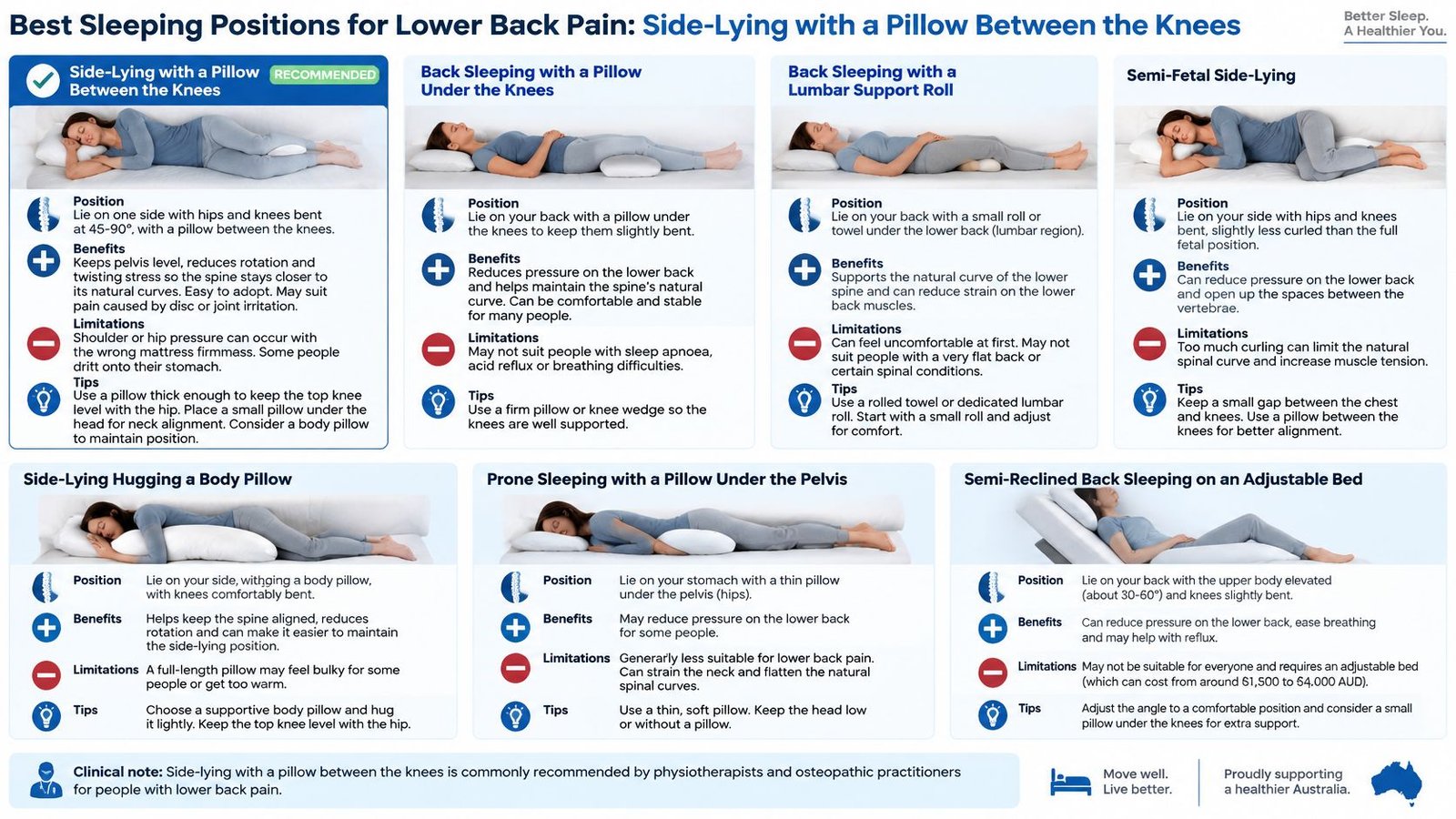
Build the support around your legs
Lie on your more comfortable side with your knees loosely bent. Place a firm bed pillow lengthways between your thighs and knees, extending towards your ankles rather than supporting only the top kneecap.
- Choose the thickness: Use enough filling to keep your top thigh roughly parallel to the mattress. Your knee shouldn't drop inward or be pushed conspicuously upwards.
- Support your head: Fill the space between your ear and mattress so your neck doesn't bend sideways. A very thin pillow often won't suit a broad-shouldered side sleeper.
- Keep your pelvis stacked: Let your upper hip sit above the lower hip, rather than rolling your chest towards the bed.
Say you fall asleep comfortably but wake with your upper knee resting on the mattress. A longer pillow that also supports the lower leg may stay useful when a small knee cushion slips away.
Quick self-check: Your waist should feel relaxed, and the bottom hip shouldn't feel sharply compressed. If the lower hip hurts, try the other side or back sleeping instead.
This setup may suit some people with sciatica, but it isn't a treatment for the irritated nerve. Stop if leg pain spreads further down the leg or tingling increases. If lower back stiffness persists despite a comfortable setup, look beyond pillow placement.
2. Back Sleeping with a Pillow Under the Knees
If lying flat makes your lower back feel pulled into an uncomfortable arch, try supporting your knees. This lets your hips and knees bend gently without requiring you to hold them there.
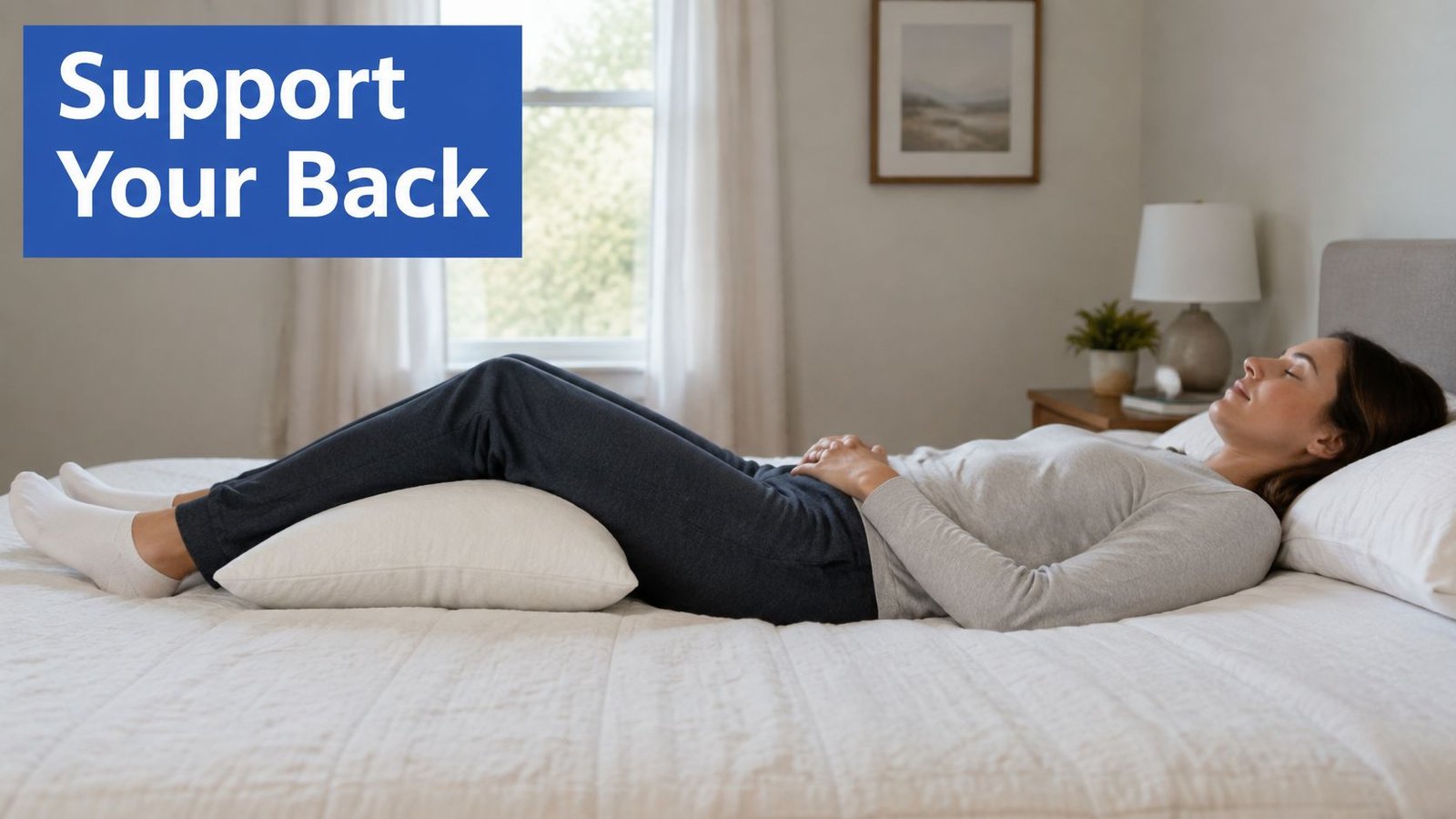
Place a firm pillow crossways beneath both knees, with its lower edge supporting the upper calves. Your heels can rest on the mattress. Avoid a narrow, hard roll pressing directly into the knee creases.
Adjust the lift, not just the softness
Start with an ordinary bed pillow folded only if necessary. Add height until your back feels easier, then stop. A large bolster that lifts your knees towards your chest may create a different strain rather than better support.
Keep the head pillow comfortable and avoid pushing your chin towards your chest. Don't try to flatten your lower back deliberately; let it settle into a comfortable curve.
Practical rule: The pillow should make lying down feel easier immediately. You shouldn't need to brace your stomach or hold your legs in place.
For example, someone whose back aches when their legs straighten may prefer this setup to unsupported back sleeping. It can also suit some people with leg symptoms, provided those symptoms settle rather than spread.
Quick self-check: Can you relax your thighs, buttocks and abdomen? If not, adjust the pillow or change position. Back sleeping may worsen snoring or sleep apnoea, so don't treat a different head pillow as a breathing remedy.
Pair a tolerable night-time setup with appropriate lower back pain relief exercises, rather than spending more of the day lying down.
3. Back Sleeping with a Lumbar Support Roll
A lumbar roll does the opposite of knee support in an important way: it adds support beneath the inward curve of your lower back. That can feel reassuring to some people and distinctly uncomfortable to others.
Use it when the hollow beneath your waist feels unsupported, not just because you've been told to maintain a perfect spinal curve. A bulky roll can increase arching and aggravate symptoms.
Make a small roll before buying a cushion
Fold a hand towel lengthways and roll it loosely into a soft, low cylinder. Place it across the mattress beneath the small of your back, around belt-line level, rather than beneath your tailbone or lower ribs.
- Start low: The towel should fill a gap, not lift your trunk away from the mattress.
- Check the edges: Keep knots, seams and tightly rolled ends away from tender areas.
- Test without tension: Rest your arms comfortably and breathe normally. Remove the roll if you have to tighten your abdomen to tolerate it.
Say a broad sofa cushion beneath your waist makes your back ache, but a lightly folded towel feels comfortable. More support isn't automatically better; the smaller towel is the more sensible trial.
Quick self-check: Remove the roll if it produces pinching, increases buttock pain or sends symptoms down your leg. People whose pain worsens with arching often won't suit this setup.
Disc irritation doesn't automatically mean you need a lumbar roll. Your response matters more than the diagnostic label, just as a comfortable sitting position for lower back pain depends on tolerable support rather than exaggerated posture.
4. Semi-Fetal Side-Lying
A loose curl can feel soothing when a straighter position makes your lower back ache. The key word is loose. Pulling your knees tightly against your chest may replace an uncomfortable arch with uncomfortable rounding.
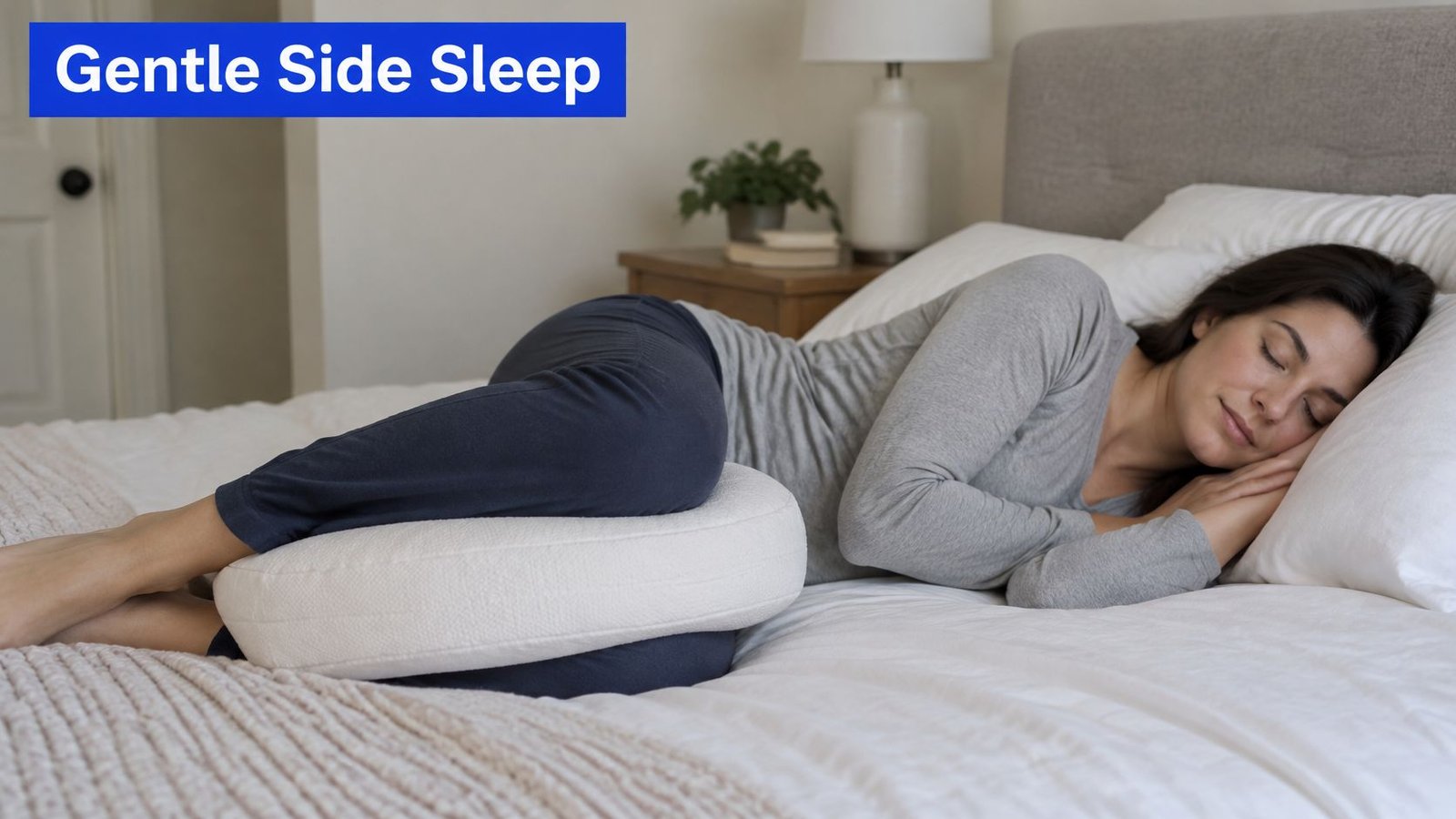
Lie on your side, then slide your knees forwards until your lower back feels relaxed. Keep your shoulders resting naturally rather than curling your chin towards your chest. Add a pillow between your knees and lower legs so the upper leg doesn't drag your pelvis forwards.
Match the curl to your symptoms
This setup may suit someone who feels better with gentle bending and worse when standing or lying very straight. For example, a person who finds a slightly rounded resting position comfortable might use a loose curl rather than forcing themselves to sleep flat.
It won't suit every person with disc irritation. If bending forwards tends to increase your pain, a deep curl may be particularly unhelpful.
Don't choose a sleeping position because it supposedly opens, closes or realigns something. Choose it because your symptoms settle and you can rest.
Use a head pillow deep enough to keep your face level with the mattress, without tilting towards either shoulder. Keep your hands somewhere relaxed rather than trapped beneath your head.
Quick self-check: Ease your knees away from your chest slightly. If that feels better, your original curl was probably too tight. Stop if numbness, tingling or radiating pain increases, even if your lower back briefly feels less sore.
For sciatica, compare this loose curl with straighter side-lying. There's no need to force either version when neither feels comfortable.
5. Side-Lying Hugging a Body Pillow
A pillow between the knees doesn't always support enough of the body. If your upper shoulder and chest keep rolling forwards, a body pillow can give your arm and leg somewhere to rest together.
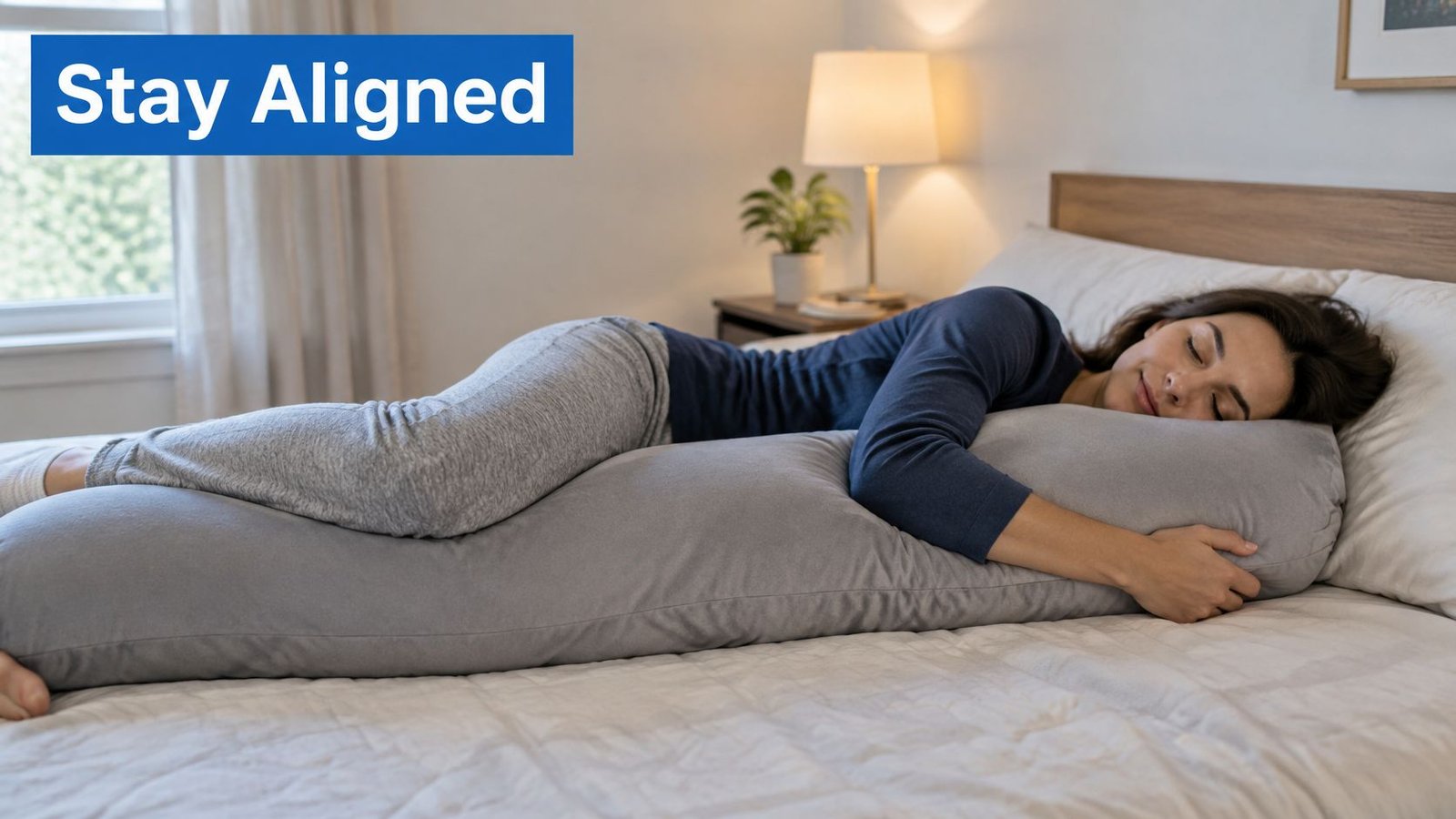
Choose a straight body pillow or C-shaped pregnancy pillow that reaches from your chest to below your knees. It should be substantial enough to support your upper leg without pushing your shoulder towards your ear.
Support the arm and leg together
Bring the pillow close to your chest and rest your upper forearm on it. Place your upper thigh, knee and lower leg along its lower section. Keep your upper knee supported near hip height instead of reaching far across the bed.
- Check the shoulder: Your upper arm should rest comfortably, not stretch forwards or hang down.
- Check the pelvis: Don't hook only your foot over the pillow while leaving your thigh unsupported.
- Check the filling: Redistribute loose filling if it bunches beneath your chest and disappears beneath your knee.
This setup is useful for someone who starts on their side but repeatedly rolls halfway onto their stomach. It provides a comfortable place to settle without pinning the body in place.
It can also suit pregnancy because it supports side-lying and can accommodate a growing abdomen. Add gentle support beneath the bump if needed, and follow your maternity team's advice about sleeping position, particularly later in pregnancy.
Quick self-check: You should be able to turn over without wrestling the pillow. If the setup overheats you, crowds the bed or strains your shoulder, separate smaller pillows may work better.
Replace or refill a pillow that no longer holds its shape. A product's pregnancy or orthopaedic label doesn't guarantee a better fit.
6. Prone Sleeping with a Pillow Under the Pelvis
Stomach sleeping is a compromise, not my first recommendation for someone with back and neck pain. It can hold the lower back in an uncomfortable arch while leaving the neck turned sideways.
Still, forcing a habitual stomach sleeper into an unfamiliar position can make sleep harder. A thin pelvic support is a reasonable modification to test if side or back sleeping hasn't been tolerable.
Keep the support broad and shallow
Place a flat, soft pillow crossways beneath your lower abdomen and the front of your pelvis. Its purpose is to reduce an uncomfortable sag, not to raise your hips into a steep bend.
Use the thinnest head pillow you find comfortable, provided your face and airway remain clear. Never press your face into bedding to keep your neck straight.
- Avoid a thick bolster: A large support can create pressure across the abdomen or an awkward bend at the hips.
- Keep the legs relaxed: Don't pull a knee far towards your chest if that twists your pelvis.
- Plan an alternative: Keep a pillow nearby for supported side-lying if stomach sleeping starts to hurt.
For example, a habitual stomach sleeper might find a flat pillow under the pelvis more tolerable than immediately switching to back sleeping. That's a comfort adjustment, not evidence that prone sleeping corrects their back problem.
Quick self-check: Abandon the position if you develop neck pain, headaches, increased back pain or spreading leg symptoms. It's also a poor choice when abdominal pressure is uncomfortable or pregnancy makes prone lying unsuitable.
Don't infer that disc irritation requires stomach sleeping. A position used briefly during supervised assessment or exercise isn't automatically suitable for an entire night.
7. Semi-Reclined Back Sleeping on an Adjustable Bed
An adjustable bed or long wedge pillow can help when lying flat is uncomfortable. Raising the trunk slightly, while supporting the knees, may make resting easier without requiring a large stack of pillows.
This is a comfort trial, not a reason to buy an expensive bed. Australian guidance doesn't establish a particular commercial sleep product as a treatment for lower-back pain.
Lift the trunk without folding the waist
Use a wedge that supports your upper back and shoulders, rather than piling pillows beneath your head alone. On an adjustable bed, begin with a modest incline and increase it only while you remain comfortable.
Place a firm pillow under your knees and upper calves. If you slide towards the foot of the bed, reduce the incline or adjust the knee support rather than bracing through your feet.
Avoid the pillow tower: A high stack beneath the head can bend the neck forwards while leaving the lower back unsupported.
Say lying flat aggravates your back and reflux discomfort makes settling harder. A supported recline may be worth testing, but persistent reflux or breathing symptoms still need appropriate medical advice.
Quick self-check: Your lower back shouldn't feel folded, stretched or suspended above the mattress. Switch positions if the incline increases pain or makes getting out of bed unsafe.
A reclined posture doesn't replace treatment for sleep apnoea. Likewise, a chair that feels comfortable for a short rest may lack the space and support needed for sleeping.
This video offers an additional visual reference.
How the seven sleeping positions compare for lower back pain
| Item | Best For | Support Needed | Main Caution |
|---|---|---|---|
| Side-Lying with a Pillow Between the Knees | Reducing lower-back twisting; a versatile starting position | Pillow between knees; supportive head pillow | Shoulder or hip pressure; may roll onto stomach |
| Back Sleeping with a Pillow Under the Knees | Lumbar stiffness or sciatic-type discomfort | Firm pillow or bolster under knees | May worsen snoring or sleep apnoea |
| Back Sleeping with a Lumbar Support Roll | People who feel a gap beneath the lower back | Thin rolled towel or lumbar pillow | A roll that is too thick may overarch the back |
| Semi-Fetal Side-Lying | People who feel relief when bending forward | Knee pillow, if helpful | A tight curl may aggravate some conditions |
| Side-Lying Hugging a Body Pillow | People who twist or roll during sleep | Full-length or C-shaped body pillow | Bulky and may restrict movement |
| Prone Sleeping with a Pillow Under the Pelvis | People who cannot sleep in another position and find prone lying comfortable | Thin pillow under the pelvis | May strain the lower back and neck |
| Semi-Reclined Back Sleeping on an Adjustable Bed | People seeking adjustable support or relief with breathing or reflux | Adjustable bed or wedge; knee support | Benefits for back pain are uncertain; may strain the neck |
Choosing the Right Position and Knowing When to Get Help
Start with the setup closest to how you already sleep. Side sleepers can begin with supported knees; back sleepers can begin with knee support. You don't need to work through every position or train yourself to stay still.
Change a single feature at a time, such as pillow thickness, knee height or the degree of curl. Keep brief notes about morning stiffness, night waking and any leg symptoms. If a setup is comfortable, give yourself several nights to judge it rather than changing everything after an unsettled night.
Keep what helps and stop what aggravates
The decision rule is simple: keep the arrangement that reduces morning stiffness and night waking. Stop any setup that increases pain, numbness or tingling. Don't continue an uncomfortable position in the hope that your spine will eventually adjust.
- If no position works: Choose the least painful option temporarily, move gently when needed and arrange an assessment.
- If sleep stays disrupted: Tell your GP about snoring, witnessed breathing pauses, restless legs or daytime sleepiness, not just back pain.
- If mornings improve: Continue normal movement and gradually build tolerable activity rather than extending your time in bed.
Pain and sleep problems can reinforce each other, so positioning may only address part of the problem. Painaustralia's submission to the RACGP describes sleep complaints across chronic pain disorders, supporting a broader discussion when pillows alone don't help.
Australia's Low Back Pain Clinical Care Standard prioritises active self-management, including physical activity and healthy sleep habits, rather than prolonged bed rest. A comfortable sleeping position should support that plan, not replace it.
Seek urgent medical care for new bladder or bowel control problems, numbness around the groin, or rapidly worsening leg weakness. Back pain with fever, significant trauma or feeling seriously unwell also needs prompt medical review.
If pain persists, repeatedly wakes you or spreads down your leg, book an assessment with Bayside Osteopathic Health. Your practitioner can assess likely contributors and develop a plan that includes practical self-care at home.
Bayside Osteopathic Health offers osteopathic assessment, hands-on care, movement advice and practical self-care guidance for lower back pain. Visit Bayside Osteopathic Health to book an appointment and discuss a sleep setup that fits your symptoms and daily needs.