

Rest until the rain passes. That's the most common advice for a sore knee, hip, hand or back on a wet day, and for most familiar stiffness it's the wrong starting point. Sitting still through a rainy afternoon usually leaves joints stiffer, muscles tighter and the next stand up harder.
You're not imagining the pattern. You may well feel worse when it's wet. The useful question isn't whether rain caused it, it's what arrived with the rain that you can change today: less walking, colder rooms, poorer sleep, tense muscles and expecting a flare. Learning how to stop joint pain when it rains starts with acting on those factors, while knowing when new swelling, heat or severe pain isn't a weather problem at all.
Table of Contents
- Your Same-Day Plan for Rainy Joint Pain
- How to Move a Stiff Joint on a Wet Day
- Layers Footwear and Supports for Wet Weather
- Sleep Hydration and Daily Pacing
- Heat Cold Tablets and Topical Options
- Book Care When Rain Keeps Limiting You
Your Same-Day Plan for Rainy Joint Pain
A wet morning often goes like this. You wake, hear rain, sit longer over breakfast, skip your usual walk, and by mid-morning your knee or hands feel locked. It's easy to blame falling air pressure.
Australian evidence doesn't support that shortcut. A University of Sydney study discussed in the ABC discussion of joint pain and weather change tracked symptoms alongside weather within the same people over time and found no relationship between weather and musculoskeletal pain, although high temperatures combined with low humidity increased the risk of gout flares among people with gout. That distinction matters. Your pain is real, but rain itself may not be the biological trigger.
Match One Row and Act Today
Don't try to fix the forecast. Match what you notice, do that one action, and check the result.
What to do for joint pain on a rainy day
| What you notice | Address this | Do this today | Do not do |
|---|---|---|---|
| Familiar stiffness after sitting | Less movement and cold | Warm the area and move gently indoors for 5 to 10 minutes | Rest the joint for the whole day |
| Muscle ache in damp cold | Tension and cold exposure | Add layers, use heat on the muscle and take a short indoor walk | Push into sharp or escalating pain |
| Pain still raised more than 2 hours after activity | The last session was too hard | Next time change only duration or repetitions | Repeat the same session unchanged |
| Hot, red or markedly swollen joint | Possible flare, gout or infection | Arrange same-day medical assessment | Load the joint or treat it as ordinary weather stiffness |
| Fever, sudden severe pain or cannot bear weight | Needs a diagnosis | Seek urgent medical care | Wait for the rain to pass |
| Known gout on a hot dry day | High temperature with low humidity | Follow the gout plan already set with the GP | Assume every weather change acts the same way |
The first two rows cover most rainy-day stiffness. A warm layer plus indoor walking or gentle range-of-motion movement tackles the inactivity and cold that came with the weather. You're not trying to train hard. You're restoring the movement the rain removed.
The third row is your two-hour check. If unusual pain is still raised more than two hours after activity, that session was too much. Next time, shorten the time or reduce repetitions. Change one thing only, so you know what helped.
Match the pattern, not the forecast. One row, one action, one check.
When the Table Says Stop Self-Care
A joint that's hot, red or markedly swollen needs assessment, not a rain remedy. The same applies if you've got fever, sudden severe pain, a first suspected gout attack, or you can't bear weight. Those patterns need a diagnosis.
Known gout is the exception in the weather evidence. If you've got gout, don't assume a wet day is your main risk. Follow the plan you've already set with your GP, and pay particular attention during hot, dry conditions.
For the next 2 to 4 weeks, note pain location, how long stiffness lasts, what activity you did, and the weather. You're looking for a personal pattern. You might find pain follows cancelled walks and cold rooms more closely than rainfall, which gives you something practical to fix next time.
How to Move a Stiff Joint on a Wet Day
Use this sequence only when the joint feels stiff or aching in a familiar way. Skip it if the joint is hot, red or acutely swollen. That safety check comes before any exercise.
Regular movement helps because joints stiffen when they stop moving, and supporting muscles lose their cue to work. The Healthdirect guide to joint pain and swelling describes the two-hour pain rule, where unusual or increased pain lasting more than two hours after exercise indicates the session was excessive and should be reduced next time. Treat that rule as your safety gate, not as a target to push toward.
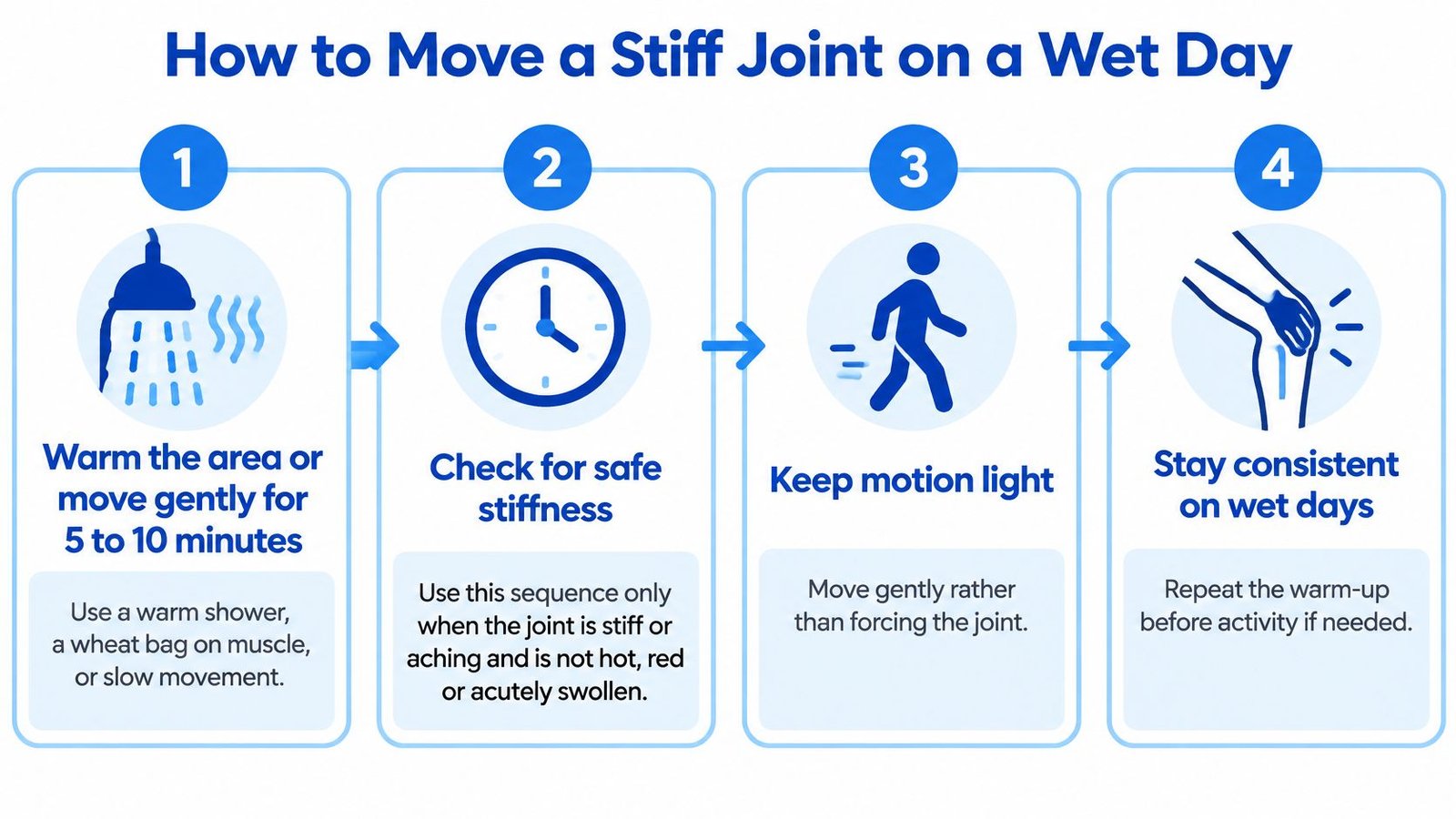
The Five-Step Sequence
Warm first for 5 to 10 minutes. Use a warm shower, a wheat bag on the muscle around the joint, or slow marching on the spot. Warmth makes the first movements easier, so you're not forcing a cold, stiff joint.
Pick one low-impact option. Try an indoor hallway walk, sit-to-stands from a firm chair, seated knee bends, shoulder circles, or walking in a warm pool. Stop short of unusual pain. Mild familiar ache during gentle movement isn't the same as sharp, escalating pain.
Finish with comfortable range of motion. Move the joint through the range that feels available today. Don't force a stretch to match yesterday. Rainy-day tissue often needs a smaller starting range that opens up as you move.
Recheck twice. Note how the joint feels straight after, then again two hours later. The second check tells you whether the dose suited you.
Progress one variable only. If recovery is acceptable, add a few minutes next time or a couple of repetitions, not both. Small changes make cause and effect clear.
You can find joint-friendly starting points in our guide to joint mobility exercises, then scale the dose using your own two-hour result.
Slips That Make a Wet Day Worse
- Staying completely still: Prolonged sitting lets stiffness build, so the eventual stand hurts more.
- Exercising through sharp pain: Sharp or escalating pain is a stop signal, not weakness.
- Loading a swollen joint hard: Vigorous exercise on a hot, swollen joint can aggravate irritation and delays proper assessment.
An acute strain is different from chronic stiffness. A fresh strain may need protection, compression and elevation for 1 to 3 days before graded movement. Don't apply this rainy-day sequence to a new injury as if it were ordinary arthritis stiffness.
Say your knee osteoarthritis flares whenever a southerly cancels your walk. Instead of writing off the day, you shower warm, walk indoors for 8 minutes, do a handful of sit-to-stands holding the bench, then bend and straighten the knee comfortably. At two hours you're back to baseline, so tomorrow you can repeat it. If you're still sore at two hours, tomorrow's walk becomes shorter.
Layers Footwear and Supports for Wet Weather
Warm the joint before you step out, not after it starts aching at the bus stop. Cold muscles guard more, and a guarded walk loads knees, hips and back unevenly.
Preparing shoes and layers indoors is part of the joint plan, not just comfort.

What to Wear and Why
Merino or thermal layers keep thigh, calf and hand muscles warm without bulky restriction. A light knee sleeve or gloves can add warmth and a clearer sense of joint position, which can make movement feel steadier. A rigid brace is different. That's for a clinician to prescribe for a specific instability or injury, not a default rainy-day purchase.
Choose shoes that stay dry and grip. Wet pavers, tiles and tram tracks change how you walk. Short, cautious steps, turned-out feet and stiff hips are protective habits that can shift load into the knee and lower back. Dry footwear with tread lets you keep a more natural stride.
For hands, warm them before you leave, then use a thin glove under a waterproof outer layer. Cold, wet hands grip umbrellas and rails harder, which can aggravate finger and thumb joints.
Balance matters even more with age. The Australian Bureau of Statistics health conditions data reported that in 2022, 48.9% of Australians aged 75 years and over had arthritis, making this age group the most affected. For this group, dry grip and a free hand for a rail can matter as much as warmth.
This short video is a useful prompt to check your wet-weather routine before you head out.
After You Arrive
Change out of damp clothes promptly. Sitting for hours in wet jeans or socks keeps muscles cold and encourages you to stay seated. Keep the room comfortably warm, dry off, and move briefly.
Say you commuted through rain to a desk job. Keep spare dry socks at work, change on arrival, and stand or walk for two minutes each hour. That breaks the cold, still pattern that often gets blamed on the weather itself.
A support is doing harm if it causes numbness, deep skin marks, swelling building under compression, or if you use it as a reason to skip movement. A sleeve should support activity, not replace muscle work.
Keep a small kit ready for the next forecast: thermal layer, dry socks, a simple soft sleeve if you use one, and a plan for your first 10 minutes after arriving. Preparation removes decision-making when you're already sore.
Sleep Hydration and Daily Pacing
Rain disrupts routines. You go to bed later because the evening feels flat, skip lunch at home, drink less water, and cancel everything active. Those shifts can lower your tolerance for pain without changing the joint itself.
Sleep
Keep a regular bedtime and a warm, dry bedroom. Poor sleep often arrives with wet-weather disruption and can make familiar stiffness feel harder the next morning. A steady wake time helps anchor the day even when outdoor plans change.
Hydration and Meals
Drink water through the day and eat regular meals. On a low-activity day it's easy to drift into fatigue, headache and heavier-feeling limbs, then blame the joints alone. Steady food and fluid help you feel more stable and willing to move, but they don't repair cartilage. Treat them as support for activity, not as treatment for arthritis.
Pacing Instead of Cancelling
Split walks or chores into short blocks with a seated break between them. Two brief indoor walks usually serve stiff joints better than one heroic effort followed by hours on the couch. Our practical self-management strategies can help you structure those blocks around your normal day.
Say a retiree spends a wet afternoon on the couch, skips lunch and naps late. The swap is simple: two short walks, a glass of water with each meal, and an earlier bedtime. The next day, compare stiffness and the two-hour check with a previous couch day.
Check Your Expectation
If you expect rain to cause a flare, you're more likely to notice every ache on a wet day and forget aches on fine days. Log forecast, sleep, activity and symptoms side by side for a few weeks. If pain tracks poor sleep and cancelled walks, pace those habits first. That takes you back to the same decision: restore movement in small blocks rather than waiting for better weather.
Heat Cold Tablets and Topical Options
The safety question behind most searches is simple: what can I safely take or apply when pain rises? Start by separating a short, familiar stiff episode from symptoms that need care. A hot, markedly swollen joint, fever, inability to bear weight, sudden severe pain or a first suspected gout attack shouldn't be managed as a rainy-day ache.
Clear advice matters at population scale. The Arthritis WA report on Australia's arthritis burden estimates Australian osteoarthritis affects 2.35 million people in 2025, and projects Australia's arthritis burden to rise from 4.11 million people in 2025 to 5.39 million by 2040. A safe flare plan prevents both under-treatment and casual overuse of medicines.
Match the Option to the Problem
Remedy options and who they suit
| Option | Suits | Check first |
|---|---|---|
| Heat pack or warm shower | Muscle aching around a stiff joint | Avoid on a joint that is hot, red or acutely swollen |
| Brief cold pack wrapped in cloth | A recently irritated joint | Keep it short and stop if it worsens |
| Paracetamol | Pain without contraindications | Keep within the label and do not double up products containing it |
| Anti-inflammatory tablets | Only after professional advice | Ask a GP or pharmacist about age, kidney disease, stomach ulcers, cardiovascular disease and other medicines |
| Topical anti-inflammatory gel | A superficial knee or hand when tablets are a poor fit | Pharmacist check first |
Heat can ease muscle aching when it feels helpful. Apply it to the muscle around a stiff joint, not to a joint that's acutely swollen, hot or red. If heat makes throbbing or swelling worse, remove it.
A cold pack suits a recently irritated joint that feels puffy after activity. Wrap it in cloth, use it briefly, and stop if pain sharpens or skin becomes numb or blotchy. Cold is for settling irritation, not for numbing a joint so you can push through exercise.
Tablets Need a Check, Not a Forecast
Keep paracetamol within the label and any existing medical advice. Check combination cold products and other pain products so you don't double up the same ingredient unknowingly.
Anti-inflammatory tablets aren't an automatic rainy-day step. Ask a GP or pharmacist first, particularly if you're older or you have kidney disease, stomach ulcers, cardiovascular disease, or you take other medicines. The pharmacist check should cover what you already take, allergies, stomach history and how long you plan to use them.
A topical anti-inflammatory gel may suit a superficial joint such as a knee, finger or hand when tablets are a poor fit. It still needs a pharmacist check, especially if skin is broken or you're using other medicines on the area.
One rule for medicines: Needing stronger or more frequent doses than usual is a reason to review the plan with a clinician, not to add another remedy because the forecast is wet.
Hydration and regular meals belong in the background. They help you feel steadier on a low-activity day, so you're more likely to complete gentle movement. They don't rebuild cartilage and they don't replace assessment when a joint becomes hot and swollen.
Book Care When Rain Keeps Limiting You
Start with three next actions, then choose the route that matches today.
- Familiar stiffness: Run the 5 to 10 minute warm-up and movement block on the next wet morning and write down the two-hour check.
- Urgent pattern: If a joint is hot and markedly swollen, or you've got sudden severe pain, fever or inability to bear weight, contact a GP or urgent care now.
- Persistent limitation: If pain is persistent, limiting or already known to be arthritic, and serious causes are known or being checked, book gentle osteopathic care for assessment and a mobility plan.

Why a Diagnosis Comes Before Another Remedy
Rainy-day advice should begin with the underlying condition. The Australian Institute of Health and Welfare arthritis report reported approximately 3.7 million Australians, or 15% of the population, had arthritis in the 2022 Australian Bureau of Statistics National Health Survey, including about 2.1 million people, or 8.3%, estimated to have osteoarthritis, with prevalence of 10% among females and 6.1% among males. Many people are managing real joint change, not weather folklore.
Osteoarthritis involves deterioration of cartilage covering the ends of bones. Symptoms vary with loading, inactivity, muscle weakness and joint irritation. That's why one person's knee responds to sit-to-stands while another person needs assessment for swelling, instability or referred hip pain.
Say a Bayside resident notices knee ache with every southerly change. She walks less for three days, then develops hip tightness and back stiffness when she does walk. Another heat pack alone won't sort the chain. The useful step is a diagnosis check, then a mobility and strengthening plan that accounts for knee, hip and walking pattern together.
What Gentle Osteopathic Care Can Add
For adults across Bayside with persistent, non-urgent joint stiffness, our Arthritis & Joint Mobility care uses gentle joint articulation and movement coaching to help manage arthritis-related stiffness. We work closely with each arthritis patient's GP and specialist team where appropriate, and we pair hands-on care with home strategies you can repeat on wet days.
Treatment should never be painful, though mild temporary soreness may be felt after a session. Osteopathy doesn't cure osteoarthritis, and it doesn't replace urgent care for a hot swollen joint, fever or sudden severe pain. If you're unsure which route fits, our guide on when to see an osteopath can help you decide before booking.
If wet days keep shrinking what you can do, the issue is no longer just today's weather. It's a pattern worth assessing.
Use your log when you book. Bring the location, stiffness duration, activity, weather notes and two-hour checks. That record helps your clinician see whether pain follows inactivity, overload, poor sleep or a joint that needs medical review.
Match today's row to one action now. If rain keeps limiting your walking, work, sleep or exercise despite that plan, book an assessment rather than adding stronger remedies at home.
If rainy days keep limiting your walking or daily activities, Bayside Osteopathic Health offers gentle arthritis and joint mobility care with movement coaching and practical home strategies suited to your joints and routine. Book an assessment through Bayside Osteopathic Health and bring your symptom log and two-hour checks so we can build a wet-weather plan that fits you.