
Australia recorded about 53,500 knee replacements in 2021–22, or 210 procedures per 100,000 people, and osteoarthritis was the most common condition leading to hip and knee replacement surgery, according to Australian Institute of Health and Welfare reporting. That same reporting counts 2.1 million Australians, or 8.3 per cent of the population, living with osteoarthritis.
Numbers like that make a sore knee look like a surgical problem. Most aren't, yet. The years between the first twinge and any operating theatre are the ones that decide what the joint can still do, and they're usually spent being careful rather than being loaded.
What follows is a graded home program rather than a list of moves to attempt until something gives. It starts with one week of osteoarthritis knee exercises, coaches you through how each movement should feel, and then hands you the checkpoint that matters most: a rule for reading pain in the hours after a session, so you know whether to hold the dose or change it.
Table of Contents
- Why a Sore Knee Still Needs Movement
- Your First Week of Knee Exercises
- How to Perform Each Movement Safely
- Using the Two Hour Pain Rule
- Walking Cycling Yoga or the Pool
- How to Progress Sets and Load
- See an Osteopath When Home Changes Are Not Enough
Why a Sore Knee Still Needs Movement

A walk with a hill can become uncomfortable, so you shorten the route. Then standing from a kitchen chair or getting out of the car may start to feel harder too. Avoiding movement can gradually narrow the range of everyday activities you feel able to do.
With knee osteoarthritis, regular movement helps maintain the strength and joint motion needed for daily tasks. When sore movements are avoided for long periods, the muscles around the knee get less practice, and ordinary activities can become harder to manage.
Movement is part of treatment, not something to wait for until the knee feels perfect. Australian guidance includes exercise among the priority non-surgical options for knee osteoarthritis, across ages and levels of structural disease.
A home programme can combine strengthening, aerobic movement and gentle mobility. Strength work on set days gives the muscles regular practice; walking or cycling adds movement without relying on high-impact activity. Gentle mobility helps keep the knee moving through a comfortable range. Weight management may also be relevant, but it is a parallel consideration, not a condition for starting exercise.
A flare is a cue to adjust the dose, not automatically to abandon movement. If the knee aches or swells after activity, reduce the repetitions or shorten the outing next time, then build up gradually. Knowing common knee osteoarthritis symptoms can help you describe what has changed and decide whether to seek advice.
The principle: regular movement within your tolerance helps you practise the strength and motion daily tasks require.
Your First Week of Knee Exercises
Here's the week in table form, before any coaching on technique.
| Exercise | Dose | How often | Support | Main target |
|---|---|---|---|---|
| Supported sit-to-stand | 2 sets of 6 to 8 | 3 days a week | Firm chair, hands light | Quads and standing up |
| Heel raises | 2 sets of 8 to 10 | 3 days a week | Bench or wall | Calves and stair push-off |
| Seated knee extension | 2 sets of 8 to 10 each leg | 3 days a week | Chair, no weight yet | Quadriceps control |
| Mini squat or low step-up | 2 sets of 6 | 3 days a week | Rail or bench | Tolerable knee bend under load |
| Hamstring or calf stretch | 2 holds of 20 to 30 seconds each side | Daily | Wall or strap | Mobility without forcing the joint |
| Walk or stationary cycle | 10 minutes | Most days | Flat path or bike | Aerobic work with low impact |
Why these six. The knee osteoarthritis clinical care standard places physical activity and exercise among the priority non-surgical interventions, and the Royal Australian College of General Practitioners strongly recommends land-based exercise for everyone with knee osteoarthritis, regardless of age, structural disease severity, functional status or pain intensity. The named options are walking, muscle strengthening and Tai Chi, with stationary cycling, Hatha yoga and aquatic exercise suiting some people.
How the week is spaced
Run the strength rows on three non-consecutive days, say Monday, Wednesday and Friday, so each knee gets a rest day between loads. The walk or bike goes on most days, ten minutes at a time, flat ground or light resistance. The stretch is daily because it costs nothing and asks nothing of you.
Three strength days, a walk on most days, and a stretch you can do while the kettle boils.
Finish a set when your form goes, not when you hit the top number. Eight clean heel raises beat ten where the last two wobble at the ankle. If you did the easier version of a row, that session counts as done.
Pick one goal for the fortnight and write it where you'll see it:
- Chair transfer: standing from the dining chair without pushing off the table.
- Walking: reaching the local shops with one fewer pause.
- Stairs: coming down the last three steps foot over foot rather than one at a time.
This chart is a starting dose for a typical irritated but stable knee. It isn't a test and it isn't the ceiling. If walking stirs the knee up, stationary cycling, Hatha yoga or pool work can take the walk's place, provided it's the option you'll keep doing. Tai Chi is named in the same guidance and works well when a class is what keeps you consistent.
Do the week as written and note what the knee says two hours afterwards. That reading decides the next step far more reliably than how the first set felt.
How to Perform Each Movement Safely
Set up once. A firm chair against a wall so it can't slide, a bench or kitchen counter at hip height, and shoes on rather than socks on tiles. Do the whole session in a warm room, in ten minutes, rather than squeezing it in before the news starts.

Supported sit-to-stand. Sit near the front of the chair with your feet pulled back under your knees. Lean your nose over your toes, push the floor away to stand tall, then lower slowly rather than dropping. The lowering is the hard part, so control it. If the knee protests on the way down, keep your fingertips on the seat and use a taller, firmer chair for a week.
Heel raises. Both feet hip-width apart, hands on the bench, rise onto your toes and pause for a second at the top. Lower over two counts with weight spread across the big toe and little toe. If balance is the limit, do them seated with knees bent and press through the floor instead.
Seated knee extension. Sit tall, straighten one leg until the thigh is working hard, hold two seconds, then lower slowly. Don't let the heel slam down. A smaller lift you control beats a full straighten you drop.
Mini squat or low step-up. For the squat, hold the bench, sit your hips back only as far as the knee stays comfortable, and keep the kneecap tracking over the middle of your foot. If a squat pinches, swap to a step-up onto a low step with a rail in reach and push through the whole foot.
Hamstring or calf stretch. Back of the thigh over a chair seat, or calf against a wall with the back heel down. Move to gentle tension and hold 20 to 30 seconds. Bouncing wakes the joint up rather than lengthening anything.
Walk or cycle. Two easy minutes to warm the joint, then a pace where you could hold a conversation. If a limp appears, shorten the outing instead of pushing to the end of the street.
Three errors account for most sore next-days:
- Locking the knee hard at the top of a sit-to-stand or extension. Straight is enough; braced is not.
- Letting the knee drift inward during a squat or chair rise. Watch the kneecap, not the ceiling.
- Bouncing a stretch to get deeper. Hold still and let the tissue give.
If you'd rather watch the pattern once before your first attempt, this short session covers the same movements at teaching pace.
Order a ten-minute session this way: two minutes of mobility, then the strength rows, then the walk or bike. The joint gets warm before it gets loaded, and the aerobic piece finishes you off with movement the knee already tolerates.
Using the Two Hour Pain Rule
Pain during a set tells you very little on its own. The useful reading comes two hours later.
The RACGP guidance on exercise for knee osteoarthritis sets out the two-hour pain rule: if pain is unusually heightened or still raised more than two hours after exercise, you've probably exceeded your current tolerance and should reduce intensity or volume, or take more breaks next time. Discomfort during the session doesn't automatically mean new joint damage, and exercise remains appropriate even with severe knee osteoarthritis.
That reframes the decision. Instead of "it hurt, so I stopped", the question becomes "what did the knee say two hours later, and what one thing changes next session?"
| What you notice | What it usually means | Change next time |
|---|---|---|
| Stiff for the first few repetitions, then eases | Cold joint, not a reason to cancel | Shorter warm-up and smaller range, then continue |
| Mild ache that settles within two hours | Dose was inside tolerance | Keep the same sets and time |
| Pain unusually high or still up more than two hours later | Session exceeded current tolerance | Fewer reps, less bend, or a shorter walk |
| Knee more swollen the next morning | Volume or depth was too much | Easier swap and skip one strength day |
| Giving way, locking, new night pain, or a hot swollen knee | Not a self-managed flare | Stop that exercise and seek a clinical review |
Two adjustments cover most situations. If sit-to-stand hurts on the way down, keep more hand support and cut two repetitions rather than dropping the movement entirely. If stairs bite, replace step-ups with the bike for a week, keep the sit-to-stands, and reintroduce the step once the two-hour window is quiet.
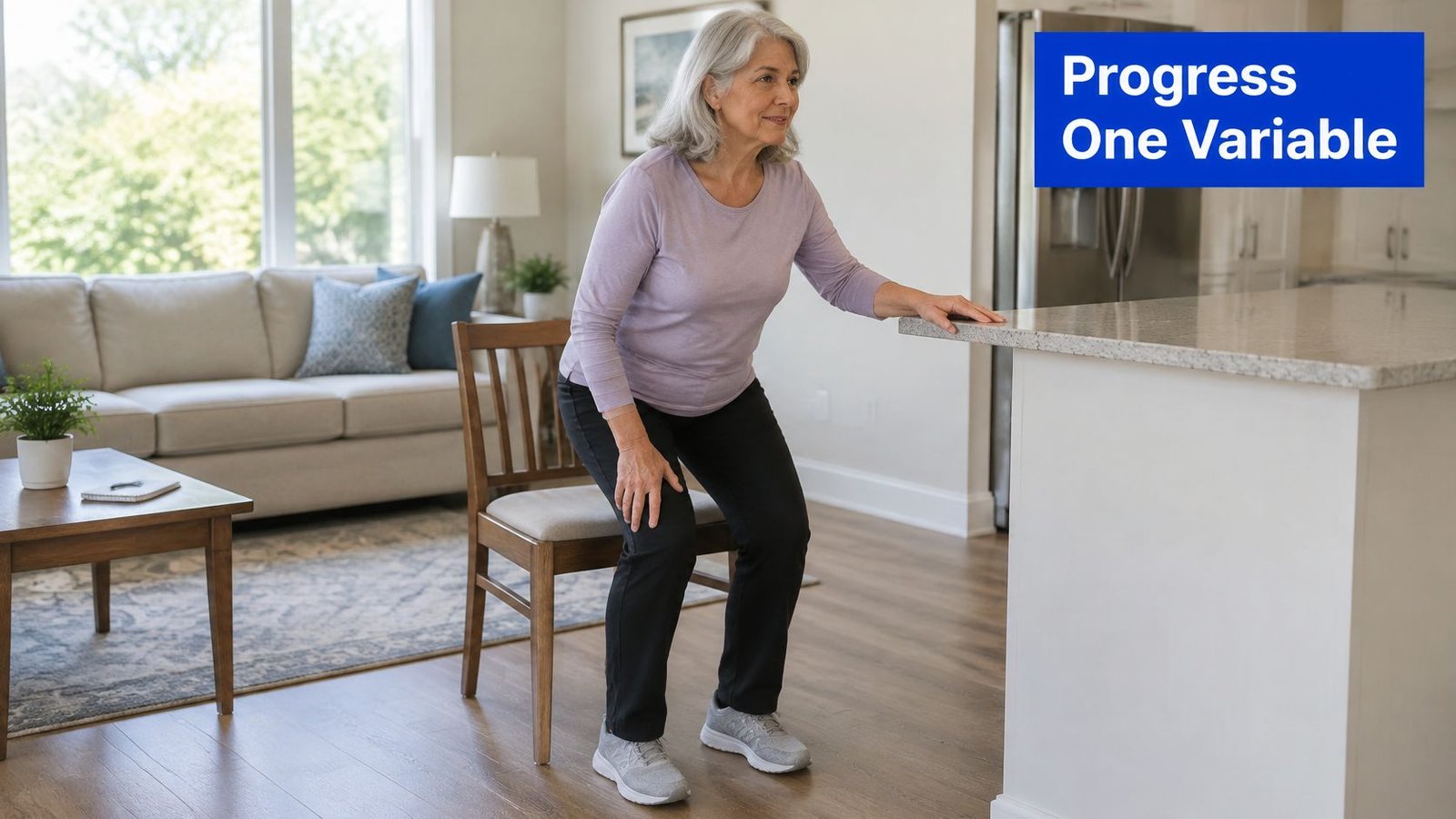
Practical rule: change one variable next session, not five. Cut the walk and the repetitions in the same week and you won't know which one worked.
Australian consumer guidance is blunt about the choice. Activity can be adjusted so you keep exercising, even a small amount is preferable to none, and the dials to turn are range, resistance, speed or volume, as set out in the consumer guide to the knee osteoarthritis standard. Turn one and leave the rest alone.
Avoiding all movement because of pain is usually the bigger risk than a session that was slightly too large. Chasing a pain-free workout isn't the goal either. A session that leaves the knee mildly sore for an hour and settled by dinner is a session you can repeat.
Walking Cycling Yoga or the Pool
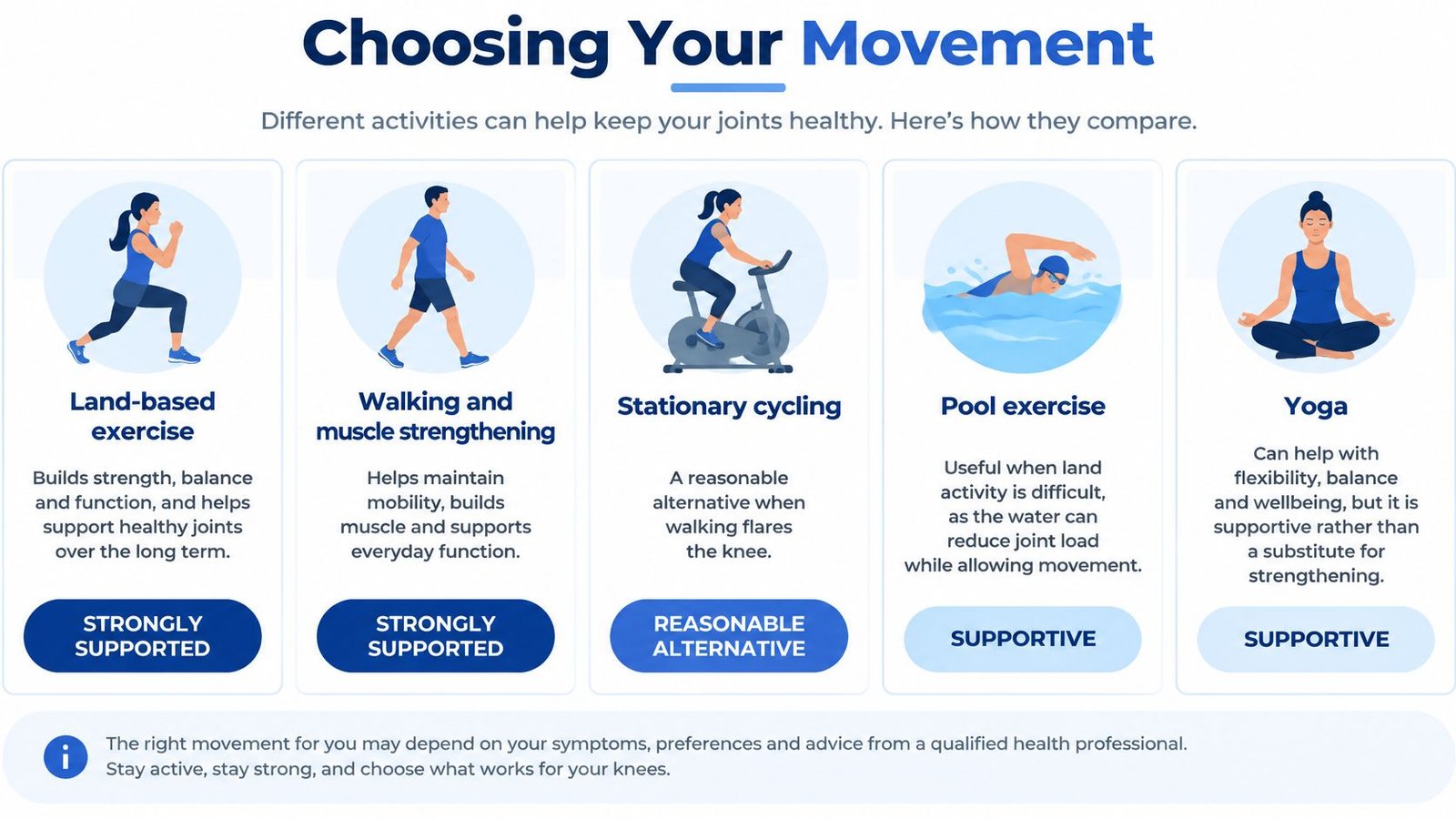
Walking, cycling, yoga and pool exercise can all help you stay active with knee osteoarthritis, but they do different jobs. Australian guidance strongly supports land-based exercise and muscle strengthening. Stationary cycling, aquatic exercise and Hatha yoga are also options, depending on your preferences, abilities and access to facilities, according to the RACGP's plain-language guidance on knee and hip osteoarthritis.
What each option asks of you
| Option | Role in Australian guidance | Impact and balance | Best fit |
|---|---|---|---|
| Walking | Strongly recommended land-based aerobic work | Low impact on flat ground; moderate balance demand | Someone who prefers walking outdoors and needs no equipment |
| Muscle strengthening | Core recommendation for pain and function | Low impact; balance demand depends on the exercise | Building capacity for chair transfers, stairs and everyday movement |
| Stationary cycling | An option based on preference and access | Very low impact; seated, with little balance demand | When hills, pavement or deeper knee bends stir symptoms |
| Aquatic exercise | An option when facilities are accessible | Water supports body weight and can make movement easier; balance is aided by water | When standing exercise flares symptoms and a pool is practical |
| Tai Chi | Named recommended option | Low impact; higher balance demand | Someone who prefers a class and can keep a chair nearby |
| Hatha yoga | An option based on preference and access | Impact and balance demand vary by pose | Someone who dislikes gyms; trial evidence suggests it can ease knee pain about as well as strengthening, as a complement or alternative, not a better treatment |
Choose activities you can repeat, while keeping strengthening in the picture. A pool session may make movement more comfortable, while strengthening works the muscles used to rise from a chair. They are useful for different reasons.
Walking, cycling, yoga or pool exercise can sit alongside your strengthening work. If a chosen activity brings on symptoms, use the two-hour pain rule to judge whether the dose was manageable, then adjust the next session rather than abandoning movement altogether.
How to Progress Sets and Load
Give the starter week a fortnight before you touch it. That's the checkpoint: two weeks at the same dose, the two-hour window quiet each time, and the goal on the fridge starting to feel slightly easier.
Then change one variable, in this order:
- Add two repetitions to a set, keeping the same support.
- Add a third set once those repetitions feel comfortable.
- Slow the lowering phase to three seconds.
- Add load or height, such as a light ankle weight on the knee extension or a slightly higher step.
- Extend the walk or ride by about five minutes.
Don't add weight and hills in the same week. That's the most common way a good fortnight turns into a flare and a lost month.
A counter and a dining chair are all the equipment the first month needs.
The clinical care standard for knee osteoarthritis frames a sound program around an individual goal, enough dose and regular review, rather than one fixed list of movements. That's also why no honest success percentage can be published for a home routine: the outcome depends on the exercise type, how closely it's followed, baseline severity and how long anyone watches for change.
Edge cases need plain answers rather than a harder exercise. After a flare, go back to the last dose that settled within two hours and hold it for several sessions before climbing again. If balance is the limiting factor, add repetitions before you take the hand support away. If a comorbidity or falls risk makes the next step unclear, that's a review point, not a reason to invent something more ambitious.
Progress is measured by what you can do on a Thursday afternoon, not by how sore you feel on a Saturday.
Over four weeks it looks like this: week one learning the moves, week two repeating them, weeks three and four adding one variable if symptoms allow. If stairs are still the sticking point at that point, it's worth looking at knee pain treatment options beyond a home program.
See an Osteopath When Home Changes Are Not Enough
Three things justify a booking rather than another fortnight of adjusting alone:
- A knee that gives way, locks, or turns hot and swollen, or night pain that's new. Those aren't dose problems and they don't belong in a self-management plan.
- Pain that stays up beyond two hours despite two sensible cuts to the volume.
- A goal that hasn't moved in about four weeks, whether that's the chair, the stairs or the walk to the shops.
An appointment adds what a chart can't. A look at how the hip, knee and foot share load, hands-on joint work, and a home plan written for that person's knee rather than a typical one. Our osteopaths hold university qualifications in osteopathic medicine and are registered with AHPRA, and we work closely with each patient's GP and specialist team where appropriate. Care for knee pain with an osteopath is gentle by design; treatment shouldn't be painful, though mild temporary soreness afterwards is normal.
Bring your starter-week notes and what the two-hour rule showed, then ask about private health cover, since major funds recognise our osteopaths, or about Medicare arrangements if you think you may be eligible. Email hello@baysideosteopathic.com.au or call 0419110004 to ask whether a knee review is the right next move.
A good program is one you can repeat next month. When the knee stops giving clear feedback, that's the moment to borrow a second set of eyes.
Bayside Osteopathic Health builds home programs for knee osteoarthritis around the same logic you've just read: a starting dose you can repeat, symptom rules that say when to hold and when to progress, and hands-on treatment when the joint needs more than exercise alone. If you'd like your own week mapped out, checked and adjusted as you go, Bayside Osteopathic Health is the place to start.