
If a sore shoulder and neck is always a posture problem, why can it flare after a quiet day, interrupt sleep, or keep returning despite a better chair? The answer often involves more than where you hold your head. Recent activity, muscle capacity, sleep and the way your nervous system processes pain can all matter.
Before choosing a stretch, though, decide whether self-care is appropriate. A familiar local ache needs a different response from pain accompanied by weakness, illness or chest symptoms. Start with safety, then look at what your symptoms stop you doing.
Table of Contents
- When a Sore Shoulder and Neck Needs Urgent Care
- Why Neck Pain and Shoulder Pain Travel Together
- Four Patterns and Real-Life Scenes
- Gentle Moves You Can Start at Home
- How an Osteopath Assesses the Whole Pattern
- Why Sore Shoulders and Necks Persist
- Book Help When Home Care Is Not Enough
When a Sore Shoulder and Neck Needs Urgent Care
Is this ordinary muscle tension, or something that shouldn't wait? Many everyday episodes involve muscles and joints, but calling pain a posture problem can be too reassuring when nerves, an injury or the heart may be involved.
Don't test a concerning symptom with harder stretches. The urgent warning signs described by Healthdirect's neck pain guidance include neurological changes, fever, symptoms after trauma, and chest pain, shortness of breath or sweating with neck pain, which warrants calling 000.
Same-day triage for a sore shoulder and neck
| Symptom pattern | What it may mean | What to do |
|---|---|---|
| Numbness, weakness, dizziness or imbalance | Possible nerve or serious neck problem | Seek urgent medical care the same day |
| Fever, or vision or hearing changes | Possible infection or neurological illness | Arrange prompt medical review |
| New bowel or bladder problems with neck pain | Possible spinal cord involvement | Seek emergency assessment |
| Pain after a fall, collision or other trauma | Possible fracture or instability | Get urgent assessment; don't force movement |
| Chest pain, shortness of breath or sweating with neck pain | Possible cardiac emergency | Call 000 |
| Local ache after desk work or training, without arm weakness or systemic signs | May be mechanical strain | Try brief self-care and gentle movement; arrange review if it isn't easing |
These patterns aren't diagnoses. They help you choose the safest next step, particularly when symptoms are new or changing.
After a fall or collision, being able to move doesn't automatically rule out an important injury. Avoid repeatedly turning your head to see whether it has loosened up, and don't ask someone to force or manipulate it.
When watching and waiting is reasonable
A local ache after a demanding desk day or familiar training session may be suitable for relative rest and comfortable movement. That means temporarily reducing the aggravating task, not staying completely still or pushing through the same workload.
Function matters alongside pain intensity. A moderate ache that prevents you lifting your arm, working safely or checking traffic deserves attention, even if you wouldn't describe the pain as severe. Seek review sooner if symptoms worsen rather than waiting for a self-care routine to work.
Before an appointment, write down:
- Onset and injury: When it started, whether it followed trauma, and what changed beforehand.
- Spread and nerve symptoms: Whether pain travels into the arm, with any tingling, numbness or weakness.
- Sleep and daily tasks: What wakes you, what you can no longer do, and which positions help.
Why Neck Pain and Shoulder Pain Travel Together
Think of carrying a backpack when a strap slips off your shoulder. The bag hasn't become heavier, but you change how you carry it. Your remaining shoulder lifts, your neck braces and the effort becomes uncomfortable.
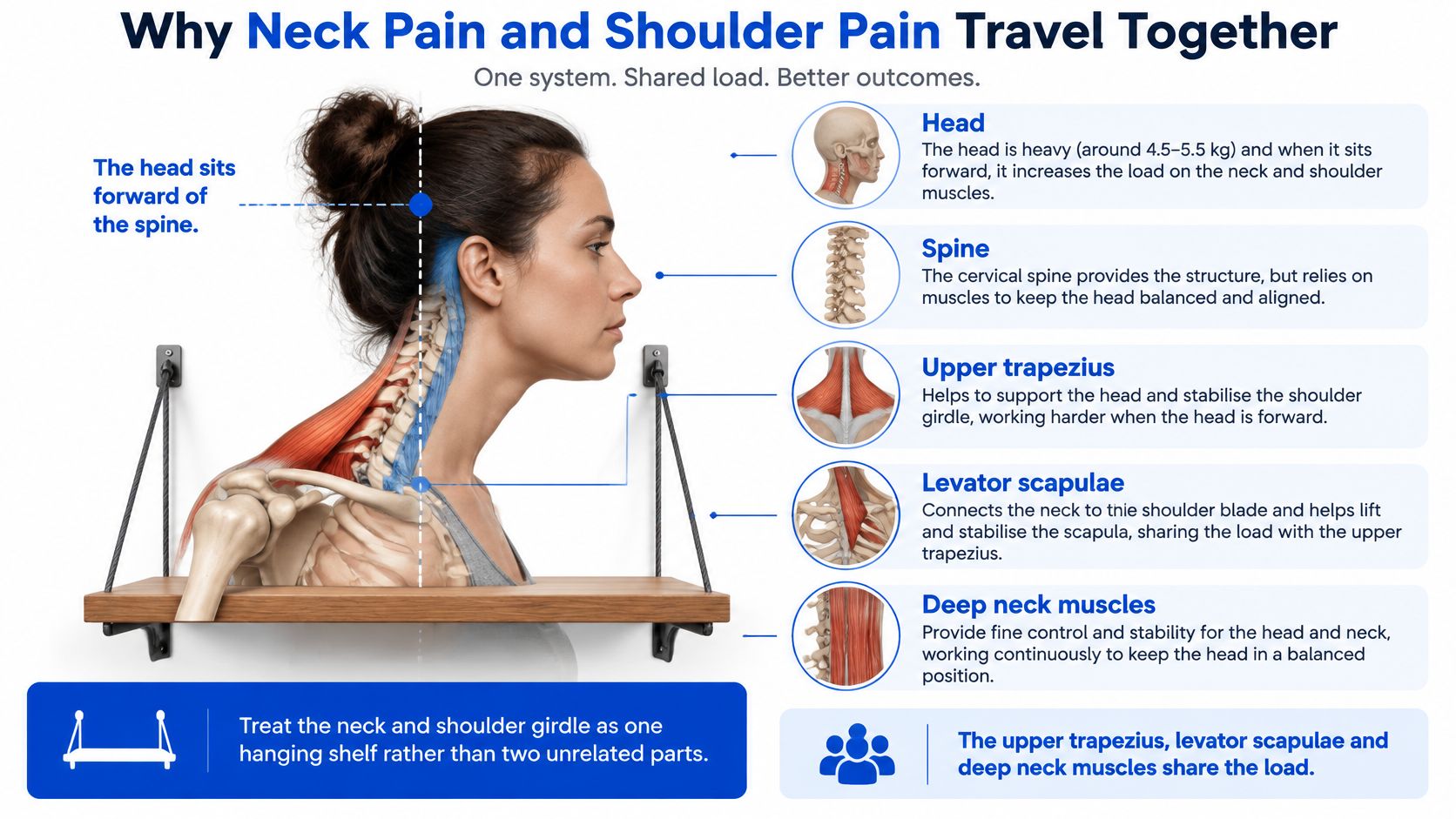
The neck and shoulder girdle work together in a similar way. Treat them as one hanging shelf rather than two unrelated parts. Muscles connect the skull, neck, upper back and shoulder blade, so changing the demands on your arm can change the work around your neck.
This illustration shows how those structures share the load.
Shared muscles, changing demands
The upper trapezius spans the neck and shoulder region. The levator scapulae connects the neck with the shoulder blade, while deeper neck muscles help control the head. These muscles don't take turns working in isolation.
Say you're using a laptop at the kitchen table. You lean towards the screen, reach for the mouse and leave your forearms unsupported. By the afternoon, the area between your neck and shoulder blade aches.
That doesn't establish that your posture has damaged anything. It suggests that the position, duration and amount of muscular work deserve a closer look. A comfortable position can become uncomfortable when you stay there without variation.
A posture is a position you use, not a test you have to pass all day.
Pain can be felt away from its source
Referred pain means discomfort is felt somewhere other than the structure contributing to it. A neck problem can produce pain over the shoulder or upper back without a torn shoulder tendon. Irritated nerves can also cause symptoms into the arm, which need a different assessment from a local muscular ache.
You might feel easier after walking, then tighter after uninterrupted screen time. Another person may notice an ache near the base of the skull or discomfort when turning towards a second monitor.
These observations don't diagnose arthritis, a disc problem or a shoulder injury. They provide clues. Notice whether turning your neck, lifting your arm or rotating your upper back first reproduces the familiar discomfort, without repeatedly provoking it.
Four Patterns and Real-Life Scenes
Pain isn't unusual: the Australian Bureau of Statistics reports that 71.1% of adults experienced bodily pain during the four weeks before the relevant National Health Survey. That's bodily pain generally, not a combined estimate of neck and shoulder pain.
The useful question is less whether your ache is common and more which pattern it resembles. These patterns help organise symptoms, but they aren't a substitute for examination.
Four patterns behind a sore shoulder and neck
| Pattern | Typical feel | Common trigger | First useful response |
|---|---|---|---|
| Postural overload | Dull ache at the neck base and shoulder tops, worse late in the day | Long screen time with little movement | Breaks and tolerable strengthening, rather than one rigid posture |
| Muscle strain | Local tenderness after a clear overload | Sport, lifting or an awkward reach | Relative rest, followed by graded movement |
| Referred pain | Shoulder ache with neck stiffness or arm symptoms | Neck or upper-back irritation or restriction | Assessment for arm symptoms; urgent review for new weakness or numbness |
| Arthritis-related stiffness | Stiffness on waking or after stillness, with a smaller comfortable range | Known arthritis or joint changes | Gentle mobility; medical review for swelling, marked night pain or sudden loss of use |
What the patterns look like during an ordinary week
The home-office afternoon. A Brighton worker starts at the kitchen table, using the laptop keyboard and screen together. Their shoulders gradually creep upwards, and a dull ache develops while answering emails.
The distinguishing clue is the build-up during sustained work, rather than a single painful incident. Supporting the forearms, separating the keyboard from the screen and changing tasks may make the setup easier to tolerate. Our guide to neck pain from sitting at a desk explores this everyday pattern without asking you to sit bolt upright indefinitely.
The weekend sport flare. A tennis player feels a local pull during a serve, then returns to full training while reaching overhead still hurts. The neck begins to brace around the sore shoulder.
Here, the clear onset and painful sporting movement matter more than whether the player slouches at work. Reducing the provoking load is sensible, but abandoning all comfortable activity isn't usually the aim.
The shoulder ache that follows neck movement. A Hampton resident assumes their shoulder is injured because that's where they feel pain. Yet turning their head brings it on more reliably than moving the arm.
That pattern warrants checking the neck as well as the shoulder. Tingling, numbness or reduced strength shouldn't be dismissed as a tight muscle.
The stiff start to the day. An older adult with known arthritis feels restricted after getting out of bed. Hanging washing becomes tiring, and they gradually avoid reaching.
The task is to work out what's changed, what remains comfortable and whether the symptoms fit their usual arthritis pattern. New swelling or a sudden loss of use shouldn't automatically be attributed to age.
Patterns can overlap. A desk worker can also strain a shoulder during sport, and someone with arthritis can develop a separate neck problem.
Gentle Moves You Can Start at Home
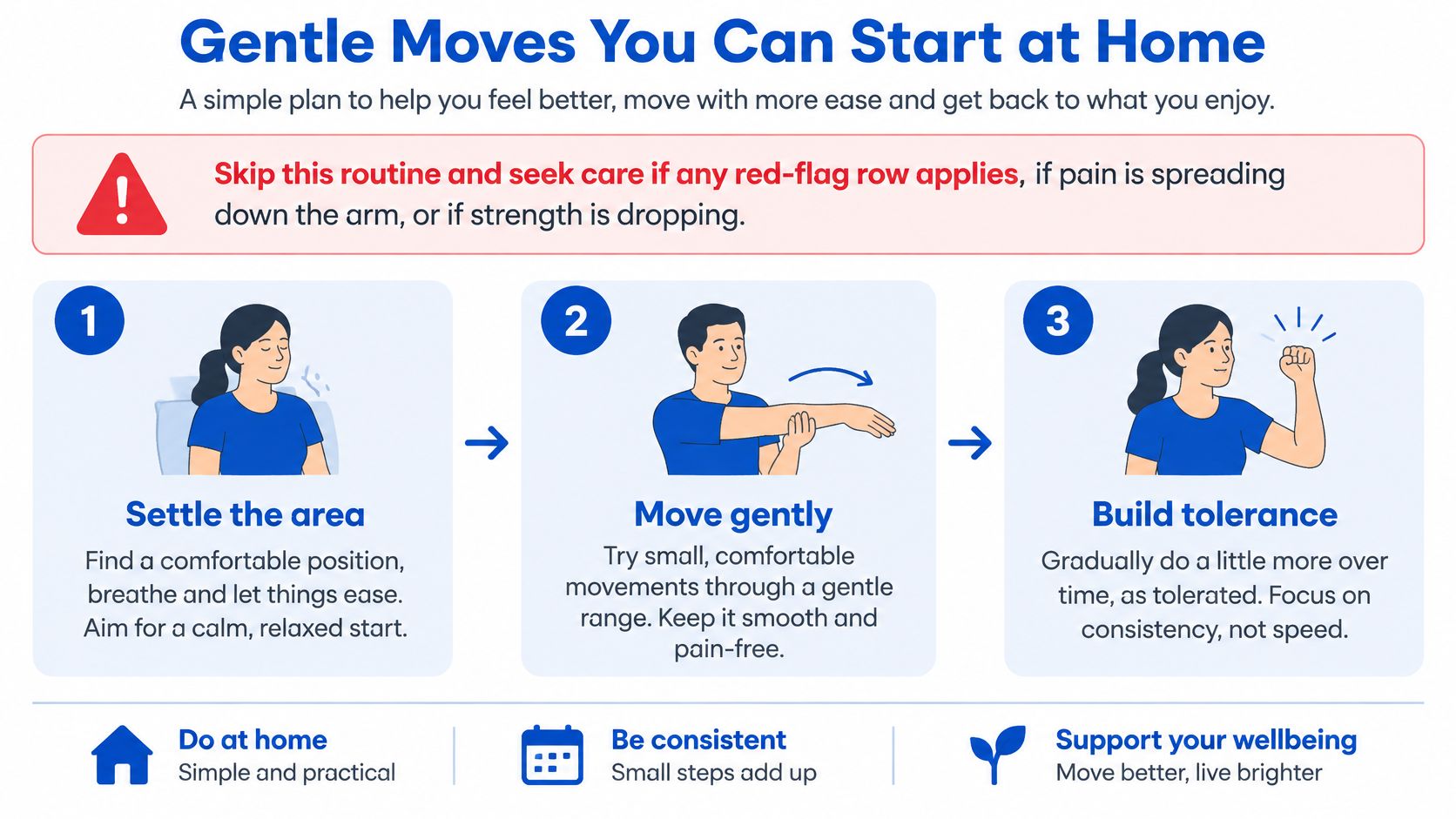
Skip this routine and seek care if any red-flag row applies, if pain is spreading down the arm, or if strength is dropping. After recent surgery or a significant injury, use your treating clinician's instructions rather than a general exercise guide.
The starter approach below moves from comfort towards tolerable activity.
Start below your limit
Settle the area without immobilising it. Sit with your forearms supported, or lie in a position that lets your neck relax. Optional gentle warmth may feel soothing, but protect your skin and don't sleep on a heat pack. Stop if warmth aggravates symptoms, and avoid pulling a freshly irritated neck into a strong stretch.
Explore easy movement. Try small chin nods, gentle side bends and relaxed shoulder circles. Move slowly within a comfortable range, rather than trying to reach the same distance on each side. Stop any movement that produces sharp pain, dizziness, tingling or symptoms travelling down the arm.
Practise light shoulder-blade control. With your arms relaxed, gently draw the shoulder blades slightly back and down, then release. This is a small movement, not a forceful squeeze or a position to hold all day. If your neck tenses or your shoulders lift towards your ears, use less effort or leave it out.
The aim is to finish feeling that movement is manageable. You don't need a strong pulling sensation for an exercise to be useful.
Build tolerance rather than brace harder
Introduce low-load strengthening when comfortable. A light resistance-band row can be a starting option: secure the band safely, keep your elbows near your sides and draw them back without shrugging. Evidence discussed by the Royal Australian College of General Practitioners includes benefit from approximately two minutes of strengthening five days weekly for 10 weeks, or approximately 30 minutes of high-load upper-trapezius exercise twice weekly for five weeks. These are studied programmes, not interchangeable prescriptions or a reason to begin heavy neck exercises without assessment. Reduce the load or stop if pain rises sharply or remains aggravated afterwards.
Interrupt static work. Use natural breaks, such as finishing a call or sending a document, to stand, walk or perform comfortable movements. Bring frequently used items closer so you aren't repeatedly reaching. If a movement break consistently makes symptoms worse, change the movement rather than forcing it.
Progress one demand at a time. Make the exercise slightly more challenging only when you can control it and your usual activities aren't becoming harder afterwards. Don't increase resistance, exercise volume and sporting workload together. New weakness, worsening night pain or a lack of improvement calls for assessment, not harder stretching.
Our shoulder pain relief exercises guide offers further movement options to discuss with your clinician. Choose movements that fit your symptoms rather than completing every exercise available.
This video provides an additional visual reference, but your symptoms and any individual clinical advice take priority.
How an Osteopath Assesses the Whole Pattern
An assessment should explain why a particular activity is difficult, not only identify the sorest spot. At Bayside Osteopathic Health, our initial assessment includes a detailed case history and a physical assessment of posture, movement and the specific area of concern.
For spinal pain, we start with a whole-body assessment to trace contributing factors rather than treating only where it hurts. That doesn't mean every body part needs treatment. It means the examination follows the history and the tasks that reproduce your symptoms.
From your story to a movement assessment
The history covers how symptoms began, any trauma, arm symptoms, sleep disruption and the activities you've stopped doing. A painful serve, difficulty fastening clothing and an ache during computer work each suggest different demands to examine.
The physical assessment may include:
- Active movement: How comfortably you turn your neck, raise your arm and move your upper back.
- Strength and control: Whether the shoulder and arm tolerate resistance, and how the shoulder blade moves.
- Symptom behaviour: Whether discomfort stays local or travels, and which movements reproduce it.
- Relevant nerve checks: When the history suggests altered sensation, weakness or nerve involvement.
A clinician should explain what these findings suggest, what remains uncertain and whether medical review is needed. A movement test isn't proof of a particular diagnosis on its own.
Why a scan isn't always the first step
The Australian Government Medical Services Advisory Committee's clinical guidelines review discourages routine imaging for uncomplicated shoulder pain unless red flags suggest serious pathology, and reports good-to-strong evidence for exercise therapy and physiotherapy over approximately five to 12 weeks.
The supported approaches include range-of-motion work, stretching, shoulder-blade exercises, progressive strengthening and graded return to normal activity. That evidence supports an active rehabilitation plan; it doesn't establish that every treatment technique will help every shoulder.
Hands-on care, where appropriate, may accompany movement advice rather than replace it. At our clinic, treatment should never be painful, although mild temporary soreness may follow a session. Tell the practitioner if a technique feels uncomfortable so it can be changed or stopped.
Measure useful progress: Reaching a shelf, tolerating a work task or returning to a controlled training drill matters more than tenderness alone.
Agree on meaningful goals and review movement, strength and function against them. When arthritis or another medical condition is involved, we work with the patient's GP and specialist team where appropriate.
Major trauma, systemic illness, unexplained weight loss, marked night pain, acute neurological changes or severe loss of function warrant medical assessment. Osteopathic care doesn't replace that assessment or reverse arthritis.
Why Sore Shoulders and Necks Persist
A new chair can make working more comfortable without resolving the whole problem. Massage may ease a tight area while the same workload remains difficult. A scan can answer a structural question without explaining every aspect of your day-to-day pain.
Persistent symptoms may involve several contributors at once: irritated tissues, reduced capacity after avoiding activity, interrupted sleep, stress and changes in pain sensitivity. None of these means the pain is imagined.
Sensitivity isn't the same as damage
Your nervous system helps decide how protective a response needs to be. With persistent pain, that response can become more sensitive, so an ordinary movement or modest load feels disproportionately uncomfortable.
This is sometimes described as increased pain sensitivity. It isn't something you can diagnose from a sore shoulder alone, and it shouldn't become another label that prevents a proper examination.
Likewise, feeling stressed doesn't prove stress caused the pain. But noticing jaw clenching, raised shoulders or disrupted breathing during demanding work can reveal habits worth changing. Our explanation of stress and muscle tension explores that relationship without reducing pain to an emotional problem.
Persistent pain deserves a broader assessment, not a judgement about how well you're coping.
Make the week more manageable
- Pace demanding tasks: Break up activities such as gardening, overhead work or prolonged computer use before you reach the point where you have to stop completely. Keep comfortable activities in your week rather than treating all movement as dangerous.
- Make sleep support practical: Choose a pillow arrangement that supports your head comfortably without holding the neck sharply bent. If your shoulder hurts when lying on it, try another position and support the arm with a pillow.
- Use function to guide decisions: Notice whether everyday tasks are becoming easier, not just whether pain disappears immediately after an exercise. If your comfortable activity keeps shrinking, seek assessment.
There isn't a single ideal pillow, chair or treatment that resolves every persistent sore shoulder and neck. The useful plan addresses the contributors that matter to you, remains affordable and can be adjusted when progress stalls.
Persistent or changing symptoms still need medical consideration where appropriate. Osteopathy can form part of care, but it isn't a substitute for medical assessment or a promise of a single cure.
Book Help When Home Care Is Not Enough
Continue gentle self-care when the ache remains local, comfortable movement is improving and you're gradually returning to ordinary tasks. Book an assessment when progress stalls, symptoms repeatedly return, or work, sport and daily activities keep being cut back.
A clinician also needs to know about symptoms that travel into the arm. New numbness or weakness needs urgent medical review rather than a routine appointment; chest symptoms and other emergency features require emergency care.
Choose a next step you can sustain
Persistent pain often comes with practical barriers: the Australian Physiotherapy Association's account of the Australian Longitudinal Study on Back and Neck Pain reports that almost 80% of participants were dissatisfied with sleep quality, while over 40% experienced financial difficulty accessing healthcare. These findings describe the study participants, but they underline why sleep and the feasibility of a care plan deserve attention.
Bring your symptom notes and explain which tasks matter most. If cost, time or the amount of home exercise feels unmanageable, say so early rather than leaving with a plan you can't use.
- Bring the history: Include onset, trauma, arm symptoms and sleep changes.
- Name the lost activity: Explain what you've stopped doing and what you'd most like to regain.
- Describe your attempts: Note which exercises, workload changes or treatments helped, aggravated symptoms or made no difference.
We welcome enquiries about acute pain, sports injuries and whether osteopathic care is appropriate. We prioritise prompt bookings for acute or urgent pain, but a clinic booking must never delay emergency assessment.
Book when home care has stopped moving the problem forward.
Bayside Osteopathic Health offers gentle hands-on care, whole-body assessment and personalised movement advice for neck and shoulder symptoms. Visit Bayside Osteopathic Health to enquire about an assessment and discuss whether osteopathic care fits your symptoms and activity goals.