
You have closed the laptop, but your shoulders have not come down. Your neck feels braced, your jaw is tight, and turning your head takes more effort than it should. Nothing dramatic happened today. There was no fall, no heavy lift, just a long run of screens, deadlines, and broken sleep. That familiar end of day tightness is often where stress and muscle tension meet, and understanding the pattern is more useful than chasing a single sore spot.
Table of Contents
- Why Stress and Muscle Tension Show Up Together
- How Stress Changes Muscle Guarding
- Who Feels Stress-Related Muscle Tension Most
- Everyday Patterns of Tightness and Pain
- Self-Care That Eases Stress and Muscle Tension
- When Gentle Osteopathic Care Is the Better Next Step
- Your Next Step Toward Easier Movement
Why Stress and Muscle Tension Show Up Together
For many people, tightness does not arrive after one obvious injury. It creeps in across a hard week. You sit through back to back calls, you skip a walk, you sleep lightly, and by Thursday your upper back feels as if it has been holding you up all day without a break.
That's a useful clue. When discomfort builds alongside worry, poor sleep, or a run of difficult weeks, it helps to look at both the sore area and everything around it. Treating only the neck or only the stress can miss half the picture.
What Australian adults report
The overlap is common. In Australia's 2020-21 National Health Survey on stressors and bodily pain, 43.7% of adults had experienced at least one significant stressor in the previous year and 20.0% had experienced two or more. Those stressors included illness, injury, the death of someone close, and relationship or financial problems.
In the same survey, 71.1% of adults reported bodily pain in the previous four weeks. That included 18.1% who described moderate pain and 6.4% who described severe or very severe pain.
The pattern was stronger where distress was higher:
- High distress and stressors: 69.1% of adults with high or very high psychological distress had experienced at least one stressor.
- Severe pain and stressors: Among adults with severe or very severe pain, 39.1% had experienced two or more stressors.
- Pain and work: 62.6% of adults who experienced bodily pain said it interfered with work in the preceding four weeks.
A calm starting point: These figures show that stress and pain often travel together. They don't prove that stress alone causes your tight shoulders.
That distinction matters. It stops you from blaming yourself, and it stops you from ignoring physical load, joint stiffness, or a lack of movement. Before you choose a remedy, ask two questions. What has my body been doing this week, and what has my mind been carrying?
How Stress Changes Muscle Guarding
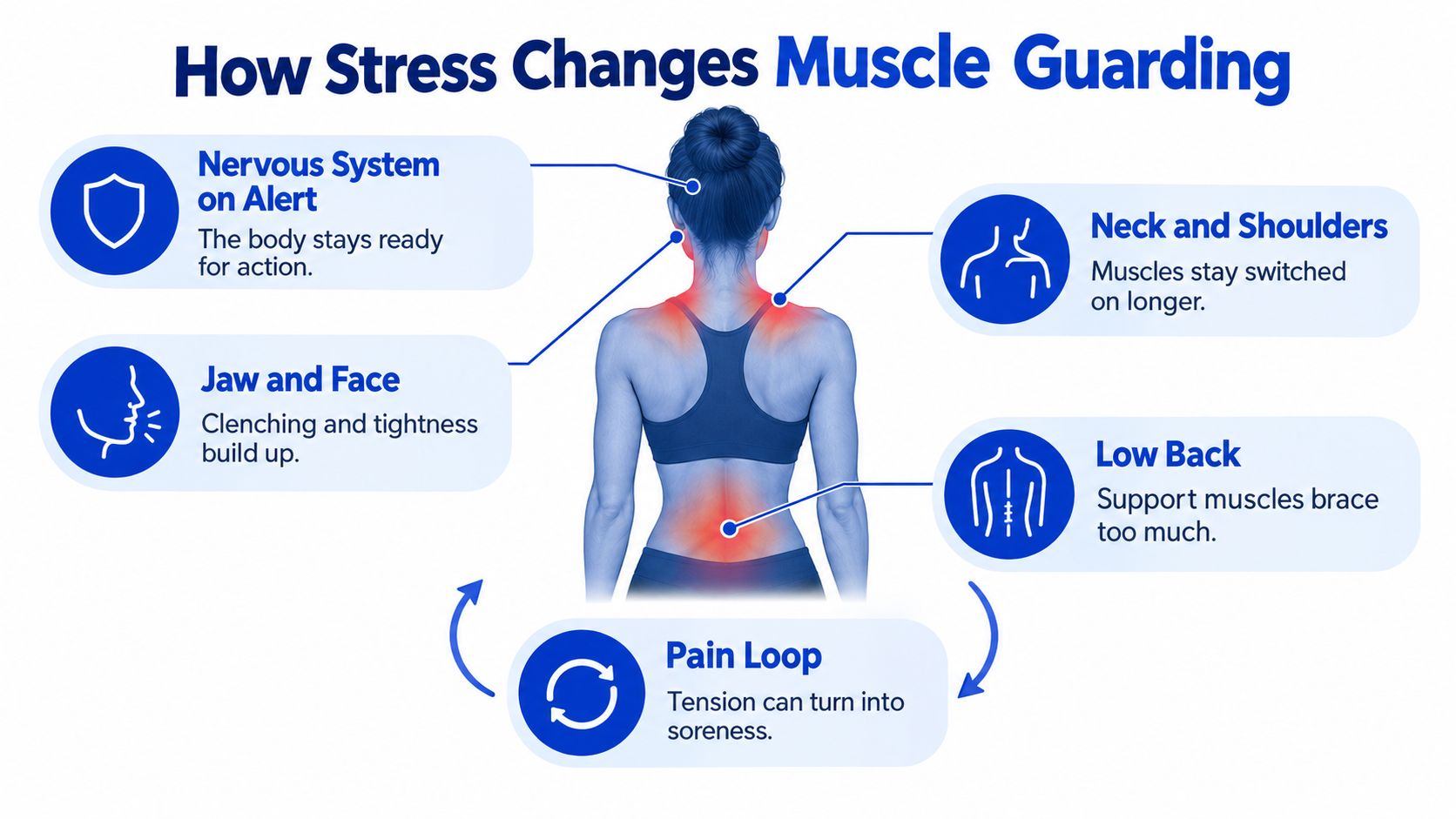
Muscle guarding is your body's protective brace. When your nervous system stays on alert, muscles in your neck, jaw, shoulders, and low back can hold a low level contraction for longer than needed. It's a bit like keeping your hand on a railing after the step underneath you is already steady.
In the short term, that brace makes sense. You're ready to react. The trouble starts when the brace doesn't switch off. Muscles that stay switched on tire sooner, movement feels narrower, and ordinary positions start to feel sharper or heavier than they should.
The infographic below maps where that guarding commonly shows up.
A loop, not a one way street
Once an area hurts, you naturally protect it. You turn your whole trunk instead of your neck, you avoid reaching overhead, or you stop bending freely. Less movement can leave the area stiffer and more sensitive, which raises worry, which invites more guarding.
Australian evidence points to this wider two way cycle rather than a simple fight or flight burst. Australian discussion of chronic musculoskeletal pain and mental health notes that chronic non-cancer pain affects more than 3.24 million Australians and can worsen mood, sleep, fatigue, activity, and quality of life, while anxiety and depression can also increase pain severity.
A 2025 Australian qualitative study of people aged 16-24 found that chronic musculoskeletal pain and mental health symptoms reinforced each other through emotions, beliefs, behaviour, healthcare encounters, stigma, and personal circumstances. That's a broad loop, not a single trigger.
Short tight spell or self perpetuating cycle
A tight neck after one deadline that eases with sleep and a walk is different from a cycle that keeps feeding itself. Watch for poor sleep, fear of movement, less activity, irritability, and pain that lingers even on quieter days.
Pain influenced by stress is still real pain. It isn't imagined, and it isn't a character flaw.
Calming your system helps, but it may not finish the job on its own. If load, movement habits, or ongoing pain sensitivity stay unchanged, tension can return as soon as the next demanding week arrives.
Who Feels Stress-Related Muscle Tension Most
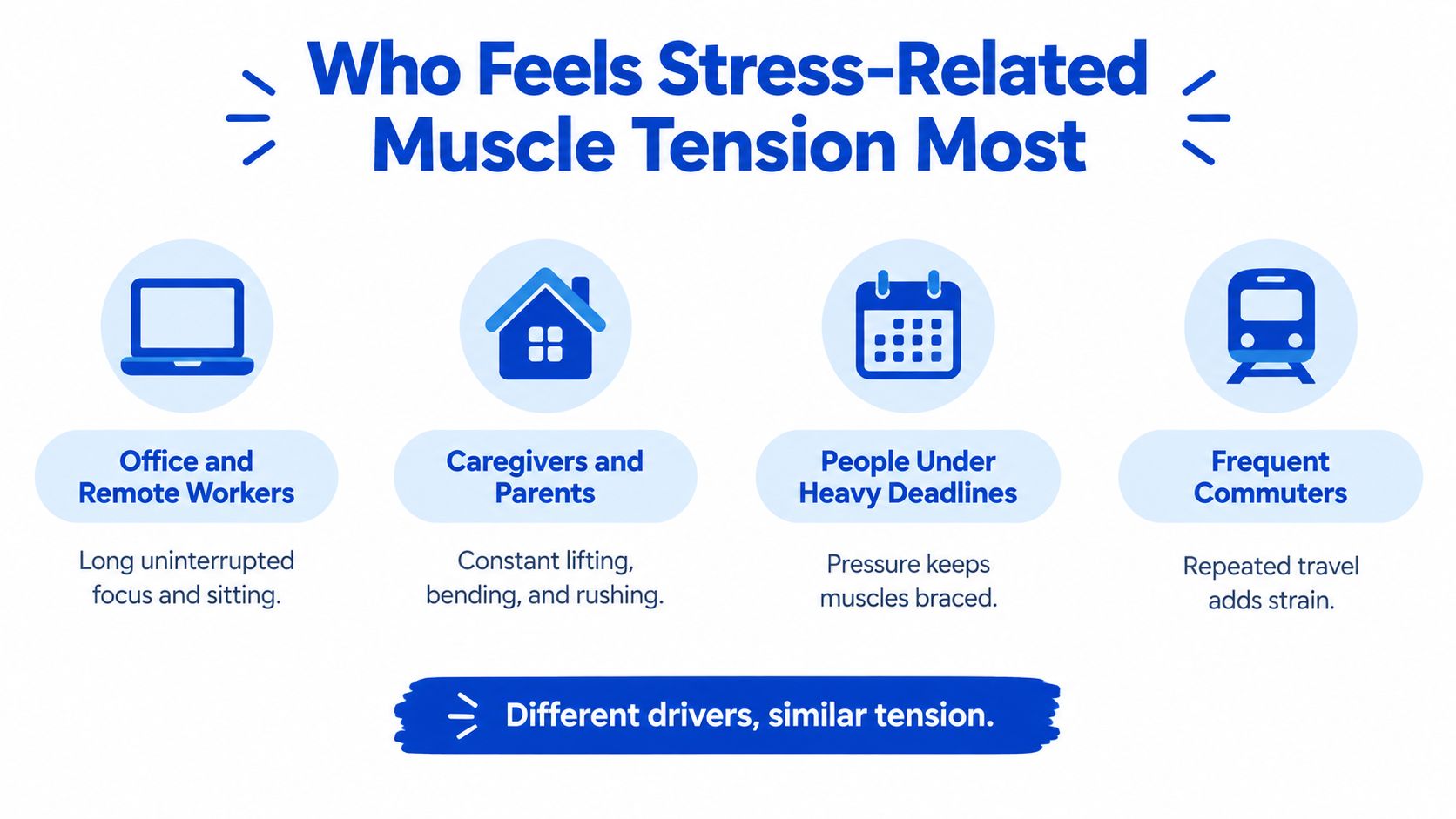
Different lives load the same muscles in different ways. Two people can both describe a tight neck, yet need quite different first steps.
The graphic below groups some common patterns, from desk work to caregiving and commuting.
Office and remote workers
For desk based workers, the driver is rarely one bad chair. It's more often uninterrupted focus, high mental demand, and little control over when you can pause. Your shoulders stay slightly raised while you type, read, and concentrate, hour after hour.
In a one year longitudinal study of Australian office workers, the estimated incidence proportion of neck pain was 49% (95% CI 36-62%). High psychological stress, defined as a score of at least 5 on the stress subscale of the Depression Anxiety Stress Scales-21, was associated with a 1.64-fold hazard of developing a neck pain episode (95% CI 0.66-4.07).
Read that carefully. Because the confidence interval crossed 1.0, the link is suggestive rather than definitive. It supports checking workload, sleep, anxiety, and perceived stress alongside physical assessment, instead of assuming tension is purely mechanical. Greater cervical mobility and frequent exercise appeared protective in that study, which again points to movement, not just posture.
Older adults and people with ongoing pain
Older adults often describe a different mix. Joint stiffness, arthritis related discomfort, and slower recovery after an inactive or tense day can make guarding feel more pronounced. That doesn't mean stress causes arthritis. It means a stiff joint and a worried, sleepless week can amplify each other.
People already living with chronic back, neck, or joint pain sit in a third group. A flare disrupts sleep, poor sleep lowers tolerance the next day, and fear of bending or reaching can tighten the same regions again. Soon you're protecting an area even when you're trying to rest it.
A short self check helps sort this out:
- Workload and mood: Has demand risen while recovery has shrunk?
- Joint history: Is there long standing stiffness or arthritis related discomfort underneath the tension?
- Function: Is pain already limiting turning, lifting, walking, or sitting?
Everyday Patterns of Tightness and Pain
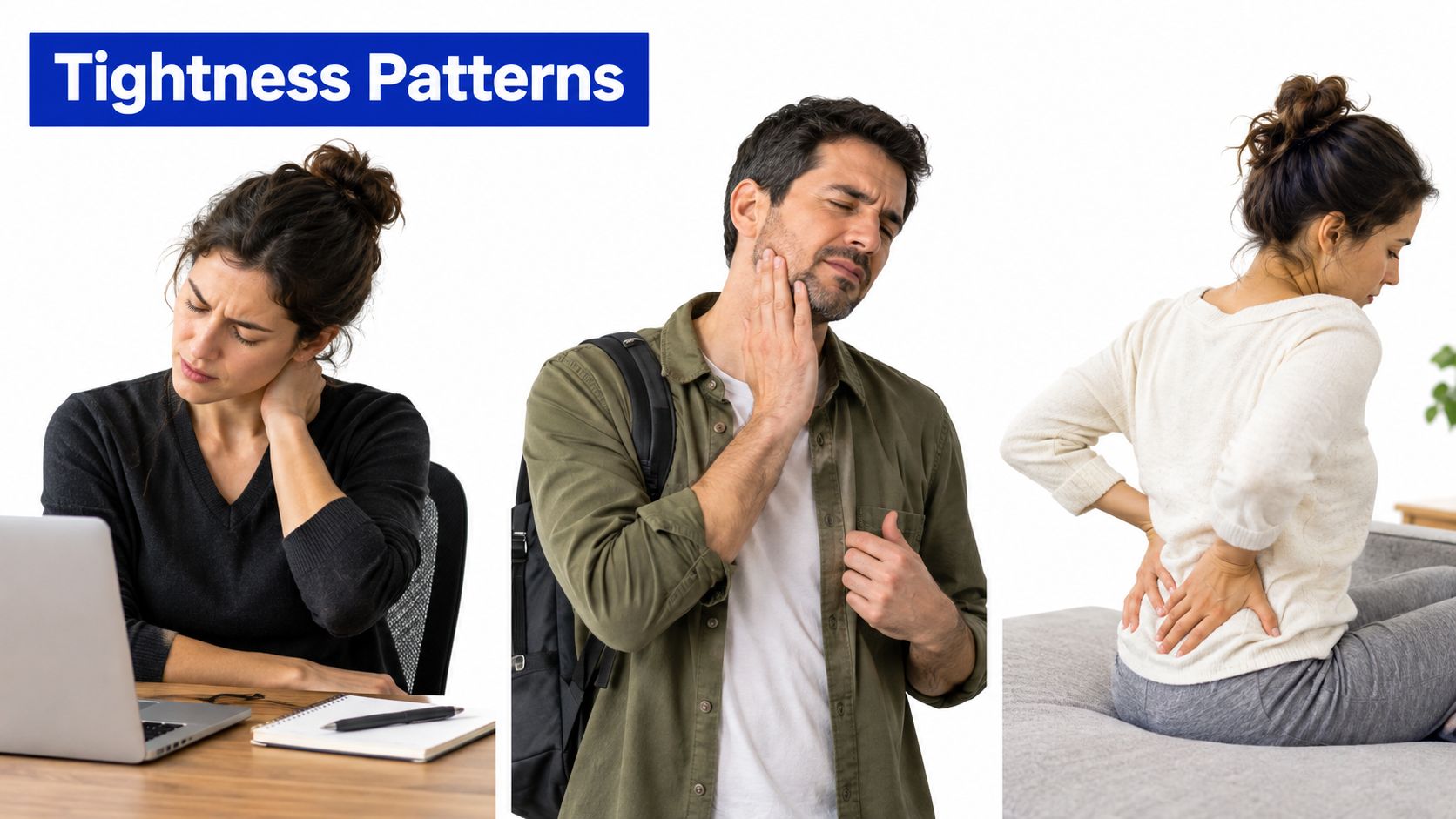
Patterns are easier to spot in real weeks than in abstract advice. The image below reflects three common sites where people first notice the brace.
Three recognisable weeks
First, consider a hybrid worker whose neck and upper back tighten after long, uninterrupted computer blocks. There's no single posture mistake. There's no break in concentration, so the shoulders never fully drop. By evening, checking a blind spot while driving feels stiff.
Second, consider someone handling loads at work or at home. Repeated lifting, carrying, putting down, or holding a child on one hip loads shoulders and low back again and again. With too little recovery between efforts, tired muscles guard, and even lifting a kettle starts to feel awkward.
Third, consider an older adult with long running joint pain. Morning stiffness is familiar, but after a worried, sleepless stretch and less walking than usual, the evening brace is stronger. Sitting through dinner becomes uncomfortable, and getting up takes longer.
The video below offers a visual way to think about how those everyday loads build.
Dose matters more than a single moment
Australian workers compensation data ground that load story. Safe Work Australia's statistics on work related musculoskeletal disorders recorded 360,180 serious musculoskeletal disorder claims nationally between 2009-10 and 2013-14, accounting for 60% of all serious claims. 63% were body stressing claims, and 79% of those resulted from muscular stress associated with lifting, carrying, putting down, or handling objects.
In plain terms, tissues tolerate a certain dose on a given day. Repeated loading, held postures, poor recovery, or a sudden force can exceed that dose. Muscles then guard and fatigue, and pain follows. If desk work is your main pattern, practical guidance on neck pain from sitting at a desk can help you look beyond chair height alone.
Don't wait out warning signs. Weakness, spreading neurological symptoms, or a clear drop in function needs clinical assessment rather than another week of hoping it settles.
Self-Care That Eases Stress and Muscle Tension
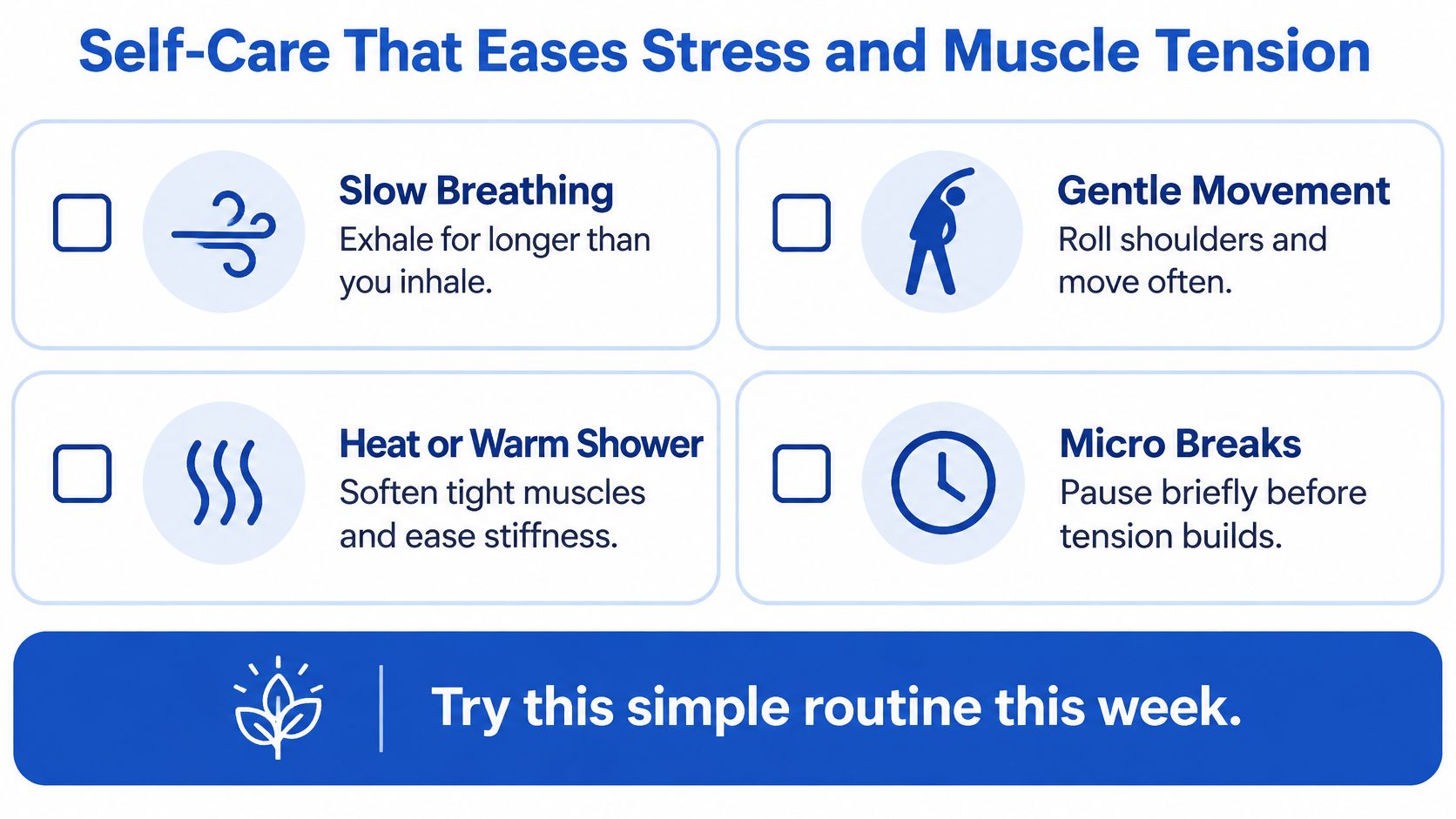
A tense neck after a busy day can reflect more than how you sat. Stress may keep muscles on guard, while stiffness and discomfort can add to stress. Self-care works best when it addresses both sides of this cycle: easing the body's alert response and making room for movement and recovery. Small habits repeated through the week usually help more than one forceful stretch on Sunday.
The graphic summarises four starting points: breathing, movement, breaks and a wind down for sleep.
Four habits to practise
Slow breathing with a longer exhale. Breathe in gently, then let your breath out for longer. There is no need to force relaxation. A slower exhale gives your shoulders and jaw a chance to soften as the sense of urgency eases.
Gentle movement, not forceful stretching. Roll your shoulders, turn your head through a comfortable range, and move your upper back little and often. Stretching techniques for flexibility offer structured ideas. Stop short of sharp pain, rather than pushing to prove you are doing it properly.
Position changes and task breaks. Stand, walk to get water, change tasks, or look away from the screen before tension builds. The aim is variety, not finding one perfect position.
A wind down that protects sleep. Dim screens, slow the pace, and keep a regular bedtime where you can. After a short night, the same neck may feel harder to release the next day, even if your workload is unchanged.
Why posture rules alone fall short
Advice about tech neck can focus too narrowly on sitting up straight. Work organisation matters too. Safe Work Australia's 2025 key work health and safety statistics identify mental stress as a continuing category of serious workers compensation claims. This points to a wider issue: changing posture may do little if work remains uninterrupted, mentally demanding, and difficult to control, with too little recovery.
Ask what is keeping the tension going. Is it long spells of screen work, high cognitive demand, limited breaks, or a schedule that leaves little room to recover? These patterns can keep muscles working while stress makes them more guarded, creating a cycle that posture rules alone cannot resolve.
Practical rule: Your next position is often your best position. Frequent change beats one perfect posture held all day.
Try regular position changes, varied tasks, short movement breaks, a sensible screen and input device setup, and realistic workload boundaries. If workload and movement stay the same, easing stress may not be enough to change the pattern.
Persistent pain, neurological symptoms, weakness, or substantial loss of function needs professional review, not another ergonomic tweak alone.
When Gentle Osteopathic Care Is the Better Next Step
At some point, the question changes from what can I try at home to who should look at this with me. Three paths cover most situations, and choosing well depends on how your symptoms behave, not on how long you can tolerate them.
Recent, mild tightness that's clearly easing often fits continued self care. Unexplained symptoms, neurological signs, weakness, or a sharp loss of function should prompt medical review first. Returning neck, back, shoulder, or joint tightness despite breaks, sleep, and gentle movement may suit a hands on assessment.
Choosing Self-Care or Osteopathic Assessment
| Pattern | Try first | Seek hands-on care when |
|---|---|---|
| Recent tightness after a busy week | Breathing, gentle movement, breaks, sleep routine | It keeps returning or stops improving |
| Desk related neck and shoulder ache | Position changes, task variation, workspace setup | Turning, sitting, or concentrating stays limited |
| Stiffness with joint discomfort | Gentle daily movement and pacing | Morning or evening stiffness restricts ordinary tasks |
| Worrying new symptoms | Medical review first | Weakness, neurological signs, or unexplained change appear |
At Bayside Osteopathic Health, practitioners assess how your whole body moves, not only the sorest spot. Care may include soft tissue work, joint articulation, and gentle mobilisation to ease tension and restore comfortable movement, combined with movement advice and home strategies for postural strain, persistent back or neck pain, joint stiffness, or arthritis related discomfort.
That whole body view matters when guarding has spread. A stiff upper back can change how your neck turns. A sore low back can change how you sit, stand, and lift. Treating one point in isolation can miss why it keeps tightening.
If you're unsure which path fits, guidance on when to see an osteopath can help you weigh timing and symptoms. On cost, some osteopathy services can be covered under certain circumstances, particularly as part of a prescribed treatment plan, and cover varies. Check with your health fund and healthcare provider before you book.
You're not choosing between doing everything yourself and handing everything over. A good plan usually blends hands on care with habits you keep using at home.
Your Next Step Toward Easier Movement
Don't try to overhaul your whole routine this week. Pick one change you can repeat, and one signal you'll watch. That's enough to learn what helps your body.
Your one change might be a short movement break inside your longest work block. It might be a consistent wind down before bed, or gentle neck and shoulder movement before tension peaks. Keep it small enough that a busy day doesn't wipe it out.
Your one signal should be functional. Does turning your head feel easier? Can you sit through a meeting with less bracing? Does lifting, walking, or getting up from a chair feel smoother by the end of the week?
A simple seven day check
- Choose one habit: Breaks, breathing, gentle movement, or wind down.
- Attach it to an existing moment: After lunch, before your longest meeting, or when you close the laptop.
- Note one function daily: Turning, sitting tolerance, lifting comfort, or sleep quality.
- Review: Easier, unchanged, or worse, without judging yourself for the answer.
If tightness is still limiting work, sleep, or ordinary movement after that honest trial, book an assessment locally so a practitioner can check your movement as a whole and suggest a plan that fits your week. Flexible booking helps, and eligible patients can ask about Medicare options where a prescribed plan applies. Local readers can also follow the practice website and newsletter for practical notes on osteopathy, injury prevention, and everyday wellbeing.
The outcome you're after isn't perfect posture or a stress free life. It's less bracing through the day, clearer movement, and a plan that treats both the tight muscles and the stress that keeps them switched on.
If recurring neck, shoulder, back, or joint tightness is limiting your work, sleep, or daily movement, gentle hands on assessment and a personal movement plan can help you understand what's driving the guarding and what to change first. Visit Bayside Osteopathic Health to explore care options and book an assessment that looks at your body as a whole, not just the sorest spot.