
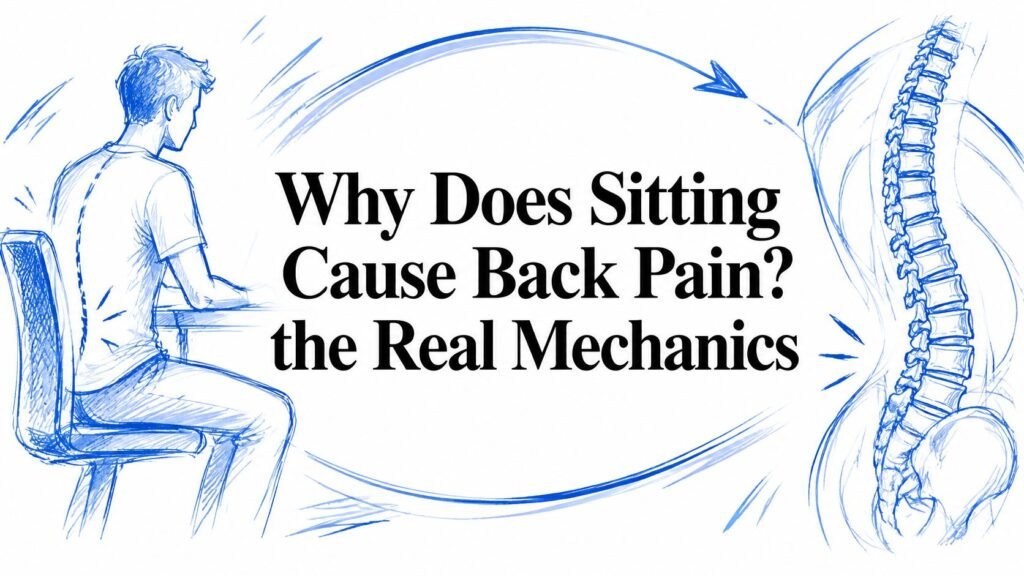
Most desk-pain advice starts with one command: sit up straight and hold it. That treats one shape as safe and every other shape as damage. It also asks your back to do something joints dislike, which is to stay frozen.
Sitting can hurt. It rarely wrecks a healthy spine by itself. So why does sitting cause back pain in one person and barely register for the person at the next desk? The difference is usually load plus variety, not a posture you failed to perfect.
A slumped hour loads discs and ligaments in a steady way. Tired hip and back muscles stop sharing that load. Still legs move blood more slowly. None of those changes equals a broken disc. Together they can make sensitive tissue complain, especially if you already have pain, a heavy week, or almost no walking.
Large reviews have not shown that sitting, on its own, causes lower-back pain. The calmer reading is more useful. Long, unchanging sitting is an aggravating exposure. Change the exposure, and many aches ease. Chase one perfect pose all day, and the ache often stays.
Table of Contents
- Sitting Stresses Your Back Without Usually Damaging It
- How Slumped Sitting Loads Discs and Ligaments
- Why Tired Muscles and Slow Circulation Add Up
- Symptom Patterns That Point to Sitting as the Trigger
- What the Evidence Says and Why Two People Differ
- Breaking Up Sitting and Setting Up Your Desk
- Deciding Whether an Osteopath Is Your Next Step
Sitting Stresses Your Back Without Usually Damaging It
Sitting rarely injures the spine by itself. Long, unchanging sitting still loads the back in ways that can produce pain, especially with low movement, a poor setup, or tissue that is already irritable.
Think of a bridge built for changing traffic. If one lane carries the same load for eight hours, wear collects where nothing moves. Your lower back is similar. It copes well with load that shifts. It complains when the load never shifts.
A Deakin University-led umbrella review examined 41 systematic reviews and more than one million people and found no association between prolonged or occupational sitting and lower-back pain. That finding should stop the scare story. It should not stop you changing a day that leaves you stiff. Sitting interacts with existing pain, low physical capacity, stress, and too little movement. It is not proof that one posture has damaged the spine.
Four ways sitting loads the back
| Mechanism | What happens while you sit | Typical sensation | Strength of evidence |
|---|---|---|---|
| Disc loading | Slumped posture raises pressure inside lumbar discs | Deep, dull ache that builds over a long session | Well established in lab studies, weaker link to pain in everyday life |
| Muscle imbalance | Hip flexors shorten while glutes and deep stabilisers switch off | Tight hips and a stiff lower back | Plausible, supported mainly by small studies |
| Reduced circulation | Blood flow in the legs and pelvis slows when muscles stay still | Heaviness, swelling or numbness in the legs | Limited, mostly indirect evidence for back pain |
| Posture and inactivity | Static, unsupported positions with no movement variety | Ache that eases with walking or position change | Common pattern, direct causal proof is mixed |
Evidence is strongest for loading and posture in the lab, and weakest for circulation as a cause of back pain. The posture row is the one readers usually recognise, and it is also the row with mixed proof that sitting itself creates the pain.
Practical rule: Treat the chair as an aggravating exposure. Ask which factor is pushing your symptoms, not whether you should abandon chairs.
For a sore back, vary position, use a relaxed supported posture, and keep doing tolerable daily activity. A rigid "perfect" posture held for hours is another way of not moving.
How Slumped Sitting Loads Discs and Ligaments
Lumbar discs sit between the vertebrae and act as shock absorbers. The natural inward curve of the lower back spreads force across each disc instead of dumping it on one edge.
Picture a water balloon on a table. Press one side and the water shifts to the other. A disc behaves in a similar way when the spine bends and stays bent.
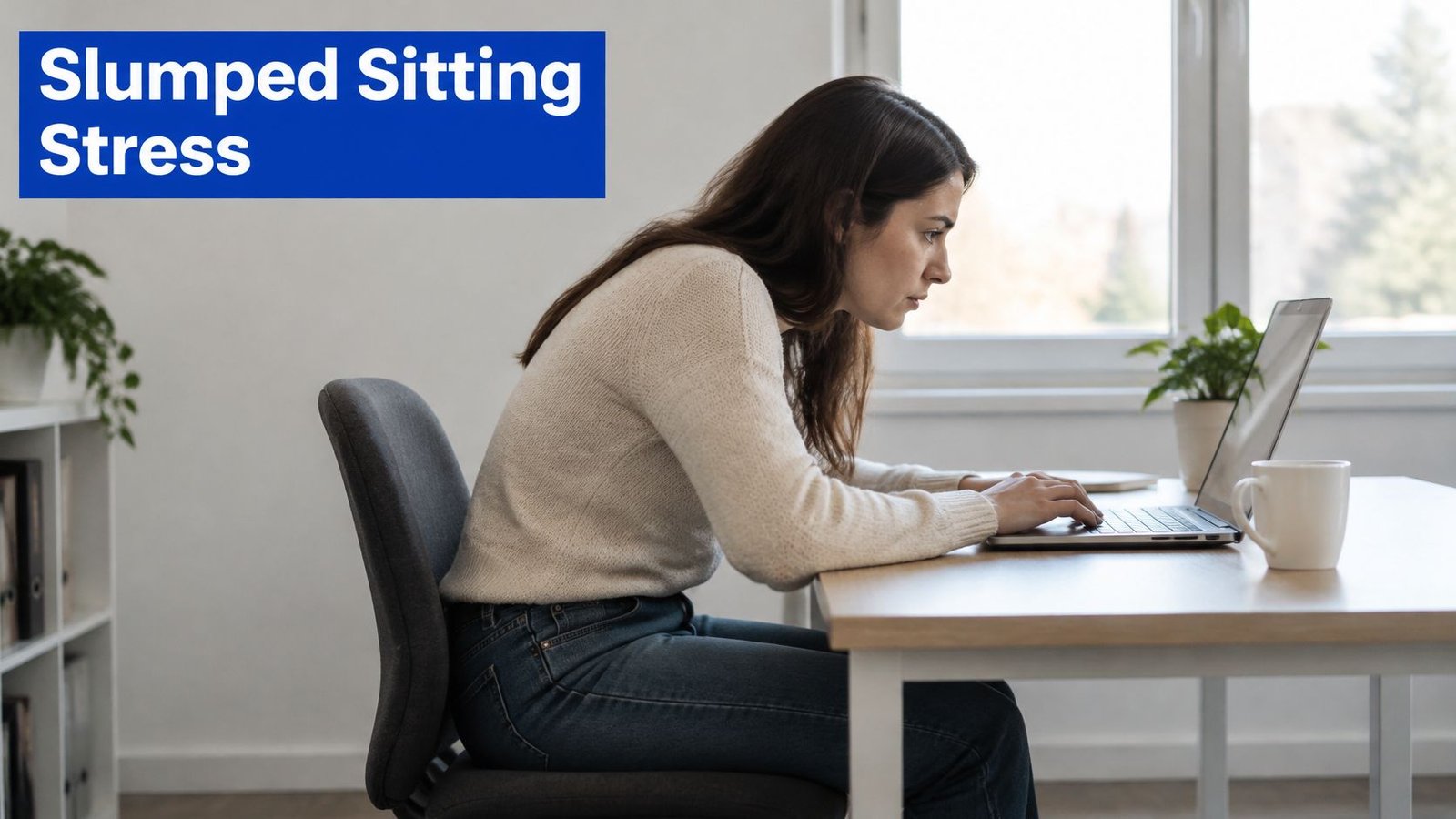
What a slumped pelvis does to the disc
The pelvis tips back. In a deep chair, or when you perch on the front of the seat, the pelvis often rolls backward. That flattens the lumbar curve. The discs lose the even spread the curve was giving them.
The lower back bends forward. Slumping adds flexion. Load shifts toward the front of the disc, and the ligaments at the back of the spine take more stretch. Classic pressure measurements from the 1960s and 1970s found disc pressure higher in sitting than in standing, highest when people slumped or leaned forward, and lower when a backrest supported the lumbar curve. Those are laboratory findings about load, not a verdict that your disc is injured.
The load stays on. Standing up, walking to a meeting, or even rocking in the chair changes that pattern. An unbroken block does not. The front of the disc and the posterior ligaments keep the same job for the whole block.
Creep, height, and the morning back
Sustained load produces creep. Discs and ligaments gradually compress and fatigue, a bit like a sponge held under a steady weight. The spine regains some height overnight, which is why many people are taller in the morning and stiffer after a long day. Morning stiffness is a recovery story, not proof of new damage.
In healthy tissue this load is temporary and reversible. The lesson is to vary position and support the curve, not to fear that every slump is permanent disc damage. A small lumbar roll or a backrest that meets you in the lower back is enough for many people. You do not need to sit like a statue.
If the ache is deep and builds only after a long session, this loading chain is the first place to experiment. Change the curve, change the duration, and see what the next hour feels like.
Why Tired Muscles and Slow Circulation Add Up
A rope held under constant tension wears through its weakest strands. Sitting does something similar to the muscles that hold you there. The tension is low. The time is long.
The muscles that switch off
The pattern is predictable once you notice it.
- Hip flexors stay short. Iliopsoas and rectus femoris live in a bent-hip angle for hours, then feel tight when you stand.
- Glutes stay quiet. They are lengthened and less active, so they contribute less when you rise or climb stairs.
- Hamstrings stiffen. They add to the tug on the pelvis when you finally straighten up.
- Deep stabilisers idle. Muscles close to the lumbar spine reduce their contribution, while erector spinae holds a low, constant contraction.
That low-level work is tiring in a way a short gym set is not. The muscle's response slows when you stand or lift. Tissue that is already irritable becomes more sensitive, so an ordinary movement feels sharper than it should. This is fatigue and sensitivity, not a sign that the muscle has torn.
What circulation can and cannot explain
The calf muscle pump slows when the legs stay still. Blood can pool in the lower legs and pelvis, and waste products clear more slowly. The link from that pooling to back pain is mostly theoretical, with limited direct evidence. The signs that are better documented are leg heaviness, swelling, and ankle puffiness after long sitting. If your main complaint is a puffy ankle rather than a spinal ache, treat circulation as a leg problem first.
Two checks you can use today:
- After about an hour, stand and see whether you can come fully upright without a long unwind.
- Walk for two minutes. If the ache eases, fatigue or stiffness is a big part of the picture.
If the walk helps and standing tall is the hard part, you are dealing with tired, under-varied muscles more than with a posture you must memorise.
People who cannot leave a phone queue or a control room can still shift weight, uncross the legs, and stand for the next short task. The rope does not need a new job. It needs the tension to change.
Symptom Patterns That Point to Sitting as the Trigger
Back problems are common enough that a desk ache is easy to over-read. The Australian Institute of Health and Welfare estimated that around 4.0 million Australians, or 16% of the population, were living with back problems in 2022, that these problems accounted for 4.3% of total disease burden in 2023 and 7.9% of non-fatal burden, and that prevalence reached 27% among people aged 65–74. Sitting is one modifiable piece inside age, workload, sleep, and previous injury. It is not a diagnosis.
How to read your own pattern
| Pattern | When it appears | Most likely driver | Next step |
|---|---|---|---|
| Dull low-back ache | Builds through a long session, often after an hour or more | Sustained flexion and muscle fatigue | Movement breaks, reassess if it lasts beyond six weeks |
| Stiff back on standing | Worst when getting up from a long session | Disc and joint stiffness, slow recovery | Gentle walking and position changes |
| Upper back and neck ache | Appears during screen work | Head-forward posture and shoulder fatigue | Adjust screen height and break routine |
| Pain into buttock or thigh | During or after sitting | Nerve irritation or referred pain | Book a clinical assessment |
| Numbness, weakness, or bladder or bowel change | Any time, sometimes sudden | Possible serious nerve compression | Seek urgent medical care |
| Night pain or unexplained weight loss | Persistent, not linked to position | Possible non-mechanical cause | See a doctor promptly |
Three of these show up constantly in office weeks.
A dull, widespread lower-back ache that builds and then eases with walking is the classic sitting pattern. It points to sustained flexion and muscle fatigue, not to a spine that has suddenly failed.
Stiffness as you first stand points to slow recovery in discs and joints. The first few steps feel wooden, then the walk oils the system. That pattern fits creep and idle muscles more than a new injury.
Upper back and neck ache during screen work is a different load. The head sits forward, the shoulders hold, and the lower back may be fine. Screen height and breaks matter more here than a new chair slogan.
Pain that travels into the buttock or thigh needs a clinical look, because nerve irritation and simple referred pain feel similar at a desk. A typical mechanical pattern often settles within days to a few weeks once movement changes. Symptoms that last beyond six weeks, or that keep returning, deserve assessment.
Numbness, weakness, or a change in bladder or bowel control needs urgent medical care. Night pain or unexplained weight loss needs a prompt doctor visit, even if you also sit all day.
What the Evidence Says and Why Two People Differ
Sitting is common in Australian work, but exposure alone does not show that sitting damages backs. It helps to separate what population studies measure from what an individual feels during a workday.
Safe Work Australia's review of sedentary work reports that 81% of workers had some occupational sitting exposure, and about half sat often or all the time. The review also reports average adult sedentary activity of 39 hours a week, or about 5.6 hours a day, including around 10 hours at work. That work figure is part of the weekly total, not evidence that work accounts for most sitting. The review describes roughly one in four Australians as sitting more than 8 hours daily, while objectively measured sedentary time reached about 8–10 hours a day. These figures describe patterns across groups, not the cause of any one person's pain.
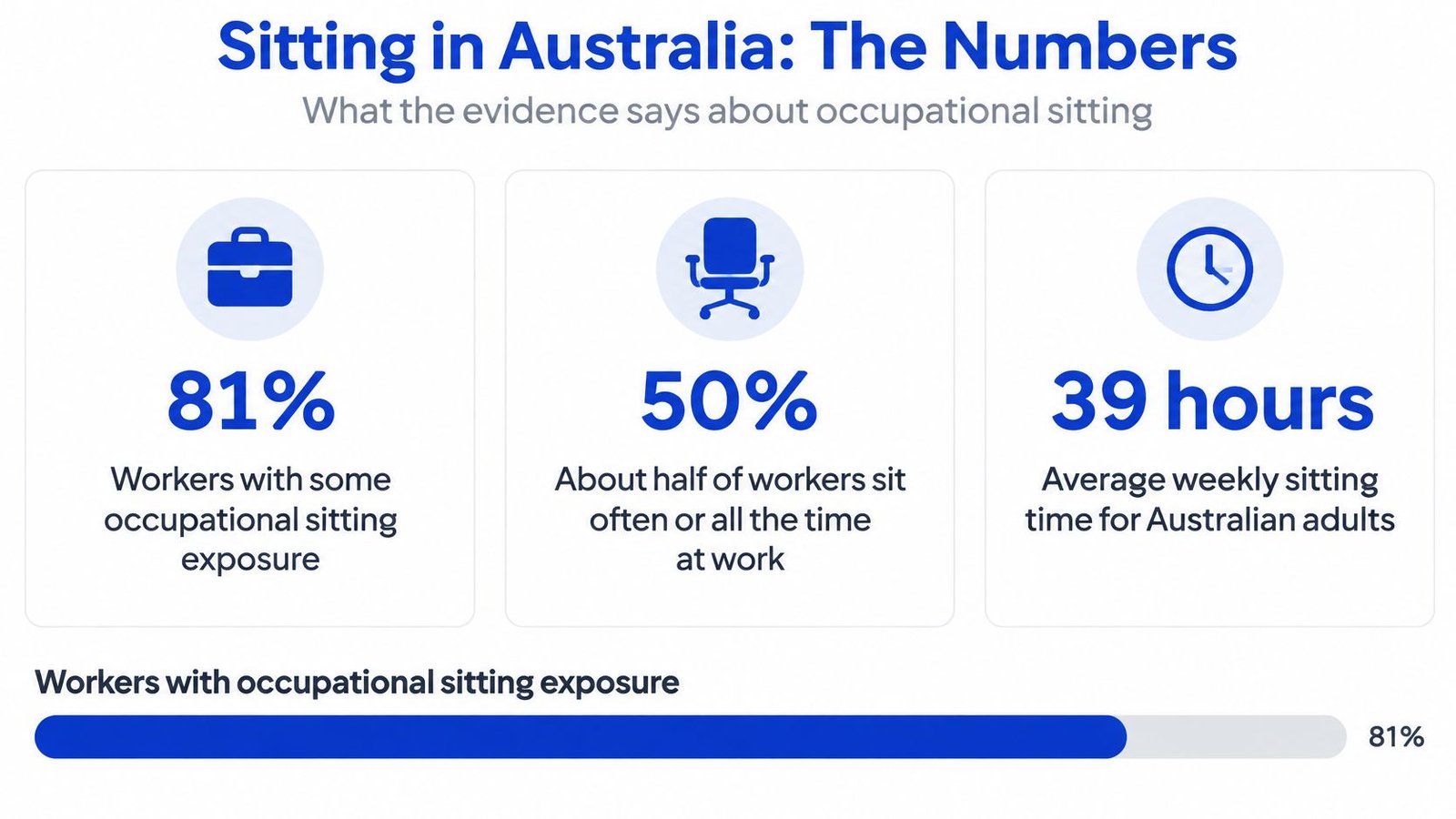
| Measure | Figure reported in the review | What it describes |
|---|---|---|
| Workers with some occupational sitting exposure | 81% | Sitting is common in Australian work |
| Workers who sit often or all the time at work | About half | Frequent sitting is part of many workdays |
| Average adult sedentary time | 5.6 hours per day, or 39 hours per week | Average time spent sedentary |
| Sedentary time at work | About 10 hours per week | A portion of total weekly sedentary time |
| Adults sitting more than 8 hours per day | Roughly one in four | The group reporting higher daily exposure |
| Objectively measured sedentary time | About 8 to 10 hours per day | Estimates based on device measurement |
Why might the same chair and schedule bother one person but not another? The figures above cannot answer that on their own. Pain is shaped by more than time seated: the person's previous symptoms, the demands of the rest of the day, and how their body responds to sustained positions may all matter. These are useful factors to consider, not a proven formula for predicting who will develop pain.
A car with worn suspension can feel rough on a road that another car handles comfortably. The comparison is imperfect, but it illustrates why the same external load can feel different to different people. A chair does not need to be harmful in itself for a long, still work period to aggravate existing symptoms. Nor does discomfort prove that a particular posture has damaged tissue.
For someone with a longer-running pain pattern, understanding chronic pain can help explain why symptoms may persist even when the original trigger is no longer the whole story. Sleep, stress, workload, and other physical demands may also affect how sensitive a person feels from one day to the next. These influences are individual, so a national average cannot tell you which one matters most in your case.
Research on younger people also cautions against simple cause-and-effect conclusions. A 2025 systematic review and meta-analysis examines the relationship between sedentary behaviour and spinal pain in children and adolescents. Its focus is not direct evidence about adult desk workers, and it should not be used to claim that sitting alone causes back pain.
The practical takeaway is measured: sitting is a common exposure and can aggravate symptoms, but it is not a complete explanation for why one person hurts and another does not. Individual history and the demands of the whole day belong in that assessment.
Breaking Up Sitting and Setting Up Your Desk
A chair does not need to be “bad” to make your back ache. The load builds when you stay in one position for a long stretch, then repeat that pattern through the day. Small changes in position and short movement breaks spread the work across more tissues. The aim is variety, not perfect posture.
Clinical care standards for low back pain support staying active and interrupting long periods of inactivity. They do not set a specific break interval. As a practical starting point, try standing, taking a short walk, or marching on the spot about every 20 minutes, then adjust according to how your back responds. During a flare, shorter sitting blocks may feel better. If your symptoms stay steady, you may be comfortable with longer blocks.
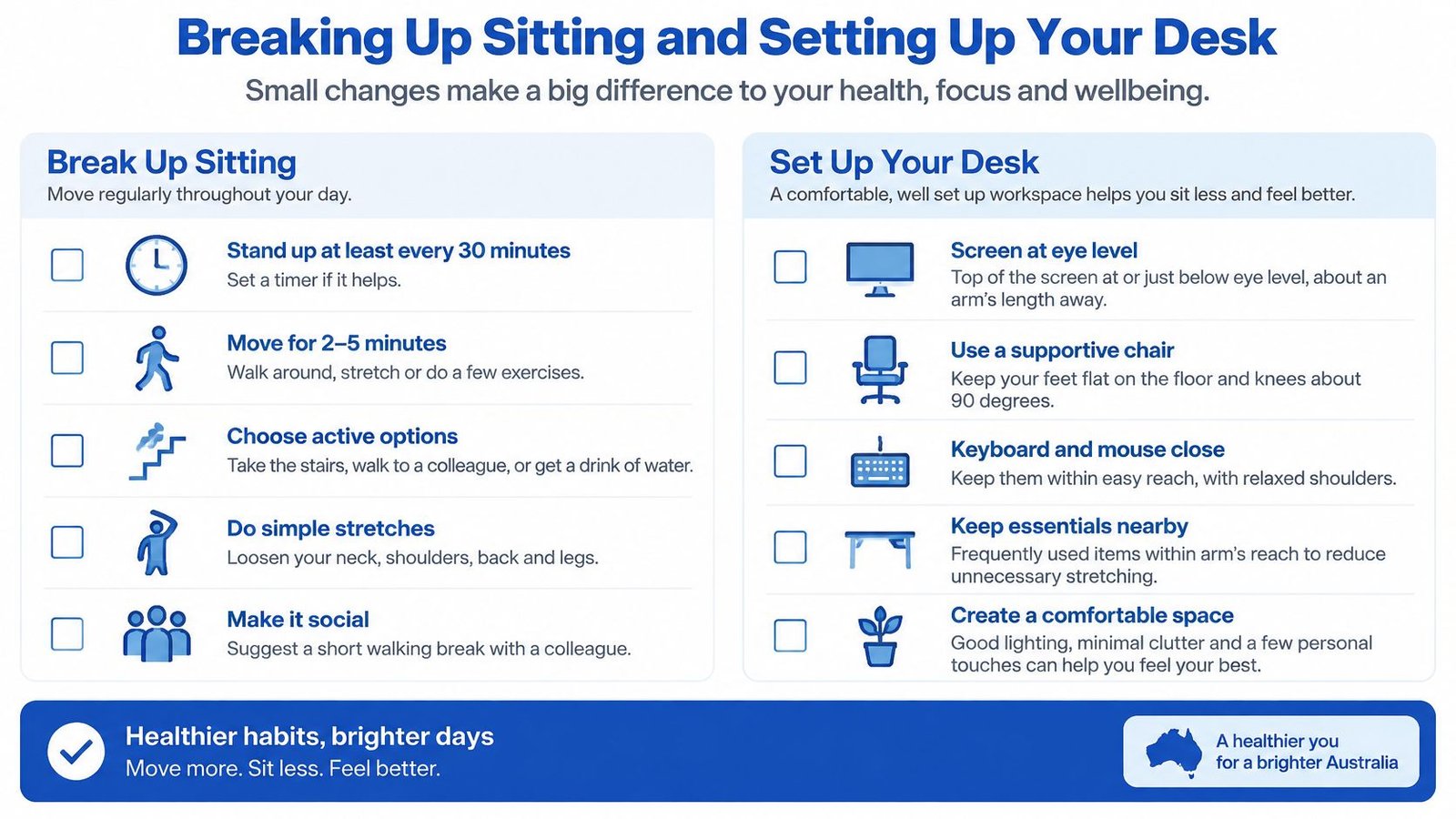
A break rhythm you can test
| Interval | Simple action | Duration | What to notice |
|---|---|---|---|
| Every 20 minutes | Stand, march on the spot or take a short walk | 1 to 2 minutes | Less stiffness when you sit back down |
| Every hour | Stand for a call or refill your water | A few minutes | Easier to get up from the chair |
| Lunch break | Walk outside or around the building | 10 to 15 minutes | More energy and more general activity |
| Mid-afternoon (sit-stand desk) | Alternate sitting and standing in blocks | 30 minutes per block | Symptoms steady across the day |
Use the table as a trial, not a prescription. Look for less stiffness and easier movement across the week, rather than expecting discomfort to disappear completely. A sit-stand desk helps when it adds variety. Standing still for hours just replaces one fixed position with another.
Desk setup and three moves
A few adjustments can make work more comfortable, but they cannot replace movement. Set the screen top at or just below eye level, about an arm's length away. Keep your feet flat or use a footrest, with hips level with or slightly above the knees. Let the backrest support the lower-back curve, and keep elbows near 90 degrees, the keyboard close, and the mouse beside it. For more ways to add movement and adjust your workstation, see this guide to preventing back pain at work.
A short demonstration can help make the setup easier to picture.
Add three simple movements rather than a long program:
- Seated pelvic tilt. Sit tall and rock your pelvis forward and back, 8 to 10 times. Notice how the curve in your lower back changes.
- Seated chest opener. Clasp your hands behind your head, open your chest, and hold for about 20 seconds. Try it if your upper back feels tight too.
- Standing hip flexor stretch. Half-kneel, gently tuck your pelvis, and hold for about 30 seconds on each side. Skip it if kneeling aggravates your back.
The same chair can feel fine to one person and uncomfortable to another because tolerance, daily movement, and symptoms differ. Breaks and desk adjustments reduce an aggravating load; they do not establish that sitting is the sole cause of pain. Persistent or severe pain still deserves assessment.
Deciding Whether an Osteopath Is Your Next Step
If the pain is mild, feels mechanical, and eases when you break up sitting, give the changes two to four weeks before you book care. Many sitting-linked aches settle once variety returns.
Book sooner if pain lasts beyond six weeks, keeps returning, or limits work, sleep, or driving. Book sooner with arthritis, or if stiffness is clearly worsening with age. Those are signs the pattern is bigger than this week's chair.
A typical osteopathic visit is a hands-on look at how you move, then soft-tissue work, gentle joint mobilisation, and a home plan for movement and the desk. Hands-on care can ease symptoms in the short term. It works best with exercise and self-care, not instead of them. Some osteopathy may be covered by Medicare in limited circumstances, such as within a prescribed care plan, and health fund rules differ, so check before you book.
Bayside Osteopathic Health is one option for Bayside residents who want that whole-body assessment and a plan matched to the job, with flexible booking. It is a next step inside self-management, not a replacement for walking, breaks, or medical care when red flags are present.
Note what you feel, how long it has lasted, and what eases it. Take that list to an assessment, and use urgent care for numbness, weakness, or bladder or bowel change.
Bayside Osteopathic Health offers gentle, hands-on osteopathic care for desk-related back strain, combining movement assessment, soft-tissue work, and practical home strategies for people who sit through the workday. If long sitting is stirring up your symptoms, you can talk it through with a practitioner who looks at how your whole body is coping, not only the sore spot. Visit Bayside Osteopathic Health to book an assessment or read more about care for Bayside residents.