

People with a sore ankle are often offered an ankle cortisone injection as if the needle were a predictable repair. It isn't. The medicine can turn down inflammation for a stretch of time, and then that effect fades. The load, the footwear, and the movement pattern that irritated the joint are still yours to sort out.
Less pain the following week does not mean the ankle has healed. It means the alarm is quieter. If nobody has named the structure causing the pain, or if another injection is booked only because the last one wore off, that is a reason to pause. A short-term tool can still help. It helps when the diagnosis is clear and the rest of the plan keeps running.
Table of Contents
- What an Ankle Cortisone Injection Actually Does
- The Numbers Behind Benefit, Frequency and Cost
- Which Ankle Problems an Injection Is Used For
- How the Injection Appointment Unfolds Step by Step
- Side Effects and Red Flags After an Injection
- Aftercare Routine for the First Two Weeks
- Non-Injection Options Worth Trying First
- Confirm the Plan Before You Book an Injection
What an Ankle Cortisone Injection Actually Does
Say you rolled your ankle on a netball court months ago. The swelling went, walking is mostly comfortable, and a deep ache still shows up on stairs. That is a common moment for an ankle cortisone injection. A clinician places a corticosteroid, usually mixed with a local anaesthetic, into the ankle joint or around a tendon sheath. The mix is meant to calm inflammation at one spot.
Picture the inflamed lining as a smoke alarm that will not switch off. The steroid turns the volume down. It does not rebuild cartilage, stitch a ligament, or strengthen a tendon that has been overloaded. The anaesthetic can numb the area within minutes, which is why the walk to the car sometimes feels easier than the walk in. The steroid's effect builds over hours to days, then fades, and the original load problem can speak up again.
Where the medicine acts
The Medical Services Advisory Committee public summary describes corticosteroid injection as steroid solution placed directly into a joint to suppress inflammation, generally as a short-term treatment for osteoarthritis or inflammatory arthritis when symptoms are otherwise controlled. In that assessment, the committee reported some evidence for injections in the ankle among people with rheumatoid arthritis. It found no available evidence sufficient to set how often injections should be repeated, or how many are appropriate in total.
A joint injection and an injection beside a tendon are different procedures. One enters the space inside the joint. The other aims at a sheath, the thin sleeve around a tendon. A needle that enters the tendon itself is a miss, not a variation, because steroid exposure can weaken tendon tissue.
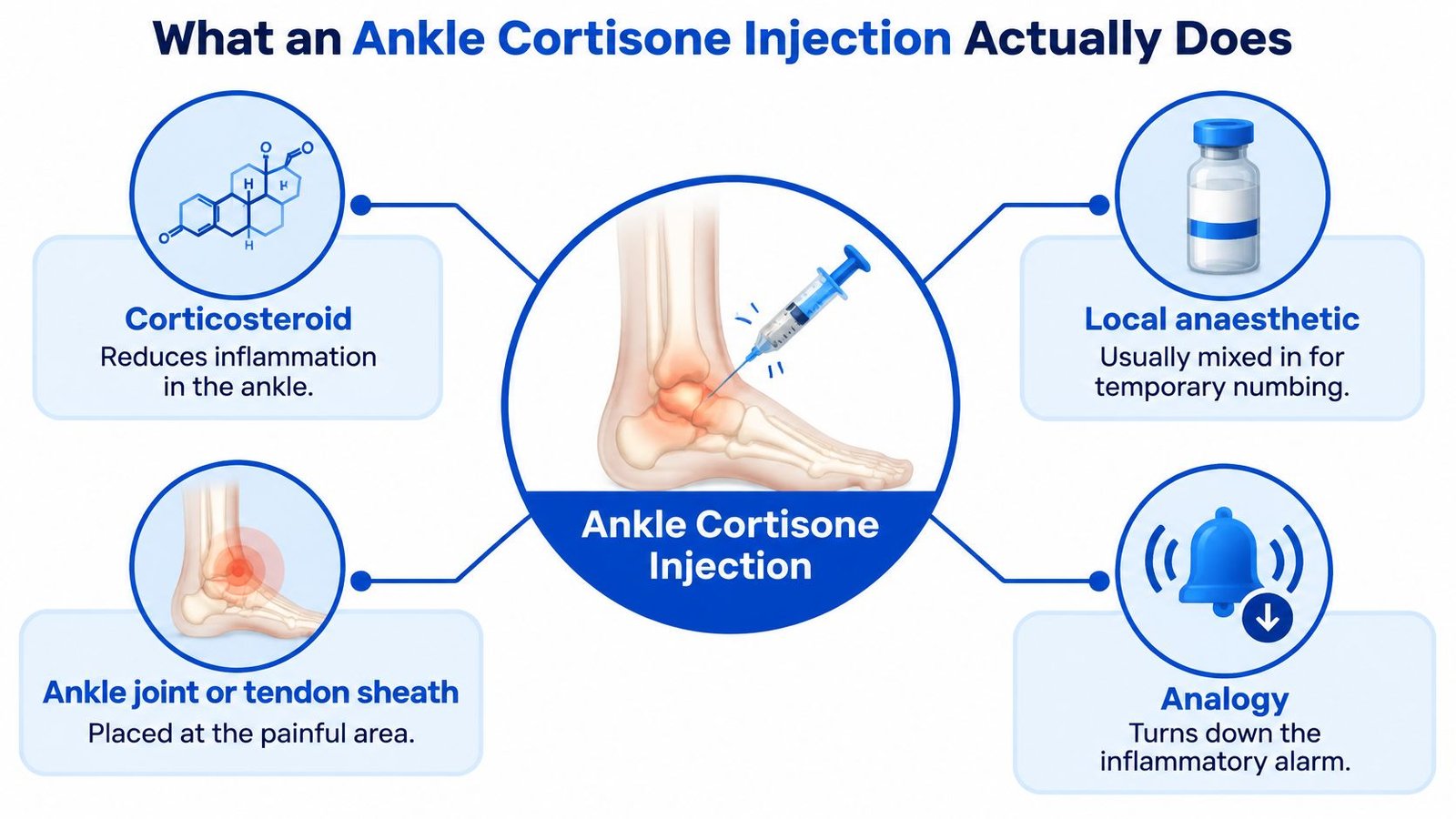
If the ankle feels quieter and you go straight back to the same hills, the same shoes, and the same training week, you have only turned the alarm down.
Less inflammation is not a repaired ankle. The injection buys a window. Walking load, strength, and footwear during that window decide whether the ache stays quiet.
The Numbers Behind Benefit, Frequency and Cost
The figures below describe reported practice and Medicare reimbursement, not a schedule for treatment. A survey of Australian podiatrists and podiatric surgeons gives a local snapshot, while Medicare's schedule fee is separate from the amount a clinic may charge.
| Measure | Typical figure | Source or context |
|---|---|---|
| Perceived benefit duration | 3 to 6 months | Survey of Australian podiatrists and podiatric surgeons |
| Mean maximum injections per patient per year | 3 | Survey; a separate Journal of Foot and Ankle Research practice paper describes a guideline ceiling of 4 per joint annually |
| Average recommended interval between injections | 3 months | Survey of Australian podiatrists and podiatric surgeons |
| Average patient out-of-pocket cost | AUD 188.18 | Survey; the bill varies by provider |
| Medicare item 39013 schedule fee (image-guided intra-articular injection) | AUD 130.60 | Medicare Benefits Schedule, item 39013. Benefit AUD 97.95 at 75% or AUD 111.05 at 85% |
What those rows actually describe
The survey received 45 responses, with 33 participants completing it, according to the survey write-up. Its results show how respondents described clinical practice. They do not establish that repeated injections work, and the small sample makes the figures a preliminary snapshot.
Respondents reported perceived benefit lasting about 3 to 6 months. Their mean maximum was 3 injections per patient per year, with an average interval of 3 months. Pain accounted for 50% of responses about factors influencing the decision to inject. The average reported out-of-pocket cost was AUD 188.18. For more detail on how clinic bills and rebates may differ, see this guide to cortisone injection costs.
The survey's average of three injections is a report of practice, not a recommended target. Separately, the Journal of Foot and Ankle Research practice paper describes Australian Therapeutic Guidelines as recommending no more than four injections per joint annually to reduce risk. A ceiling sets a limit; it does not mean that injections should be repeated up to that limit.
How to read the figures
A Medicare schedule fee is not necessarily the clinic's invoice. Item 39013 covers an image-guided injection into a joint. The total bill may also include the consultation, medicine, and the provider's charge, so the Medicare fee and the survey's average out-of-pocket figure measure different things.
If relief fades sooner than expected, or another injection is being considered before the usual interval, the diagnosis and treatment plan need review. Pain relief can provide a useful short-term window, but it does not show on its own that the ankle has healed. Repeating an injection by calendar alone turns an average into a routine, rather than basing the decision on the confirmed problem and the response to treatment.
Which Ankle Problems an Injection Is Used For
An injection is chosen for a confirmed diagnosis, not for ankle pain in general. Two people can point at the same spot and need opposite decisions, because one has an inflamed joint and the other has a failing tendon.
| Problem | Injection considered? | Key condition or evidence |
|---|---|---|
| Inflammatory arthritis affecting the ankle | Possibly, for short-term control | Symptoms not controlled by other treatment; some evidence in rheumatoid arthritis |
| Ankle osteoarthritis | Sometimes, with limited evidence | Evidence sparse for the ankle; trial data insufficient to guide routine use |
| Post-traumatic subtalar osteoarthritis | Studied, with mixed results | One small trial suggested repeated steroid with hyaluronic acid may help more than steroid alone |
| Achilles or other weight-bearing tendon pain | No, not injected | Risk of tendon weakening and rupture |
| Suspected infection or unstable joint | No | Infection must be excluded; steroids are not injected into unstable joints |
| Pain from an uncertain source | Only after diagnosis | The pain generator must be confirmed before any injection |
For inflammatory arthritis, an injection is a short-term option when other treatment has not settled the flare. There is some evidence for ankle injections in rheumatoid arthritis. It is not a substitute for the medicines that treat the disease itself.
For ankle osteoarthritis, the record is much thinner than the familiar knee literature. A 2025 systematic review found only two eligible randomised or quasi-randomised trials, involving 57 people, for foot or ankle osteoarthritis. Neither provided strong evidence that corticosteroid injections reliably improve pain or function. One trial found no difference over eight weeks between a single corticosteroid injection and prolotherapy for first metatarsophalangeal osteoarthritis.
The other trial suggested that repeated corticosteroid injections combined with hyaluronic acid may outperform corticosteroid alone in post-traumatic subtalar osteoarthritis. Both trials had methodological concerns, and the authors concluded the evidence is insufficient to guide routine use. A single promising comparison is not a reason to book a series.
Steroid is not injected into the Achilles or other weight-bearing tendons, because weakening and rupture are the safety concern. Suspected infection rules an injection out until that possibility is excluded. An unstable joint is also a reason to hold, not a reason to numb the warning.
Pain without a named source waits. If your clinician is still unsure whether the ache is joint, tendon, or nerve, the useful next step is a clearer diagnosis, not a trial dose. Persistent foot and ankle pain often has more than one driver, and treating the wrong one wastes the window.
Three questions before you agree
- What is the diagnosis? Ask which structure is being treated, in plain words.
- How long should relief last? Ask what fading early would mean for the next step.
- What continues alongside? Strength, footwear, and activity changes stay in the plan even if the needle helps.
How the Injection Appointment Unfolds Step by Step
A careful appointment is mostly checking, not injecting. The needle is the short part. Skipping the checks is the usual way a reasonable procedure becomes the wrong one.
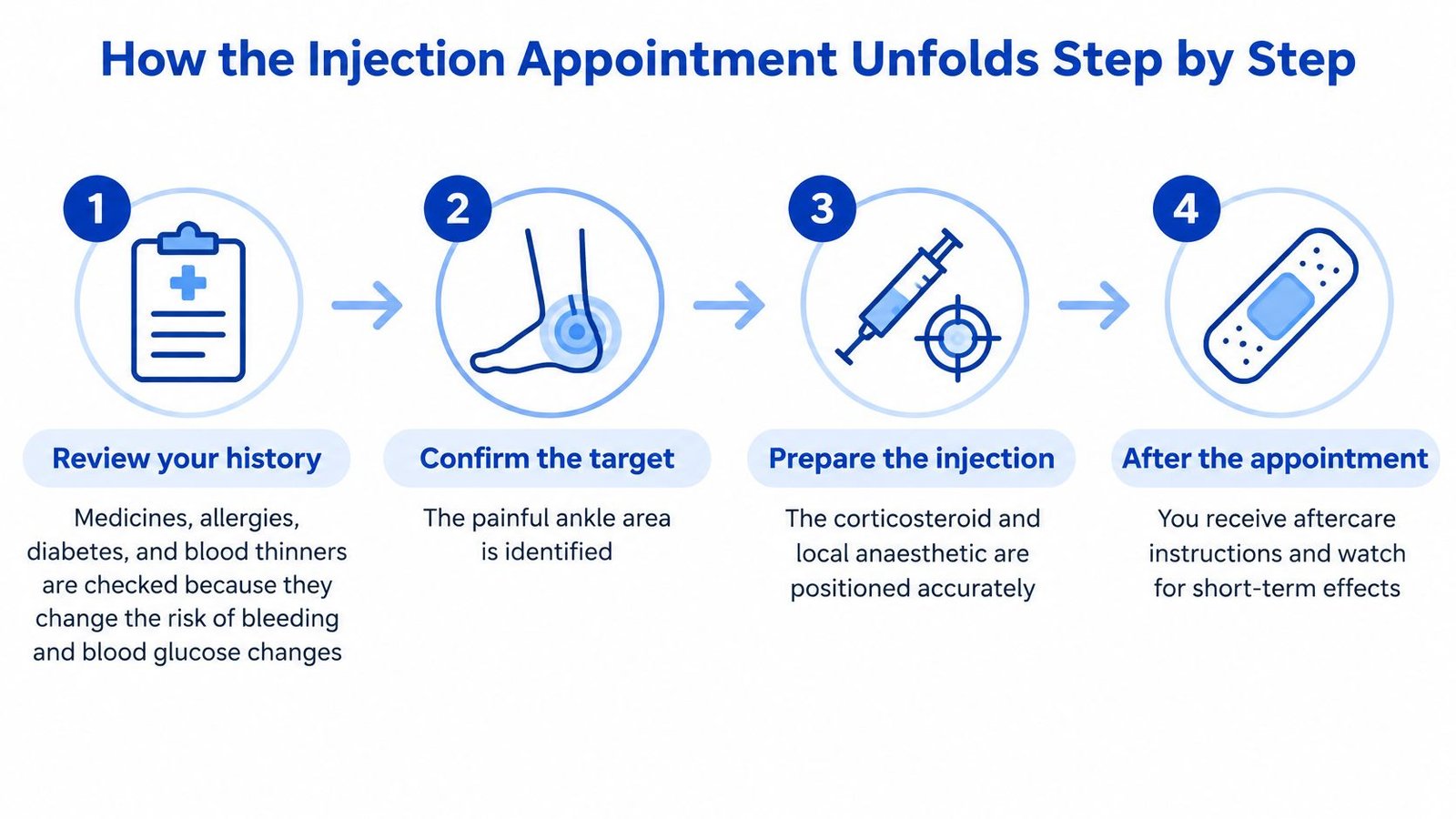
- Review your history. The practitioner checks medicines, allergies, diabetes, and blood thinners, because they change bleeding risk and blood glucose. The common slip is forgetting a new anticoagulant or a recent course of antibiotics.
- Confirm the diagnosis and rule out infection. Examination, and imaging where it changes the decision, should point at one pain source. The slip is injecting because the ankle "looks sore" on a referral, without checking the joint against the tendon.
- Clean and mark the site. Antiseptic and a marked entry point keep the needle on the planned path. Rushing the skin prep is a small slip with an outsized downside.
- Numb the skin, and guide the needle if ultrasound is used. Local anaesthetic eases the entry. Ultrasound can show the joint or sheath and help the clinician avoid tendon, vessel, and nerve. Guessing the depth from the surface alone is the slip this step is meant to prevent.
- Inject the mix. You may feel pressure, and a brief ache is common. A sharp pain that shoots into the foot should be said out loud, not tolerated in silence.
- Withdraw, dress, and check. The needle comes out, a dressing goes on, and the clinician looks at colour, swelling, and how the ankle moves. Leaving before that check hides an early problem.
- Take written aftercare for the next 24 to 48 hours. Rest limits, glucose checks, and warning symptoms should be on paper. Relying on memory in the car park is the slip that causes the late-night worry.
This short clip shows the kind of guided placement many clinics use, so the room feels less abstract before you are in it.
What it feels like from the chair
You will sit or lie with the foot supported. The antiseptic is cold, the skin needle stings, and the joint injection feels more like pressure than a cut. Most of the visit is talking and positioning. The injection itself is over in moments, and you should leave knowing who to call if the ankle behaves badly that night.
Side Effects and Red Flags After an Injection
A quieter ankle is not a cleared ankle. People often treat the first easy walk as permission to load. That assumption is the one to drop. Pain relief does not prove the joint surface, the ligament, or the tendon is ready for hills, sport, or a long shift on your feet.
A steroid flare, or plain post-injection soreness, is the reaction clinicians most often expect. It can feel worse before it feels better, and it usually settles over a few days. It should not race away in the wrong direction.
What needs same-day care
The Australian Government's healthdirect identifies joint infection, or septic arthritis, as rare but serious after a steroid injection. Australian product information for triamcinolone states that rapidly increasing pain with swelling, reduced movement, fever, and malaise can indicate septic arthritis and needs immediate treatment. The same information warns that corticosteroids should not be injected into unstable joints, and that repeated injections may sometimes contribute to joint instability.
| Symptom | Usually expected? | Seek urgent care |
|---|---|---|
| Mild soreness or a steroid flare, settling within a few days | Expected | Not alone; review if it persists or worsens |
| Rapidly increasing pain with swelling and reduced movement | Not expected | Yes, same day |
| Fever or feeling generally unwell | Not expected | Yes, urgently |
| Skin thinning or lightening around the injection site | Possible, uncommon | Book a review |
| Tendon pain or weakness, especially in the Achilles | Not expected | Review promptly |
Other effects sit between those rows. Skin at the site can thin or lighten. Bruising is more likely if you take a blood thinner. New tendon pain, particularly in the Achilles, is not a normal flare, because a joint injection must not be treated as if it were safe for a tendon problem. If you have diabetes, blood glucose can rise after the dose, so check more often than usual and follow the range your diabetes clinician has already set.
Practical rule: Keep a short symptom diary for the first week, with pain, swelling, temperature, and, if relevant, glucose. Take it to the review, and call sooner if a line in the diary is moving the wrong way.
Aftercare Routine for the First Two Weeks
Aftercare starts when the needle is out. The injection has not changed what the ankle must tolerate next month.
- Keep the dressing dry for the time the clinic specifies, typically 24 to 48 hours, and skip soaking on the first day. A wet dressing is an open door you do not need.
- Ice in short sessions if soreness flares. Wrap the pack in cloth. Ice straight on the skin burns, and it does not speed the steroid.
- Ease the load. Walk within comfort. Skip running, jumping, and heavy stairs for the first few days unless you were told otherwise, then add small steps, not a full training week.
- Keep the rehabilitation plan running. Strength, balance, and calf work are why the quieter fortnight is useful. Stopping them because you feel better wastes the window.
- If you have diabetes, check glucose more often for several days, on the schedule you were given. A rise is a monitoring job, not a reason to guess a new insulin dose.
- Change blood thinners only on medical advice. Holding them yourself, to avoid a bruise, can be more dangerous than the bruise.
- Attend the planned review. Judge how much relief you got, and whether the next step should change. Do not book a repeat because the diary looks "a bit better".
If pain climbs quickly, swelling spreads, movement locks, or you feel feverish or generally unwell, act on that the same day. Waiting for the routine review is the wrong use of a diary.
Non-Injection Options Worth Trying First
Plenty of ankle problems settle with care that never involves a needle. An injection, when it is appropriate, sits beside that care. It does not retire it. Compare the options by what they change, not by which one feels fastest.
Loading and rehabilitation is the piece an injection cannot do. A progressive strength, balance, and calf programme, guided by a physiotherapist or exercise professional, raises the load the ankle can tolerate. Without it, a quieter month often ends where the last one ended.
Footwear and supports change the demand on each step. Supportive shoes, insoles or orthoses, and a short brace, when someone who has assessed you advises one, can unload a joint while strength catches up. They are a poor match if the pain is not coming from load at all.
Activity changes are the unglamorous option. Shorter runs, fewer stairs, and a slower return to sport let irritated tissue settle. Rest without a plan to reload tends to leave you just as unprepared when you start again.
Osteopathic care works on restrictions and movement patterns rather than on the injection site alone. At Bayside Osteopathic Health, sports injury assessment looks at the injury site and at muscle imbalances, joint restrictions, and movement patterns that may have contributed. That includes ankle sprains and Achilles tendon problems, alongside other sporting injuries, using targeted manual therapy with a progressive rehabilitation programme. Most sporting injuries see significant functional improvement within three to six sessions. This supplements a diagnosis from your GP or specialist. It does not replace one. If you are weighing hands-on care against a needle, start with ankle pain treatment that names the driver.

Used together, rehabilitation builds capacity, footwear changes each step, activity changes the weekly dose of load, and manual therapy addresses stiffness that is blocking those changes. Speed of relief is the wrong scoreboard.
Confirm the Plan Before You Book an Injection
Before booking, make sure you and the clinician agree on the reason for the injection and what it is meant to achieve. Pain relief can make movement easier, but it does not prove the ankle has healed.
Use these questions to clarify the plan:
- Which structure is being treated? Ask whether the injection is going into a joint or around a tendon. “The painful area” is not a clear diagnosis.
- What result is expected, and for how long? Ask how many injections are being considered and what interval is planned between them.
- What will it cost? The Medicare Benefits Schedule lists a schedule fee of AUD 130.60 for image-guided intra-articular injection item 39013, with a 75% benefit of AUD 97.95. The schedule fee is not necessarily the amount you will be billed. Confirm the provider's fee and your out-of-pocket cost.
- What health details could affect the appointment? Tell the clinician about blood thinners, diabetes, allergies, and any recent infection.
- What activity or rehabilitation plan will accompany the injection? Agree how to return to loading the ankle, rather than relying on temporary pain relief alone.
- What symptoms need follow-up, and whom should you contact? Know what to do if the ankle worsens after the appointment.
- How will you judge whether it helped? Set a review date and identify a practical change to track, such as a movement or activity that was limited before treatment.
A clear plan also includes a realistic recovery timeline. At an assessment, the clinician should take a detailed history and examine posture, movement, and the area of concern. These details help connect the proposed injection to a diagnosis and a meaningful goal.
If pain persists or returns after an injection, ask your GP to review the diagnosis and options before considering another one. Repeat injections should follow a reasoned plan, not become the automatic response to recurring pain.
If you are also considering the movement and rehabilitation side of ankle pain, Bayside Osteopathic Health assesses the injury site and contributing factors such as muscle imbalances, joint restrictions, and movement patterns. Sports injury care combines targeted manual therapy with progressive rehabilitation suited to your sport, body, and return-to-activity timeline. You can enquire about acute pain or sports injuries, and whether osteopathic care may suit you.