
If your knee pain feels mild but you've stopped walking to the shops, is the pain score really telling the whole story? What your knee lets you do can be more useful than how strongly it aches at a particular moment.
Osteoarthritis knee symptoms often become noticeable through ordinary tasks: getting out of a chair, taking the stairs or turning over in bed. Learning to describe those changes helps you decide whether to arrange a routine assessment or seek medical attention sooner. It also gives your clinician something more useful than “my knee hurts”.
Table of Contents
- Core Knee Osteoarthritis Symptoms and How to Match Your Pattern
- How Knee Symptoms Progress Over Time
- Red Flags That Mean Your Knee Needs Prompt Review
- Knee Osteoarthritis Compared With Other Knee Conditions
- Why a Normal Scan Does Not Rule Out Symptoms
- Deciding When to Book an Osteopathic Assessment
Core Knee Osteoarthritis Symptoms and How to Match Your Pattern
Knee osteoarthritis involves gradual thinning and wearing of the cartilage that cushions the joint, alongside changes in other joint tissues. Symptoms usually build gradually rather than beginning with a single injury, although a person may first notice them during a flare-up.
The characteristic combination is activity-related pain, brief morning stiffness and reduced function. Australian clinical guidance summarised in the Osteoarthritis of the Knee Clinical Care Standard infographic describes a typical diagnostic pattern in adults aged 45 years or older, with activity-related pain, morning stiffness lasting less than 30 minutes, and crepitus during active movement.
That's a pattern, not a home diagnostic test. People often describe several features together, and a clinician checks how well they fit your history and examination.
Recognising the core symptoms
Core knee osteoarthritis symptoms and their usual patterns
| Symptom | What It Feels Like | Typical Pattern |
|---|---|---|
| Pain | A deep ache around or inside the knee | Begins during or after walking, stairs or other loading, often eases with rest, and can later occur with minor movement or at rest |
| Morning stiffness | A tight, slow-to-loosen feeling after getting up | Usually brief and eases as you start moving |
| Crepitus | Grating, crunching or clicking during movement | Noticeable during active bending or straightening and may occur without pain |
| Swelling | Soft, puffy fullness around the knee | May become more noticeable after activity or heavier loading |
| Tenderness | Soreness when pressing along the joint line | Can be identified during examination and may accompany movement-related pain |
| Reduced range of motion | Difficulty bending fully or straightening the knee | Can develop gradually and make kneeling, dressing or getting into a car harder |
| Bony enlargement | Firm, hard prominence around the joint edges | Develops slowly and can be felt during examination |
| Giving way | Sudden buckling or a feeling that the knee won't support you | Repeated episodes need review rather than being assumed to be uncomplicated osteoarthritis |
Pain location isn't always precise. You might point to the inside of the knee, describe discomfort around the kneecap, or feel an ache throughout the joint.
Crepitus isn't a measure of damage. A noisy knee alone doesn't establish osteoarthritis, and a quiet knee can still be painful. What matters is whether the sound accompanies stiffness, swelling or difficulty doing things you previously managed comfortably.
Similarly, distinguish a feeling of tightness from a true movement restriction. Feeling reluctant to bend because it hurts is different from being physically unable to straighten the knee, particularly if it seems caught or locked.
Matching your own pattern
Use this checklist to organise your observations, not to count your way to a diagnosis:
- Age and background. Does your age fit the usual clinical profile, and have symptoms developed without a clear recent injury?
- Loading triggers. Does walking, standing, squatting or using stairs reliably bring on or worsen the ache?
- Brief morning stiffness. Does the knee loosen reasonably soon after you get moving, rather than staying markedly stiff?
- Movement sounds. Do you notice grinding or crunching while actively bending or straightening?
- No obvious heat or redness. Does the knee lack the marked warmth or redness that would make another cause more concerning?
- Examination findings. Has a clinician found joint-line tenderness, bony enlargement or restricted movement?
Say an older adult feels stiff when setting off to walk the dog, then loosens up along the street. Their knee aches towards the end of the walk and grinds on stairs. That combination fits the usual pattern more closely than any symptom considered separately.
Contrast that with a younger adult whose knee becomes swollen and warm after a sudden twist. Even if they also hear clicking, the injury and sudden change deserve a different assessment.
Practical rule: Matching the pattern makes osteoarthritis plausible. It doesn't confirm the diagnosis or explain every symptom.
A clinician weighs your medical history, movement and examination findings together. A knee that repeatedly swells, gives way, locks or rapidly loses function needs professional assessment, even if other features seem familiar.
How Knee Symptoms Progress Over Time
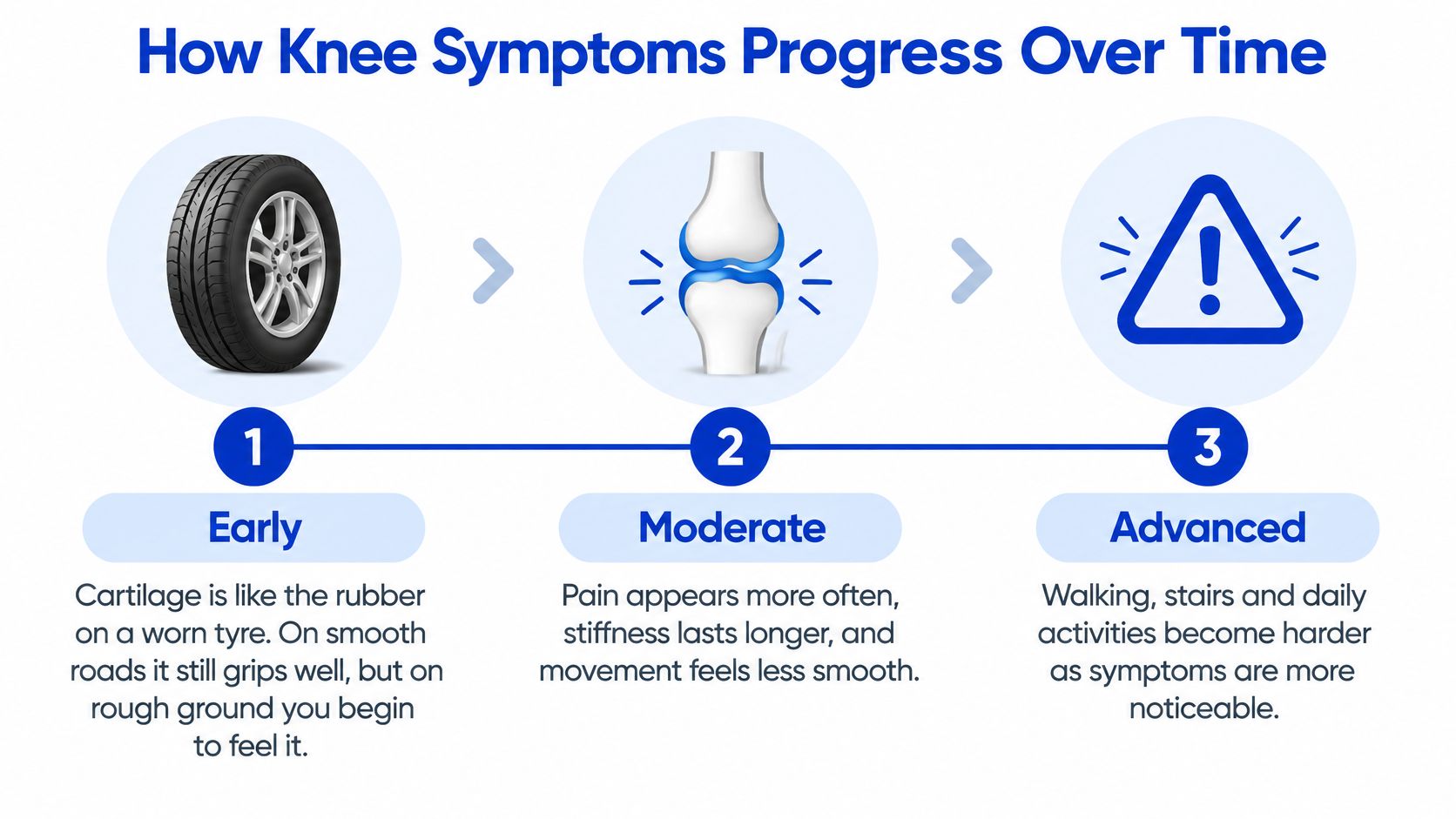
Think of cartilage as the rubber on a worn tyre. On a smooth road, the difference may be less noticeable; on rough ground, you begin to feel it. The analogy helps explain why a knee might cope with moving around the kitchen yet become uncomfortable on hills, although a living joint is more complex than a tyre and symptoms aren't a simple wear gauge.
The HBF overview of osteoarthritis symptoms and treatment describes pain that can begin during or after activity and later occur with minor movement or at rest, alongside stiffness and restricted movement.
The timeline below illustrates broad symptom patterns, not an inevitable sequence.
From occasional difficulty to disrupted routines
Early on, someone might finish their usual shopping trip but feel an ache afterwards. They can still manage most tasks, though prolonged standing or extra stairs expose the problem.
With more intrusive symptoms, the same person may start choosing parking spaces closer to the entrance. Everyday stairs become uncomfortable, swelling follows busier days, and they begin avoiding hills or using a railing.
When symptoms become substantially limiting, even moving between rooms or standing to prepare dinner may be difficult. Pain can disturb rest or sleep, and a walking aid may be worth discussing with a clinician.
How symptoms change across the three stages
| Stage | Pain Pattern | Stiffness | Daily Impact |
|---|---|---|---|
| Early | Mainly after longer walks, prolonged standing or stairs | Brief stiffness after waking or resting | Most tasks remain manageable |
| Moderate | Appears with shorter walks and ordinary daily loading | More noticeable after inactivity or during flares | Routines change, hills are avoided and swelling may follow activity |
| Advanced | Can occur with minimal movement, at rest or at night | Can substantially interfere with starting and completing movement | Walking, standing and stairs are significantly limited; support may be needed |
These labels describe symptom burden, not formal scan grades. Symptoms can fluctuate, and a bad spell doesn't prove that the joint has suddenly deteriorated. Equally, prolonged stiffness or an abrupt loss of movement shouldn't be labelled an advanced stage.
Compare the same everyday task over time, rather than comparing today's pain with someone else's pain.
Record the route you can walk, where you stop and whether you need a railing. Those details make changes easier to recognise than a pain number alone.
Red Flags That Mean Your Knee Needs Prompt Review
Osteoarthritis usually develops gradually. A sudden, hot or rapidly worsening knee shouldn't be dismissed as another arthritis flare, particularly when you feel unwell.
Seek same-day medical advice or urgent care for:
- A hot, red, very swollen knee, especially when pain has appeared suddenly.
- Fever or feeling generally unwell alongside a painful, swollen joint.
- Inability to bear weight, particularly after an injury.
- Rapid swelling after a twist or fall, or a knee that looks newly deformed.
- New calf pain with swelling, which needs assessment rather than being treated as knee arthritis. Associated breathlessness or chest pain requires emergency care.
Why these changes matter
The Australian Commission on Safety and Quality in Health Care's knee osteoarthritis standard emphasises assessment of the symptom pattern and function, including gait, movement, tenderness, swelling and crepitus. Marked warmth, prolonged stiffness or rapid deterioration can point towards inflammatory, infectious, traumatic or referred-pain causes instead.
Those conditions may need treatment that routine osteoarthritis care doesn't provide. Don't wait for a hands-on treatment appointment to find out whether a hot, painful joint is safe to treat.
Arrange a prompt GP review for:
- True locking, where the knee catches and won't straighten, rather than feeling stiff.
- Repeated buckling, especially if you're falling or losing confidence walking.
- Recurring unexplained swelling or a clear decline in walking ability.
- Persistent night pain, particularly when it's new, worsening or repeatedly waking you.
- Unusually prolonged morning stiffness, or warmth and swelling affecting other joints.
- Pain outside the joint, including symptoms that seem to travel from elsewhere.
Night pain doesn't automatically mean something dangerous, and locking doesn't identify a particular injury on its own. These are reasons for assessment, not diagnoses.
What to bring to the appointment
Write down when the change started, whether there was an injury, and whether you've had fever or felt unwell. Note what you can no longer do, such as putting weight through the leg or straightening it.
A photograph can help describe swelling that comes and goes. Bring your medication list too, and explain whether the symptoms are settling, recurring or getting worse.
Knee Osteoarthritis Compared With Other Knee Conditions
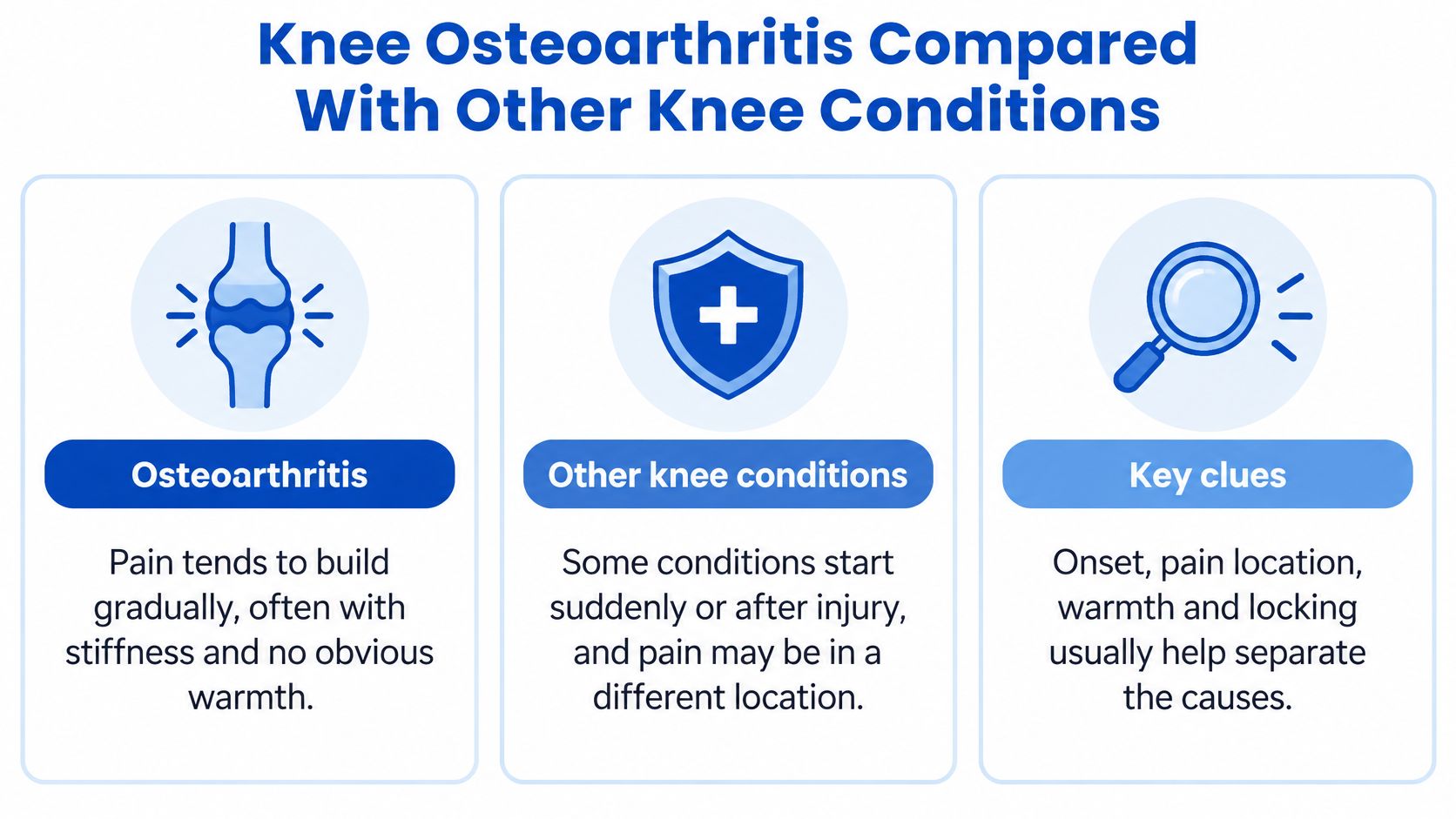
Several conditions can make stairs painful or leave a knee feeling stiff. How symptoms started, exactly where they hurt and whether the joint is hot or mechanically blocked help a clinician separate the possibilities.
This visual highlights the broad differences before the more detailed comparison.
Knee osteoarthritis compared with other common knee conditions
| Condition | Typical Onset | Pain and Stiffness Pattern | Clue That Points Away from Osteoarthritis |
|---|---|---|---|
| Knee osteoarthritis | Usually gradual | Loading-related ache, brief post-rest stiffness and possible crepitus | This is the baseline pattern, rather than an exclusion test |
| Meniscal tear | After twisting, or gradually in a degenerative knee | Joint-line pain, discomfort pivoting and possible catching, locking or swelling | A mechanical block or clear twisting injury needs further assessment |
| Patellofemoral pain | Often gradual, associated with activity | Pain around or behind the kneecap during stairs, squats or prolonged sitting | Symptoms concentrated around the kneecap suggest another possibility |
| Iliotibial band syndrome | Often follows repetitive running or cycling loads | Localised outer-knee pain recurring during activity | A consistent outer-knee pain point associated with repetitive loading |
| Inflammatory arthritis, such as rheumatoid arthritis | May develop without injury | Prolonged stiffness, warmth and swelling, sometimes involving several joints | Widespread joint symptoms, fatigue and marked warmth |
| Gout or septic arthritis | Can begin suddenly | A hot, swollen, intensely painful joint; fever may occur | Sudden severe symptoms need urgent medical assessment |
Common overlaps that cause confusion
Meniscal symptoms and osteoarthritis can overlap. A twist followed by a knee that won't straighten is a different story from occasional clicking during an otherwise manageable walk. Tell the clinician what happens: whether the knee physically stops, briefly catches or merely hurts when you turn.
Patellofemoral pain can also resemble osteoarthritis because stairs and squatting load the kneecap region. Point to the painful area rather than calling everything knee pain. If your discomfort sits higher than the joint, this explanation of pain above the kneecap can help you describe its location more clearly.
Inflammatory conditions deserve particular attention when stiffness dominates the morning, joints feel distinctly warm or symptoms extend beyond the knee. Don't assume that age makes every new joint symptom osteoarthritis.
Location helps frame the questions, but no single pain location reliably settles the diagnosis.
Gout and joint infection can look similar to someone examining their own knee. Fever isn't required for a problem to be urgent, so a suddenly hot, very painful joint still needs medical review.
People can also have osteoarthritis and a meniscal tear together. Use the comparison to describe your symptoms accurately, not to choose a diagnosis before an examination.
Why a Normal Scan Does Not Rule Out Symptoms
A scan is a map of the terrain; your symptoms describe how the walk feels. A map might show rough ground, but it can't tell you how tired your legs are, how confidently you'll move or whether the journey will interrupt your sleep afterwards.
This distinction matters whether your knee hurts during a bushwalk or while crossing the car park.

Structure isn't a pain score
The Australian clinician fact sheet on knee osteoarthritis explains that structural changes and symptoms correlate poorly, routine imaging usually isn't required, and an X-ray is generally the first imaging test when imaging is clinically warranted.
Someone may struggle with everyday walking despite only minor X-ray changes. Another person may have obvious degenerative changes but continue their usual activities with little discomfort. Neither person's experience is invalid.
Degenerative meniscal tears are also common in osteoarthritic knees, including knees without symptoms. An MRI report can therefore describe a real structural finding without establishing that it's the main source of pain.
For a broader explanation of persistent pain, understanding chronic pain can help put scan language into context without dismissing what you feel.
This video offers another way to engage with the topic.
Using results without letting them define your limits
Treat imaging as information about structure, not a forecast of disability. A reassuring scan doesn't remove the need to assess persistent symptoms, and a concerning-sounding report doesn't automatically mean you should stop moving.
Keep a practical record of:
- Walking, including your route and stopping points.
- Stairs, including whether you need a railing.
- Sleep and work, including interruptions and changed duties.
- Confidence, including movements you avoid or fear.
Bring those observations alongside any scan report. Together, they support a more useful discussion about what needs attention.
Deciding When to Book an Osteopathic Assessment
Book an osteopathic assessment when your symptoms fit a gradual, movement-related pattern, there are no red flags, and you want help managing everyday activity. Seek medical review first when the diagnosis is uncertain, the knee is newly hot or substantially swollen, or symptoms suggest an injury or another condition needing investigation.
You don't need to arrive with a polished explanation. “I used to walk to the beach without stopping, but now I turn back early” is a useful starting point.
What happens at the first assessment
At Bayside Osteopathic Health, our initial assessment includes a detailed case history and a physical assessment of your posture, movement and the specific area of concern. We'll consider how the knee affects your daily activities rather than examining the painful spot in isolation.
Bring relevant reports, your medication list and notes about what makes symptoms better or worse. Describe your goals in practical terms, such as getting out of a low chair, returning to a regular walk or managing the steps at home.
We give a realistic recovery timeline during the first assessment. For osteoarthritis, that means discussing expectations for symptoms and function, not promising to reverse cartilage changes or guarantee a pain-free knee.
Useful questions to discuss include:
- Your main limitation. Which activity should the plan address first?
- Your starting point. What can you comfortably manage now?
- Your progress markers. What change would make daily life meaningfully easier?
- Your review plan. When should the approach change if you're not improving?
A plan that supports activity
Our approach can combine soft-tissue work, gentle joint mobilisation and guided movement with practical home strategies. Depending on the assessment, these may include strengthening, a manageable walking plan and pacing demanding tasks rather than alternating between doing too much and avoiding activity entirely.
Hands-on care shouldn't replace active rehabilitation or necessary medical care. Treatment at our clinic should never be painful, although mild temporary soreness may occur afterwards.
We work closely with each arthritis patient's GP and specialist team where appropriate. You can explore our knee pain treatment options to understand how conservative care may fit into that wider plan.
Before booking this week, write down your main activity limitation and what you'd like to do more comfortably. Bring that record so the assessment starts with a clear, personal goal.
Bayside Osteopathic Health offers assessment, gentle hands-on care and movement guidance for arthritis-related knee pain and stiffness. Visit Bayside Osteopathic Health to arrange an assessment, and bring your symptom notes so we can discuss your walking, stairs and daily activity goals.