
If your knee hurts just above the kneecap, does that tell you which part is injured? Not reliably. The sore spot gives you a starting point, but what brings the pain on, how it changes afterwards, and whether warning signs appear matter more when deciding what to do.
People searching for “knee pain above knee cap” may be describing a tender tendon, discomfort from the joint behind the kneecap, or swelling after an injury. A useful approach is to match the location first, then check the pattern rather than jumping straight to a diagnosis.
Table of Contents
- What Pain Above the Kneecap Usually Points To
- History Clues That Narrow Down the Cause
- When Arthritis Is a Likely Cause
- Causes and Load Management
- How to Settle Knee Pain With Home Care
- Returning to Running and Gym Work Safely
- Decide Whether to Book a Check-Up Now
What Pain Above the Kneecap Usually Points To
| Where the pain sits | Structure most often involved | Typical trigger |
|---|---|---|
| Pinpoint, directly above the kneecap | Quadriceps tendon | Stairs, jumping, or a sudden jump in running or squatting |
| Diffuse, around or behind the kneecap | Patellofemoral joint | Stairs, squatting, or long sitting with the knee bent |
| Above the knee with swelling after a twist or fall | Quadriceps tendon or muscle strain, or meniscus or ligament injury | Sudden injury or the knee giving way |
| Ache above the kneecap with morning stiffness, usually in middle age or later | Joint changes from osteoarthritis | Getting up after rest, sometimes easing with gentle movement |
| Above the knee with locking or inability to straighten the knee | Possible meniscus, ligament or tendon injury | Twisting, falling or another clear injury |
These are possible matches, not confirmed diagnoses. The injury-related rows are particularly important because several damaged structures can produce pain and swelling in the same area.
The quadriceps are the muscles at the front of your thigh. Their tendon attaches to the top of the kneecap, which explains why tendon pain can feel very localised there. The patellofemoral joint is the contact between the kneecap and the thigh bone, so pain from that joint may feel broader or harder to pinpoint.
Australian primary-care guidance from the Royal Australian College of General Practitioners describes patellofemoral pain as pain around or behind the kneecap, aggravated by stairs, squatting and prolonged sitting. It also identifies hip and thigh strength as relevant considerations.
Location narrows the search. It doesn't settle the diagnosis.
For example, stairs can provoke both tendon pain and patellofemoral pain. Tenderness directly above the kneecap adds a useful clue, but it doesn't prove that the tendon is the only structure involved.
Find the row that most closely resembles your symptoms, without forcing an exact match. Then consider the onset, swelling, weakness and day-to-day response alongside it.
History Clues That Narrow Down the Cause
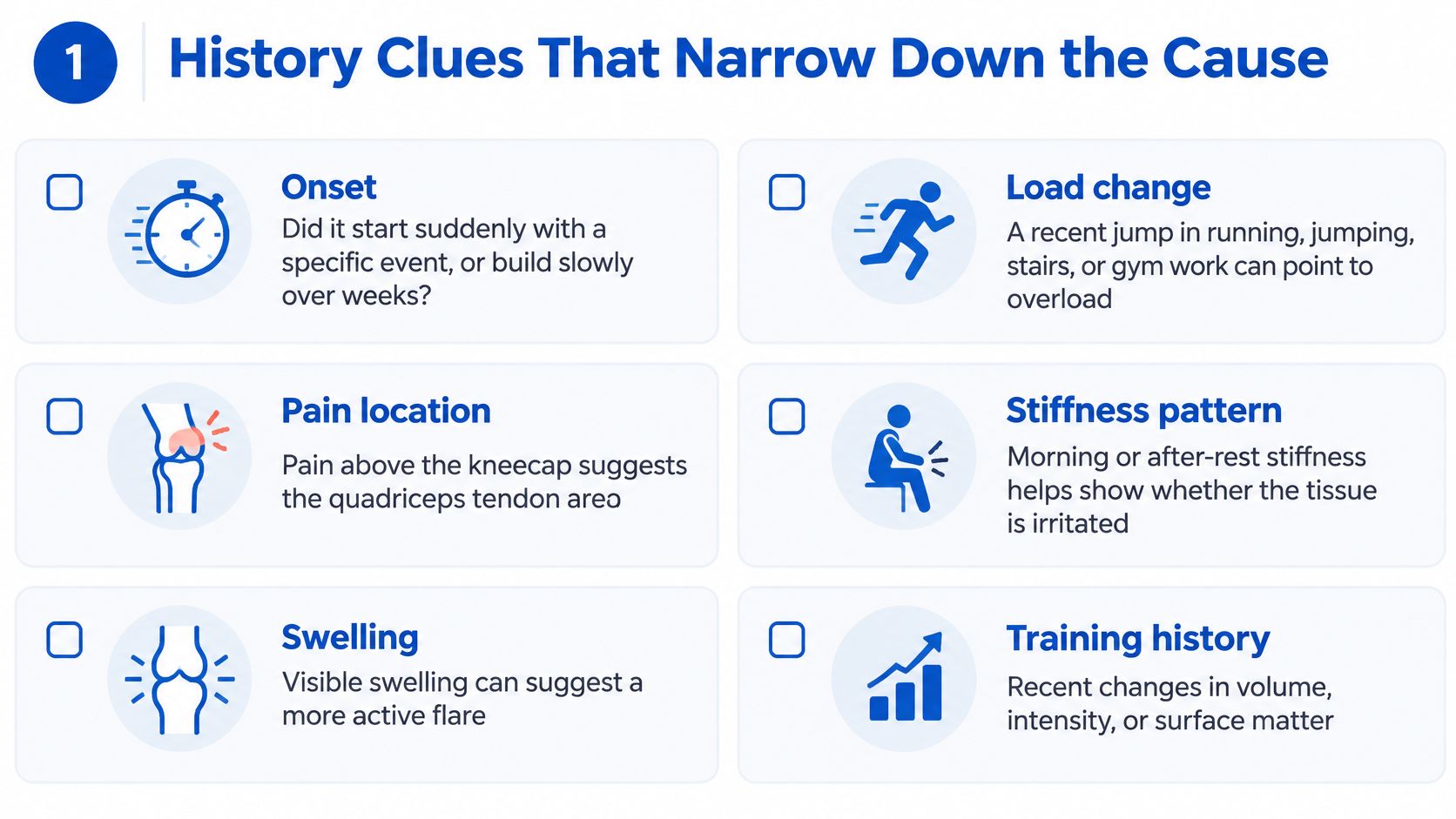
A clinician needs more than the answer to “Where does it hurt?” Your recent activity and the way symptoms behave help distinguish a manageable load-related problem from an injury that needs prompt review.
- Onset: Did the pain begin during a particular movement, or develop gradually? A sudden event raises different concerns from discomfort that builds with repeated activity.
- Load change: Have you increased running, jumping, stairs or gym work? Include changes in terrain and longer periods sitting with bent knees.
- Swelling: Does the knee look fuller above or around the kneecap? Note whether this followed an injury or appears after activity.
- Stiffness: Is movement difficult after sitting or on waking? Record whether gentle movement helps or makes it worse.
- Mechanical symptoms: Does the knee catch, lock or give way? Distinguish a noise from an actual interruption to movement.
- Weakness: Does the leg struggle on stairs or when rising from a chair? Pain can limit effort, but sudden loss of function needs attention.
- Systemic signs: Fever, unusual warmth or redness aren't ordinary training soreness and warrant medical advice.
A runner's example
Say a recreational runner adds hill sessions to an otherwise comfortable routine. Pain develops gradually above the kneecap, becomes noticeable on stairs, and improves when hill running stops.
That history makes a load-related tendon or patellofemoral problem worth checking. It's less suggestive of arthritis as the main explanation than a longstanding pattern of stiffness and reduced movement, but it still doesn't establish a diagnosis.
Keep a simple diary while arranging care or trying appropriate self-management. Record the activity, symptoms afterwards and how the knee feels the next morning. Bring those notes to your clinician rather than relying on your memory of the worst day.
When Arthritis Is a Likely Cause
Osteoarthritis commonly affects weight-bearing joints such as the knees. It can cause pain, stiffness, swelling and reduced movement, including discomfort that feels as though it sits above the kneecap.
The Australian Institute of Health and Welfare reports that approximately 2.1 million Australians, or 8.3% of the population, were living with osteoarthritis in 2022, based on Australian Bureau of Statistics survey data. That national figure establishes how common the condition is, not whether it explains your particular pain.
The pattern matters more than age alone
Arthritis may feel like a deeper ache with stiffness after rest. Gentle movement can help the knee loosen, although longer or heavier activity may aggravate it. Symptoms often develop gradually rather than beginning during a single exercise.
A GP may assess your walking, joint movement, swelling and activity limitations. An X-ray may be appropriate when it would help clarify the diagnosis or guide treatment, but a scan isn't automatically needed for every sore knee.
- Describe practical limits: Explain whether dressing, shopping, stairs or sleep have become harder.
- Mention changes: Increasing swelling, loss of movement or a different pain pattern can affect the assessment.
- Discuss ongoing care: Significant joint problems may need specialist input alongside conservative management.
The guide to arthritis pain in the knee provides further context for stiffness and mobility concerns. Arthritis can also coexist with tendon or kneecap-related pain, so finding arthritis doesn't necessarily explain every symptom.
Causes and Load Management
The tissues above and behind the kneecap do different jobs. Understanding those jobs makes activity changes more purposeful than avoiding everything that hurts.
Pain during outdoor exercise is a reason to examine the activity load, not to assume a diagnosis.
Quadriceps tendon overload or strain
The quadriceps tendon transfers force from the thigh muscles to the kneecap as you straighten the knee. Tendons adapt to repeated loading, but an abrupt increase can exceed what they currently tolerate.
A gradual, activity-related problem may involve tendinopathy. Pain beginning during a specific forceful movement may instead involve an acute strain or tear. Marked weakness or difficulty straightening the knee shouldn't be treated as routine overuse.
For uncomplicated knee injuries, healthdirect's knee injury guidance advises avoiding complete inactivity for more than 48 hours, with gentle exercise and graded activity as appropriate. That advice doesn't mean exercising through a suspected tear.
Consider a weekend hiker who replaces short, level walks with steep descents. Reducing downhill exposure while keeping comfortable flat walking may be more useful than abandoning walking altogether.
Patellofemoral loading
The kneecap glides over the end of the thigh bone as the knee bends and straightens. How that joint is loaded, including tracking and movement control, can contribute to irritation.
Healthdirect's knee pain guidance identifies patellofemoral pain as a condition linked to how the kneecap runs over the femur. This is why cause-specific assessment matters rather than labelling every front-of-knee symptom a tendon injury.
An office worker whose knee aches during long meetings and again on stairs may need assessment of knee movement, thigh control and hip strength. They don't necessarily need the same programme as the hiker.
The accompanying video offers a visual resource to discuss alongside individual exercise advice.
Practical rule: Reduce the provoking load, preserve comfortable movement, then rebuild capacity progressively.
Quadriceps and hip strengthening should match your symptoms and current ability. Ultrasound, MRI or X-ray may be considered when examination suggests a tear, substantial injury or another cause that needs clarification, rather than as an automatic starting point.
How to Settle Knee Pain With Home Care
Home care suits mild, gradual symptoms without significant injury or warning signs. Don't begin strengthening a knee that is markedly swollen, unstable or unable to straighten normally without getting it assessed.
A structured programme is more useful than searching for a single corrective exercise. A 2024 Melbourne randomised controlled trial indexed by PEDro compared exercise programmes in 60 people with patellofemoral pain. That supports discussing structured exercise as a recognised approach, but it doesn't establish that every exercise below suits every cause of knee pain.
Start with control and comfortable movement
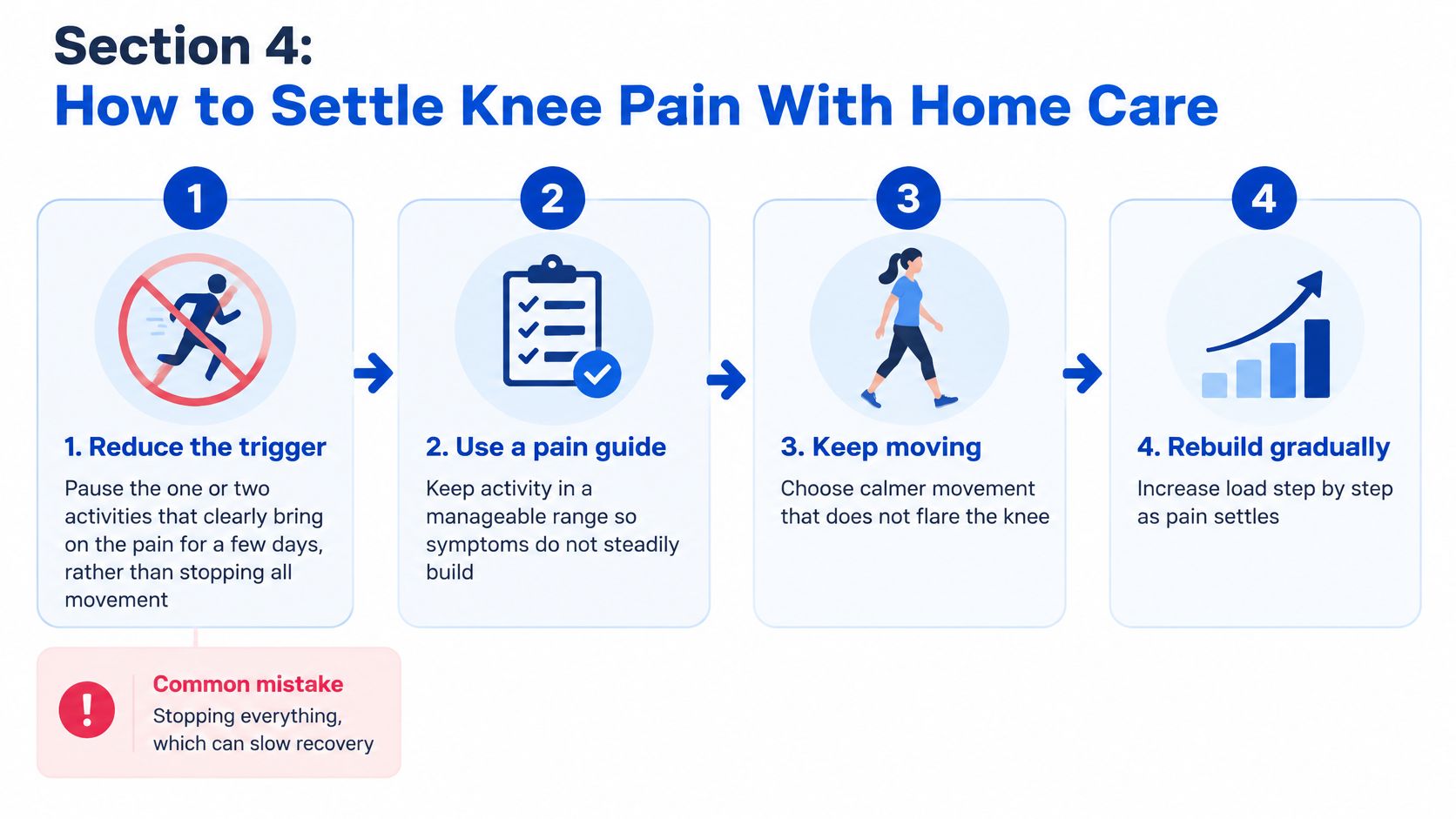
Reduce the clearest trigger. Temporarily replace painful hills, jumping or deep squats with an activity you tolerate. The common mistake is stopping all movement rather than changing the aggravating task.
Use symptoms as feedback. Keep exercise comfortable or only mildly uncomfortable, without steadily increasing pain. Stop for sharp pain, altered walking or symptoms that remain noticeably worse the next morning.
Try a gentle quadriceps contraction. With your leg supported and straight, tighten the front of your thigh without forcing the knee down. Release fully between efforts. This practises muscle activation without adding a demanding bend.
Keep bending comfortable. Lie or sit with the leg supported and slide your heel towards your bottom, then away again. Don't pull through a painful block or force the range.
Add strength when the knee tolerates it
Practise sit-to-stand. Use a firm chair and rise smoothly, then lower with control. A higher seat can make the movement easier. Avoid dropping into the chair or repeatedly testing a painful depth.
Include hip work. For side-lying hip abduction, keep your pelvis stacked and lift the top leg without rolling backwards. Hip exercises complement knee exercises rather than replacing them.
Consider a bridge. Lie on your back with knees bent and lift your pelvis gently. This mainly works the buttock muscles and can provide another strengthening option when direct knee loading is uncomfortable.
Start with a manageable amount rather than copying someone else's repetitions. A clinician can tailor the selection and progression through appropriate knee pain treatment options.
A settling knee should make everyday tasks easier, with less lingering soreness and more predictable symptoms. Use your diary to judge that trend, not a single good afternoon.
Returning to Running and Gym Work Safely
Returning to activity is a progression based on what your knee can tolerate, not a date on the calendar. Pain easing at rest doesn't necessarily mean you're ready for your previous training load.
Progress from ordinary tasks to demanding loads
Establish comfortable daily movement. Start with flat walking and necessary stairs. You should be able to move without limping, increasing swelling or a clear deterioration afterwards.
Change one training demand at a time. Increase walking distance, stair exposure or gym resistance separately. If symptoms rise, return to the last manageable level rather than adding another challenge.
Reintroduce running on predictable ground. Begin with brief running intervals separated by walking. Leave hills, speed work and uneven surfaces until the simpler session is consistently tolerated.
Restore higher-force activity last. Jumping and heavier squats place different demands on the knee. Introduce them only after easier loading feels reliable, using controlled technique and adequate recovery.
A successful session leaves you able to manage the next day, not just pleased that you finished.
For the weekend hiker, that means returning to flat trails before gradually adding descents. For a gym-goer, it may mean a shallower squat and lighter resistance before restoring depth and weight.
Know when to hold the progression
The common mistake is returning to peak load as soon as pain eases. Instead, compare your walking, stairs and next-morning symptoms before deciding to progress.
If running remains a consistent trigger, a running gait analysis may help explore relevant movement patterns alongside training history. It shouldn't replace assessment of a swollen, weak or mechanically restricted knee.
Persistent symptoms, a changing pain pattern or repeated setbacks deserve clinical review rather than an increasingly complicated self-directed programme.
Decide Whether to Book a Check-Up Now
| Warning sign | What it may suggest | How soon to act |
|---|---|---|
| Cannot bear weight or walk | Significant injury or possible fracture | Seek urgent assessment today |
| Cannot fully straighten the knee | Possible quadriceps tendon tear or another mechanical block | Seek urgent assessment today |
| Marked swelling or deformity after injury | Significant structural injury | Seek urgent assessment today |
| Fever, heat or redness around the knee | Possible infection or another acute inflammatory problem | Seek urgent medical advice today |
| Knee locks or gives way | Possible meniscus, ligament or other joint problem | Arrange prompt assessment; seek urgent care if locked or unsafe to walk |
| Pain steadily getting worse | Continuing overload, joint disease or another unresolved cause | Book assessment promptly rather than continuing to increase activity |
| Pain persists despite sensible home care | Ongoing tendon, patellofemoral or joint-related symptoms | Arrange a GP or allied health review |
The table is a triage guide, not a diagnosis. Inability to straighten the knee, for example, doesn't prove a tendon tear, but it does make self-directed exercise an inappropriate first step.
Choose the right type of care
A knee that is hot, red and painful with fever needs medical assessment, not a routine manual therapy appointment. Likewise, substantial trauma, deformity or inability to walk may require an emergency department or urgent medical service.
Don't repeatedly test a locked knee or force it straight. If the leg feels unsafe, reduce unnecessary walking and arrange help getting assessed.
For gradual, mild symptoms without warning signs, a cautious trial of load adjustment and suitable exercise is reasonable. Continue only while function and symptoms are moving in the right direction. There's no need to wait for an arbitrary deadline if pain feels unusual, disrupts ordinary tasks or concerns you.
What to bring to an appointment
- Your symptom history: Include the first noticeable change, any injury and the activities that provoke pain.
- Your activity diary: Bring notes about exercise, swelling and next-morning symptoms.
- Your main goal: Explain whether you want to manage stairs, return to running or walk comfortably at work.
Osteopathic assessment is an option for appropriate musculoskeletal presentations. At Bayside Osteopathic Health, we welcome enquiries about acute pain and sports injuries, including whether osteopathic care suits your situation, and prioritise prompt bookings for patients with acute or urgent pain. That booking policy isn't a substitute for urgent medical care when warning signs are present.
If you're unsure which path fits, call for advice rather than guessing from the pain location alone.
Bayside Osteopathic Health offers knee and sports injury assessment, movement advice and rehabilitation support for suitable presentations. If pain above your kneecap is limiting daily activity, visit Bayside Osteopathic Health to request a check-up or ask whether osteopathic care is appropriate for your symptoms.