
You've probably tried the usual fixes already. A few days off, extra stretching, a different pair of shoes, maybe some ice after a run. Yet the same pain keeps returning. It might be the knee that starts to ache once your distance builds, the shin that tightens every time you try to get consistent, or the hip that nags enough to make you question whether running is worth it.
That pattern is frustrating because the pain often isn't the true starting point. The sore area is just where your body is complaining the loudest. A proper running gait analysis helps uncover how you're moving, how you're absorbing load, and why one structure may be doing more work than it should. The aim isn't to make you run like a textbook diagram. It's to understand your movement signature, then use that information to build a plan that suits your body, your injury history, and your goals.
Table of Contents
- Beyond Just a Niggle Why Your Running Form Matters
- What Is a Running Gait Analysis
- Common Running Patterns and Their Causes
- Your Gait Analysis Appointment What to Expect
- From Analysis to Action How We Use Your Results
- Who Benefits From a Running Gait Analysis
- FAQs and Your Next Steps
Beyond Just a Niggle Why Your Running Form Matters
A lot of runners arrive at this point after months of managing symptoms rather than solving the problem. They've rested enough for the pain to settle, returned to running, then watched the same issue flare again. It often feels random. In practice, it usually isn't.
A recurring niggle often means your body has found a way to keep you moving, but not always in a way that shares load well. That could be a slight pelvic shift, a long reaching stride, poor control through the trunk, or a foot position that changes how force travels up the leg. None of these automatically mean your form is “bad”. They tell us how your system is coping.
The myth of perfect running form
One of the most helpful things to know is that there isn't one ideal running style that every body should copy. In this discussion of what's normal in running gait, the average recreational runner's step rate was 164 steps per minute, not the often repeated 180 spm, and moderate asymmetry was not associated with higher injury risk. That matters because it shifts the focus away from chasing a single number or appearance.
Good running form isn't about looking polished on video. It's about whether your body can tolerate the loads your running places on it.
For one runner, a visible asymmetry may be perfectly manageable. For another, a smaller change in stride timing or hip control may be enough to irritate the knee every week. The clinical question isn't, “Does this look textbook?” It's, “Does this pattern fit the pain, and is it modifiable?”
Why form matters when pain keeps coming back
Running form matters because it influences where load goes. If one joint is stiff, another area often picks up the slack. If your capacity is low because of weakness, fatigue, or a recent training increase, even a common movement pattern can become a problem.
A good analysis gives context to symptoms such as:
- Knee pain that appears during longer runs or downhill running
- Shin or calf tightness that returns whenever pace or volume increases
- Hip or lower back ache that seems disconnected from the feet but starts with running load
- Foot or ankle irritation that worsens despite changing shoes
That's why running gait analysis is useful. It helps connect pain to movement, and movement to a practical plan.
What Is a Running Gait Analysis
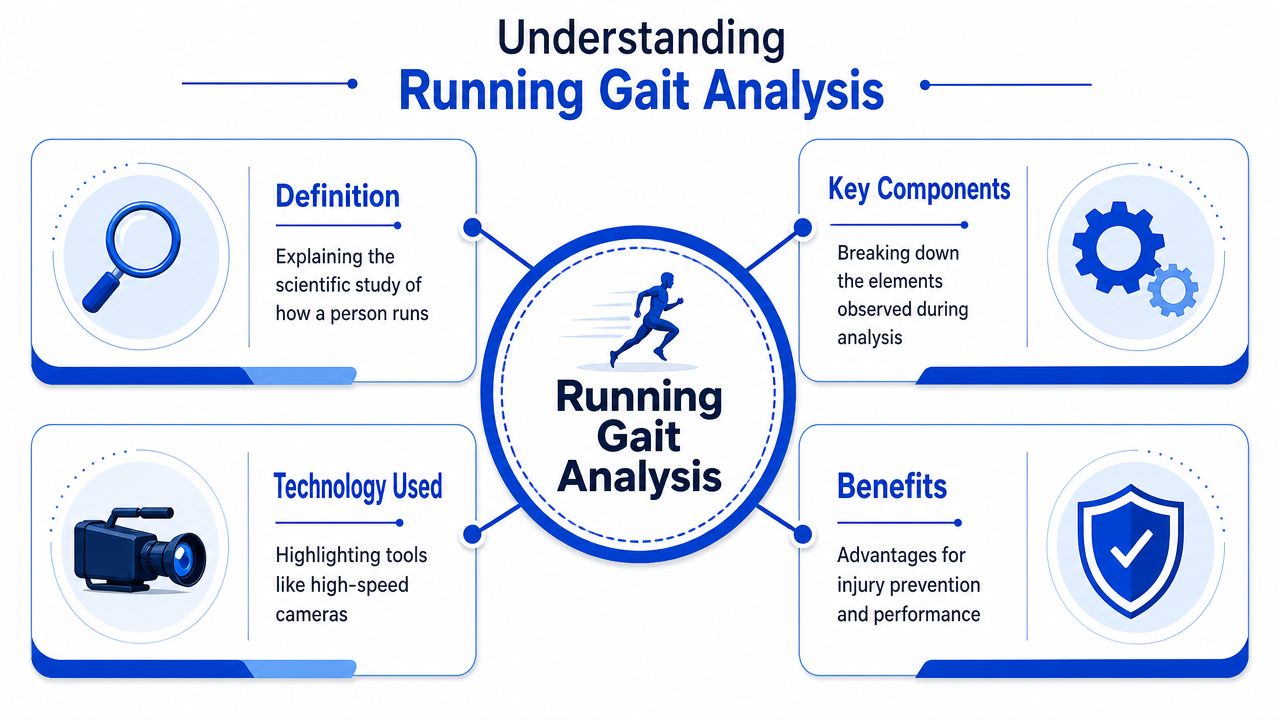
A running gait analysis is a structured assessment of how you move while running. It looks at the sequence from one foot strike to the next on the same side, and it examines how the feet, knees, hips, pelvis, trunk, and arms work together while you absorb and produce force.
Gait analysis slows down a mechanical system, allowing its moving parts to be properly examined. During a run, many events happen too quickly to judge well with the naked eye. Video lets us review them frame by frame and compare what you feel with what your body is doing.
Your stride is a sequence, not a snapshot
In a peer-reviewed review of running gait analysis, quantitative gait analysis was described as measuring spatiotemporal parameters, kinematics, and kinetics. In plain language, that means we're looking at timing, position, and loading. The same review noted that a semi-automatic video-based system could identify cadence and step length from 1 minute of video recording plus 10 minutes of analysis, which shows how assessment has become faster and more accessible while still capturing useful biomechanics.
What matters for patients is that we don't judge your run from one still image. We look at movement over time.
Common terms include:
- Cadence means how many steps you take per minute.
- Stride length is the distance covered between steps.
- Contact time is how long the foot stays on the ground.
- Flight time is the period when neither foot is on the ground.
These markers help show whether you're spending too long on one side, reaching too far out in front, or working harder than necessary to control each landing.
The markers that matter
Not every data point deserves the same attention. A useful running gait analysis focuses on the variables that help explain symptoms.
For example, we may look at:
| Marker | What it means in plain English | Why it matters |
|---|---|---|
| Cadence | Your step rhythm | Can influence stride length and loading |
| Foot strike position | Where the foot lands relative to the body | Can affect braking forces and joint stress |
| Pelvic control | How steady the pelvis stays in stance | Can relate to hip and knee load |
| Trunk position | How the upper body manages momentum | Can change how force travels through the lower limb |
Practical rule: A useful gait analysis should make the problem simpler, not more confusing. If a finding doesn't help explain your symptoms or guide treatment, it's probably not the priority.
Running gait analysis isn't valuable because it produces lots of terms. It's valuable because it turns movement into something we can interpret, discuss, and act on.
Common Running Patterns and Their Causes
By the time someone sees their running footage slowed down, they often expect one dramatic fault to explain everything. Usually that's not what appears. More often, we see a handful of smaller patterns that combine with training load, joint stiffness, previous injury, and fatigue.
What we look for on video
Some running patterns show up repeatedly in clinic. They're not diagnoses on their own, and they're not always problems. Their value comes from how well they match the person's symptoms.
Here's a simple way to think about the common ones:
| Gait Pattern | What It Looks Like | Potential Causes & Related Pain |
|---|---|---|
| Overstriding | The foot lands too far in front of the body, often with a longer reaching step | May reflect low cadence, reduced hip drive, or an attempt to lengthen stride. Often linked with braking forces and may show up alongside knee, shin, or hip irritation |
| Pelvic drop | One side of the pelvis drops when the opposite leg swings through | Can be associated with reduced control through the hip and trunk, fatigue, or limited load tolerance. Often seen in runners with lateral hip pain or pain around the knee |
| Crossover gait | The foot lands close to or across the body's midline | May relate to balance strategy, hip control, or stride width habits. Can contribute to irritation through the hip, knee, or lower leg in some runners |
| Excessive trunk sway | The torso shifts more than expected side to side or rotates poorly | Can reflect compensation for pain, reduced hip capacity, or stiffness elsewhere. Sometimes linked with back discomfort or inefficient load transfer |
Why the same pattern can mean different things
Online advice often falters here. Two runners can show the same visible pattern for completely different reasons.
A pelvic drop, for example, might reflect poor hip strength in one runner. In another, it may be a temporary strategy caused by ankle stiffness after a recent sprain. Trying to correct both with the same cue won't work well.
Clinical interpretation also needs context. A medical review of running assessment recommends observing the runner from each side, front, and back, using high-speed filming at at least 60 frames per second. That matters because timing-related issues can happen very quickly, and a single low-quality angle can miss them.
Seeing a pattern doesn't automatically tell you the cause. That's why gait analysis works best when it's paired with a physical examination, not treated as a stand-alone video review.
A runner might also self-identify with a pattern and still be wrong about what needs changing. Someone may notice overstriding and assume the foot is the issue, when the more important driver is poor control through the trunk and pelvis. Another runner may focus on asymmetry when the larger issue is doing too much, too soon.
That's why we interpret patterns with care:
- We match movement to symptoms, not just appearance.
- We consider training load, because an otherwise manageable pattern can become painful when volume rises.
- We check physical capacity, since mobility and strength often explain why the body adopted that strategy.
The aim isn't to label your running style. It's to understand which features are relevant, and which are just part of your normal variation.
Your Gait Analysis Appointment What to Expect
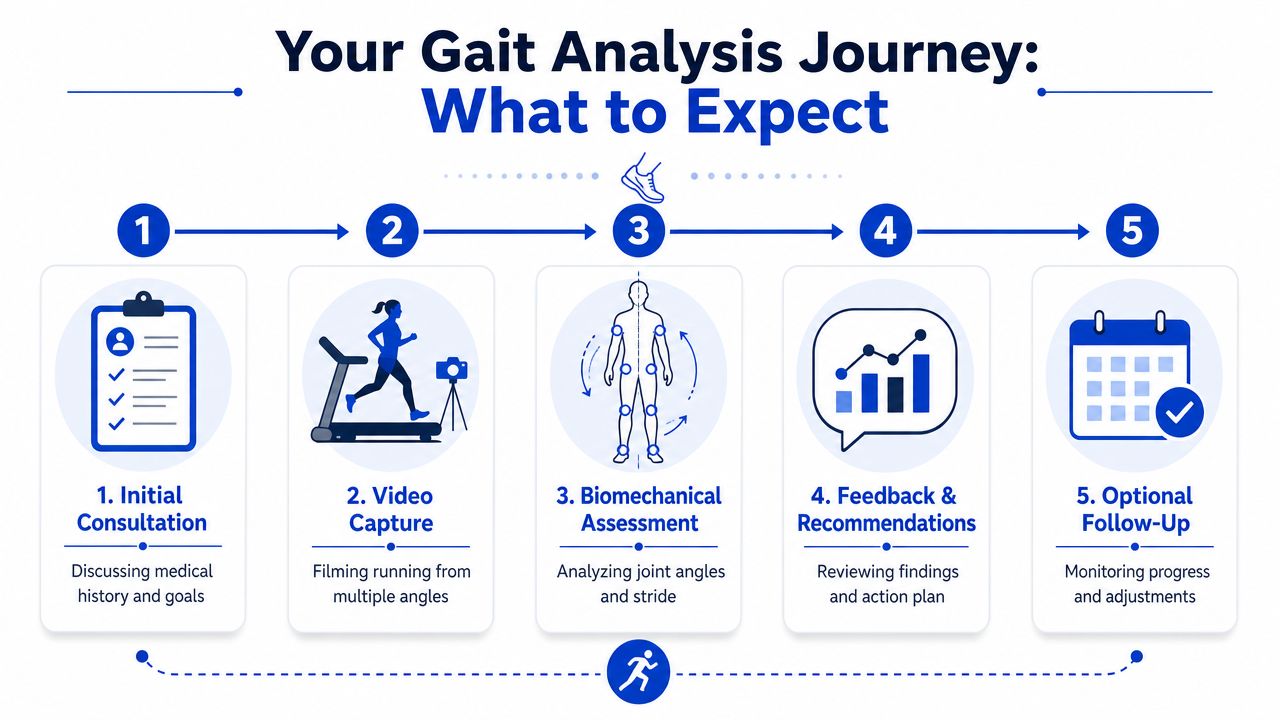
Individuals often feel more comfortable once they know what happens in a running gait analysis appointment. It's not a test you can fail, and you don't need to arrive running perfectly. The process is designed to gather useful information in a calm, structured way.
It starts before you step on the treadmill
The first part is a conversation. We ask about your pain, when it comes on, what makes it worse, what shoes you run in, what surfaces you usually train on, and how your running has changed recently. A runner training for an event needs a different plan from someone trying to jog comfortably again after time off.
Then comes a physical assessment away from the treadmill. That may include checking ankle motion, hip mobility, spinal movement, balance, single-leg control, and how well you manage load through the foot and pelvis, for while video often shows the effect, the physical examination helps explain the cause.
If you've ever wondered about the broader role of manual therapy and movement assessment, this comparison of osteopaths and physiotherapists can help clarify how different practitioners approach similar problems.
The treadmill assessment and video review
The running portion is detailed. A clinically sound assessment uses video from multiple angles, not just one side view. A published clinical running assessment guide recommends filming from the side, front, and back at at least 60 frames per second so trunk movement, pelvic control, foot strike, and knee or hip alignment can be reviewed frame by frame.
That level of detail matters because some timing faults occur so quickly that a standard low-frame-rate clip can miss them.
Before looking at the footage, it helps to see the process in motion:
What you'll leave with
By the end of the appointment, you should understand more than just what your running looks like. You should know which findings matter, which ones don't, and what the next steps are.
That usually includes:
- A clear explanation of the main movement findings in plain language
- An interpretation linked to your symptoms, not generic form advice
- A practical plan that may include treatment, exercises, running cues, and load changes
- A realistic expectation of what should improve first and what may take longer
The most useful appointment isn't the one with the longest report. It's the one that leaves you knowing what to do next.
From Analysis to Action How We Use Your Results
A gait analysis only becomes valuable when it changes management. If all you receive is a list of observations, you're left with interesting footage but no real solution.
We match the finding to the problem
The first step is deciding which findings deserve attention. Not every visible asymmetry needs correction. Not every unusual foot strike is causing pain. We focus on the patterns that fit your symptoms, your examination findings, and your training demands.
That can lead in several directions at once:
- Hands-on treatment may help if joint stiffness or soft tissue restriction is changing how you load through the leg.
- Exercise prescription matters when the body lacks the strength, control, or endurance to hold a better pattern.
- Running retraining cues are useful when a small technique change can reduce irritation without rebuilding your entire stride.
For runners dealing with pain around the side of the hip or pelvis, it can also help to understand how local symptoms often connect with broader movement problems. This guide to hip pain treatment gives a good example of that relationship.
What usually works better than chasing perfect form
One of the most practical tools from running gait analysis is cadence change. In an AMSSM clinical lecture on running gait, step rate was highlighted as one of the most useful 2D gait measures for reducing knee force, and about 180 steps per minute was presented as a typical normal cadence reference point. For runners with certain kinds of knee pain, increasing cadence can shorten stride length, reduce braking forces, and lower joint loading without a complete form overhaul.
That doesn't mean everyone should force themselves to 180. It means cadence is a modifiable lever. If your current pattern includes a long reaching stride and front-of-knee pain, changing rhythm may be far more useful than trying to consciously alter five separate body parts at once.
A practical treatment plan often includes a mix of:
| Part of the plan | What it may involve |
|---|---|
| Manual care | Improving motion where restriction is forcing compensation |
| Strength work | Building tolerance in the hip, calf, foot, or trunk |
| Mobility work | Restoring movement that the stride depends on |
| Running cues | Simple changes such as rhythm, posture, or step placement |
| Load management | Adjusting distance, hills, pace, or frequency while symptoms settle |
Small changes that reduce load usually beat dramatic changes that you can't maintain.
What doesn't work well is over-cueing. If a runner tries to “fix” arm swing, foot strike, posture, and knee drive all at once, they usually become tense and less efficient. The better approach is selective. Choose the highest-value change, test it, and build from there.
Who Benefits From a Running Gait Analysis
It's not only for serious runners
You don't need to be fast, competitive, or training for a marathon to benefit from running gait analysis. It's often most useful for everyday runners who feel stuck.
The main groups who tend to benefit are:
- Runners with recurring pain who've rested multiple times but never resolved the underlying issue
- Beginners who want a sensible baseline before increasing distance
- People returning after injury or time off who need confidence and a graded plan
- Experienced runners who feel one area repeatedly tightens or breaks down under load
What matters is not your pace. It's whether understanding your movement would help you train more comfortably.
A key point from a recent review of clinical 2D running gait analysis is that gait analysis is useful for identifying biomechanical features such as hip adduction and pelvic drop, but its real value is realised when those findings are paired with strength, mobility, and load management. That fits what we see clinically. The assessment itself doesn't fix pain. The right response to the assessment does.
For older runners, office workers starting again, or adults managing joint stiffness, this personalised approach matters even more. A textbook running cue may not suit a body with reduced ankle mobility, hip arthritis, or a long history of back pain. Running gait analysis helps separate what's changeable from what just needs to be worked around.
FAQs and Your Next Steps
Common questions before booking
Do I need to be a good runner?
No. Running gait analysis is often more helpful for people who feel unsure, uncomfortable, or repeatedly injured than for runners who feel great.
Do I need to run fast on the treadmill?
No. The goal is to observe your usual running pattern, not to test your top speed.
What should I bring?
Bring your usual running shoes, and if you rotate pairs, bring the ones you use most often. It can also help to bring any recent scans, reports, or notes about your symptoms.
Will you try to change everything about my stride?
No. Individuals typically require a few targeted changes, not a complete rebuild. Good care is selective.
Can I use Medicare or private health insurance?
Coverage depends on your individual circumstances and policy. If you're booking, it's worth asking about private health claiming and whether you may be eligible for care under a Chronic Disease Management Plan through your GP.
If you're ready to get your running assessed by a local practitioner, you can start by finding an osteopath near you in Bayside.
The main thing to remember is simple. Pain that keeps returning usually has a pattern behind it. Running gait analysis helps make that pattern visible, so treatment can be more specific and your return to running can feel much less guesswork-driven.
If you're dealing with recurring running pain and want a clearer path forward, Bayside Osteopathic Health offers gentle, personalised care that looks at how your whole body moves, not just where it hurts. Book an appointment to assess the drivers behind your symptoms and build a practical plan back to comfortable running.