

You wake with stiff hands, your knees complain on the stairs, and your shoulders ache before the day has properly started. Perhaps you've tried stretching one area, only to notice another becoming sore. When several places hurt, it's hard to know whether you need more movement, more rest or a medical appointment.
Searching for “joint pain all over body” describes an experience, not a diagnosis. The useful starting point is to map the pattern before treating each painful spot. Where the pain occurs, how it behaves and what comes with it can help your clinician distinguish joint disease from muscle pain, altered pain processing or a condition affecting the whole body.
Table of Contents
- Which Cause Fits Your Pattern of Pain
- How Pain Spreads Across Several Joints
- Alarm Signs That Need Prompt Medical Review
- How to Map Your Symptoms Before Your Appointment
- Self-Care and Lifestyle Steps That Ease Widespread Pain
- Which Appointment to Book and How Care Fits Together
Which Cause Fits Your Pattern of Pain
Read this table as a guide to possibilities, not a way to diagnose yourself. The accompanying clues matter more than finding an exact match.
| Pain pattern | Most likely cause | Key clue |
|---|---|---|
| Worse with use, better with rest, mainly hips, knees, hands or spine | Osteoarthritis, often in several joints | Stiffness tends to ease after getting moving |
| Symmetrical swelling in small joints, especially hands or feet | Inflammatory arthritis | Persistent swelling and prolonged morning stiffness |
| Persistent widespread aching, poor sleep and tenderness | Fibromyalgia or chronic widespread pain | Fatigue and unrefreshing sleep, without joint swelling caused by the condition |
| Single hot, red, sudden and very painful joint, sometimes the big toe | Gout or septic arthritis | Needs same-day medical assessment |
| Joint pain with fever, rash, recent infection or unexplained weight loss | Infection or systemic inflammation | Prompt medical review rather than self-treatment |
| Aches with hot flushes and sleep change around midlife | Menopause-related musculoskeletal pain | Timing overlaps with hormonal change, but other causes still need checking |
| Pain with unusually mobile joints, recurrent dislocations, easy bruising or stretchy skin | Hypermobility-related condition | Instability and movement beyond the usual joint range |
| New aches after starting or changing a medicine, such as a statin | Medication side effect | Review the timing with your GP before changing treatment |
Similar symptoms can have different causes
Pain near a joint doesn't always come from inside it. Muscles, tendons and other surrounding tissues can produce discomfort that feels like joint pain. A clinician will ask you to point to the painful area and check whether movement, pressure or joint swelling helps explain it.
Several conditions can also coexist. Someone with knee osteoarthritis might develop muscle tension from walking differently, while poor sleep makes their pain harder to tolerate. That combination needs a broader plan than treating the knee alone.
Age changes which explanations deserve attention. The AIHW's snapshot of arthritis in Australia describes arthritis's strong association with ageing and its effects on mobility and independence. New shoulder and hip-girdle stiffness in an older adult also warrants consideration of conditions such as polymyalgia rheumatica, rather than being dismissed as ordinary ageing.
Our guide to arthritis pain and symptoms can help you describe joint-specific changes. But neither a symptom list nor your age can establish the diagnosis.
A pattern is a reason to investigate, not a label to attach to yourself.
If a row sounds familiar, note the matching features and anything that doesn't fit. Visible swelling, systemic symptoms or declining function are particularly useful details to tell your GP.
How Pain Spreads Across Several Joints
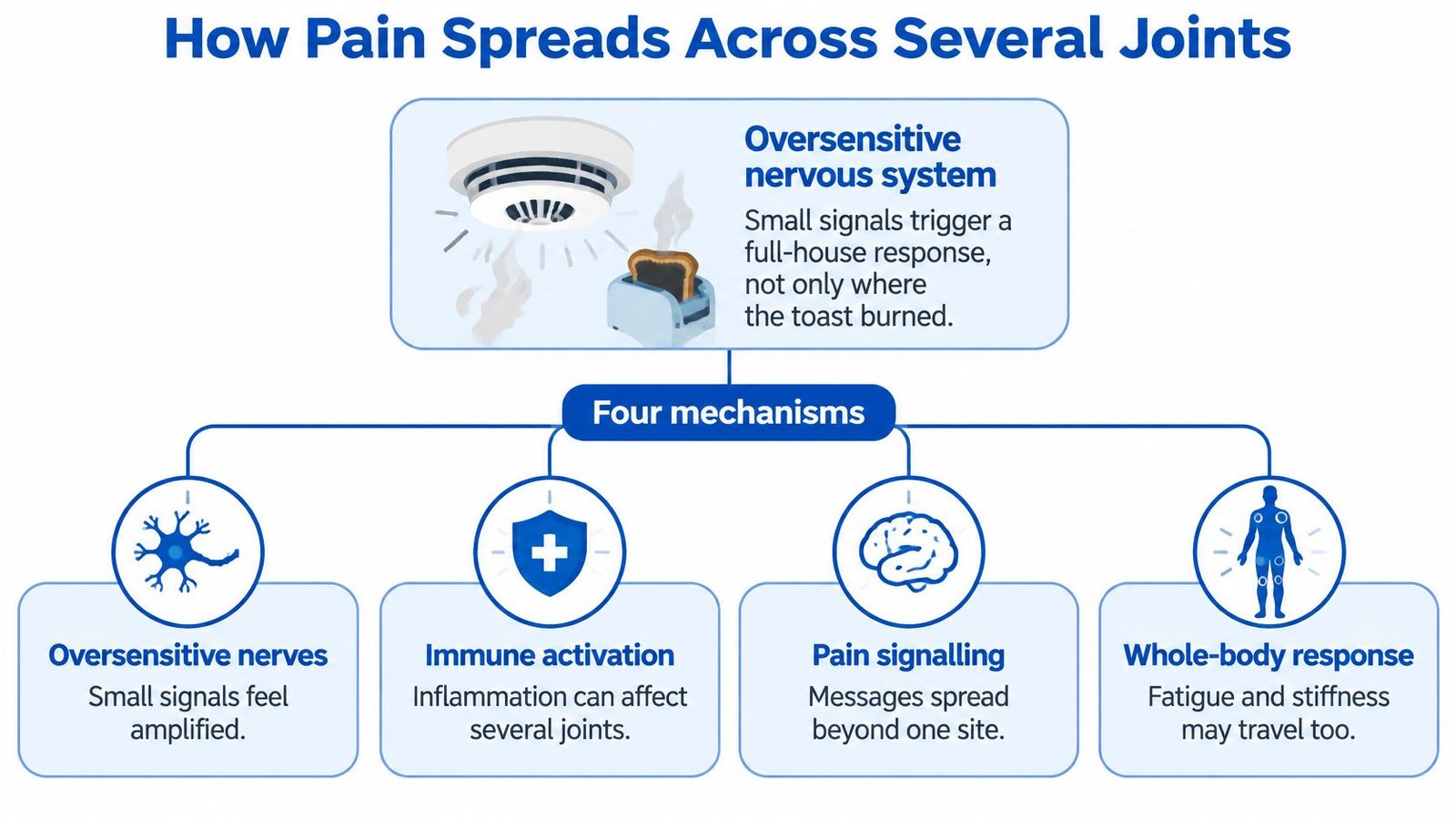
An oversensitive nervous system can behave like a smoke alarm that triggers a full-house response to burnt toast in the kitchen. That's one possible explanation for widespread pain, but it isn't the only one.
Different routes to widespread pain
Systemic inflammation can affect several areas during infection or autoimmune activity. Much as a flu-like illness can leave your body aching, an inflammatory condition may involve more than a single joint.
With central sensitisation, the spinal cord and brain become more responsive to incoming signals. Pain may extend beyond the original sore area, such as a painful wrist occurring alongside arm and neck sensitivity. This doesn't mean the pain is imagined.
Mechanical overload works differently. If you guard a sore foot, you may change your stride and place unfamiliar demands on your knee, hip and lower back.
Hormonal and metabolic changes, including menopause or thyroid disorders, can also contribute to widespread aches. Assessment helps establish whether these are relevant rather than assuming every painful site has been injured.
This diagram illustrates how pain can involve more than one pathway.
The AIHW estimates that approximately 7.3 million Australians, or 29% of the population, lived with a musculoskeletal condition in 2022. That broad category includes different disorders, not just people with widespread joint pain.
The mechanisms suggest different assessment priorities:
- Inflammation: Look for inflammatory arthritis or systemic illness.
- Amplified signalling: Consider chronic widespread pain after assessing other explanations.
- Altered loading: Examine movement and mechanical joint problems.
- Hormonal or metabolic change: Discuss whole-body symptoms with your GP.
Alarm Signs That Need Prompt Medical Review
The urgency depends on what accompanies the pain, not just how many joints hurt. A new hot joint or sudden loss of function shouldn't be managed as routine stiffness, even if you already have arthritis.
Get emergency help for sudden serious symptoms
Call 000 for chest pain, severe shortness of breath, new confusion, sudden weakness or numbness, or a sudden unexplained inability to walk. These symptoms need emergency assessment rather than a routine musculoskeletal appointment.
Don't drive yourself if you're acutely unwell or have sudden neurological symptoms. Tell the emergency operator what changed and when it started.
Seek same-day assessment for a hot or unusable joint
Arrange urgent medical assessment for:
- A hot, swollen, very painful joint: Infection is one possible cause and needs to be excluded promptly.
- Sudden inability to bear weight: Especially when the joint has become painful without an obvious minor explanation.
- Joint pain with fever or significant illness: Don't assume this is an arthritis flare.
- Significant trauma: Particularly with deformity, major swelling or inability to use the limb.
For example, someone who wakes overnight with a swollen knee and a temperature needs medical review, not a trial of stretching or massage. Gout and joint infection can look similar from the outside, so appearance alone isn't enough to choose treatment.
Arrange prompt GP review for unexplained changes
Contact your GP promptly for marked night pain, unexplained weight loss, a new rash or mouth ulcers, progressive swelling, or steadily worsening everyday function. Persistent widespread pain also deserves an appointment, especially when getting dressed, walking or using your hands becomes harder.
The AIHW's osteoarthritis summary describes pain, stiffness and restricted movement associated with progressive cartilage breakdown. Pain that predictably worsens with loading and eases with rest is more mechanically consistent, but fever, marked night pain or an acutely hot swollen joint changes the assessment.
Night pain alone doesn't prove a dangerous condition. Its significance depends on whether it's new, persistent, severe or accompanied by other changes, which is why your clinician needs the full picture.
Safety rule: An alarm sign takes priority over exercise, hands-on treatment or any other self-care advice.
If you're unsure how urgently to be seen, describe the specific symptoms to a medical service rather than asking only whether widespread pain is normal.
How to Map Your Symptoms Before Your Appointment
A useful symptom record doesn't need an app or elaborate scoring system. A notebook, phone note or printed body outline is enough. Start now, but don't postpone an appointment to finish the record.
The AIHW's overview of chronic musculoskeletal conditions distinguishes osteoarthritis, which involves cartilage deterioration, from rheumatoid arthritis, an autoimmune inflammatory disease. That distinction explains why the location of pain alone isn't enough, timing, swelling and associated symptoms matter too.
Build a record your clinician can use
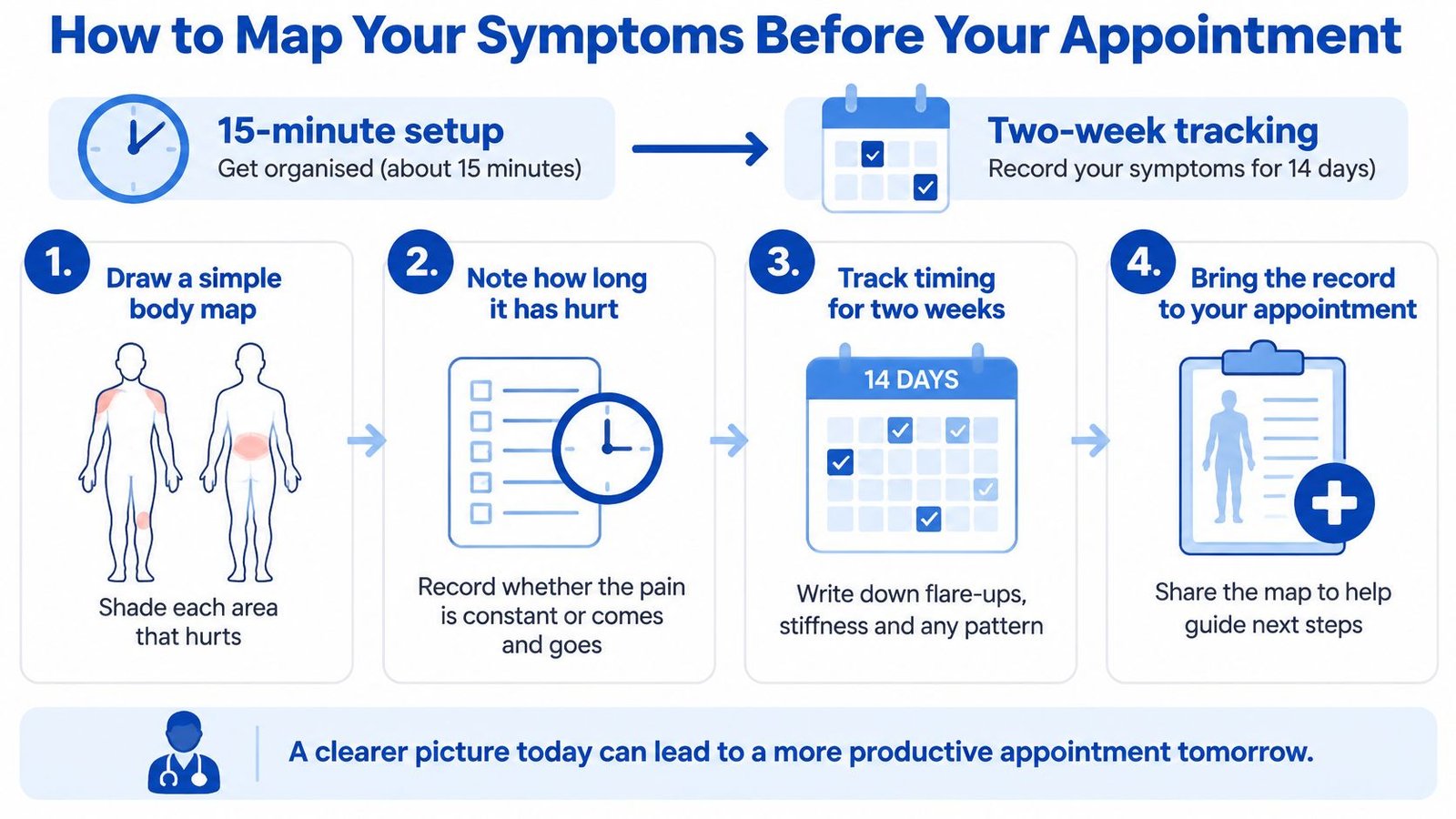
Draw a body map. Sketch a simple front and back outline and shade each painful area. Mark whether the discomfort feels centred in a joint, spread through a muscle or accompanied by tingling.
Record when each area started hurting. Note whether everything began together or whether pain appeared in separate areas over time. Include whether it's constant, intermittent or moving between locations.
Describe morning stiffness. Record how long it takes to loosen up after waking and what you struggle to do during that period. Distinguish stiffness from pain, since they don't always change together.
Look for visible changes. Note swelling, warmth, redness or a change in joint shape. A photograph can help show an intermittent change that may not be present at the appointment.
Include whole-body symptoms. Record fatigue, fever, sleep quality and mood alongside the pain. This helps your clinician understand whether difficult days involve only movement or a broader change in how you feel.
List medicines and recent health changes. Include prescriptions, non-prescription medicines, supplements, recent infections and unexplained weight change. Write down when a medicine was started or adjusted, but don't stop it without advice.
Describe activities and lost function. Note what worsens or eases symptoms and which tasks have changed. Being unable to turn a key or climb your usual stairs is more informative than recording only that pain was bad.
The visual guide offers a simple way to organise the record.
Describe patterns without deciding the diagnosis
Say an office worker notices that neck, wrist and lower-back discomfort peaks after uninterrupted desk work and eases on less sedentary days. That gives the clinician a reason to examine work demands and mechanical loading, but it doesn't independently rule out inflammation.
Record observations rather than conclusions. Write that your fingers looked swollen on waking, not that you definitely have rheumatoid arthritis. If you haven't measured a temperature, describe feeling feverish rather than recording a fever as confirmed.
At Bayside Osteopathic Health, our initial assessment includes a detailed case history and a physical assessment of posture, movement and the specific area of concern. Bringing your record helps us understand symptoms that may not be obvious during the appointment.
Keep the record brief enough to maintain. Bring the body map, medicine list and your main functional concerns to your GP or practitioner, along with any questions you most want answered.
Self-Care and Lifestyle Steps That Ease Widespread Pain
Start with movement you can tolerate comfortably and repeat reliably, such as a short walk, gentle household activity or easy joint movements. Consistency matters more than exhausting yourself on a good day. If activity causes escalating symptoms, the answer isn't automatically to push harder.
Pacing means spreading demanding tasks across the day and stopping before you're depleted. For example, alternate gardening with a lighter task instead of finishing the whole garden and then spending the following day recovering.
Adjust activity to your response
Once urgent causes have been excluded, a practitioner can help you introduce strength work at an appropriate load. Gentle joint-range movement can complement strengthening, but avoid forcing a stiff joint into a painful end position.
Use your usual symptoms as a reference point. The table below is a practical decision aid, not a diagnostic test or a rigid exercise prescription.
| Next-day response | What it suggests | Adjustment |
|---|---|---|
| Back to your usual baseline, without a flare | Activity may have matched your current capacity | Consider a small increase if the response remains consistent |
| Mild ache that settles readily | You may need more time to adapt | Repeat the same manageable activity before increasing |
| A sustained flare after activity | The session may have exceeded your tolerance | Reduce duration, resistance or repetitions |
| Pain remains above baseline or function keeps declining | Excessive load or another cause needs consideration | Stop progressing and arrange assessment |
| Sleep worsens, mood drops and stiffness increases | Your overall demands may be too high | Review recovery, stress and the activity plan before adding more |
A temporary muscle ache isn't the same as a hot swollen joint or a loss of function. Those changes need assessment rather than another adjustment to your exercise routine.
Support recovery without making life more complicated
- Sleep: Keep bedtime and waking time reasonably consistent, with a cool, dark bedroom. Tell your GP if pain repeatedly wakes you or sleep remains unrefreshing.
- Stress and mood: Try slow breathing, regular social contact and goals based on useful tasks rather than eliminating every sensation. Psychological support can help without implying that pain is imaginary.
- Heat: Gentle warmth may ease stiffness. Protect your skin and avoid applying heat to an acutely hot, swollen joint.
- Weight and nutrition: If weight management is relevant, seek a sustainable plan rather than crash dieting. Don't assume supplements will correct an unidentified cause of pain.
- Alcohol and smoking: Discuss alcohol use if it's affecting sleep or interacting with medicines, and seek smoking-cessation support where relevant.
Our joint pain relief guide offers further context for movement-based care. The right plan still needs to fit your health conditions and day-to-day circumstances.
The AIHW's musculoskeletal conditions overview describes primary-care management involving multiple health professionals and the psychological burden associated with these conditions. For First Nations Australians, care may need explicit attention to cultural safety and coordination, beyond a generic exercise sheet.
Cost, transport, caregiving and work schedules can determine what's achievable. Tell your clinician about these constraints so the plan can use accessible spaces, realistic appointments and manageable home activities.
Progress means finding a level you can recover from, not proving how much pain you can tolerate.
Which Appointment to Book and How Care Fits Together
| Practitioner | Best for | When to book |
|---|---|---|
| GP | Whole-body screening, targeted blood tests and referrals | First step for widespread or unexplained pain |
| Rheumatologist | Inflammatory and autoimmune arthritis | Persistent swelling, prolonged morning stiffness or other findings suggesting inflammatory disease |
| Physiotherapist | Graded strength and movement programmes | Pain limiting activity, rehabilitation or difficulty rebuilding capacity |
| Osteopath | Whole-body movement assessment, soft-tissue work and joint mobilisation | Mechanical stiffness and guidance on movement and home care |
| Remedial massage therapist | Muscle tension and trigger points | Muscle tightness after concerning causes have been assessed |
| Psychologist or pain specialist | Pain coping, sleep and persistent pain management | Ongoing pain despite treatment, distress or difficulty functioning |
A consultation is most useful when you can show where symptoms occur and describe how they affect everyday activities.

Let the GP coordinate unexplained widespread symptoms
Your GP can review your medical history, examine joints and assess whether the pattern suggests inflammation, medication effects or another whole-body condition. Blood tests and imaging should answer a clinical question rather than being ordered because several places hurt.
Not everyone needs scans of every painful area. Equally, a reassuring test result doesn't automatically explain persistent symptoms, so follow-up matters if swelling, fatigue or function changes.
A rheumatologist becomes particularly relevant when the examination and history suggest inflammatory disease. You don't need to wait until symptoms are severe before discussing whether a referral is appropriate.
Combine care around a shared goal
Different practitioners can contribute without each treating the whole problem independently. For example, a GP might assess unexplained symptoms first, a physiotherapist guide progressive strengthening, and an osteopath address mechanical movement restrictions where appropriate.
That doesn't mean everyone needs every service. Choose care around a specific goal, such as walking comfortably to the shops or managing a working day, and review whether treatment is helping you achieve it.
Hands-on treatment may support comfort and movement, but it doesn't replace medical treatment for inflammatory arthritis or infection. Remedial massage is directed at muscular problems, not the underlying cause of a hot swollen joint.
Psychological care is also compatible with physical treatment. It can help you manage disrupted sleep, distress and the practical consequences of ongoing pain while medical assessment continues.
For spinal pain, our process begins with a whole-body assessment to trace contributing factors rather than focusing only on the painful site. We also work closely with each arthritis patient's GP and specialist team where appropriate, so supportive care fits alongside their medical management.
If pain has become persistent, chronic pain treatment options can help you understand how different approaches may fit together. Ask each practitioner what they're treating, what improvement they expect and when they would reconsider the plan.
The following video is an additional viewing resource, not a substitute for an individual assessment.
Make a practical booking decision
- Emergency or urgent symptoms: Use emergency services for serious sudden symptoms, or seek prompt medical review for a hot swollen joint, fever or rapidly declining function. Don't book routine hands-on care as a substitute.
- Widespread pain without alarm signs: Arrange a GP appointment, bring your symptom record and ask which causes need checking. Discuss whether tests or specialist referral would change the next step.
- A medically assessed mechanical pattern: An osteopath or physiotherapist can assess movement and help develop a manageable rehabilitation plan. Agree on what to do if symptoms broaden or new swelling appears.
For regulated professions, confirm registration with AHPRA. Remedial massage therapists aren't registered through AHPRA, so check their relevant qualifications and professional membership instead.
All Bayside Osteopathic Health osteopaths are AHPRA-registered. When arranging care, ask how information will be shared with your GP and make sure you understand who is coordinating the overall plan.
Bayside Osteopathic Health offers gentle osteopathic care, movement guidance and personalised home-care strategies for joint stiffness and mechanical discomfort. If widespread pain has been medically assessed and you'd like help moving more comfortably, visit Bayside Osteopathic Health to enquire about an assessment and bring your symptom map to the appointment.